Welcome to the Kenneth Spencer Research Library blog! As the special collections and archives library at the University of Kansas, Spencer is home to remarkable and diverse collections of rare and unique items. Explore the blog to learn about the work we do and the materials we collect.
This blog may contain archived web content. This blog may link to catalog records which no longer exist as of a software change in 2026.
October is American Archives Month, a nationwide effort spearheaded by the Society of American Archivists to raise public awareness about the importance of historic documents and records and the importance of archivists. Spencer Research Library has a robust schedule of special events happening this October to celebrate Archives Month. All events are free and open to the public. We hope to see you at one, or even more!
During Fall of 2025, my Dean in KU’s School of Social Welfare forwarded an announcement to our faculty from Kenneth Spencer Research Library, calling for submissions to the newly established Bergeron-Souza Exhibit Program. At the time, I had only visited the library once for a special event and had come away with some mild curiosity about what other archival materials one might access there.
I immediately had an idea about using this guest curation opportunity to showcase artwork from a digital archive I had been managing for several years, the Untold Stories of Aging exhibition of aging-focused artwork from intergenerational creators. I was intrigued by the possibility of showing the work in a display setting that would focus not only on the pieces’ artistic merit, but also on their commentary on aging as a universal human experience. By putting contemporary artwork into conversation with archival materials, I envisioned bringing to life a deeper and richer narrative about the ways in which artistic representations of aging motivate us to envision our own futures in more expansive ways and inspire us to action – individual and collective – to realize those futures.
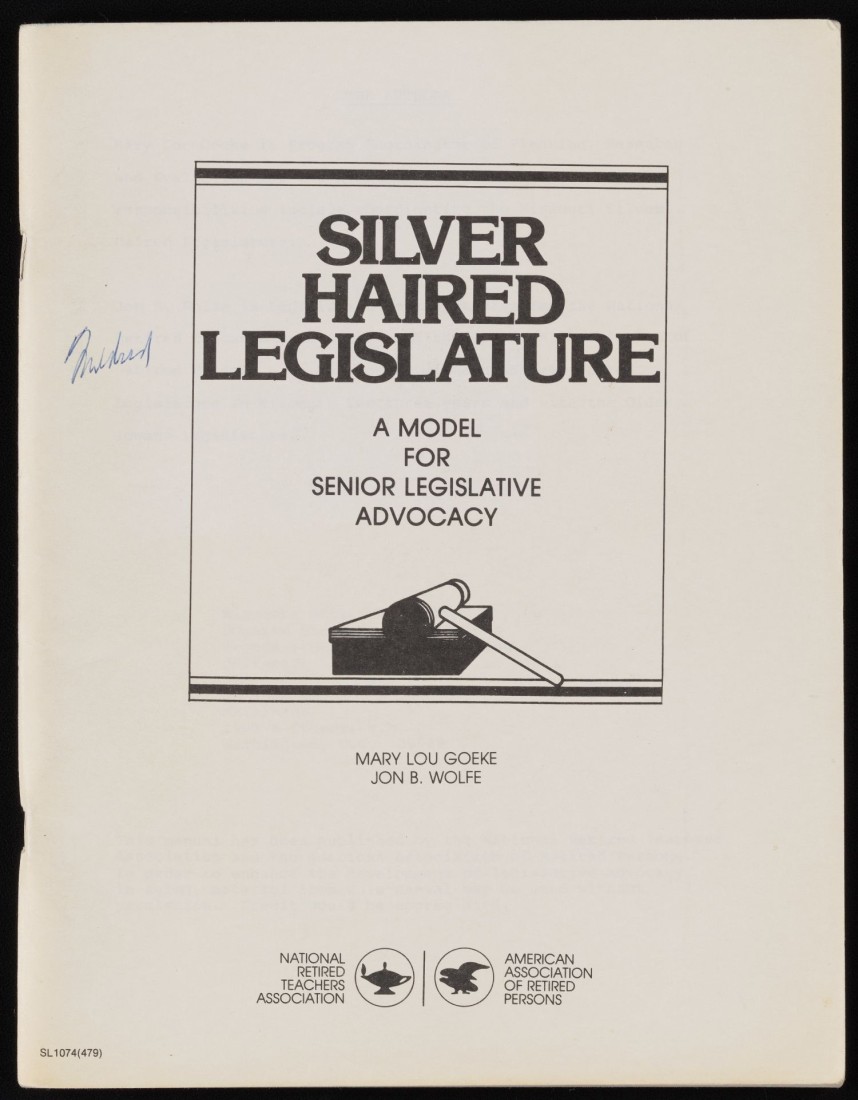
What followed was a loosely guided and ever evolving process of uncovering what the research library had to offer. I, along with my PhD Graduate Research Assistant Zhiqi Yi, perused over 100 boxes worth of material as well as dozens of individual artifacts sourced from various collections. There were the 20 or so boxes documenting the extensive efforts of long-time activist Mildred Harkness, who seemed to have her hands in all things aging within Kansas over the span of several decades. There were the seemingly endless boxes from the Jayhawk Area Agency on Aging. There were dozens of memoirs, artistic works, books, and essays penned and created by older adults that we requested, never really sure where they would lead.
Silver Haired Legislature guidebook of activist Mildred Harkness, 1981. Papers of Mildred Harkness. Call Number: RH MS 1548, Box 2, Folder 44. Click image to enlarge.
Silver Haired Legislature nametag of activist Mildred Harkness, 1981. Papers of Mildred Harkness. Call Number: RH MS 621, Box 2, Folder 18. Click image to enlarge.
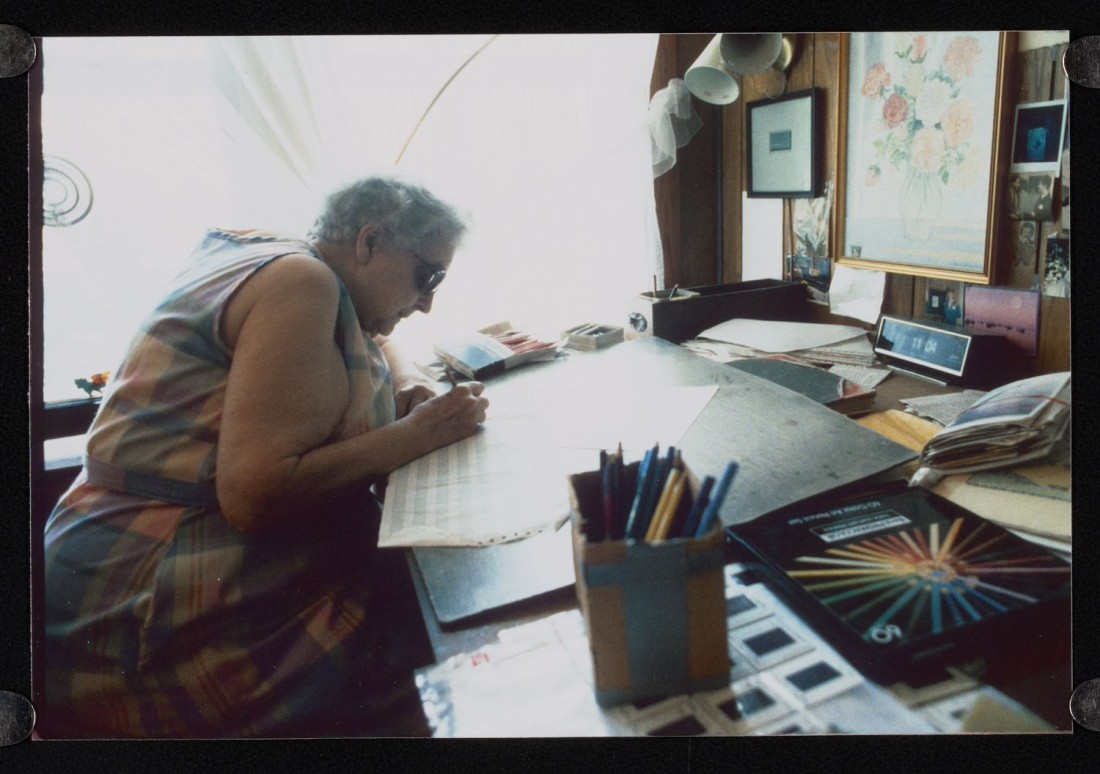
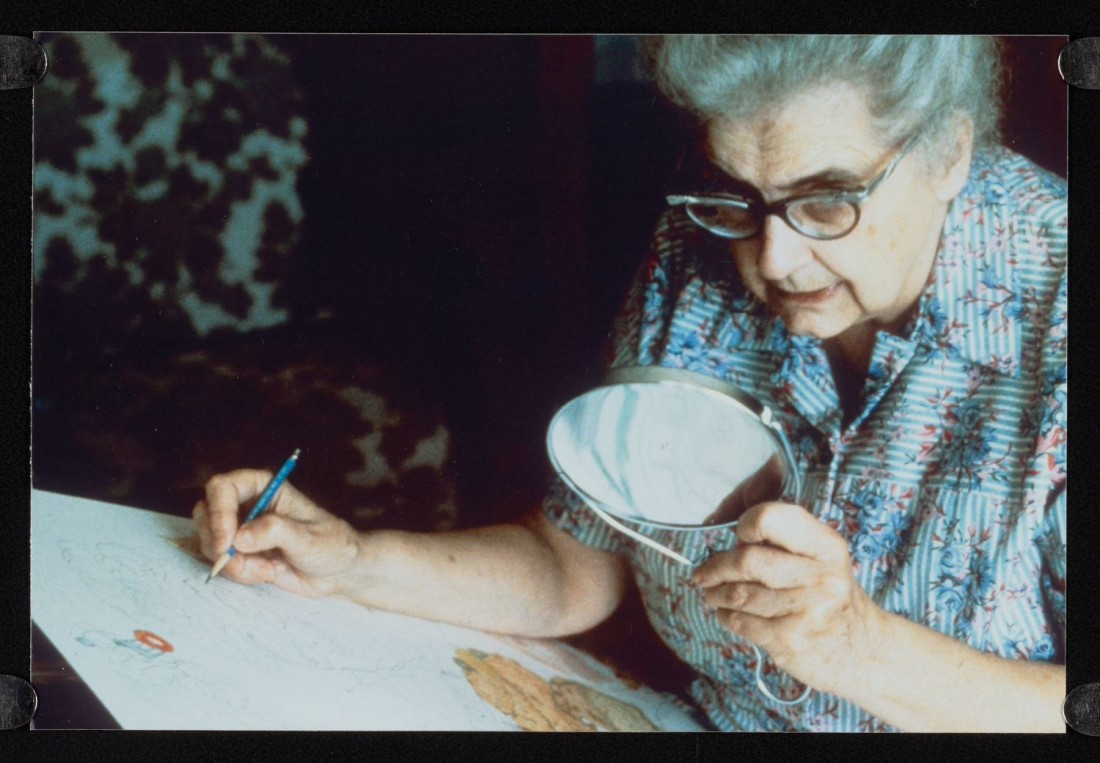
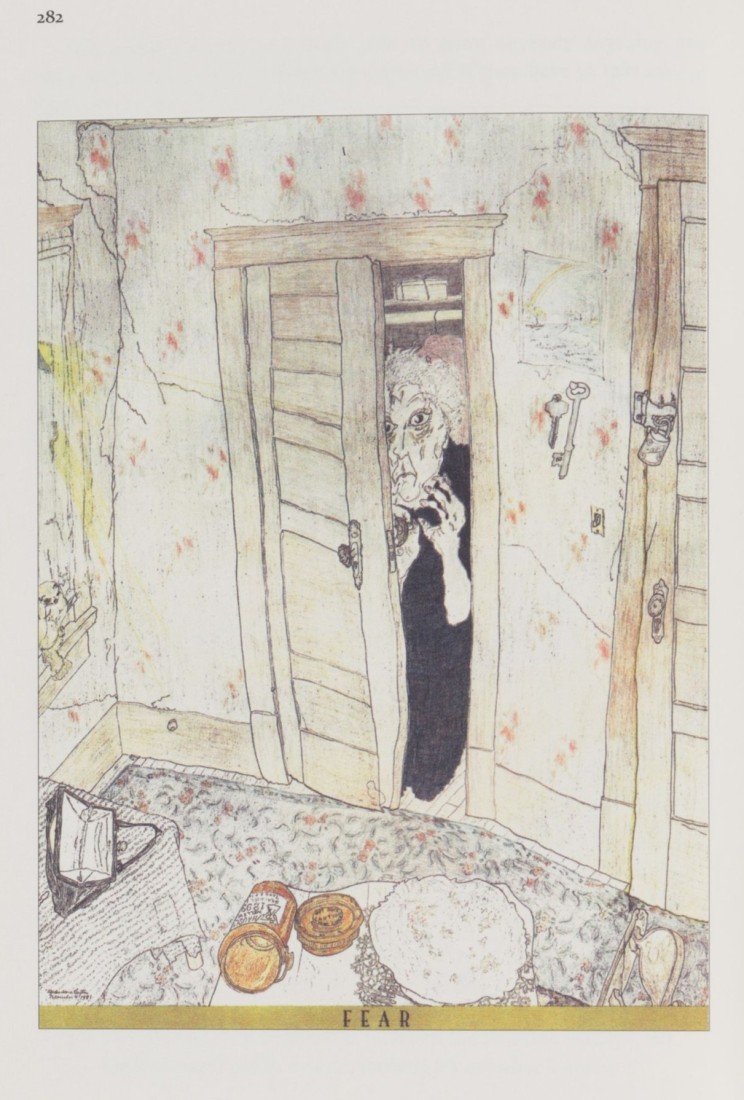
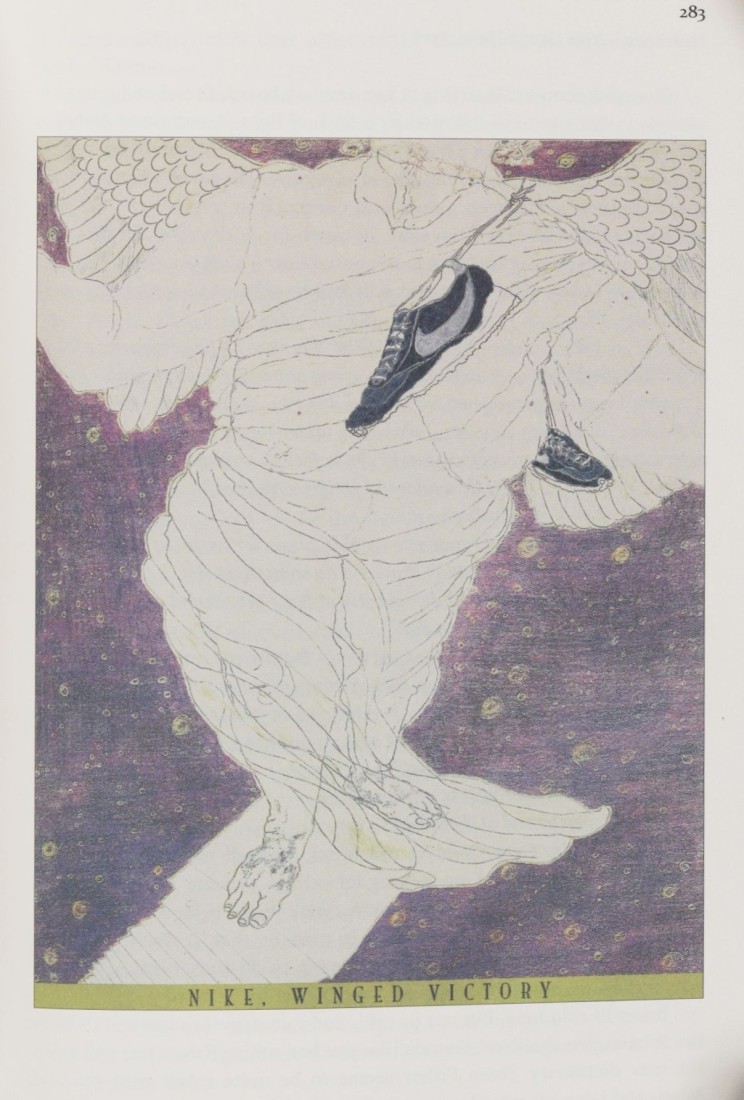
Some discoveries were more impactful than others. Having viewed the artistic drawings of Elizabeth “Grandma” Layton over the past decade, it was a tremendous joy to find that the library had archived over a dozen boxes of her personal documents, photographs, news clippings, exhibition flyers, and reprinted artwork. I read her memoir alongside her personal documentation, interweaving a rich storyline between the individual artifacts. Having begun drawing at the age of 68, Layton’s drawings document her struggles with and victory over mental illness. She often credited her discovery of blind contour drawing with having healed her life-long depression, illustrating the rich potential of artistic exploration and creation in the lives of older adults.
Photos of Elizabeth Layton, blind contour drawing in process, undated. Don Lambert Collection of Elizabeth Layton Papers. Call Number: RH MS 1538, Box 12, Folder 6. Click images to enlarge.
Drawings titled “Fear” (left) and “Nike, Winged Victory” (right) in Elizabeth Layton’s memoir Signs Along the Way, 2013. Call Number: RH C12442. Click images to enlarge.
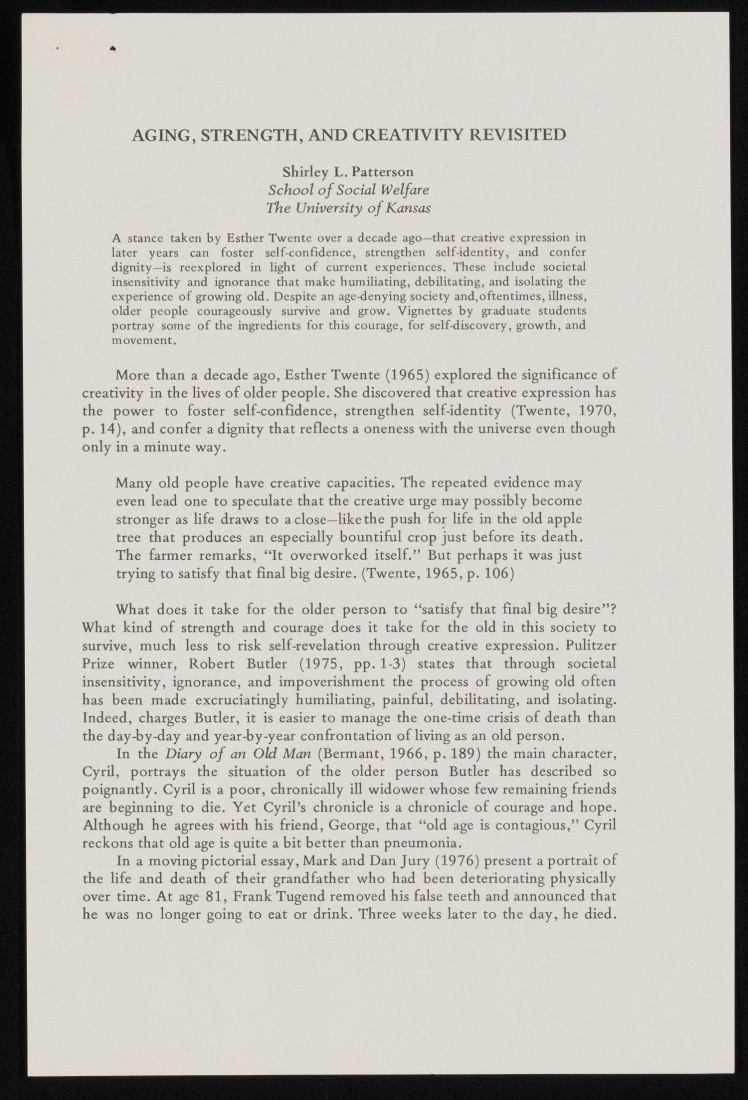
Similarly, I was delighted to stumble across several emeritus faculty who had contributed to KU’s aging-focused curricula over the years. This includes Shirley Patterson, who had her social work students interview older adults in the local community and create poems and brief essays based on their experiences. Additionally, Janet Hamburg of KU’s Department of Theatre and Dance taught “Dance for Seniors” and developed movement-based interventions for individuals living with Parkinson’s disease. These rich discoveries had to somehow be narrowed down to what could fit into a handful of display cases, and choosing amongst artifacts turned into a tall order, indeed. We will have to return to explore new topics another day!
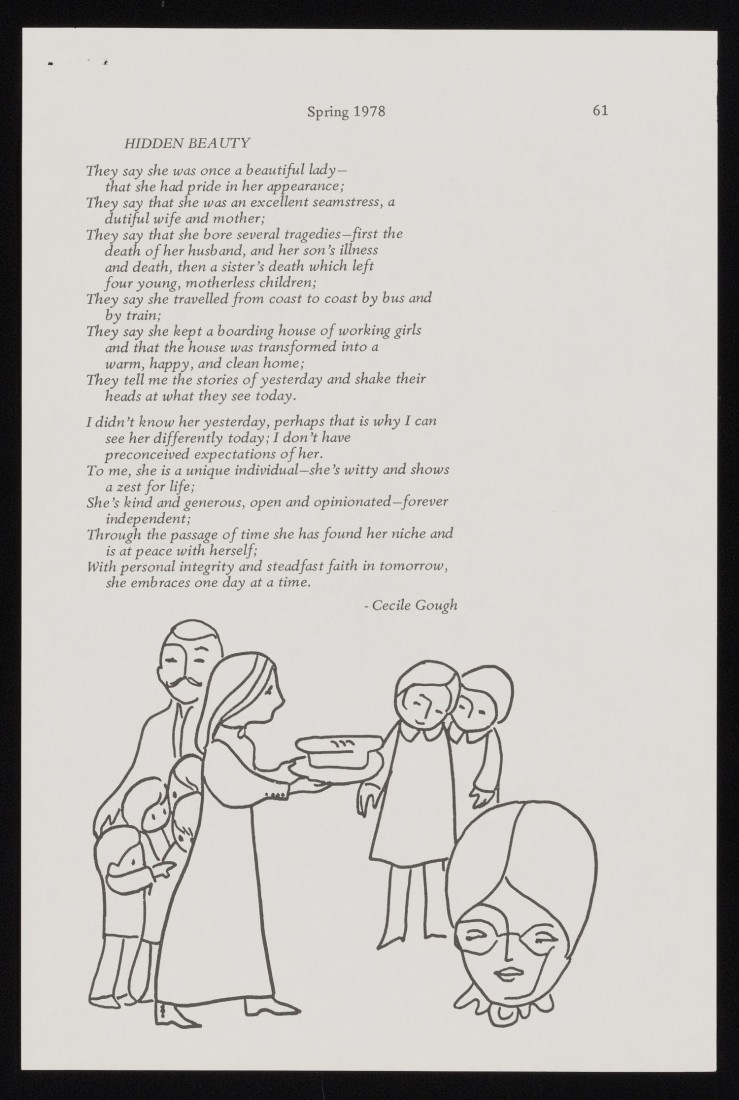
Selected pages from “Aging, Strength, and Creativity Revisited” by Shirley Patterson, 1978. Personal Papers of Shirley L. Patterson. Call Number: PP 607, Box 2, Folder 26. Click images to enlarge.
From this year-long process, the resulting exhibition opened on February 23, 2026, and is organized into six sequential display cases of archival materials. The exhibit also includes 15 contemporary art works, both in display cases and along the exhibition walls, through which the exhibition themes are interwoven and illustrated in vibrant and moving detail.
The overarching narrative of the exhibition explores societal discourses around aging, illustrating that the ways in which we talk about a thing, person, or experience come to shape our ability to imagine and engage with the object of conversation. In this case, audience members are asked to grapple with societal conversations around aging and later life, considering the impact of how we construct and envision this universal, life-long experience and how those constructions shape our hopes and plans for our own aging present and futures. Historical discourses are captured in artifacts dating back to 1780, representing older citizens as making up a vulnerable and needy population. Documents from aging activists, creative essays, portraits, poetry, and much more provide contrasting and nuanced constructions of aging, balancing more varied images of later life based on agency, growing or evolving self-knowledge, hardships and joys brought by new phases of life, and more.
A special event next Tuesday, March 31, 2026 (5:30-7:00pm) will feature a mini-presentation on the making of the exhibition and will be attended by several of the exhibit’s contributing artists, who will mingle with attendees and informally share the meaning of their work. Come and join us to explore your own hopes for the future!
Sarah Jen Associate Professor and PhD Program Director KU School of Social Welfare
What makes a monster, well, monstrous? Monsters carry the fears of the people that create them, tapping into existential dreads and cultural tensions to flay our superficial defenses and expose the weak societal organs and vulnerabilities beneath. Today, our monsters array from the cannibalistic and supernatural vampires of Sinners to Barbarian’s brutal, lonesome and pitiable Mother – and the movie’s true monster, a landlord.
In the later Middle Ages, however, monsters sometimes played a more ambivalent role than violent antagonists. The word “monster” derives from the Latin “monēre” or “to warn, to admonish.” These monsters embodied omens or manifested God’s admonishment of human behavior, inviting conscious and deliberate analysis and contemplation on their meanings. So-called “monstrous races” were born from tales and anecdotes of human and human-like peoples born in far-off lands, repurposing anecdotal entrails from the Bible and classical authors like Pliny the Elder into haruspices of divine interpretation. They were frequent subjects of fascination and debate for their meanings, paired with prodigies and marvels as the myriad ways that God’s will manifested in nature and the real world, as well as theological debates as to whether such races possessed souls and could be converted to Christianity.
Konrad Lykosthenes was one such interpreter, a humanist and encyclopedist who sought to sew together a comprehensive history of signs, prodigies, and portents from biblical times into his own modernity with his Prodigiorum ac ostentorvm chronicon [Chronicle of Prodigies and Signs]. He built a body of text from the limbs of other historical and contemporary sources onto which he sutured his own interpretations. These portents included everything from natural disasters like earthquakes to the appearance of mythical and monstrous creatures, as well as so-called “wonders,” “marvels,” and “monstrous” births. His work proved sensationalist and popular, a theological treatise that leaned lurid and sometimes traded on the grisly and gruesome to appeal to a wider audience.
An image of monstrous races from Lykosthenes’ Prodigiorum, including a “scioped” or “monopod” – a mythological one-footed race of people drawn from Greek classical literature. Lykosthenes, Konrad. Prodigiorvm ac ostentorvm chronicon. Basil: Henricvm Petri, 1557. Call Number: Summerfield E392. Click image to enlarge.
By the end of the sixteenth century, science and medicine had pierced their talons into the tender underbelly of the study of monstrosities, clawing it away from the sole purview of priests, philosophers, and theologians. With that shift, natural historians like Ulisse Aldrovandi and physicians like Fortunio Liceti dissected the meanings of monstrosities not as reflections of divine will or intent, but as natural phenomena that could be classified and analyzed under the newly invented microscope.
Ulisse Aldrovandi sought to document all forms of nature, collecting a cabinet of curiosity with over 7,000 specimens – including an alleged and infamous dragon, likely fabricated by grafting together the stuffed carcasses of other animals. From those studies and collections he wrote over 400 volumes on everything from mollusks to metals. Monsters were a natural inclusion, and thus was wrought his Monstrorum Historia, the eleventh of a fourteen-volume encyclopedia. It bled together what we today treat as unequivocally monstrous creatures – centaurs and satyrs – with concepts that today we might conceive as mere medical conditions, such as neurofibromatosis or hypertrichosis, transplanting alien viscera of exotic monstrosity into the hollow body cavity of the reader’s imagination and understanding of nature. Aldrovandi’s amalgamation of monstrous creatures, humans, and hybrids reflected an ambition to reflect a complete and total natural history of monsters in parallel to birds, fish, and all of the natural world, rather than flensing the impossible from the plausible like extraneous fat from muscle and meat.
A “monstrous marine horse,” and a “demon-formed marine monster.” Aldrovandi, Ulisse. [Works] Monstrorum Historia [Histories of Monsters]. Bologna: Nicolaus Tebaldinus and others, 1637. Call Number: Ellis Aves E70. Click image to enlarge.
In De Monstrorum causibus [On the Causes of Monsters], Fortunio Liceti, meanwhile, purported to analyze monsters not only as a phenomena born from nature – or “nature’s mistakes” or even its jokes and pranks – rather than divine will, but also sought their causes and their taxonomic classifications a landmark in teratology – the study of monsters which today has come to mean the study of congenital birth defects. The modern conflation is no accident, as Liceti’s work treats them as one and the same: monsters were born, not made, and his work discusses everything from dog-headed humans to conjoined twins, framed in antithesis to the ideal or perfect human body that was increasingly the focus of medical study.
Liceti described monsters not as warnings or admonishments but as “showings,” claiming that the term derived from “monstrare,” or “to demonstrate or show.” His examination of “monsters” demystified them and challenged the portentous interpretations of monstrosities that deemed them a reflection of the wrath of God upon the parent or their community writ large. This metamorphosed monstrosities into something not inherently ominous or harrowing but still oozing with interpretations.
A pig with the face of a human, and a cat with a pair of human legs, in which Liceti explains the causes of monsters born with the limbs or body parts of multiple species. Liceti, Fortunio. De monstrorum caussis, natura, et differentiis libri duo… 2. ed. [On the Causes, Nature, and Differences of Monsters]. Patavii [Padua]: Apud Paulum Frambottum, 1634. Call Number: Summerfield C802. Click image to enlarge.
As we examine historical horrors, it invites a vivisection of our own insecurities and fears, to peel back the flesh of our society and examine the sinews beneath that tie together our own identities: What do we think of as monstrous, and why? When does humanity itself become monstrous? And when something goes bump in the night, what are we really afraid of?
All of above books will be on display at this year’s Haunting Humanities event this Wednesday, October 29th, 5:30 to 9pm at Abe and Jake’s Landing (800 E. 6th Street), together with an array of horrifying, prodigious, and compelling activities, including a monstrously-themed escape room in a box, coloring pages, Rare Book Bingo, monster reviews, and more. Come contemplate the meanings of monstrosity with us and walk away with your own nightmares to divine.
In the course of my work as a conservator at KU Libraries, one of my favorite bookbinding features to spot “in the wild” is paste paper. A book covered in paste paper might come to the lab for treatment, or I might catch sight of one while working in the stacks, and I always take a moment to look at them closely and enjoy the variety of colors, patterns, and styles that paste papers come in. It was no easy task to narrow down Spencer’s abundant selection of paste papers to just a few volumes that will be on view in a temporary exhibit in the North Gallery through August and September.
Paste paper is a style of decorative paper made by coating the surface of paper with a thick pigmented starch adhesive (usually wheat paste or methylcellulose) and then manipulating the wet paste mixture to create patterns. Combs, stamps, brushes, wadded paper or textiles, rollers, fingers and more could be used to create designs. Paste papers were an economical alternative to marbled papers, which required a high degree of skill and costly materials to produce. No special training or supplies were needed to make paste papers; bookbinders could create them right in their workshops with materials already at hand.
Paste papers were most often used for book covers and endpapers and were popular from the late 16th through the 18th century. Paste papers are often seen on books from Germany and Northern Europe, although there are many lovely examples of block-printed paste papers from Italy. There was renewed interest in paste papers during the Arts & Crafts movement of the late 19th and early 20th century. Today, paste papers are still created by book artists and hobbyists, and can be seen on some fine-press editions. The examples on view represent just a fraction of the many beautiful paste papers found in Spencer’s collections and available to view in the Reading Room.
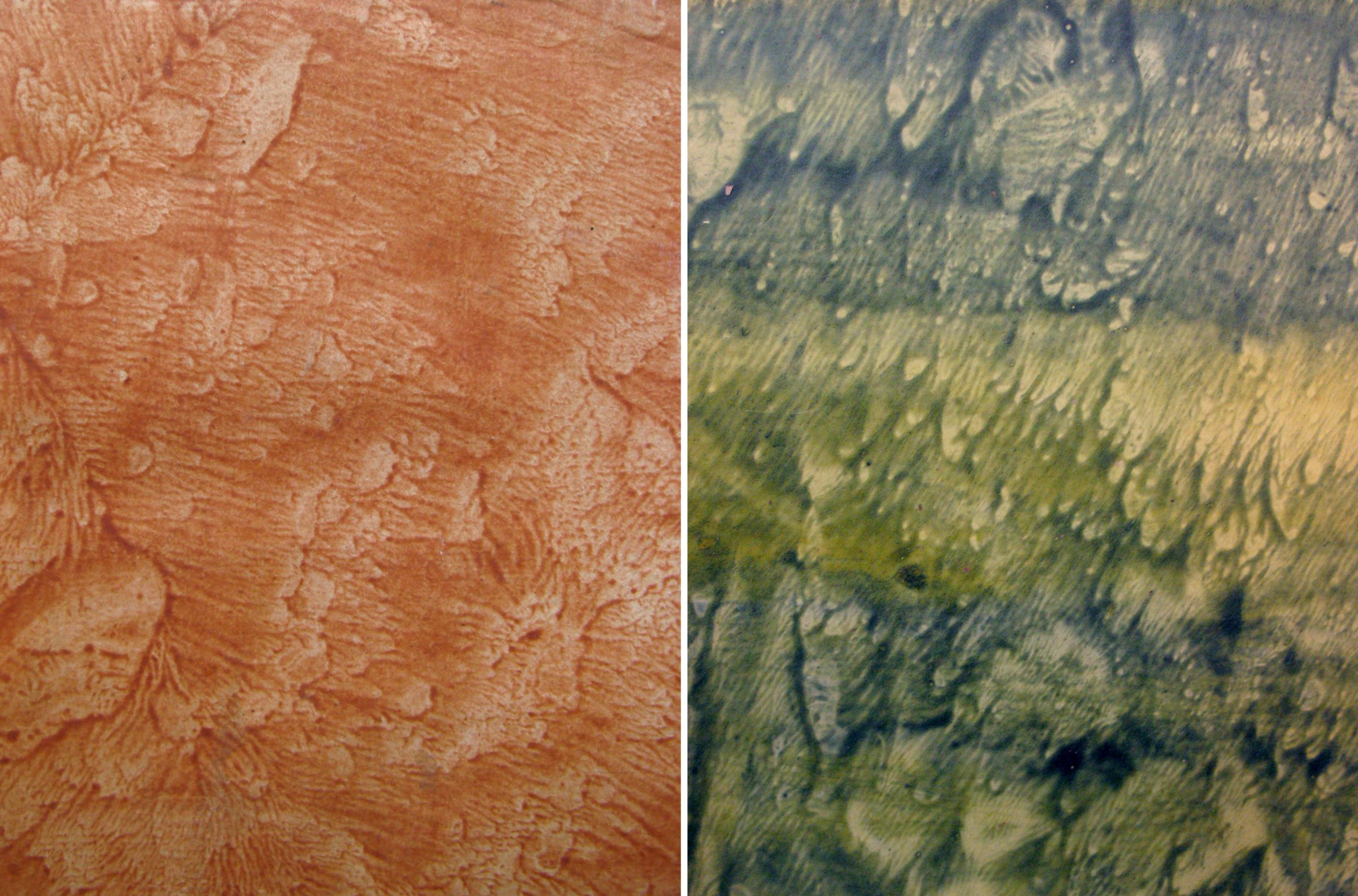
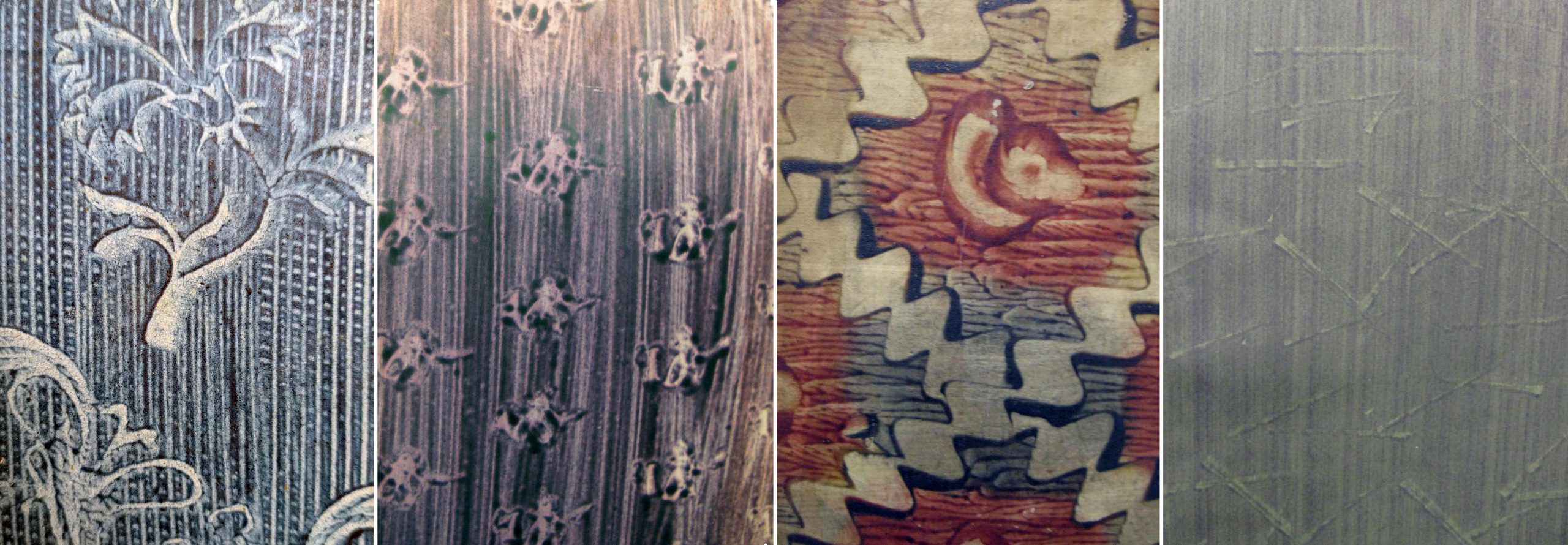
Pulled (or veined) paste papers were created by coating two sheets of paper with the colored paste, pressing the two pasted sides together, and then pulling the sheets apart, creating a unique wave-like pattern on each sheet.
Left: Cover of De Mentha piperitide commentatio botanico medica, 1780. Call Number: C9291. Right: Cover of Rules and orders of the Linnean Society of London,1788. Call Number: Linnaeana C112. Click collage image to enlarge.
Drawn paste papers (also called scraped or combed) were made by “fingerpainting” in the wet paste or dragging various implements through the paste layer. The results can range from painterly and whimsical to clean and graphic. A faux wood graining tool was used to create the pattern on Summerfield E156 (second from left).
Left: Cover of Lectionary, incomplete. [Italy, between 1101-1200]. Call Number: MS E22. Second from left: Cover of De origine et amplitudine ciuitatis Veronae, 1540. Call Number: Summerfield E156. Center: Cover of [Notes on agriculture.] Fletcher of Saltoun collection Scotland, 17–. Call Number: MS 109:4. Second from right: Cover of De ponderibus et mensuris veterum Romanorum…, 1737. Call Number: B3981. Right: Cover of Bookplates and labels by Leo Wyatt, 1988. Call Number: D3245. Click collage image to enlarge.
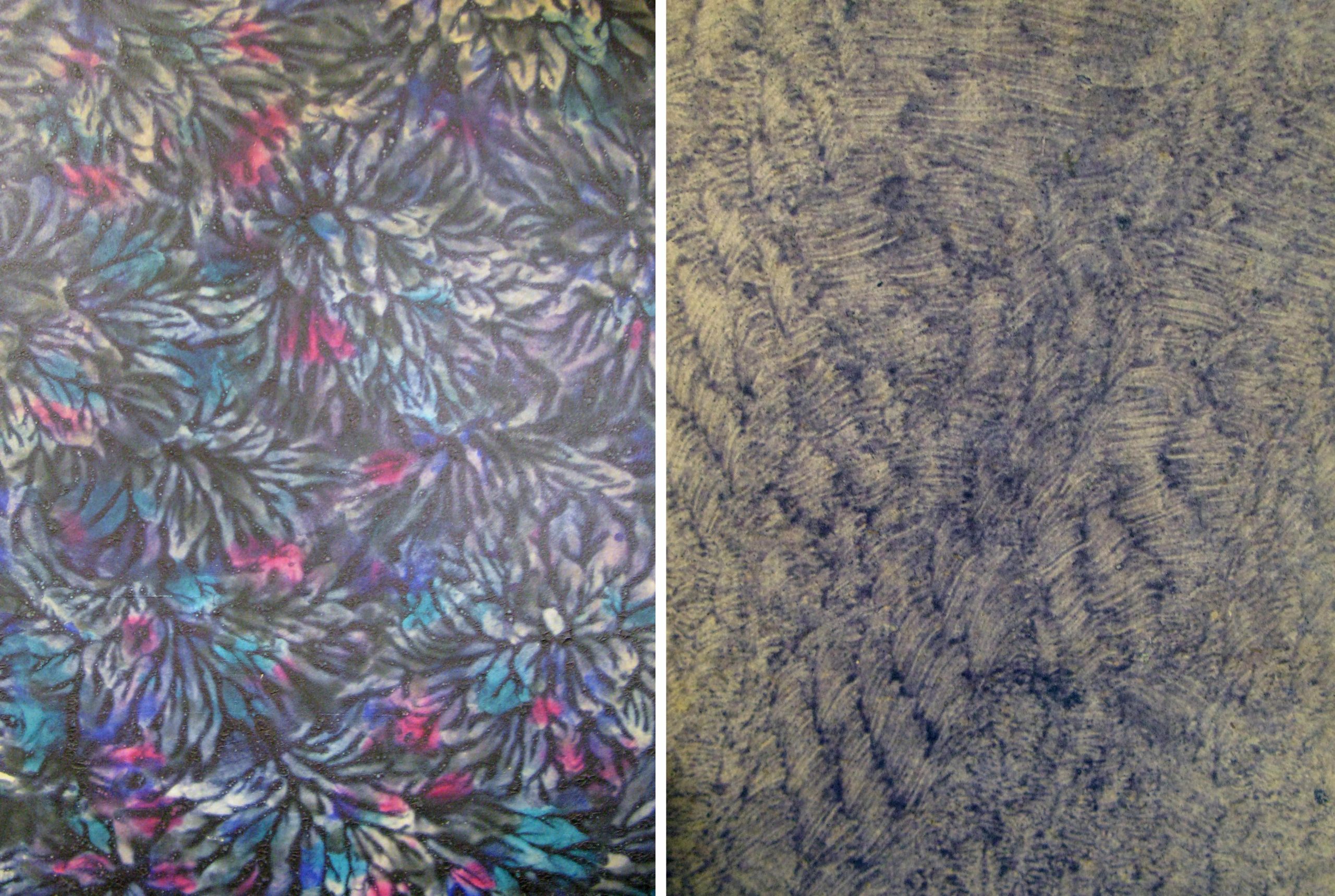
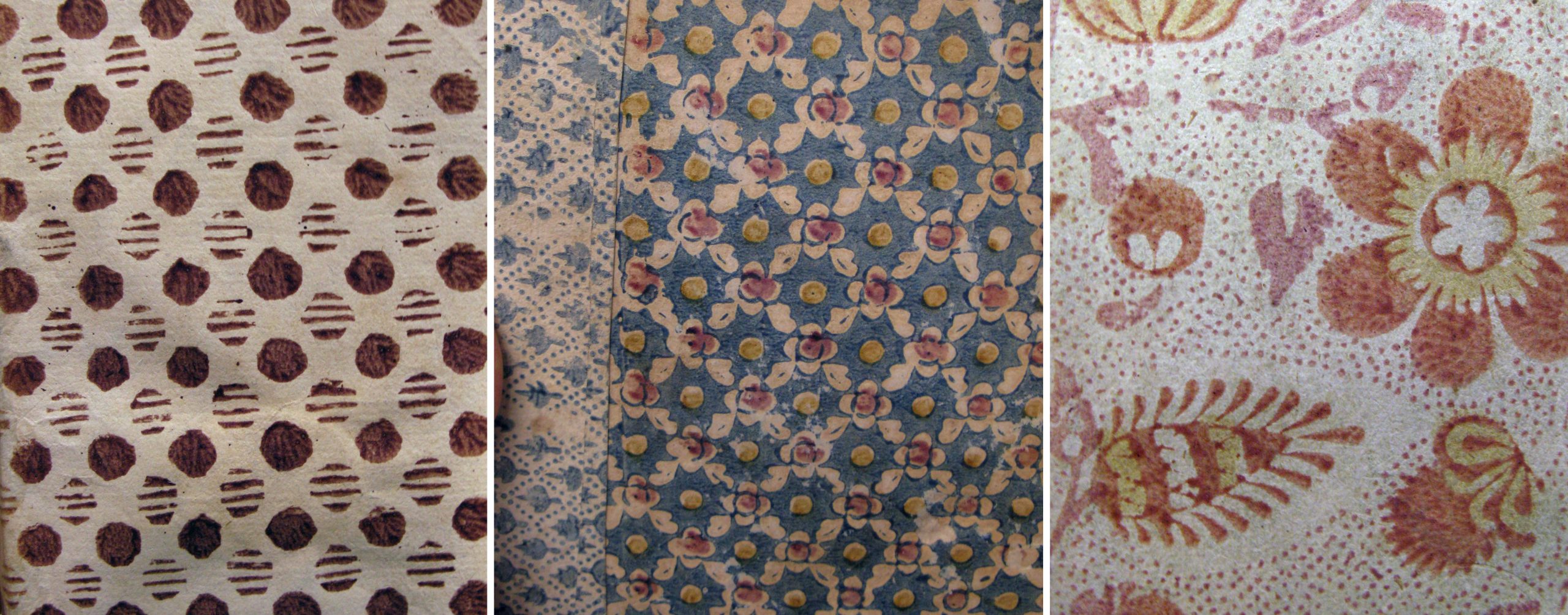
These are two very different examples of daubed paste papers: a boldly colored design executed in a thick layer of paste, and a subtle pattern possibly created with stiff brush bristles.
Left: Back cover of Deutschlands Beruf in der Gegenwart und Zukunft, 1841. Call Number: Howey D126. Right: Cover of Det enda nödvändiga för et rikes financer, 1792. Howey B1083. Click collage image to enlarge.
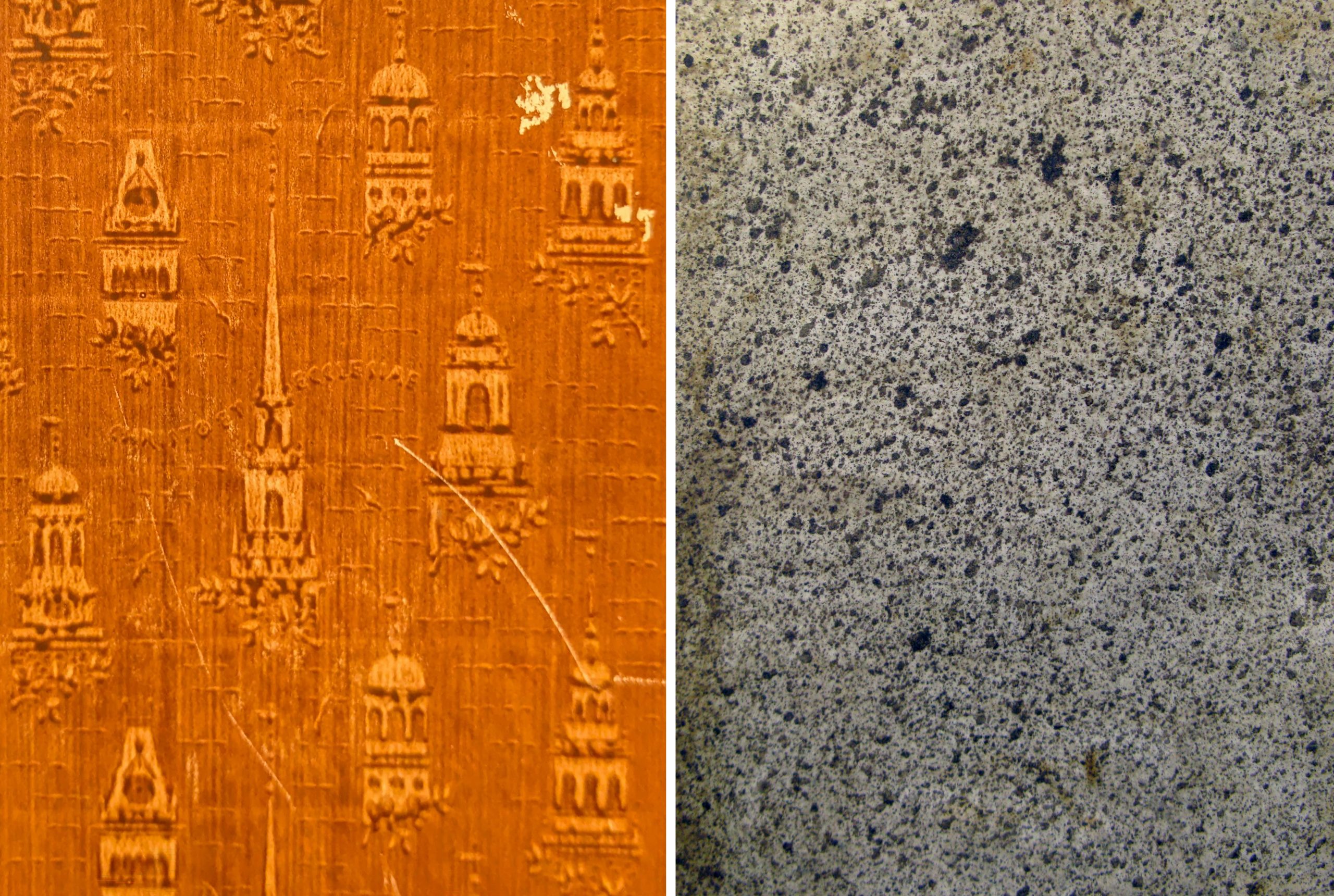
This charming stamped (or printed) design appears, appropriately, on the cover of a book about decorative papers used in bookbinding. An assortment of stamps in architectural shapes were pressed into the paste to create the pattern. Spattered (or sprinkled) papers were made by loading a brush with the colored paste mixture and striking the brush while holding it above the paper, creating a shower of drops.
Left: Cover of Decorated book papers, 1942. Call number: C6396. Right: Cover of Considerazioni sulle compagnie, 1769. Call Number: Howey B1116. Click collage image to enlarge.
Block printed paste papers used a matrix, probably carved as for a woodblock print, that was “inked” with the colored paste and stamped onto the paper. These designs can be simple or ornate and often use multiple colors. On Summerfield C1300 (at left) the binder used block printed papers in two different patterns.
Left: Cover of Anticamera di D. Pasquale, 1690. Call Number: Summerfield A866. Center: Cover of De iurisprudentia extemporali, 1628-1629. Call Number: Summerfield C1300. Right: Cover of Göttinger Taschen Calender für das Jahr 1790. Call Number: A274 1790. Click collage image to enlarge.
In these examples the makers have used a combination of techniques on a single sheet: stamped over drawn, drawn over pulled, and so on. D2763 (at right) is also an example of a paste paper created using a colored sheet of paper, instead of white or light paper, as the starting point.
Left: Endpaper of Göttinger Taschen Calender für das Jahr 1782. Call Number: A274 1782. Second from left: Cover of Hortus Celsianus i Uppsala, 1927. Call Number: Linnaeana C456. Second from right: Cover of Poems, 1768. Call Number: O’Hegarty C1129. Right: Cover of Poem to the memory of Lady Miller, 1782. Call Number: D2763. Click collage image to enlarge.
In Conservation Services we sometimes make paste papers to use in our own bookbinding models or in book making activities for colleagues or the public. Making paste papers is a fun and messy activity that invites exploration of colors, patterns, and mark-making tools. There are many online tutorials for making paste papers at home; bookbinder Erin Fletcher has a great video and written instructions on her blog. Tutorial // Paste Papers – Flash of the Hand
Happy Halloween all you screechers, screamers, and hollerers! We’ve also been celebrating over here at Kenneth Spencer Research Library in the best we know how: combing the KU Libraries online catalog and finding what cursed history we can find. We asked our student workers to recommend their picks for items that best represent the spirit of Halloween. They went beyond the safety of the Reading Room and braved the stacks to bring us these unsettling tomes and relics, but not everything is what it seems. Here are a few of our favorites!
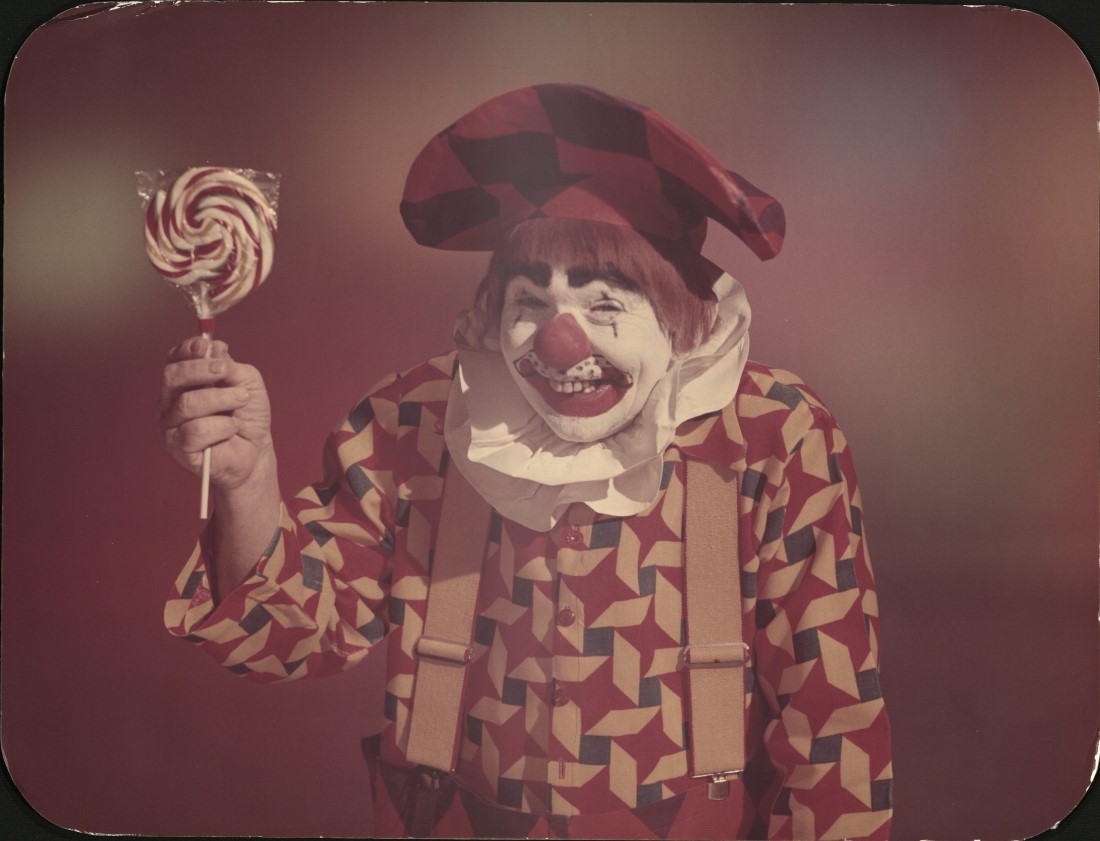
Our very first recommendation comes from the Centron Corporation, a film production company founded right here in Lawrence, Kansas. Perhaps best known for their work in educational films, the company also had a hand in the cult classic horror film Carnival of Souls. Elly Masteller found this lovely portrait in the Centron Corporation records collection. This cheerful gentleman was used in a film to help encourage literacy and creative writing among children. Remember kids, he can’t get you if your nose is in a book!
Production still of a clown from Reaching Your Reader, undated [circa 1985]. Centron Corporation Records. Call Number: RH MS Q514. Click image to enlarge.
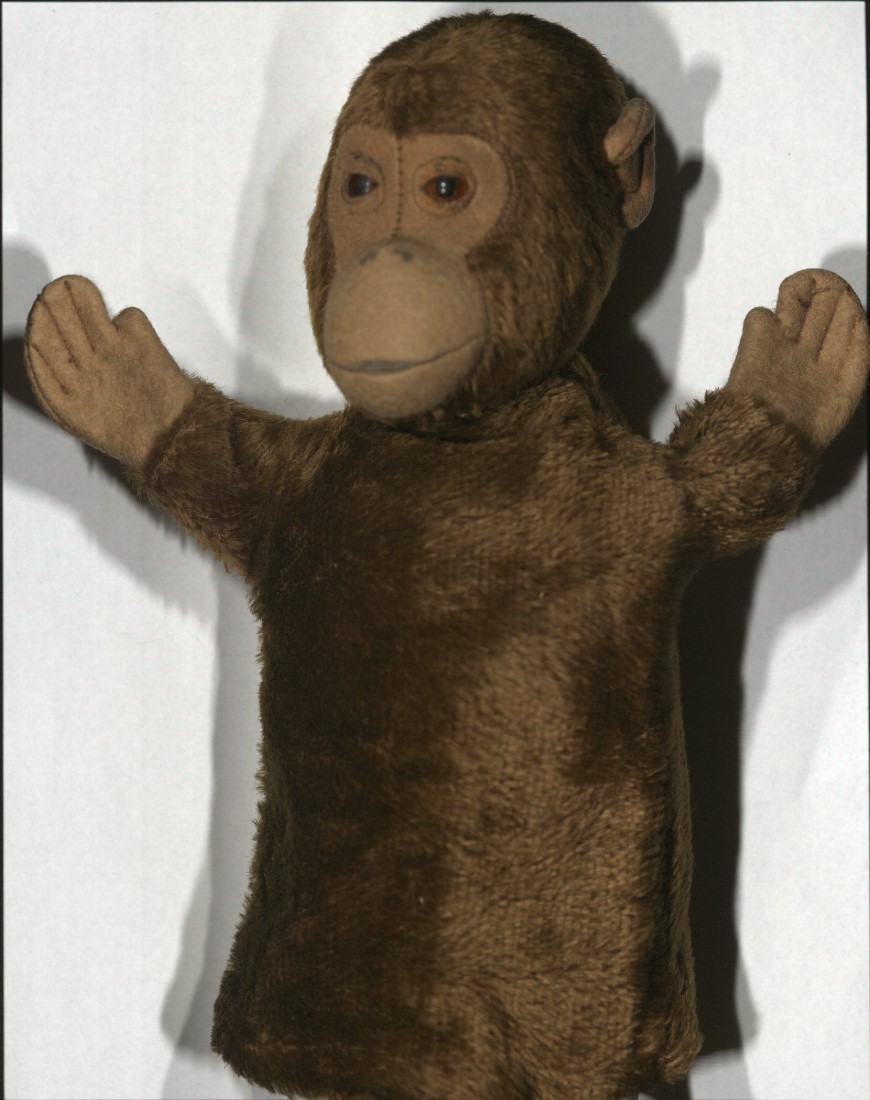
Kathryn Sauder sent in our next recommendation, another artifact, but this time from the Thomas Woodson Poor papers. Poor was an Olympic high jumper who competed for the University of Kansas from 1921 to 1925 and placed fourth in the high jump at the 1924 Summer Olympics in Paris, France. Poor is also known for his lifelong crusade in helping children receive the polio vaccine after the tragic death of his daughter, Melinda Sue, from polio. One of the toys he used to do so was this monkey puppet, and while the puppet may look demonic, it helped save lives! Absolutely heartwarming, not chilling, but perhaps maybe do not look into its eyes for too long.
Monkey puppet, undated [circa 1955-1956]. Thomas Woodson Poor Papers. Call Number: RH MS 1568. Click image to enlarge.
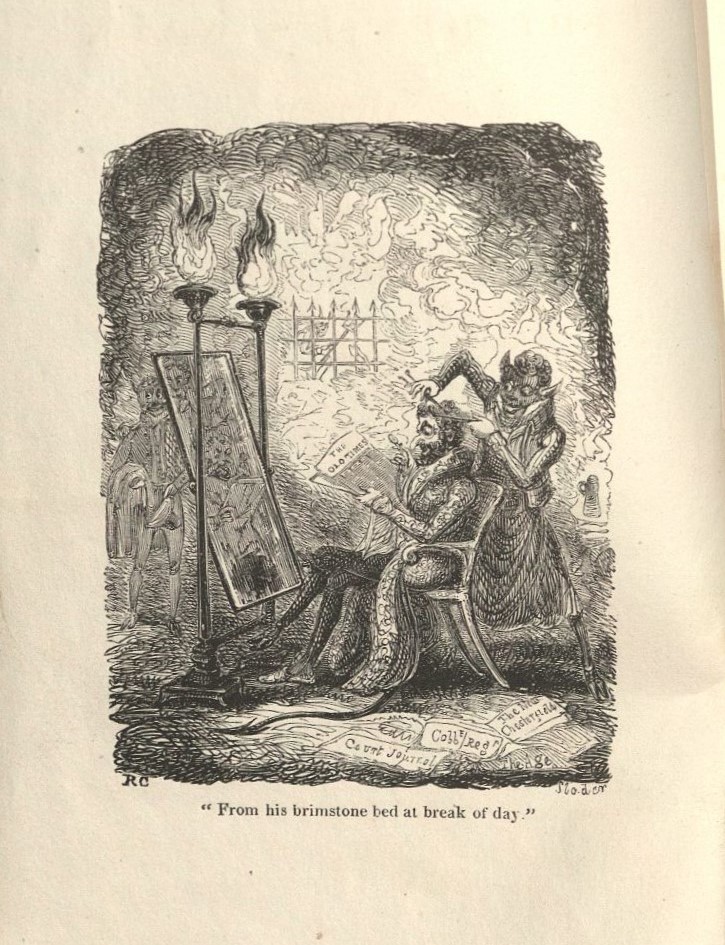
Literary giant Samuel Taylor Coleridge brings us our next spooky item, recommended by Nile Russo: a copy of The Devil’s Walk, or alternatively titled The Devil’s Thoughts. The Devil cuts a dapper shape as he gets himself dressed in his Sunday’s best for a walk around the town. In this poem, the Devil offers commentary about passersby, questioning perhaps if mankind might be the scariest creature of all.
The illustration accompanying the title page of The Devil’s Walk: A Poem by Samuel Taylor Coleridge and Robert Southey, 1830. Call Number: B4254. Click image to enlarge.
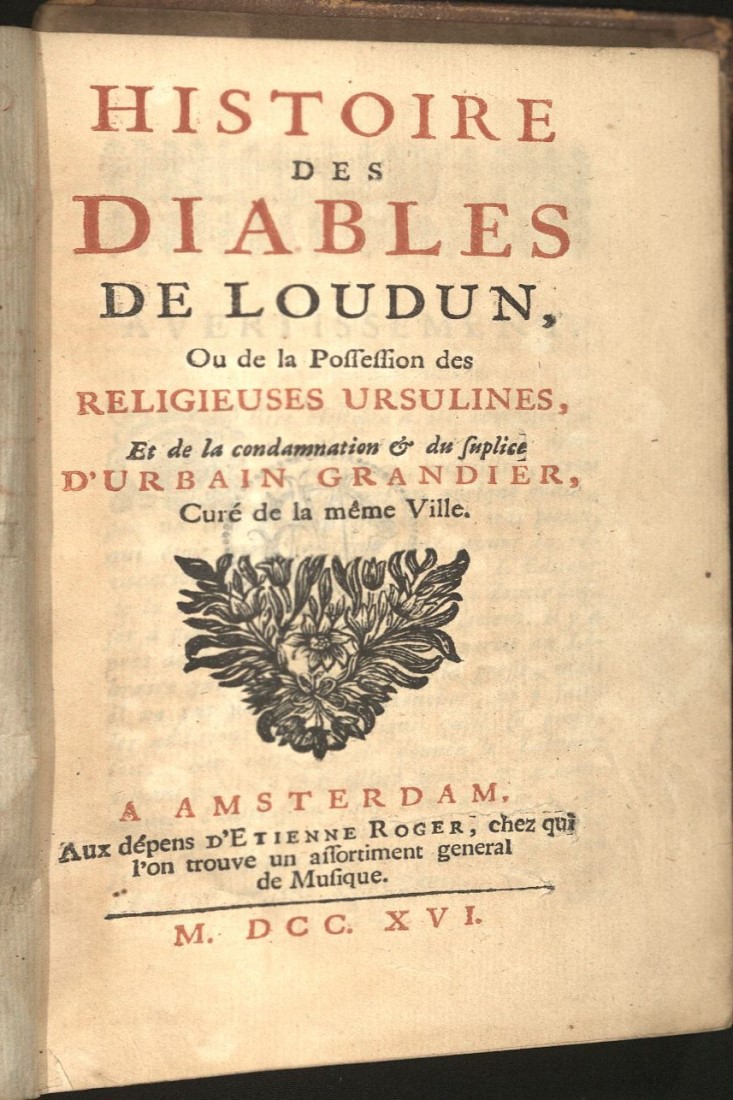
Molly Leonard recommended perhaps the most soul-wrenching item among our recommendations this year: a copy of Historie des diables de Loudun. This is a book about the Loudun possessions, a piece of history about an Ursuline convent being taken over by unusual behavior and visions attributed to demonic possession. In the end, through the intervention of Cardinal Richelieu, a local priest and decrier of Richelieu’s policies named Urbain Grandier was tried and executed for witchcraft in connection with the possessions. Again, and we can’t reiterate this enough, mankind might just be the scariest monster of all.
Title page of Histoire des diables de Loudun, 1716. Call Number: B12841. Click image to enlarge.
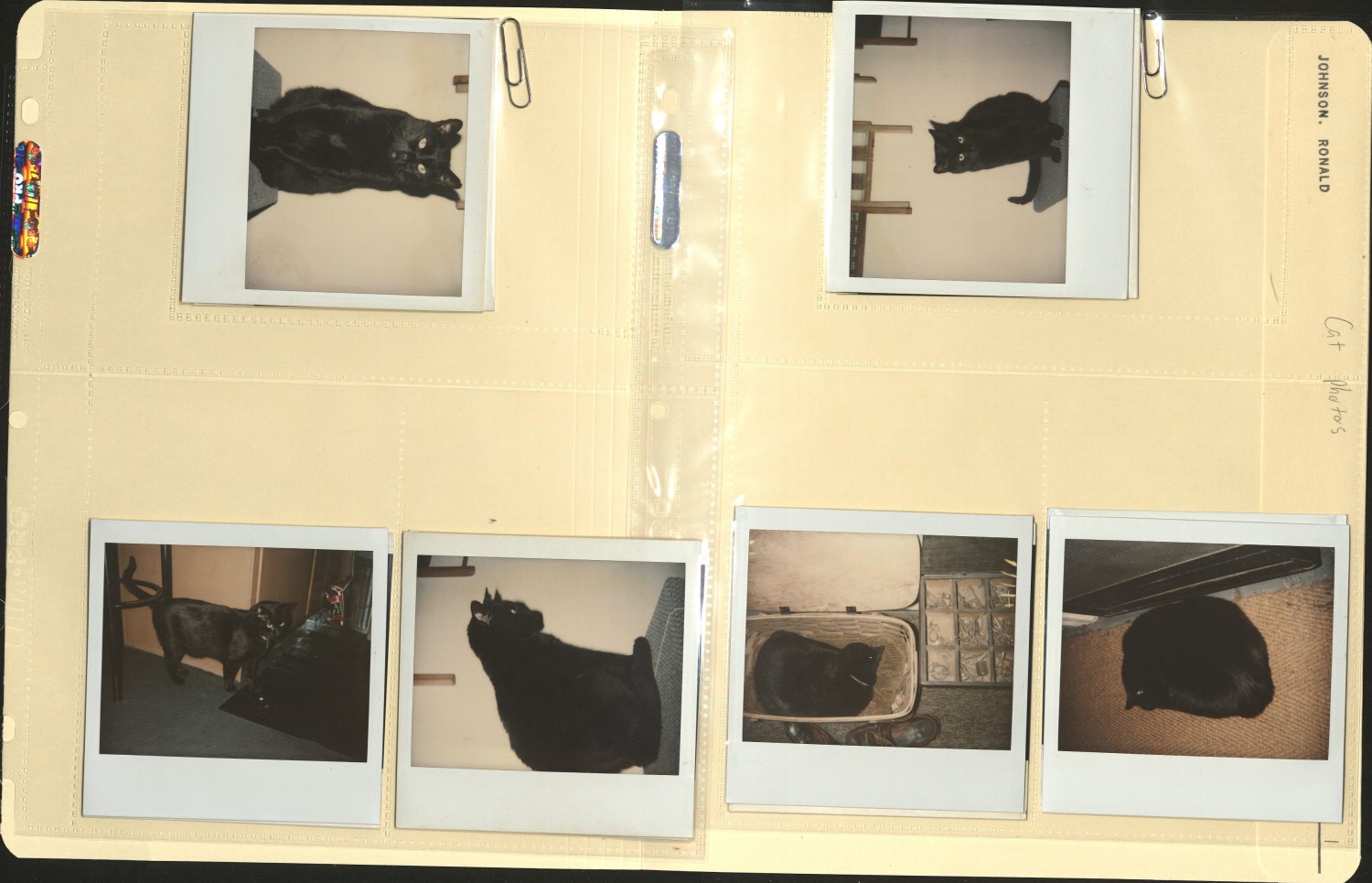
And finally, Ian Strasma reminds us that Halloween isn’t only about creepy clowns, puppets and possessions, and dashingly dressed demons with this recommendation: a black cat found lurking in the Ronald Johnson collection (literary estate papers). The cat may be cute, but be careful that you do not cross him!
“Cat photos,” undated [but timeless]. Ronald Johnson Collection (Literary Estate Papers). Call Number: MS 336. Click image to enlarge.
Best of luck out there as you begin finishing up semester and don’t be afraid to check out the many – completely safe, we promise – collections here at Kenneth Spencer Research Library!