The University of Kansas

Inside Spencer: The KSRL Blog

Books on a shelf

Welcome to the Kenneth Spencer Research Library blog! As the special collections and archives library at the University of Kansas, Spencer is home to remarkable and diverse collections of rare and unique items. Explore the blog to learn about the work we do and the materials we collect.

Inventory and Rehousing: A workflow for 3D objects in archives

April 14th, 2026
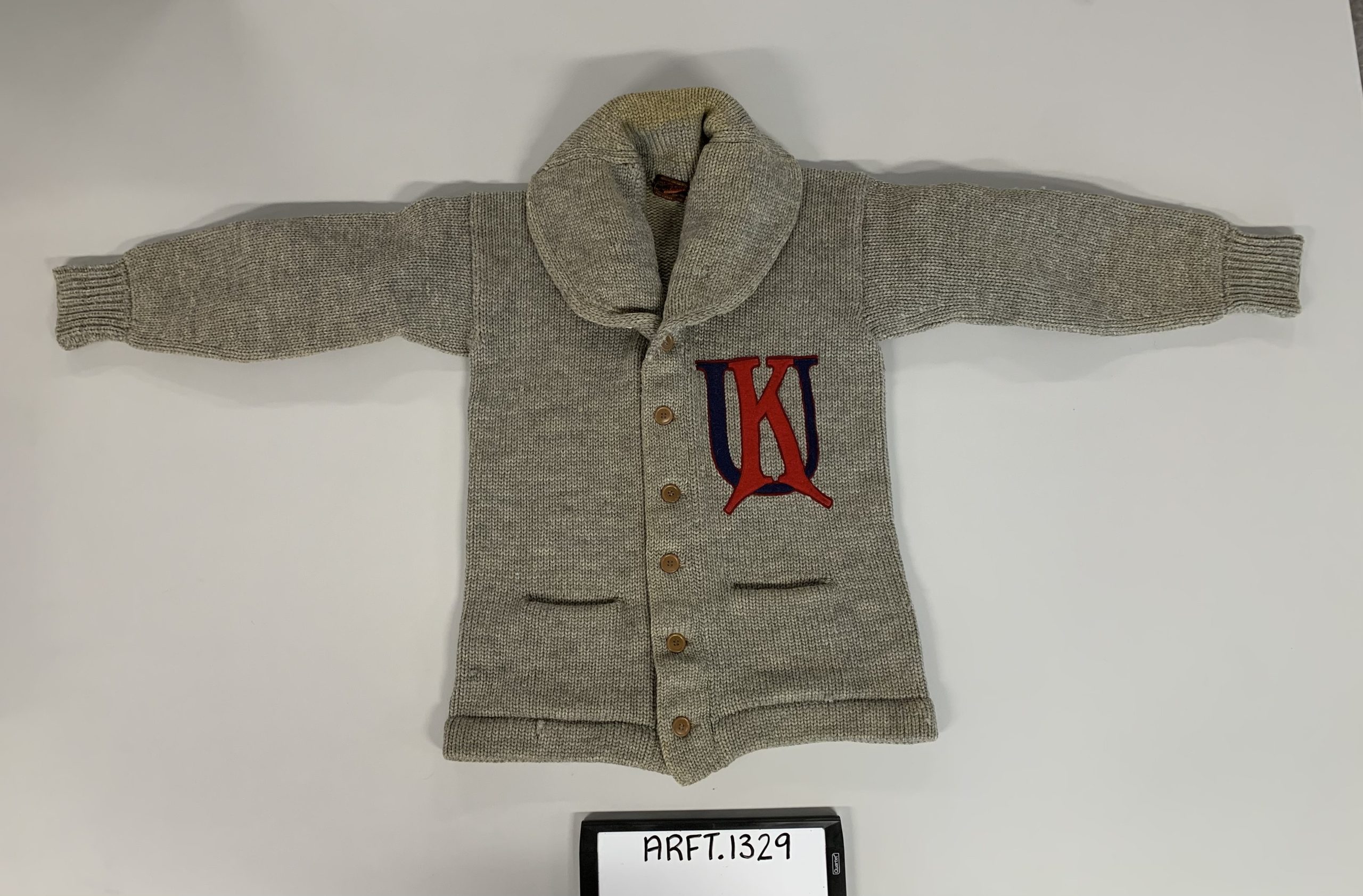
Lela Duncan Cardozo’s KU letter sweater is pictured. The sweater is knitted from gray wool with red capital letter K and blue capital letter U sewn on the left front.
Figure 1: Lela Duncan Cardozo’s KU letter sweater. Call number RG 66/20.

From Student Senate buttons and sports memorabilia to a vial of uranium connected to the Manhattan Project, the unexpected breadth of objects preserved by the University Archives reveals lesser-known aspects of the University of Kansas’s history. The University Archives is the official repository for all materials related to the University of Kansas. Its holdings include official records, publications, correspondence, research papers, and more. However, the University Archives contains more than just documents; it has a robust Artifact Collection that uses objects to tell the KU story.

I began my Graduate Assistant position with Conservation Services in August 2025, and I quickly became familiar with the Artifact Collection and its unique challenges. The University Archives has been collecting objects for decades, but documentation and housing efforts have been largely inconsistent. When I began this project, there was no item-level inventory of the collection, and many objects were stacked precariously in mismatched or overfilled boxes (See Figure 2). Inconsistent storage practices increase the risk of physical damage, and a lack of intellectual control over the collection makes items difficult to access.
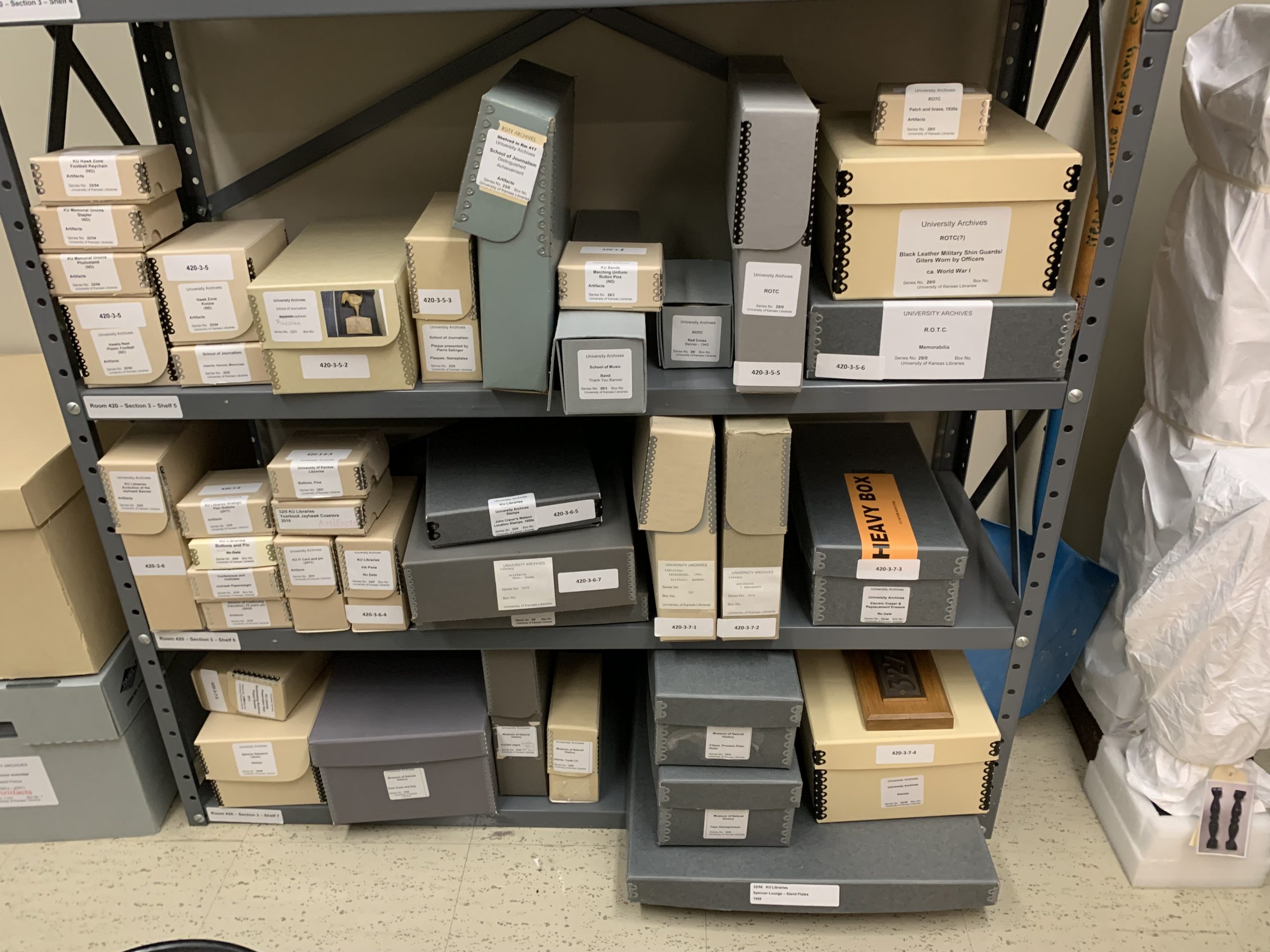
Archival artifact storage is pictured before inventory and rehousing, with many disparate sizes and shapes of boxes.
Figure 2: Inconsistent storage practices highlighted a need to standardize future storage solutions.

This project consisted of several key phases. First, I conducted a full item-level inventory of the Artifact Collection to gain a complete understanding of its contents. For each object, I assigned a unique sequential Artifact ID number (e.g. ARFT.1, ARFT.2, etc.) and recorded any label information from the exterior of the box, including associated Record Group numbers. I then created a brief title and a full description noting color, material type, and any identifiable features on the object, along with any dates indicated on the item or its housing. I documented the object’s exact measurements in centimeters, assessed and recorded its condition, and noted its current location, housing method, and any outstanding questions or comments.

Following the written documentation, I photographed each object using a temporary photo setup consisting of a white paper background and a light-diffusing shade made from corrugated plastic. I used my iPhone to take the photographs, which were intended to provide visual documentation of the objects rather than high-quality, exhibit-ready images. Their purpose was to capture essential physical details that cannot be conveyed through text alone. In each image, I included a small dry-erase board displaying the Artifact ID number in each image to ensure consistent identification (See Figure 3).
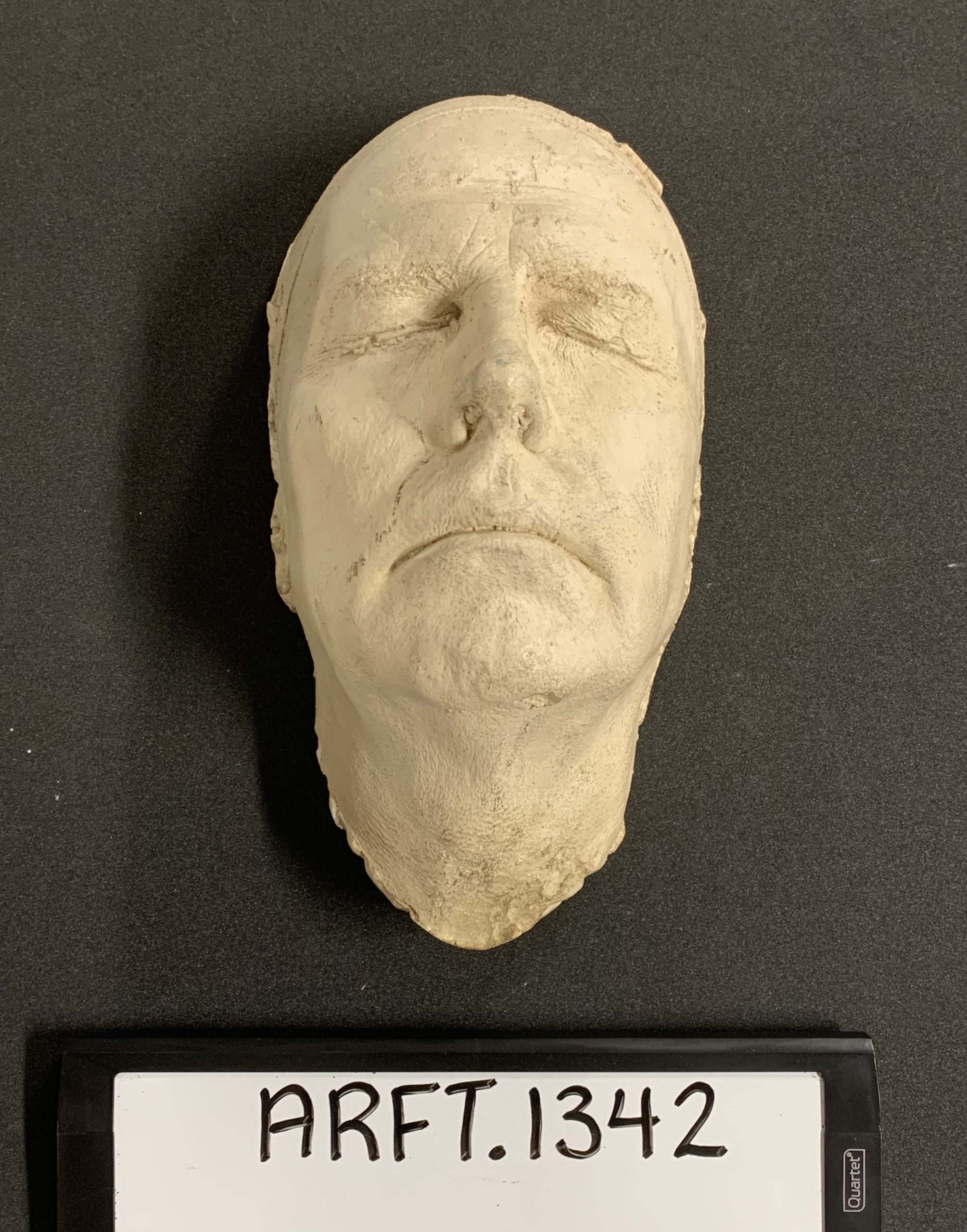
A sample photo from the project inventory, showing the plaster mask of Chancellor Franklin Murphy, 1957.
Figure 3: A sample photo from the project inventory, showing the plaster mask of Chancellor Franklin Murphy, 1957. Call number: RG 22/12.

Finally, I attached a small, hand-cut white paper tag to each object using simple white thread and labeled it with its corresponding Artifact ID number. Instead of ordering object tags from an archival supply company, I created the tags in-house using scrap paper to conserve resources. I inventoried as many objects as possible every day, and I reserved the final half-hour of my shift to upload photos, downloading them to a shared networked drive and organizing them into folders based on the objects’ current room locations. This consistent workflow not only ensured thorough documentation but also allows future users to track the overall timeline and progress of the inventory for similar projects.

After the inventory phase, I developed a comprehensive rehousing plan for the University Archives’ Artifact Collection that focused on standardizing storage materials in order to improve the long-term safety and accessibility of the collection. Developing this rehousing plan required balancing preventive conservation best practices, archival theory, spatial limitations, and institutional realities. Organizing by size improves efficiency and reduces handling risks, while material-based grouping mitigates chemical and environmental threats. On the other hand, contextual organization preserves provenance and research value, and standardized documentation ensures continued intellectual control. Balancing all of these concepts, the rehousing plan details first steps and priorities, lists existing storage solutions to follow, and models potential storage solutions for objects whose current housings need improvement. It also provides a list of standard box sizes so that storage solutions stay consistent moving forward. Designed with flexibility in mind, the plan is meant to support future growth, ensuring the collection can evolve without compromising curatorial integrity. Following this plan, I have now begun rehousing objects.

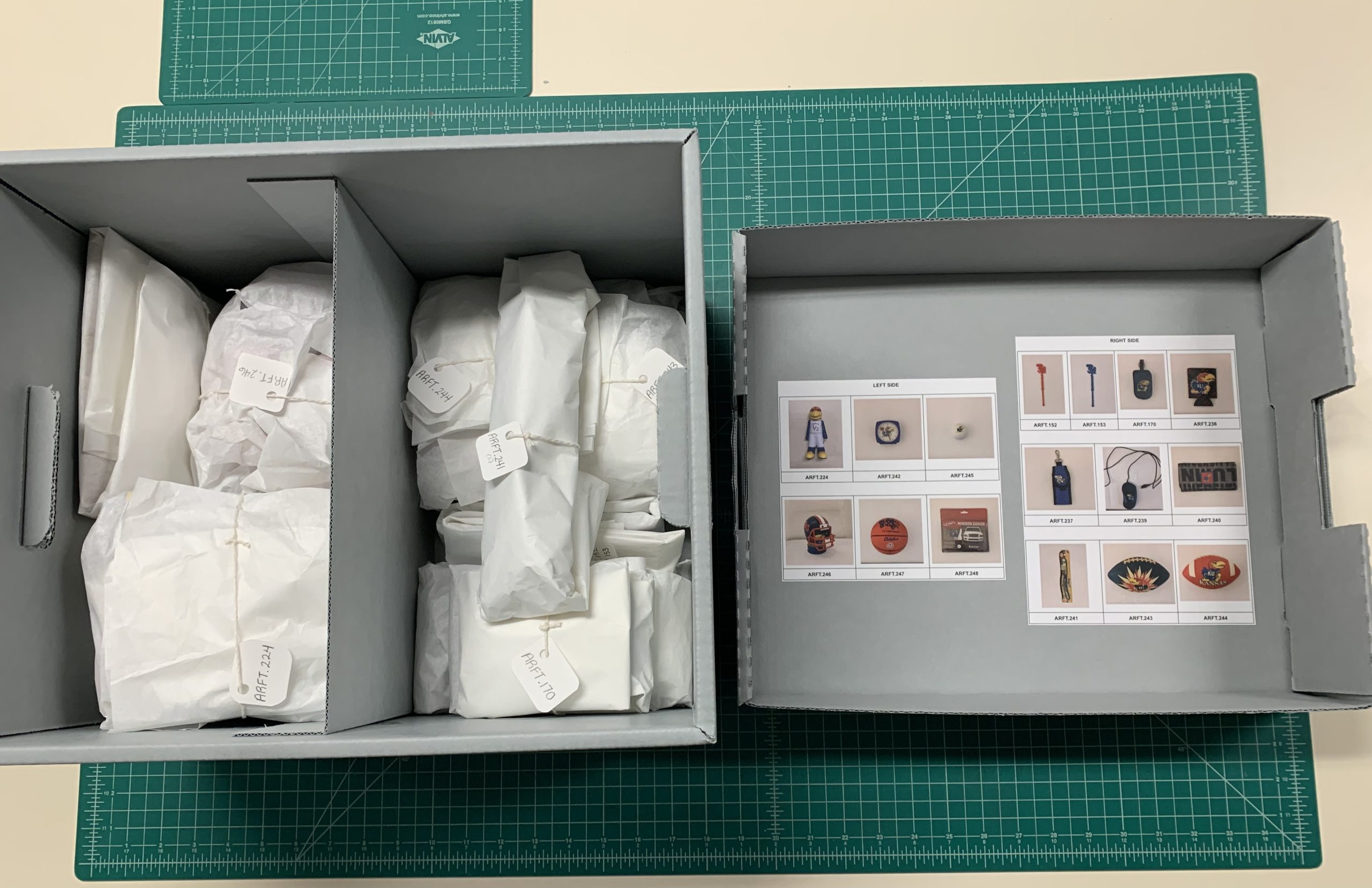
While rehousing Record Group 0/25: Jayhawks, I encountered an oversized box filled with plastic objects that were visibly deteriorating (see Figure 4). Several items exhibited yellowing and surface changes that suggested they were being affected by surrounding materials. In response, I removed all non-plastic objects from the box and rehoused them separately. The remaining plastics, particularly those showing signs of degradation, were wrapped individually in tissue and placed in a standard banker’s box designed to function as a containment unit rather than a highly customized enclosure. Photographs of each object were affixed to the lid, and labeled tags were tied to the exterior of each wrapped item to improve retrievability (see Figure 5). Because these objects possess relatively low research value, constructing individualized custom enclosures was not an efficient use of limited resources. Instead, I prioritized risk mitigation and containment. This solution reflects a central methodological principle of this project: rehousing does not aim for perfection, but for measurable improvement and increased standardization.
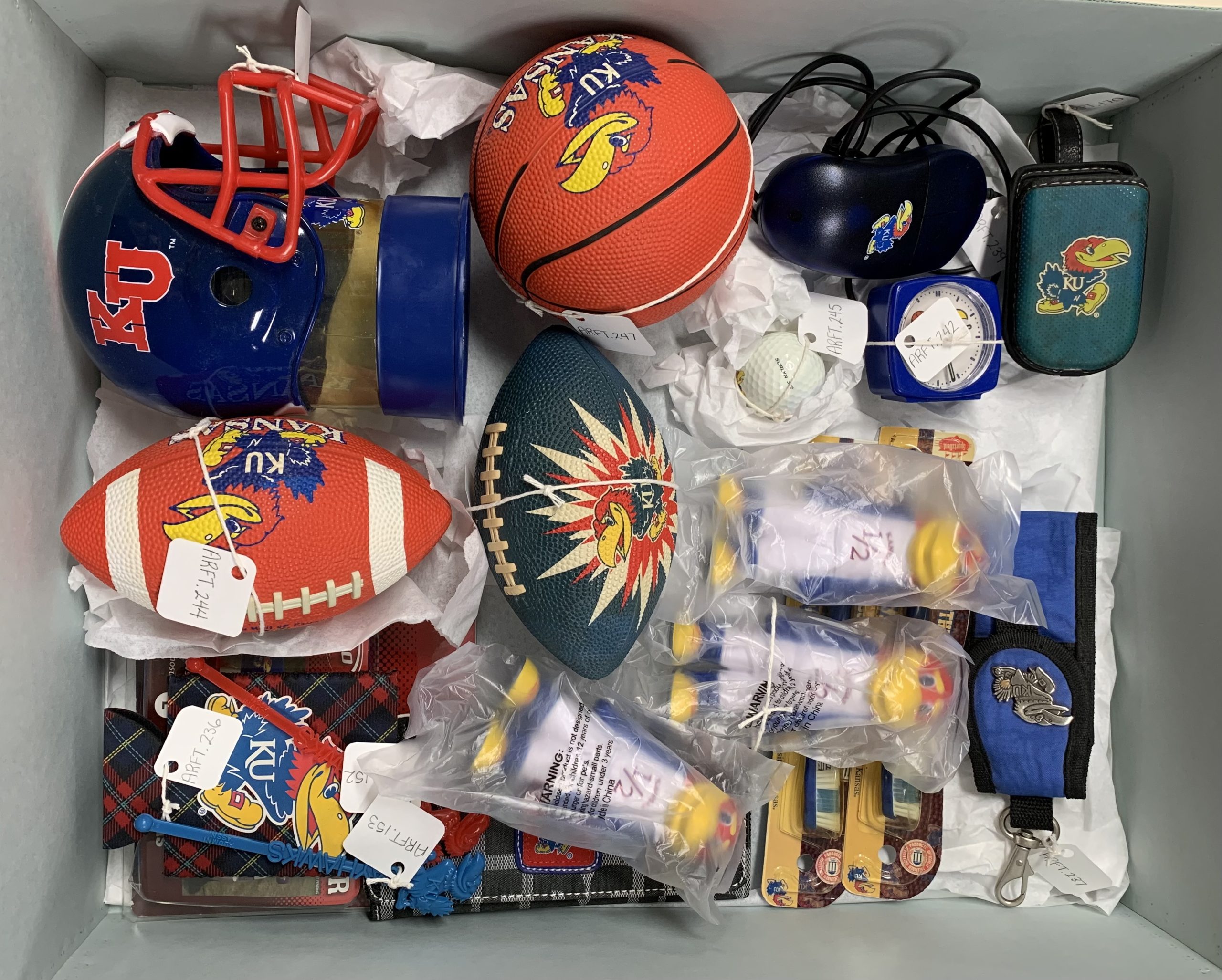
An assortment of off-gassing plastic artifacts are pictured together in a box before rehousing.
Figure 4: Off-gassing plastic artifacts before rehousing. Call number: RG 0/25.
Plastic artifacts pictured after rehousing, individually wrapped and numbered with a photographic key affixed to the inner lid of the box.
Figure 5: Plastic artifacts rehoused. Call number: RG 0/25.

Every storage decision reflects institutional realities, professional standards, and long-term stewardship commitments. By integrating collections management strategies with conservation principles, this project provides a flexible and sustainable framework for not only the continued care of the Artifact Collection but an example for any archive drawing on museological best practices to deal with 3D objects.

While I was able to complete an item-level inventory of the Artifact Collection, the rehousing stage of the project will likely extend beyond my time at KU. As a result, the rehousing plan developed here will serve as a guide for future staff, supporting consistent and standardized decision-making. In addition, I have outlined detailed workflows for the continued care of the collection. This project would not have been possible without the collaboration of the University Archives, Conservation Services, and Spencer’s Archival Processing Team.

A very special thanks to Letha Johnson for warmly welcoming me into the University Archives and for placing her trust in me as I engaged critically with the Artifact Collection. Her trust and collaboration were essential to the success of this project.

Brenna Hobbs, M.A. Museum Studies 2026, Graduate Assistant in Conservation Services
“Snap Shots of My University Life”: The Student Scrapbook of Nola Ayers 

March 7th, 2025
This image has text.
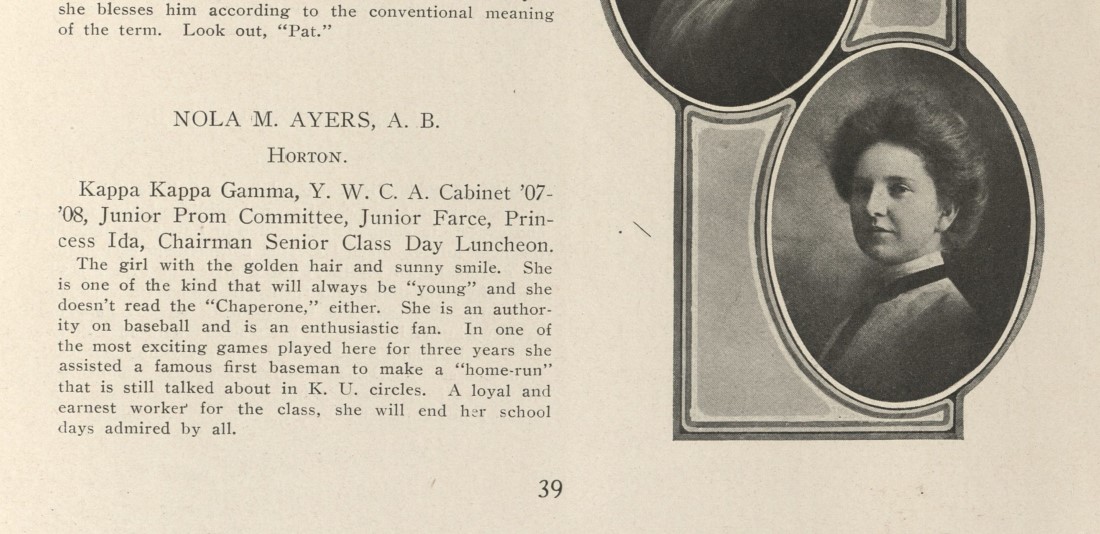
Nola Ayers’s senior picture and a description of her KU life in the 1909 Jayhawker yearbook. University Archives. Call Number: LD 2697 .J3. Click image to enlarge.

Nola Mary Ayers was born in Horton, Kansas, in 1886. She arrived in Lawrence in the fall of 1905 to enter the University of Kansas and graduated from KU with a bachelor’s degree in 1909. Nola documented her college years by creating a scrapbook, as did many other university students at the time. 

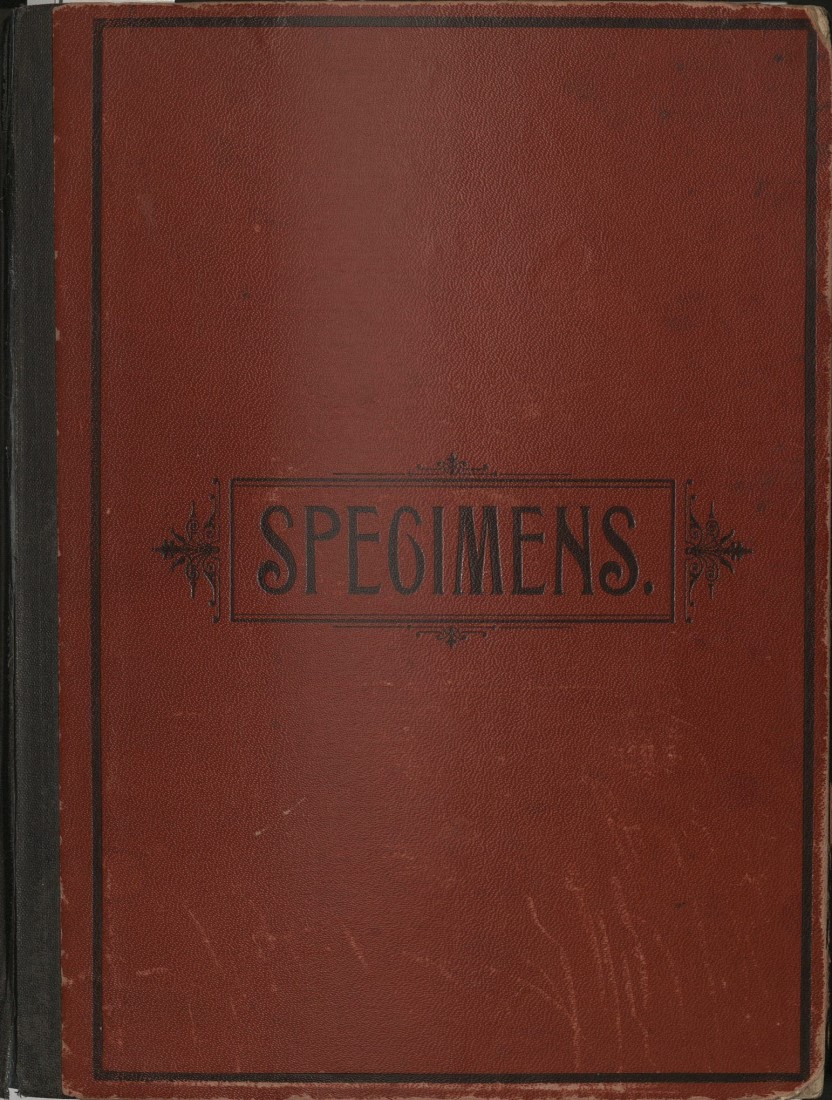
Typically, students purchased a large scrapbook from one of the bookstores near the university. Nola broke with tradition by using a blank “Specimens” science notebook to paste in mementos of her life at KU. 

Red book cover with the word "Specimens" in black text.
The front cover of Nola Ayers’s scrapbook, 1905-1909. Call Number: SB 71/99/8. Click image to enlarge.

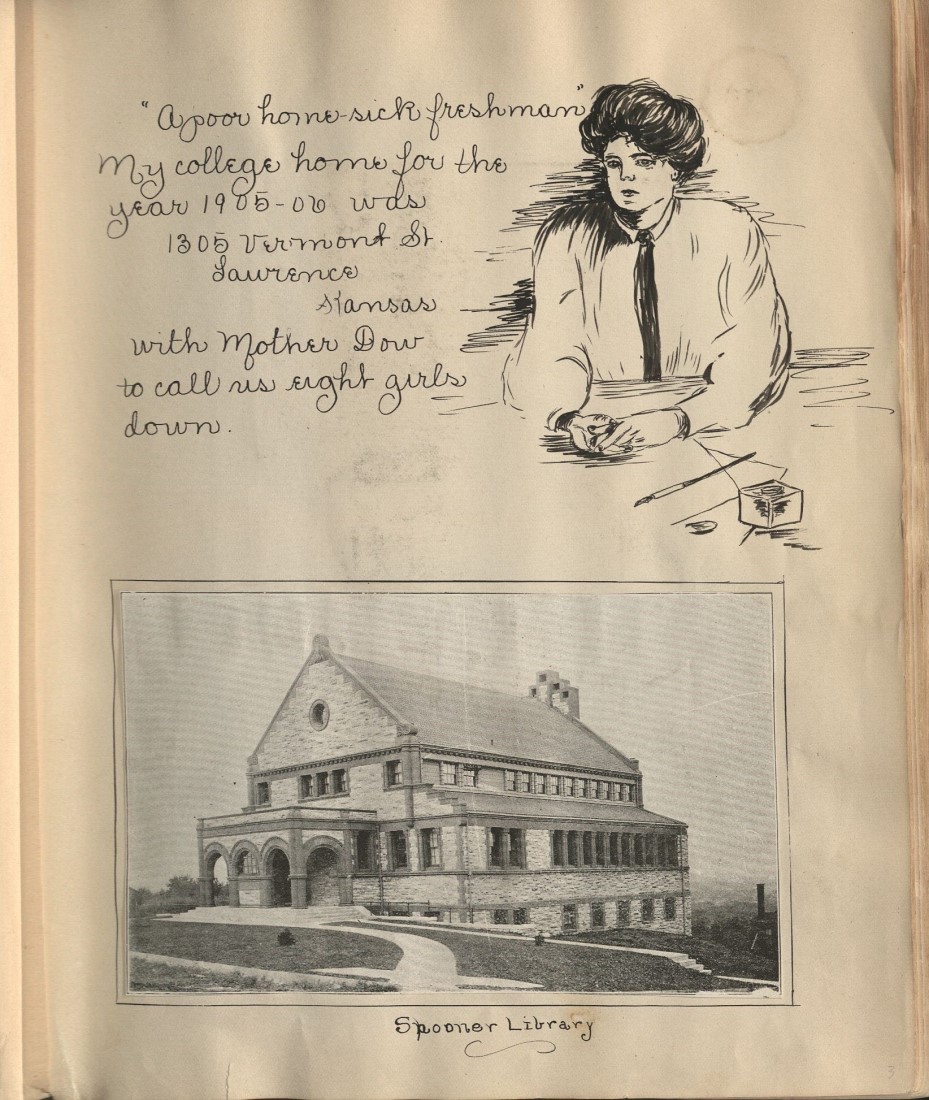
Nola’s scrapbook was also unique because she was an artist and decorated her album with original pen and ink drawings. One of the first drawings in the scrapbook is a self-portrait where she describes herself as a “poor home sick freshman” whose “college home for the year 1905-06 was 1305 Vermont St. Lawrence, Kansas with Mother Dow to call us eight girls down.” This house on Vermont is still standing in the Oread neighborhood. In the years before dormitories, many students lived in boarding houses near campus; many of these large multi-story houses still exist. 

This image has text accompanied by a black-and-white sketch of a woman sitting at a desk. There is also a photograph of Spooner Library.
Nola Ayers’s scrapbook entry about being “a poor home-sick freshman,” 1905. Call Number: SB 71/99/8. Click image to enlarge.

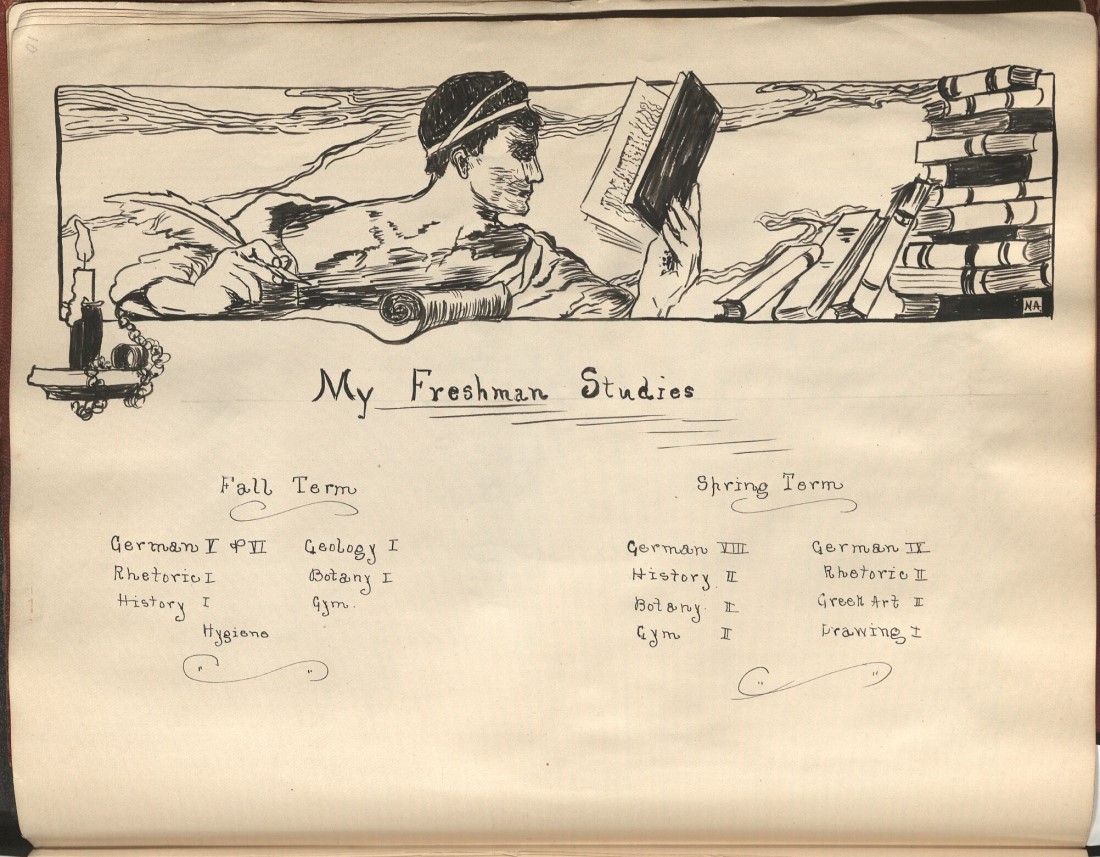
Nola documented her studies in her scrapbook. As seen in the image below, she took “Hygiene” and “Gymnasium” during her freshman year – courses that all KU students in the early twentieth century were required to enroll in. Nola also studied rhetoric, German, geology, solid geometry, and botany. Her scrapbook reflects her love of drawing, and her coursework included drawing, ornament design, and Greek art. 

List of classes taken by Nola Mary Ayers in the fall and spring terms of her freshman year. There is a black-and-white sketch of a man reading and writing.
Nola Ayers’s freshman-year courses listed in her student scrapbook, circa 1906. Call Number: SB 71/99/8. Click image to enlarge.

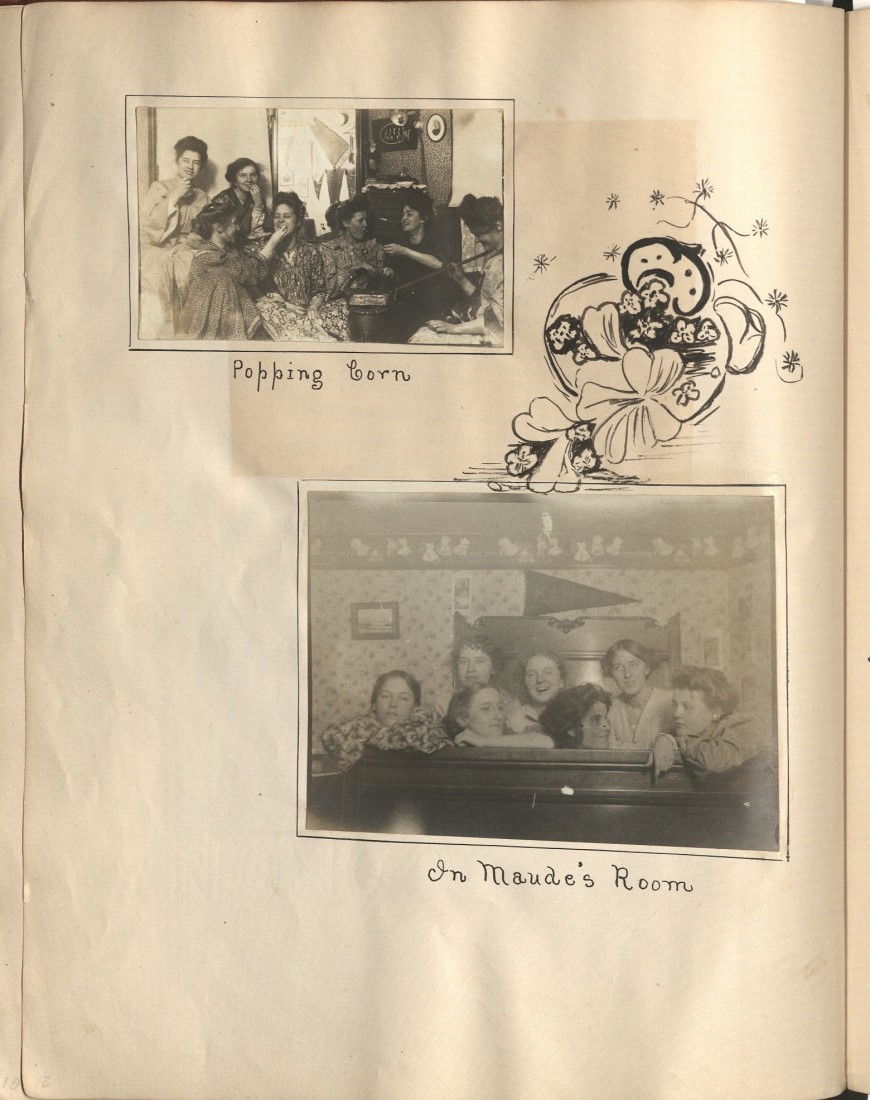
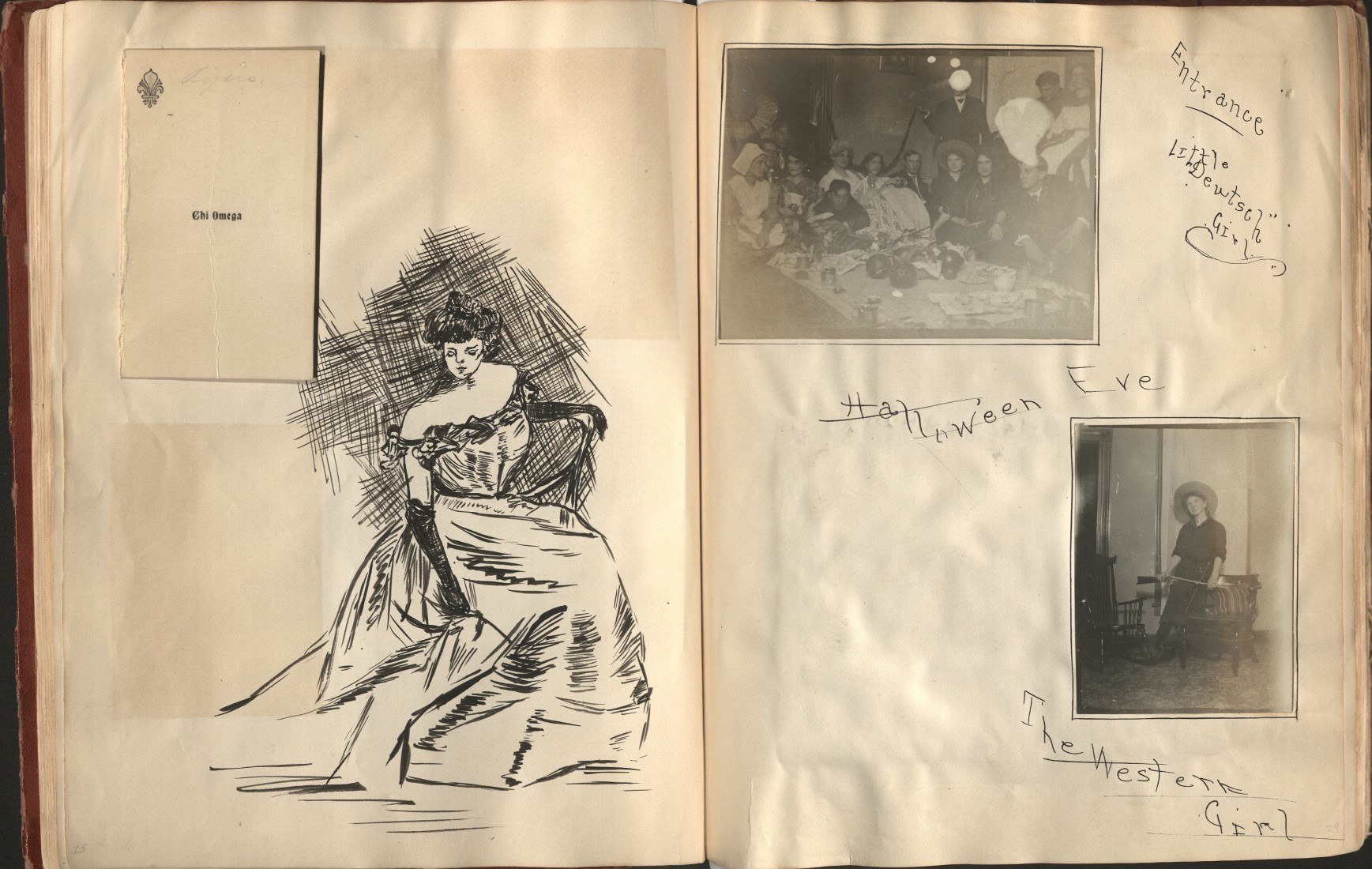
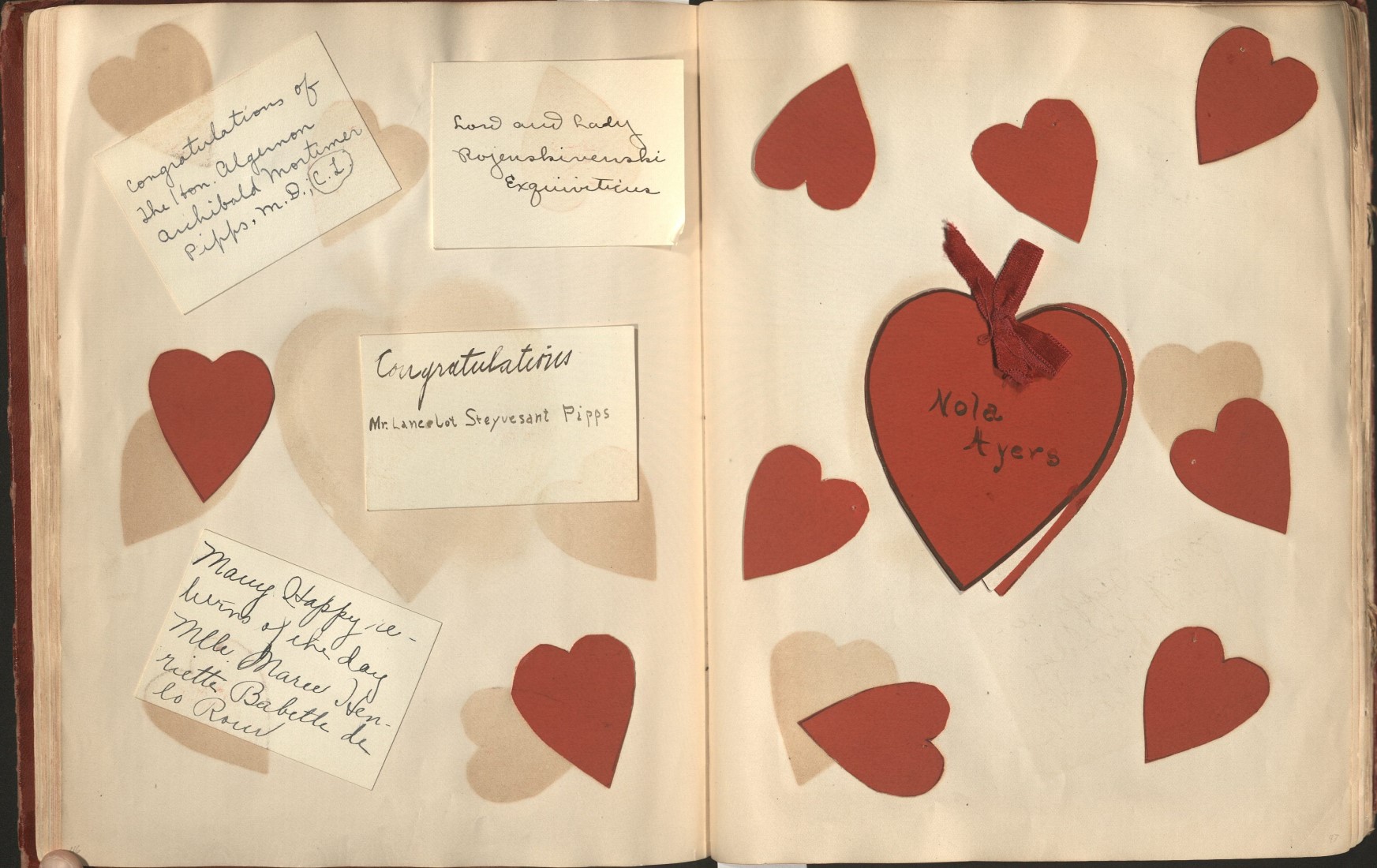
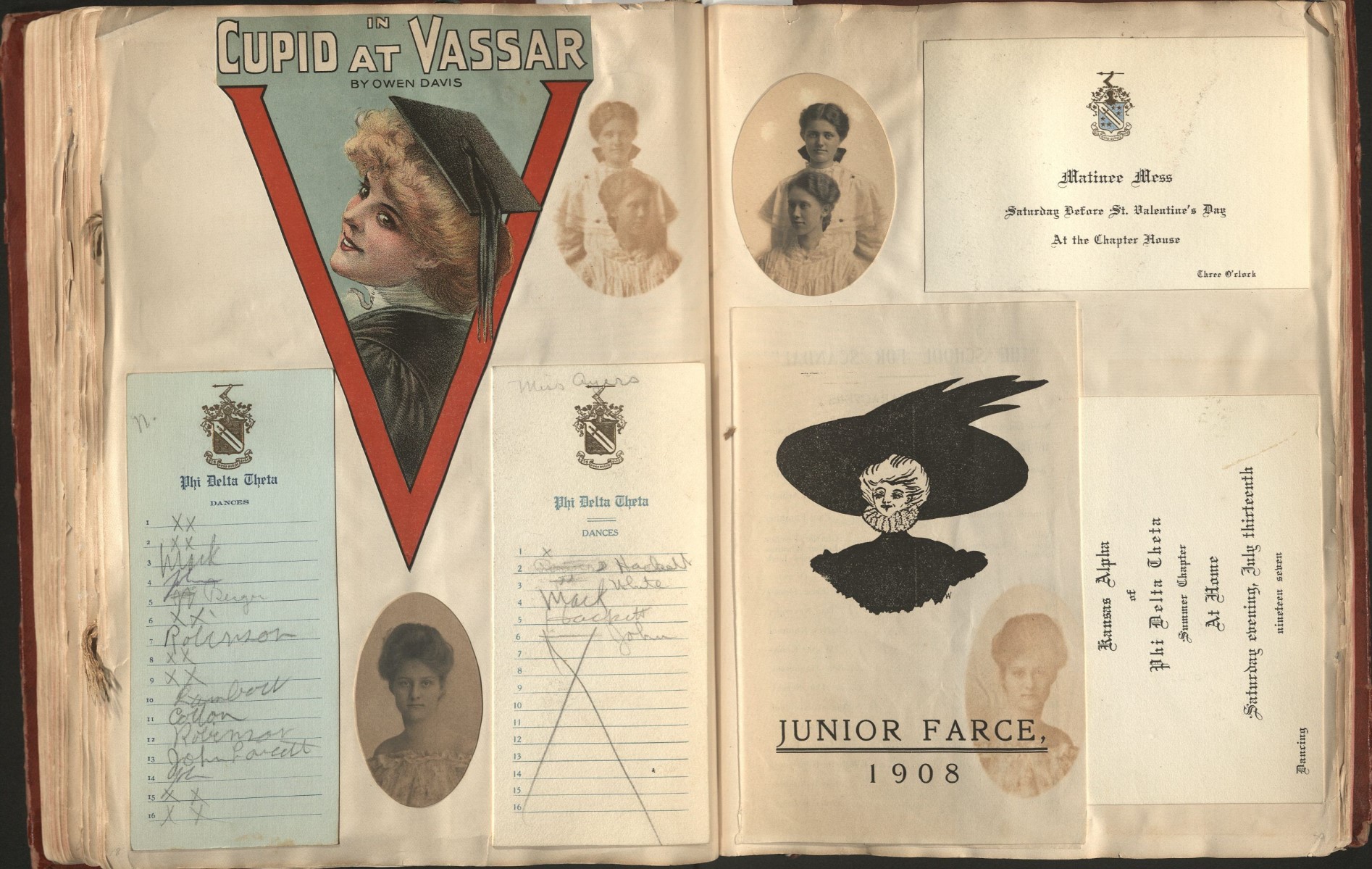
Besides coursework, friendships with other students are well represented in the pages of Nola’s scrapbook. She documented slumber parties with other girls, popcorn making, a Halloween party where she dressed as the “Western Girl,” and events at her sorority, Kappa Kappa Gamma. Nola celebrated Valentine’s Day with a party and red hearts pasted into her scrapbook. 

Two black-and-white photos attached to a larger piece of off-white paper. One shows a group of girls making and eating popcorn. The other shows a group of girls laying on a bed "in Maude's room."
|
Two-page scrapbook page. On the left is a dance card and a black-and-white sketch of a girl in an evening gown. On the right are two black-and-white photos: a group at a Halloween party and Nola Mary Ayers dressed as "the Western Girl."
|
Two-page scrapbook page with Valentine's notes and red paper hearts.
Selected pages from Nola Ayers’s scrapbook showing her hanging out and celebrating holidays with friends, 1905-1909. Call Number: SB 71/99/8. Click images to enlarge.

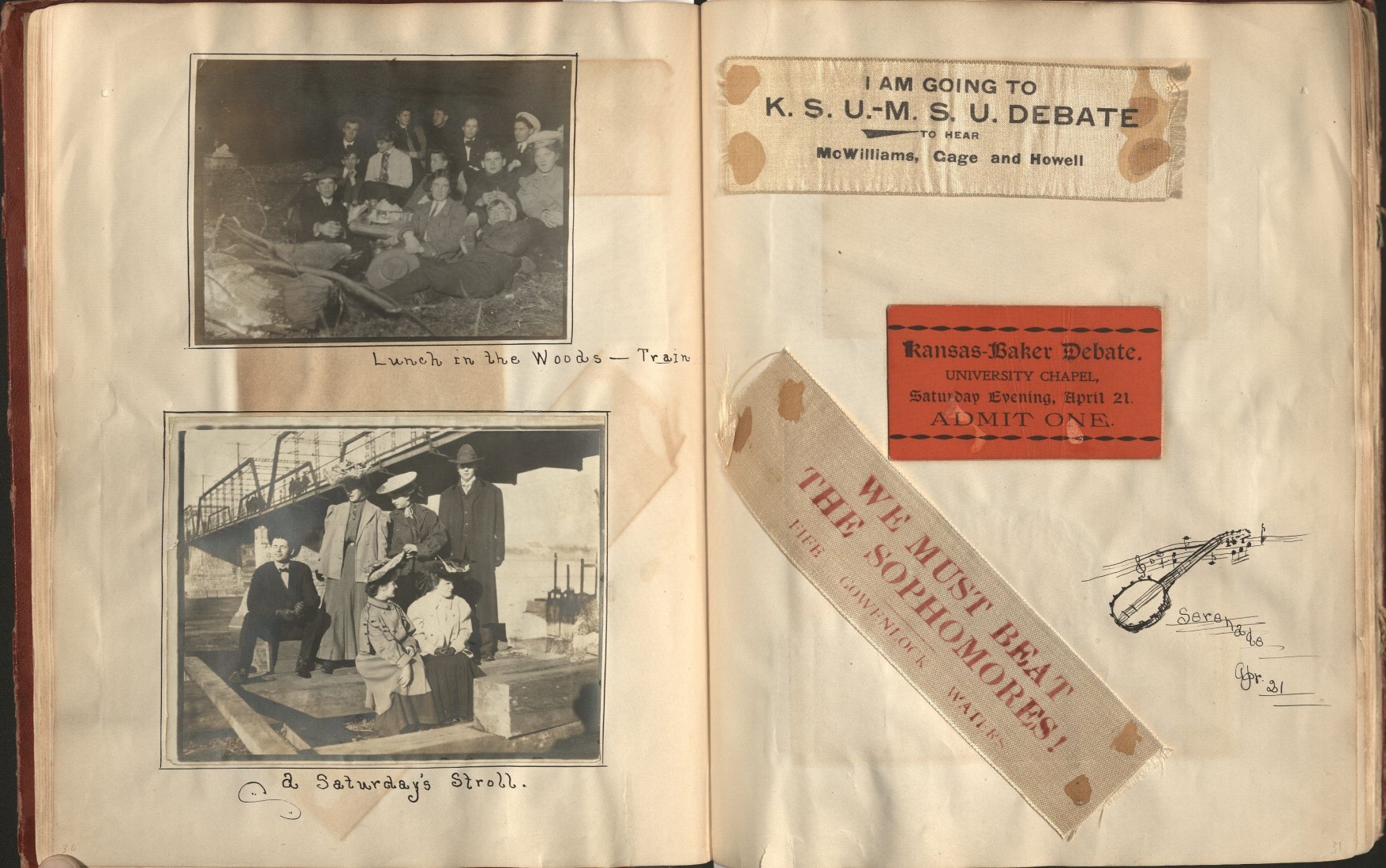
As evidenced by her scrapbook, Nola partook many of the outdoor activities KU students enjoyed in the early twentieth century: walking, boating on the Kaw River, picnicking in the countryside, and attending sporting events. According to the 1908 Jayhawker yearbook, Nola was an “authority on baseball” and an “enthusiastic fan.” Indeed, she pasted photos of the KU baseball team into her scrapbook. Nola also included items related to the KU debate team. Debate was almost as popular as athletic sports during the early twentieth century, and students would travel to other cities like Topeka to support the KU team. 

Two-page scrapbook page with photographs of students enjoying "lunch in the woods" and "a Saturday's stroll." There are also two items from KU debate team events.
A two-page spread in Nola Ayers’s scrapbook, circa 1906. Call Number: SB 71/99/8. Click image to enlarge.

According to a newspaper article, Nola was crowned Queen of the May at the second annual May Fete in 1909. She was a member of Allemania (German Club) and attended their events. She appeared to have attended many dances, plays, and concerts while a student, as documented by the many programs decorating her scrapbook. Plays and concerts were held on campus and in downtown Lawrence at the Bowersock Opera House. 

Two-page scrapbook page with invitations, dance cards, photographs, and a dance program.
A page of invitations and dance cards in Nola Ayers’s KU student scrapbook, circa 1907-1908. Call Number: SB 71/99/8. Click image to enlarge.
Scrapbook page with two black-and-white photographs: the Kappa Kappa Gamma House at the University of Colorado, and a group of women in graduation caps and gowns.
The bottom photo on this page might show Nola Ayers with her housemates, circa 1909. During her junior and senior years at KU, Nola lived at 1400 Tennessee Street in Lawrence. Call Number: SB 71/99/8. Click image to enlarge.

Nola Ayers married KU alumus Benjamin P. Young in 1910. According to a newspaper article announcing their wedding, the couple settled in Halstead, Kansas, where Ben was a high school principal. Ben and Nola relocated to Ithaca, New York, by 1923 and appear to have lived there for the rest of their lives. They had two children. Ben died in 1958; Nola passed away in 1973 at age 86.

Becky Schulte
Retired University Archivist and Curator of the Wilcox Collection

Dear Soldier

October 15th, 2021

In the fall of 2007, Air National Guard Sergeant William Leggett was doing his laundry. He was serving a third tour of duty in the Middle East, this time in Iraq. As he walked past a trash bin, he glanced into it and saw a large envelope addressed “To Any Soldier.” Never one to resist a possible trash treasure, he opened the envelope to find a packet of “Dear Soldier” letters, written by fifth- and sixth-grade students from Oil Hill Elementary School in El Dorado, Kansas.

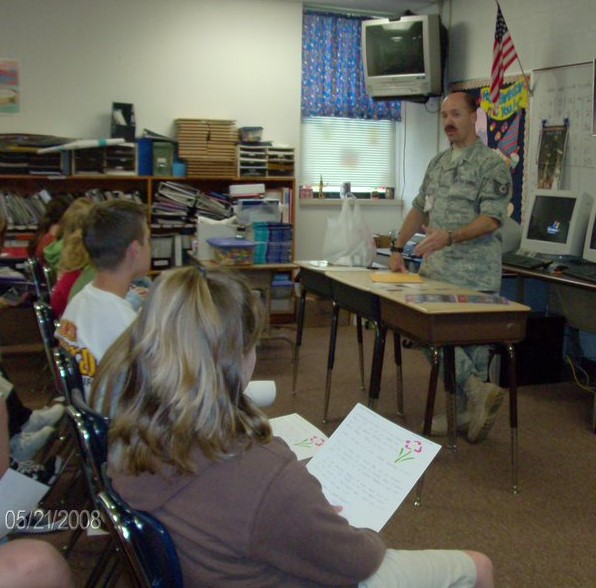
Photograph of a uniformed soldier standing at a desk. The students are sitting in chairs facing him.
Sergeant Bill Leggett talking with students at Oil Hill Elementary School, 2008. Photo taken and provided by Kathy Lafferty. Click image to enlarge.

Sergeant Leggett was my brother, five years younger than me. From this point on I will call him Bill. Growing up together in Pennsylvania, he was the typical little brother. He chased me with Cicada shells from his bug collection, ditched me when we had chores, and announced on the school bus that I wore flowered underwear. On long car rides, he annoyed me by looking out of my window or breathing on me.

Nevertheless, we were close, despite our age difference. We made bike ramps out of old scrap wood our Dad had in his workshop, and we rode our bikes up and down our long driveway, trying to best each other’s jumps. I taught him how to make a bridge for his Tonka toys out of books and a rug, but he sometimes forgot the “trick” for getting the books to stay in place, so he asked me to show him again…and again…and again. We played baseball, taking turns pitching. On some of those long car rides, if I was feeling a little motherly and he didn’t smell too badly, I let him put his head on my lap to sleep (this was before seatbelts laws). He shared a bunk bed with our youngest brother, and many nights, after he had gone to bed, I heard him crying over something. We talked it out until he felt better, while I stood on tip toes on the bottom bunk. After I moved away, we wrote letters to each other throughout the rest of his childhood. I still have them.

Bill lived in Pennsylvania, with his family. He had been to Kansas to visit me a few times, and I saw him whenever I went to Pennsylvania. But we didn’t see each other, or have opportunities to talk, very often. He called me on my birthday and sang to me, badly on purpose. I wish I would have kept at least one of those voicemails. While he was in Iraq, we emailed each other almost every day. It was wonderful to talk again. He told me about the packet of letters he had found. I was excited to learn that the school was in Kansas, just off I-35, only two hours from my house.

He told me that he planned to hand-write letters to each student, individually. While I found it rather over the top that he would actually take the time to respond to each child, rather than just writing to the class as a whole or using email, I wasn’t surprised that he would do that. He told me that he felt the students deserved individual letters because THEY were the ones who had written individual letters in the first place, and it would be a shame if they each didn’t get a response. Besides, it gave him a project to pass the time.

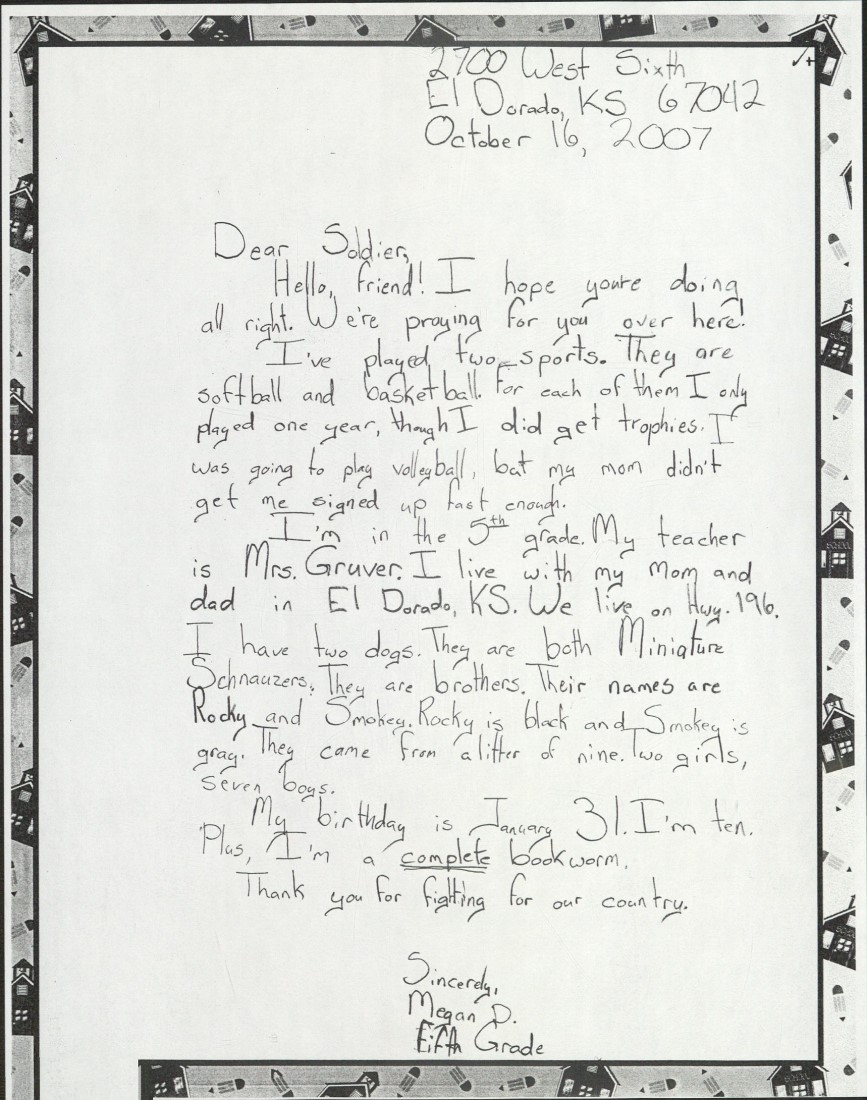
Black-and-white scan of a handwritten letter. The border of the paper has pencils and schoolhouses.
Letter from fifth grader Megan D. to Bill Leggett, October 2007. Sergeant William J. Leggett Correspondence with Students of Oil Hill Elementary School. Call Number: RH MS 1525. Click image to enlarge.
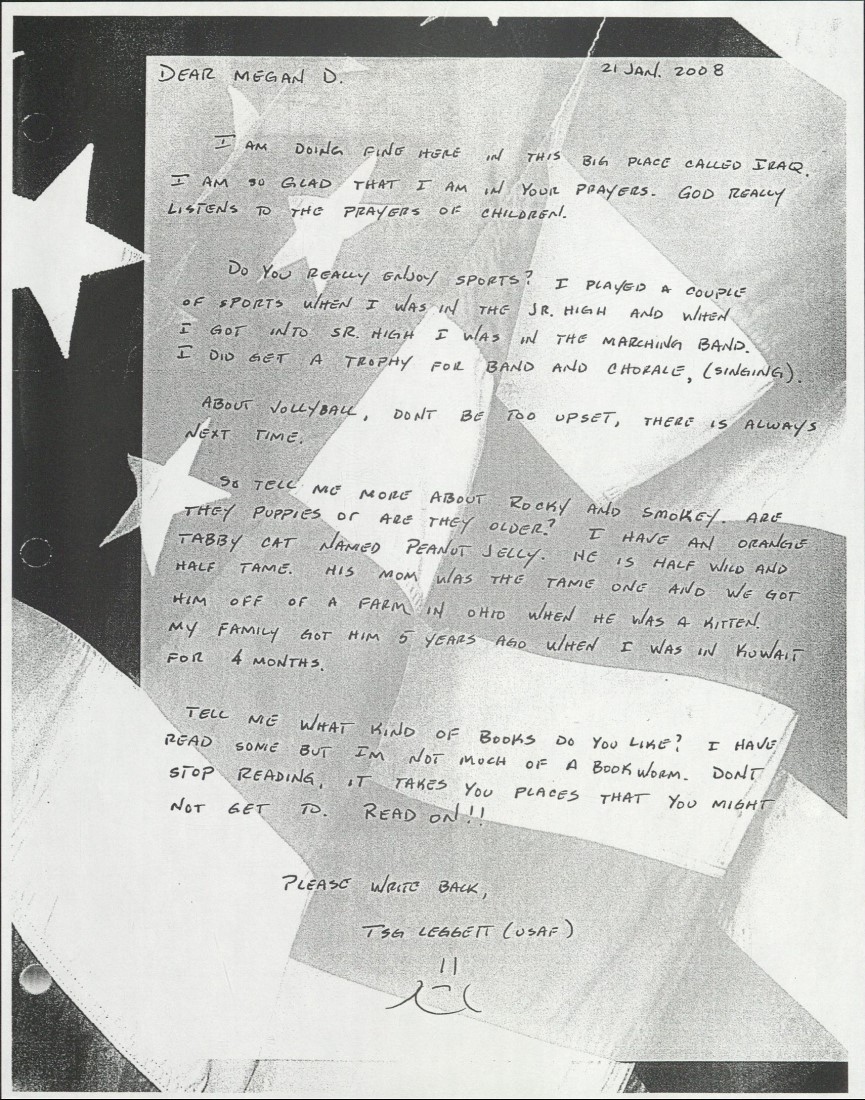
Black-and-white scan of a handwritten letter. The paper's background is an American flag.
Letter from Bill Leggett to fifth grader Megan D., January 2008. Sergeant William J. Leggett Correspondence with Students of Oil Hill Elementary School. Call Number: RH MS 1525. Click image to enlarge.

So, for the rest of his tour of duty, he wrote to them, and they wrote back. He asked them to call him Bill. The students wrote of family members, pets, favorite sports, and things of childhood and school. They sent him artwork. They asked Bill questions about his life, what it was like to be in the military, and what his favorite things were. They closed by asking him to please write back. Bill wrote about his boys, Peanut Jelly the cat, and NASCAR. He described Iraq, its people, and the places he had been. He talked about life in the military, his job, and things like what food the soldiers ate. He wrote of what he missed back home. In each letter, he made sure to include encouragement. He reminded the students to do their best, to study hard, and to pursue their dreams. And he often included a smiley face when he signed off.

As the time to come back to the States got closer, Bill and I started talking about a visit to Kansas and the school. I contacted the teacher who had given the letter writing assignment about the possibility, and she took it from there. All we had to do was get him there. The visit was a surprise for the students, and it went beautifully. He hand-delivered his last letters, gave out some gifts he brought back from Iraq, held a question/answer session, played basketball with them at recess, and ate lunch with them. Students had their picture taken with him. He was presented with a school t-shirt and a flag that had been signed by the students and teachers. Bill was treated like royalty. When he left, there were hugs and tears, and promises to keep writing.

The students are in their mid-twenties today. They probably don’t know that Bill has passed. He died in 2020, in a work-related accident, just fifty-five years old. I hope they know, or someday know, that their letters are now the “Sergeant William J. Leggett Correspondence with Students of Oil Hill Elementary School, El Dorado, Kansas” collection, in Kenneth Spencer Research Library. When I asked Bill if I could make copies of the letters and donate them, he asked me why anyone would be interested in them. I explained that the best parts of the collections in Spencer are the personal stories that put history in context and make it real. He wasn’t convinced, but he let me do it anyway. He kept the originals because he wasn’t ready to part with them yet. I believe the letters meant as much to him as they did to the students.

Kathy Lafferty
Public Services

Throwback Thursday: Commencement Take Two Edition

May 20th, 2021

Each week we’ll be posting a photograph from University Archives that shows a scene from KU’s past. We’ve also scanned more than 34,800 images from KU’s University Archives and made them available online; be sure to check them out!

Rain, rain go away! We’re hoping for clear skies on Sunday for KU’s second weekend of Commencement ceremonies. Congratulations to the Classes of 2020 and 2021!

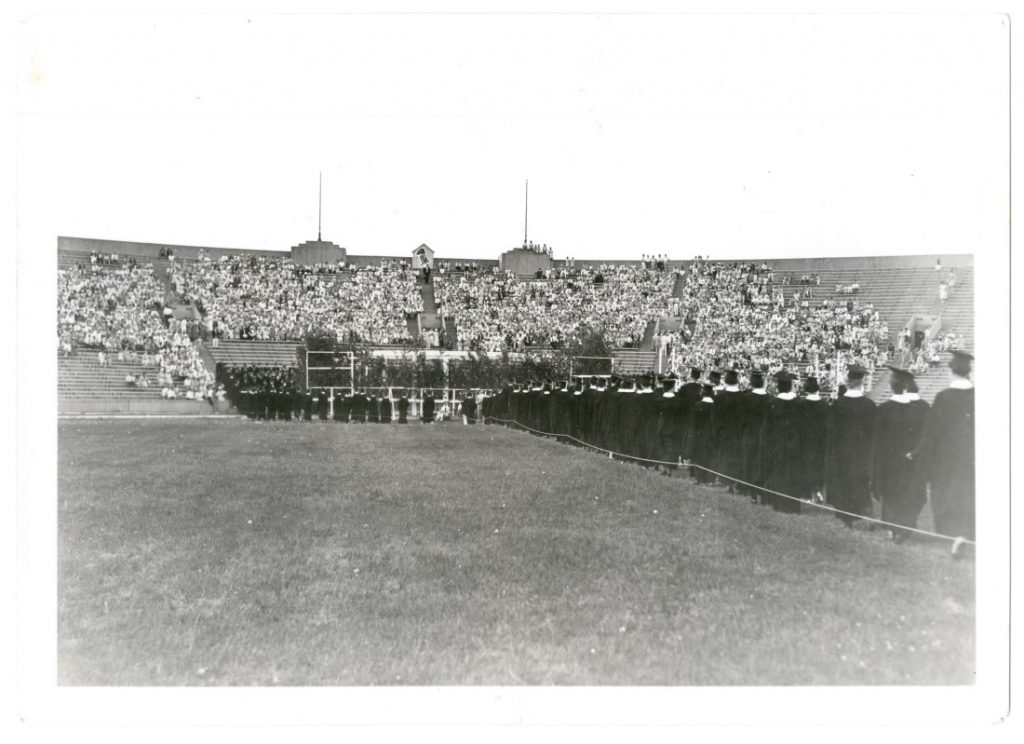
Photograph of KU graduates walking in Memorial Stadium for Commencement, 1933
KU graduates walking in Memorial Stadium for Commencement, 1933. University Archives Photos. Call Number: RG 0/17 1933 Prints: University General: Commencement (Photos). Click image to enlarge (redirect to Spencer’s digital collections).

Caitlin Klepper
Head of Public Services

Throwback Thursday: Commencement Edition, Part II

May 13th, 2021

Each week we’ll be posting a photograph from University Archives that shows a scene from KU’s past. We’ve also scanned more than 34,800 images from KU’s University Archives and made them available online; be sure to check them out!

Commencement for the class of 2021 is on Sunday, and we join others in congratulating all graduating Jayhawks and wishing them the very best. Rock Chalk!

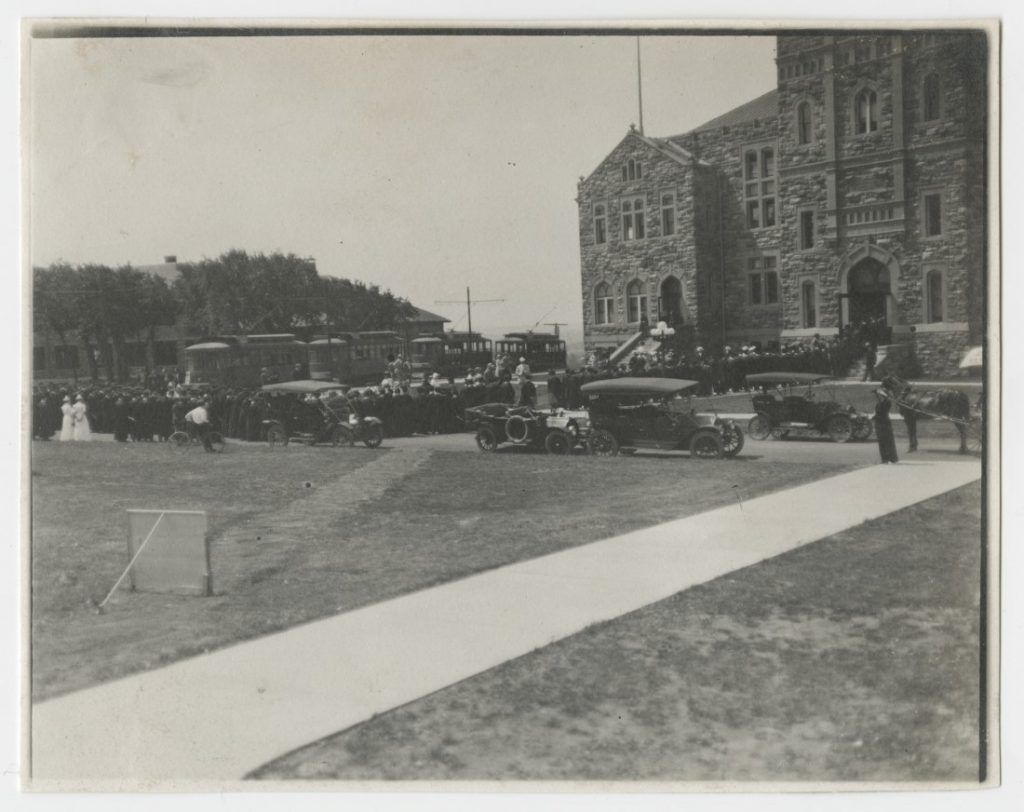
Photograph of KU graduates walking into Robinson Gymnasium on Commencement Day, 1913
KU graduates walking into Robinson Gymnasium on Commencement Day, 1913. The structure once known as the Fowler Shops (present-day Stauffer-Flint Hall) is barely visible behind the trees on the left. University Archives Photos. Call Number: RG 0/17 1913 Prints: University General: Commencement (Photos). Click image to enlarge (redirect to Spencer’s digital collections).

Caitlin Klepper
Head of Public Services