The University of Kansas

Inside Spencer: The KSRL Blog

Books on a shelf

Welcome to the Kenneth Spencer Research Library blog! As the special collections and archives library at the University of Kansas, Spencer is home to remarkable and diverse collections of rare and unique items. Explore the blog to learn about the work we do and the materials we collect.

This blog may contain archived web content. This blog may link to catalog records which no longer exist as of a software change in 2026.

Poetry with Purpose: Thematic Through Lines in Special Collections

July 16th, 2026

Poetry is occasionally seen as a “sillier” form of writing due to its limited boundaries and subjective meanings. However, as a form of revolution and rebellion, it remains a constant in the zeitgeist of American literary movements. By highlighting a handful of Special Collections material published by Beat poets, a fellow Kansan, and a Slavic studies scholar, I hope to shine a bit more light on the impactful messaging that came from different, often subversive, poetry collections! 
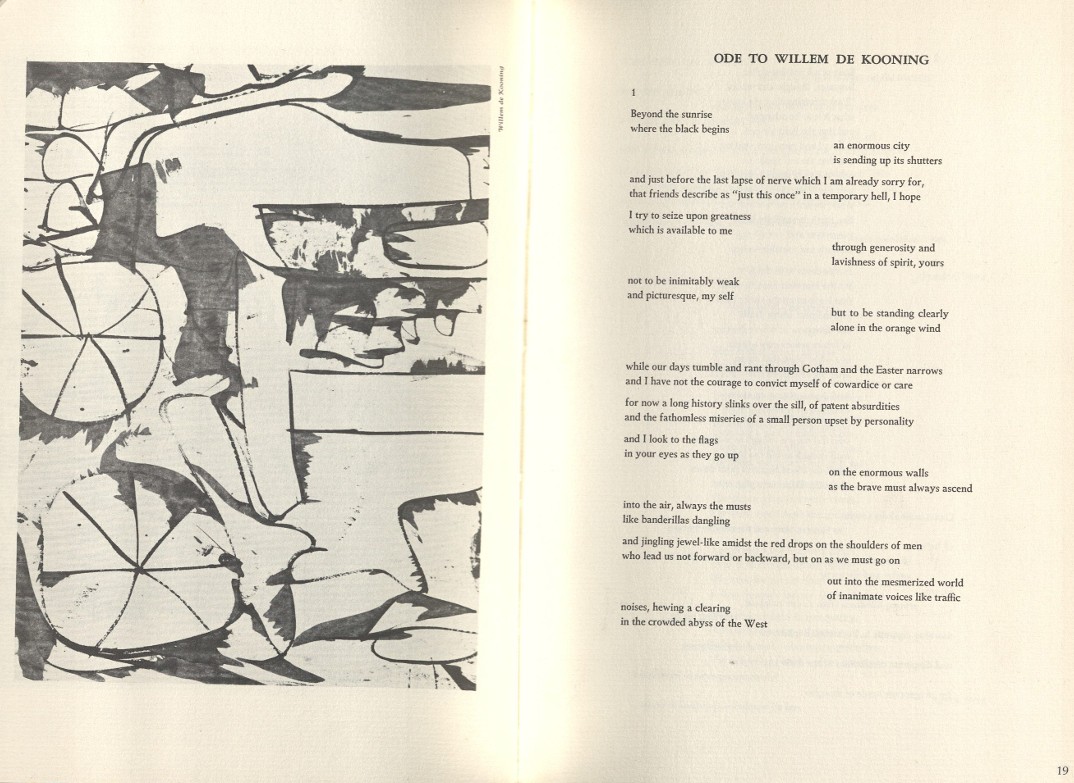
This image has text. The facing page has a black and white version of an unidentified painting by Willem de Kooning.
The poem “Ode to Willem de Kooning” by Frank O’Hara in A New Folder, Americans: Poems and Drawings, edited by Daisy Aldan with a foreword by Wallace Fowlie, 1959. Call Number: LE 1959 B23. Click image to enlarge.

The first work published in this list, Daisy Aldan’s A New Folder (1959) expresses the desire to reflect American poets’ complicated identity through their writing. The thematic subject for this collection is explained by Wallace Fowlie in his foreword. Fowlie writes that the book testifies to the “continuing vitality of American poetry” (1). With only the common thread of nationality, each poem in this collection provokes Fowlie’s quote: “The artists of a society are its only individuals, and society, by nature and definition, is opposed to individuals” (1). Complemented by American abstract artists like Jackson Pollock, Willem de Kooning, and Franz Kline, A New Folder pinpoints an incredibly specific time in Western art and culture. A product of Beat Generation ideals, the volume concentrates anti-conformist beliefs in relation to human expression and creation through the use of art and poetry.  
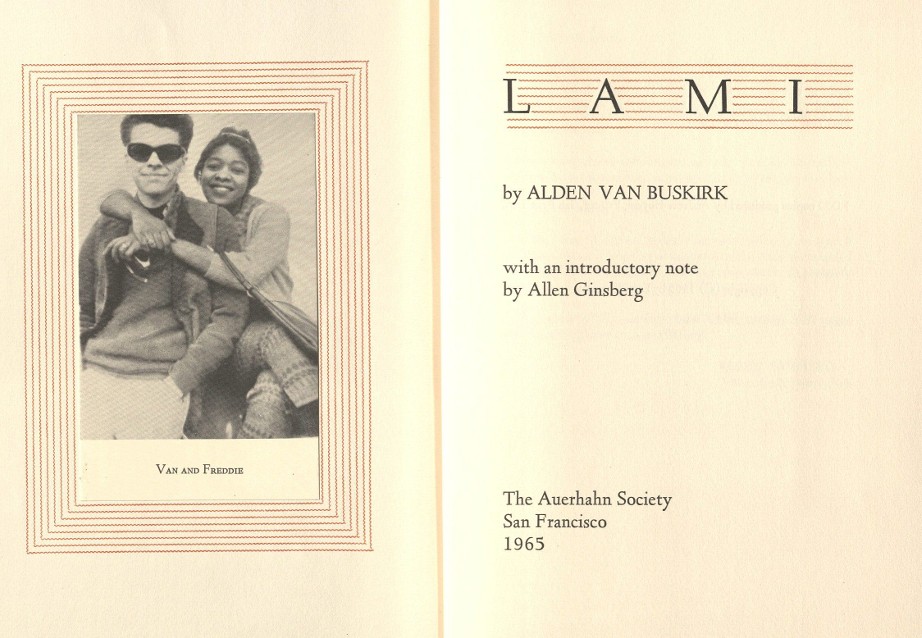
This image has text accompanied by a black-and-white photo of a white man and a Black woman labelled "Van and Freddie."
The frontispiece and title page of Lami by Alden Van Buskirk, with an introductory note by Allen Ginsberg, 1965. Call Number: LE 1965 B25. Click image to enlarge.

Composed and published by David Rattray, Lami (1965) memorializes the life of Alden Van Buskirk through a compilation of his poetry, which explores life in fragments leading up to his death in 1961. In his introduction, Allen Ginsberg describes the collection as a “whole witty­ – somber – book” that “consists of 91 pages and makes a complete statement of Person” (1). The reader is given a collection that feels raw and intimate as the posthumous publication reflects a beloved figure in the Beatnik subculture of the ’60s. The title is accompanied by many definitions as “Lami” is cited to mean “tenement elf but above all guiding genie”; “American lama descended from golden age ‘lambish folke’”; and “also l’ami” (Rattray, Table of Contents). Marked as a collection of poetry that encapsulates one man’s being, Van Buskirk’s mortality and the thematic presence of grief for one’s own life finds a certain intimacy within Lami that holds through to the end.  
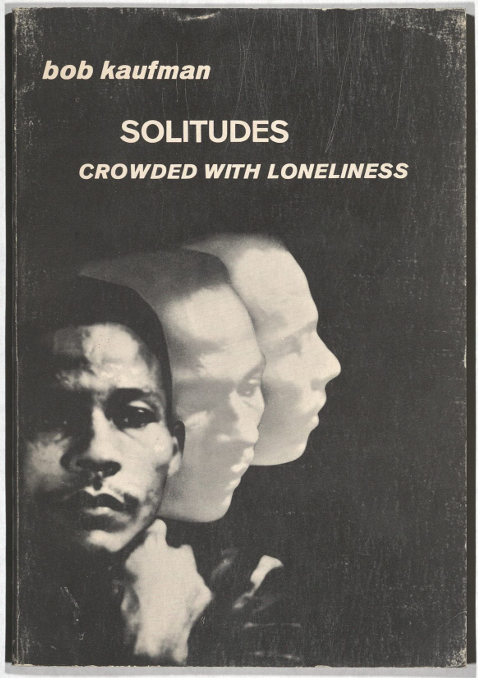
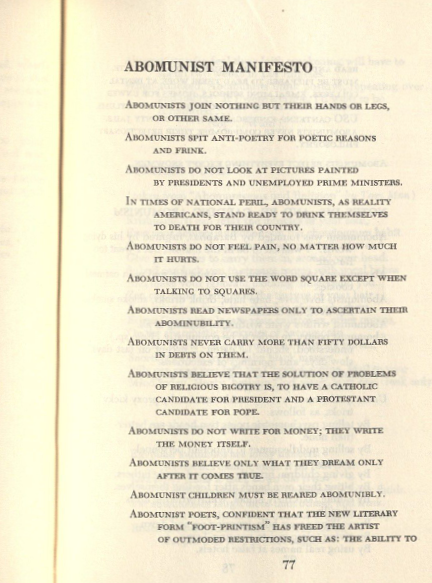
The front cover of (left) and the first page of the poem “Abomunist Manifesto” in (right) Solitudes Crowded with Loneliness by Bob Kaufman, 1965. Call Number: LE 1965 B16. Click images to enlarge.

A personal favorite of mine from Spencer’s collection, Bob Kaufman’s Solitudes Crowded with Loneliness (1965) is a tribute to social protest and, as the title suggests, the fight of the lonely subject amongst a crowd. Held at the back of Solitudes Crowded is a broadside of Kaufman’s “Abomunist Manifesto,” which appropriates the Communist Manifesto. Kaufman modifies the language of Marx and Engels with provocative, humorous statements designed to reflect his own radicalism within the counterculture of the 1960s. An “abomunist” is defined by Kaufman as a noun meaning “one who avows Abomunism, disavowing everything else, especially butterscotch” (81). Accompanying political rhetoric, the collection is rich with Kaufman’s “prophetic verse” in which he was known to have written with inspiration “from the improvisatory bebop jazz featured at the Beats’ favorite North Beach watering holes” [1]. The absurdity of Kaufman’s writing subverts expectation as he dedicates himself to the protest of a societal collective. 
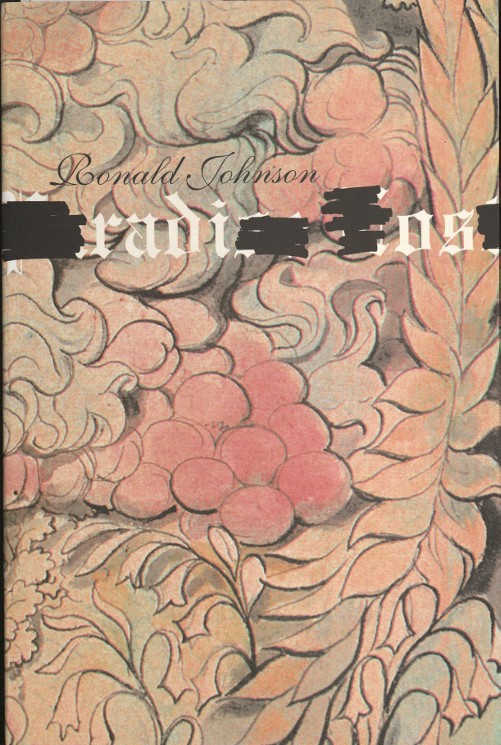
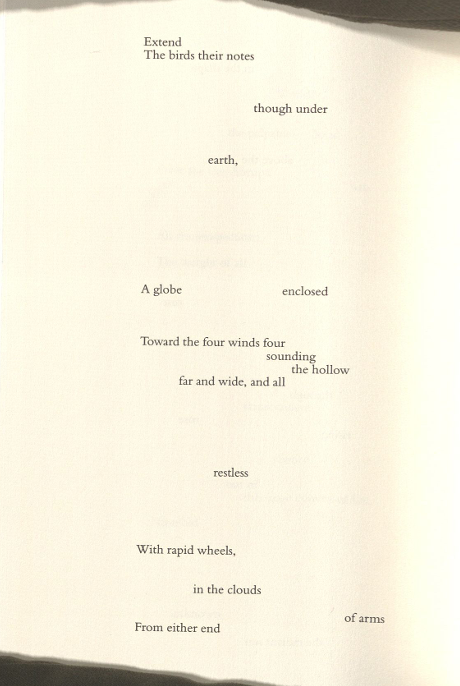
The front cover (left) and section (right) of RADI OS by Ronald Johnson, 1977. Call Number: C23084. Click images to enlarge.

Comparatively a much less political piece than the previous examples, Ronald Johnson’s RADI OS (1977) uses abstract design for the art and structure of his poetry. Erasure poetry is made by taking an already written text and erasing the words to create new poetry. As one of the earliest poets to create erasure poetry – one with Kansas roots, no less – Johnson takes John Milton’s Paradise Lost and transforms its text to express his own thematic subject and purpose. The genius of Johnson’s originality and meaning are enforced by Guy Davenport’s afterword, with its notes on the complex and thoughtful use of negative space and the ordering of each page. A particularly favorite insight of mine that Davenport says in his afterword: “What the artist seems to create has, as the artist is the first to appreciate and acknowledge, already been created. Design and arrangement are the artist’s passion. Place is all” (96). Davenport’s words ring true throughout this list, finding creation as a backbone to what makes an artist, and how that creation translates into meaning whether that is political, personal, or both.  
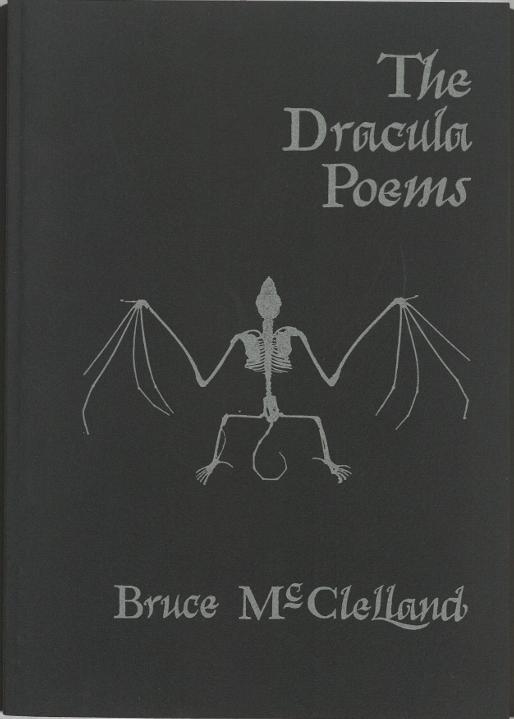
This image has text with a bat skeleton in silver gray.
This image has text.
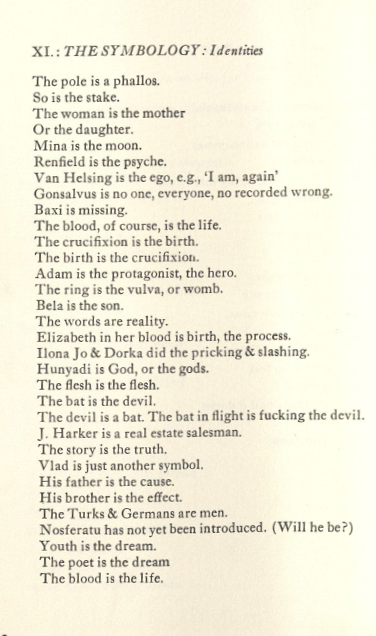
The front cover (top) and a portion (bottom) of The Dracula Poems by Bruce McClelland, 1978. Call Number: C24538. Click image to enlarge.

Finally, at first glance McClelland’s 1978 collection dedicated wholly to the existence of a brooding, bloodsucking myth has a comedic air to it. The 21st-century vampire has become more of an angsty, sparkling romantic lead than the seductive, psychological, and aristocratic figure that erupted from authors like Polidori, Le Fanu, and Stoker. Published in 1978 and prefaced by Robert Kelly, The Dracula Poems conceptualize the identity of “poet” as a vampire/monster who is uniquely open to interpretation by language. McClelland’s background in Slavic studies with a concentration in anthropology as well as linguistics offers more to every poem as they attempt to convey metaphorical wonderings of a monster “preserved and isolated at once” in the literary canon [2]. Still remaining an enjoyable and creative collection of well-crafted poetry, McClelland’s book suffuses a popular figure with identity, making the vampire a much more personal beast.  

Theo McKay
Public Services student assistant

[1] Biography of Bob Kaufman by the Academy of American Poets  
[2] Bruce A. McClelland’s website 

Creepy, Curious, and Cursed Collections at Spencer Research Library

October 30th, 2023

Happy Halloween all you screechers, screamers, and hollerers! We’ve also been celebrating over here at Kenneth Spencer Research Library in the best we know how: combing the KU Libraries online catalog and finding what cursed history we can find. We asked our student workers to recommend their picks for items that best represent the spirit of Halloween. They went beyond the safety of the Reading Room and braved the stacks to bring us these unsettling tomes and relics, but not everything is what it seems. Here are a few of our favorites!

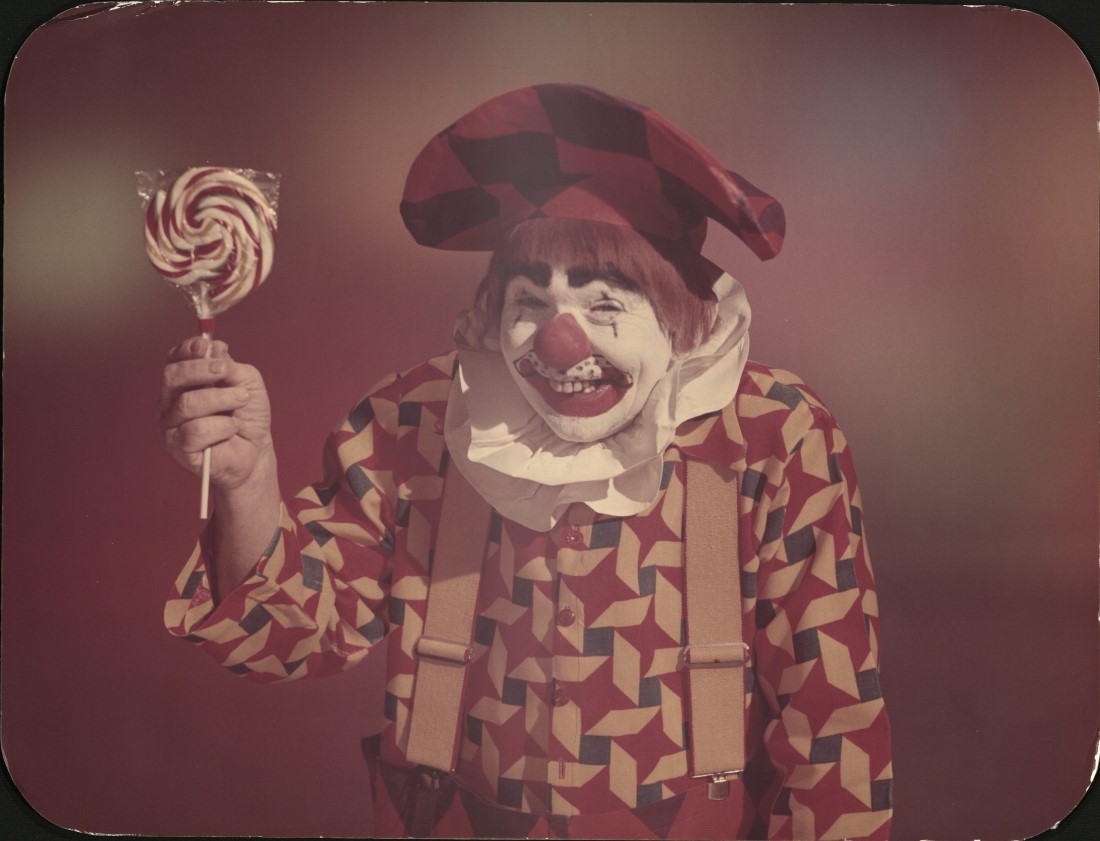
Our very first recommendation comes from the Centron Corporation, a film production company founded right here in Lawrence, Kansas. Perhaps best known for their work in educational films, the company also had a hand in the cult classic horror film Carnival of Souls. Elly Masteller found this lovely portrait in the Centron Corporation records collection. This cheerful gentleman was used in a film to help encourage literacy and creative writing among children. Remember kids, he can’t get you if your nose is in a book!

Color photograph a smiling clown who is holding a large lollipop.
Production still of a clown from Reaching Your Reader, undated [circa 1985]. Centron Corporation Records. Call Number: RH MS Q514. Click image to enlarge.

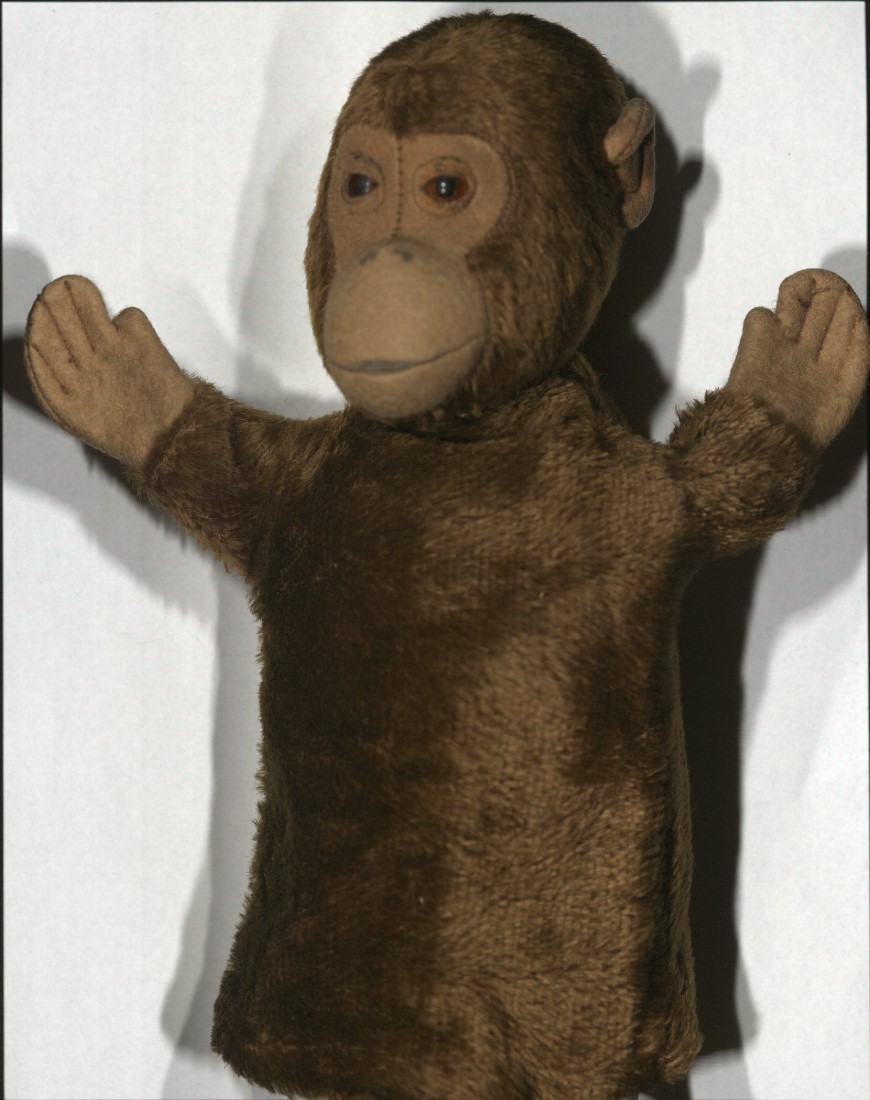
Kathryn Sauder sent in our next recommendation, another artifact, but this time from the Thomas Woodson Poor papers. Poor was an Olympic high jumper who competed for the University of Kansas from 1921 to 1925 and placed fourth in the high jump at the 1924 Summer Olympics in Paris, France. Poor is also known for his lifelong crusade in helping children receive the polio vaccine after the tragic death of his daughter, Melinda Sue, from polio. One of the toys he used to do so was this monkey puppet, and while the puppet may look demonic, it helped save lives! Absolutely heartwarming, not chilling, but perhaps maybe do not look into its eyes for too long.

Photograph of a brown monkey with his hands in the air.
Monkey puppet, undated [circa 1955-1956]. Thomas Woodson Poor Papers. Call Number: RH MS 1568. Click image to enlarge.

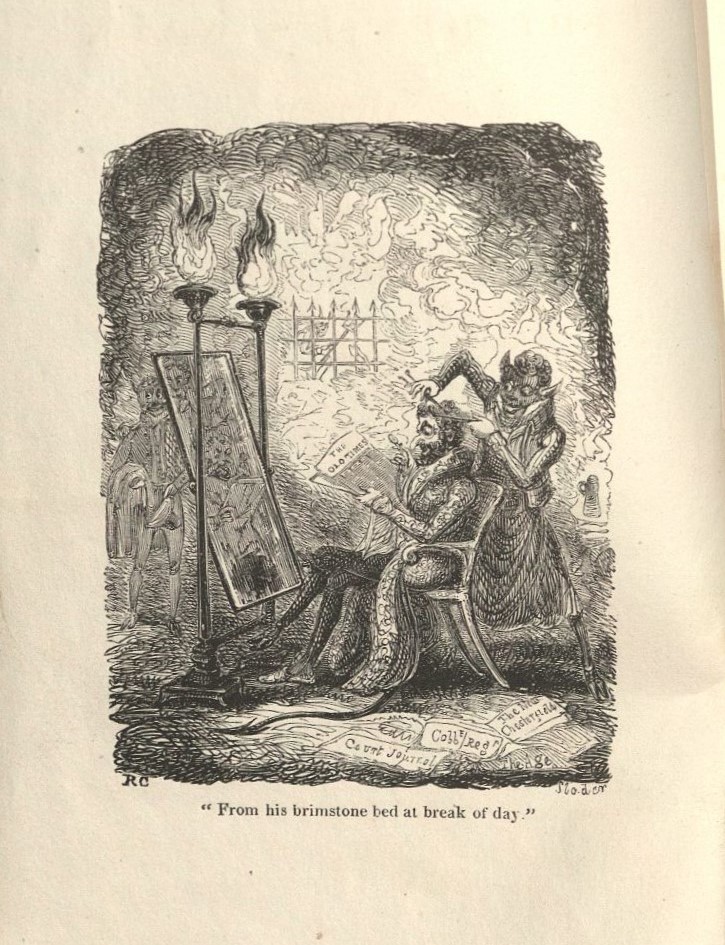
Literary giant Samuel Taylor Coleridge brings us our next spooky item, recommended by Nile Russo: a copy of The Devil’s Walk, or alternatively titled The Devil’s Thoughts. The Devil cuts a dapper shape as he gets himself dressed in his Sunday’s best for a walk around the town. In this poem, the Devil offers commentary about passersby, questioning perhaps if mankind might be the scariest creature of all.

Black-and-white sketch of a demon cutting the devil's hair while he reads the newspaper in front of a mirror.
The illustration accompanying the title page of The Devil’s Walk: A Poem by Samuel Taylor Coleridge and Robert Southey, 1830. Call Number: B4254. Click image to enlarge.

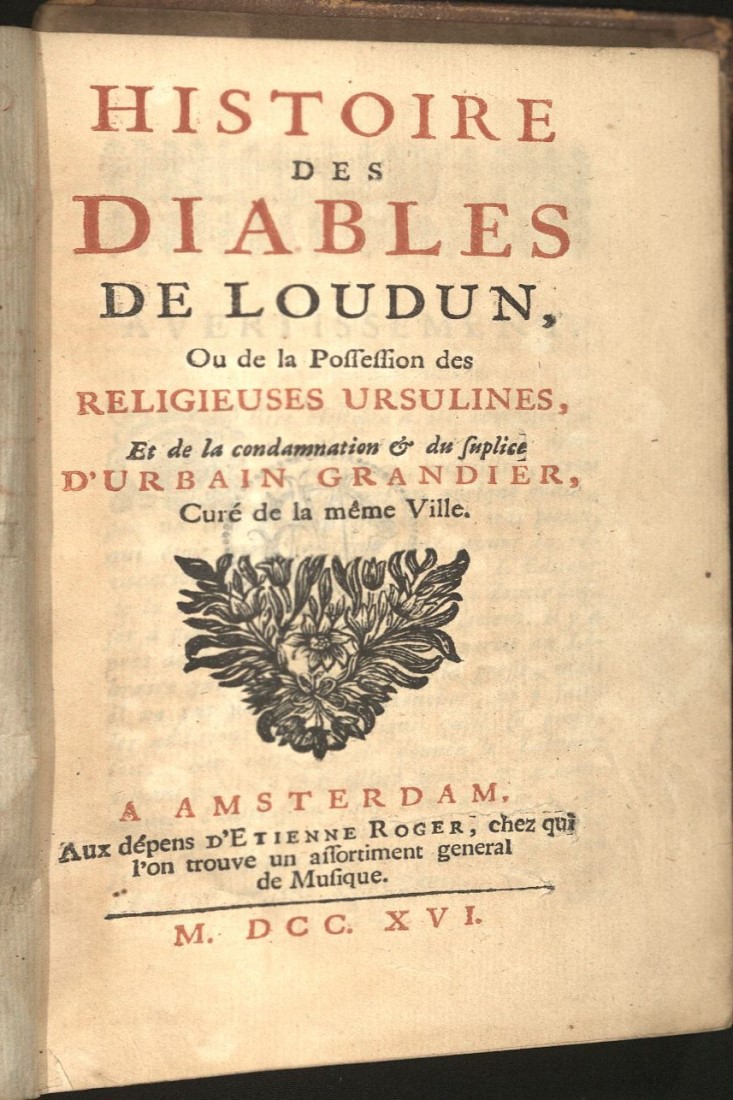
Molly Leonard recommended perhaps the most soul-wrenching item among our recommendations this year: a copy of Historie des diables de Loudun. This is a book about the Loudun possessions, a piece of history about an Ursuline convent being taken over by unusual behavior and visions attributed to demonic possession. In the end, through the intervention of Cardinal Richelieu, a local priest and decrier of Richelieu’s policies named Urbain Grandier was tried and executed for witchcraft in connection with the possessions. Again, and we can’t reiterate this enough, mankind might just be the scariest monster of all.

This image has text.
Title page of Histoire des diables de Loudun, 1716. Call Number: B12841. Click image to enlarge.

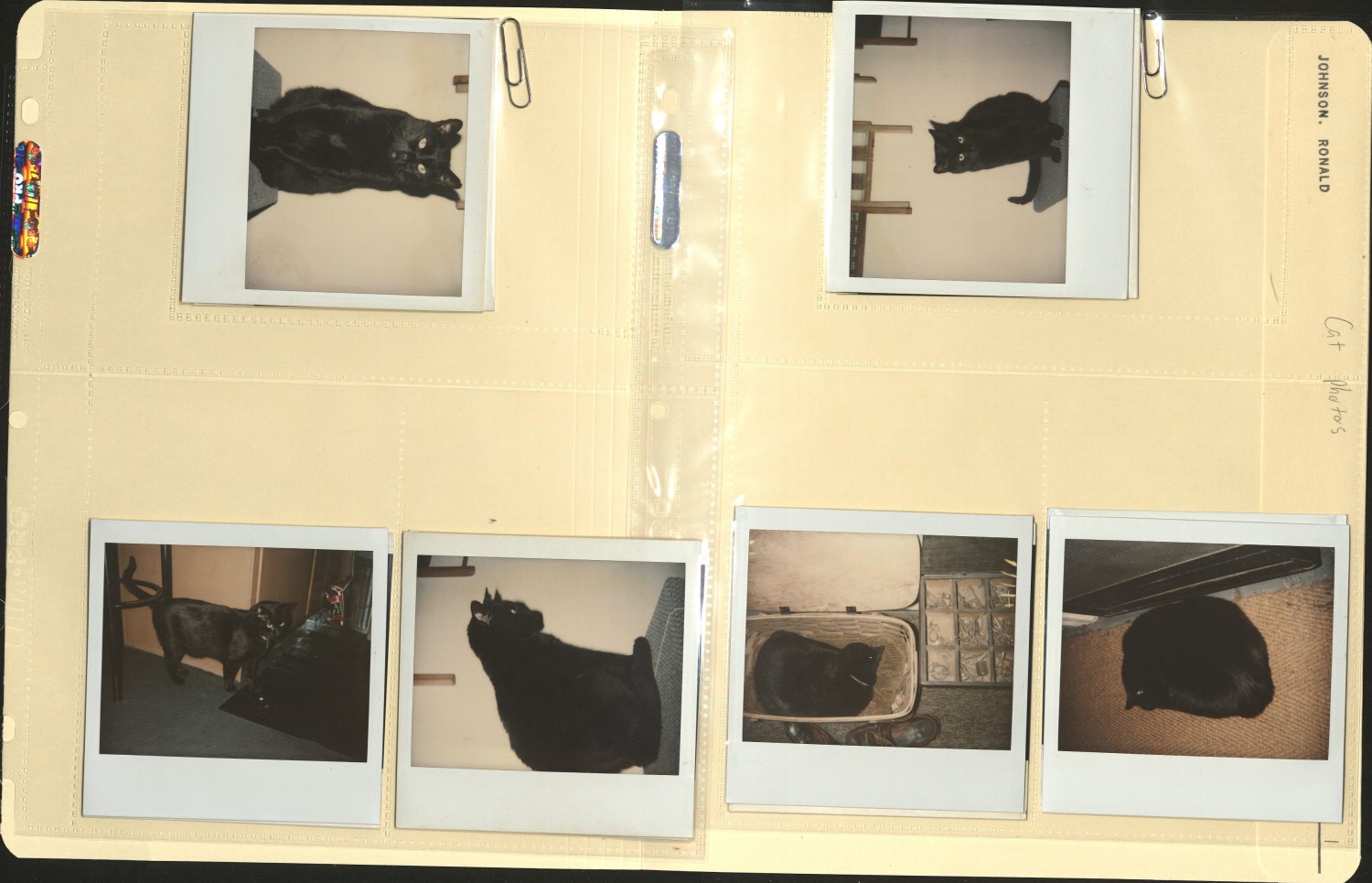
And finally, Ian Strasma reminds us that Halloween isn’t only about creepy clowns, puppets and possessions, and dashingly dressed demons with this recommendation: a black cat found lurking in the Ronald Johnson collection (literary estate papers). The cat may be cute, but be careful that you do not cross him!

Polaroid pictures of a black cat doing various things.
“Cat photos,” undated [but timeless]. Ronald Johnson Collection (Literary Estate Papers). Call Number: MS 336. Click image to enlarge.

Best of luck out there as you begin finishing up semester and don’t be afraid to check out the many – completely safe, we promise – collections here at Kenneth Spencer Research Library!

Charissa Pincock
Processing Archivist

Celebrating Ronald Johnson and Poetry In Kansas

April 12th, 2013

April is National Poetry Month, and in honor of this KU Libraries will host an event celebrating Ronald Johnson and poetry in Kansas at the Kenneth Spencer Research Library on Tuesday, April 16.

Revered as a poet’s poet, Ronald Johnson (1935-1998) was born and raised in Ashland, Kansas. Though he spent much of his literary career away from Kansas, first on the East Coast and then in San Francisco (where he lived for over two decades), his literary papers have long acted as a physical tie to his birth state.

The Kenneth Spencer Research Library acquired its first cache of the poet’s papers in April of 1969. By this time, Johnson had already published his early collections A Line of Poetry, A Row of Trees (1964) and The Book of the Green Man (1967), but was still building his reputation as a poet. Subsequent major installments followed in 1971 and 1987, culminating with a final acquisition of papers from Johnson’s literary estate in March of this year (2013).

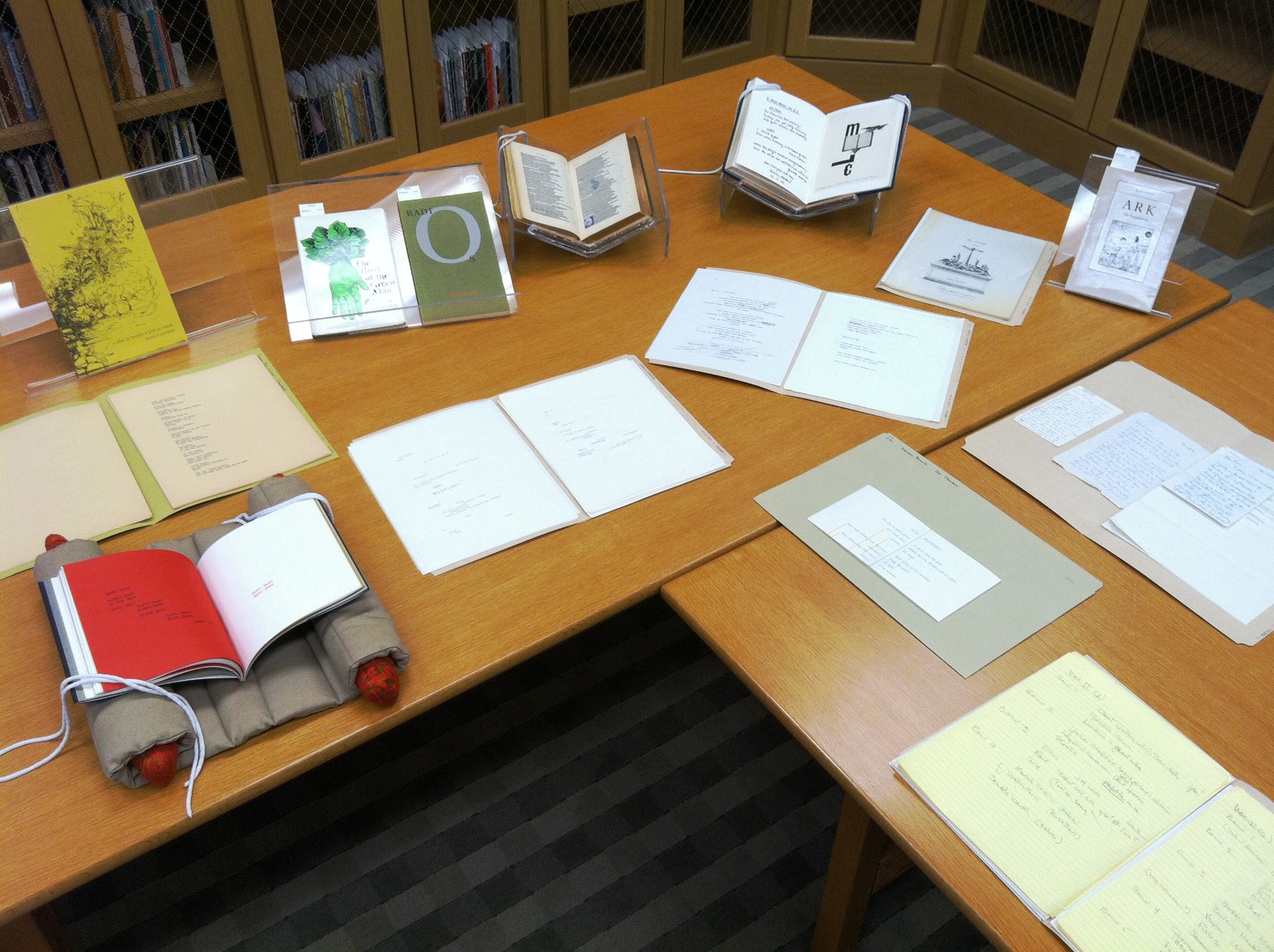
Photograph of a selection of book and manuscript holdings for Ronald Johnson

The papers are a magnificent record of Johnson’s life and literary endeavors. They include,

  • multiple drafts of his poetic works, such as his erasure poem Radi os (a re-writing of sections of Milton’s Paradise Lost by excision), and ARK, a long poem composed over twenty years (which will be republished by Flood Editions later this year)
  • drafts and prototypes for his concrete poetry (poetry which emphasizes and plays upon the visual element)
  • correspondence with friends, loved ones, and literary peers, such as writer Guy Davenport, a great champion and admirer of Johnson’s writing; Jonathan Williams, Jargon Society publisher, poet, and former love; and fellow poets such as Ian Hamilton Finlay, Louis Zukofsky, Mary Ellen Solt, and Robert Creeley.
  • materials documenting Johnson’s “other” career as a chef, caterer, and cookbook writer, including drafts of his popular cookbooks, such as The American Table and The Aficionado’s Southwestern Cooking, and (in the most recent accession) correspondence with food writer M. F. K. Fisher
  • research notes and writing journals
  • photographs and audio recordings of Johnson

One of the highlights of the new acquisition are drafts of Johnson’s The Shrubberies, poems which he composed upon returning to Kansas from San Francisco.  These were collected, edited, and posthumously published by his friend and literary executor, poet Peter O’Leary.  The poems were inspired in part by Ward-Meade Park in Topeka, where Johnson had worked before succumbing to brain cancer and where a plaque now stands in his honor.

Though the materials that arrived in March are not yet cataloged, an online guide exists for the twenty-nine boxes of Johnson’s earlier papers.  The library also houses a large number of Johnson’s published works, many of which exist in scarce and limited editions. These materials complement Spencer’s New American Poetry holdings and its wealth of materials for Kansas writers.

The celebration on April 16 will feature three Kansas poets renowned in their own right: Joseph Harrington and Kenneth Irby, Professors in KU’s Department of English, and Denise Low, Kansas Poet Laureate, 2007-2009.  These speakers will fête Johnson by reading favorite passages from his works alongside poems of their own.  A selection of materials from the library’s Ronald Johnson holdings will be on display during the event.

Elspeth Healey
Special Collections Librarian