The University of Kansas

Inside Spencer: The KSRL Blog

Books on a shelf

Welcome to the Kenneth Spencer Research Library blog! As the special collections and archives library at the University of Kansas, Spencer is home to remarkable and diverse collections of rare and unique items. Explore the blog to learn about the work we do and the materials we collect.

This blog may contain archived web content. This blog may link to catalog records which no longer exist as of a software change in 2026.

Poetry with Purpose: Thematic Through Lines in Special Collections

July 16th, 2026

Poetry is occasionally seen as a “sillier” form of writing due to its limited boundaries and subjective meanings. However, as a form of revolution and rebellion, it remains a constant in the zeitgeist of American literary movements. By highlighting a handful of Special Collections material published by Beat poets, a fellow Kansan, and a Slavic studies scholar, I hope to shine a bit more light on the impactful messaging that came from different, often subversive, poetry collections! 
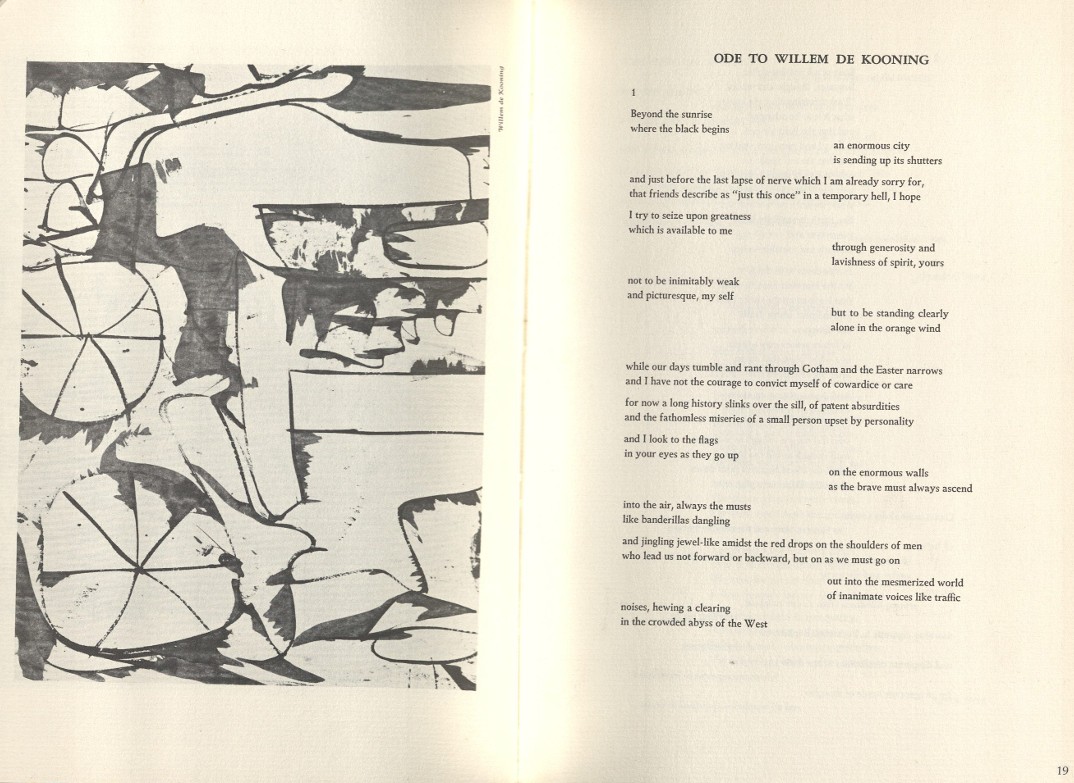
This image has text. The facing page has a black and white version of an unidentified painting by Willem de Kooning.
The poem “Ode to Willem de Kooning” by Frank O’Hara in A New Folder, Americans: Poems and Drawings, edited by Daisy Aldan with a foreword by Wallace Fowlie, 1959. Call Number: LE 1959 B23. Click image to enlarge.

The first work published in this list, Daisy Aldan’s A New Folder (1959) expresses the desire to reflect American poets’ complicated identity through their writing. The thematic subject for this collection is explained by Wallace Fowlie in his foreword. Fowlie writes that the book testifies to the “continuing vitality of American poetry” (1). With only the common thread of nationality, each poem in this collection provokes Fowlie’s quote: “The artists of a society are its only individuals, and society, by nature and definition, is opposed to individuals” (1). Complemented by American abstract artists like Jackson Pollock, Willem de Kooning, and Franz Kline, A New Folder pinpoints an incredibly specific time in Western art and culture. A product of Beat Generation ideals, the volume concentrates anti-conformist beliefs in relation to human expression and creation through the use of art and poetry.  
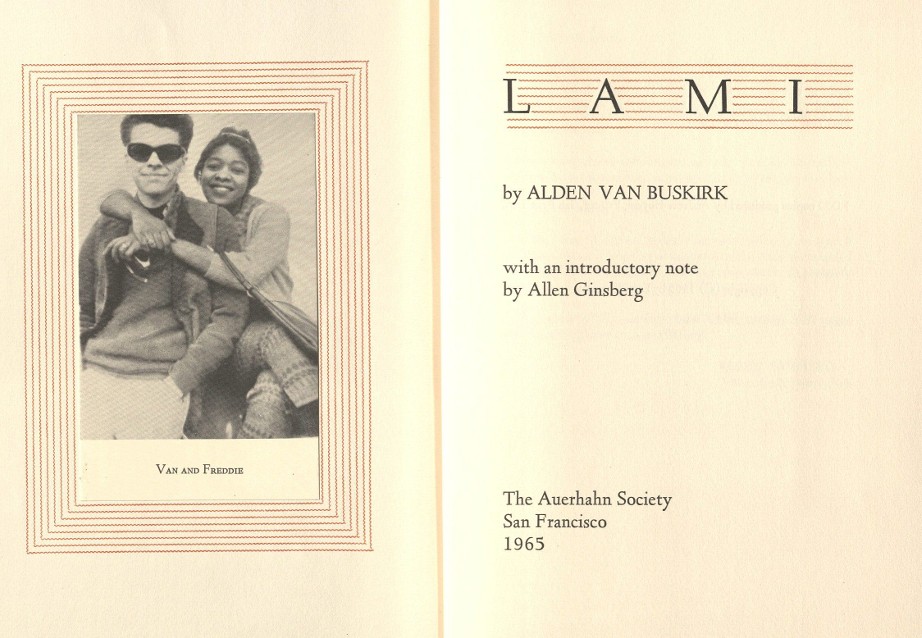
This image has text accompanied by a black-and-white photo of a white man and a Black woman labelled "Van and Freddie."
The frontispiece and title page of Lami by Alden Van Buskirk, with an introductory note by Allen Ginsberg, 1965. Call Number: LE 1965 B25. Click image to enlarge.

Composed and published by David Rattray, Lami (1965) memorializes the life of Alden Van Buskirk through a compilation of his poetry, which explores life in fragments leading up to his death in 1961. In his introduction, Allen Ginsberg describes the collection as a “whole witty­ – somber – book” that “consists of 91 pages and makes a complete statement of Person” (1). The reader is given a collection that feels raw and intimate as the posthumous publication reflects a beloved figure in the Beatnik subculture of the ’60s. The title is accompanied by many definitions as “Lami” is cited to mean “tenement elf but above all guiding genie”; “American lama descended from golden age ‘lambish folke’”; and “also l’ami” (Rattray, Table of Contents). Marked as a collection of poetry that encapsulates one man’s being, Van Buskirk’s mortality and the thematic presence of grief for one’s own life finds a certain intimacy within Lami that holds through to the end.  
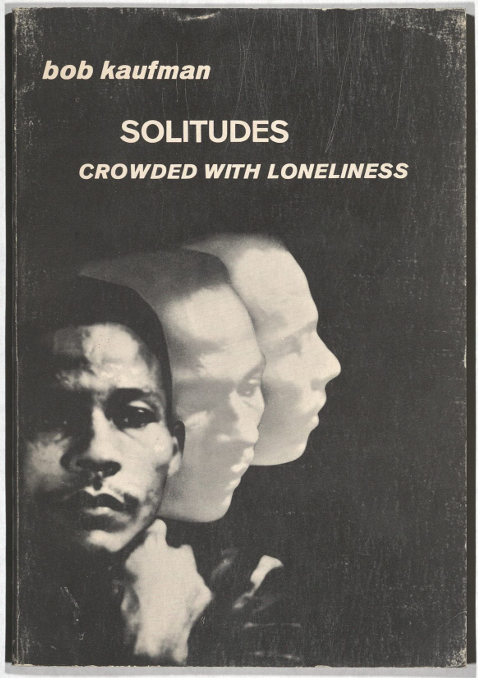
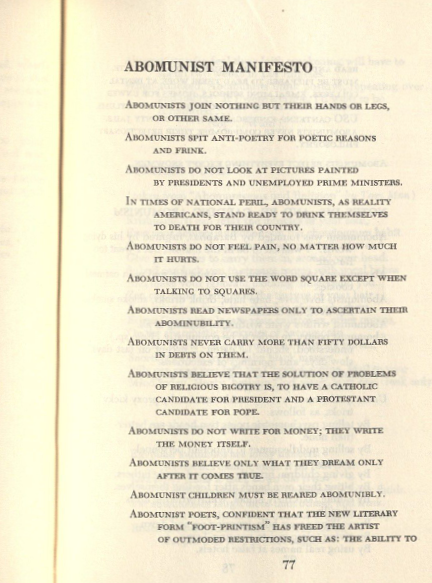
The front cover of (left) and the first page of the poem “Abomunist Manifesto” in (right) Solitudes Crowded with Loneliness by Bob Kaufman, 1965. Call Number: LE 1965 B16. Click images to enlarge.

A personal favorite of mine from Spencer’s collection, Bob Kaufman’s Solitudes Crowded with Loneliness (1965) is a tribute to social protest and, as the title suggests, the fight of the lonely subject amongst a crowd. Held at the back of Solitudes Crowded is a broadside of Kaufman’s “Abomunist Manifesto,” which appropriates the Communist Manifesto. Kaufman modifies the language of Marx and Engels with provocative, humorous statements designed to reflect his own radicalism within the counterculture of the 1960s. An “abomunist” is defined by Kaufman as a noun meaning “one who avows Abomunism, disavowing everything else, especially butterscotch” (81). Accompanying political rhetoric, the collection is rich with Kaufman’s “prophetic verse” in which he was known to have written with inspiration “from the improvisatory bebop jazz featured at the Beats’ favorite North Beach watering holes” [1]. The absurdity of Kaufman’s writing subverts expectation as he dedicates himself to the protest of a societal collective. 
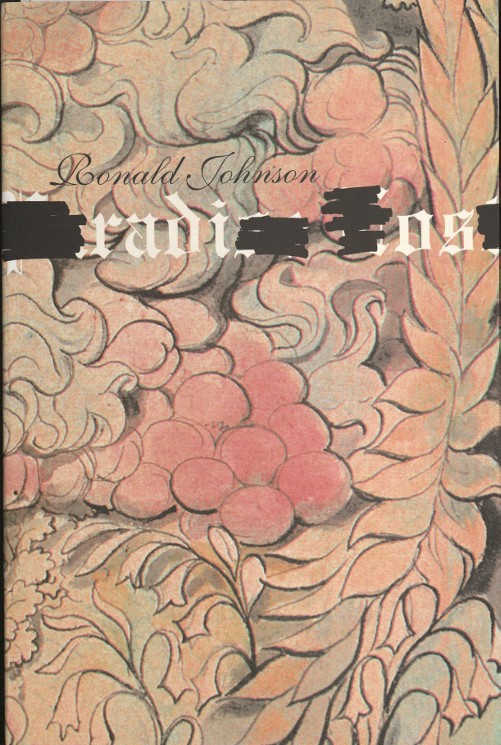
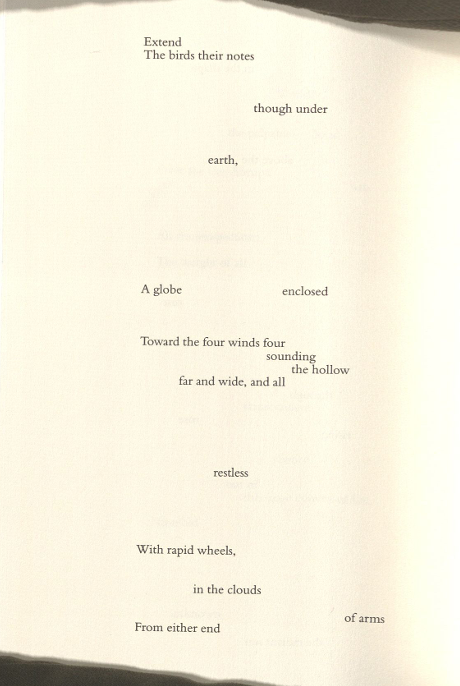
The front cover (left) and section (right) of RADI OS by Ronald Johnson, 1977. Call Number: C23084. Click images to enlarge.

Comparatively a much less political piece than the previous examples, Ronald Johnson’s RADI OS (1977) uses abstract design for the art and structure of his poetry. Erasure poetry is made by taking an already written text and erasing the words to create new poetry. As one of the earliest poets to create erasure poetry – one with Kansas roots, no less – Johnson takes John Milton’s Paradise Lost and transforms its text to express his own thematic subject and purpose. The genius of Johnson’s originality and meaning are enforced by Guy Davenport’s afterword, with its notes on the complex and thoughtful use of negative space and the ordering of each page. A particularly favorite insight of mine that Davenport says in his afterword: “What the artist seems to create has, as the artist is the first to appreciate and acknowledge, already been created. Design and arrangement are the artist’s passion. Place is all” (96). Davenport’s words ring true throughout this list, finding creation as a backbone to what makes an artist, and how that creation translates into meaning whether that is political, personal, or both.  

This image has text with a bat skeleton in silver gray.
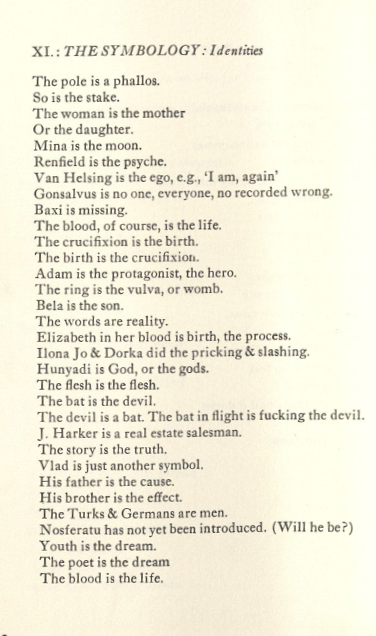
This image has text.
The front cover (top) and a portion (bottom) of The Dracula Poems by Bruce McClelland, 1978. Call Number: C24538. Click image to enlarge.

Finally, at first glance McClelland’s 1978 collection dedicated wholly to the existence of a brooding, bloodsucking myth has a comedic air to it. The 21st-century vampire has become more of an angsty, sparkling romantic lead than the seductive, psychological, and aristocratic figure that erupted from authors like Polidori, Le Fanu, and Stoker. Published in 1978 and prefaced by Robert Kelly, The Dracula Poems conceptualize the identity of “poet” as a vampire/monster who is uniquely open to interpretation by language. McClelland’s background in Slavic studies with a concentration in anthropology as well as linguistics offers more to every poem as they attempt to convey metaphorical wonderings of a monster “preserved and isolated at once” in the literary canon [2]. Still remaining an enjoyable and creative collection of well-crafted poetry, McClelland’s book suffuses a popular figure with identity, making the vampire a much more personal beast.  

Theo McKay
Public Services student assistant

[1] Biography of Bob Kaufman by the Academy of American Poets  
[2] Bruce A. McClelland’s website 

The Magic of Classic Children’s Books: Beatrix Potter Edition

July 8th, 2026

This is the third post in a series highlighting various titles from Spencer Research Library’s vast children’s book collection.

Well-loved children’s books spark magic from the thrill of adventure to imagination of far-off, enchanted places. Beloved by generations, classic children’s stories remain with us throughout life, whether it is re-reading childhood favorites or sharing our most loved stories with young people in our lives. These classics ignite imaginations and impart timeless lessons. They become some of our most cherished friends that stay with us throughout our lives.

Color illustration of a rabbit in a blue jacket.
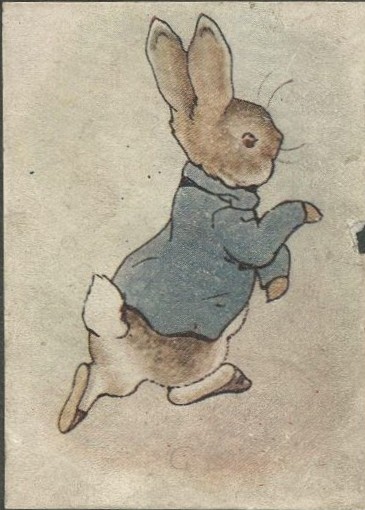
A picture of Peter Rabbit from the cover of The Tale of Peter Rabbit, London and New York: Frederick Warne & Co., undated. Call Number: Children 2978. Click image to enlarge.

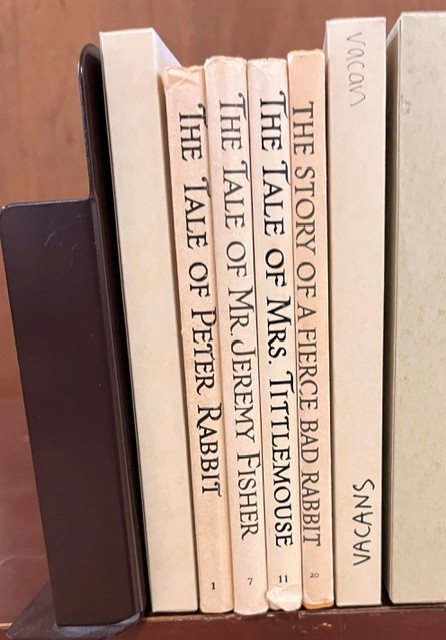
Most people first think of Peter Rabbit when they think about Beatrix Potter and her little, whimsical books. For me, the memories go somewhere else entirely. I think of my grandparents and those sleepover nights when I was small: the familiar rhythm of Wheel of Fortune and Jeopardy, the soft glow of the Lawrence Welk Show, and then the quiet ritual of getting tucked into bed. Before I’d climb up onto the tall double bed, Grandma let me choose a story. She had a small collection of Beatrix Potter books lined up neatly on the shelf of the secretary. I always picked The Tale of Mr. Jeremy Fisher. Something about that brave little frog in his tiny coat and galoshes captured my imagination every time.

Jeremy Fisher always stood out to me, and I think it began with something wonderfully simple: I liked his name and he wore galoshes. “Galoshes” is a funny word. Jeremy lived by a pond doing the kinds of things frogs like to do. There was an easy, everyday magic in that little world of lily pads, fishing lines, and soft water‑sounds. A place that simultaneously felt adventurous, comforting, and calming, thinking about the lily pads at Great Grandma and Great Pop’s house on Lake Pleasant. I could imagine him living out in the channel where the lily pads grew. There was something irresistible about this earnest little frog in his smart red coat, setting off across the water with more optimism than caution. He wasn’t the mischievous troublemaker like Peter or the tidy, bustling figure of Mrs. Tiggy‑Winkle. Jeremy was gentle, hopeful, and just a little bit unlucky, which made him feel wonderfully real. His world was quieter and calmer, full of reeds, shaded banks, and the small bravery of trying again after a mishap. That big water beetle was scary, but Jeremy persevered. Even then, I think I loved that he wasn’t perfect. He was brave and simply did his best, and somehow that made his story feel like a friend I’d return to every time I visited Grandma’s.

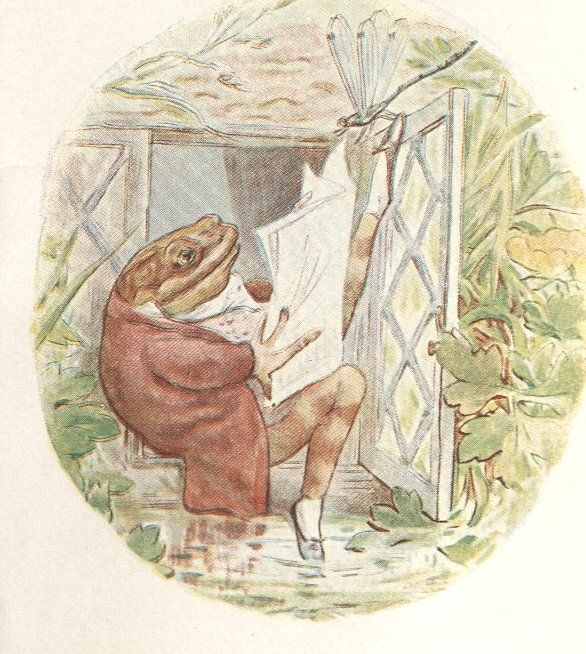
Color illustration of a frog in a brown jacket who is sitting in a window reading the newspaper.
An image from The Tale of Mr. Jeremy Fisher, New York: Frederick Warne & Co., 1906. Call Number: Children 2983. Click image to enlarge.

Beatrix Potter’s characters have a way of lasting, settling into memory long after childhood has passed. Part of their endurance comes from how Potter built them as small creatures with very human hearts. They’re mischievous or hopeful or a little unlucky, but always recognizable. Peter’s impulsiveness, Jemima’s earnestness, Jeremy’s gentle optimism: these aren’t just traits of animals in waistcoats (and galoshes), they’re reflections of us. And because Potter never talked down to children, her stories carry an honesty that still feels fresh. The stakes may be small like a lost handkerchief or a ruined fishing trip, but the emotions are real. Her characters inhabit tiny, complete worlds where courage is quiet, mistakes are forgivable, and trying again is its own kind of triumph. That’s why they stay with us. They grow as we grow, offering something new each time we return to them.

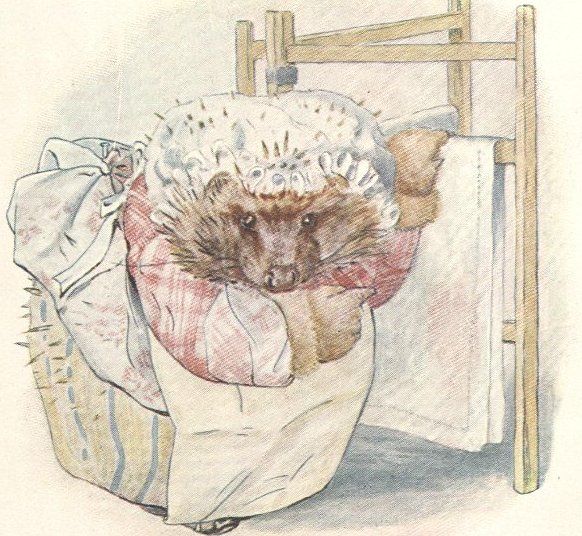
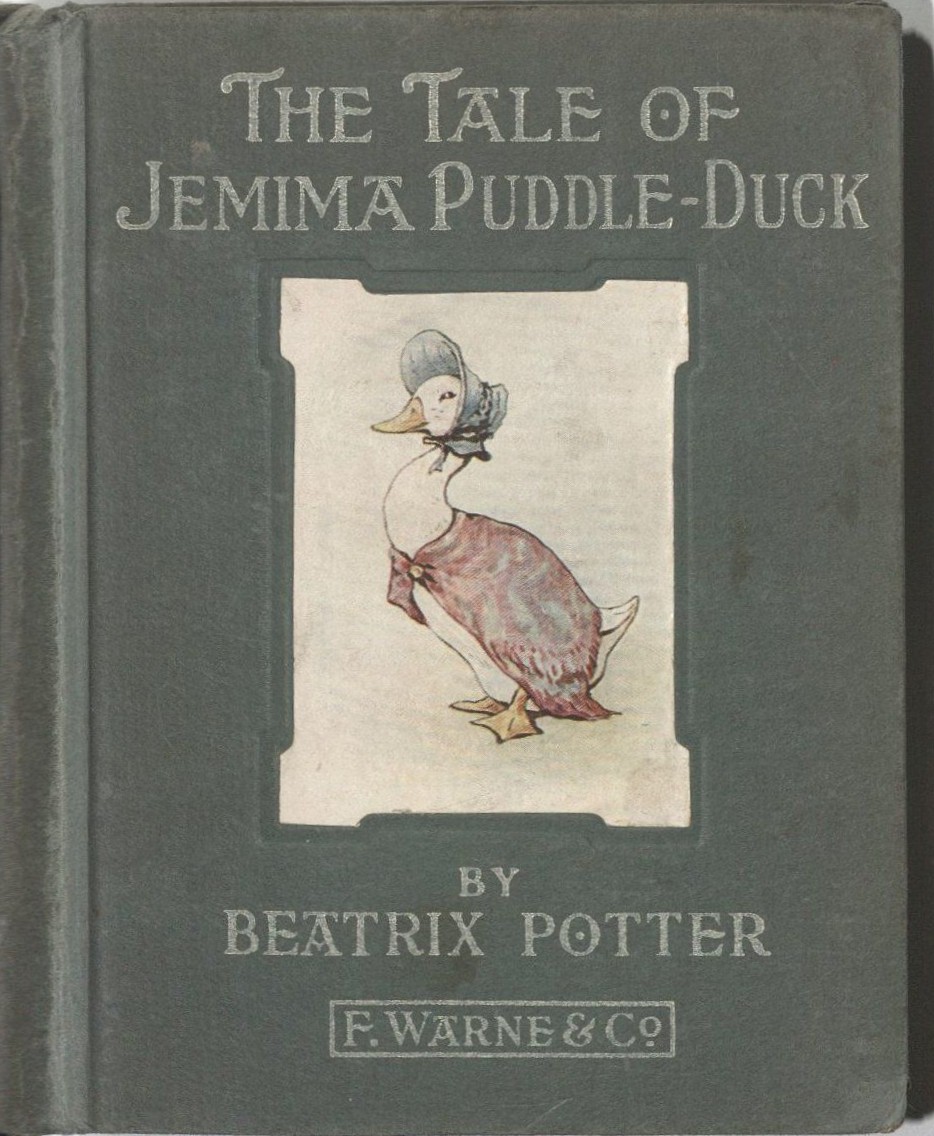
Left: An illustration of Mrs. Tiggy-Winkle in The Tale of Mrs. Tiggy-Winkle, New York: Frederick Warne & Co., 1905. Call Number: Children 2972. Right: The front cover of The Tale of Jemima Puddle-Duck, New York: Frederick Warne & Co., Inc., 1936. Call Number: Children 2974. Click images to enlarge.

Potter was famously particular about the size of her books. She wanted them to be small enough for children to hold comfortably as intimate little volumes that fit into a pocket or a bedtime routine. Her publishers pushed for larger formats, but she held her ground. To her, the charm of these stories depended on scale: tiny creatures deserved tiny books. A child should feel as though they were peeking into a private world, one they could cup in their palms. That insistence on smallness created a kind of closeness between reader and story, a feeling that Peter Rabbit or Mr. Tod might jump right off the page. It’s part of why her tales endure, they were designed not just to be read, but to be held.

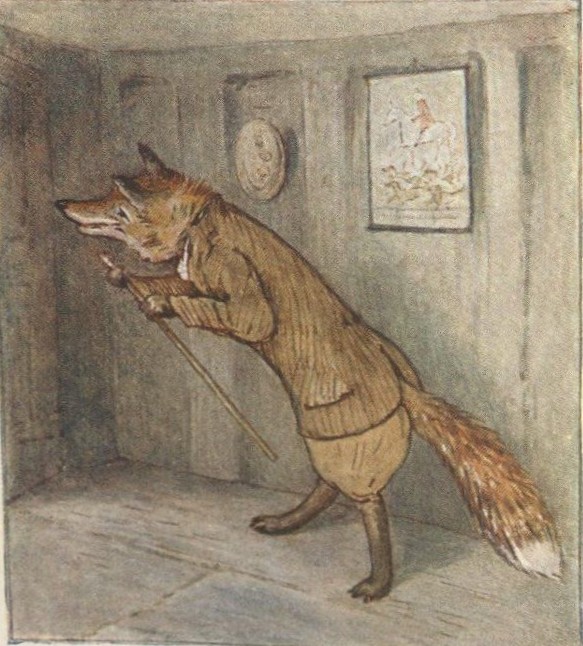
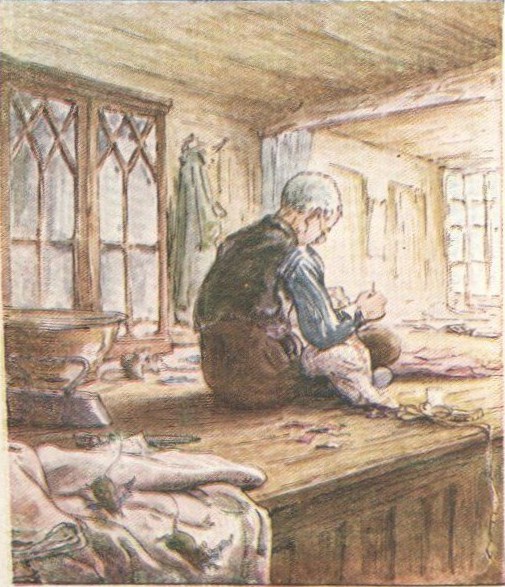
Left: The titular character of The Tale of Mr. Tod, New York: Frederick Warne & Co., Inc., 1912. Call Number: Children 2982. Right: An illustration from The Tailor of Gloucester, New York: Frederick Warne & Co., 1903. Call Number: Children 2981. Click images to enlarge.

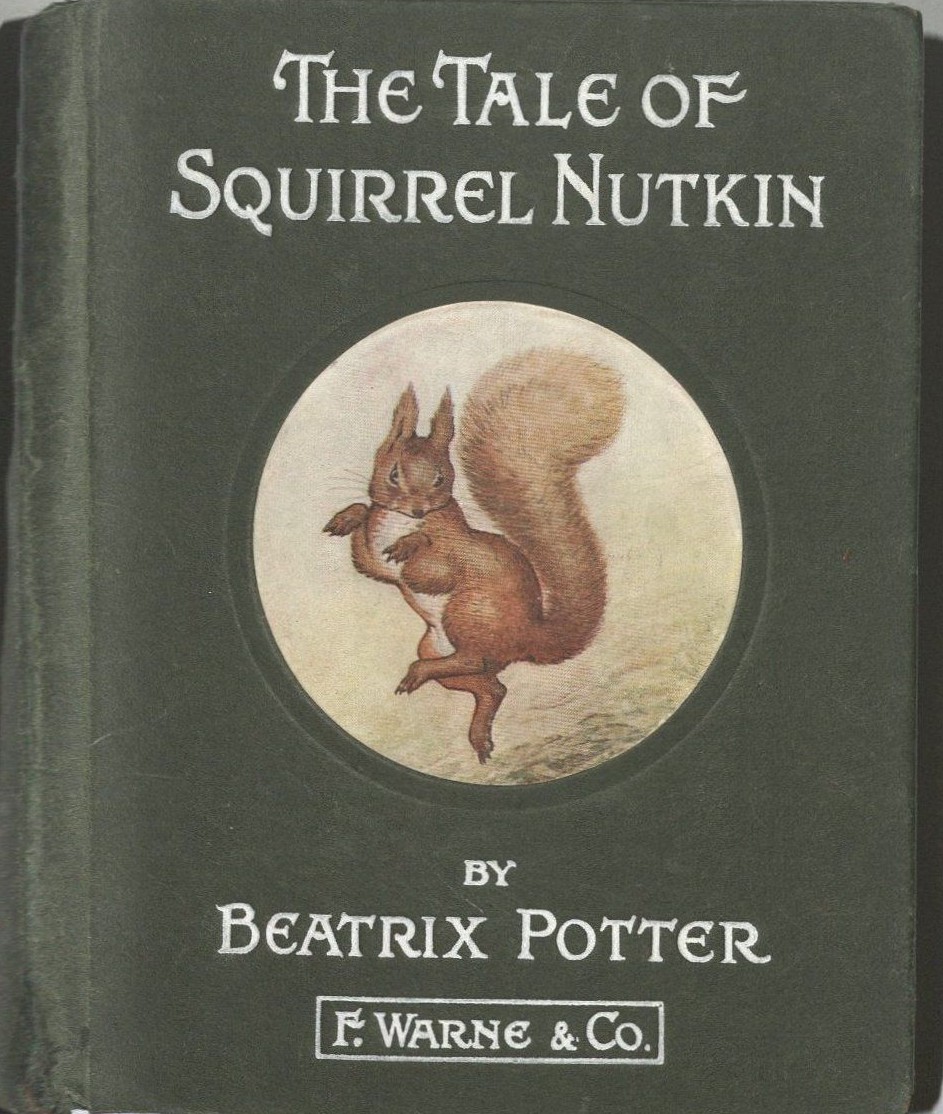
This image has text with a color illustration of a brown squirrel who appears to be jumping.
The front cover of The Tale of Squirrel Nutkin, New York: Frederick Warne & Co., 1903. Call Number: Children 2971. Click image to enlarge.

Potter’s little books didn’t just fit small hands; they shaped how children read. Their size created a sense of ownership, as if each story were a secret meant just for you. A child could hold the whole world of Squirrel Nutkin or the Tailor of Gloucester in one palm, turning pages that felt perfectly scaled to their own sense of wonder. The intimacy of that design slowed the reading experience down: you leaned in closer, studied the illustrations more carefully, and felt as though you were peeking into a miniature universe. Those tiny volumes made reading feel personal, portable, and inviting a quiet invitation to step into a story and carry it with you wherever you went.

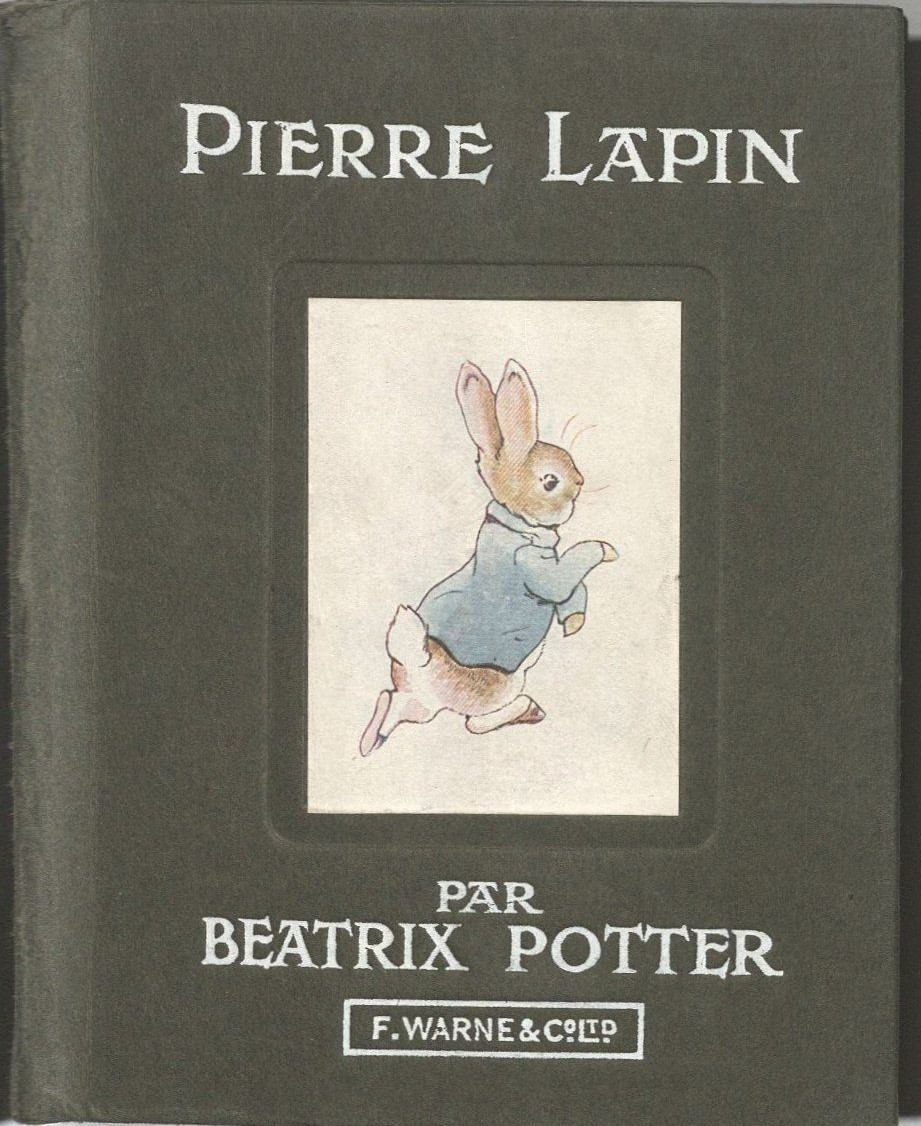
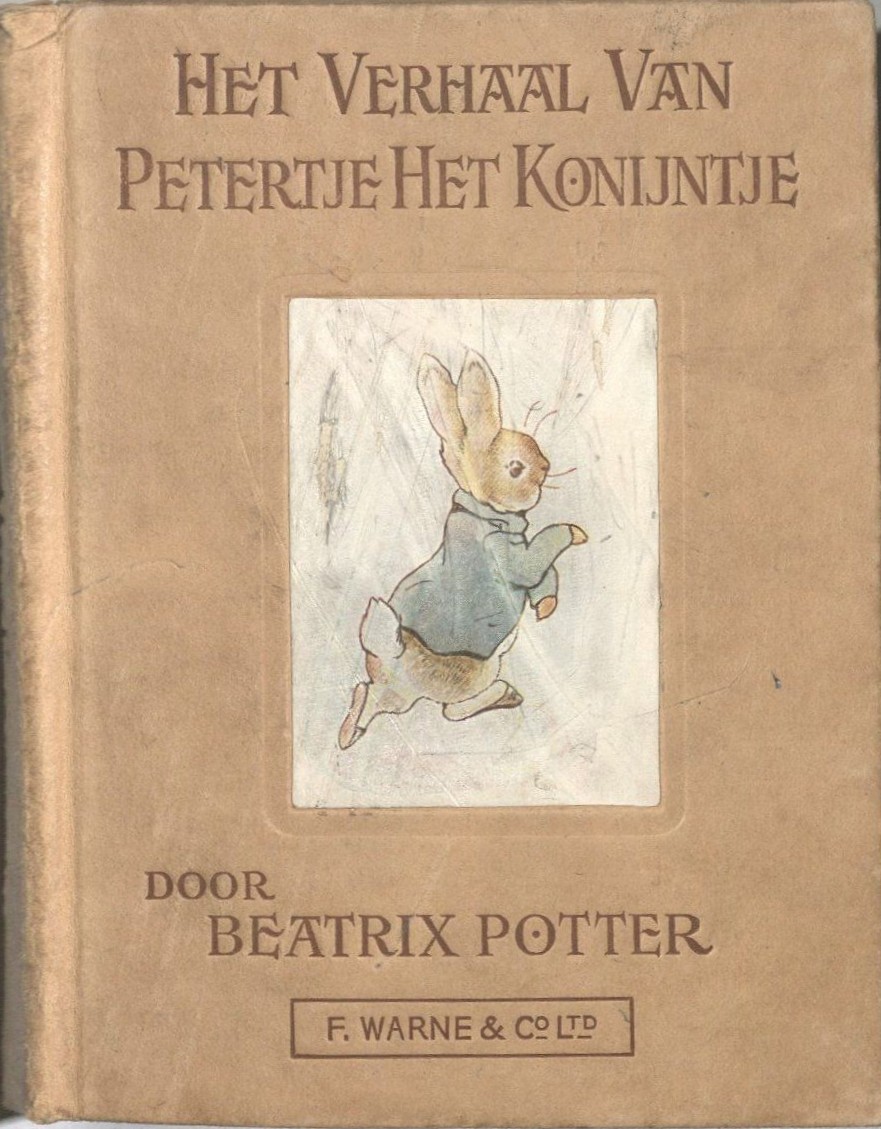
Potter’s tiny, whimsical books didn’t stay tucked away in English nurseries for long. Their charm crossed borders almost as quickly as they captured hearts. They were small, easy to hold, easy to carry, and almost like treasures. They translated beautifully into other languages. Soon children around the world were meeting Peter Rabbit, Jemima Puddle‑Duck, and Jeremy Fisher in their own words, discovering the same quiet ponds, tidy burrows, and bustling little villages. Those pocket‑sized stories became tiny passports, carrying her small animal worlds from one country to the next, proving that gentle, kind wonder needs no translation.

French (left) and German (right) translations of The Tale of Peter Rabbit, London and New York: Frederick Warne & Co., LTD, undated. Call Numbers: Children 2973A and Children 2975A. Click images to enlarge.

In the end, that’s what Beatrix Potter’s work has always done; taken something small and made it feel expansive. Her tiny books, perfectly sized for little hands, carried whole worlds inside them. And somehow those miniature stories traveled far beyond the quiet corners of English nurseries, finding their way into new languages, new homes, and new childhoods. It’s amazing that the same Jeremy Fisher who kept me company at my grandparents’ house has hopped across continents, meeting children who see their own wonder reflected in his gentle courage. These stories endure because they invite us in close, offering a world we can hold and one that, if we’re lucky, holds us right back.

Color illustration of a frog sitting on a lily pad and fishing.
Jeremy Fisher, perched with that gentle determination I loved as a child, in The Tale of Mr. Jeremy Fisher, New York: Frederick Warne & Co., 1906. This illustration shows that even the most modest adventures have heart and that there’s joy in offering what we can, however small, to the friends who gather around our table. Call Number: Children 2983. Click image to enlarge.

Even for those of us who come to Beatrix Potter simply as readers, not scholars, there’s something quietly powerful about knowing these tiny books and their many editions are preserved in places like Spencer Research Library. Holding a physical copy of The Tale of Mr. Jeremy Fisher or The Tailor of Gloucester connects us to the way children first encountered these stories: small pages, careful illustrations, and a scale Potter insisted on because it shaped how young readers experienced wonder. Archives protect that experience. They safeguard the variations in printings, the translations that carried Peter Rabbit across borders, and the little design choices that made these books feel like treasures in a child’s hands. Preserving the books themselves ensures that future readers – whether curious visitors, devoted fans, or someone simply remembering a bedtime story at their grandparents’ house – can still encounter Potter’s world as she meant it to be held.

Color photograph of four Beatrix Potter books lined up vertically.
This well-loved set of Beatrix Potter books comes from the collection of my grandmother, Doris Kotesky Phares. Their gentle wear is its own kind of provenance: evidence of countless nights when she read to me, creating a lineage of comfort, imagination, and love that still lives in every page. Click image to enlarge.

Spencer Research Library has twenty-one holdings of Beatrix Potter books. Frederick Warne & Co. (also Frederick Warne & Co., Inc. and Frederick Warne & Co., LTD) published Potter’s little books. The company had publishing houses in London and New York. The publication date and call number of each title are listed below:

  • The Tale of Ginger and Pickles, 1909 (Children 2970)
  • Histoire de Pierre Lapin [The Tale of Peter Rabbit, French], undated (Children 2973A)
  • The Tale of the Pie and the Patty-Pan, 1905 (Children 2965)
  • The Roly-Poly Pudding, 1908 (Children C606)
  • The Tailor of Gloucester, 1903 (Children 2981)
  • The Tale of Jemima Puddle-Duck, 1936 (Children 2974)
  • The Tale of Mr. Jeremy Fisher, 1906 (Children 2983) and 1934 (Children 2984)
  • The Tale of Mr. Tod, 1912 (Children 2982)
  • The Tale of Mrs. Tiggy-Winkle, 1905 (Children 2972)
  • The Tale of Mrs. Tittlemouse, 1910 (Children 2979)
  • The Tale of Peter Rabbit, undated (Children 2978)
  • The Tale of the Pigling Bland, 1913 (Children 2980)
  • The Tale of Squirrel Nutkin,1903 (Children 2971)
  • The Tale of the Flopsy Bunnies, 1909 (Children 2976A)
  • Het verhall van Petertje het Konijntje [The Tale of Peter Rabbit, German], undated (Children 2975A)
  • Wag-by-Wall, 1944 (Children B1119 and Children 2969)

Beatrix Potter titles by other publishers:

  • The Fairy Caravan, Philadelphia: David McKay Company, 1929 (Children 3479)
  • Peter Rabbit, Philadelphia: Henry Altemus Company, DATE (Children 5159A)
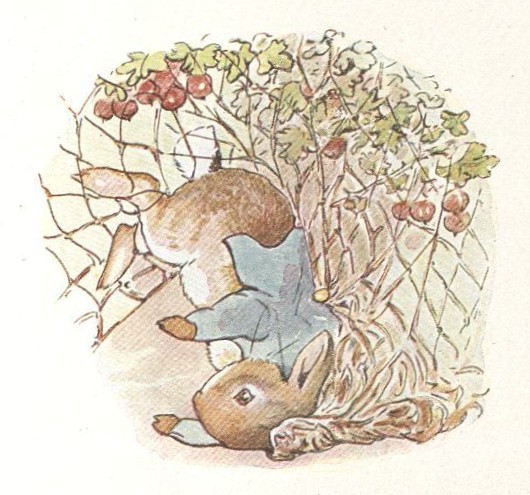
Color illustration of a rabbit in a blue jacket, upside down with his paw caught in a garden fence.
Peter Rabbit caught red pawed in the garden again, in The Tale of Peter Rabbit, London and New York: Frederick Warne & Co., undated. It’s a cheerful reminder that life’s little mishaps often become the stories we retell with friends, laughing as we go. Like Peter, a dash of mischief and a child’s outlook can turn even snags and stumbles into the moments that shape us. Call Number: Children 2978. Click image to enlarge.

Meredith Phares
Operations Manager

A KU Fourth of July

July 2nd, 2026

In honor of the celebrations surrounding the 250th birthday of the United States this week, we’re taking a look back at how KU commemorated the bicentennial fifty years ago.

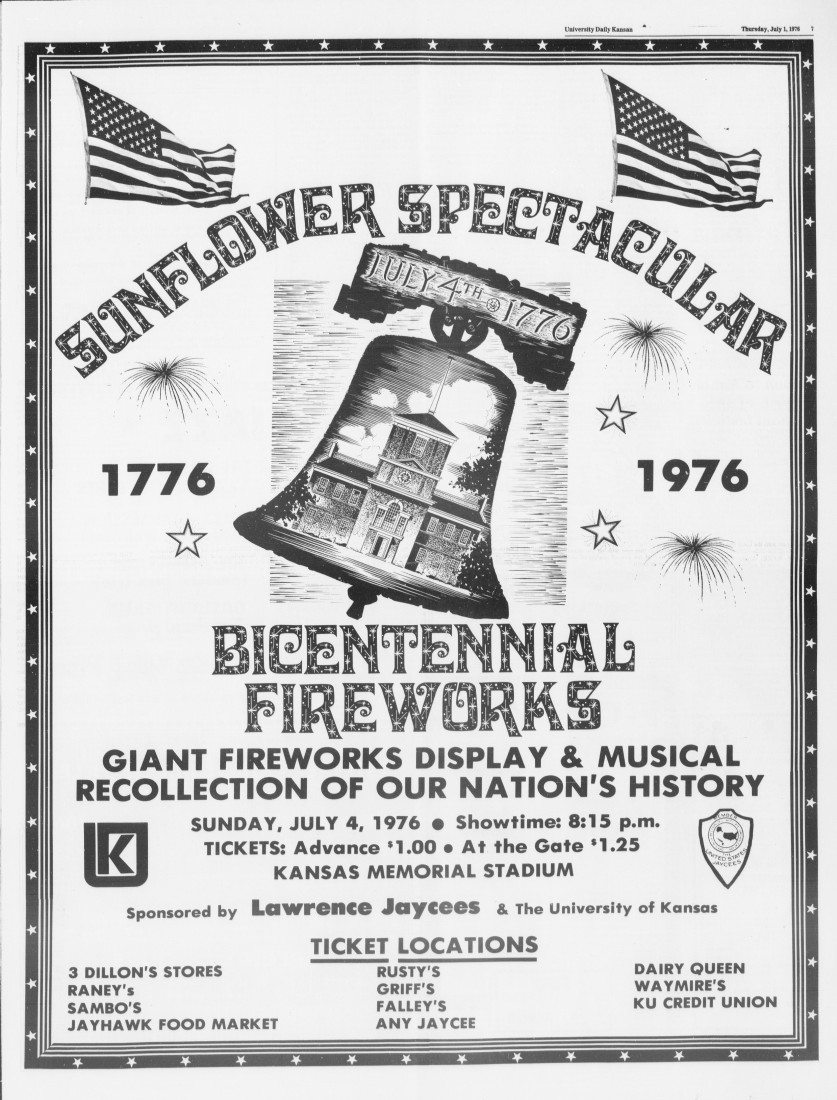
This image has text.
A full-page advertisement in the University Daily-Kansan for the Sunflower Spectacular bicentennial fireworks show, July 1, 1976. University Archives. Call Number: UA Ser 69/2/1. Click image to enlarge (redirect to Spencer’s digital collections).

A year of intensive planning, special projects, and varied events at the university culminated in the Sunflower Spectacular fireworks show at Memorial Stadium on July 4, 1976. The show “featured the cooperation of the University Alumni Association with Vince Bilotta as coordinator, the Summer Band Camp under the direction of Robert Foster, and the Lawrence Jaycees with their annual sponsorship of the fireworks display.” Prior to the show were afternoon and evening performances of patriotic music at the Memorial Campanile and Carillon, part of a bicentennial summer concert series. Lawrencians also participated in a broad array of off-campus festivities that weekend, concluding the Douglas County Bicentennial Commission’s similarly busy and productive year.

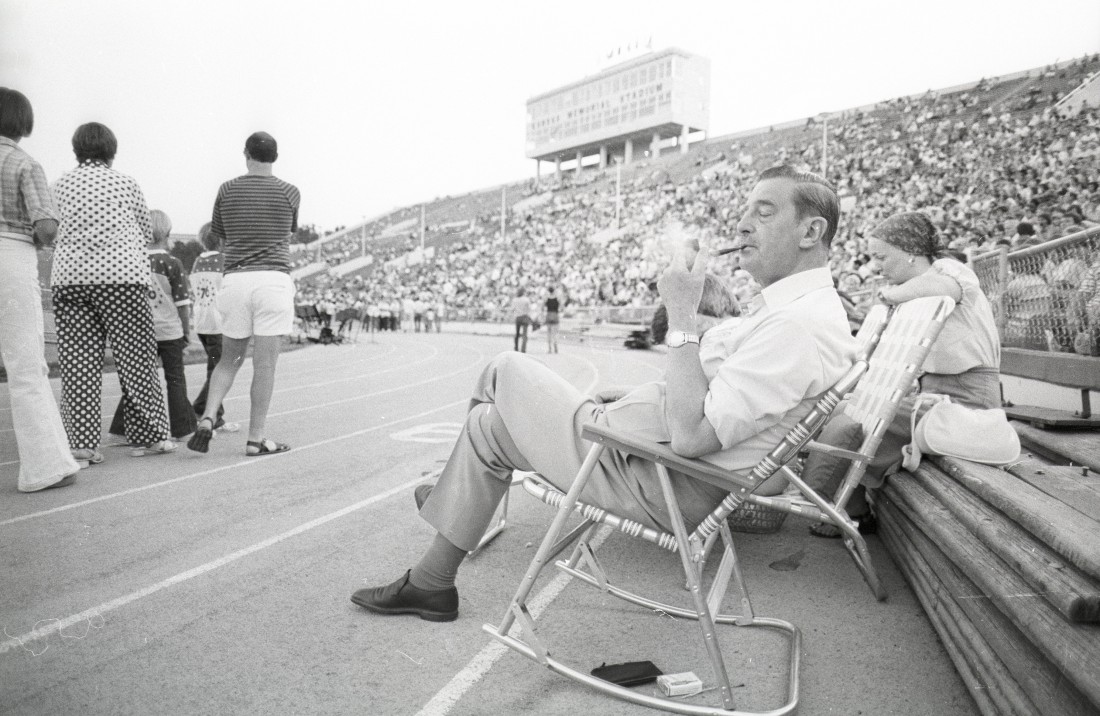
Black-and-white photograph of a man sitting in a rocking lawn chair and smoking. A small group of people is walking by and, in the background, there is a large crowd in the stands.
People at Memorial Stadium for the Sunflower Spectacular show, July 4, 1976. Photo by George Millener for the Lawrence Journal-World. Lawrence Journal-World Photograph Collection. Call Number: RH PH LJW (negatives). Click image to enlarge.

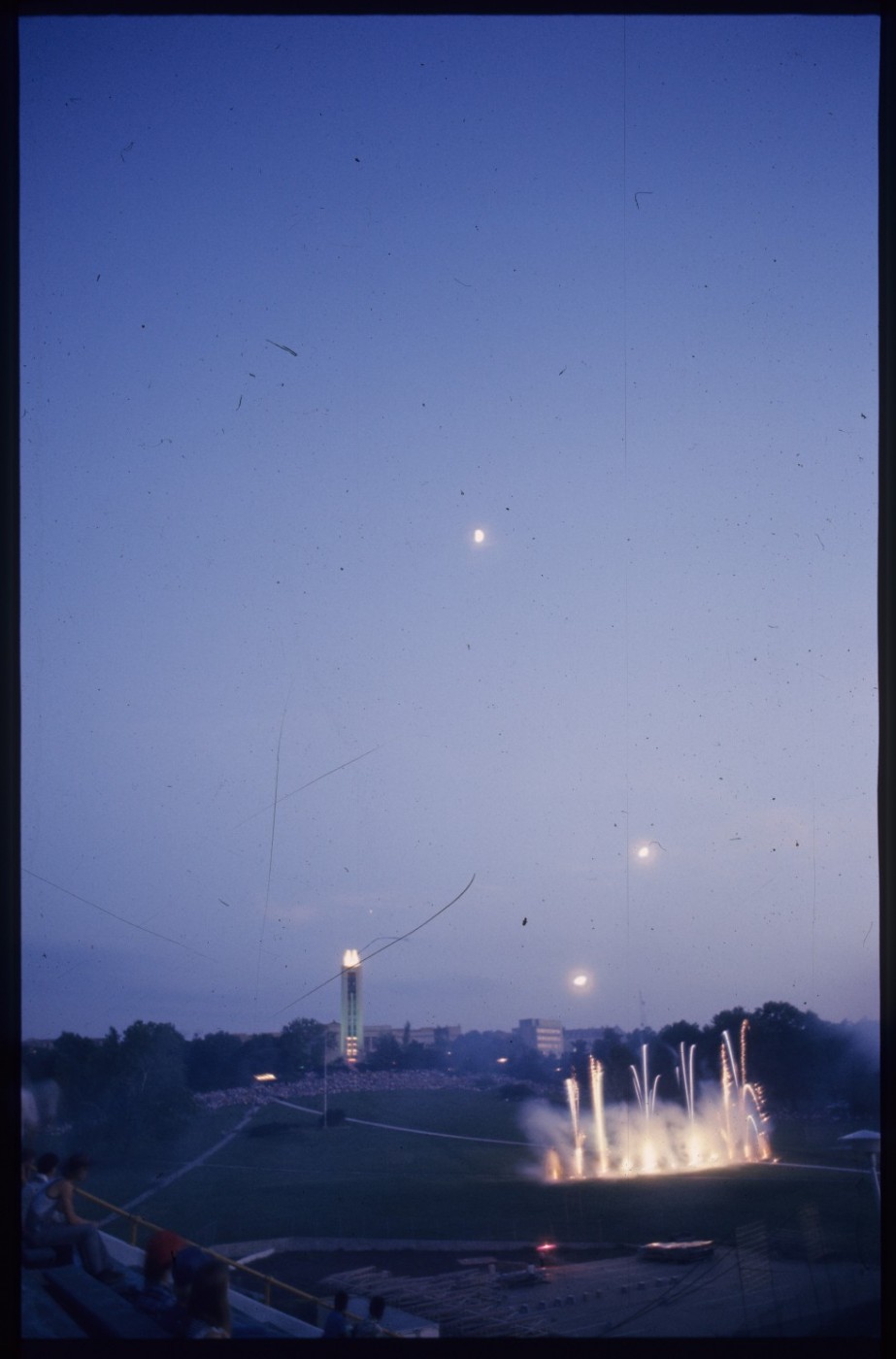
Fireworks during the Sunflower Spectacular show, July 4, 1976. In the first two images, note the spectators on the hill near the Campanile. Photos by George Millener for the Lawrence Journal-World. Lawrence Journal-World Photograph Collection. Call Number: RH PH LJW (negatives). Click images to enlarge.

This image has text under the headline "Festive air prevails at show in stadium."
A description of the fireworks show and preceding musical program in the Lawrence Journal-World, July 5, 1976. Article courtesy of the Google News Archive. Click image to enlarge.

A questionnaire attached to the final report of KU’s seventeen-member Bicentennial Committee stated that 1,335 individuals had been “actually involved and participating” in its various commemorative efforts. The Committee also estimated that more than 70,500 people had attended KU’s bicentennial events (“based on estimates where numbers could be determined”). “The philosophy of the University Bicentennial Committee,” noted the document, “was reflected in the nature of the projects and events that were identified and sponsored. The emphasis was upon activities that coordinated closely with the major missions of the University in its academic programs, its research projects, and its responsibility of service to the people of the state of Kansas.”

Reflecting back on the academic year, the editors of the 1976 Jayhawker yearbook wrote (somewhat hyperbolically):

If nothing else, the student of ’76 always will remember this year for the pomp and sure-coin-stance of the American Revolution Bicentennial. Attending an official Bicentennial university, living in an official Bicentennial community, taking a course in the history of the American Revolution from W. Stitt Robinson, professor of history and chairman of the KU Bicentennial Committee, celebrating homecoming with the theme of Jayhawk Rebellion, going to one of the five Humanities Series lectures with a Bicentennial theme, taking in a Saturday afternoon of Bicentennial music at Off-the-Wall-Hall, watching the official Bicentennial flag flutter in the Bicentennial breeze, seeing musical presentations, theater productions and museum exhibits with a Bicentennial flavor, applauding a Bicentennial Rock Chalk Revue, seeing the KU Symphonic Band off for a Bicentennial tour and dancing to Bicentennial banjos in a Bicentennial street dance during a Bicentennial Festival of the Arts were some of the things the Bicentennial student did.

Caitlin Klepper
Public Engagement Librarian

FIFA World Cup Exhibit

June 24th, 2026

If you’re a fan of soccer in general or Team Algeria in particular, be sure to stop by Spencer Research Library this summer and check out our small exhibit in honor of this year’s FIFA World Cup.

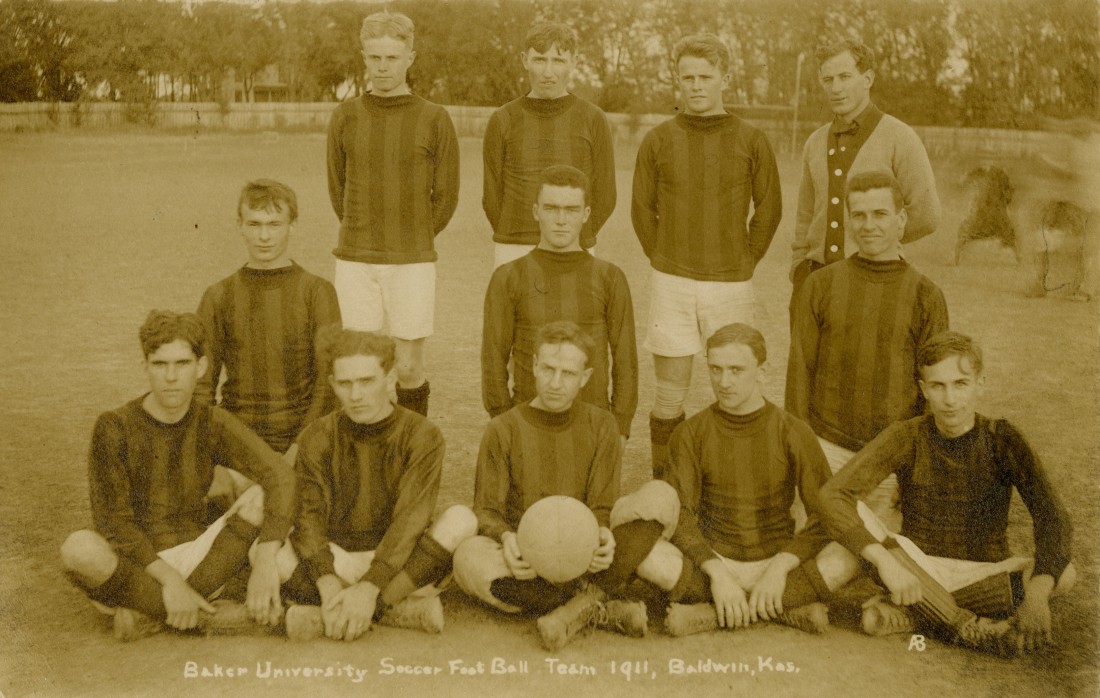
Sepia-toned photograph of a group of young men in white shorts, striped long-sleeve shirts, and dark knee-high socks.
A photograph of the Baker University soccer team in Baldwin City, Kansas, 1911. Leonard Hollmann Photograph Collection. Call Number: RH PH 536. Click image to enlarge.

One case features materials documenting the history of soccer locally and internationally. For example, Matthew Concanen’s 1721 work A Match at Foot-Ball; Or the Irish Champions: A Mock-Heroick Poem, in Three Canto’s (Call Number: B519) is a very early account of “foot-ball,” a precursor to modern Association Football (soccer), Rugby, and Gaelic Football, which were not codified separately until the mid-1800s.

The other case in this display highlights items about the history of Algeria, whose national soccer team is based in Lawrence during the tournament. The exhibited items span more than four centuries and reveal both European and Algerian perspectives toward the North African country.

Black-and-white illustration of a fortified coastal city on a hill.
An illustration of the Algerian capital Algiers in Description de l’Afrique [Description of Africa] by Olfert Dapper, 1686. Heavily defended under Ottoman rule during the 1500s and 1600s, Algiers was protected by the series of fortifications, walls, and gates seen in this image. Call Number: Summerfield E1118. Click image to enlarge.

Spencer’s FIFA World Cup exhibit will be installed in the reception area through August 14. Also on display is a short-term exhibit about Latino history and culture in Kansas, located in the North Gallery until July 31. And, there’s still time to explore Aging, Art, and Activism: Reimagining Our Aging Futures through Creative Representations and Personal Narratives, which you can find in Spencer’s Exhibit Space through August 14.

Caitlin Klepper
Public Engagement Librarian

The Magic of Classic Children’s Books: Rumpelstiltskin Edition

June 12th, 2026

This is the second post in a series highlighting various titles from Spencer Research Library’s vast children’s book collection.

Well-loved children’s books spark magic from the thrill of adventure to imagination of far-off, enchanted places. Beloved by generations, classic children’s stories remain with us throughout life, whether it is re-reading childhood favorites or sharing our most loved stories with young people in our lives. These classics ignite imaginations and impart timeless lessons. They become some of our most cherished friends that stay with us throughout our lives.

While browsing our children’s collections for this series, my eye caught the book Rumpelstiltskin. It was a beloved story from my childhood. I carefully pulled the volume from the shelf and discovered that this is the exact same book with the little yellow troll that I remembered. The copy I grew up with made it from 1973 through three kids and years of love, although the dust jacket was lost along the way.

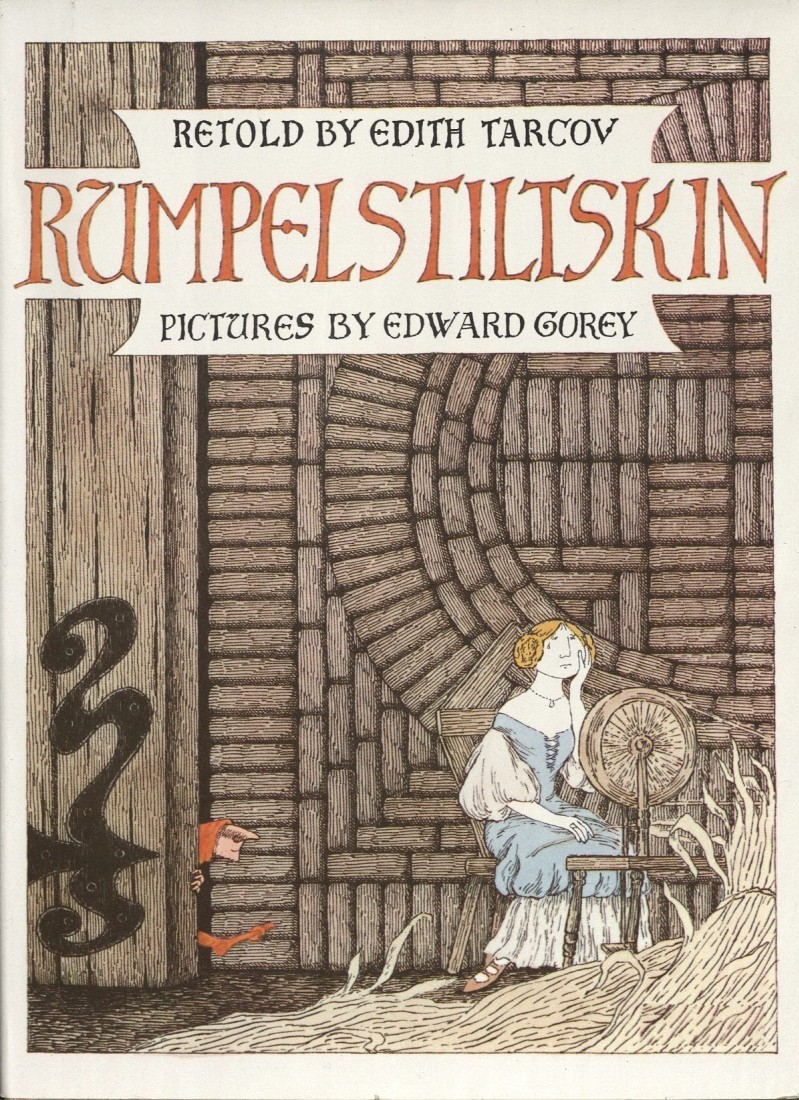
The front cover (left) and title page (right) of Edith H. Tarcov’s retelling of the Brothers Grimm story Rumpelstiltskin, illustrated by Edward Gorey, Four Winds Press: 1973. Call Number: Children C262. Click images to enlarge.

Before opening Spencer’s copy, I realized how little of the story I actually remembered – just impressions, really. A spinning wheel. A frightened girl. A strange little man whose name felt impossible and magical all at once. Childhood stories often linger this way, not as full plots but as bright fragments that stay tucked in the corners of memory. Holding the book again, I felt those fragments stir, as if the story had been waiting patiently for me to return.

Browsing through the pages, I was transported back to a place and time I had not visited in years. Books have that effect on people. They can sweep you into imagined worlds filled with wonder, but they can also return you to the most familiar corners of your own story: the home of your youth, your small hands turning the pages, the feeling of sitting on your mother’s lap as she reads to you. That quiet comfort stays with you long after childhood has passed.

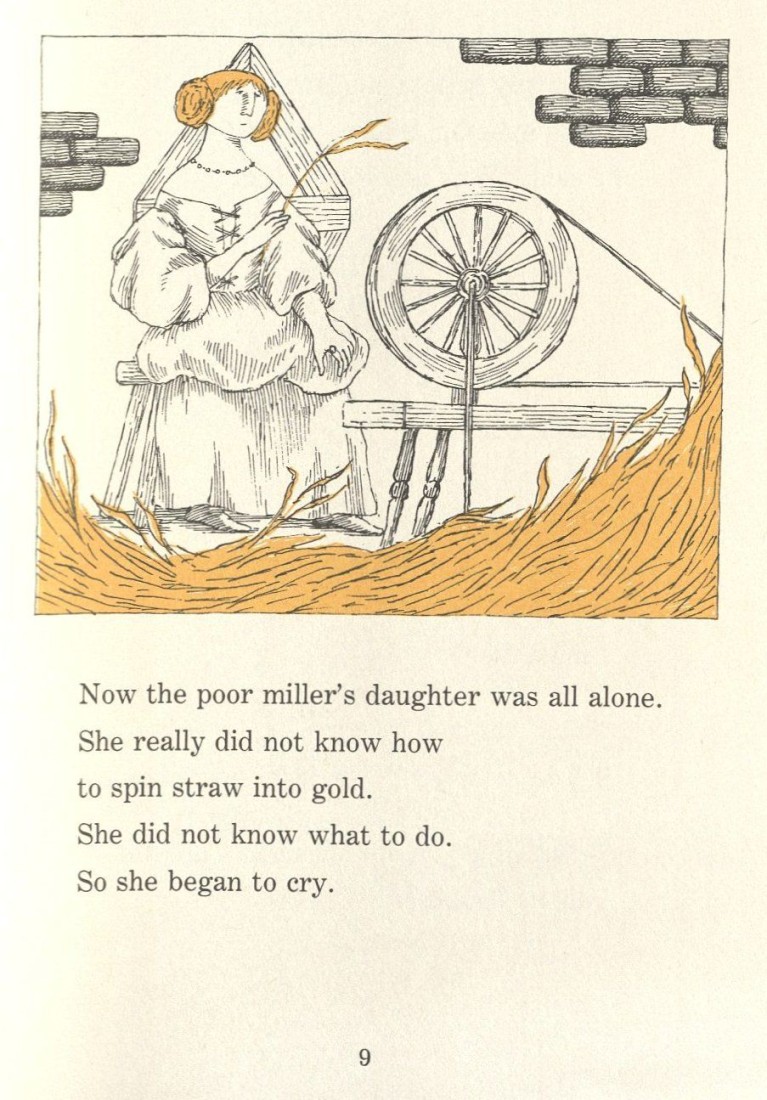
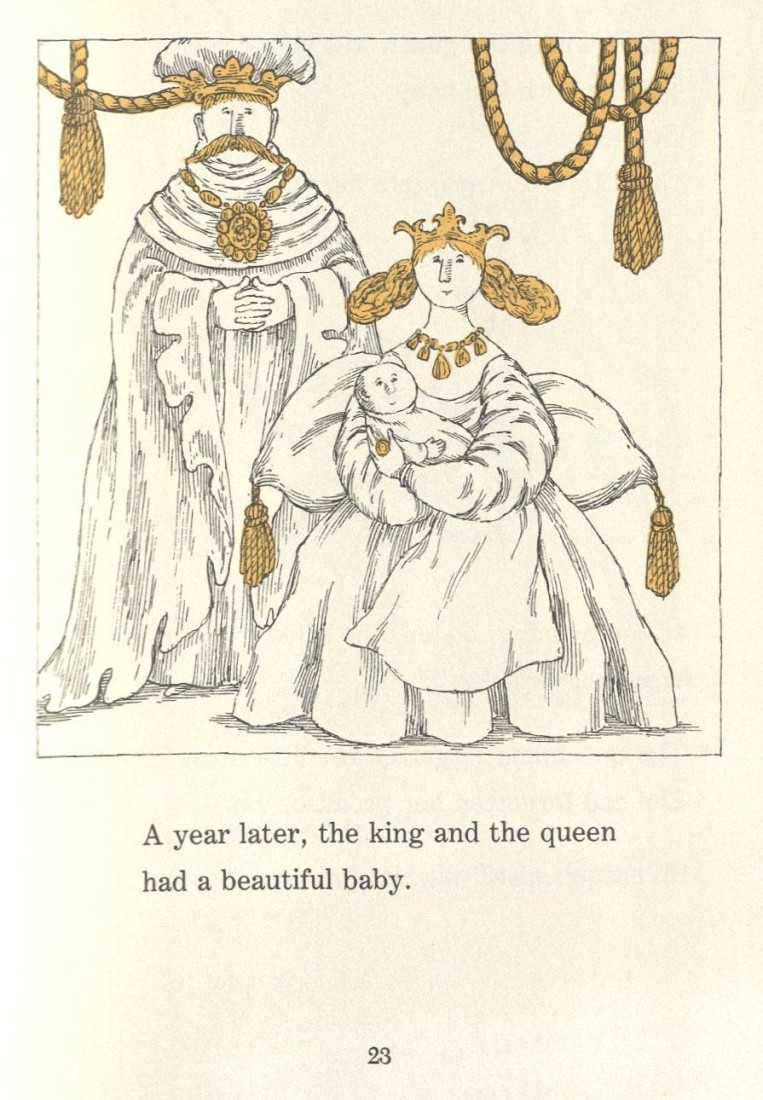
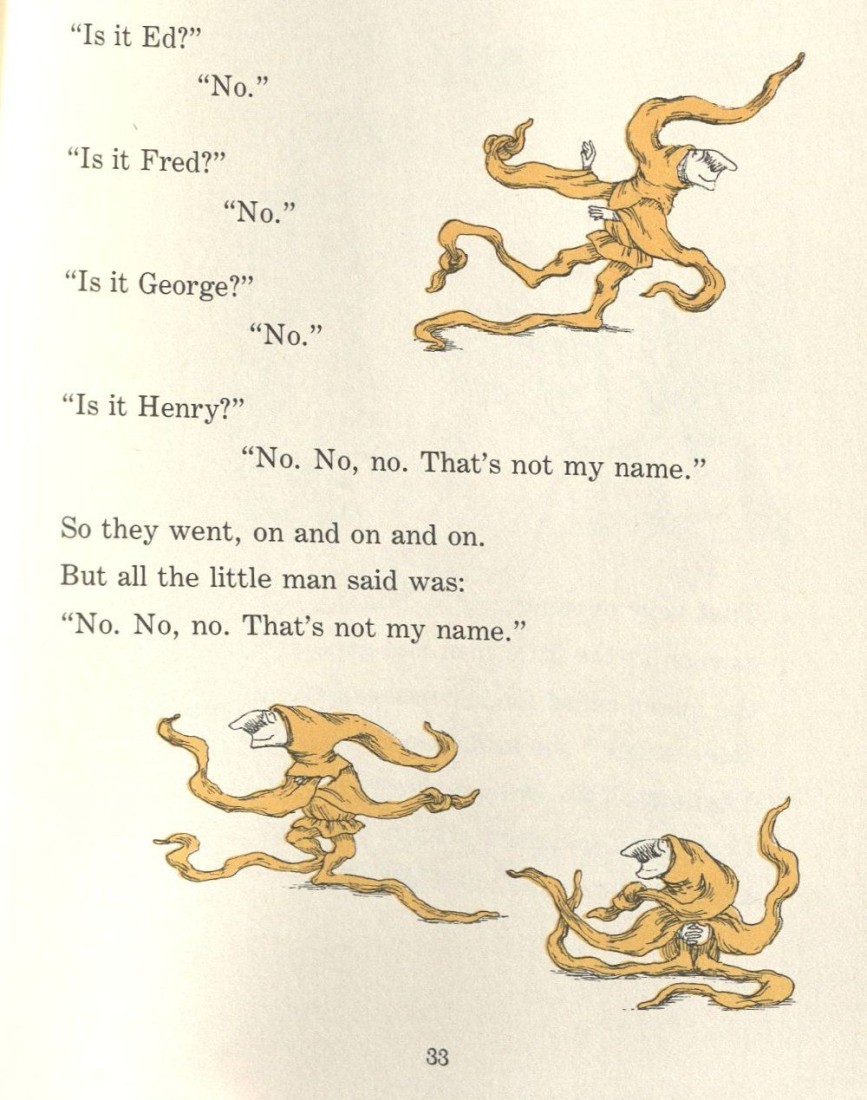
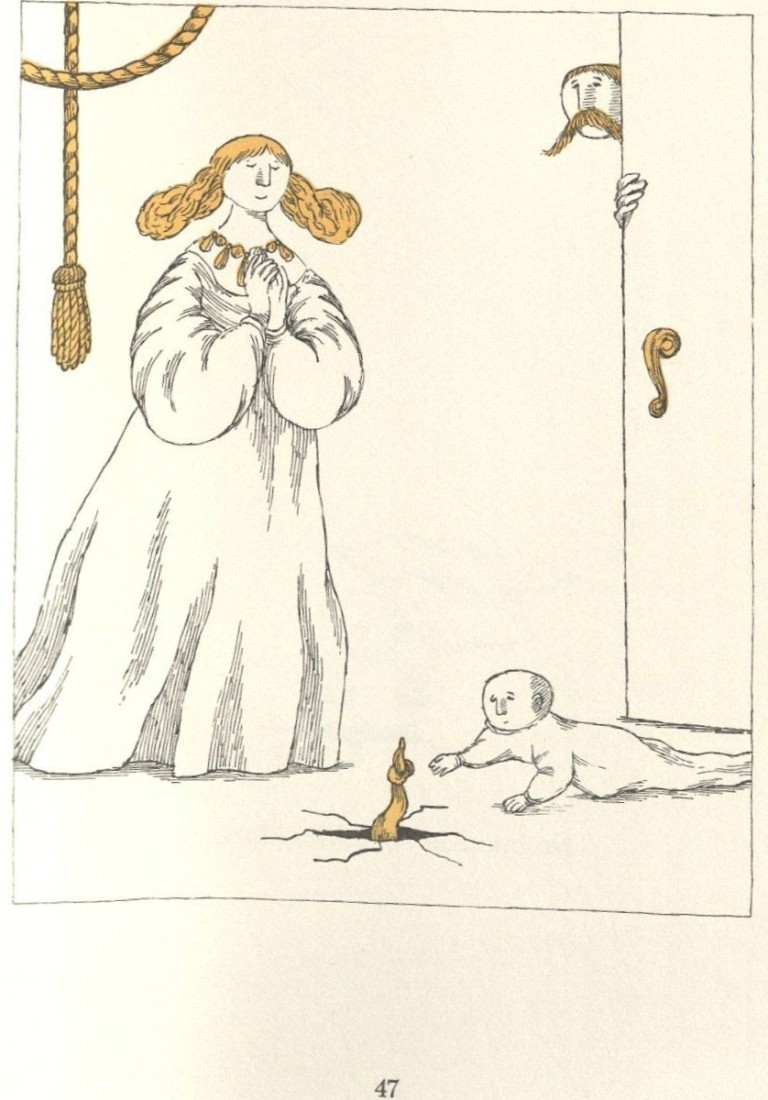
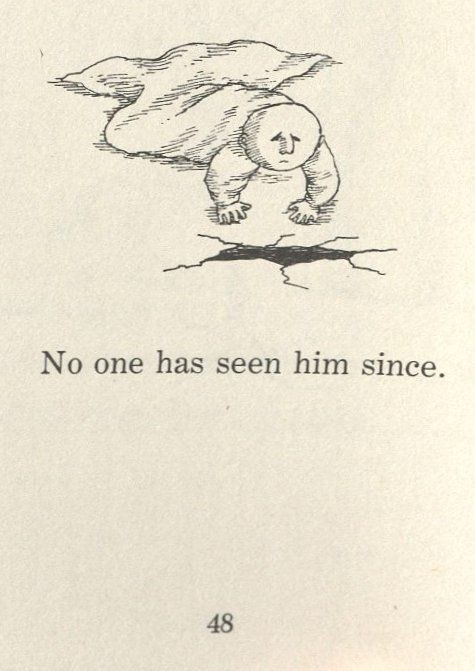
Selected pages in Rumpelstiltskin, 1973. Call Number: Children C262. Click images to enlarge.

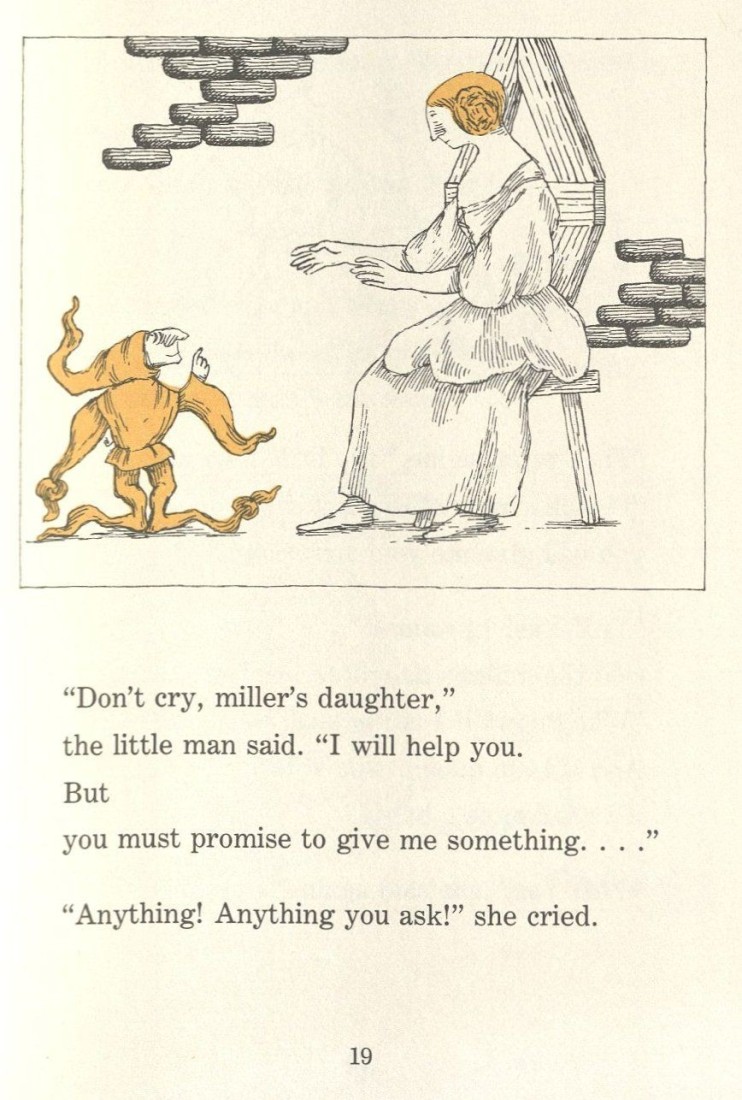
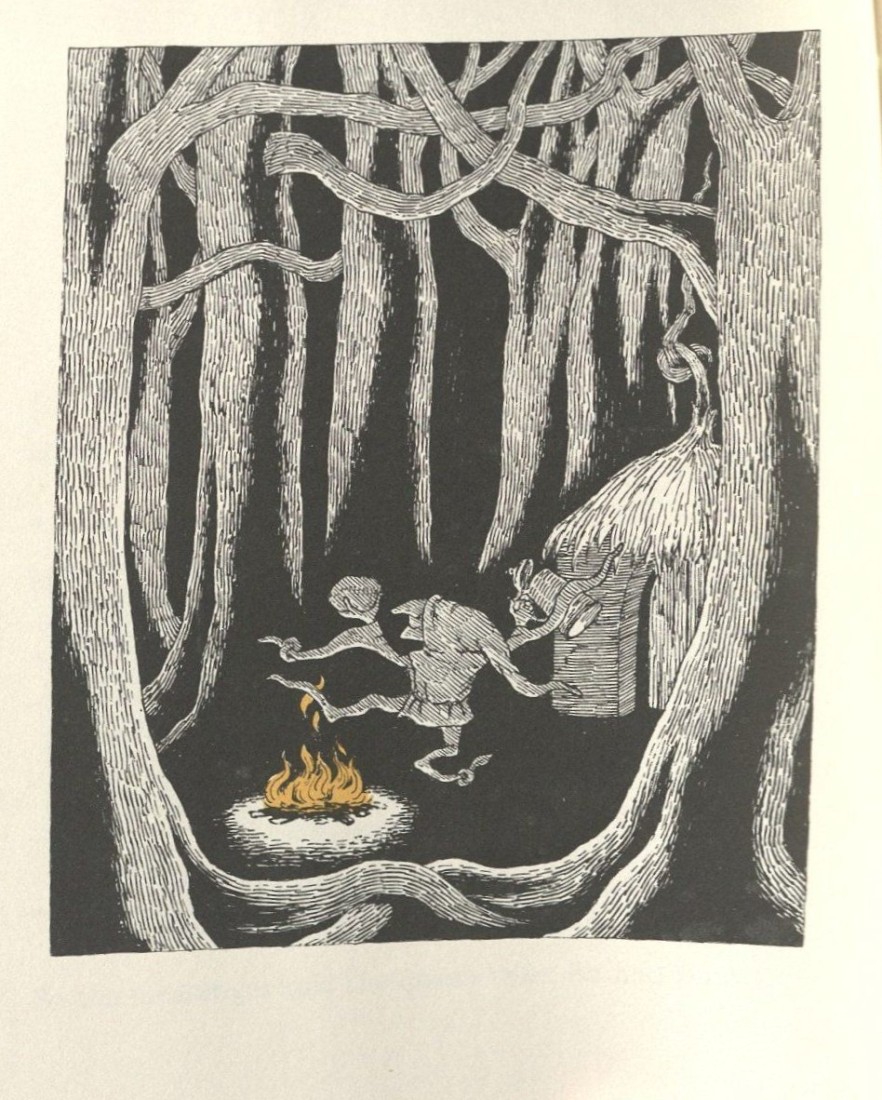
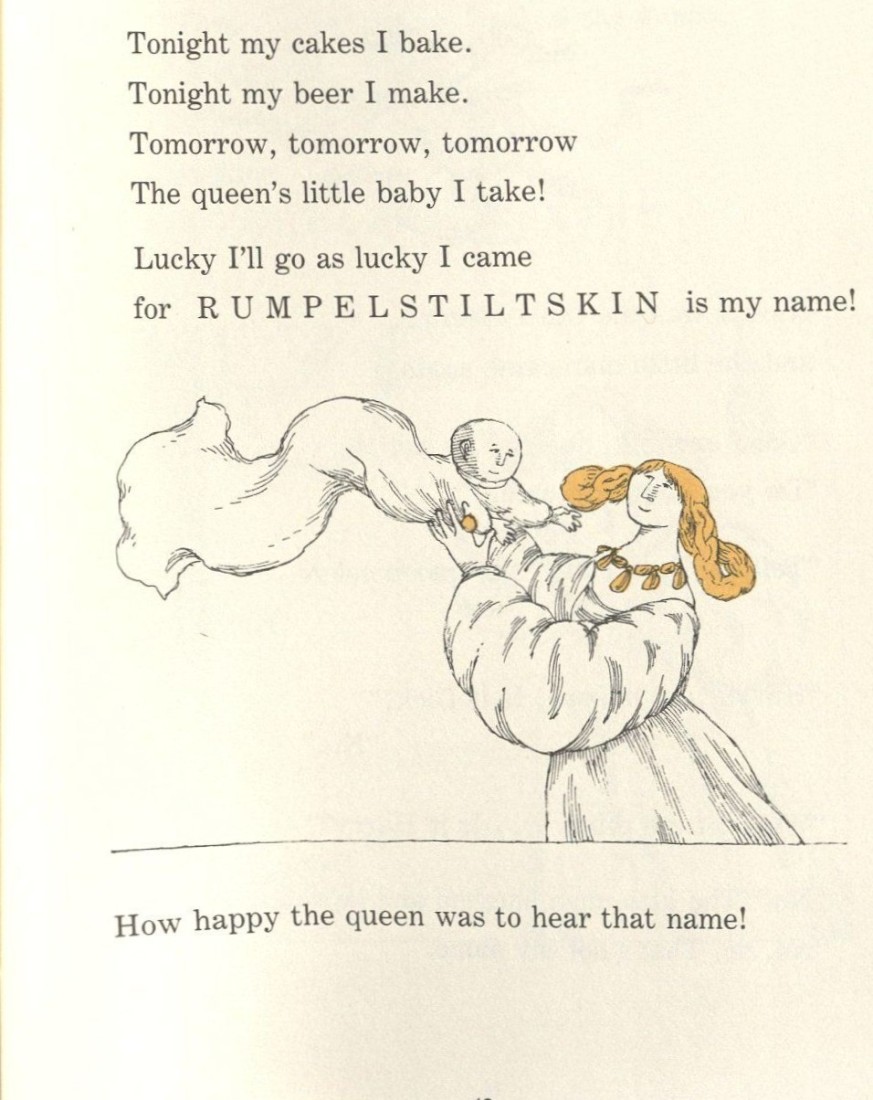
The illustrations were the first things to rise up from memory, those bold shapes and bright colors that once felt larger than life. Seeing them again was like recognizing an old friend across a crowded room. Childhood stories often imprint themselves visually before anything else, and these images had lived quietly in the back of my mind for decades. Each page brought back a flicker of familiarity: the tilt of a character’s expression, the sweep of a dress, the way the little man seemed both mischievous and mysterious. Illustrations have a way of anchoring a story in the imagination and rediscovering them reminded me just how powerfully art shapes the way we remember the tales we loved.

Selected pages in Rumpelstiltskin, 1973. Call Number: Children C262. Click images to enlarge.

Stories also change as we change. The tale I remembered from childhood – a frightened girl trapped in an impossible bargain – reads differently now. With adult eyes, I see a young woman navigating power, danger, and impossible expectations and ultimately outwitting the very creature who sought to control her. What once felt like a simple “damsel in distress” story reveals itself as something more layered: a narrative about resourcefulness, resilience, and the quiet strength of naming what threatens you. It is remarkable how familiar tales shift over time, offering new meanings as we grow into new versions of ourselves.

That feeling – that sudden, tender collapse of past and present – is exactly why special collections stewardship matters. We preserve these books because they are more than paper and ink. They are anchors. They are memory‑keepers. They are the quiet, steady companions that shaped childhoods, sparked imaginations, and offered refuge on difficult days. When we protect them, we are not just saving objects; we are safeguarding the emotional landscapes they hold.

Selected pages in Rumpelstiltskin, 1973. Call Number: Children C262. Click images to enlarge.

In special collections, we make sure that these touchstones of childhood do not disappear into attics or thrift stores or the slow erosion of time. We keep them so that someone, decades from now, can open a familiar story and feel that same rush of recognition, that same warmth of being transported home.

Selected pages in Rumpelstiltskin, 1973. Call Number: Children C262. Click images to enlarge.

As I closed the book and placed it back on the shelf, that familiar warmth lingered: the feeling of being carried, just for a moment, back into childhood. That is the quiet power of these stories, and the reason we preserve them. Through the work of special collections and the care of special collections stewardship, we ensure that these tales endure not only as artifacts, but as living companions. They remain ready to inspire new readers, spark new imaginations, and offer that same sense of home to someone else, years or even decades from now.

Meredith Phares
Operations Manager