Welcome to the Kenneth Spencer Research Library blog! As the special collections and archives library at the University of Kansas, Spencer is home to remarkable and diverse collections of rare and unique items. Explore the blog to learn about the work we do and the materials we collect.
This blog may contain archived web content. This blog may link to catalog records which no longer exist as of a software change in 2026.
October is American Archives Month, a nationwide effort spearheaded by the Society of American Archivists to raise public awareness about the importance of historic documents and records and the importance of archivists. Spencer Research Library has a robust schedule of special events happening this October to celebrate Archives Month. All events are free and open to the public. We hope to see you at one, or even more!
As an elder millennial who loved history as a child and grew up with American Girl, I’ve been excited about the company’s 40th anniversary this year. As a result, I will be sharing a series of posts highlighting Spencer collection materials that connect to AG’s six original historical characters, in chronological order of when they “lived”: Felicity Merriman, Josefina Montoya, Kirsten Larson, Addy Walker, Samantha Parkington, and Molly McIntyre. Each post will focus on a different character and explore a selection of items that relate to the time and place in which she “lived” and topics or themes explored in her stories.
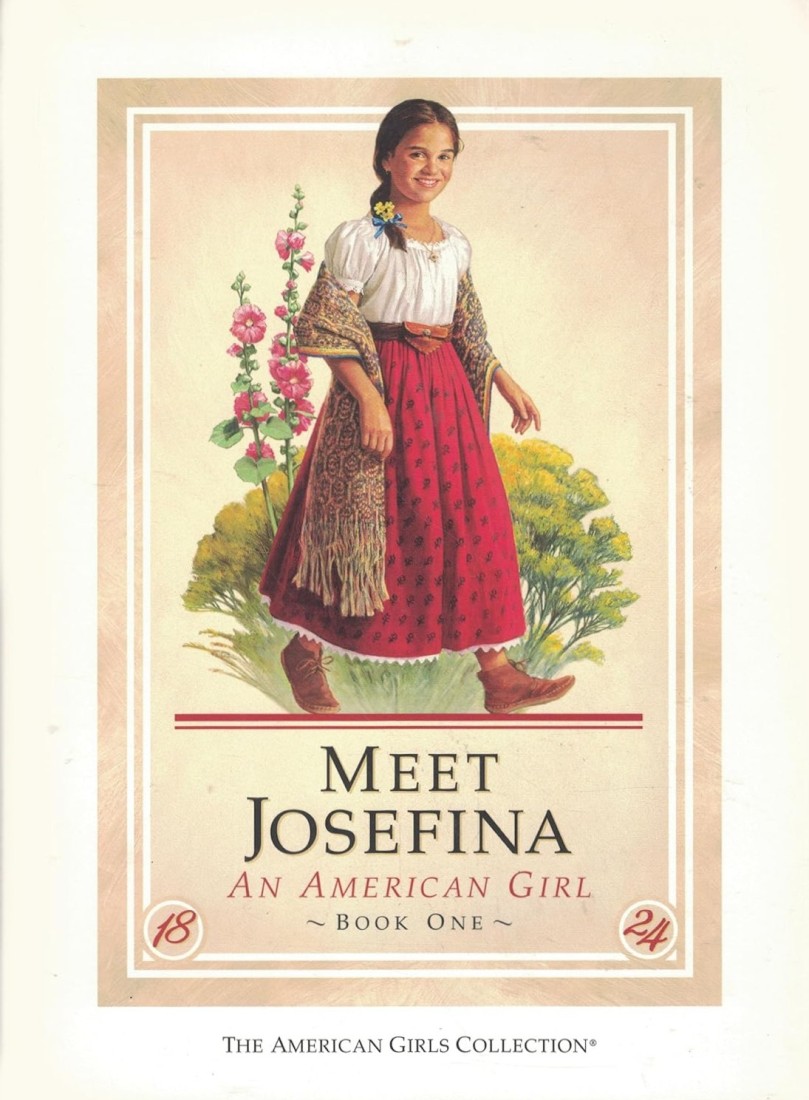
The front cover of the first book in Josefina’s series, first published in 1997. The book was also published in Spanish with the title Así es Josefina: Una Niña Americana. Click image to enlarge.
When readers meet Josefina Montoya, she is a nine-year girl described as having a big heart and big hopes. She lives with her father and sisters on a ranch outside Santa Fe, New Mexico – then part of Mexico – in 1824. Josefina’s stories are set against the backdrop of Mexico’s recent independence from Spain, and a significant plot point is the arrival of Americans via the Santa Fe Trail (which passed through Douglas County, Kansas, roughly fifteen miles south of Lawrence and KU). Throughout her stories, Josefina grieves and remembers her deceased mother; adjusts to changes at the ranch brought about her aunt, Tía Dolores; deals with goats, including her nemesis Florecita and the orphaned baby goat Sombrita; and starts the journey of becoming a curandera (healer).
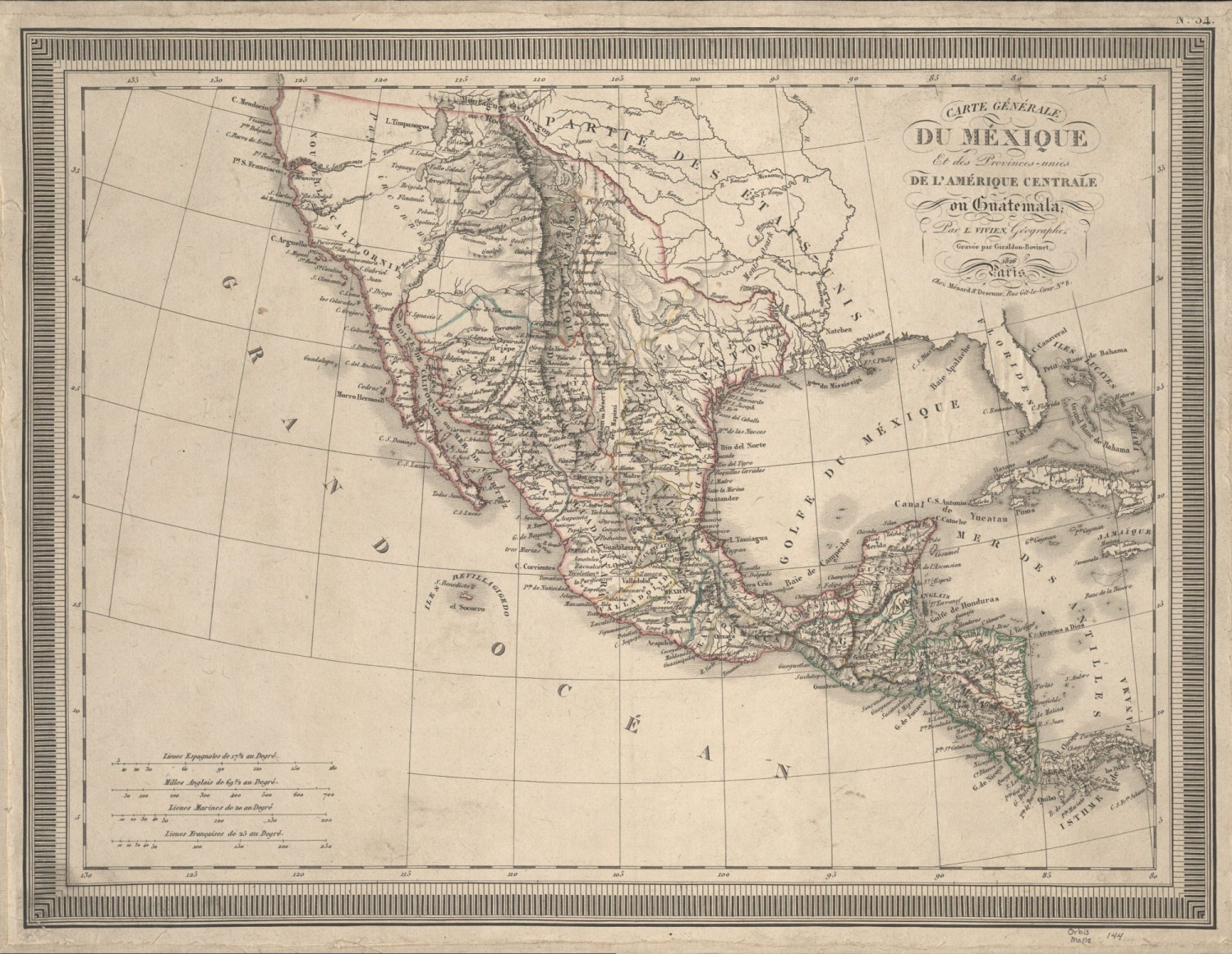
A French map of Mexico and Central America [Carte générale du Méxique et des provinces-unies de l’Amérique centrale on Guatemala], 1826. Call Number: Orbis Maps 1:144. Click image to enlarge.
–
–
–
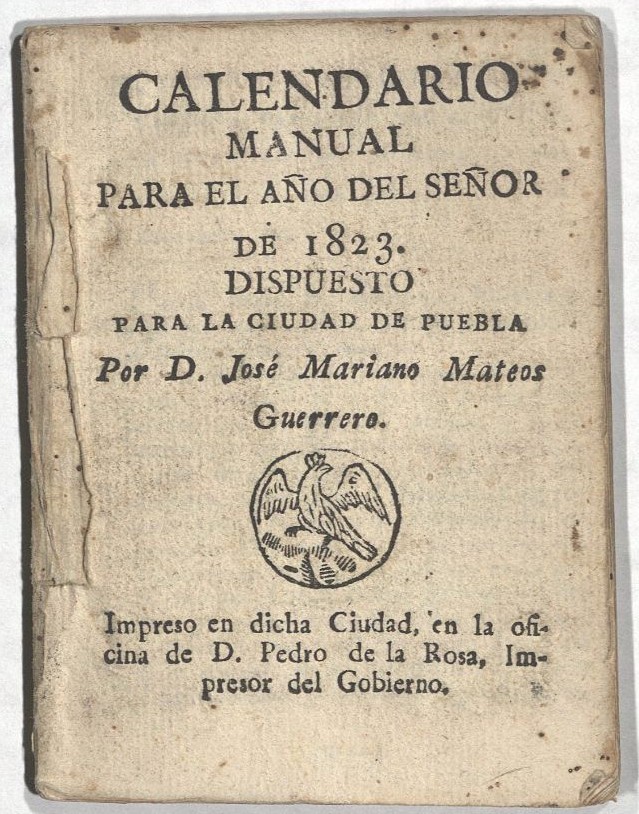
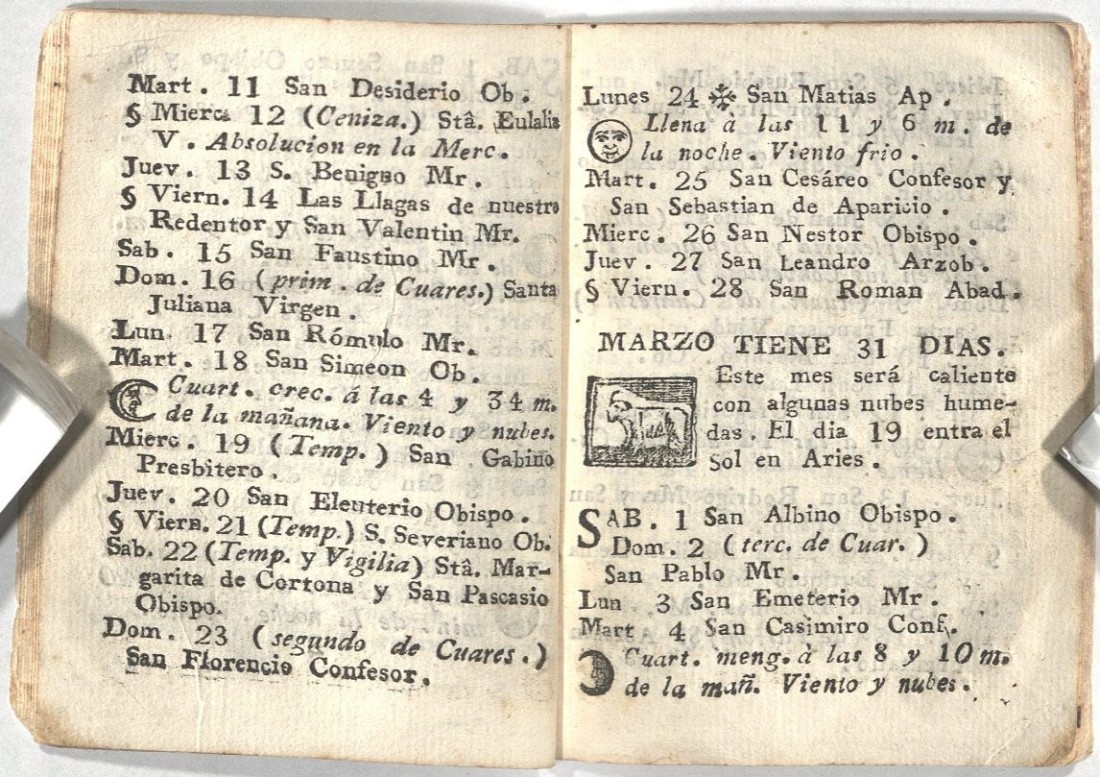
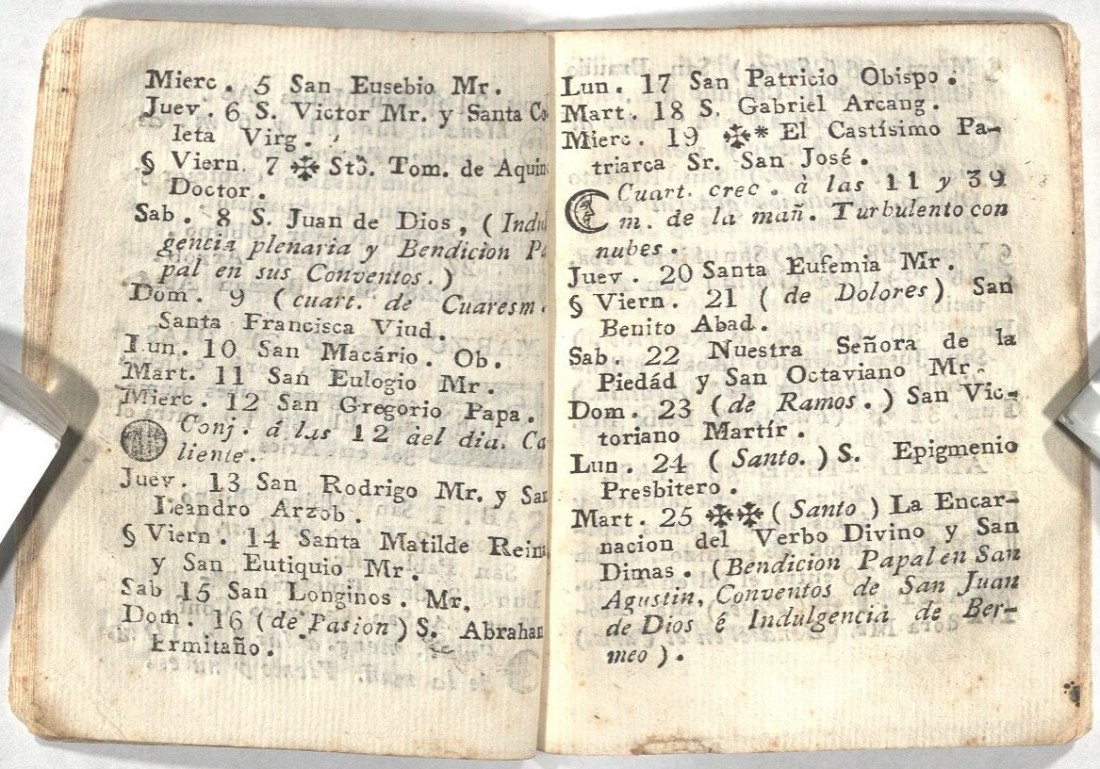
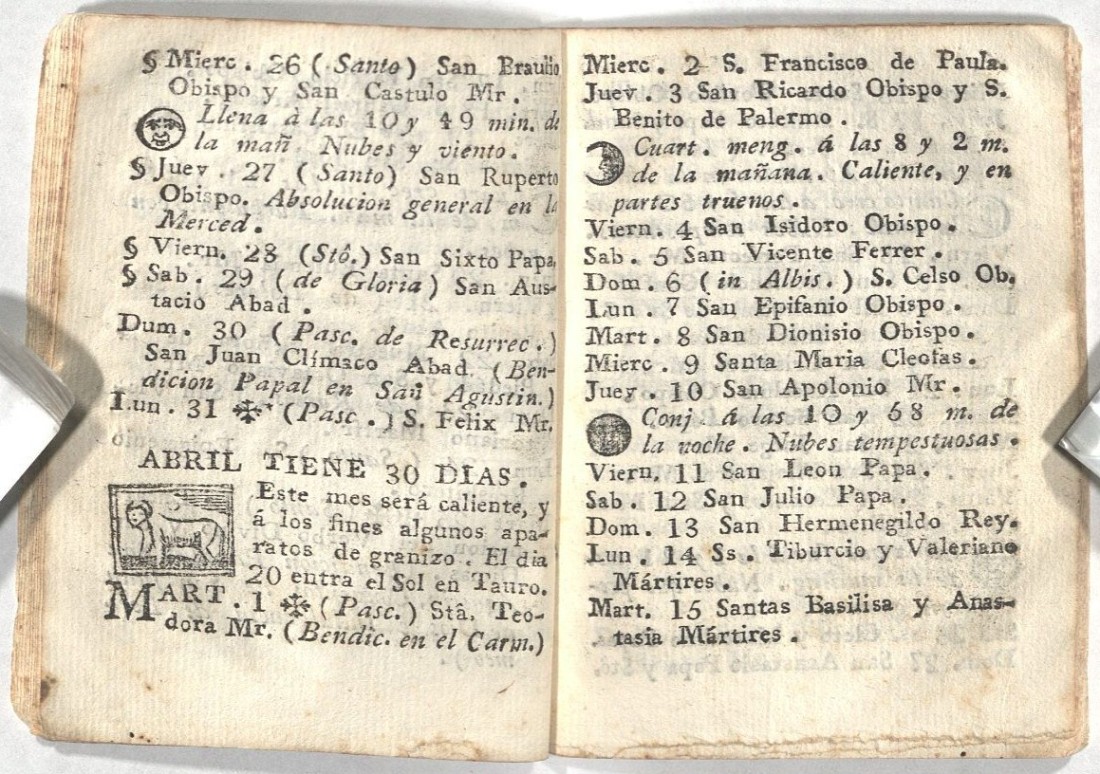
The title page and pages for the month of March in the pocket-sized Calendario manual para el año del señor de 1823. Dispuesto para la ciudad de Puebla [Manual Calendar for the Year of Our Lord 1823. Prepared for the City of Puebla]. Josefina’s birthday is March 19, the feast day of San José (St. Joseph). Call Number: t131. Click image to enlarge.
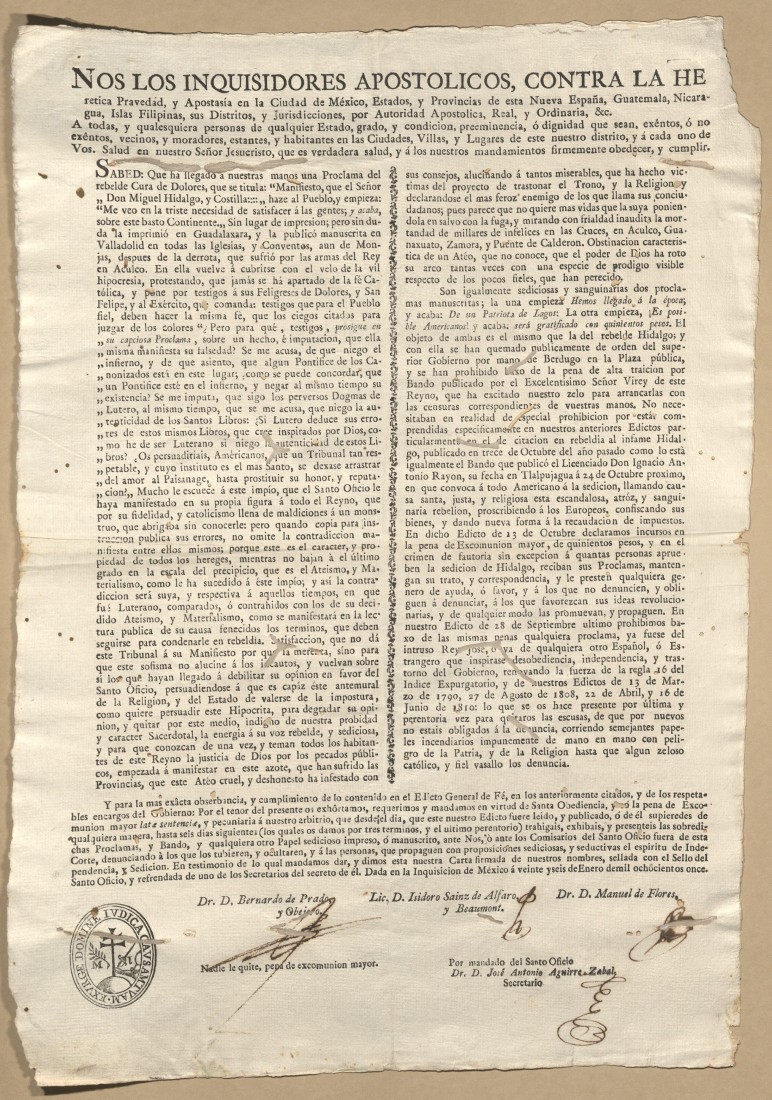
A broadside communicating an edict issued by the Inquisition of Mexico against the revolutionary proclamations of Miguel Hidalgo y Costilla, January 26, 1811. Hidalgo was a Catholic priest who led the first phase of the Mexican War of Independence beginning in 1810. Captured in March 1811, he was officially defrocked and excommunicated before being executed in July of that year. Call Number: Summerfield H121. Click image to enlarge.
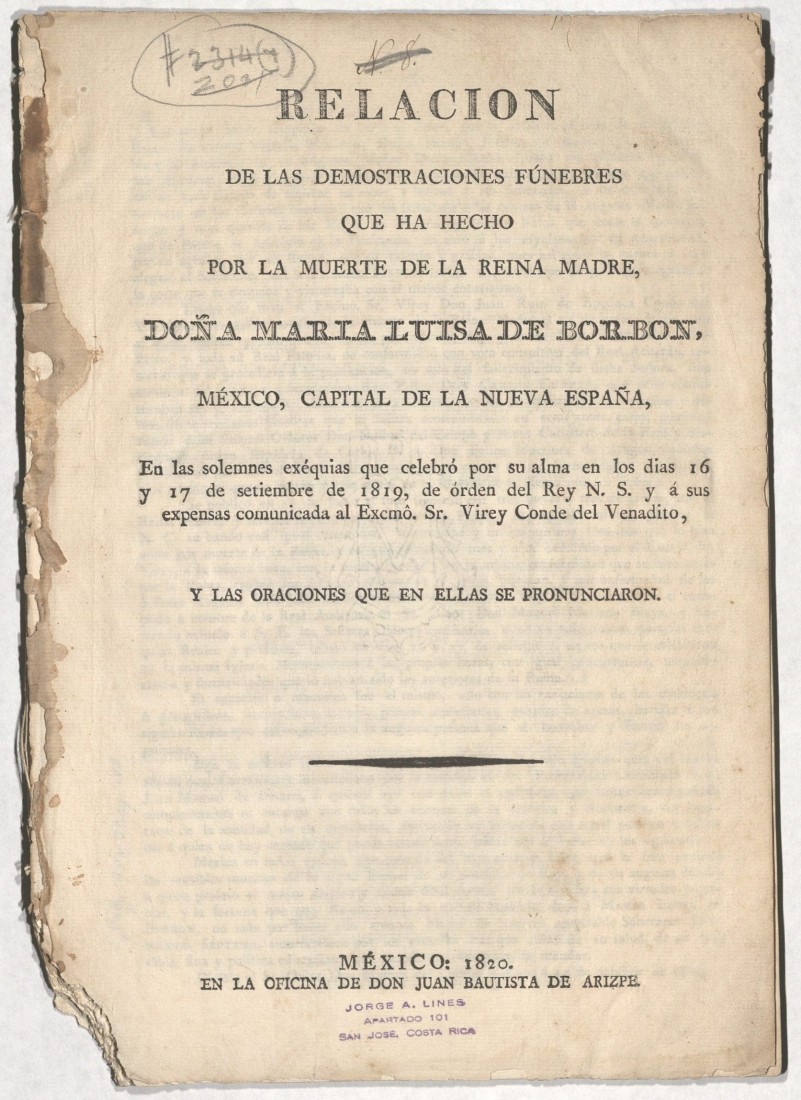
The title page of an account of the elaborate funeral ceremonies held for Maria Luisa of Parma, formerly the Queen Consort of Spain, in Mexico City, September 16-17, 1819. Josefina’s Tía Dolores would have been living in Mexico City at that time. Call Number: D3524. Click image to enlarge.
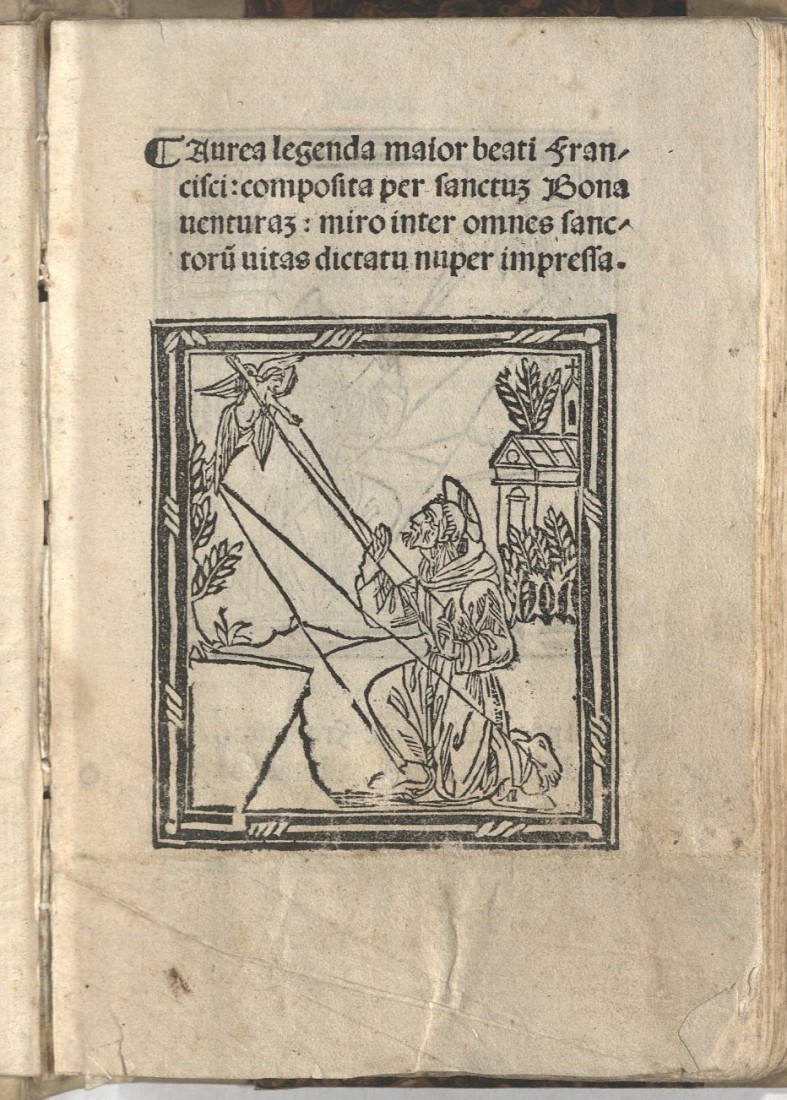
The title page of a 1509 copy of St. Bonaventure‘s biography of St. Francis of Assisi, who is the patron saint of Santa Fe. The city’s name – Spanish for “Holy Faith” – is the shortened form of its original name, La Villa Real de la Santa Fe de San Francisco de Asís (Royal Town of the Holy Faith of Saint Francis of Assisi). The image depicts St. Francis receiving the wounds of Christ. Call Number: Summerfield B584. Click image to enlarge.
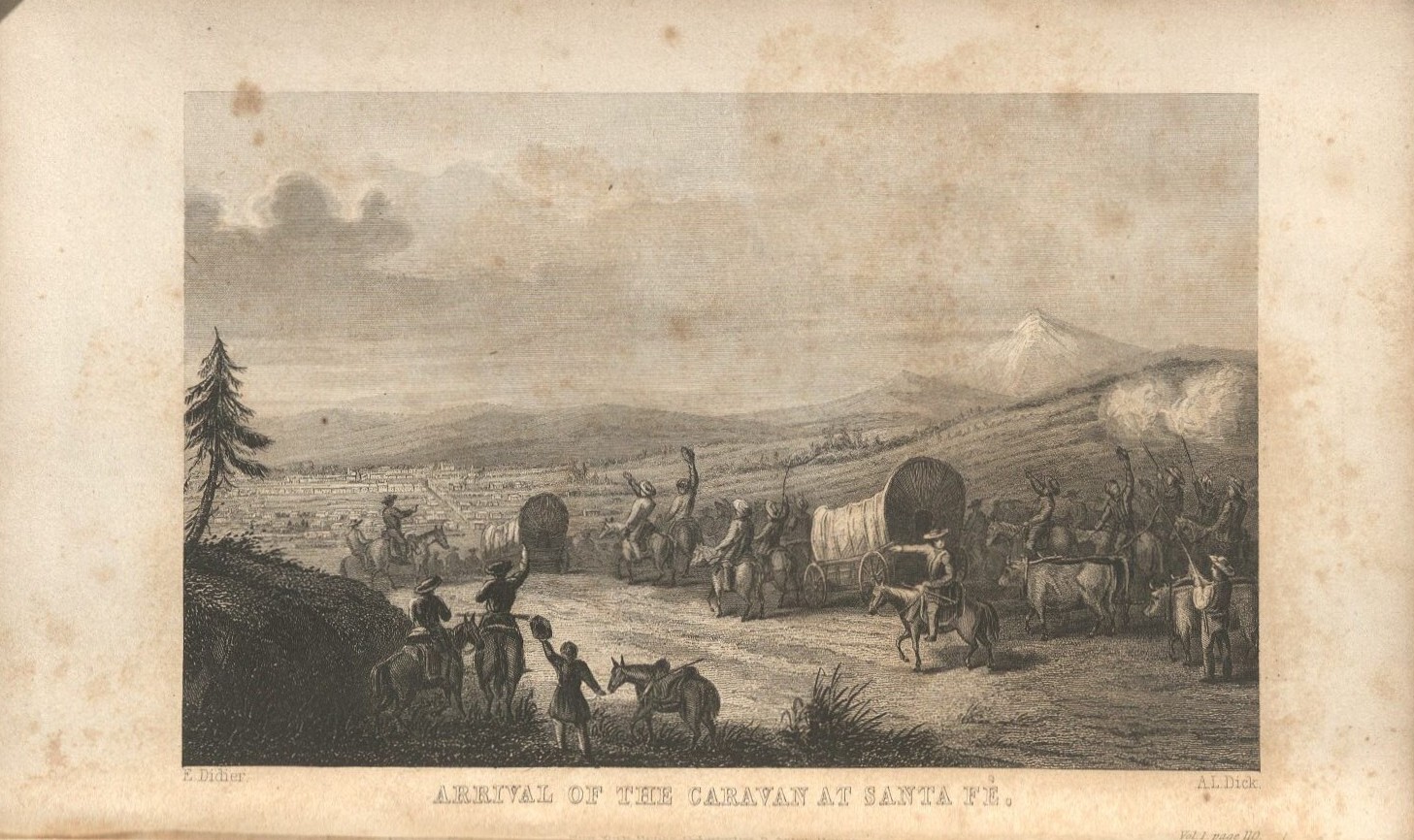
“Arrival of the Caravan at Santa Fe,” the frontispiece illustration in Commerce of the Prairies, or, The Journal of a Santa Fé Trader (Volume 1) by Josiah Gregg, 1844. In this work, Gregg describes his travels along the Santa Fe Trail between 1831 and 1839. Call Number: RH C521. Click image to enlarge.
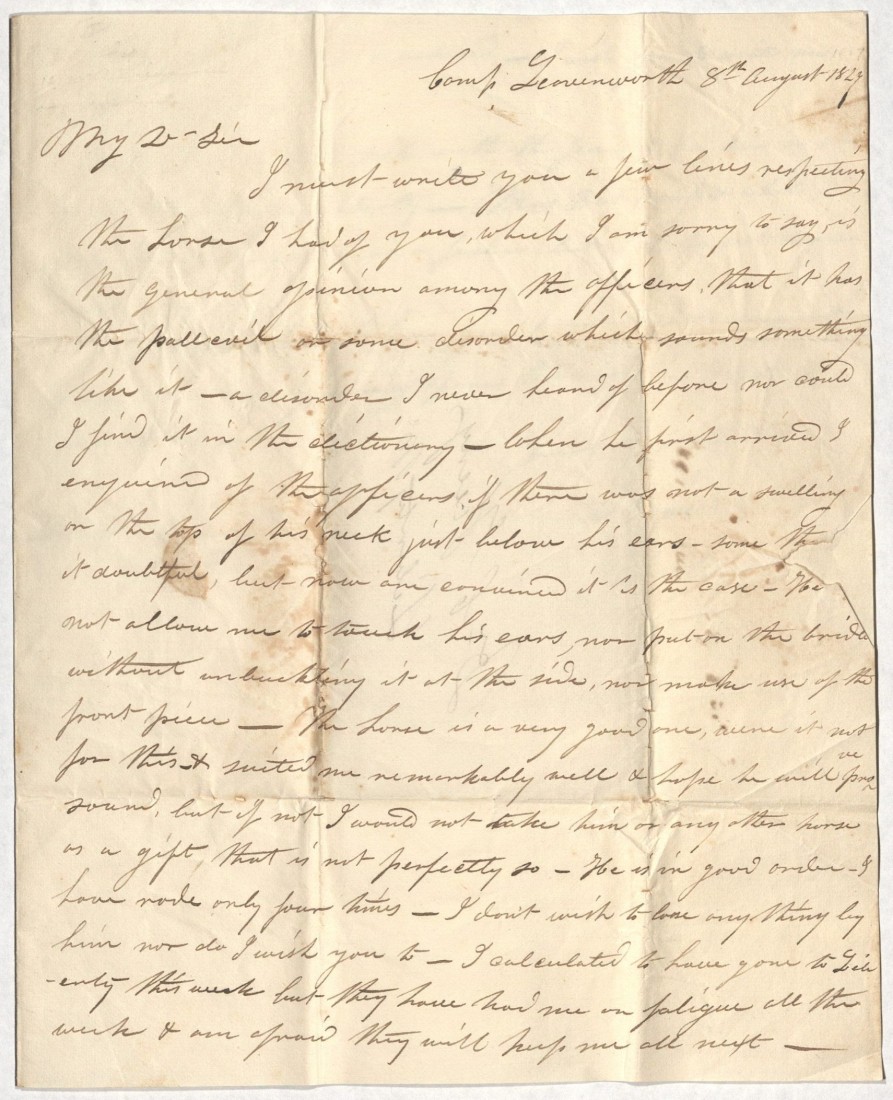
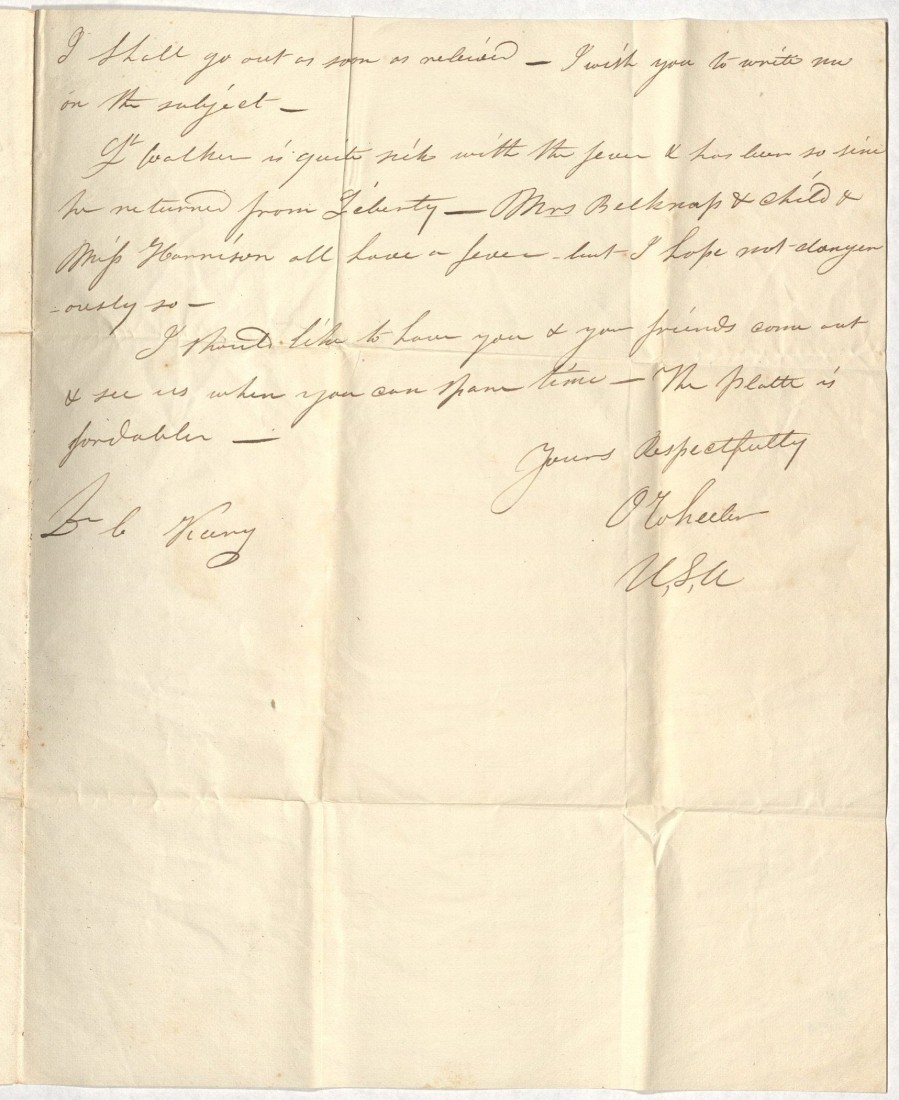
A letter from O. Wheeler, Camp Leavenworth, Kansas, to Dr. C. Keeny, Liberty, Missouri, August 8, 1827. Most of the letter concerns a “disorder” or illness affecting Wheeler’s horse. The U. S. Army established Camp (now Fort) Leavenworth in 1827, the same year this letter was written, to serve as a forward base protecting the Santa Fe Trail. Call Number: RH MS P174.
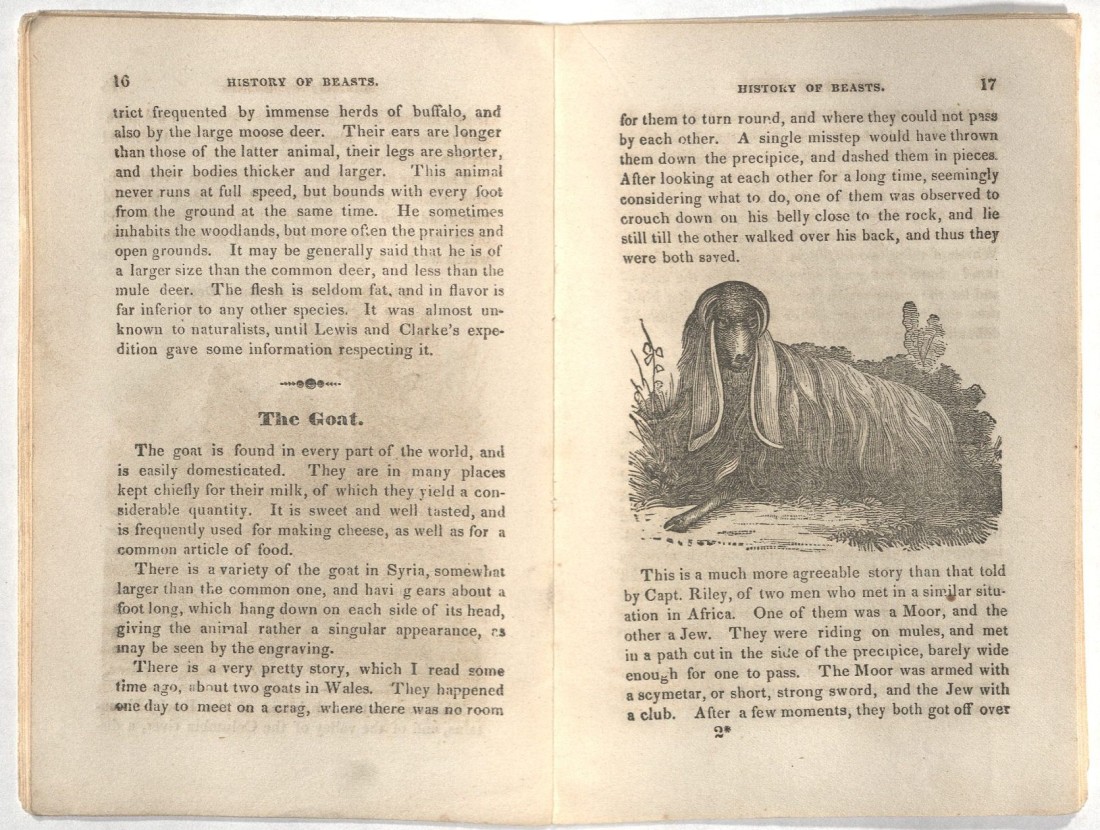
Information and commentary about goats in the children’s book The Natural History of Beasts: Illustrated with Cuts, 1843. The lesson the author draws from the two featured stories is that “surely the goats were wiser than the men – and let the young reader learn from this, that kindness and humanity are better calculated to remove difficulties than pride and obstinacy.” Call Number: Children 504B. Click image to enlarge.
Selected Additional Collection Items
Maps
Regni Mexicani seu Novæ Hispaniæ, Floridæ, Novæ Angliæ, Carolinæ, Virginiæ, et Pennsylvaniæ, nec non insvlarvm archipelagi Mexicani in America septentrionali [The Kingdom of Mexico, or New Spain, Florida, New England, the Carolinas, Virginia, and Pennsylvania, as Well as the Insular Archipelago of Mexico in North America] by Johann Baptist Homann, 1722. Call Number: Orbis Maps 1:60.
A Map of Louisiana and Mexico = Carte de la Louisiane et du Mexique, 1820. Call Number: Orbis Maps 1:134.
Map of the Western Territory of the United States by Lt. Enoch Steen. Coverage includes Indian lands from 80 miles east of Leavenworth to 50 miles west of Pikes Peak and Black Hill to Santa Fe. Call Number: RH Map S31.
A Map of the Indian Territory, Northern Texas and New Mexico: Showing the Great Western Prairies by Josiah Gregg, from Commerce of the Prairies, 1844. Call Number: RH Map Q57.
Mapa de los Estados Unidos de Méjico [Map of the United States of Mexico], 1847. Call Number: Orbis Maps 2:61.
Map of Santa Fe County, New Mexico, 1880s? Shows railroads and pre-European pueblos in and near Santa Fe County. Call Number: RH Map R529.
New Spain and Mexico
Exploratory Travels Through the Western Territories of North America by Zebulon Pike, 1811. During his 1806-1807 expedition to the region south and west of the Louisiana Purchase, Pike ended up in Spanish territory. His party was captured by Spanish soldiers, and their subsequent journey took them through Santa Fe. Call Number: D678.
Memoirs of the Mexican Revolution: Including a Narrative of the Expedition of General Xavier Mina by William Davis Robinson, 1820. Call Number: Howey C4191.
Six Months’ Residence and Travels in Mexico by William Bullock, 1824. Call Number: Ellis Aves C207.
A View of South-America and Mexico, Comprising Their History, the Political Condition, Geography, Agriculture, Commerce, &c. by John M. Niles, 1825. Call Number: B11232.
New Mexico, Santa Fe, and the Santa Fe Trail
The Daily New Mexican newspaper, published in Santa Fe, 1880-1881. Call Number: RH H24.
Santa Fe: Ancient and Modern, Including Its Resources and Industries edited by W.G. Ritch, 1885. Call Number: RH C1375.
Southwest on the Turquoise Trail: The First Diaries on the Road to Santa Fe edited by Archer Butler Hulbert, 1933. Call Number: RH C451.
Historic Santa Fe, Founded About 1525: Oldest Town in the United States: The End of the Old Santa Fe Trail, 1940s? Call Number: RH AK121.
Santa Fe Trail: First Reports, 1825 by Augustus Storrs and Alphonso Wetmore, 1960. Call Number: RH B1126.
Household Matters
Quatro libros de la naturaleza, y virtudes de las plantas, y animales que estan receuidos en el uso de medicina en la Nueua España [Four Books on the Nature and Virtues of Plants and Animals for Medicinal Purposes in New Spain] by Francisco Hernandez, 1615. Call Number: Summerfield B2225.
Mexican recipes, early 1800s. This is a collection of culinary recipes – written in various hands and mostly undated – that appear to be from central and southern Mexico. The collection was previously featured on Spencer’s blog. Call Number: MS 346.
A New Dictionary of the Spanish and English Languages compiled by by Henry Neuman, 1823. Call Number: C26852.
El cocinero mexicano, o Coleccion de las mejores recetas para guisar al estilo americano [The Mexican Cook, or Collection of the Best Recipes for Cooking in the American Style], volume 3 only, 1831. This work is one of two cookbooks from 1831 that are considered the first on Mexican cuisine published in Mexico. Call Number: B14945.
Good luck to all Kansas law school graduates who are taking the bar exam next week! In honor of the occasion, we’re sharing the first two parts of the first Kansas bar exam, which was administered in Topeka on October 13-14, 1903, and later published in the Summary of the First Year’s Work of the State Board of Law Examiners. The Board’s first three annual reports – which include the bar exams administered during those years – can be found in Spencer’s collections (Call Number: RH C5864), although they are housed at the Annex and must requested ahead of a Reading Room visit.
The general guidance to “follow instructions in the Bulletin of Information to Applicants” included in the first exam was replaced by more specific instructions in the second (February 1904) exam: “The Board calls special attention to the fact that answers ‘yes’ and “no” will not be considered. In every case give the principles involved and the reasons for the answer. ” This statement was repeated for the third exam in June 1904, and additional clarification was added: “Write your answers plainly, on one side of the paper only, and guard your spelling and punctuation. Accuracy, clearness, and conciseness will be given weight.”
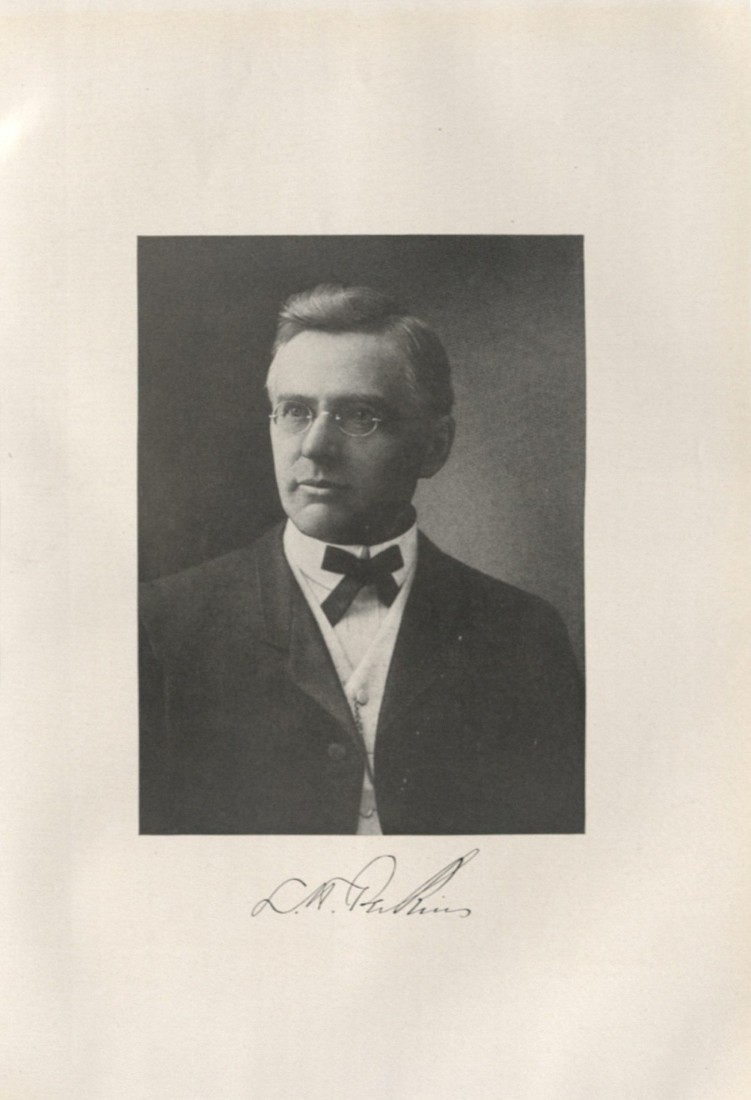
Portrait of Lucius H. Perkins (1855-1907), the first secretary of the Kansas State Board of Law Examiners, in A Standard History of Kansas and Kansans by William E. Connelley, volume 5, 1918. Call Number: RH D214. Click image to enlarge.
More details about the first bar exam can be found in the paper “The State Board – A Landmark in Lawyer-making” by Lucius H. Perkins, D. C. L., secretary of the Kansas Board. Perkins presented the paper at the first national conference of the State Boards of Law Examiners, which was held at the St. Louis World’s Fair in 1904. It was reprinted – “by request” – in the Board’s Second Annual Report (1904-1905). Perkins noted that applicants who had been “admitted to the highest courts of another jurisdiction and actually practiced for more than three years immediately preceding their application” were tested via an oral examination. Beyond that,
“all other examinations are in writing. We proposed eighty questions, divided into four sessions of three hours each [across two days]. We require a few definitions and ask a few categorical questions; but by far the greater number are hypothetical, and are intended to raise the ordinary questions that might be put to a lawyer any day. We ask no catch [trick] questions, nor any of extraordinary difficulty. Our aim is to test the applicant’s mental caliber as well as his knowledge of the law, and we give good credit for a brainy answer even though the solution be wrong…
At the beginning of an examination the clerk of the supreme court [sic] gives each applicant a number, with which he signs all his papers. The board does not know one from another, and each performance is passed upon solely on [sic] its merits. This impersonal method relieves the board from every suspicion of partiality.”
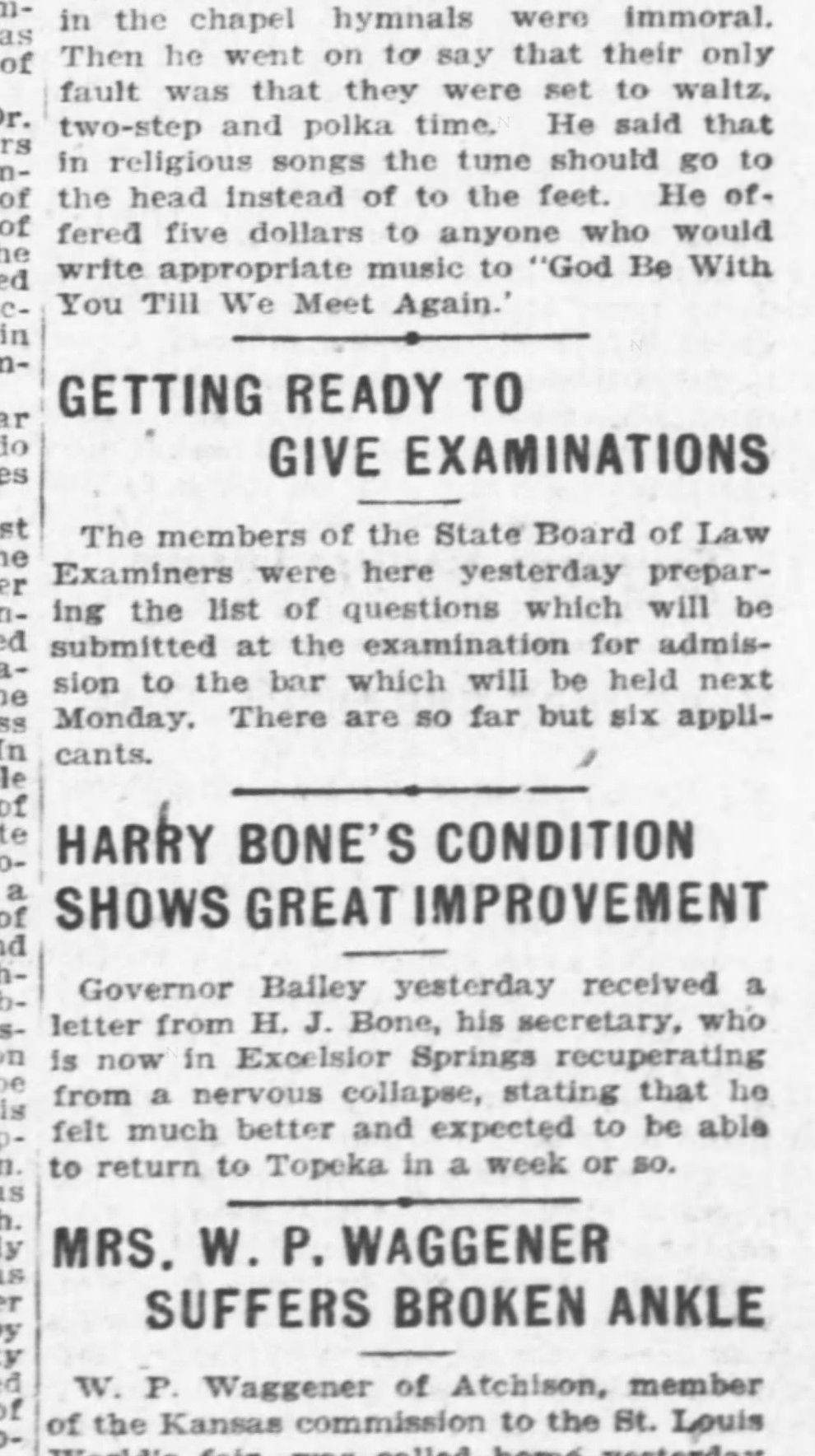
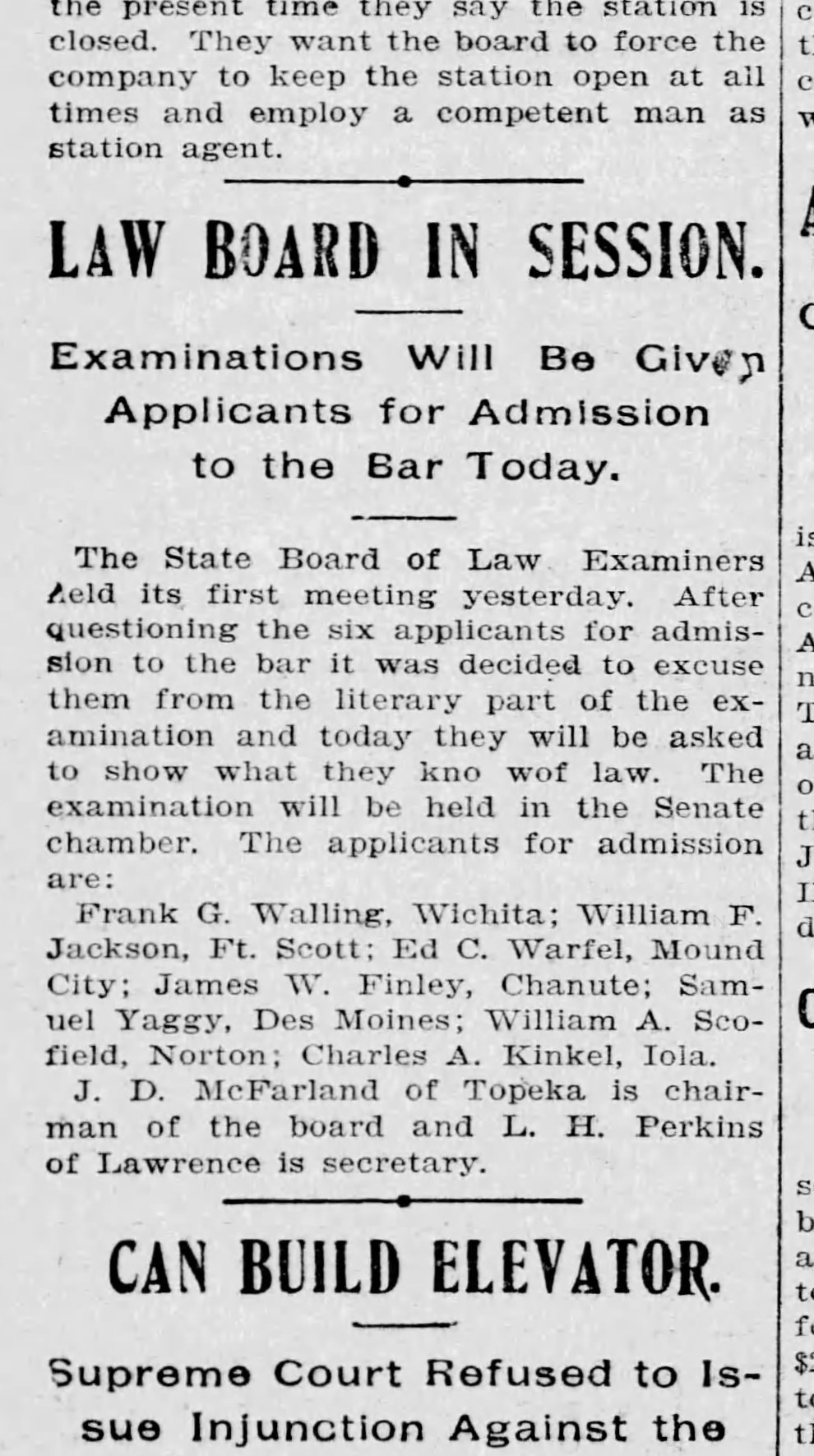
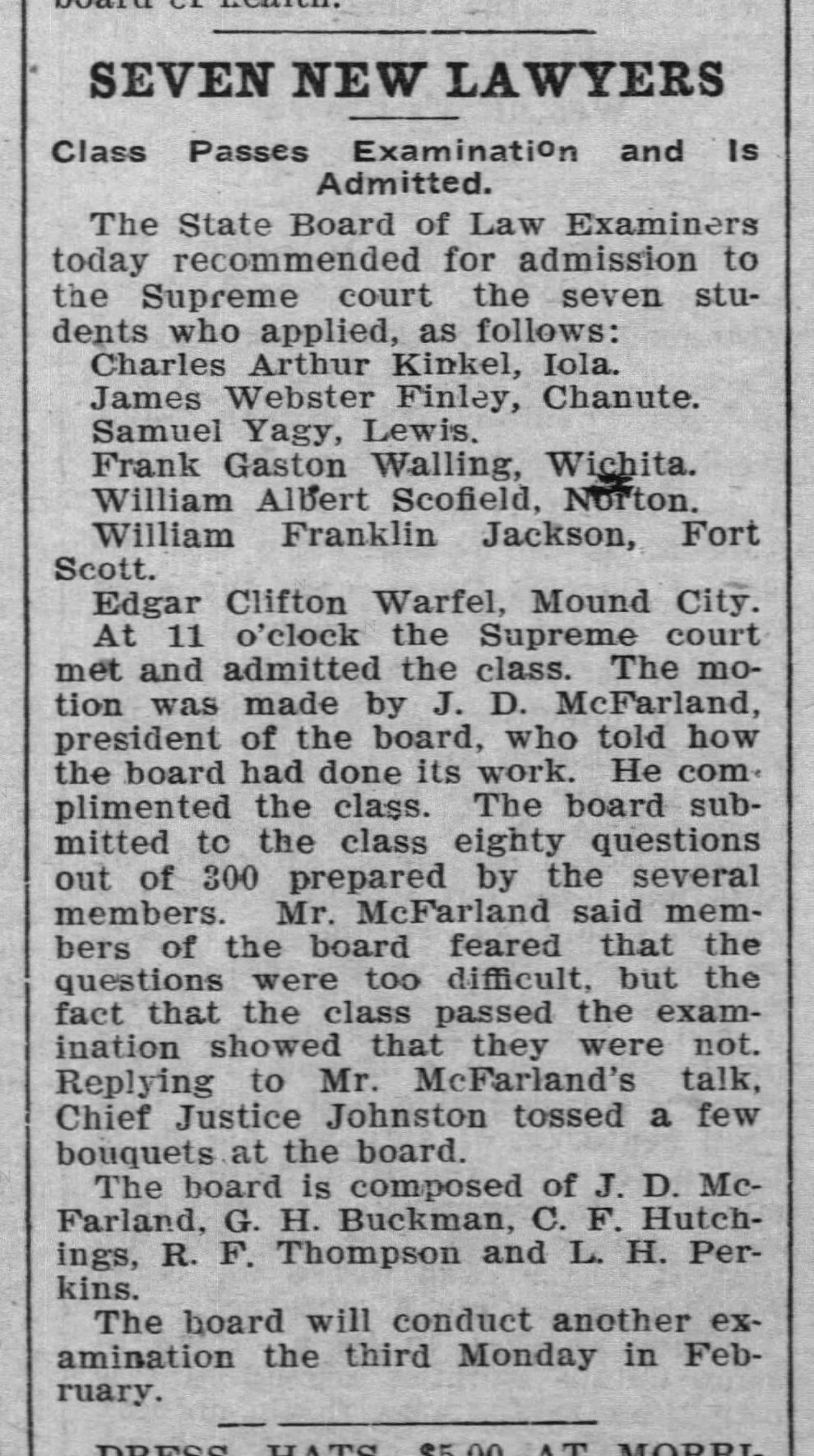
Newspaper coverage of the first Kansas bar exam. Left: The Topeka Daily Capital, October 9, 1903. Middle: Capper’s Weekly: The Kansas Semi-Weekly Capital, October 13, 1903. Right: The Topeka Daily Herald, October 15, 1903. All articles accessed via Newspapers.com. Click images to enlarge.
Additionally in his paper, Perkins describes the process by which individuals applied to take the bar exam, commenting that “the methods adopted by the Kansas board are in accord with the most advanced thought and the most successful experience in this work.”
“We furnish each applicant a regular set of printed forms, consisting of an application, affidavit of the applicant, affidavit of his preceptor, and a certificate of the local district judge and three practicing attorneys that he is a person of good moral character, and, if qualified, a suitable person to be admitted to the bar. We also send a copy of the rules and a bulletin of information. The applicant is required to frame his petition to the supreme court [sic], and it must be in his own handwriting. He files his petition in the office of the clerk of the supreme court, and sends a copy of it with all his other papers to the secretary of the board. In the application he gives his history, and especially the character of his education, the studies pursued, and what he has been doing for the past five years.
One of the most important requirements is that he give a satisfactory account of himself, and no man will be received in the examination if there is any cloud upon his character. We cannot reach the rascals who are already in, but the State Board of Law Examiners stands between [unscrupulous attorneys] and the lawyers of the future. We cannot catch them all, but we shall stop those whose rascality is already known.
Our requirements of preliminary education are equal to a four-year course in a standard high school. No diploma, ipso facto, admits the applicant to the examination. We reserve the right to determine what schools shall be accredited, and a diploma from a law school does not excuse the applicant from the preliminary examination, unless the standard of admission is up to the standard of the board. All applicants are examined. Graduates from our own or any other university or law school are not exempt.”
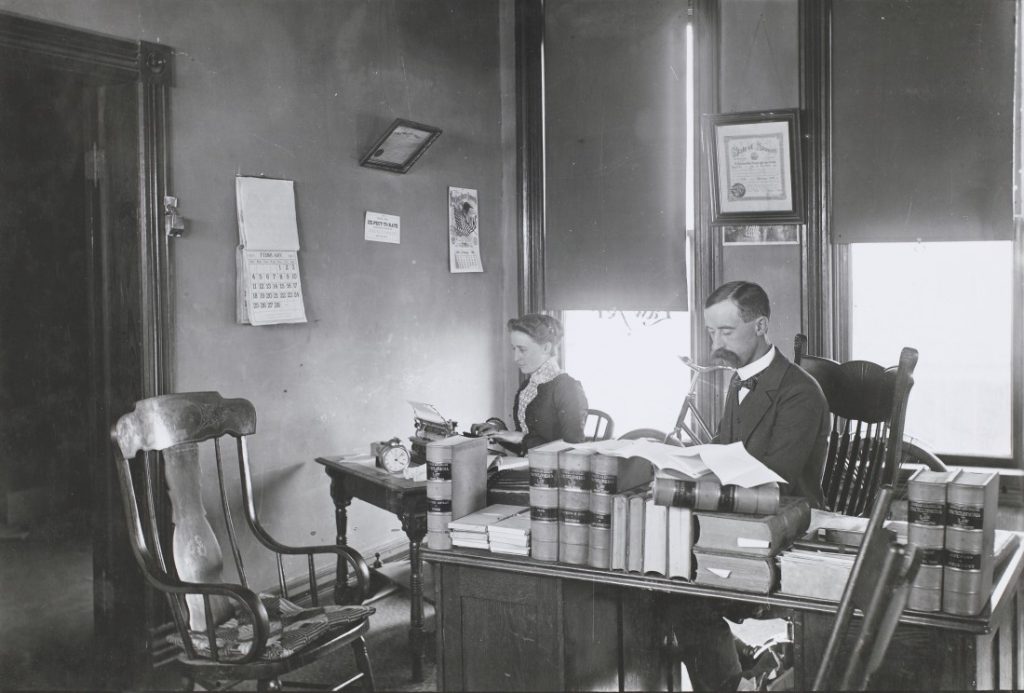
The interior of J. D. Rairdon’s law office in Junction City, Kansas, 1903. Joseph Judd Pennell Photograph Collection. Call Number: RH PH Pennell. Click image to enlarge (redirect to Spencer’s digital collections).
Readers, do you have a favorite question from the first Kansas bar exam?
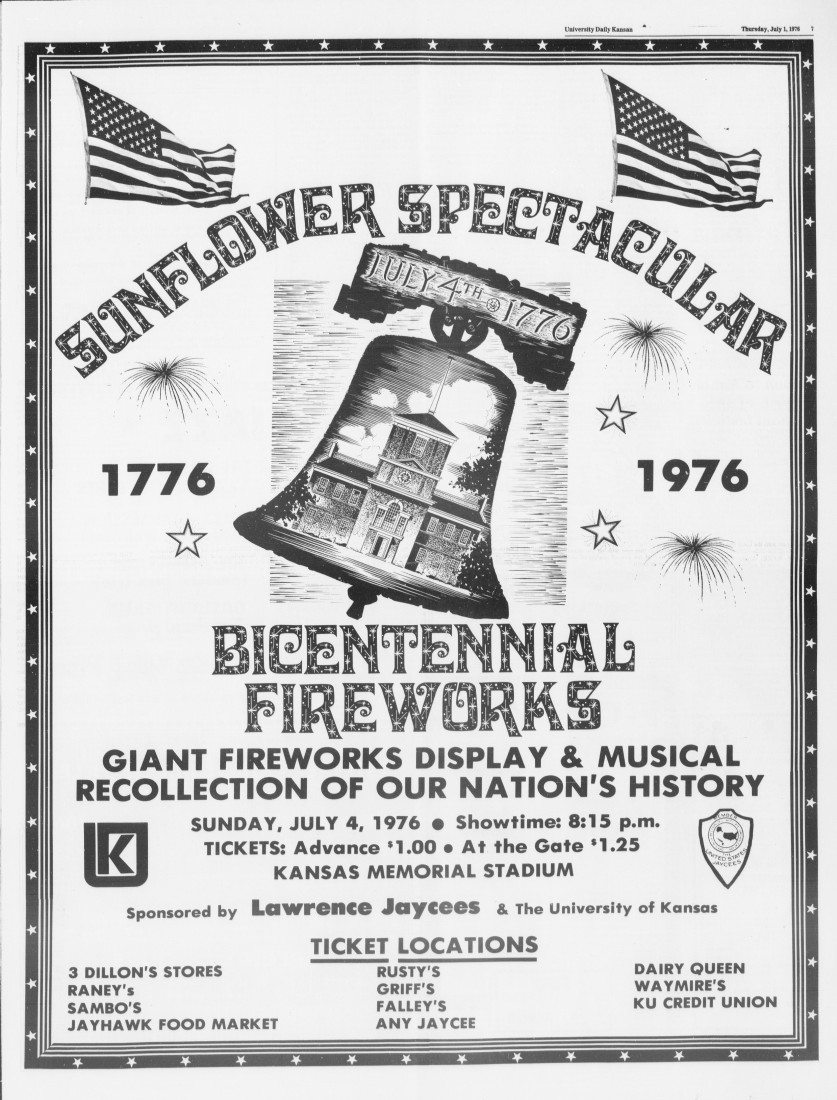
In honor of the celebrations surrounding the 250th birthday of the United States this week, we’re taking a look back at how KU commemorated the bicentennial fifty years ago.
A full-page advertisement in the University Daily-Kansan for the Sunflower Spectacular bicentennial fireworks show, July 1, 1976. University Archives. Call Number: UA Ser 69/2/1. Click image to enlarge (redirect to Spencer’s digital collections).
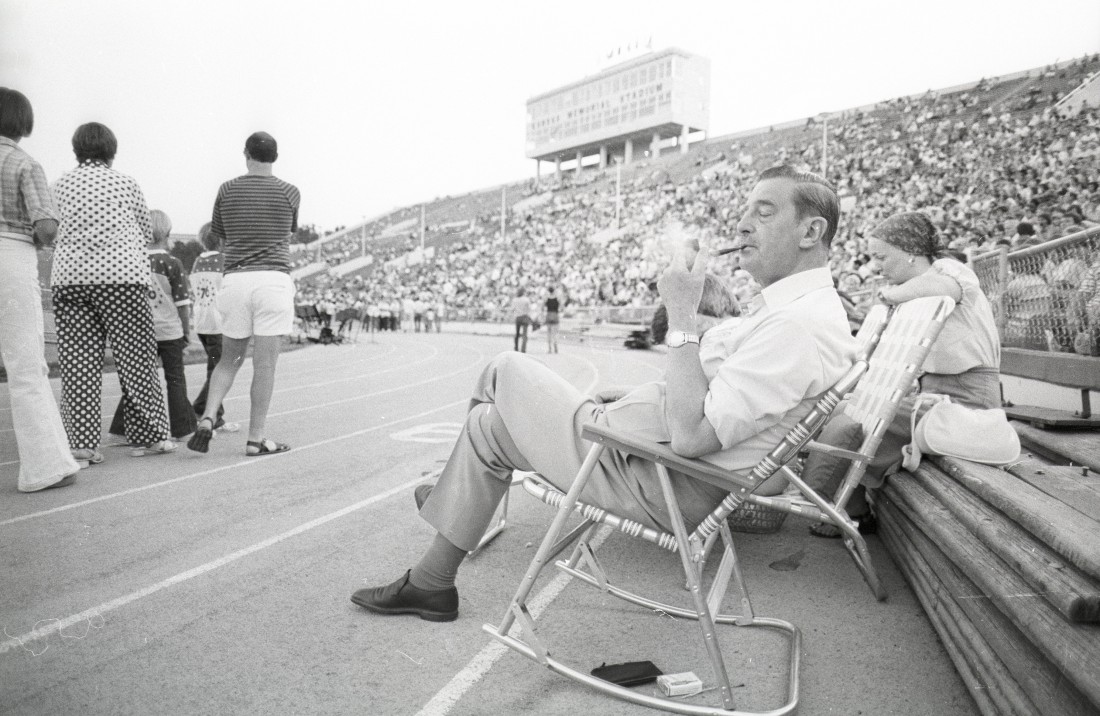
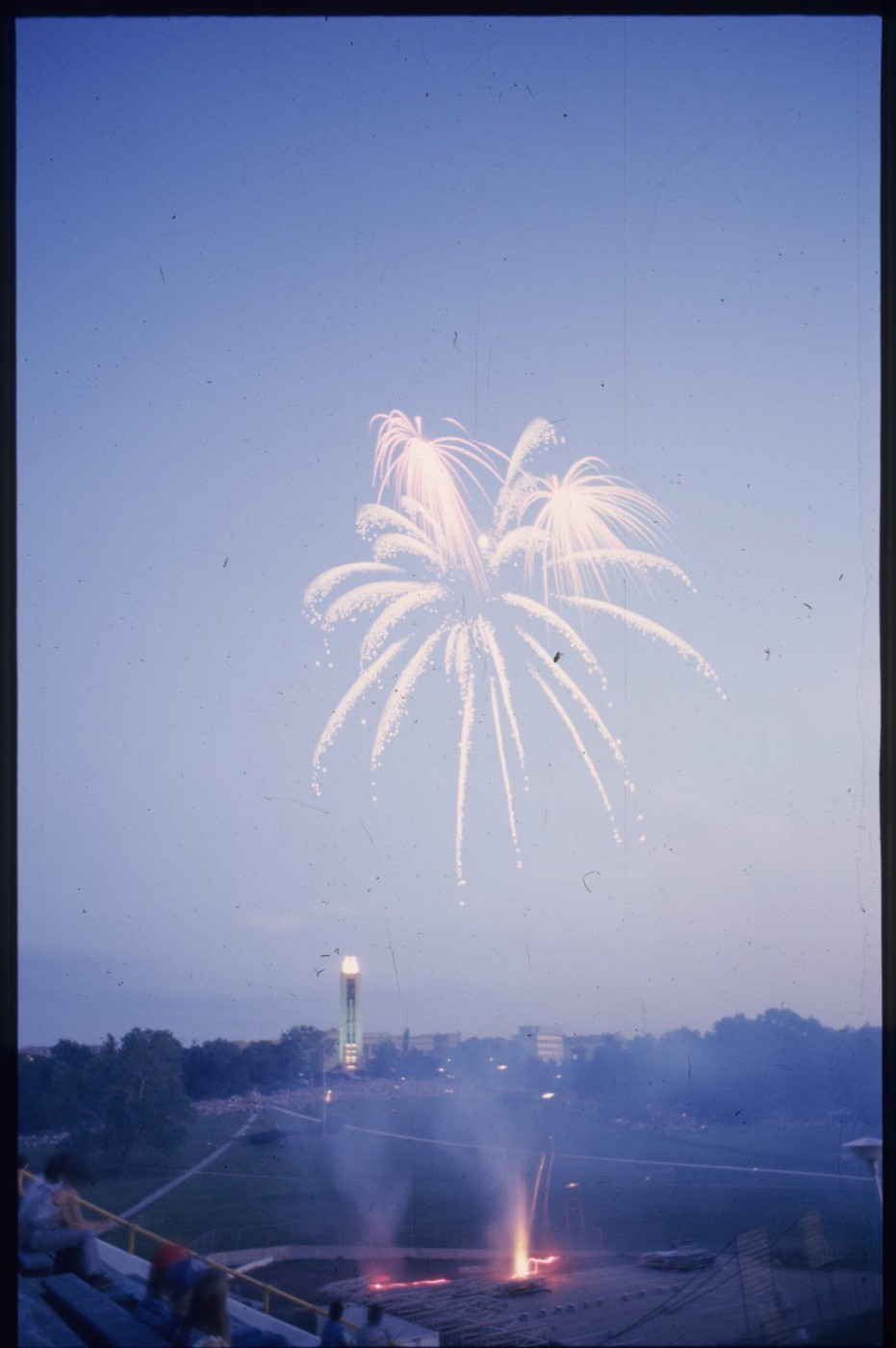
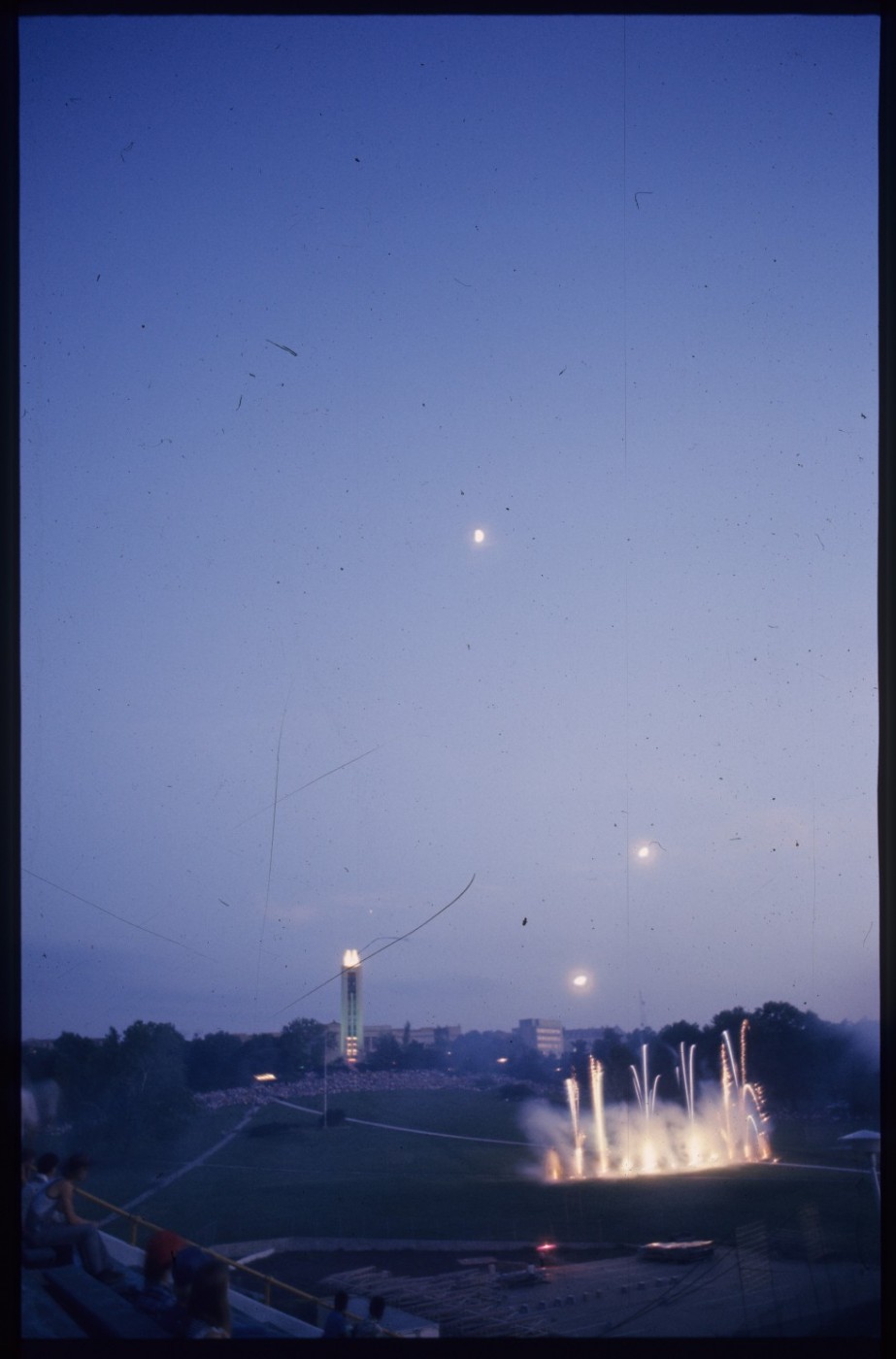
A year of intensive planning, special projects, and varied events at the university culminated in the Sunflower Spectacular fireworks show at Memorial Stadium on July 4, 1976. The show “featured the cooperation of the University Alumni Association with Vince Bilotta as coordinator, the Summer Band Camp under the direction of Robert Foster, and the Lawrence Jaycees with their annual sponsorship of the fireworks display.” Prior to the show were afternoon and evening performances of patriotic music at the Memorial Campanile and Carillon, part of a bicentennial summer concert series. Lawrencians also participated in a broad array of off-campus festivities that weekend, concluding the Douglas County Bicentennial Commission’s similarly busy and productive year.
People at Memorial Stadium for the Sunflower Spectacular show, July 4, 1976. Photo by George Millener for the Lawrence Journal-World. Lawrence Journal-World Photograph Collection. Call Number: RH PH LJW (negatives). Click image to enlarge.
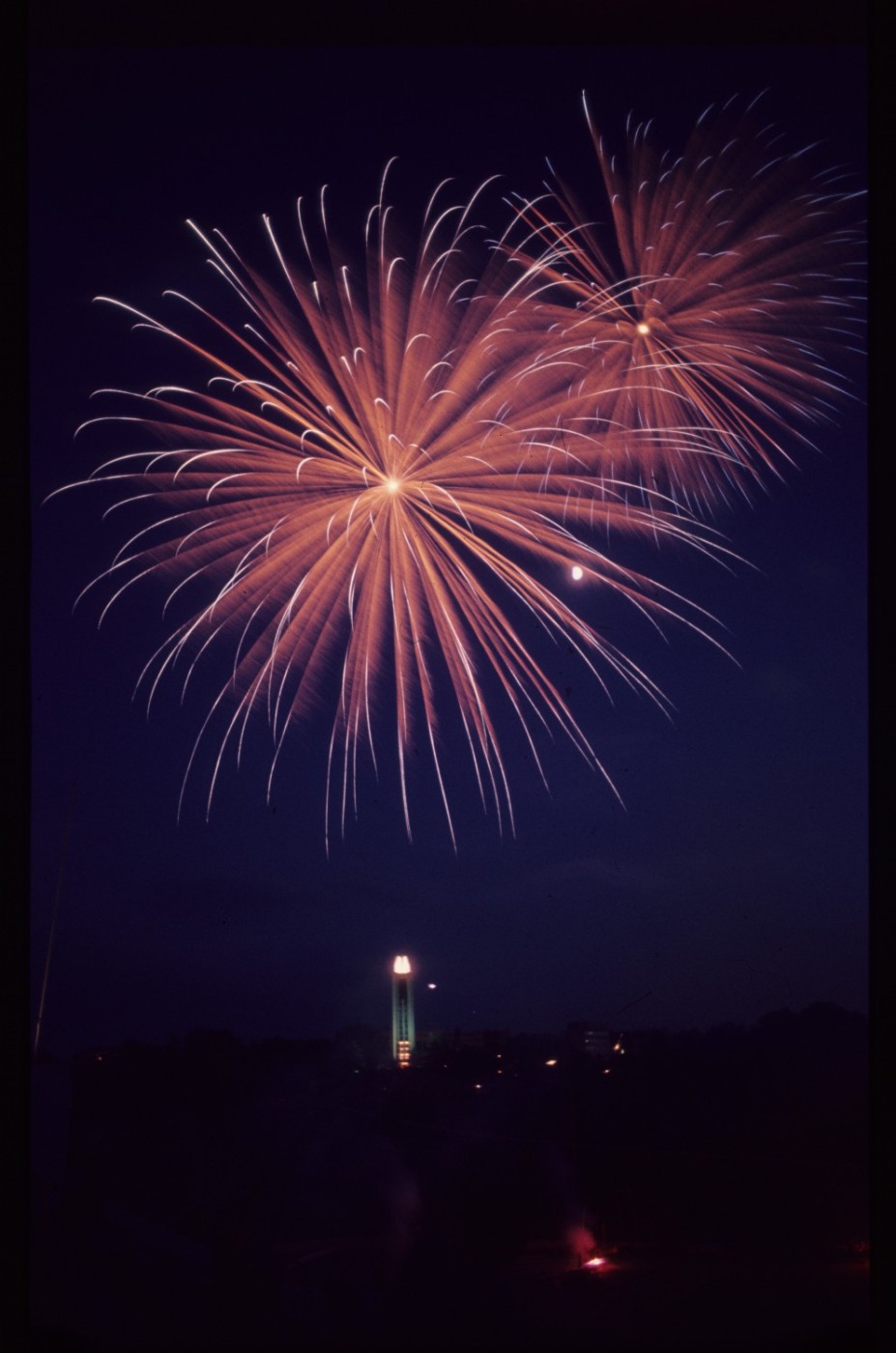
Fireworks during the Sunflower Spectacular show, July 4, 1976. In the first two images, note the spectators on the hill near the Campanile. Photos by George Millener for the Lawrence Journal-World. Lawrence Journal-World Photograph Collection. Call Number: RH PH LJW (negatives). Click images to enlarge.
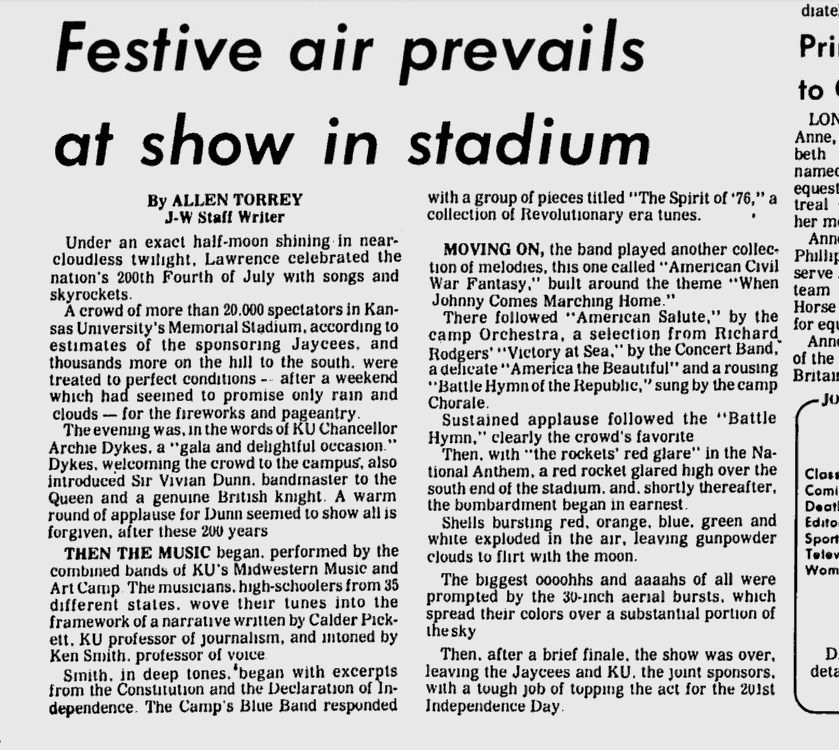
A description of the fireworks show and preceding musical program in the Lawrence Journal-World, July 5, 1976. Article courtesy of the Google News Archive. Click image to enlarge.
A questionnaire attached to the final report of KU’s seventeen-member Bicentennial Committee stated that 1,335 individuals had been “actually involved and participating” in its various commemorative efforts. The Committee also estimated that more than 70,500 people had attended KU’s bicentennial events (“based on estimates where numbers could be determined”). “The philosophy of the University Bicentennial Committee,” noted the document, “was reflected in the nature of the projects and events that were identified and sponsored. The emphasis was upon activities that coordinated closely with the major missions of the University in its academic programs, its research projects, and its responsibility of service to the people of the state of Kansas.”
Reflecting back on the academic year, the editors of the 1976 Jayhawker yearbook wrote (somewhat hyperbolically):
If nothing else, the student of ’76 always will remember this year for the pomp and sure-coin-stance of the American Revolution Bicentennial. Attending an official Bicentennial university, living in an official Bicentennial community, taking a course in the history of the American Revolution from W. Stitt Robinson, professor of history and chairman of the KU Bicentennial Committee, celebrating homecoming with the theme of Jayhawk Rebellion, going to one of the five Humanities Series lectures with a Bicentennial theme, taking in a Saturday afternoon of Bicentennial music at Off-the-Wall-Hall, watching the official Bicentennial flag flutter in the Bicentennial breeze, seeing musical presentations, theater productions and museum exhibits with a Bicentennial flavor, applauding a Bicentennial Rock Chalk Revue, seeing the KU Symphonic Band off for a Bicentennial tour and dancing to Bicentennial banjos in a Bicentennial street dance during a Bicentennial Festival of the Arts were some of the things the Bicentennial student did.
If you’re a fan of soccer in general or Team Algeria in particular, be sure to stop by Spencer Research Library this summer and check out our small exhibit in honor of this year’s FIFA World Cup.
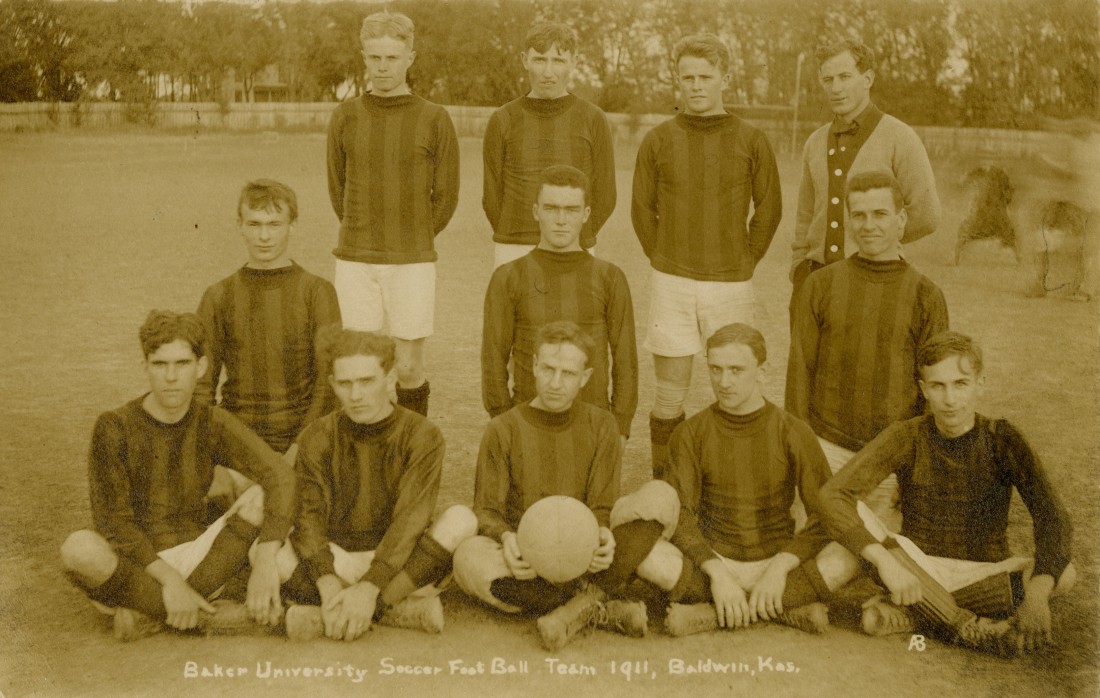
A photograph of the Baker University soccer team in Baldwin City, Kansas, 1911. Leonard Hollmann Photograph Collection. Call Number: RH PH 536. Click image to enlarge.
One case features materials documenting the history of soccer locally and internationally. For example, Matthew Concanen’s 1721 work A Match at Foot-Ball; Or the Irish Champions: A Mock-Heroick Poem, in Three Canto’s (Call Number: B519) is a very early account of “foot-ball,” a precursor to modern Association Football (soccer), Rugby, and Gaelic Football, which were not codified separately until the mid-1800s.
The other case in this display highlights items about the history of Algeria, whose national soccer team is based in Lawrence during the tournament. The exhibited items span more than four centuries and reveal both European and Algerian perspectives toward the North African country.
An illustration of the Algerian capital Algiers in Description de l’Afrique [Description of Africa] by Olfert Dapper, 1686. Heavily defended under Ottoman rule during the 1500s and 1600s, Algiers was protected by the series of fortifications, walls, and gates seen in this image. Call Number: Summerfield E1118. Click image to enlarge.