The Magic of Classic Children’s Books: The Little Golden Books Series
September 10th, 2026Classic children’s books continue to connect generations through stories that inspire imagination, adventure, and wonder. In this fifth post in a series highlighting titles from Spencer Research Library’s vast children’s book collection, I’ll explore the classic series: Little Golden Books.

Children’s books offer more than stories. As physical objects, they preserve evidence of how young readers learned, collected, shared, and experienced books across generations. Few books reveal the history of childhood as vividly as Little Golden Books. Long before they entered library collections, they served as affordable companions in childhood, passing through the hands of generations of young readers.
Among the countless treasures preserved at Spencer Research Library, Little Golden Books stand out because they were never intended to be rare or exclusive. They were affordable, mass-produced books created for everyday childhood reading. Unlike finely bound volumes designed for collectors, these books were meant to be handled by small hands, carried from room to room, and read over and over again.

Particularly notable among Spencer’s holdings are four of the twelve original Little Golden Books released in 1942: The Little Red Hen, Nursery Songs, The Poky Little Puppy, and The First Little Golden Book of Fairy Tales.
Little Golden Books are one of the oldest and likely the longest running continuously published children’s book series, still releasing new titles today. For more than eight decades, generations of children have recognized the distinctive gold spine on books ranging from classic stories to contemporary favorites. The series grew from a small collection of affordable children’s books into a publishing phenomenon that shaped generations of young readers.
When Little Golden Books first appeared in the early 1940s, they represented a significant shift in children’s publishing. Their creators sought to produce books that families could afford and children could enjoy independently. The result was a compact, durable format accompanied by engaging illustrations and a price point that made ownership possible for many families. They sold for just twenty-five cents, a fraction of the cost of most children’s books of the era. Their creators aimed to make books accessible to a much wider audience than traditional children’s publishing had previously reached. For most children, a Little Golden Book was one of the first books they could truly call their own. Their low cost placed ownership within reach of families who might not otherwise been able to purchase children’s books, allowing children to build personal collections one volume at a time.

The books themselves were designed with young readers in mind. Large type, uncluttered layouts, and abundant illustrations made them appealing to children who were just beginning to develop literacy skills. Even before a child could read independently, illustrations offered a way to engage with stories and follow their narratives. Illustrations played a significant role in the success of Little Golden Books. For many children, the pictures were as memorable as the stories themselves.
Full-color printing increased production costs, publishers often combined color and black-and-white illustrations within the same volume. This approach helped keep books affordable while maintaining visual appeal. A particularly striking example appears in The Taxi That Hurried, where a panoramic illustration stretches across facing pages printed in both color and black and white. The spread illustrates how publishers balanced engaging artwork with economical production methods.

Affordability alone, however, did not guarantee success. Publishers also expanded where children’s books could be found, placing Little Golden Books in department stores (like Filene’s), drug stores, supermarkets, and other everyday retail spaces rather than only in bookstores. The shiny gold spine made each book feel special like a treasure to cherish. The recognizable gold spines, bright covers, and low price worked together to make reading approachable and accessible.
Little Golden Books were marketed not simply as individual books, but as part of a larger series. Publishers encouraged readers to discover additional titles through lists printed on back covers. These lists transformed each book into a child’s wishlist.
Books preserved in Spencer’s collection reveal the remarkable growth of the series over time. An edition of The Poky Little Puppy advertises only a few dozen titles available, while later books list well over one hundred titles. The books themselves document the expansion of the publishing program and the increasing variety available to young readers.
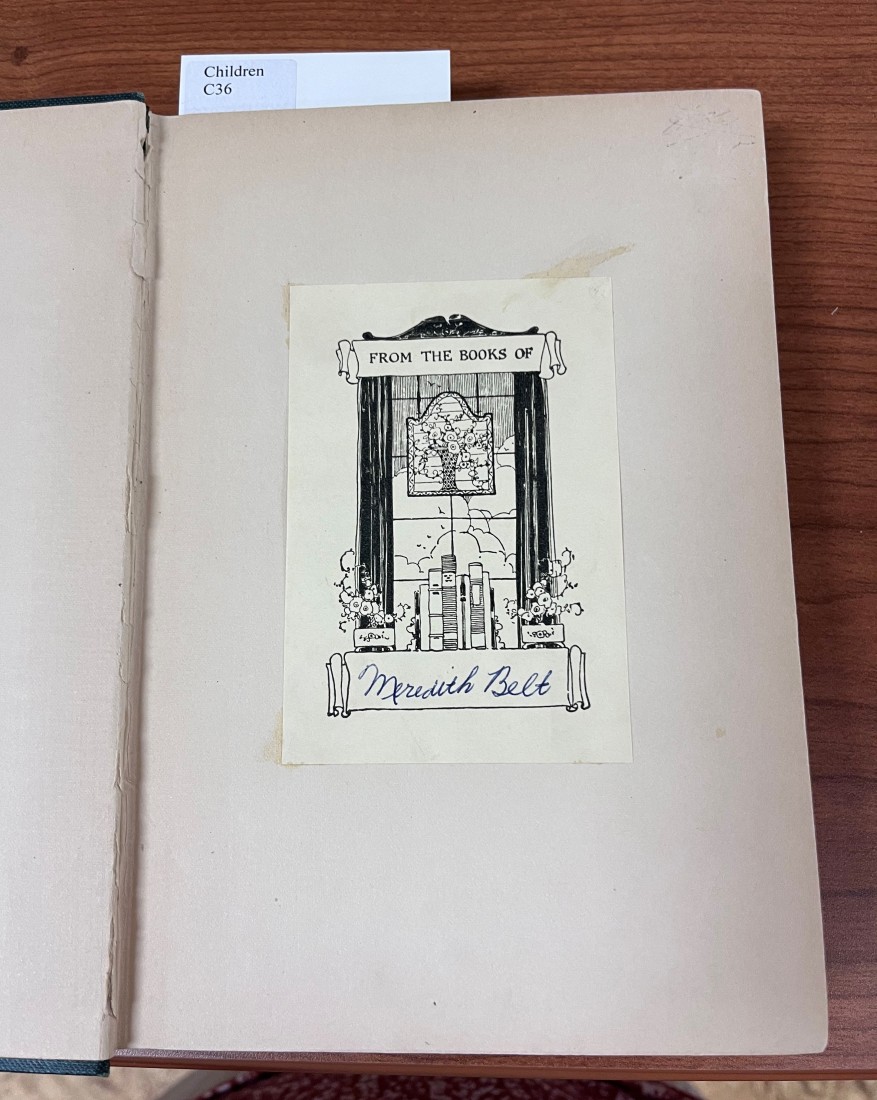
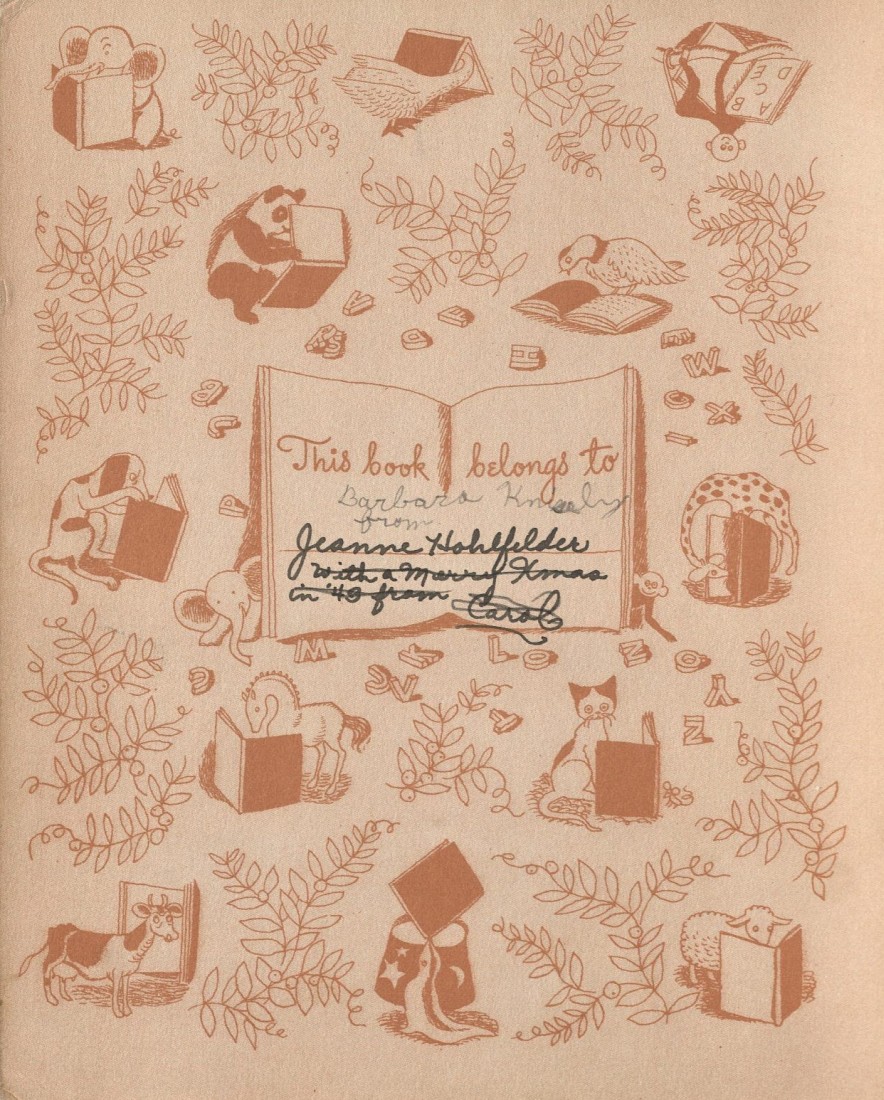
Although Little Golden Books were mass-produced, no two surviving copies necessarily share the same history. Gift inscriptions, ownership markings, and names written on endpapers transform standardized commercial products into individualized artifacts. These handwritten traces document the children and families who owned the books and remind us that Little Golden Books were frequently given as gifts for birthdays, holidays, book themed baby showers, and other special occasions.

Gift inscriptions and ownership marks document how Little Golden Books circulated among families and became part of everyday childhood experiences. Left: Chip Chip, 1947. Call Number: Children C947. Right: The First Little Golden Book of Fairy Tales, 1946. Call Number: Children 3681. Click images to enlarge.
After the stories themselves faded from memory, other things remained: the shine of a gold spine catching the light on a bedroom shelf, pages worn soft at the corners, a carefully written name inside the cover, a favorite and read again and again. The books were taken on long car rides, tucked beneath a pillow, buried in a toy box, or kicked across the living room floor before being gathered up with sticky fingers and read again. Others disappeared beneath couch cushions, were packed into Going to Grandma’s bags, or sat in a stack beside the bed waiting for bedtime. Covers became creased. Spines lost their shine. Yet those signs of wear are reminders that these books were doing exactly what they were meant to do: being loved.

Many Little Golden Books still survive in family collections, tucked away in boxes, resting on bookshelves, or passed from one generation to the next. Years later, they become reminders of a time when a child could still snuggle beside you for a story, when the day’s worries paused for a few pages, and when an inexpensive little book could feel like treasure.
Their gold spines made them feel important. Not because they were rare or valuable, but because they belonged to someone. They were the books children reached for at bedtime and lined up on shelves as a small collection grew one title at a time.
One day there are only a few books on the shelf. Then there are ten. Then twenty. Before long, a small row of shiny gold spines becomes a child’s first library, growing quietly alongside the child who treasures it. Without realizing it, parents measure the passing years in bedtime stories, favorite characters, and books that become worn through use and affection.

Long after the gold spine has faded and the corners have softened, the memory remains: the sound of pages turning, a familiar voice reading aloud, and the quiet realization that the little library built one story at a time was never just a collection of books. It was a record of a childhood that passed far too quickly. The stories come to an end, the bookshelf fills up, and the years slip by. But what remains are the memories and the quiet magic of sharing a story together.
Copies of Little Golden Books (published by Simon and Schuster, New York) in Spencer’s holdings:
- Little Red Hen, illustrated by Rudolf Freund, 1942 (Call Number: Children 3680).
- Nursery Songs, arranged by Leah Gale and illustrated by Corinne Malvern, 1942 (Call Number: Children 3675).
- Poky Little Puppy by Janette Sebring Lowrey, illustrated by Gustaf Tenggren, 1946 (Call Number: Children B2889).
- The First Little Golden Book of Fairy Tales, illustrated by Gertrude Elliott, 1946 (Call Number: Children 3681).
- A Day in the Jungle by Janette Sebring Lowrey, illustrated by Tibor Gergely, 1943 (Call Number: Children B2888).
- The Lively Little Rabbit by Ariane [Georges Duplaix], illustrated by Gustaf Teggren, 1943 (Call Number: Children B2701).
- Nursery Tales, illustrated by Masha [Maria Simchow Stern], 1943 (Call Number: Children: C866).
- Fairy Tales, illustrated by Gertrude Elliott, 1946 (Call Number: Children 3681).
- The Taxi That Hurried by Lucy Sprague Mitchell, Irma Simonton Black, and Jessie Stanton; pictures by Tibor Gergely, 1946 (Call Number: Children C863).
- The Seven Sneezes by Olga Cabral; pictures by Tibor Gergely, 1948 (Call Number: Children C862).
- Chip Chip by Norman Wright; pictures by Nino Carbe, 1947 (Call Number: Children C947).
- Walt Disney’s Bambi, adapted by Bob Grant; illustrations from Walt Disney’s Studio, 1948 (Call Number: Children C861).
- Walt Disney’s Cinderella, adapted by Campbell Grant; illustrations from Walt Disney’s Studio, 1950 (Call Number: Children C873).
- Walt Disney’s Alice in Wonderland: Finds the Garden of Live Flowers, told by Jane Werner; pictures by the Walt Disney Studio, 1951 (Call Number: Children 4479).

Meredith Phares
Operations Manager