The University of Kansas

Inside Spencer: The KSRL Blog

Books on a shelf

Welcome to the Kenneth Spencer Research Library blog! As the special collections and archives library at the University of Kansas, Spencer is home to remarkable and diverse collections of rare and unique items. Explore the blog to learn about the work we do and the materials we collect.

This blog may contain archived web content. This blog may link to catalog records which no longer exist as of a software change in 2026.

A Find in Fraser

September 20th, 2013

This summer I was the Stannard Conservation Lab Intern at the University of Kansas. I worked on many projects, but the most challenging one was treating a large collection of architectural plans. University Archives already has many architectural plans of KU campus buildings, so it was a surprise when more original plans were found in the attic of Fraser Hall. The plans had been rolled up, tied with string, and left for years in the attic. They were stacked on top of each other and very dirty, some showing signs of bird droppings and cobwebs. Due to this rough storage environment, some of the plans were severely damaged, although most were in fairly stable condition. The plans were moved from Fraser’s attic to University Archives until a more appropriate and permanent storage situation could be found.
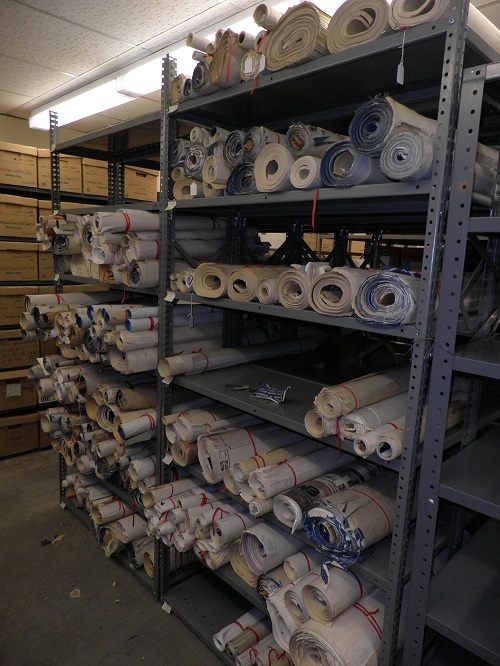
Photograph of architectural plans temporarily stored in University Archives.
Rolled architectural plans temporarily stored in
University Archives. Click image to enlarge.

It is best for architectural plans to be stored flat, not only for their preservation but also to save space. Since the plans were stored rolled for so long, they needed to be humidified and flattened before they could be stored in horizontal files in the Archives. This required some creative thinking by the KU conservation team because a humidity chamber had to be specially made to accommodate these large plans.

The construction of the humidity chamber was finished when I started my internship, so I was able to start right in on developing the work procedure for humidifying and flattening the plans. I developed a documentation process to keep track of the plans that were treated and instituted an efficient work flow to keep the project rolling.
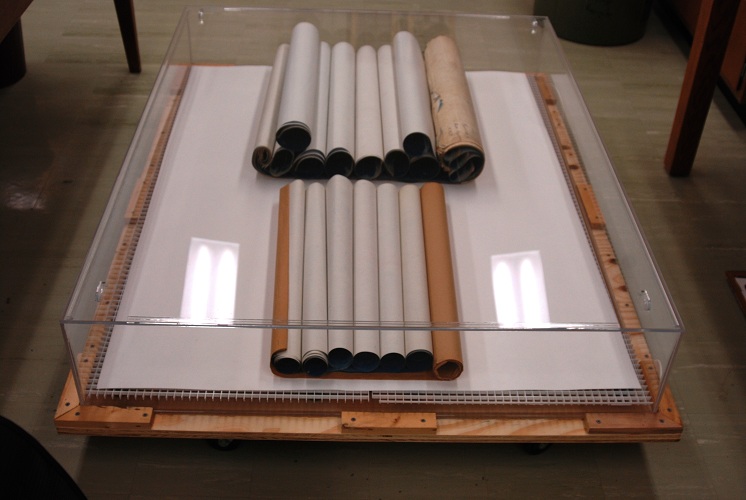
Photograph of the humidity chamber.
The specially-built humidity chamber at KU’s Conservation Lab.
Click image to enlarge.

The rolled plans were sorted by what building they depicted and then moved to the work room in their respective groups. Next, the drawings were prepared for humidification: staples were removed and important information about the plans – including title and date – were recorded in a database. The plans were then humidified and flattened. Lastly, the plans were placed in labeled folders and stored in the Archive’s new horizontal storage cases. The work procedure I developed allowed the other interns to continue the flattening and filing process even after my internship ended.
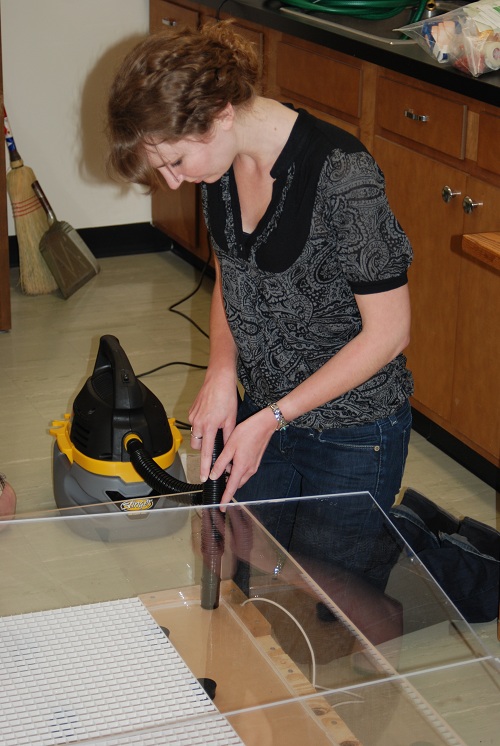
Photograph of Summer Conservation Intern Erin Kraus.
Summer Conservation Intern Erin Kraus removes
water from the humidity chamber with a wet vac.
Click image to enlarge.
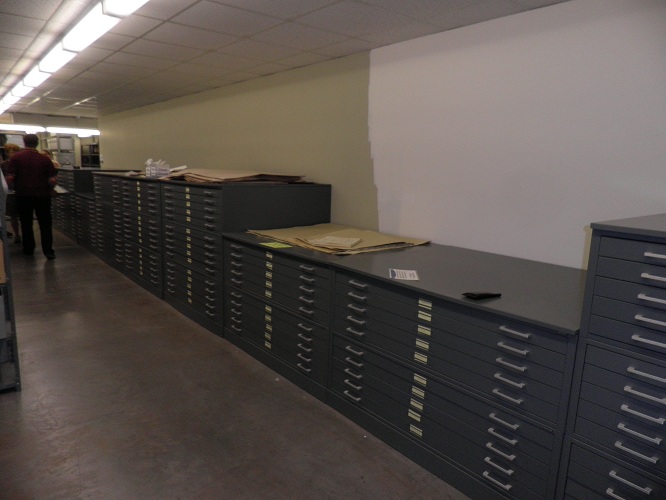
Photograph of horizontal storage cases.
New horizontal storage cases in University Archives.
Click image to enlarge.

These historic plans were an important discovery because they can still be useful to architects today when improvements are being made to buildings. The conservation of the plans so far turned out beautifully, so it was very satisfying to see the progress made on the project.
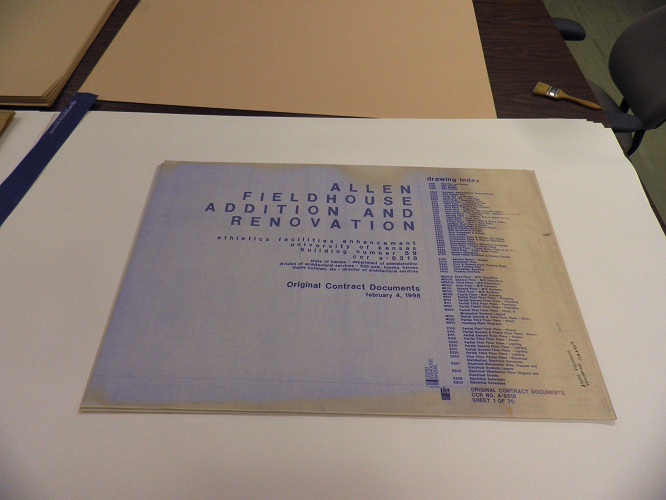
Photograph of humidified and flattened plans.
Architectural plans after humidification and flattening.
Click image to enlarge.

The conservation lab at KU was a great place to spend my summer and I learned a lot from this project. Having an internship in Kansas allowed me to not only spend time in my home state, but to also get to know all of the wonderful people at the Stannard Conservation Lab. Thanks for a great summer!

Erin Kraus
2013 Conservation Summer Intern

“This is a Fun Locality for Botanizing”: Francis H. Snow and KU Students in Colorado

August 30th, 2013

Soon after my arrival at Spencer Research Library, a patron request provided me the opportunity to poke around some of the photographs contained within KU’s University Archives. I was especially excited by a collection of approximately forty-five photographs showing Professor Francis H. Snow with a group of students on a summer collecting expedition to Colorado in the late 1800s.

Photograph of Specimen Mountain Party, No. 3, August 19, 1889 [1891?].
Specimen Mountain Party, No. 3, August 19, 1889 [1891?].
Call Number: RG 17/40/1889 Prints: Biological Sciences (Photos).
Click image to enlarge.

Long a prominent fixture on campus during KU’s early years, Snow (1840-1908) was a professor of mathematics and sciences, 1866-1890; the university’s fifth chancellor, 1890-1901; and a professor of natural history/director of the natural history museum, 1901-1908. His reports to the regents “furnish ample evidence that the direct study of nature was a vital part of his instruction,” wrote Clyde Kenneth Hyder in his biography, Snow of Kansas. His classes “appealed to the impulse to collect, often compelling, whether the objects collected be patchboxes, African violets, or insects” (142-143). Moreover, between 1876 and 1907, Snow – frequently accompanied by his students and sometimes even his family – led twenty-six summer collecting expeditions: eight in Colorado, six in New Mexico, six in Arizona, four in Kansas, and two in Texas. As Hyder noted, “those who accompanied Snow on these expeditions included some who afterwards became distinguished scientists” (153). Future journalist and author William Allen White participated in one of the expeditions during his time as a KU student. The thousands of specimens Snow and his students collected and classified during these trips – including insects, birds, reptiles, and plants – were brought back to Lawrence and preserved as part of the university’s “cabinet of natural history,” now the Natural History Museum.

Photograph of Lily Mountain and Park from Eagle Cliff, June 26, 1889 [1891?].
Lily Mountain and Park from Eagle Cliff, June 26, 1889 [1891?].
Will Franklin, [James Frank?] Craig, Harry Riggs (standing).
Call Number: RG 17/40/1889 Prints: Biological Sciences (Photos).
Click image to enlarge.

Photograph of the Big Thomson and Terminal Moraine, July 2, 1889 [1891?].
The Big Thomson and Terminal Moraine, July 2, 1889 [1891?].
Call Number: RG 17/40/1889 Prints: Biological Sciences (Photos).
Click image to enlarge.

Snow’s expeditions are well-documented in various primary and secondary sources at Spencer, but only one or two were photographed. Notes on the back of the images I examined indicate that they were taken in Estes Park, Colorado, but there is some confusion as to whether they were taken during the expedition there in 1889 and/or during the collecting trip to Manitou Park, Colorado, two years later. Either way, the photographs provide a glimpse into camp life and the collectors’ activities against the backdrop of dramatic and beautiful mountain landscapes. (I’m also left wondering how the female students managed to trek around – collecting samples, hunting, and fishing – in those long, voluminous skirts!)

Photograph of E. C. Franklin. Top of Windy Gulch, 1889 [1891?].
E. C. Franklin. Top of Windy Gulch, 1889 [1891?].
Call Number: RG 17/40/1889 Prints: Biological Sciences (Photos).
Click image to enlarge.

Photograph of "The Girls Bridge," August 19, 1889 [1891?].
“The Girls Bridge,” August 19, 1889 [1891?].
Helen Sutliff, [James Frank?] Craig, J. S. Sutliff,
Will [William Suddards] Franklin, Eva Fleming, Harry Riggs,
woman “not of our party but a K.U. girl I think.”
Call Number: RG 17/40/1889 Prints: Biological Sciences (Photos).
Click image to enlarge.

Photograph of group off for Specimen Mountain, July 22, 1889 [1891?].
Off for Specimen Mountain, July 22, 1889 [1891?].
In front, S. C. [Schuyler Colfax?] Brewster, Fred Funston,
Will Brewster, Herb Hadley, Ed Franklin, Harry Riggs, Billy the Burro,
Will [William Suddards] Franklin, [James Frank?] Craig.
Call Number: RG 17/40/1889 Prints: Biological Sciences (Photos).
Click image to enlarge.

Photograph of group on Long's Peak Trail, August 6, 1889 [1891?].
On Long’s Peak Trail, just beyond Keyhole
looking towards the Trough, August 6, 1889 [1891?].
V. L. Kellogg, Ed Franklin, Will [William Suddards] Franklin,
[Alvin Lee] Wilmouth?, Eva Fleming, [James Frank?] Craig,
S. C. [Schuyler Colfax?] Brewster, ?Will Brewster, Hadley,
Dr. Snow. Call Number: RG 17/40/1889 Prints:
Biological Sciences (Photos). Click on image to enlarge.

For additional information about the 1889 collecting expedition, see Professor Snow’s wonderful letter to his wife and family, dated August 2nd. The original document, from which the title of this blog post was drawn, is held within KU’s University Archives (RG 2/6/6, Chancellor’s Office. Francis H. Snow. Correspondence, 1883-1885. Letters, 1862-1903.); Hyder included almost all of the letter in his Snow of Kansas.

Caitlin Donnelly
Head of Public Services

Summer on the KU Campus, 1920s-2000s

August 6th, 2013

Celebrate the last weeks of summer (according to the academic calendar, at least) with these photographs of a sun-soaked past on the KU campus.  And while you’re at it, contemplate a new fall research project: when did Potter Lake lose its diving platform and why?!?

Photograph of people swimming at Potter Lake, 1925

Swimming at Potter Lake, 1925 (above) and circa 1926 (below).
Call Number: RG 0/24/1: Potter Lake (Photos). Click to images to enlarge.

Photograph of swimmers, diving platforms, and sunbathers at Potter Lake, ca. 1926

Photograph of four women with rackets preparing to play tennis or badminton, 1940s

Summer sports:  women with rackets, 1940s (above) and croquet during summer session PE, 1941 (below).
Call Number: RG 71/0: Student Activities (Photos). Click to images to enlarge.

Photograph of man with croquet mallet and ball during summer session PE class, 1941

Photograph of Potter Lake with two boys fishing , 1950.

Above: Fishing at Potter Lake, 1950. Photograph by Bill Olin. Call Number: RG 0/24/1: Potter Lake (Photos).
Below: Chatting in front of Watson Library, 1950s. Call Number: RG 71/0: Student Activities (Photos).
Click to images to enlarge.

Photograph of a man and a woman chatting in front of Watson Library, 1950

Photograph of two women playing in the water of the Chi Omega Fountain, 1970s

Above: Splashing in the Chi Omega Fountain, 1970s. Call Number: RG 0/24/1: Chi Omega Fountain (Photos).
Below: Fishing at Potter Lake, 1970s. Call Number: RG 0/24/1: Potter Lake (Photos). Click to images to enlarge.

Photograph of boy fishing at Potter Lake in the 1970s.

Photograph of man skateboarding Skateboarding at "Wescoe Beach" in front of Wescoe Hall, 1980s.

At “Wescoe Beach”: skateboarding, 1980s (above) and sunbathing, 1980/1981 (below).
Call Number: RG 71/0: Student Activities (Photos). Click to images to enlarge.

Photograph of student sunbathing at the "Wescoe Beach" in front of Wescoe Hall, ca. 1980/1981.

Photograph of two five students by the Chi Omega Fountain, 1991

Chi Omega Fountain: lounging by the edge, 1991 (above) and floating on rafts, 2000 (below).
Second photograph by Doug Koch. Call Number: RG 0/24/1: Chi Omega Fountain (Photos).
Click to images to enlarge.

Photograph of two men floating on rafts in the Chi Omega Fountain, circa 2000.


Elspeth Healey
Special Collections Librarian

We’re Not Just About Papers

January 31st, 2013

When the Spencer Research Library receives a collection of personal papers it can sometimes include materials that aren’t papers at all. Further, the creator of the papers may just be the most famous of a whole constellation of friends and family members whose stories are also revealed in those papers.

This first came to my attention, as an assistant in the Processing Department, with the personal papers of E. H. S. Bailey (call number: PP 158).  Edgar Henry Summerfield Bailey arrived at the University of Kansas in the fall of 1883, where he taught chemistry for the next fifty years until his death in 1933. In addition to teaching he also authored the lyrics for the famous KU “Rock Chalk” chant and pioneered the detection and exposure of fraudulent practices on the part of food manufacturers in the early 20th century.

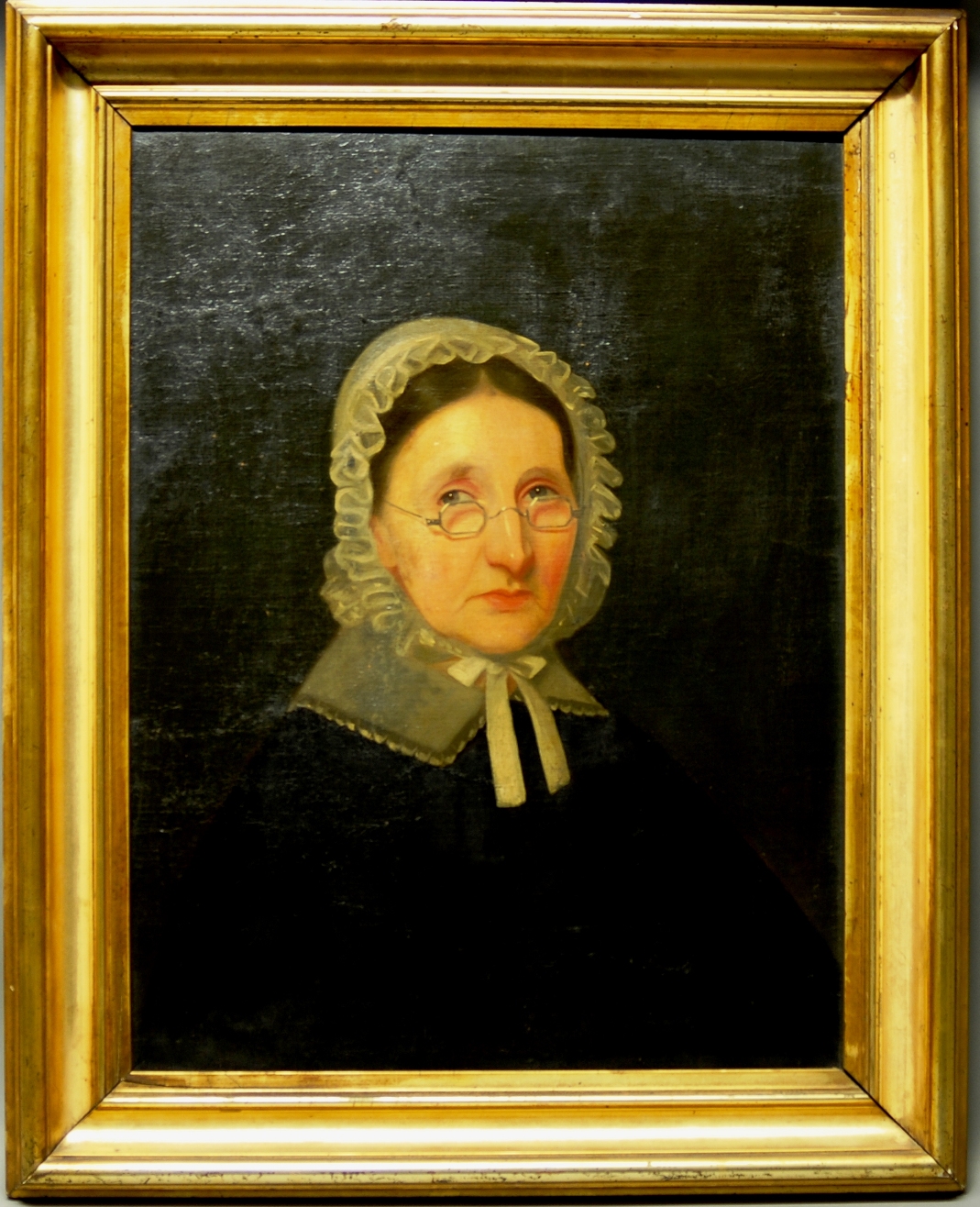
Late in his life, he took a great interest in genealogy, and his papers include much about his relatives in 19th century Connecticut. Among them, his maternal grandmother, Charity Birdsey Miller, is vividly represented by a surviving portrait in oil (artist unknown) that also arrived with the Bailey papers. A stern, sensible-looking woman, she is portrayed wearing eye glasses. Those spectacles are included with Bailey’s papers in the University Archives, as is the original case in which they were sold by a jeweler and optician in Meriden, Connecticut.

Portrait of Charity Birdsey Miller

Photograph of Charity Birdsey Miller's glasses and glasses case

Top: Portrait of Charity Birdsey Miller. Personal Papers of E. H. S. Bailey.  Call Number: PP 158, Oversize Folder 8. Bottom: Charity Birdsey Miller’s eye glasses and eye glasses case. Personal Papers of E. H. S. Bailey.  Call Number: PP 158, Box 4, Folder 140. Click images to enlarge.

For further insight into the life of this woman, the collection includes her Last Will and Testament, as well as probate documents inventorying her possessions and their distribution among her three grown daughters.

Thus, a collection which might have been expected to address only the life of a Midwestern academic in the early 20th century can also be of great value in illuminating the life of a virtuous woman of modest property in early- and mid-19th century New England.

Larry M. Brow
Program Assistant,  Spencer Research Library Processing Department

Collection Snapshot: Living the Dream

January 21st, 2013

Reposted from the KU Libraries Facebook page: http://www.facebook.com/KULibraries

Picture of marchers with the banner, "Living the Dream - Martin Luther King Jr / University of Kansas Jan. 20, 1986" on the KU Campus

Remembering Dr. King today with an image from the University Archives in the Spencer Research Library, home to some of the most precious materials in the world—-and to gems like this one–that capture remarkable moments in our rich KU history.