Welcome to the Kenneth Spencer Research Library blog! As the special collections and archives library at the University of Kansas, Spencer is home to remarkable and diverse collections of rare and unique items. Explore the blog to learn about the work we do and the materials we collect.
This blog may contain archived web content. This blog may link to catalog records which no longer exist as of a software change in 2026.
I am currently treating items from the North Family Papers to accommodate various patron digitization requests and on-site visits. These documents are estate and personal archives of the North family of Kirtling, Cambridgeshire, and Wroxton Abbey, Oxfordshire, as well as other places in England. The collection includes items from the 13th to 19th centuries, with the majority of documents dating from the 16th through 18th centuries. Document types include deeds, manorial documents, legal and official matters, accounts, family papers, and correspondence.
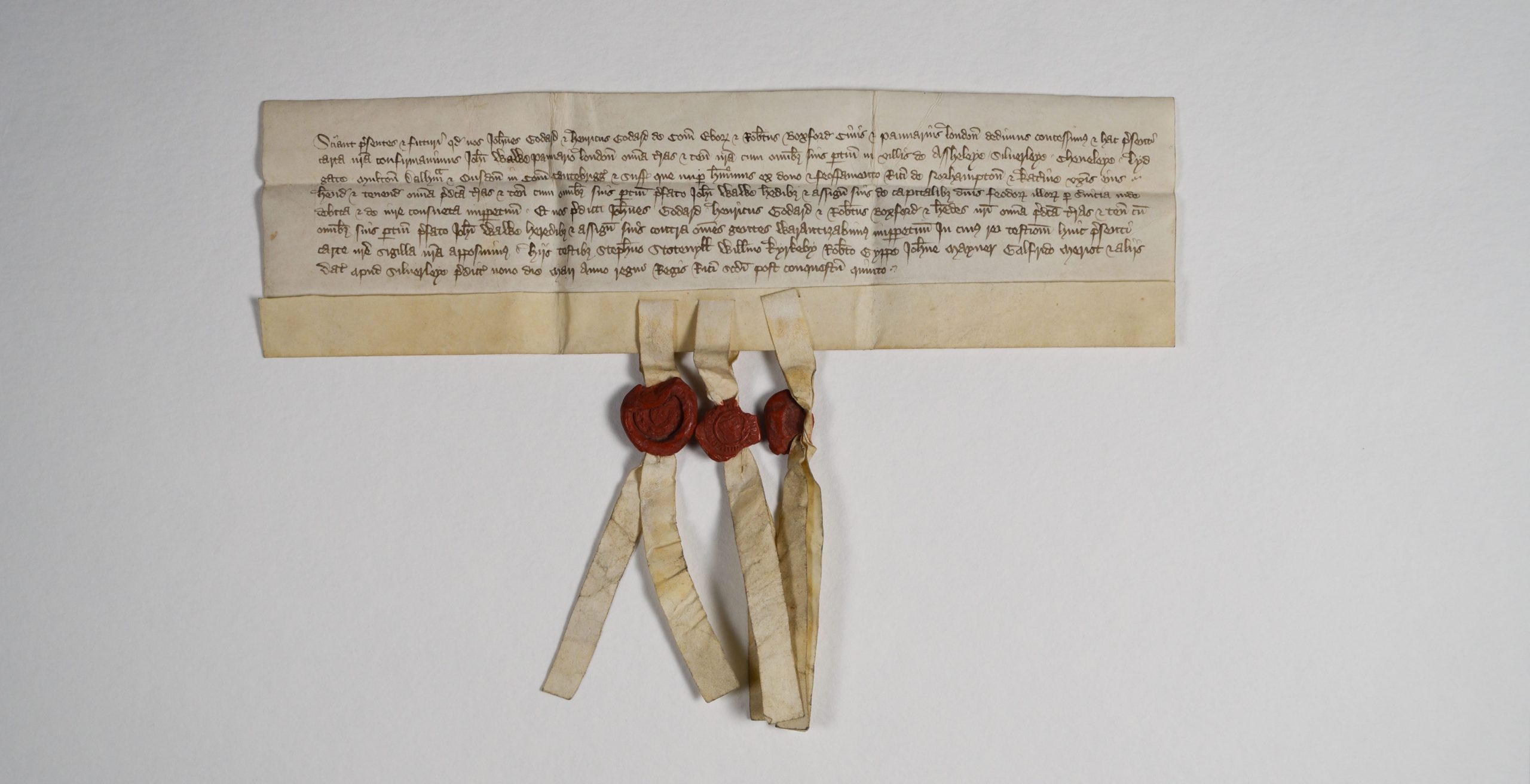
This collection includes many items with wax seals, both pendent seals that hang off the document on a parchment tag and tongue seals that are applied to a parchment strip in a horizontal orientation.
Typical small parchment document with attached pendent seals. Deed, gift, May 9, 1382. Call number MS 240A:425. Spencer Library, University of Kansas.
A student intern and I recently completed simple housings for small parchment items with both of those seal types. Although it is preferable to store items with attached seals in a horizontal orientation, the North Collection is so large that many small items will have to remain in vertically-oriented folders. Angela Andres, Special Collections Conservator, helped us design this housing.
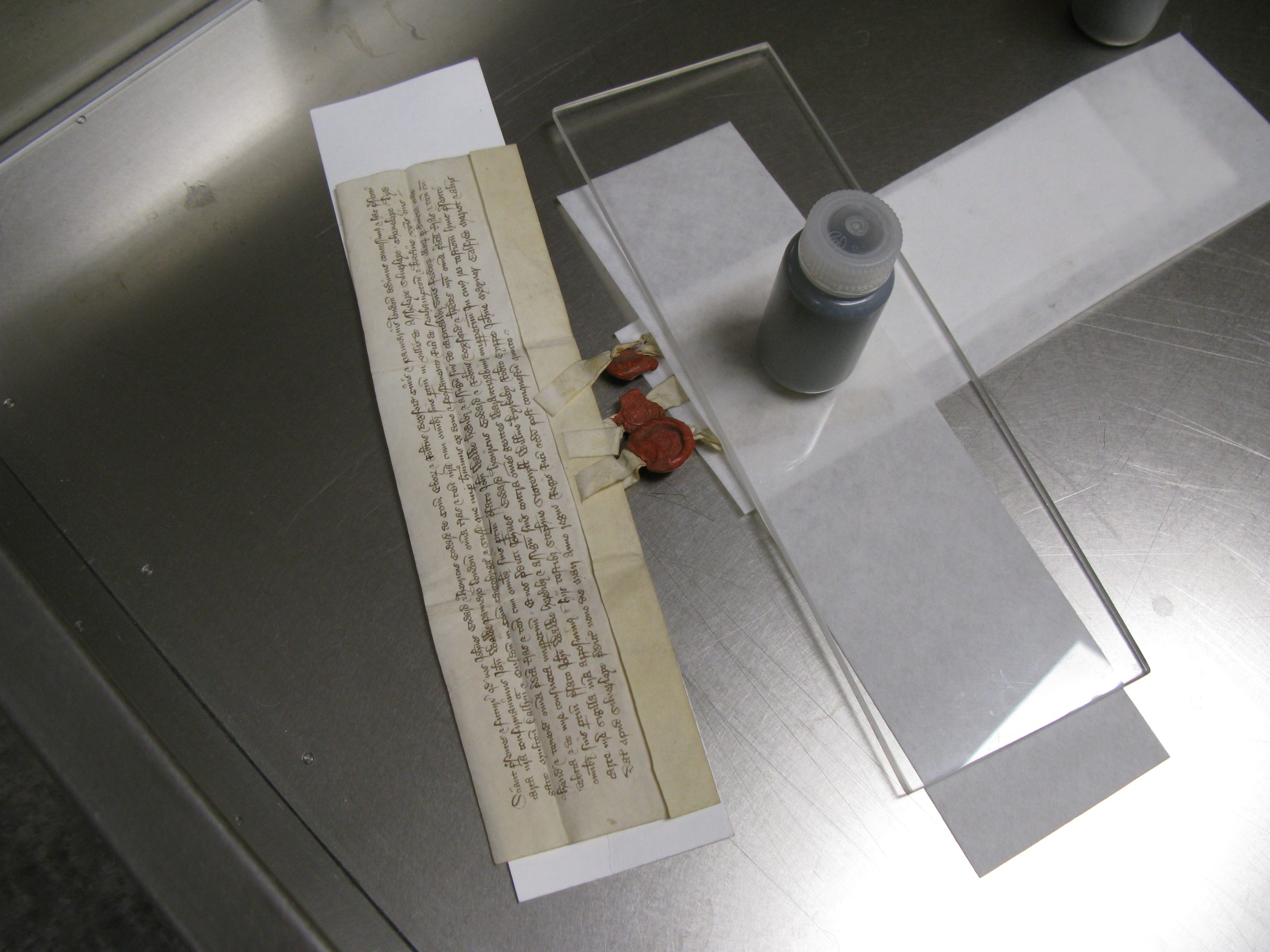
Some items need some gentle humidification and flattening to ensure that the text is legible and the parchment tags are out of the way of the seals before housing. For this project, I used damp blotter, Gore-Tex, and Pellon strips to gently humidify areas of the parchment under light weight.
Localized humidification of the parchment tags on a small document. Deed, gift, May 9, 1382. Call number MS 240A:425. Spencer Library, University of Kansas.
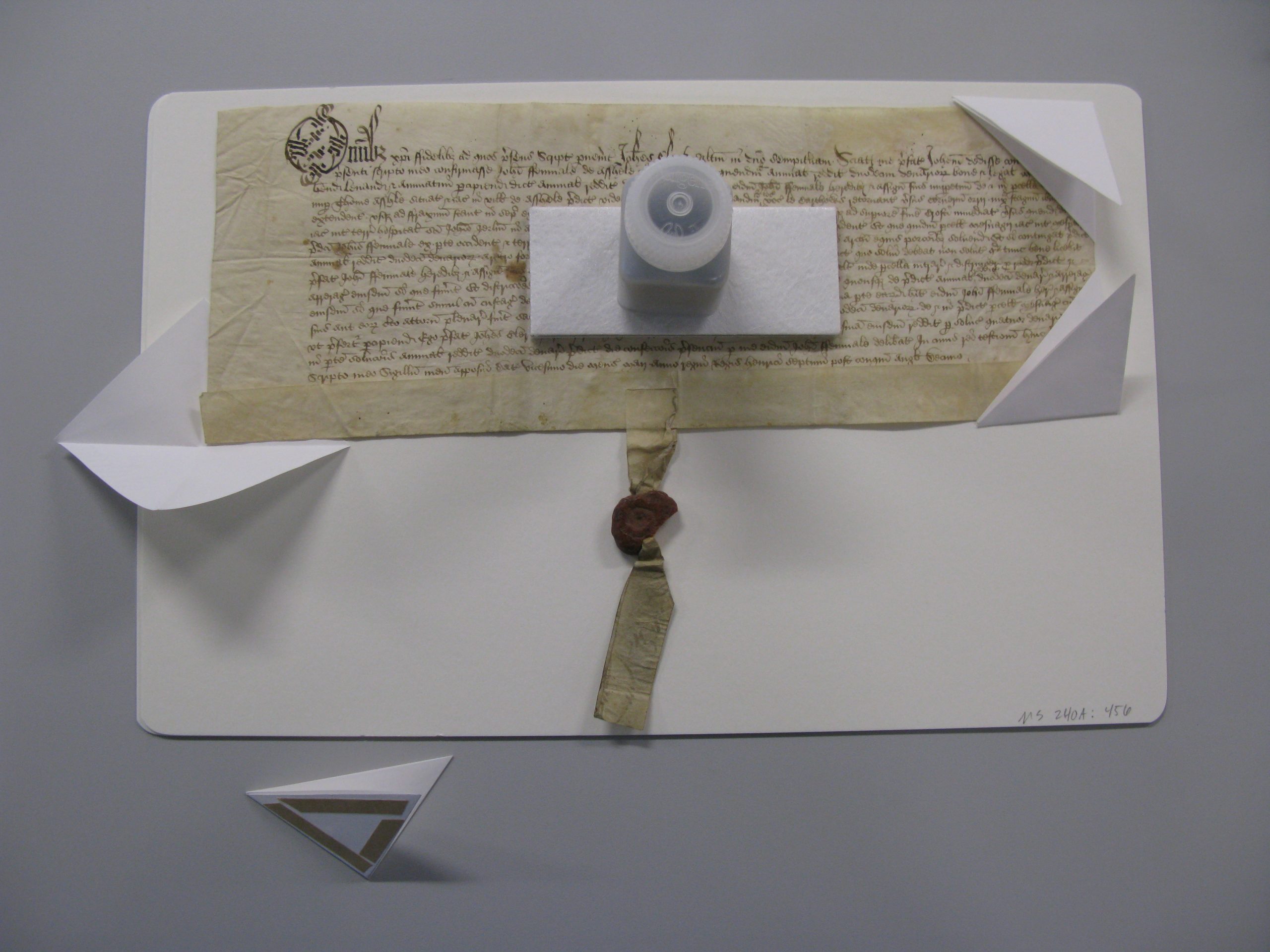
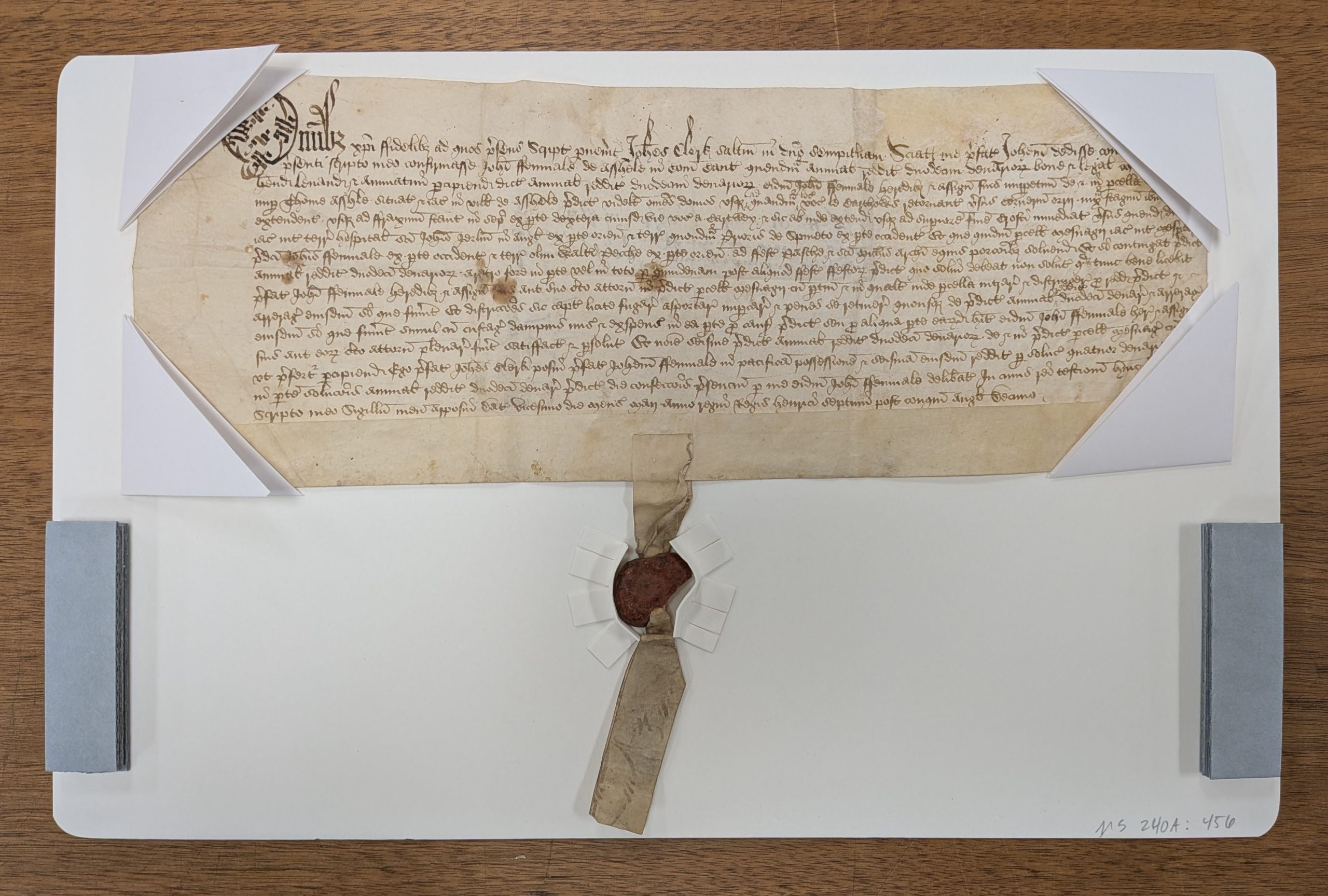
The item is supported by a backing board of thin, two-ply matboard to provide support but take up little extra depth in the folder. The document is held in place with corners, but because many of these documents have writing on both sides, the corners are made to be easily openable. The corners are constructed from squares of alkaline-buffered paper, folded twice to form triangles that can be unfolded if needed.
Foldable, openable corners made from alkaline-buffered paper and attached to the support board. Deed, grant of rent charge, May 20, 1495. Call number MS 240A:456. Spencer Library, University of Kansas Libraries.
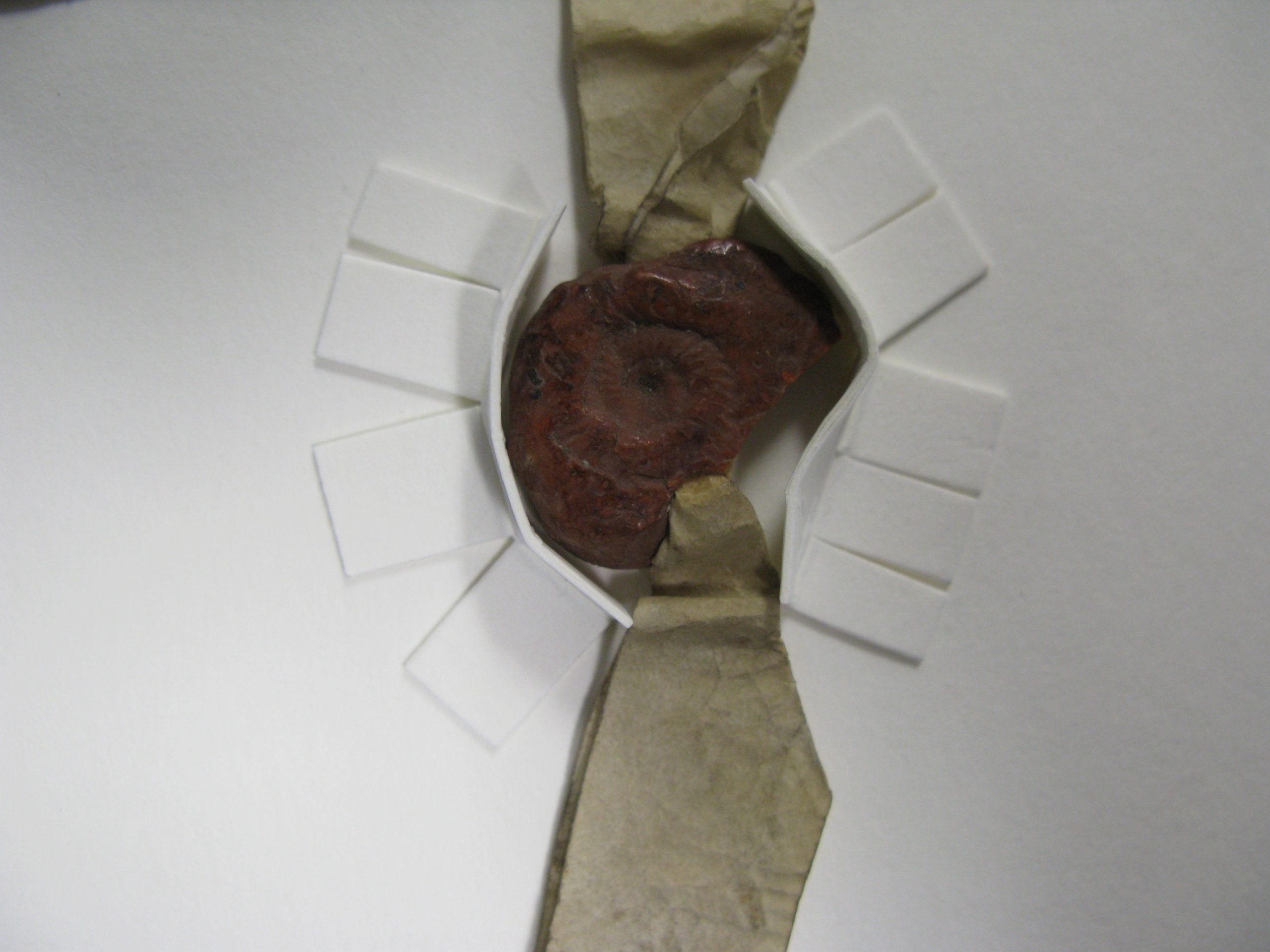
The seals are protected from jostling with tabbed strips constructed from 2-ply matboard. Long strips of matboard are folded in half, then cut to the size of the seals. One side of the matboard is cut into tabs to allow the bumpers to bend to the shape of the seal. The tabbed strips are adhered to the backing matboard close enough to the seals to protect them, but far enough away that the bumpers can be pushed back for the seals to be released safely.
Detail of the two-ply matboard tabbed strips attached to the support board on either side of a wax seal.
We constructed bumpers on the sides of the support board order to further protect the seal from touching the folder in the vertical orientation. The layers of alkaline-buffered corrugated board are slightly deeper than the seal.
Small parchment document with pendent seal, mounted on support board for storage in a vertical orientation. Deed, grant of rent charge, May 20, 1495. Call number MS 240A:456. Spencer Library, University of Kansas Libraries.
Although these items would ideally be stored flat, this simple approach allows them to be stored vertically with added support.
This summer I was the Stannard Conservation Lab Intern at the University of Kansas. I worked on many projects, but the most challenging one was treating a large collection of architectural plans. University Archives already has many architectural plans of KU campus buildings, so it was a surprise when more original plans were found in the attic of Fraser Hall. The plans had been rolled up, tied with string, and left for years in the attic. They were stacked on top of each other and very dirty, some showing signs of bird droppings and cobwebs. Due to this rough storage environment, some of the plans were severely damaged, although most were in fairly stable condition. The plans were moved from Fraser’s attic to University Archives until a more appropriate and permanent storage situation could be found.
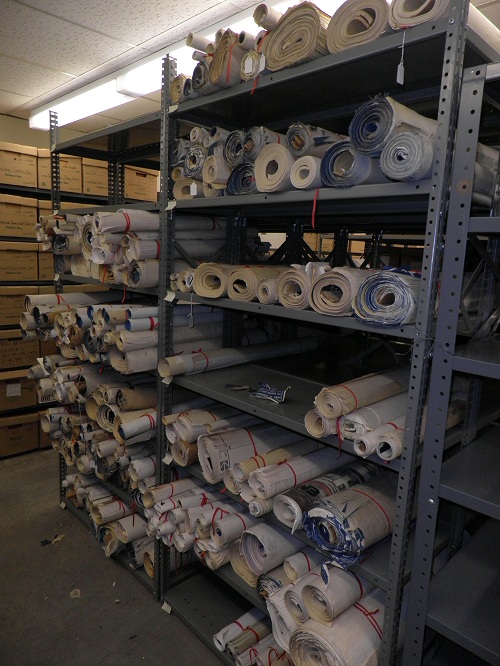
Rolled architectural plans temporarily stored in
University Archives. Click image to enlarge.
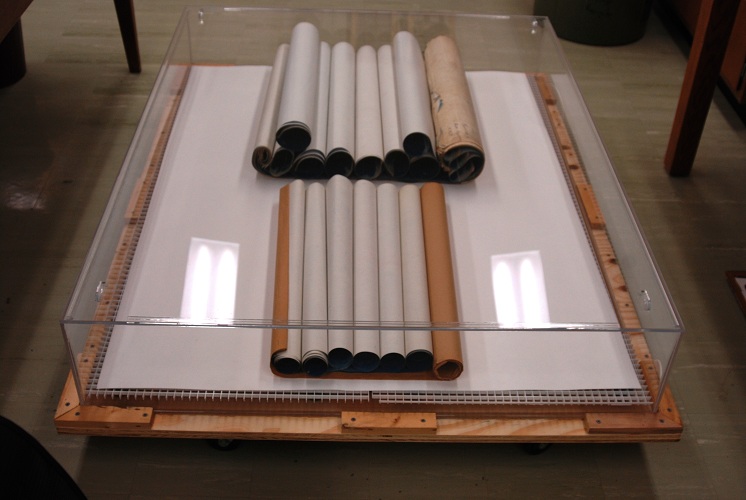
It is best for architectural plans to be stored flat, not only for their preservation but also to save space. Since the plans were stored rolled for so long, they needed to be humidified and flattened before they could be stored in horizontal files in the Archives. This required some creative thinking by the KU conservation team because a humidity chamber had to be specially made to accommodate these large plans.
The construction of the humidity chamber was finished when I started my internship, so I was able to start right in on developing the work procedure for humidifying and flattening the plans. I developed a documentation process to keep track of the plans that were treated and instituted an efficient work flow to keep the project rolling.
The specially-built humidity chamber at KU’s Conservation Lab.
Click image to enlarge.
The rolled plans were sorted by what building they depicted and then moved to the work room in their respective groups. Next, the drawings were prepared for humidification: staples were removed and important information about the plans – including title and date – were recorded in a database. The plans were then humidified and flattened. Lastly, the plans were placed in labeled folders and stored in the Archive’s new horizontal storage cases. The work procedure I developed allowed the other interns to continue the flattening and filing process even after my internship ended.
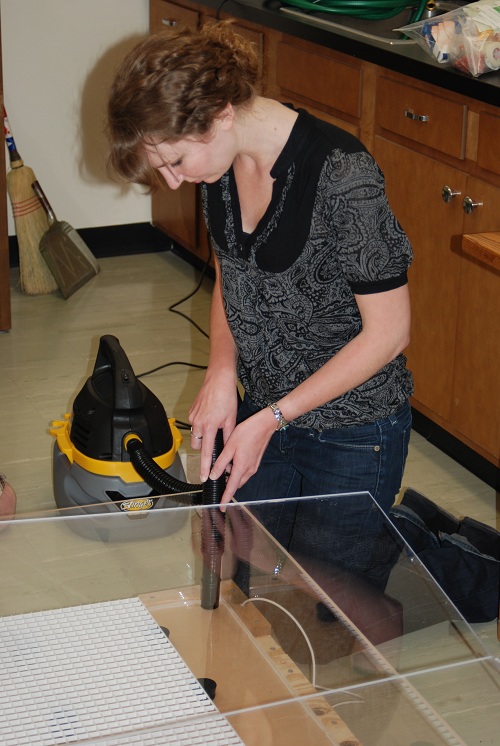
Summer Conservation Intern Erin Kraus removes
water from the humidity chamber with a wet vac.
Click image to enlarge.
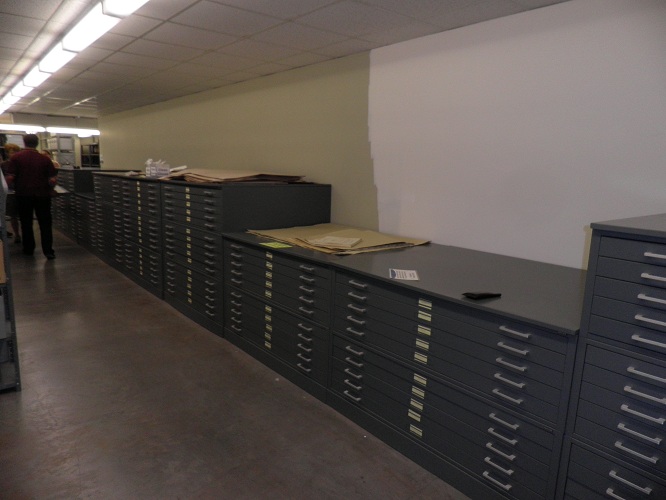
New horizontal storage cases in University Archives.
Click image to enlarge.
These historic plans were an important discovery because they can still be useful to architects today when improvements are being made to buildings. The conservation of the plans so far turned out beautifully, so it was very satisfying to see the progress made on the project.
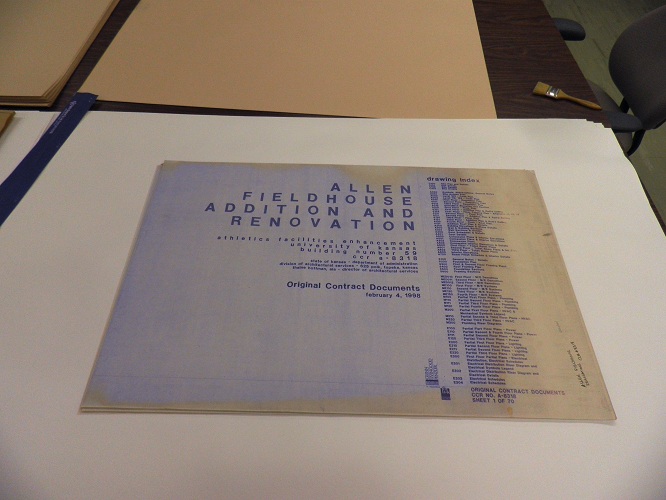
Architectural plans after humidification and flattening.
Click image to enlarge.
The conservation lab at KU was a great place to spend my summer and I learned a lot from this project. Having an internship in Kansas allowed me to not only spend time in my home state, but to also get to know all of the wonderful people at the Stannard Conservation Lab. Thanks for a great summer!
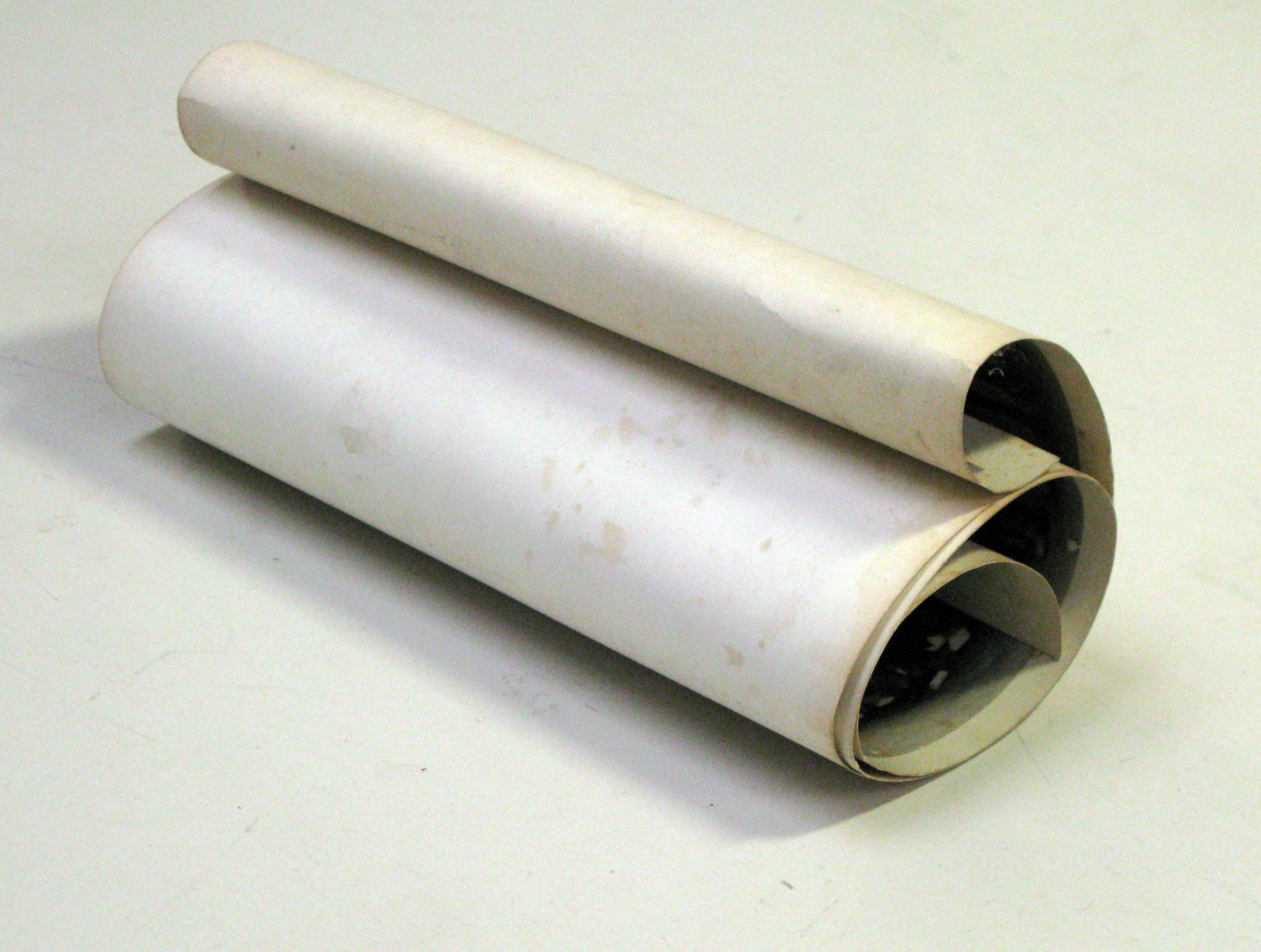
We receive many rolled posters, maps, photographs, and other paper items in the conservation lab. Oftentimes the cataloger or processor hasn’t been able to open the item to determine what it is. For most of these items, humidification and flattenting is the standard treatment.
Image of a rolled photograph before dehumidification.
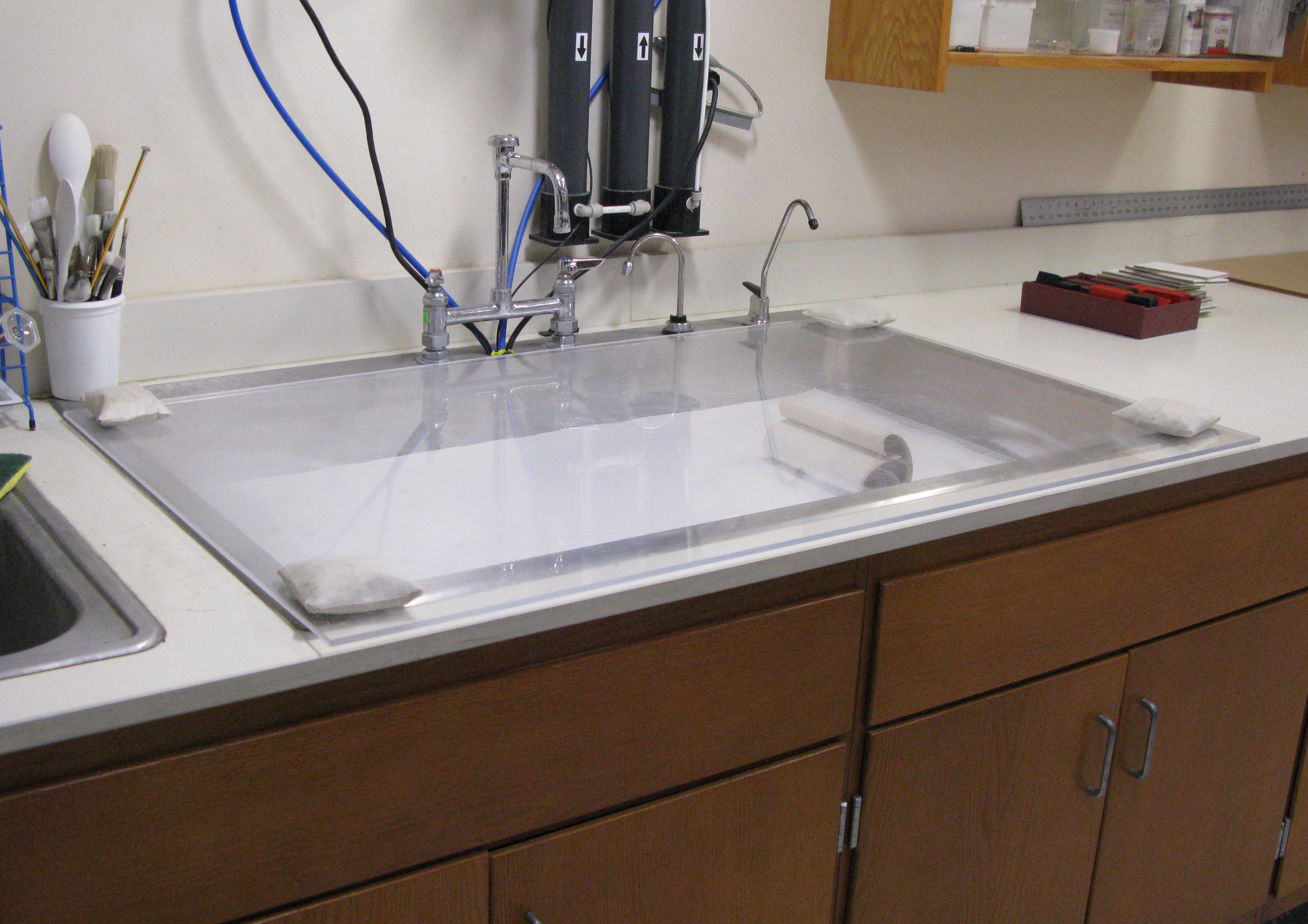
High humidity environments can be deleterious to paper if not closely monitored. However, sometimes we use humidity to our advantage: to relax rolled paper in order to flatten it. I often use the sink in the conservation lab to create a humidity chamber. On the bottom is the water. We use rubber stoppers with a layer of plastic eggcrate sheeting to make a platform above the water level. On top of that is a blotter paper to protect the collection item from the grid of the eggrate. The rolled item is placed on the blotter and the lid is put on the chamber.
Humidity chamber created in a sink.
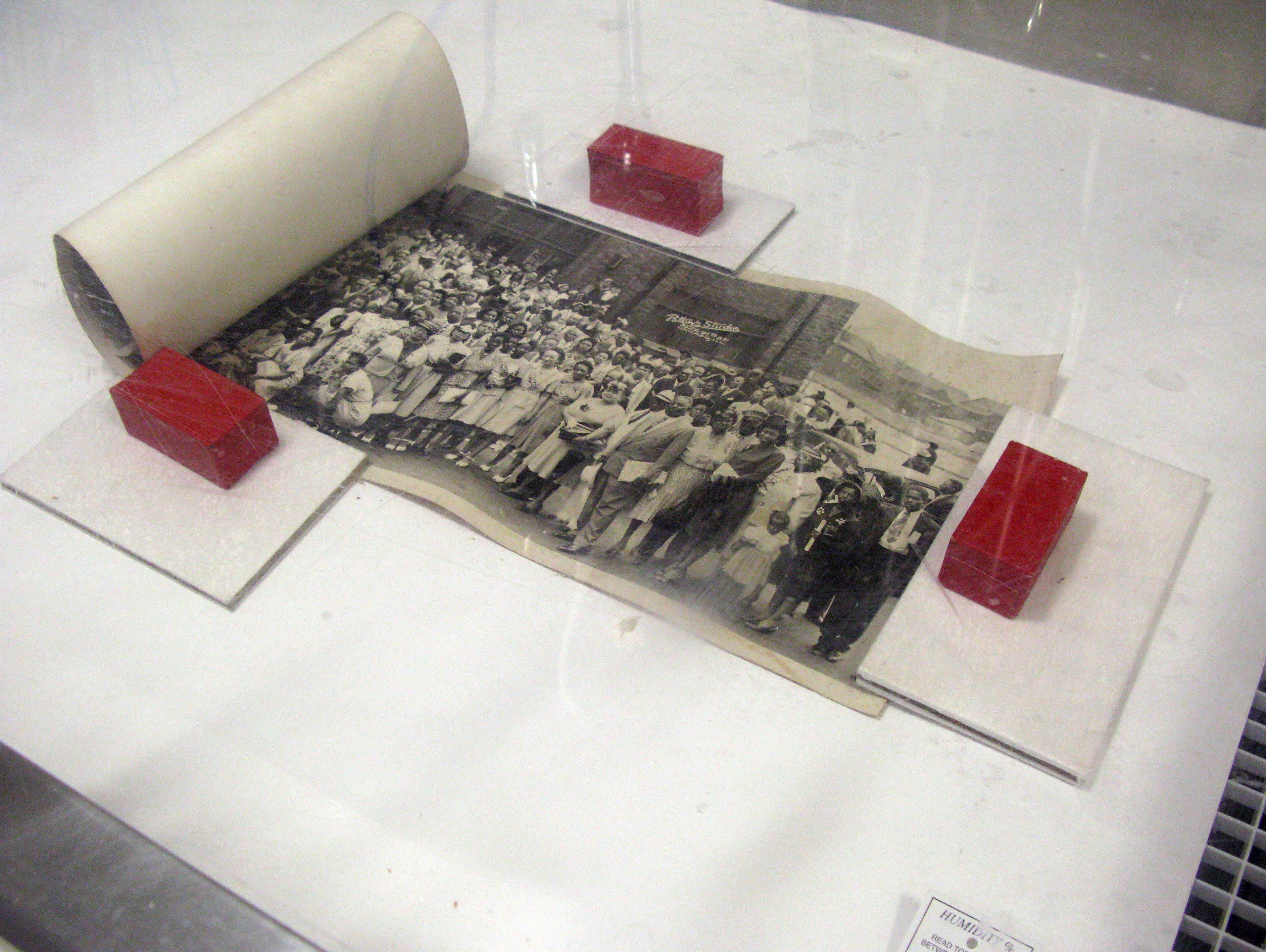
I closely watch the rolled item to determine when I might begin to gently unroll it or when it’s ready to come out of the chamber. Especially for photographs, this step has to be done with utmost care.
Unrolling a humidified photograph.
Once it is completely unrolled or very relaxed, I remove the item from the chamber and press it between blotters and a spun polyester cloth called Hollytex, with a Plexiglas sheet and weight on top.
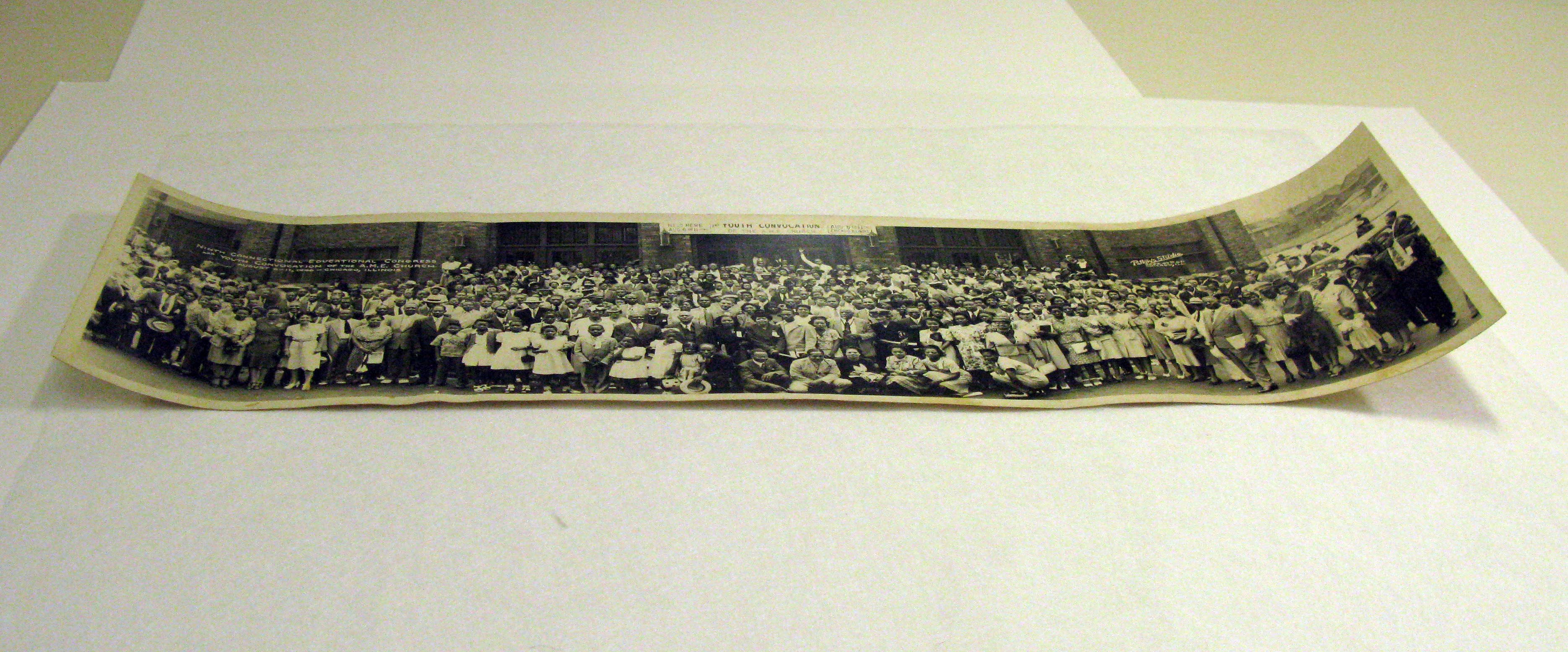
Finished photograph after humidification treatment.
Sometimes items aren’t 100% flat after treatment. In this case, the photograph is flat enough for a patron to use it, without overstressing the layers comprising the photograph.