The University of Kansas

Inside Spencer: The KSRL Blog

Books on a shelf

Welcome to the Kenneth Spencer Research Library blog! As the special collections and archives library at the University of Kansas, Spencer is home to remarkable and diverse collections of rare and unique items. Explore the blog to learn about the work we do and the materials we collect.

Flashback Friday: Hinman Collator Edition

April 15th, 2016

Each week we’ll be posting a photograph from University Archives that shows a scene from KU’s past. We’ve also scanned more than 26,900 images from KU’s University Archives and made them available online; be sure to check them out!

This week we’re celebrating National Library Week! First sponsored in 1958, National Library Week is a national observance sponsored by the American Library Association (ALA) and libraries across the country each April. It is a time to celebrate the contributions of our nation’s libraries and librarians and to promote library use and support.

The theme of this year’s National Library Week is “Libraries Transform,” so today’s entry highlights a transformational piece of equipment that can be found in numerous libraries across the country, including Spencer. It’s a Hinman Collator, and it was invented by former KU English professor Charlton Hinman in the late 1940s. The machine was used to compare pairs of documents or books for differences in the text.
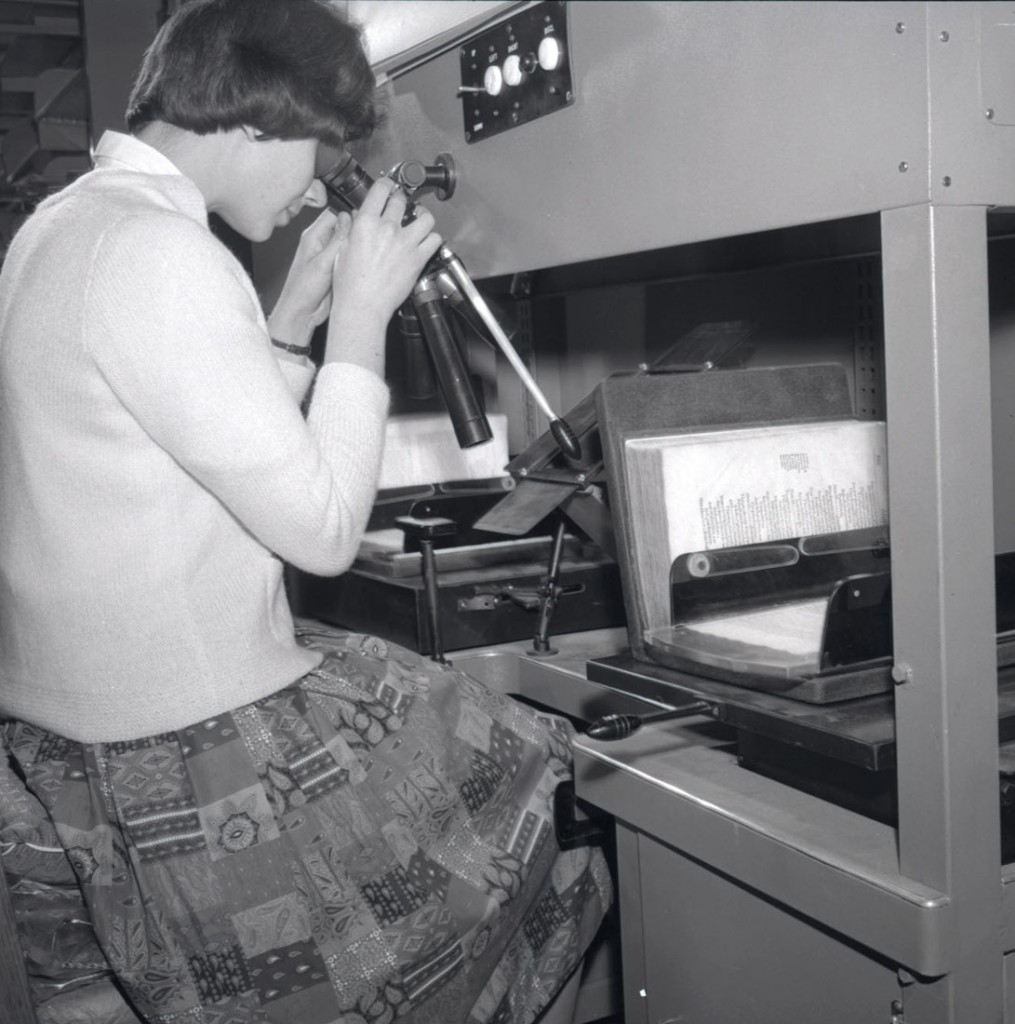
Photograph of woman using Hinman Collator, 1959

Woman using a Hinman Collator at Watson Library, 1959. The machine was moved to
Spencer Research Library sometime after it opened in 1968. University Archives Photos.
Call Number: RG 32/37 1959 Negatives: University of Kansas Libraries:
Special Collections (Photos). Click image to enlarge (redirect to Spencer’s digital collections).

Here’s how the Hinman Collator worked (as described on the blog of the Folger Shakespeare Library): The user placed a book in each of the two holders so that they were aligned when s/he looked through the eyepiece. The Collator then “used strobe lights to rapidly alternate between views of the two pages [i.e. superimposing them], and any differences would jump out at the viewer, seeming to lift off the page.”

One scholar has described the Hinman Collator as “one of the most important applications of technology to the study of literature ever made.” This was because, according the Folger blog, it “rapidly increased the rate at which two texts could be compared. The manual method that preceded Hinman’s mechanical collator consisted of placing one finger on each text and looking back and forth between them…[It] was not only slow, but potentially inaccurate.”

The Collator’s inventor, Charlton Hinman (1911-1977) attended the University of Colorado, Cornell, and Oxford before receiving his Ph.D. in English from the University of Virginia in 1941. He held positions at the University of Missouri (1937-1939) and Johns Hopkins University (1946-1950) before arriving at the University of Kansas in 1960; he taught at KU until he retired in 1975. Hinman’s areas of specialization included Shakespeare and Elizabethan drama as well as analytical bibliography.
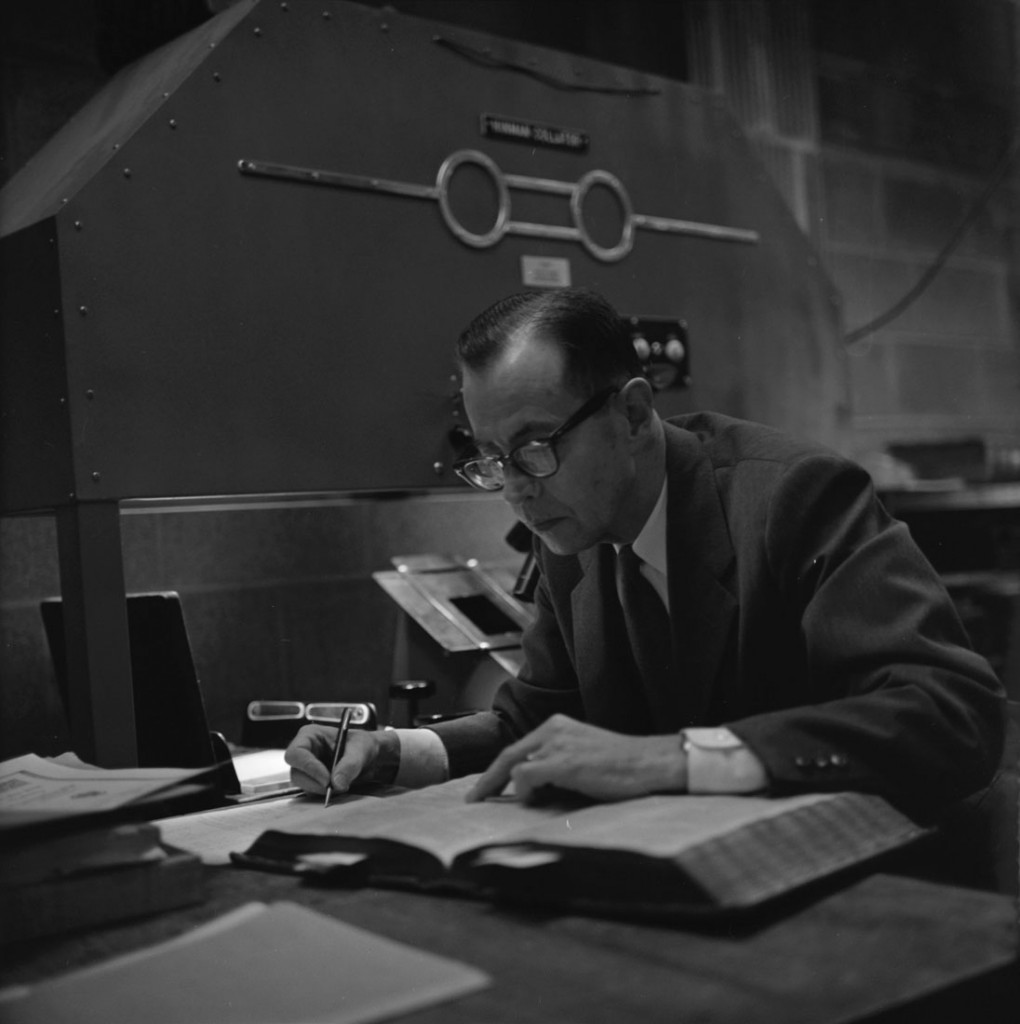
Photograph of Charlton Hinman working at his desk, circa 1960-1975

Charlton Hinman working at his desk, circa 1960-1975. University Archives Photos.
Call Number: RG 41/ Faculty and Staff: Hinman, Charlton (Photos).
Click image to enlarge; you can see this and other pictures of
Charlton Hinman and KU’s Collator at Spencer’s digital collections.

As Shakespeare Quarterly reported in a remembrance piece on Hinman, his “academic endeavors were twice interrupted by military service: he distinguished himself in naval intelligence and communications both during World War II and during Korean conflict.” Hinman got the idea for the Collator as a result of his wartime work comparing aerial reconnaissance photographs for evidence of bombing damage.

According to the Folger blog, “with his mechanical collator and the large collection of First Folios at the Folger, Hinman was able to compare each page–indeed, each impression of inked type–of fifty-five copies, leading to his monumental work exploring the process by which Shakespeare’s collected plays were printed, Printing and Proof-reading of the First Folio of Shakespeare (1963).” The effort took him almost a decade to complete, but Hinman once estimated that without the machine, it would have taken him more than forty years, if he had been able to complete the project at all.

Hinman Collators are generally not used today, but be sure to see the one at Spencer the next time you visit the library.

Caitlin Donnelly
Head of Public Services

Melissa Kleinschmidt, Megan Sims, and Abbey Ulrich
Public Services Student Assistants

Ogilby’s Britannia: Bringing English Cartography into the Scientific Age

April 11th, 2016

John Ogilby, was born in Scotland in 1600, and held many different careers in his life; a dancing-master, theater owner, poet, translator, publisher and cartographer. He is most remembered for bringing English cartography into the scientific age with his 1675 road atlas of England and Wales titled, Britannia. To create the wonderfully detailed strip maps that displayed the topographical features and distances of the roads, Ogilby’s team of surveyors worked with the precise and easy-to-use perambulator or measuring wheel to record the distance of the roads in miles; implementing the standardized measurement of 1,760 yards per mile as defined by a 1592 Act of Parliament. They also used the surveyor’s compass or theodolite to better record the changes in the directions of the roads. Besides the use of scientific instruments, Britannia was also the first published work to use the scale of one inch equaling one mile, which became the prevailing scale for cartography. Through the use of detailed illustrations and precise technology, Ogilby’s Britannia became the first comprehensive and accurate road atlas for England and Wales, making it the prototype for almost all English road books published in the following century. Our Special Collections house several editions and iterations of Britannia and its surveys, including the first edition from 1675.

Title Page for John Ogilby's Britannia (1675).
The title page for the first edition of Ogilby’s Britannia, 1675.
Special Collections, Spencer Research Library. Call Number: H1. Click image to enlarge.

Strip map from Britannia of “The Road From LONDON to ABERSWITH…”.
Strip map of “The Road From LONDON to ABERSWITH…” Note the illustration around the title,
the perambulator/measuring wheel is being used by the man on foot and
the surveyor’s compass/theodolite is being used by the man on horseback.
Special Collections, Spencer Research Library. Call Number: H1. Click image to enlarge.

After Ogilby’s death in 1676, his step-grandson, William Morgan, continued his work. Morgan utilized many of the original maps and descriptions created by Ogilby and his team of surveyors, since Britannia provided such exact and thorough accounts of the British roads. Many travelers and merchants desired to take these accounts with them, so the maps, surveys and descriptions used in Britannia were often scaled down and published in more portable works.

Ogilby editions size comparison
Comparing the size of the works from left to right: Britannia followed by The traveller’s guide or,
a most exact description of the roads of England. Being Mr. Ogilby’s actual survey,
and lastly The traveller’s pocket-book: or, Ogilby and Morgan’s book of the roads improved and amended.
Special Collections, Spencer Research Library. Call Numbers: H1, Bond C69, A297. Click image to enlarge.

Unfolding map for The traveller’s pocket-book: or, Ogilby and Morgan’s book of the roads improved and amended.

Open map for The traveller’s pocket-book: or, Ogilby and Morgan’s book of the roads improved and amended.
The traveller’s pocket-book: or, Ogilby and Morgan’s book of the roads improved and amended

with attached map of England and Wales, 1765. Special Collections, Spencer Research Library.
Call Number: A297. Click images to enlarge.

To learn more about John Ogilby and Britannia, come by Spencer Research Library and take a look at these sources:

  • Hyde, Ralph. “John Ogilby’s Eleventh Hour.” Map Collector No11 (1980): 2-8. Print. Call Number: E1814.
  • Ogilby, John. Britannia: London 1675 with an introduction by Dr. J.B. Harley. Amserdam: Theatrum Orbis Terrarum, 1970. Print. Call Number: G730
  • Worms, Laurence and Baynton-Williams, Ashley. “Ogilby, John (1600-1676)—London.” British Map Engravers: a Dictionary of Engravers, Lithographers and Their Principal Employers to 1850. London: Rare Book Society, 2011. 498-500. Print. Call Number: GA793 .W67 2011.

Mindy Babarskis
Library Assistant
Public Services

Use the Force and Our Special Collections

December 14th, 2015

Since most of you are unable to attend the world premiere of Star Wars: The Force Awakens today in Los Angeles, I’ve selected a few Star Wars items from our Special Collections to hold you over until December 18th. Thanks to the tireless efforts of University of Kansas Professor Emeritus James E. Gunn (former head of KU’s Gunn Center for the Study of Science Fiction) and others, Spencer Library houses an amazing collection of Science Fiction materials. So enjoy these images and come visit us to discover more treasures from a long time ago in a galaxy far, far away.

Official Star Wars Fan Club membership application form     Official Star Wars Fan Club membership application form, back.

Star Wars Fan Club membership application form, one double-sided sheet. Papers of T.L. Sherred.
Call Number: MS 253. Click images to enlarge.

Movie still of Darth Vader and Boba Fett from Star Wars: Episode V - The Empire Strikes Back, 1980

Movie still of Darth Vader and Boba Fett from Star Wars Episode V: The Empire Strikes Back, 1980.
John Tibbetts Collection: Movie Stills. Call Number: MS 297. Click image to enlarge.

Star Wars Episode I: the Phantom Menace stills depicting Darth Maul and Queen Amidala, 1999.

Star Wars Episode I: the Phantom Menace stills depicting Darth Maul and Queen Amidala, 1999.
John Tibbetts Collection: Hollywood Press Kits. Call Number: MS 292. Click image to enlarge.

Mindy Babarskis
Library Assistant

Collection Snapshot: Campront Family Cartulary

July 27th, 2015

When I am asked about my favorite item in the Spencer collection, in addition to praising the glorious Vosper Book of Hours, I always mention a much more humble item, the Campront family cartulary, known by its call number, MS D47. A cartulary is a collection of charters, especially a book holding copies of the charters and title deeds of an estate.

Image of the first page of the Campront (de) family papers, La Manche, 1268-1438

First page of the Campront family papers,
La Manche, 1268-1438. Transcript of legal instruments. France,
copied after 1438. Call Number: MS D47. Click image to enlarge.

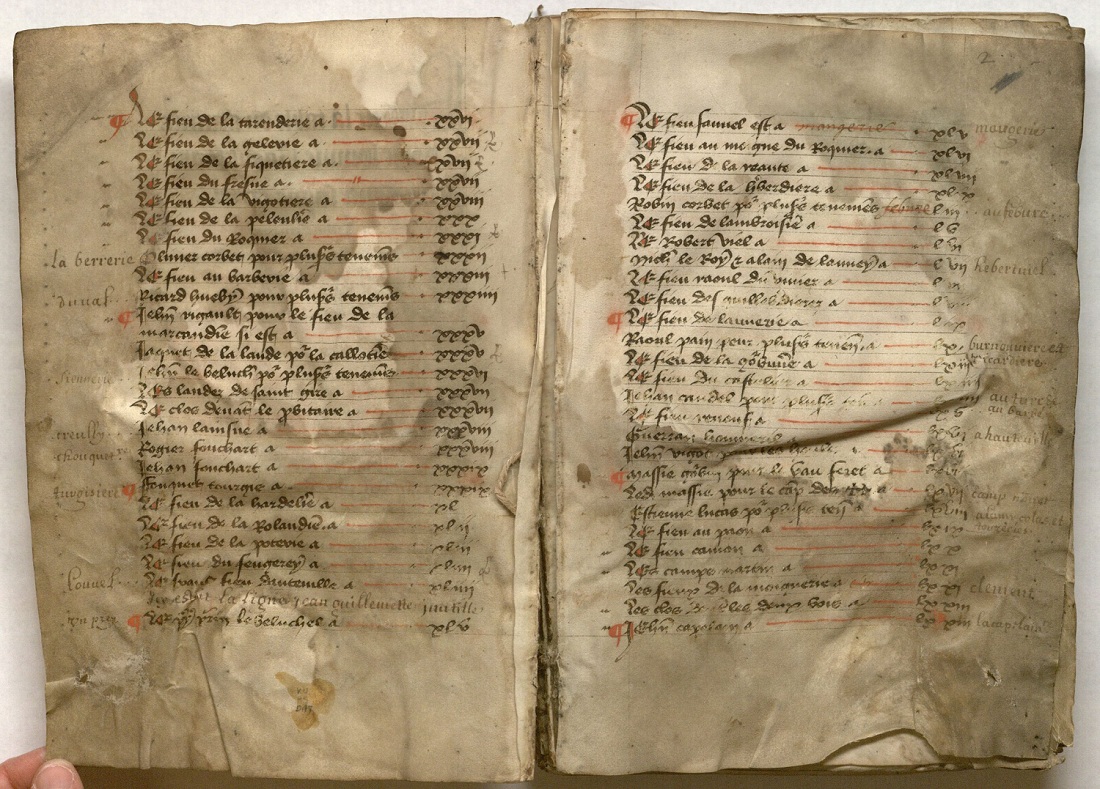
This small (23 x 16 cm), rather worn, manuscript contains copies of thirty-nine legal documents related to the Campront family of Normandy, France. Most date from the tumultuous years of the Hundred Years’ War (1337-1453), a series of conflicts between the rulers of England and France – with their allies – for control of the latter kingdom, the largest in Western Europe at the time. Land transactions, marriage settlements, and documents detailing contested claims were copied in a clear, functional hand. This was a volume designed not for show, but for its content, or, as we would say now, its “informational value.”

Image of a selected page from the Campront (de) family papers, La Manche, 1268-1438

Selected page from the Campront family cartulary. Call Number: MS D47. Click image to enlarge.

I encountered this document as a student at KU. I was thrilled to be able to work with an original manuscript and, although deciphering the old French was a challenge, I excitedly pored over each page, transcribing nearly the entire volume by hand in the days before laptop computers were widespread. I relied heavily on the preliminary work done by the late Ann Hyde, whose exhaustive description was just one example of the legacy she left behind to the Spencer Library. I learned quickly that while I could discover much about the family from this source, it was never intended to be a comprehensive document about the family’s affairs, and I was left wanting to know more about the generations of people mentioned in its pages.

Flash forward many years: I had deposited an electronic copy of my master’s thesis in the open access repository at The Ohio State University, where I then worked. (It’s also available at KU’s ScholarWorks, as is the preliminary research that formed my senior thesis.) Through the magic of Google, the current owner of the property in Normandy where the Campront family lived for hundreds of years came across my research while searching for information about his home. The historical documentation I had uncovered was personally exciting to him and, like many people, he wondered how the document ended up in Lawrence, Kansas. This gave me a chance to explain Kenneth Spencer Library and its amazing collections of early manuscripts, preserved here and made available to both amateur and professional scholars.

Image of a selected page from the Campront (de) family papers, La Manche, 1268-1438

Selected page from the Campront family cartulary.
Call Number: MS D47. Click image to enlarge.

The estate owner placed a copy of a translation of my work into the official archives of La Manche in Lower Normandy, thereby physically and linguistically extending the reach of my work even further. Finally, he offered to host me at this amazing property, parts of which appear not to have changed much from the sixteenth century, should I ever have the chance to visit.

For me, this one humble, centuries-old document, is not only a major signpost along my journey to becoming a librarian. It also captures so richly the power of the written word and the connections we make as human beings.

Beth M. Whittaker
Assistant Dean for Distinctive Collections
Director of Spencer Research Library

Hidden Treasure Found in the Stacks

April 15th, 2015

Working at Spencer for the past two years, I’ve discovered many amazing manuscripts and old novels that I never dreamed of getting the chance to actually work with. An even more far-fetched idea, however, was finding books that I read when I was a kid and had completely forgotten about.

Yet I did.

It started off as any other day: reshelving books within the stacks. I pushed my book cart, complete with its squeaky wheels, down the rows as I returned the books back to their homes on the shelves. Walking around the perimeter of the stacks, I found a section of books that I hadn’t noticed before. They stood out amongst the old, leather bound covers of books published before the 1700s. Instead, these spines were cloth and colorful, rich in design and detail.

And they looked eerily familiar.

Image of the cover of In the Reign of Terror by G. A. Henty, 1888

The cover of In the Reign of Terror by G. A. Henty.
Illustrated by J. Schönberb. London: Blackie, 1888.
Call Number: O’Hegarty B805. Click image to enlarge.

Leaving my book cart behind me, I walked up to take a closer look, disbelief forming in the back of my mind. No, these couldn’t be the same books I read in middle school, I thought. There was no chance. Upon closer inspection, my gut was proven to be right: I had discovered a treasure trove of books by British author George Alfred (G. A.) Henty. Shelves upon shelves were lined by his masterpieces, a series of adventure books that I’d barely scratched the surface of, reading them in my youth.

Instantly, I was transported back home, as an eleven-year-old, acne-riddled, glasses wearing middle-schooler, standing in my public library. I discovered a book by accident: it had a simple red cover that was torn on the sides. The title read In the Reign of Terror: The Adventures of a Westminster Boy by G. A. Henty. I have never heard of him before, but I decided to take the book home with me and give it a try.

I finished it within the week.

Henty was a mastermind of writing stories threaded within historical events. In the Reign of Terror was about a boy named Harry Sandwith, who was sent to live with the Marquis de St. Caux during the French Revolution, in a time when political stresses tore the country apart during the reign of King Louis XVI. Even though his novels were written in the late nineteenth century and intended for a young male audience (he always started off his tales with a letter to his audience, addressed to his “Dear Lads…”), I still found them to be enlightening, enjoyable and one heck of a political and historical ride.

And I had completely forgotten about Henty and his tales.

Image of the cover of St. Bartholomew's Eve, G. A. Henty, 1894

The cover of St. Bartholomew’s Eve by G. A. Henty.
Illustrated by H. J. Draper. London: Blackie, 1894.
Call Number: O’Hegarty B818. Click image to enlarge.

Since being reunited, I have been reminded of the books that I raided when I was a kid. After reading Reign, I quickly went through our library’s collection back home, which consisted of six titles. My favorite I’ve read is St. Bartholomew’s Day Massacre, which is a tale of the Huguenot Wars.

Illustration in St. Bartholomew's Eve, G. A. Henty, 1894

An illustration in St. Bartholomew’s Eve by G. A. Henty.
Illustrated by H. J. Draper. London: Blackie, 1894.
Call Number: O’Hegarty B818. Click image to enlarge.

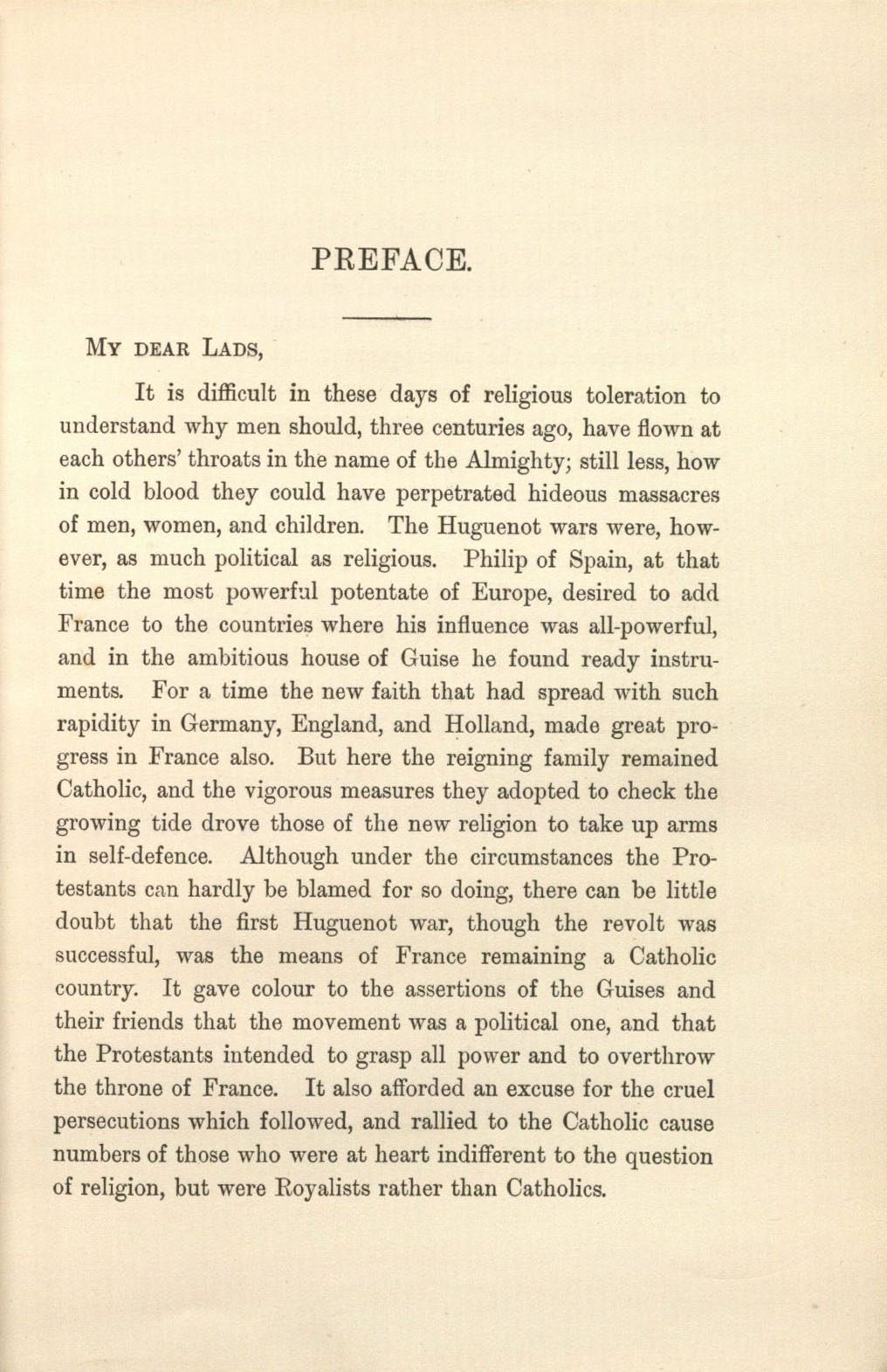
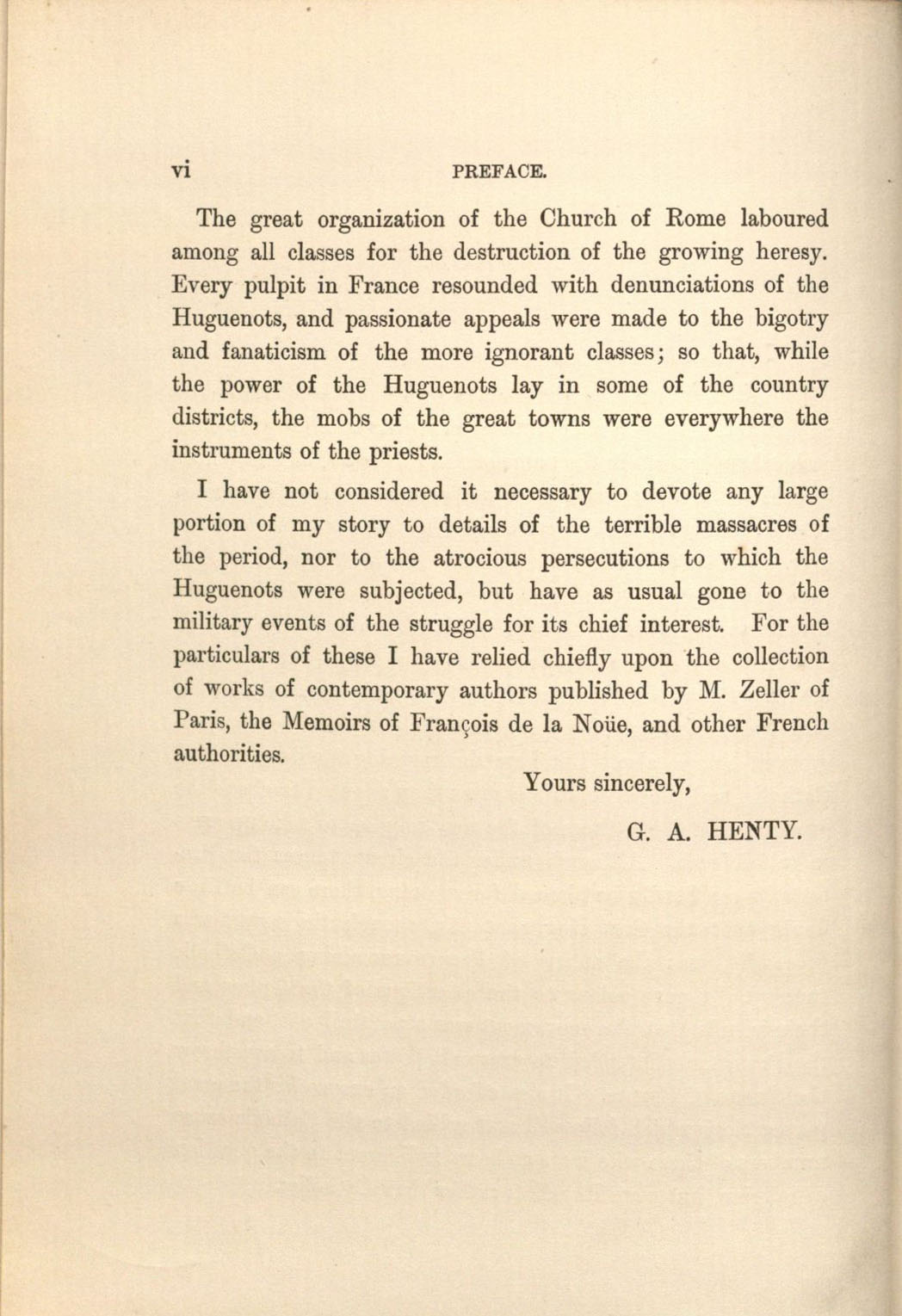
Image of preface in St. Bartholomew's Eve, G. A. Henty, 1894 Image of preface in St. Bartholomew's Eve, G. A. Henty, 1894

The preface of St. Bartholomew’s Eve by G. A. Henty, addressed to “my dead lads.” Illustrated by H. J. Draper.
London: Blackie, 1894. Call Number: O’Hegarty B818. Click image to enlarge.

Now that I have rediscovered Henty, I’ve been looking into him again and trying to decide which book to read next in order to get back into reading him. Yet I also realized that there are plenty of controversies surrounding the author I’d accidentally discovered. While these stories are advertised as stories of adventures for young boys, they were also criticized – both during the time of publication and especially since then – as being xenophobic towards anything that wasn’t part of British culture and nationalism. His books were also labeled as strong propaganda towards British imperialism, raising the question of if there was another purpose behind Henty’s agenda for writing these novels.

None of this political scandal was noticed by me as a young reader, but recognizing it now, I think it would be interesting to go back and reread some of his stories, or pick up a brand new one. Rediscovering one of my favorite childhood authors was something I definitely didn’t expect to happen while working within the stacks. It was an experience that made me feel like I went back in time, while at the same time, opened a door to learning more about this controversial, yet very popular, late-nineteenth-century author.

It just goes to show that no matter what you’re doing in a library – working, researching or just simply browsing – the treasures waiting to be discovered are endless.

Nicole Evans
Public Services Student Assistant