A Look Back at Day on the Hill
September 30th, 2026This coming Tuesday, October 6th, will see the return of Day on the Hill, KU’s storied music festival that was sponsored by Student Union Activities (SUA) from 1989 to 2007. With the newly digitized University Daily Kansas (UDK) and some artifacts and photos from University Archives, we can piece together a history of “one of the best college music festivals in the nation,” as the manager of the band Soul Coughing described Day on the Hill in 1998.
Starting in 1978, many outdoor day-long music events in spring and summer were held at KU near Allen Fieldhouse or on Campanile Hill under various names such as Day on the Green, Day on the Green Hill, Wheatstock (in homage to Woodstock), Summer on the Hill, and Jayhawk Jamboree. These events featured local or regional bands, which kept costs low and made the event free for both students and locals. By the 1980s, the Jayhawk Jamboree’s title had officially changed to its nickname to Jayhawk Jam, but it was cancelled in 1987 and 1988 because SUA did not have enough money to host it.

In 1989, SUA decided to use the budget it had left over at the end of the year and teamed up with the Student Senate, the Association of University Residence Halls, and radio station KJHK to host a new all-day concert event called Day on the Hill. It was part of the Student Senate’s Celebrate Diversity program and it included cultural performances, local bands, Love Tractor from Athens, Georgia, and Too Much Joy from New York. Forty-seven local bands had sent in cassette tapes of their music to be considered by a committee from SUA and KJHK. Students were hired to work the event for $20, and 1,500 people attended.
The next year, 3,000 people attended to watch more local bands, Buffalo Tom, and Toad the Wet Sprocket with reportedly beautiful weather and buckets of fried chicken. In 1991, complaints about the lack of diversity and the selection process for local bands resulted in a bigger committee and the inclusion of hip-hop groups in the lineup for the first time.


Left: A University Daily Kansan ad for the first Day on the Hill, April 1989. Right: A UDK photo from the 1991 Day on the Hill concert. University Archives. Call Number: UA Ser 69/2/1. Click images to enlarge.
The year 1992 changed everything for Day on the Hill. In February, SUA offered the little-known band Pearl Jam $3,000 to be the headliner for the event that year on May 2nd. Their album Ten had been released the summer before, but it wasn’t until their second single “Even Flow” was released in March 1992 that the band’s popularity and album sales began to rise quickly.

When word got out that Pearl Jam was playing a free outdoor concert at KU, high school and college students from around the region drove to Lawrence to join KU students and locals at the show. Crowd estimates range from 18,000 to 30,000; the latter number would have been Pearl Jam’s biggest show to date. A mosh pit formed in the crowd, and during an extended version of the song “Porch” singer Eddie Vedder climbed up the scaffolding of the stage, swung across the rafters, hung upside down while grabbing the mike, and finished singing the song while sitting on top of the roof, a stunt Vedder would repeat many times at outdoor shows.

Pearl Jam’s appearance at KU became a legendary story for those lucky enough to have attended. It also, in many ways, set students’ expectations very high when it came to future Day on the Hill shows. As voiced in the UDK later in the 1990s, many students asked why SUA could not bring in bigger bands or questioned SUA’s choices when they were usually working with a budget of $20,000 to $30,000. Members of SUA had to repeatedly explain that the Pearl Jam show had been a great stroke of luck. The 1992 concert remained Day on the Hill’s highest attendance for its entire run.
In 1993, SUA decided to host a battle of the bands to choose local performers for Day on the Hill, adding another hurdle after cassette tape submissions. The concert was called the Farmers’ Ball, and it continued throughout the 1990s. Heavy rain led to a very muddy show with headliners the Gin Blossoms and Reverend Horton Heat in 1993, and the mud came again in 1994 with Urge Overkill.
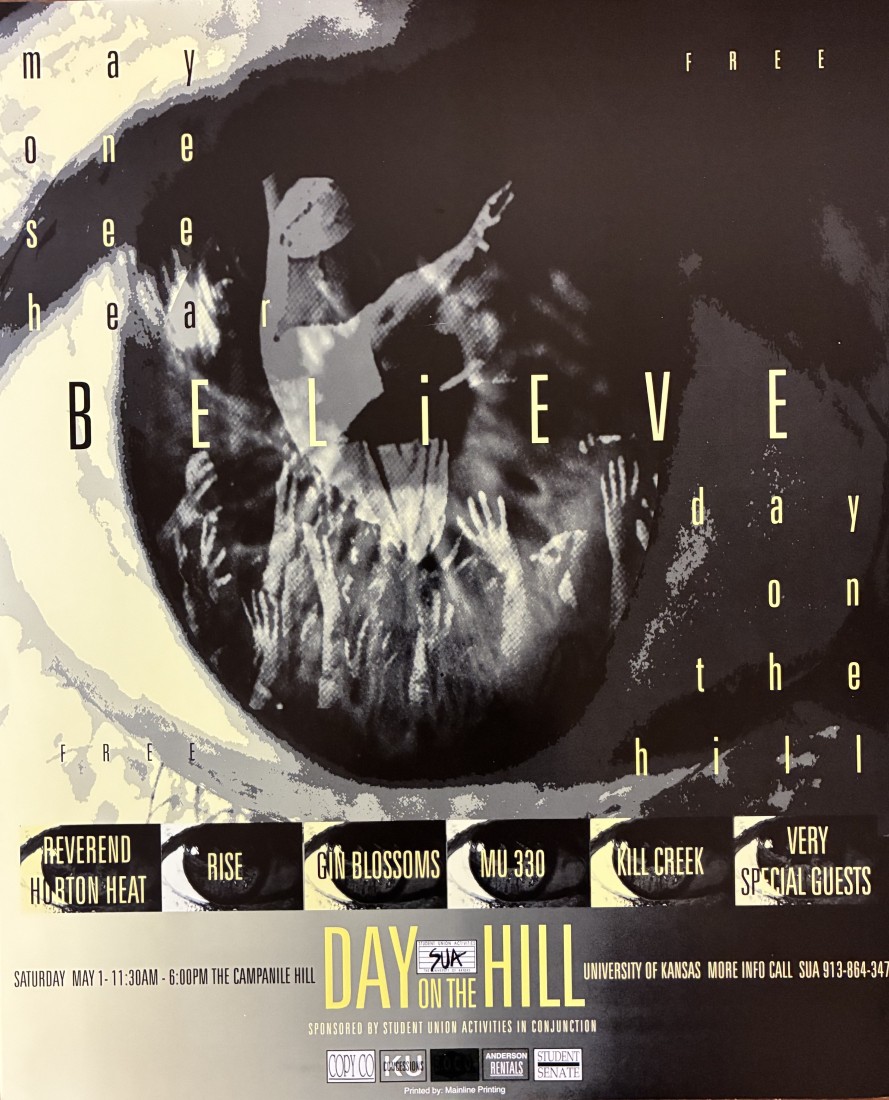
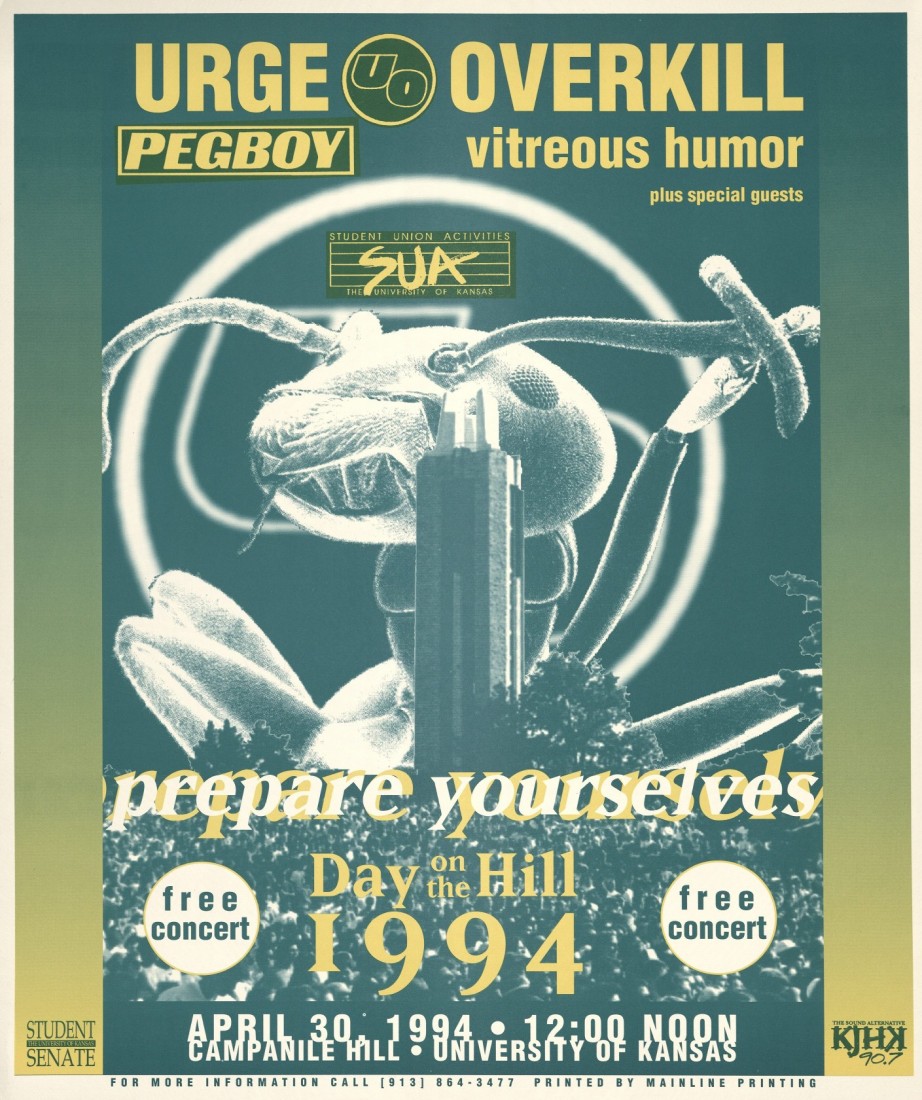
Posters from the 1993 (left) and 1994 (right) Day on the Hill shows. University Archives Records, Student Activities: Student Union Activities. Call Number: RG 71/23. Click images to enlarge.
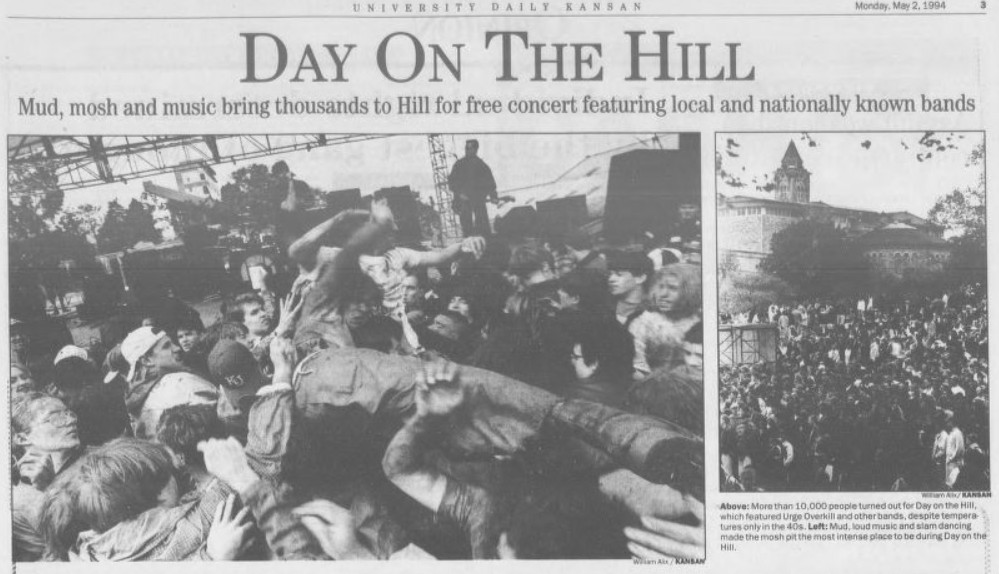
Leading up the 1995 show, someone started a hoax that the band Phish was going to be the headliner and posted fake flyers around campus, leading to disappointment when Matthew Sweet was announced as the real headliner. Also that year, a few students decided to load a couch into a truck and bring it to the hill to sit on during the event. For many years later, students brought couches and other furniture, hauling them up the hill to enjoy a comfortable view.
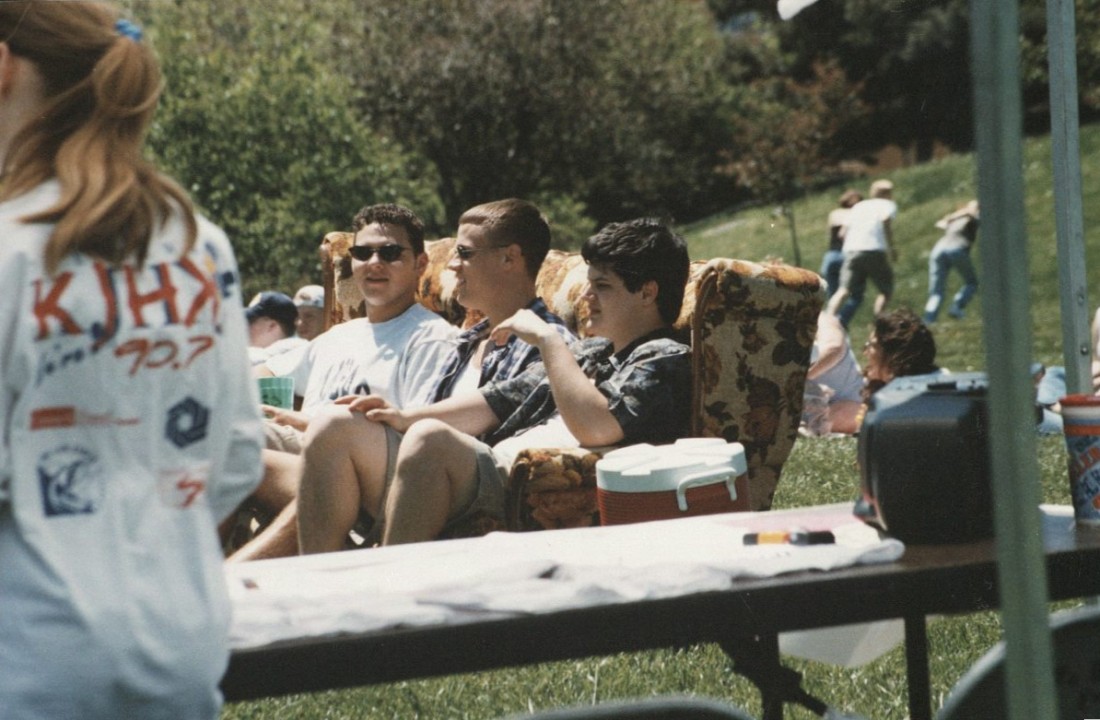
The late ’90s brought new changes including games and carnival-like activities, and the show ended at 6pm rather than at 9pm or later. Despite its budget struggles, SUA was able to book Urge Overkill, They Might Be Giants, Soul Coughing, the Urge, and HUM.
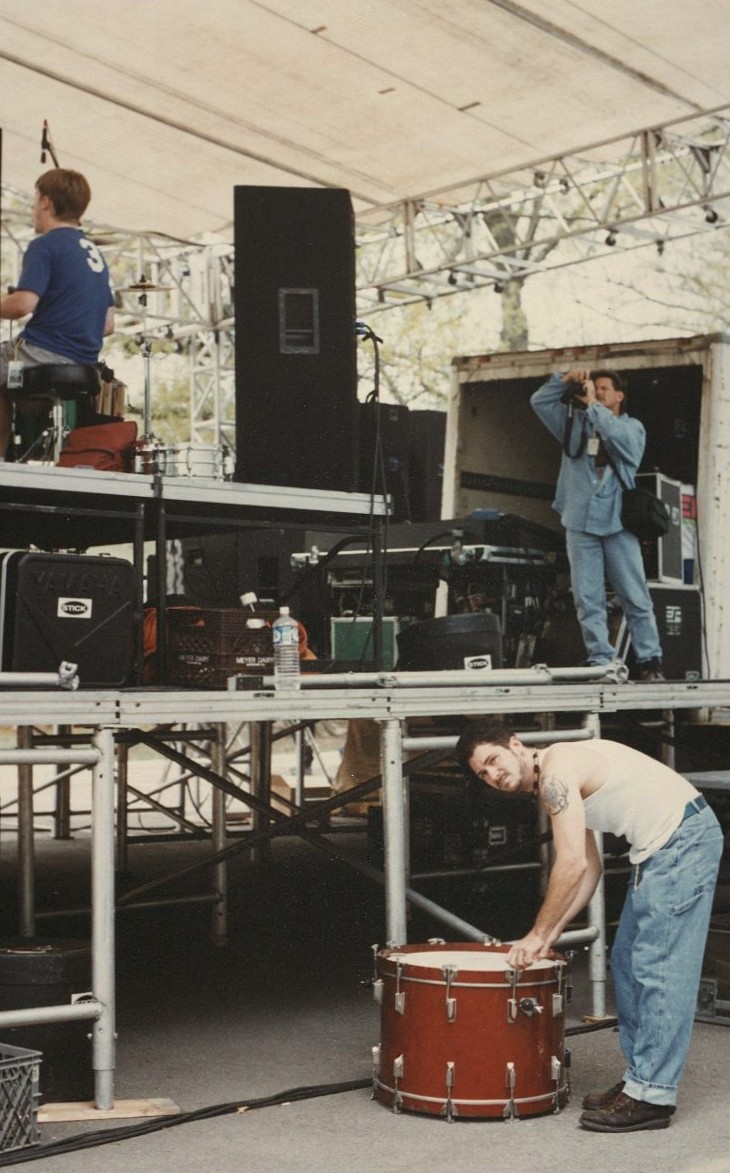
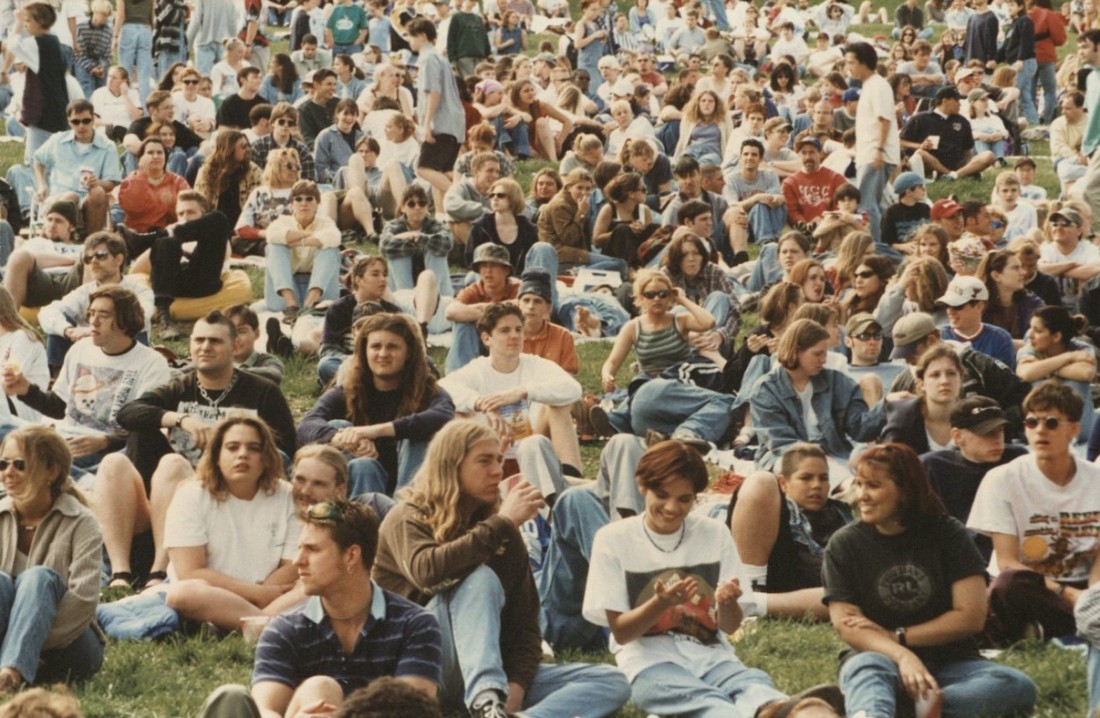
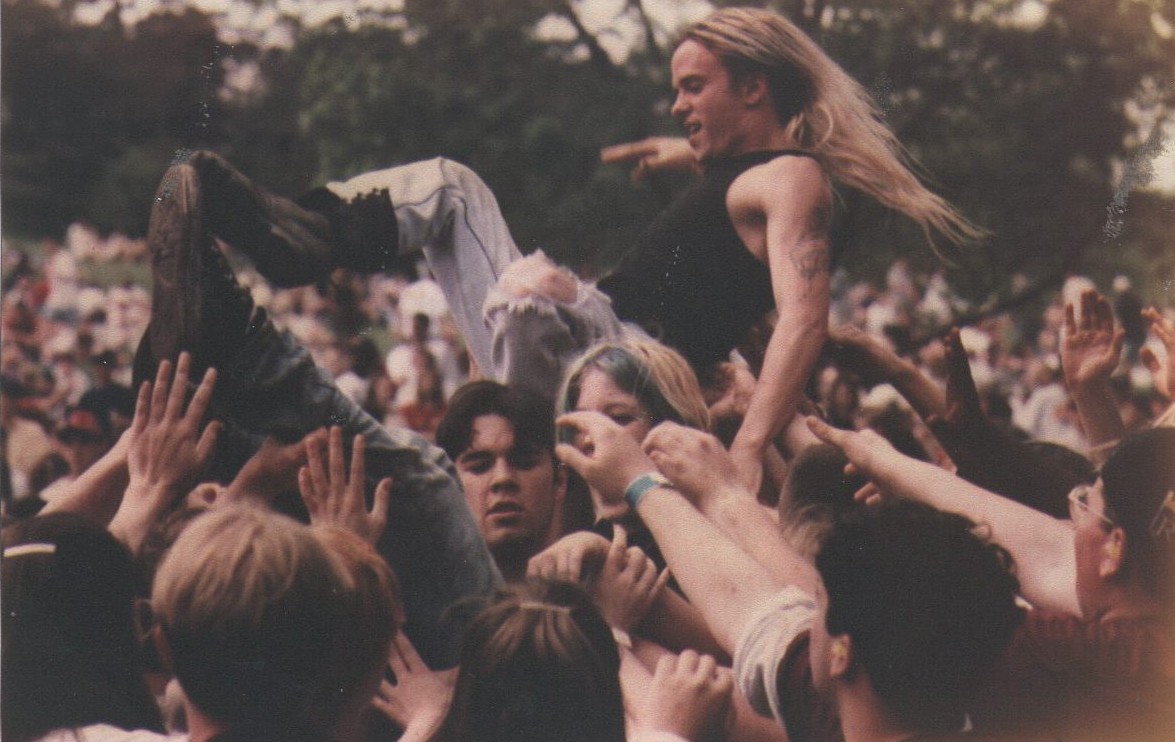
Scenes from Day on the Hill concerts, 1990s. University Archives Photographs, Student Activities: Student Union Activities. Click on images to enlarge.
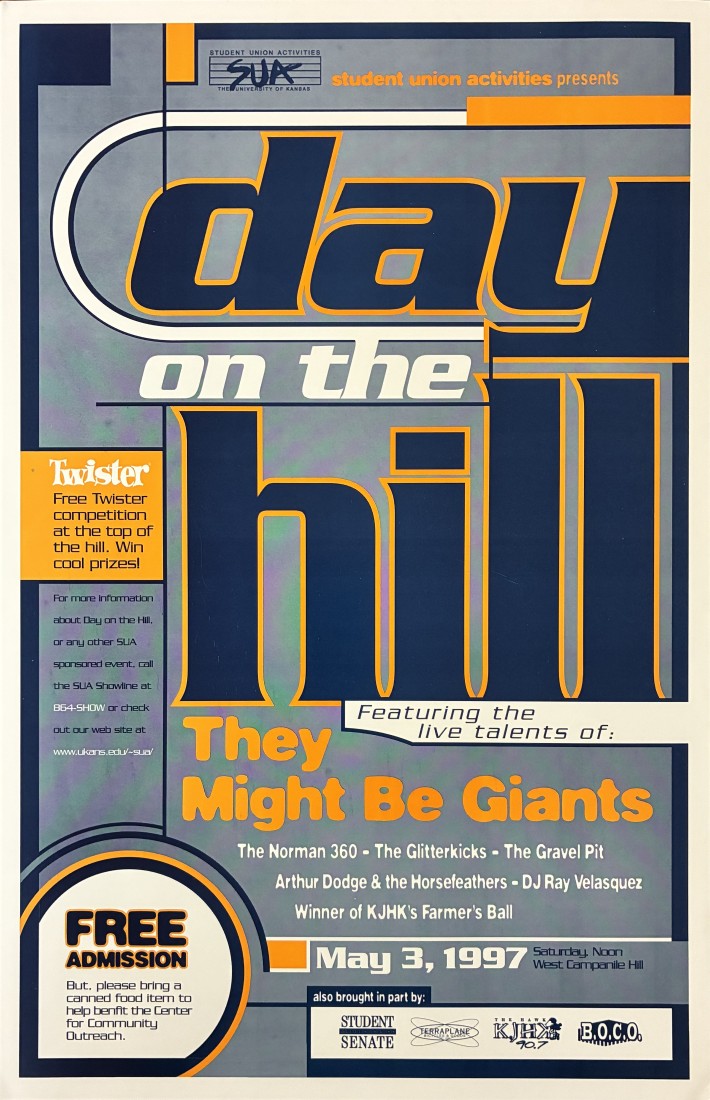
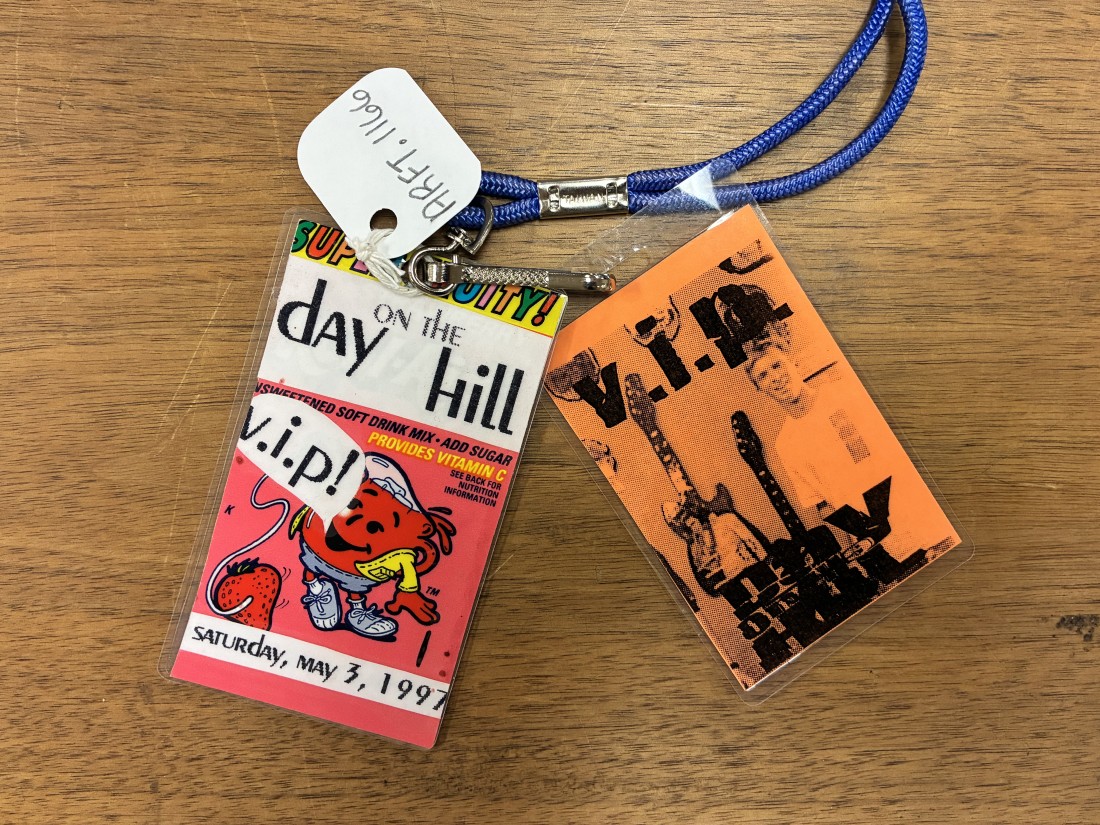
In 2002, SUA decided to return to Day on the Hill’s roots as an event for local bands only. The show was also rescheduled a week later because of rain and moved to a parking lot near the football stadium. The low turnout that year prompted SUA to cancel Day on the Hill for the next three years.
With a new student activity fee in 2006, Day on the Hill returned with headliners Sharon Jones & the Dap-Kings and Spoon. In 2007, it was moved to the Leid Center’s lawn with G. Love & Special Sauce and the Faint. In the UDK, there are no reports about that last show or why SUA stopped it entirely.
Enjoy these lineups (compiled from the UDK) and links to some videos on YouTube. Many thanks to those who digitized their recordings and preserved these glimpses of what was possible on KU’s campus when determined, resourceful students were able to pull off ground-breaking, free shows that celebrated the very important role that music plays in young people’s lives.
- 1989: Pathetic Excuse, The Mahoots, The Works, The Moving Van Goghs, Love Tractor, Too Much Joy
- 1990: The Witch Doctors, 2-Mile Death Plunge, Chris Beneke, Joe Worker, The Fluid, Sin City Disciples, Buffalo Tom, DJ Sir Light, Toad the Wet Sprocket
- 1991: Now See Hear, Two Guitars and a Short Guy, Zoom, Mutt Finicky, Az-One, DOPE (Disciples of Peace and Equality), Paris
- 1992: Big B, Cicada Rhythm Band, Zoom, Trademark, Tribe After Tribe, Let’s Go Bowling, Pearl Jam (full set and another view)
- 1993: Rise, Kill Creek, MU330, Crash Vegas, Gin Blossoms, Reverend Horton Heat
- 1994: Bubble Boyz, Pegboy, Vitreous Humor, Urge Overkill
- 1995: Lou’s Revenge, Bastard Squad, Tenderloin, Matthew Sweet
- 1996: Champion Guts to Glory Obstacle course, Justin Case, Sick, Poster Children, The Floyds
- 1997: Chebella!, Arthur Dodge and the Horsefeathers, The Glitterkicks, Norman 360, The Gravel Pit, They Might Be Giants
- 1998: 2 Player Option, Fear & Whiskey, The Believe It Or Nots!, The Creature Comforts, Soul Coughing
- 1999: Sarsky, Frogpond, Son Venezuela, Panel Donor, Poster Children, HUM
- 2000: Proudentall , The Jesse Jackson 5, Rex Hobart and the Misery Boys, The Co-op, The Urge
- 2001: Preferred Villain, Brent Barry and the Secondhands, The Youngblood Brass Band, Pomeroy, The Daybirds, Fastball
- 2002: Hardaway, Thulium, No Lessons, Hotsauce, Emilia Dahlin, The Anniversary
- 2006: Ghosty, Kelpie, The Belles, Superargo, DJ’s Hot Lunch Sharon Jones & the Dap-Kings, Spoon
- 2007: The Roseline, Pomeroy, G. Love & Special Sauce, The Faint
Kate Stewart
Curator of the Wilcox Collection of Contemporary Political Movements