The University of Kansas

Inside Spencer: The KSRL Blog

Books on a shelf

Welcome to the Kenneth Spencer Research Library blog! As the special collections and archives library at the University of Kansas, Spencer is home to remarkable and diverse collections of rare and unique items. Explore the blog to learn about the work we do and the materials we collect.

This blog may contain archived web content. This blog may link to catalog records which no longer exist as of a software change in 2026.

“We Ask No Catch Questions, Nor Any of Extraordinary Difficulty”: The First Kansas Bar Exam

July 23rd, 2026

Good luck to all Kansas law school graduates who are taking the bar exam next week! In honor of the occasion, we’re sharing the first two parts of the first Kansas bar exam, which was administered in Topeka on October 13-14, 1903, and later published in the Summary of the First Year’s Work of the State Board of Law Examiners. The Board’s first three annual reports – which include the bar exams administered during those years – can be found in Spencer’s collections (Call Number: RH C5864), although they are housed at the Annex and must requested ahead of a Reading Room visit.

The general guidance to “follow instructions in the Bulletin of Information to Applicants” included in the first exam was replaced by more specific instructions in the second (February 1904) exam: “The Board calls special attention to the fact that answers ‘yes’ and “no” will not be considered. In every case give the principles involved and the reasons for the answer. ” This statement was repeated for the third exam in June 1904, and additional clarification was added: “Write your answers plainly, on one side of the paper only, and guard your spelling and punctuation. Accuracy, clearness, and conciseness will be given weight.”
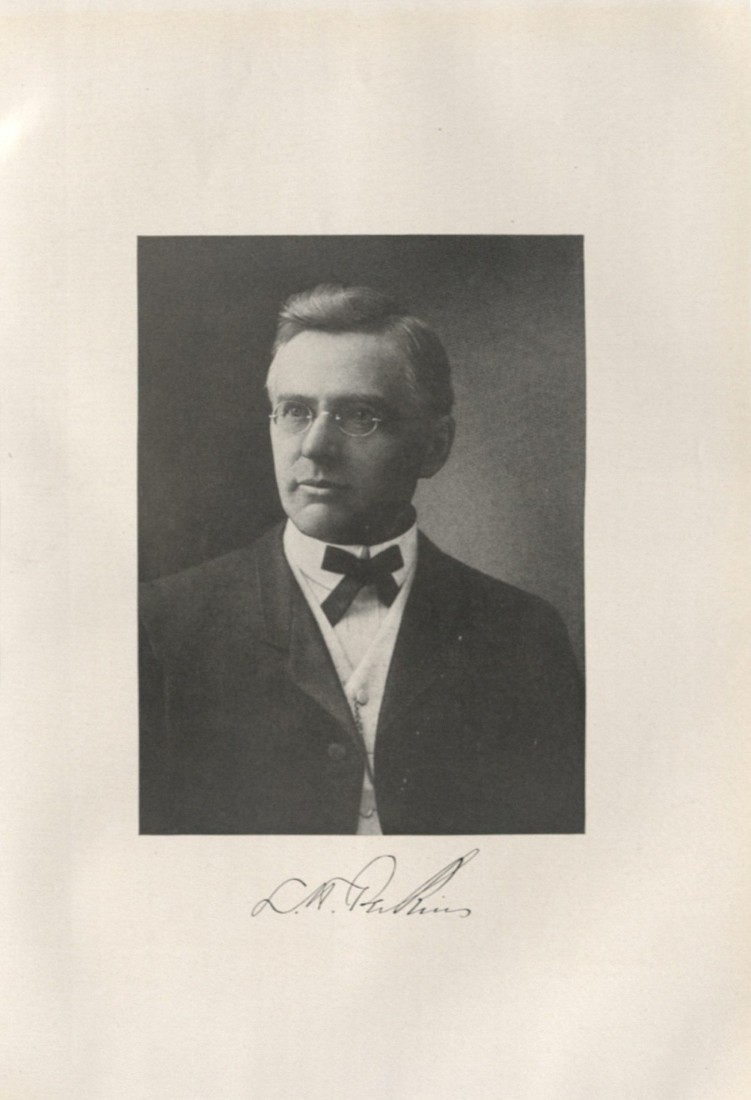
Black-and-white headshot portrait of a white man wearing glasses.
Portrait of Lucius H. Perkins (1855-1907), the first secretary of the Kansas State Board of Law Examiners, in A Standard History of Kansas and Kansans by William E. Connelley, volume 5, 1918. Call Number: RH D214. Click image to enlarge.

More details about the first bar exam can be found in the paper “The State Board – A Landmark in Lawyer-making” by Lucius H. Perkins, D. C. L., secretary of the Kansas Board. Perkins presented the paper at the first national conference of the State Boards of Law Examiners, which was held at the St. Louis World’s Fair in 1904. It was reprinted – “by request” – in the Board’s Second Annual Report (1904-1905). Perkins noted that applicants who had been “admitted to the highest courts of another jurisdiction and actually practiced for more than three years immediately preceding their application” were tested via an oral examination. Beyond that,

“all other examinations are in writing. We proposed eighty questions, divided into four sessions of three hours each [across two days]. We require a few definitions and ask a few categorical questions; but by far the greater number are hypothetical, and are intended to raise the ordinary questions that might be put to a lawyer any day. We ask no catch [trick] questions, nor any of extraordinary difficulty. Our aim is to test the applicant’s mental caliber as well as his knowledge of the law, and we give good credit for a brainy answer even though the solution be wrong…

At the beginning of an examination the clerk of the supreme court [sic] gives each applicant a number, with which he signs all his papers. The board does not know one from another, and each performance is passed upon solely on [sic] its merits. This impersonal method relieves the board from every suspicion of partiality.”
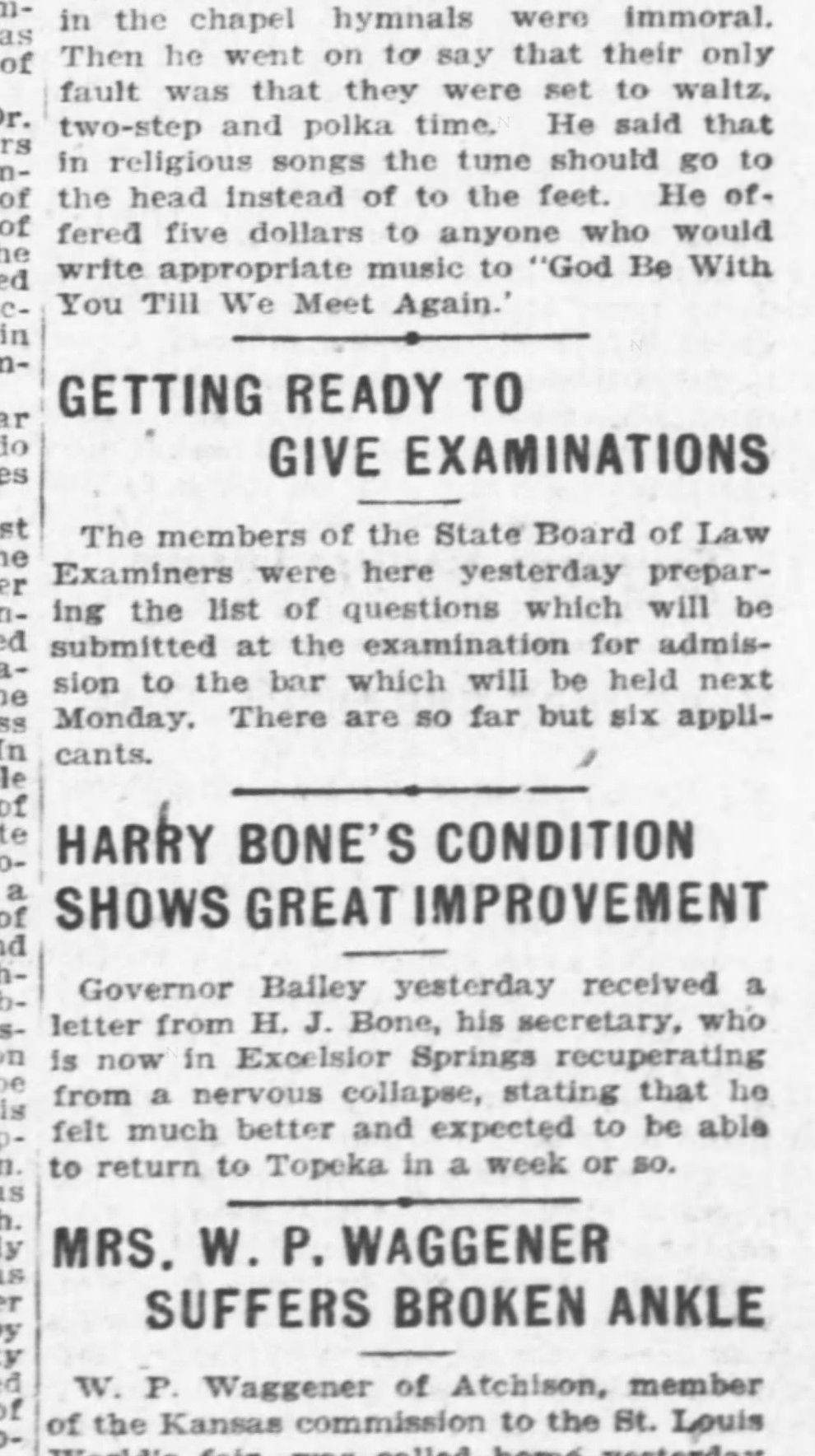
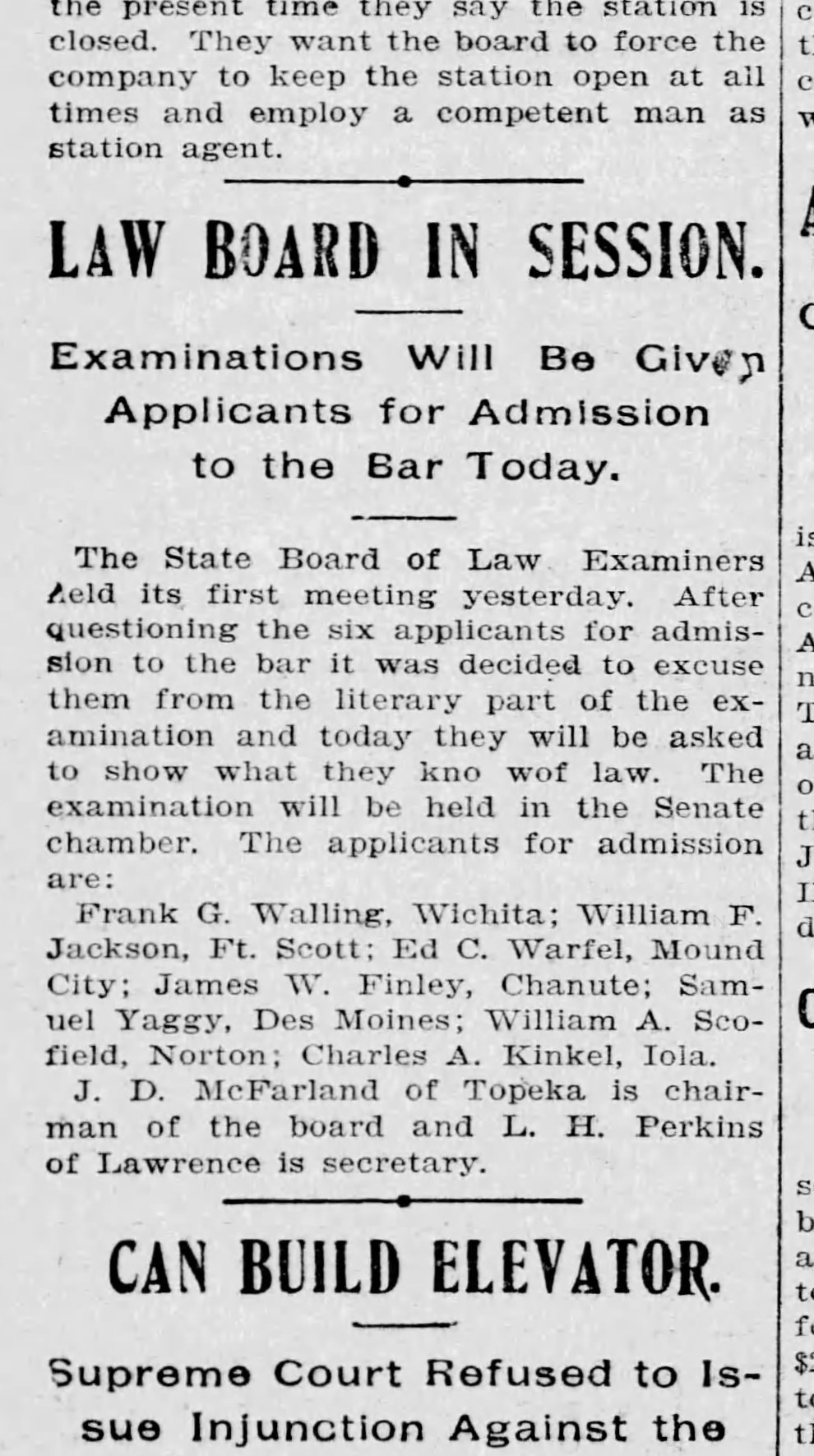
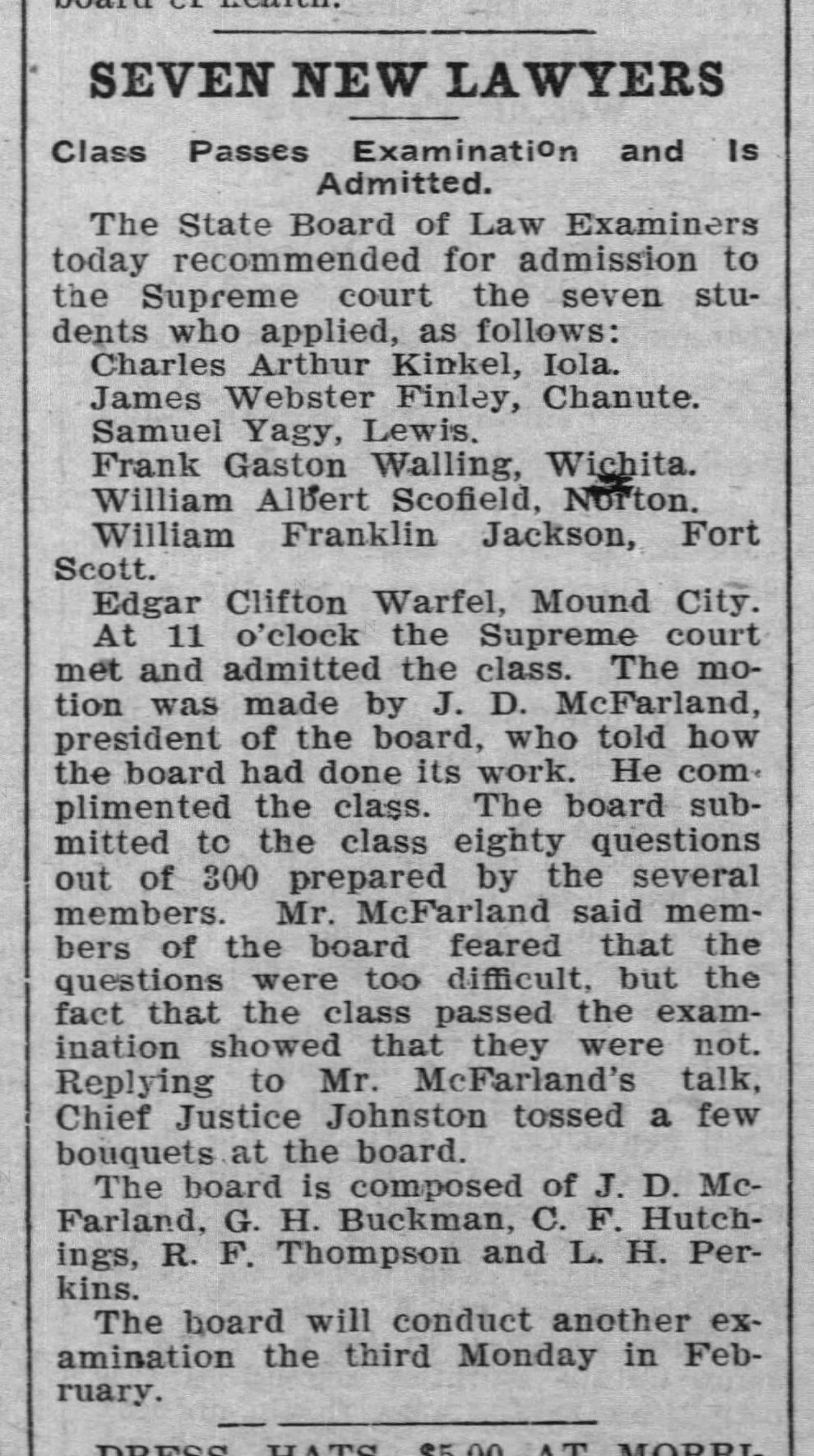
Newspaper coverage of the first Kansas bar exam. Left: The Topeka Daily Capital, October 9, 1903. Middle: Capper’s Weekly: The Kansas Semi-Weekly Capital, October 13, 1903. Right: The Topeka Daily Herald, October 15, 1903. All articles accessed via Newspapers.com. Click images to enlarge.

Additionally in his paper, Perkins describes the process by which individuals applied to take the bar exam, commenting that “the methods adopted by the Kansas board are in accord with the most advanced thought and the most successful experience in this work.”

“We furnish each applicant a regular set of printed forms, consisting of an application, affidavit of the applicant, affidavit of his preceptor, and a certificate of the local district judge and three practicing attorneys that he is a person of good moral character, and, if qualified, a suitable person to be admitted to the bar. We also send a copy of the rules and a bulletin of information. The applicant is required to frame his petition to the supreme court [sic], and it must be in his own handwriting. He files his petition in the office of the clerk of the supreme court, and sends a copy of it with all his other papers to the secretary of the board. In the application he gives his history, and especially the character of his education, the studies pursued, and what he has been doing for the past five years.

One of the most important requirements is that he give a satisfactory account of himself, and no man will be received in the examination if there is any cloud upon his character. We cannot reach the rascals who are already in, but the State Board of Law Examiners stands between [unscrupulous attorneys] and the lawyers of the future. We cannot catch them all, but we shall stop those whose rascality is already known.

Our requirements of preliminary education are equal to a four-year course in a standard high school. No diploma, ipso facto, admits the applicant to the examination. We reserve the right to determine what schools shall be accredited, and a diploma from a law school does not excuse the applicant from the preliminary examination, unless the standard of admission is up to the standard of the board. All applicants are examined. Graduates from our own or any other university or law school are not exempt.”
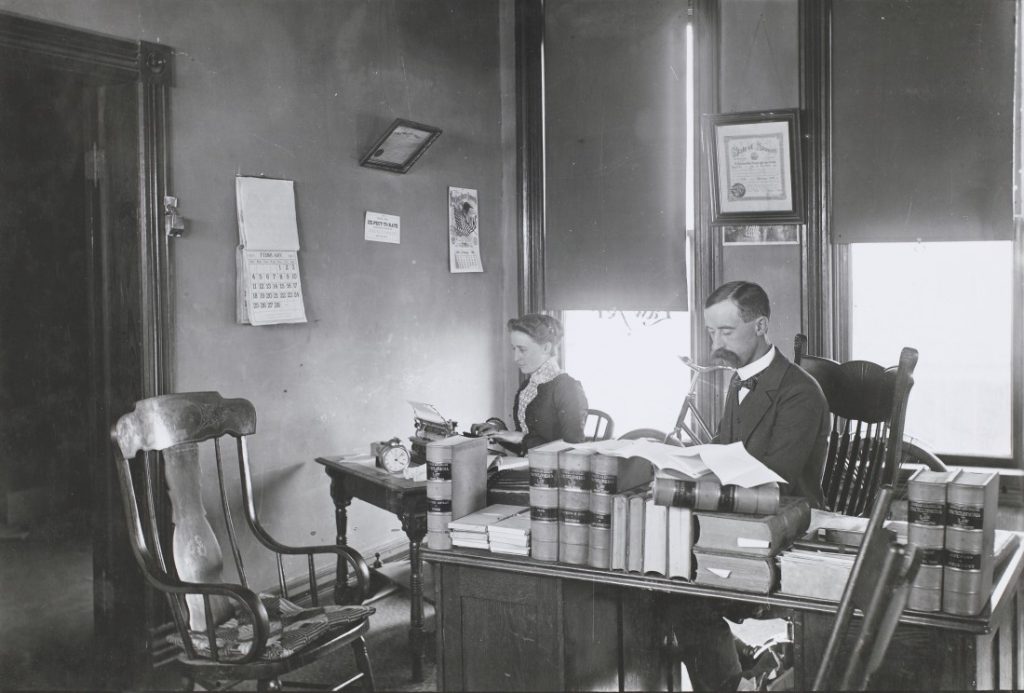
Black-and-white photograph of a man sitting at a desk crowded with books. A woman sits to left, using a typewriter.
The interior of J. D. Rairdon’s law office in Junction City, Kansas, 1903. Joseph Judd Pennell Photograph Collection. Call Number: RH PH Pennell. Click image to enlarge (redirect to Spencer’s digital collections).

Readers, do you have a favorite question from the first Kansas bar exam?

Caitlin Klepper
Public Engagement Librarian
Irish Manuscripts for Beyond 2022

March 17th, 2021

In honor of St. Patrick’s Day, this week we are highlighting KU’s participation in Beyond 2022: Ireland’s Virtual Record Treasury. On June 30, 1922, in the midst of the Irish Civil War, the Public Record Office of Ireland (PROI) was destroyed by an explosion and fire at the Four Courts in Dublin.  As the Beyond 2022 website explains, seven centuries’ worth of Ireland’s historical records were lost in this fire.

To overcome this harm to “Ireland’s collective memory,” Beyond 2022 is undertaking an international collaboration to digitize copies of records held across Ireland, Northern Ireland, and beyond in order to launch a “Virtual Record Treasury for Irish history—an open-access, virtual reconstruction of the Record Treasury destroyed in 1922.” One particularly exciting aspect of the initiative is its work with Transkribus to employ HTR (Handwritten Text Recognition) to automate the transcription of manuscript records.

Beyond 2022: Ireland’s Virtual Record Treasury.  A short video about Beyond 2022, explaining the project. Video available at https://beyond2022.ie/?page_id=171#videos. Photo Credits: UCD Archives; National Archives of Ireland; Irish Architectural Archive; NoHo; Trinity College Dublin; ADAPT Centre.

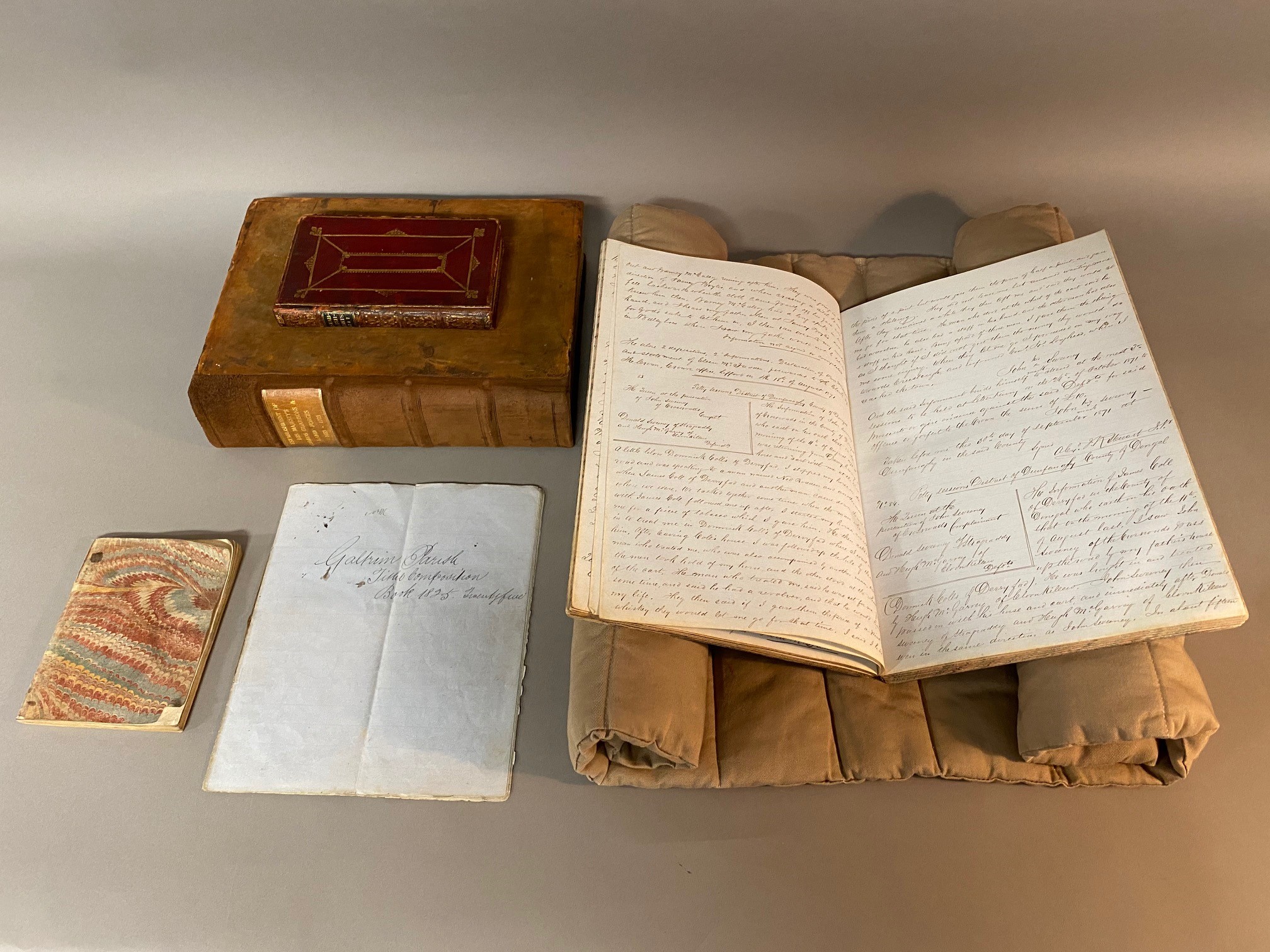
To assist in this ambitious effort, Spencer Research Library is digitizing several manuscripts from its collections that Beyond 2022 has identified as pertinent to its treasury. These manuscripts bearing on Irish history include volumes containing civil and military establishments for late 17th and early 18th century Ireland (MSD88, MS B86, and MS A42), a “Galtrim Parish tithe composition book,” Co. Meath, 1825 (MS P403A), and a volume containing “Copies of informations &c taken in Dunfanaghy Petty Sessions district, County Donegal,” 1863-1901 (MS E109).  Such manuscripts are the types of records that might have once been held in the Public Record Office of Ireland (PROI). 

Image of five manuscripts pertaining to Ireland from Spencer Research Library's collections digitized for inclusion in Beyond 2022: Ireland's Virtual Record Treasury
Five manuscripts (MS A42, MS P403A, MSD88, MS B86, and MS E109) pertaining to Ireland from Spencer Research Library’s collections that are being digitized to contribute to Beyond 2022: Ireland’s Virtual Record Treasury.

Of these, MS E109 is particularly intriguing. The manuscript volume contains copies of depositions, informations, statements, and declarations of complainants, witnesses, and occasionally defendants taken between 1863 and 1901 in the Dunfanaghy Petty Sessions district of Co. Donegal, a county in the northwest of Ireland bordering the Atlantic ocean. Petty Sessions were “courts held by the justices of the peace to try minor criminal offences summarily—i.e. without a jury.”[i] More serious cases would also be referred to other court proceedings, such as quarter sessions and assizes. (For a brief overview of the legal system in Ireland during the 19th century, visit the “History of the Law in Ireland” page on the website of The Courts Service of Ireland.)

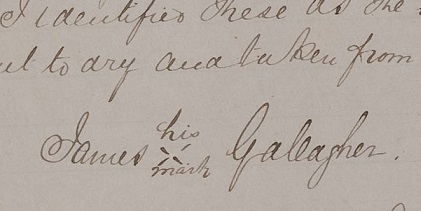
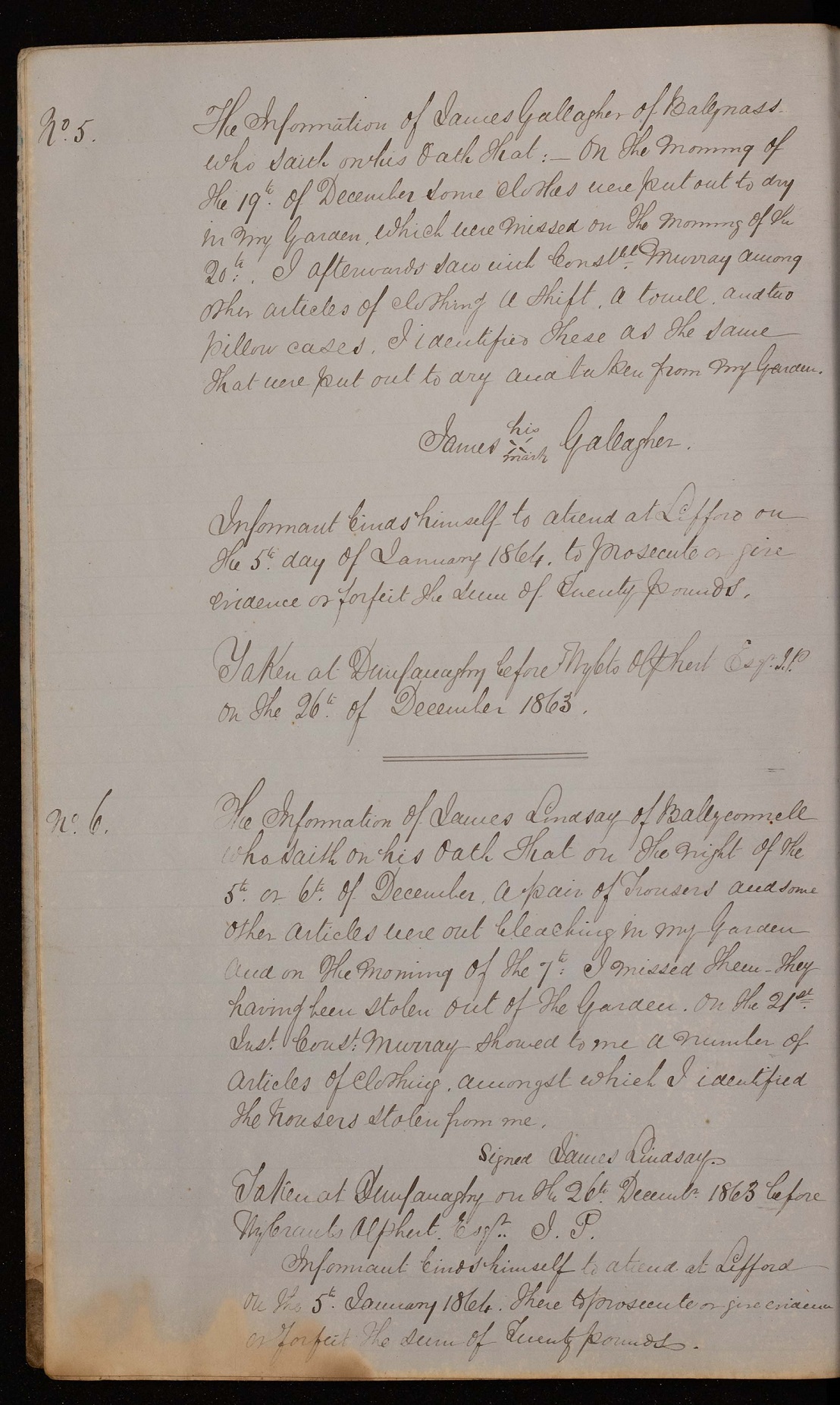
Manuscripts such as the Dunfanaghy Petty Sessions district copy book can be particularly interesting to historians and genealogists alike because they offer views of the experiences and conditions of individuals for whom other types of written evidence may not exist or survive. For example, a significant number of those providing sworn informations and depositions in the Dunfanaghy copy book are recorded as having signed with their mark—the x or symbol that individuals unable to write would use in place of their signature. Such individuals are unlikely to have left other written documentation of their lives, such as letters or diaries, so their statements (though filtered through the clerk’s transcription) may be all that survives of their voices. Of course, it is worth remembering that a volume like the copy book for the Dunfanaghy Petty Sessions district isn’t necessarily capturing everyday life, but the experiences of individuals—whether complainants/victims, defendants, or witnesses—as their lives intersect with the legal system and crime.

Image showing how the Dunfanaghy Petty Sessions copy book (MS E109) records that James Gallagher signed with his mark (x)  Image showing how the Dunfanaghy Petty Sessions copy book (MS E109) records that James Lindsay used a signature to attest to his sworn testimony (information)

Details from the sworn “informations” of James Gallagher (Item 5) and James Lindsay (Item 6) concerning the theft of clothes hanging in their respective gardens in December of 1863. The notations in the copy book suggest that Gallagher (left) signed with his mark, whereas Lindsay (right) used a signature. “Copies of Informations &c taken in Dunfanaghy Petty Sessions district, County Donegal.” Dunfanaghy, copybook, 1863-1901. Call #: MS E109.  Click here to see the full page containing the sworn information of both Gallagher and Lindsay. 

The types of offenses recorded in the copy book include fights, theft (of clothes, of oats, of horses, sheep, and cattle, etc.), unlicensed guns, misappropriation of letters, threats of violence, and resisting the bailiff’s confiscation of a horse, to name a few. Occasionally the volume also contains accounts of more serious and violent crimes, such as assault and battery, murder, and rape. The witness and complainant statements for these matters can be quite harrowing to read. These cases would be referred to the assizes, the courts where the most serious offences (felonies) were addressed.

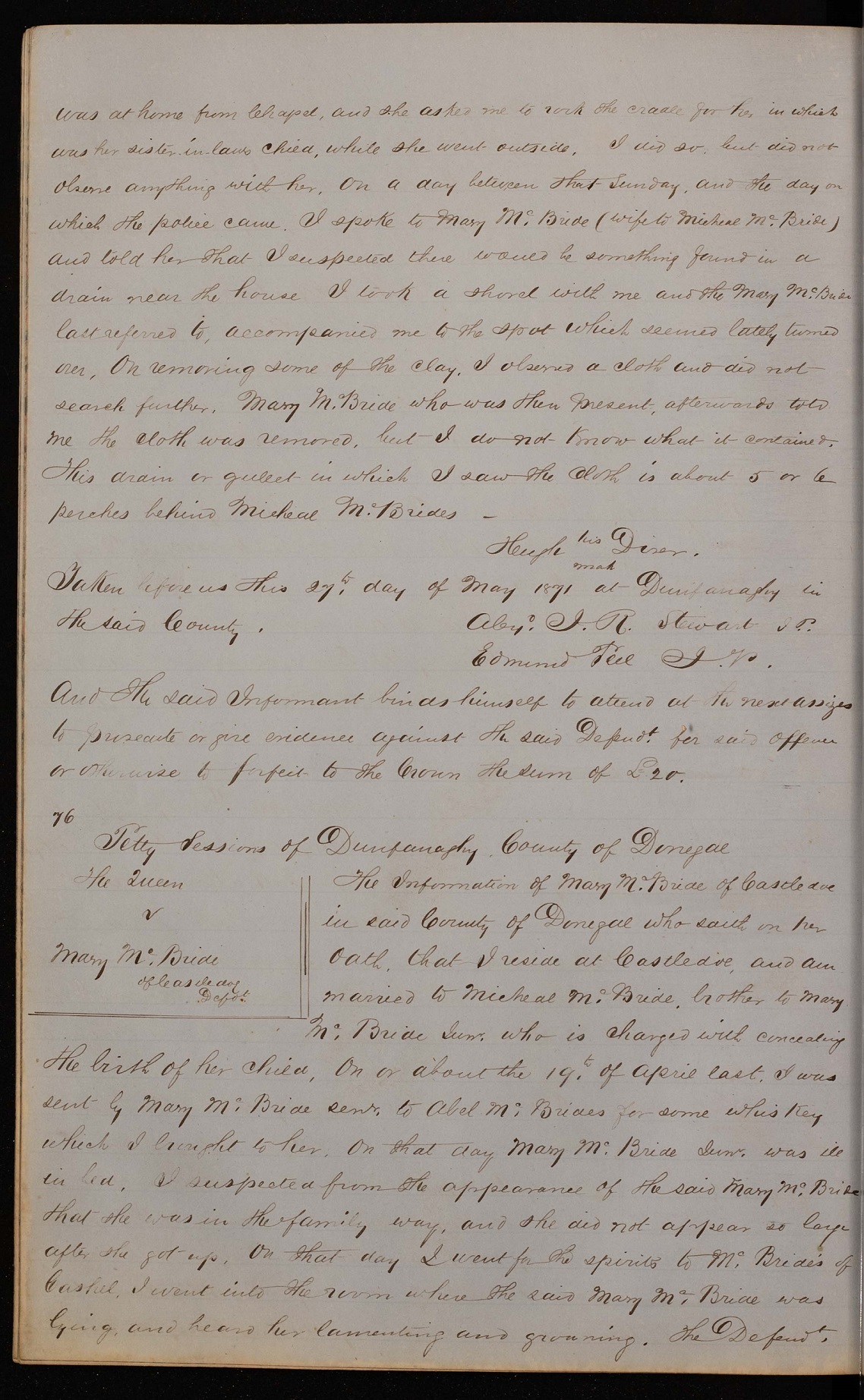
Several sworn statements offer glimpses into some of the difficult conditions of the lives of women. One example involves the case of Mary McBride, who in the spring of 1871 is accused of the concealment of the birth of a child. The sworn informations associated her case can be challenging to read, not only because of the difficult subject matter, but also because they make reference to no fewer than three Mary McBrides:  1) the woman who gave birth (sometimes referred to as Mary McBride junior); 2) that woman’s mother (Mary McBride senior); and 3) Mary McBride junior’s sister-in-law (Mary McBride, wife to Michael McBride). However, it is worth pushing through the confusion that the shared names might pose since the content of the statements is likely to hold much interest for researchers in the field of women’s history; women, gender, and sexuality studies; and the law.  

Detail showing the beginning of Item 76, the sworn information taken on May 27, 1871 of Mary McBride (wife to Michael McBride) concerning her sister-in-law Mary McBride (junior), who is charged with concealing the birth of her child. From: “Copies of Informations &c taken in Dunfanaghy Petty Sessions district, County Donegal.” Dunfanaghy, copy book, 1863-1901. Call #: MS E109. Click image to see full page.

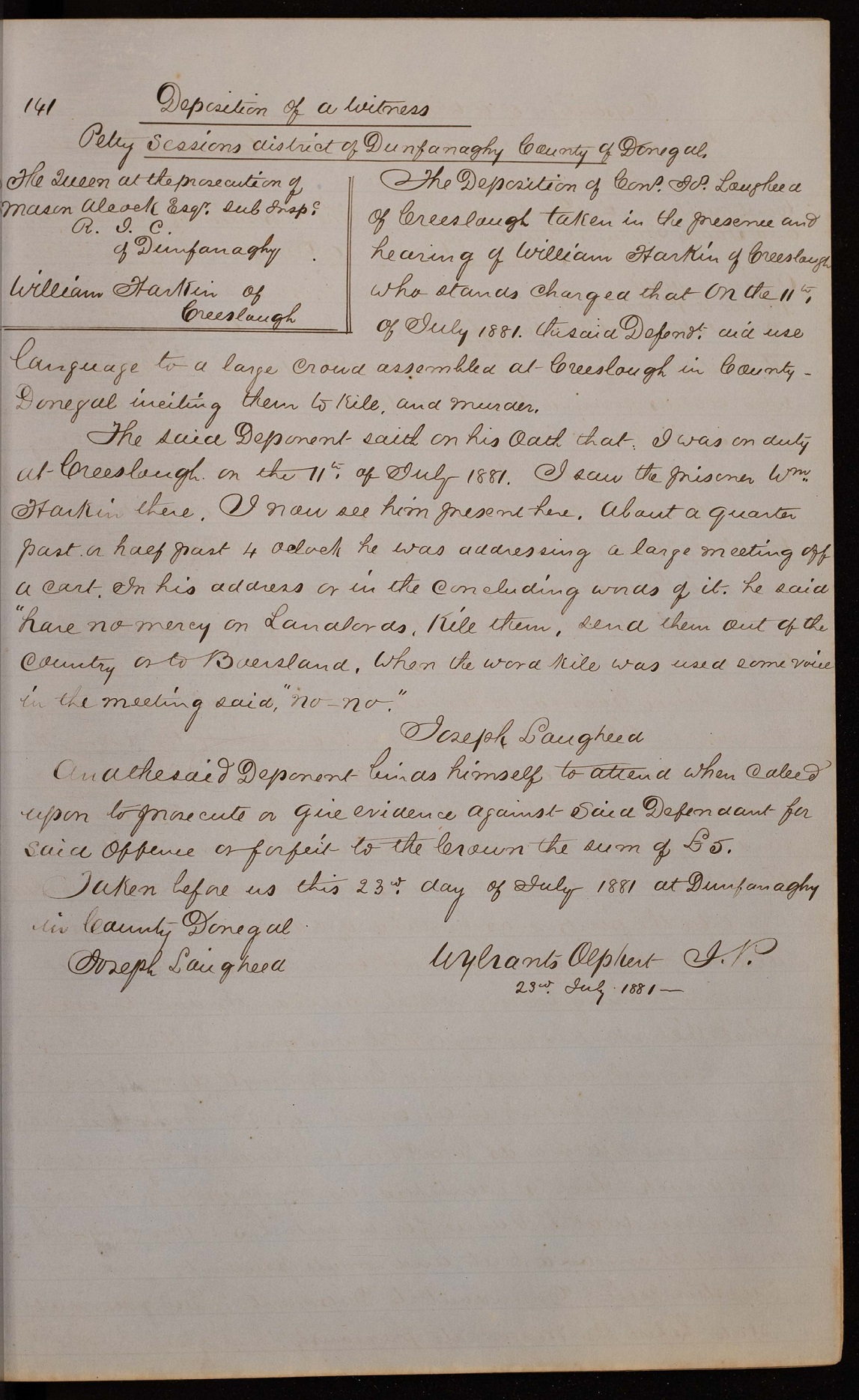
Though most of the cases are non-political, a few have a larger political valence. One notable instance relates to William Harkin of Creeslough, who is accused of inciting a meeting (which some witnesses referred to as a Land League meeting) to violence. The Land League was political agrarian organization that campaigned against landlordism and its more predatory practices, seeking rights for farmer tenants, such as fair rents, rights to sale of occupancy, and security of tenure. The date of the incident recorded in the Dunfanaghy copy book, July 11, 1881, falls during a period of heightened agrarian agitation referred to as the Land War, and indeed, later that year, the Land League would be suppressed and several of its national leaders, including Michael Davitt and Charles Stewart Parnell, jailed. The Dunfanaghy copy book contains witness statements of three members of the Royal Irish Constabulary against Harkin.  Constable Joseph Lougheed’s brief deposition reports, “In [Harkin’s] address or in the concluding words of it, he said ‘have no mercy on Landlords. Kill them, send them out of the country into Boersland.[’],” although he also notes, “When the word kill was used some voices in the meeting said, ‘no-no.’” News of the charges against Harkin reached as far as New South Wales, where Sydney’s The Freeman’s Journal reported on it a month and a half later as part of a section on the Land War, under the heading “A Land League Secretary Charged With Inciting to Murder.”[ii] The depositions surrounding Harkin’s case may appeal to students and scholars studying Irish nationalism, reform movements, and agricultural history alike.

Image of a detail from Constable Joseph Laugheed's deposition regarding William Harkin (Item 141) in the Dunfanaghy Petty Sessions copy book (MS E109)
Detail from Constable Joseph Lougheed’s deposition regarding William Harkin (Item 141). From “Copies of Informations &c taken in Dunfanaghy Petty Sessions district, County Donegal.” Dunfanaghy, copy book, 1863-1901. Call #: MS E109. Click image to see full page.

In the coming months, the five selected manuscripts will be made available online through Beyond 2022’s Treasury and in KU Libraries’ own digital collections, enabling researchers around the world to make new investigations into Irish history. On this St. Patrick’s Day, following a full year during which so many of our activities have migrated online in response to the Covid-19 pandemic, it’s exciting to think that students, scholars, and members of the public will soon be able to read (and make discoveries with) several of Spencer’s Irish manuscripts from wherever they can access a computer.  

Elspeth Healey
Special Collections Librarian


[i] Mulholland, Maureen. “Petty sessions,” in The Oxford Companion to British History. Oxford University Press, 2015. https://www.oxfordreference.com/view/10.1093/acref/9780199677832.001.0001/acref-9780199677832-e-3360.

[ii] “A Land League Secretary Charged With Inciting to Murder,” The Freeman’s Journal (Sydney, NSW). Vol. XXXII, No. 1958 (17 September 1881): 7. https://trove.nla.gov.au/newspaper/page/12664516.

Criminal Cases in Medieval Bologna

March 28th, 2016

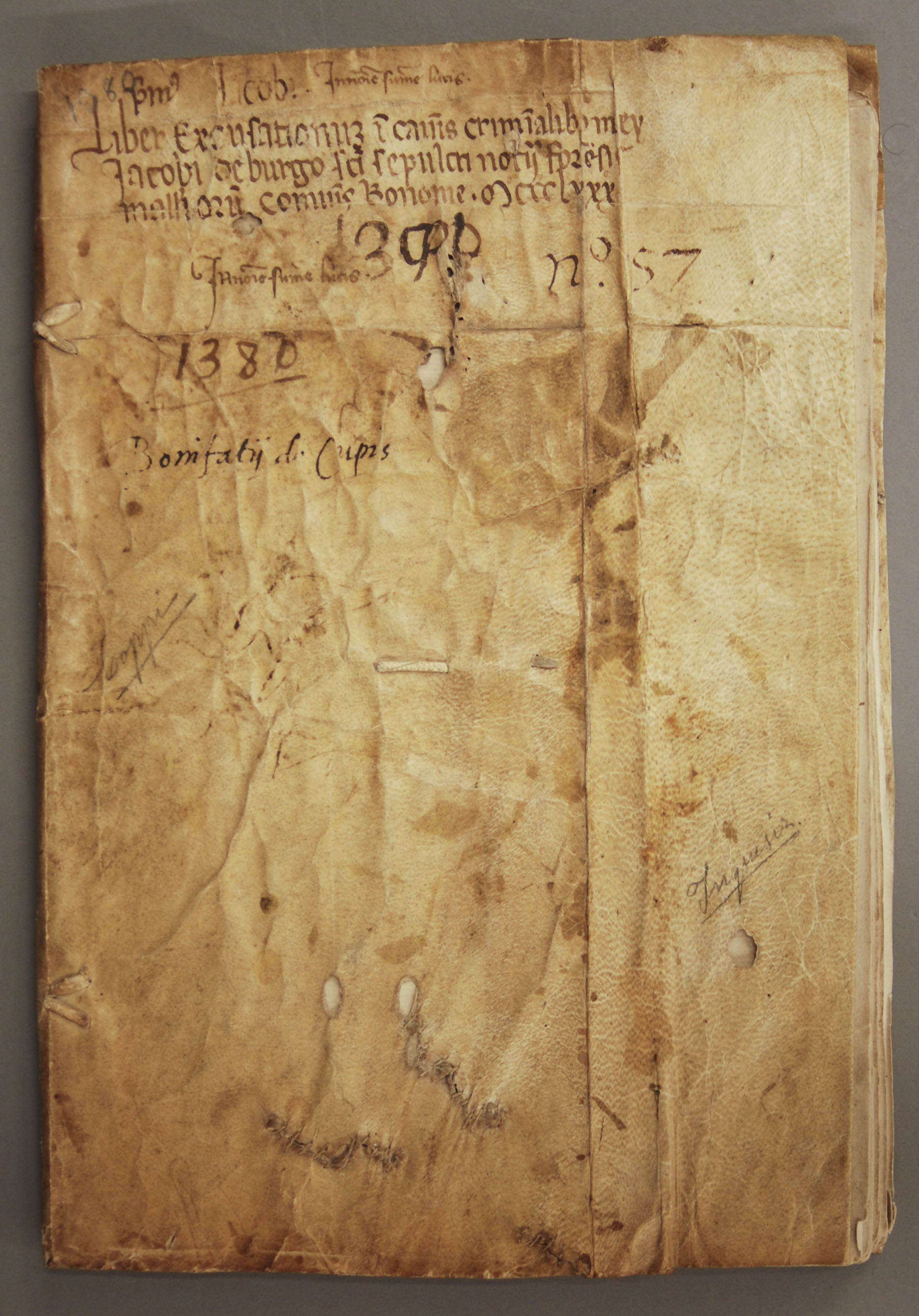
Jacobus de Burgo Sancti Sepulcri (fl. 1380) was a notary and magistrate’s forensic official for misdeeds in Bologna. This is his official record of the charges and pleas he handled in twenty cases involving Bolognese citizens. The cases are mostly minor assaults and theft, although there is one long case of sorcery, seduction, quackery, and con-games.

In one example, German-speaking Ubertus, son of the late Henricus de Norfa, came to the house of Gimignanus Ramainus and stole a woman’s tunic, colored green and worth 10 pounds. Talianarius the notary translated the charge into German for him. He confessed everything.

MS E77 cover MS E77 first page

Liber excusationum in causis criminalibus, Bologna, 31 October 1380 to 24 January 1381. Left: Front cover. Right: First page. Call number MS E77. Click images to enlarge.

MS E77 back cover dragon

Doodle on inside of back cover. Call number MS E77. Click images to enlarge.

Adapted from Civil, Canon, and Common: Aspects of Legal History. An Exhibition of Books and Manuscripts in the Kenneth Spencer Research Library, University of Kansas, 1996.
Alexandra Mason: Catalogue and exhibition; James Helyar: Design