The Magic of Classic Children’s Books: The Odyssey Edition (Or, From Page to Screen: A Child’s Name in an Ancient Story)
August 14th, 2026Classic children’s books continue to connect generations through stories that inspire imagination, adventure, and wonder. In this fourth post in a series highlighting titles from Spencer Research Library’s vast children’s book collection, a well-traveled copy of The Odyssey for Boys and Girls reveals an unexpected connection across time.
My recent interest in The Odyssey began somewhat unexpectedly. I had seen discussions of a recent adaptation by a female author and was intrigued by the conversation surrounding it. There is something fascinating about watching a story evolve as each generation discovers new ways to tell it. Even so, I did not plan to see the new film adaptation. I rarely go to movies, and it likely would have passed me by had I not been invited. The experience left me thinking not only about Odysseus and his journey home, but also about the remarkable journey of the story itself.
A short time later, while searching for animal stories for an entirely different blog post, I happened upon a 1923 copy of The Odyssey for Boys and Girls translated and edited by Alfred John Church (Call Number: Children C36). Its striking Art Deco cover and spine immediately caught my attention, standing out among the surrounding volumes in a way they might not have only a few weeks earlier. Perhaps it was serendipity. Perhaps it was simply timing. Much like buying a new car and suddenly noticing the same model everywhere, once The Odyssey was on my mind, I seemed to encounter it at every turn.
Curious, I pulled the book from the shelf. I initially picked it up because of the story. Yet, as often happens when exploring historical children’s books, I soon found myself just as interested in the people hidden inside.
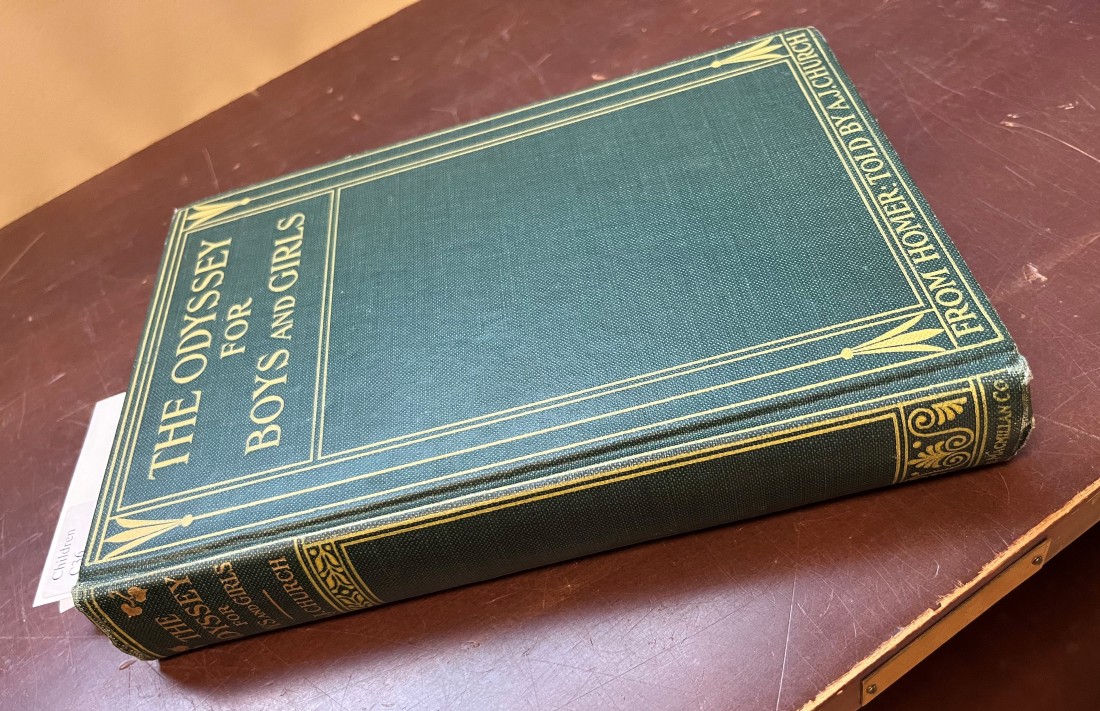
Like many people, I encountered The Odyssey through references, retellings, and popular culture long before I ever considered reading Homer himself. The Odyssey is a story about an epic journey. Odysseus struggles to find his way home, but the story itself has also been on a remarkable journey. For nearly three thousand years it has traveled across generations, languages, formats, and audiences. This 1923 edition, The Odyssey for Boys and Girls, represents one stop along that path, introducing an ancient hero to young readers who were beginning their own journeys.
As I opened the book, I didn’t expect the dedication to be the following:
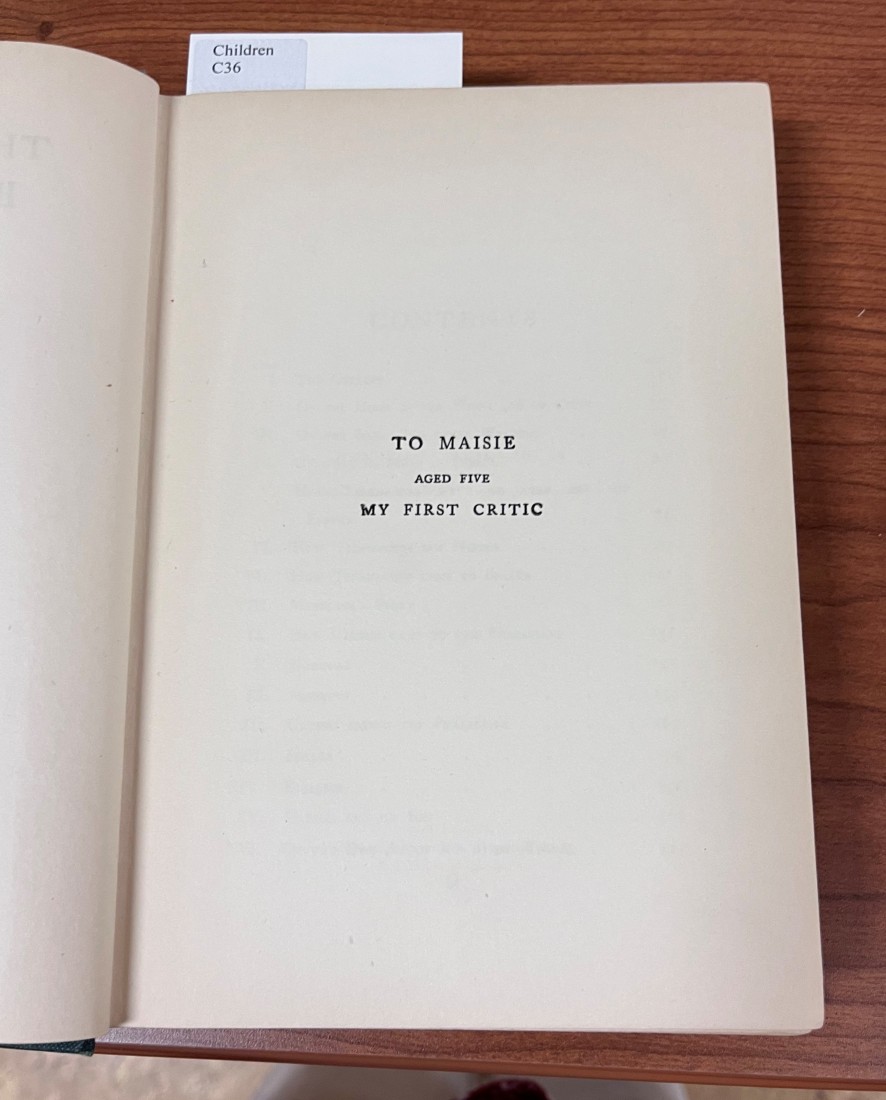
Long before online reviews, social media, and star ratings, there was a five-year-old named Maisie whose opinion mattered enough to earn a dedication, which sparked my interest in the edition. It wasn’t just another adaptation. It came alive. Who was Maisie? How did her suggestions shape the story? What captured her imagination? Was she being read The Odyssey at age five?
The inscription reminded me of a phrase we still use today: “Explain it to me like I’m five.” Despite its humorous use, the phrase reflects something important. We are not asking for an idea to be made less significant. We are asking for it to be made accessible. In many ways, The Odyssey for Boys and Girls serves exactly that purpose. It does not attempt to replace Homer. Rather, it offers readers a place to begin. Every lifelong reader starts somewhere, and children’s adaptations often serve as the bridge between curiosity and confidence.
The Odyssey for Boys and Girls does not contain any illustrations of Odysseus, the Cyclops, the Sirens, or the storm-tossed seas. A child opening this book in the 1920s would be expected to create those images independently. That absence feels significant because it marks a transition many readers’ experience. Picture books invite us to look at a story. Chapter books ask us to imagine one. Somewhere between those stages, readers discover that words alone can create entire worlds.
Perhaps that is why I found myself thinking about Maisie who influenced The Odyssey for Boys and Girls. Was this one of the books that encouraged the transition from looking at stories to imagining them?
Often discussions about modern adaptations of classical texts focus on changes made. Yet I found myself asking a different question: Who might discover the story because of this adaptation? Children’s adaptations such as The Odyssey for Boys and Girls have been answering that question for generations. They are not replacements for the original work. They are invitations. Every lifelong reader starts somewhere. For nearly three thousand years, readers have continued finding meaning in Homer’s tale, a story explored in literary and historical contexts.
As I continued exploring The Odyssey for Boys and Girls, I found a bookplate (“from the books of”) with the handwritten name Meredith Belt.
There are a only few of us Merediths out there. Growing up, I was typically the only Meredith around. When you spend most of your life as the only Meredith in the room, seeing or hearing your name tends to feel personal. Encountering another Meredith has always felt unusual. Discovering one in a century-old children’s book felt even more so. Seeing their name transformed the book into an artifact with a personal connection. The owner was no longer an anonymous child from the past. I began imagining another Meredith, who claimed ownership one hundred years ago.
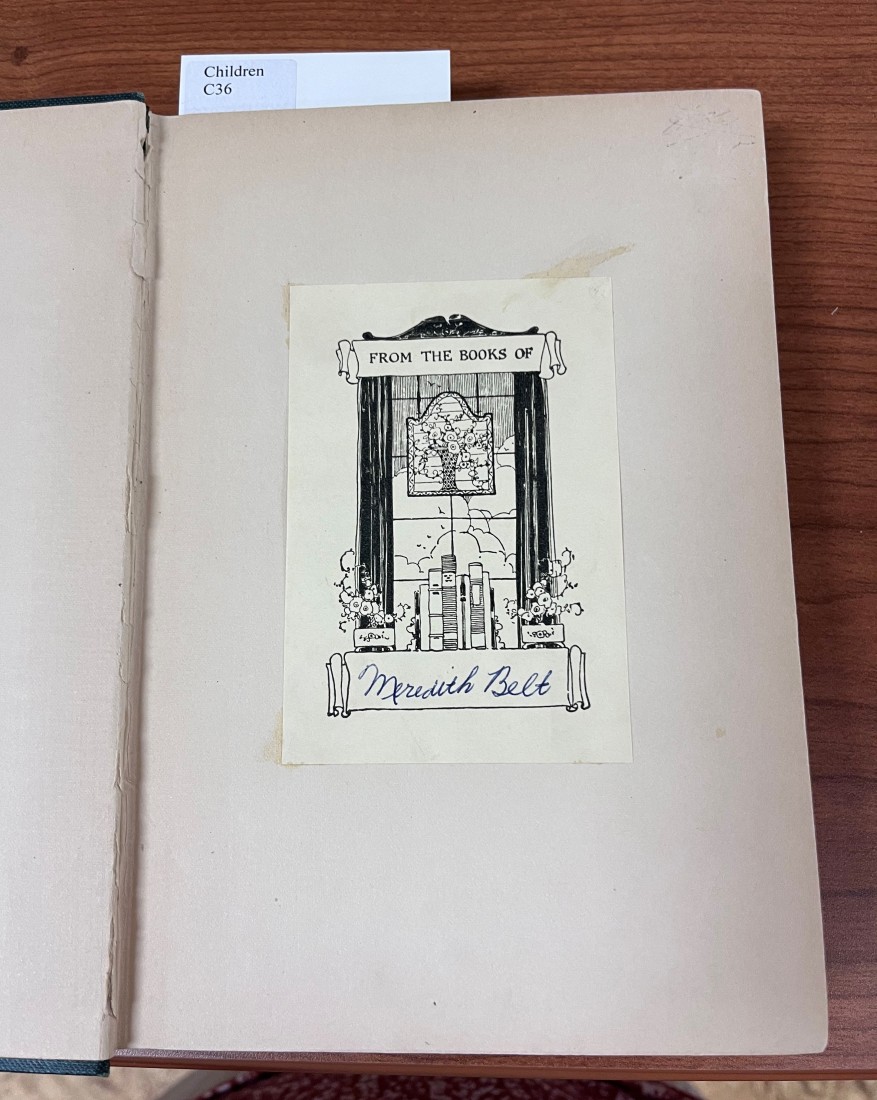
My understanding is that Meredith began as a masculine Welsh name before becoming more commonly associated with girls, which raises another question. Was Meredith Belt a girl or a boy? The inscription offers no clues and keeps its secret. Moreover, who was Meredith Belt? Was the book a gift to them? Did someone read it aloud to Meredith, or did they read it independently? The questions are impossible to answer.
For librarians and special collections staff, the history of a book’s ownership and use is known as provenance. Not every inscription makes a book historically significant, and not every marked book belongs in a special collection. In collections focused on children’s literature, however, traces left behind by readers can add valuable context. They help us understand not only what children read, but also how books moved through families, schools, and communities. A name inside a cover transforms a book from simply a text into evidence of a reader. Books were gifts, companions, bedtime rituals, and treasured possessions. Preserving them allows us to preserve not only stories, but evidence of how those stories were experienced. For me, Meredith Belt’s inscription is a reminder that every old book was once new to someone. Long before it arrived in our collection, this belonged to a child who turned its pages, imagined its adventures, and cared enough to claim ownership.
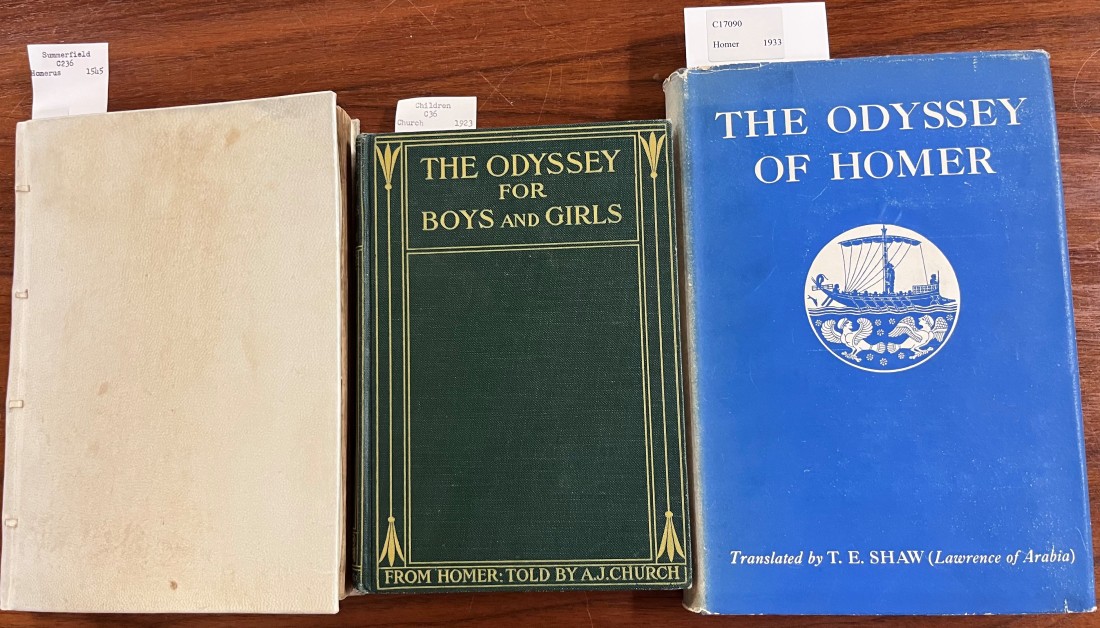
In working on this post, I discovered that Odysseus was not the only one on a journey.
There was Maisie, the five-year-old “first critic.” There was Meredith Belt, a child reader whose name remains inside the cover. There was the story itself, traveling across centuries and finding new audiences through adaptations, retellings, and children’s editions. And there was my own journey, which began with curiosity about a modern adaptation and led me to a century-old book.
The many questions raised about Meredith Belt’s inscription and Maisie, the first critic, will never be answered. One Meredith left behind a name. Another Meredith found it. For a moment, the distance between a child reader in the 1920s and a librarian one hundred years later felt surprisingly small.
Perhaps that is its own kind of legacy. Odysseus sailed across the wine-dark sea in search of home. His story has traveled even further, crossing centuries, languages, and generations of readers. This book has made a remarkable journey of its own. Meredith Belt could never have imagined that more than a century later, someone would still be speaking their name.
We rarely know which traces of our lives will endure. A favorite book. A handwritten inscription. Notes tucked inside. A name carefully written inside a cover. Yet sometimes those small remnants become a bridge between strangers separated by generations. Perhaps that is the quiet magic of old books. They remind us that we are all, in one way or another, leaving pieces of ourselves behind. And when those pieces are found, we are remembered.
Somewhere between ancient seas and a library shelf, a child’s name continues its journey across time.
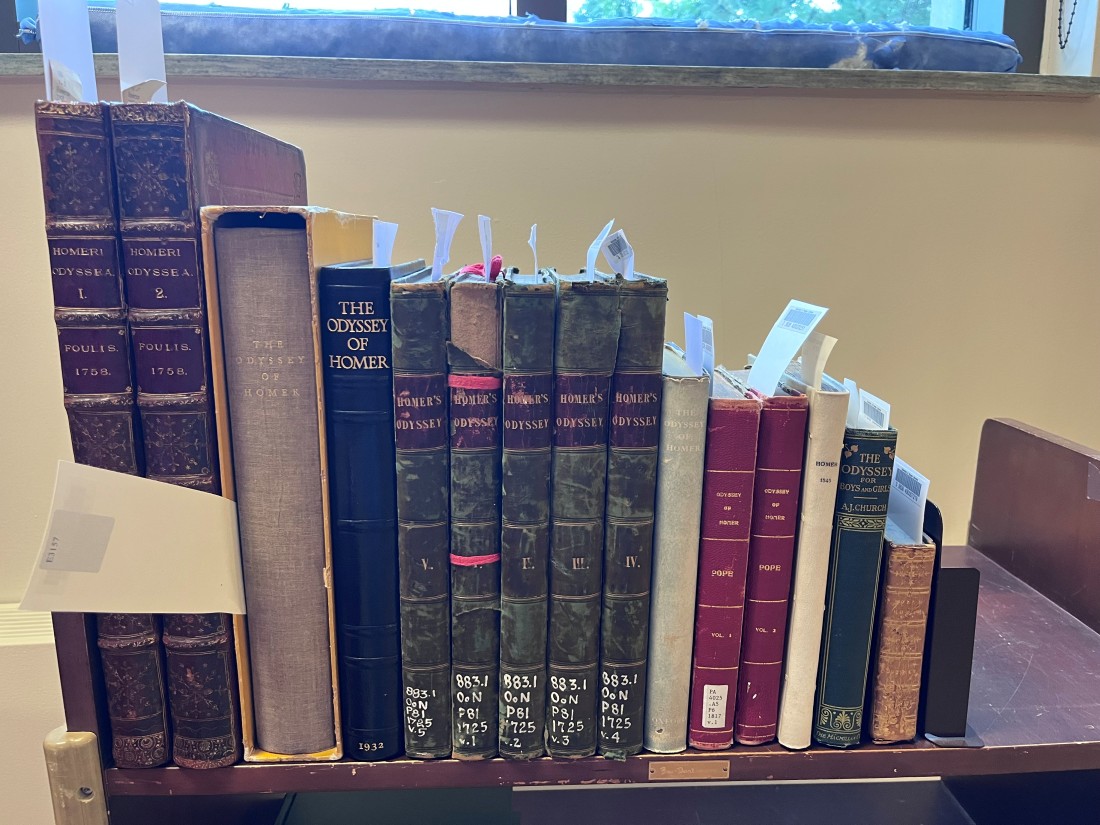
Here are some additional copies of The Odyessy in Spencer’s holdings:
- Homeri Odysseae libri VIII. Francisco Florido Sabine interprete [Homer’s Odyssey, Books 1-8, translated into Latin by Francisco Florido], 1545 (Call Number: Summerfield C236).
- The Odyessy of Homer, translated into English by Alexander Pope, 1725 (Call Number: D711).
- Tes tou Homerou Odysseias, in ancient Greek, 1758 (Call Number: G50).
- The Odyssey of Homer, translated into English by Alexander Pope, 1811 (Call Number: A586).
- The Odyssey of Homer, translated into English by Alexander Pope, 1817 (Call Number: C22294).
- The Odyessy of Homer, translated into English by Alexander Pope, with an introduction by Carl Van Doren, 1931 (Call Number: E3157).
- The Odyssey of Homer, translated into English by T. E. Lawrence, 1932 (Call Number: D440).
- The Odyssey of Homer: Newly Translated into English Prose by T. E. Shaw [T. E. Lawrence], 1933 (Call Number: C17090).
Meredith Phares
Operations Manager