The University of Kansas

Inside Spencer: The KSRL Blog

Books on a shelf

Welcome to the Kenneth Spencer Research Library blog! As the special collections and archives library at the University of Kansas, Spencer is home to remarkable and diverse collections of rare and unique items. Explore the blog to learn about the work we do and the materials we collect.

Inventory and Rehousing: A workflow for 3D objects in archives

April 14th, 2026
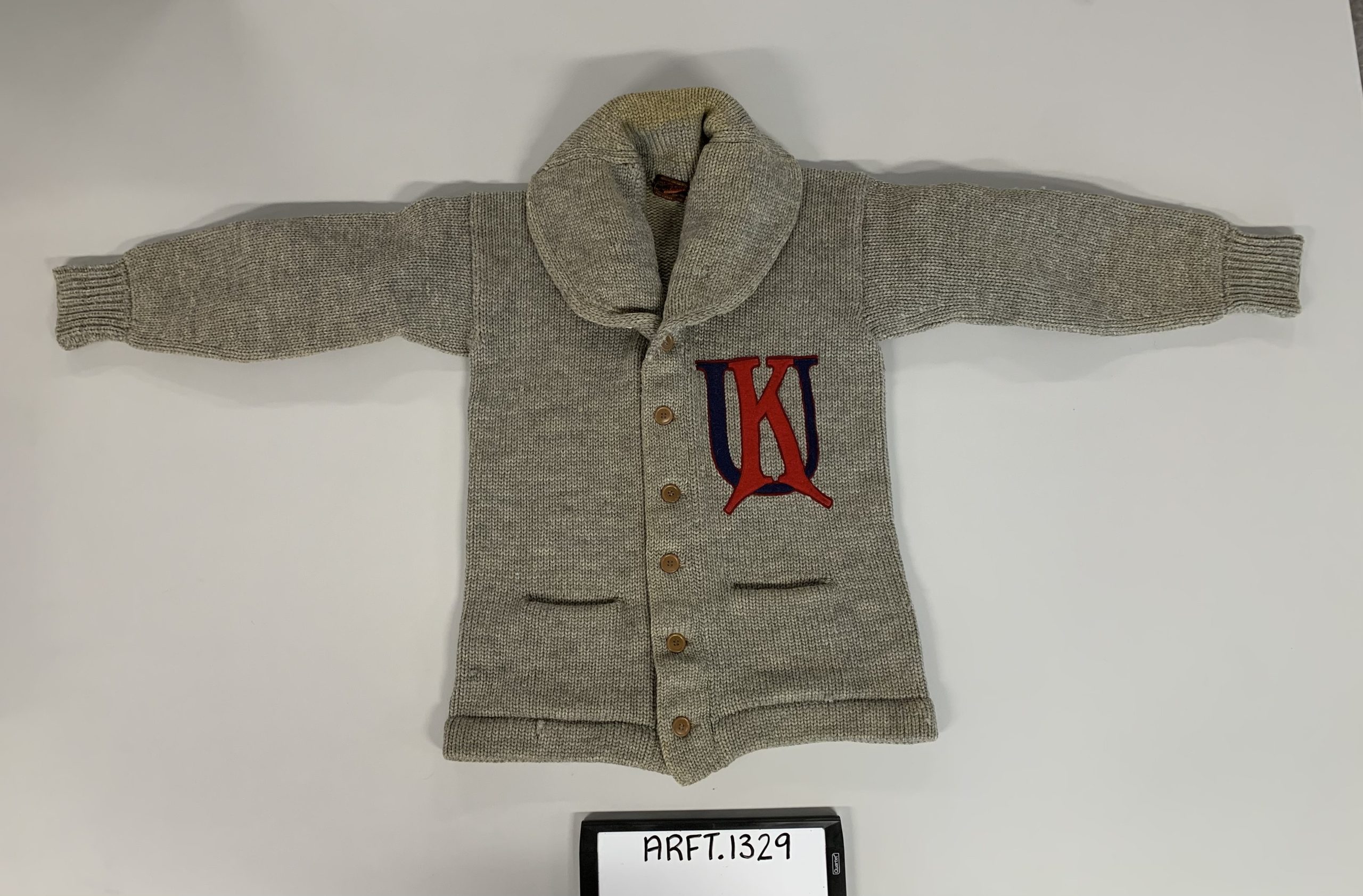
Lela Duncan Cardozo’s KU letter sweater is pictured. The sweater is knitted from gray wool with red capital letter K and blue capital letter U sewn on the left front.
Figure 1: Lela Duncan Cardozo’s KU letter sweater. Call number RG 66/20.

From Student Senate buttons and sports memorabilia to a vial of uranium connected to the Manhattan Project, the unexpected breadth of objects preserved by the University Archives reveals lesser-known aspects of the University of Kansas’s history. The University Archives is the official repository for all materials related to the University of Kansas. Its holdings include official records, publications, correspondence, research papers, and more. However, the University Archives contains more than just documents; it has a robust Artifact Collection that uses objects to tell the KU story.

I began my Graduate Assistant position with Conservation Services in August 2025, and I quickly became familiar with the Artifact Collection and its unique challenges. The University Archives has been collecting objects for decades, but documentation and housing efforts have been largely inconsistent. When I began this project, there was no item-level inventory of the collection, and many objects were stacked precariously in mismatched or overfilled boxes (See Figure 2). Inconsistent storage practices increase the risk of physical damage, and a lack of intellectual control over the collection makes items difficult to access.
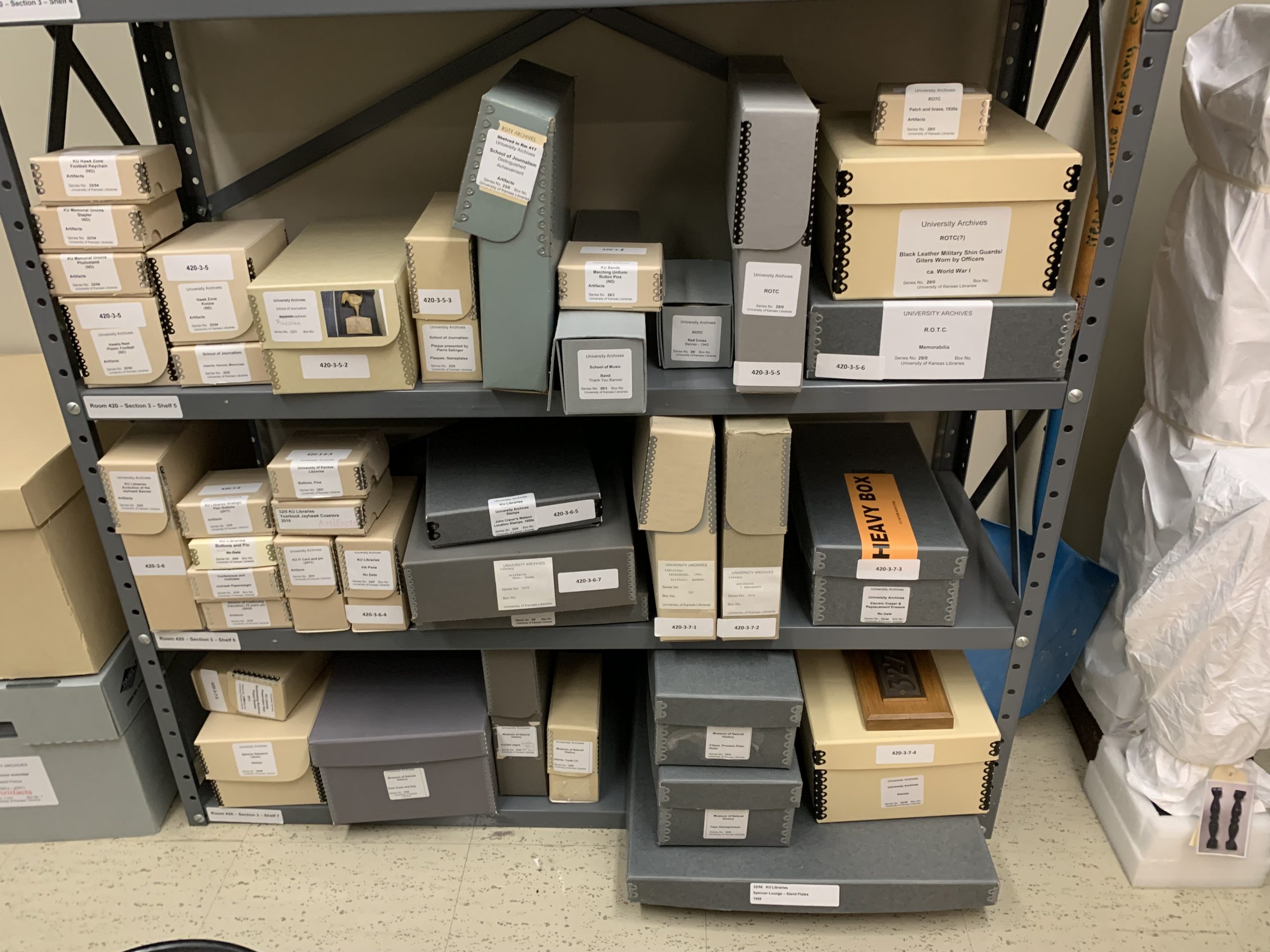
Archival artifact storage is pictured before inventory and rehousing, with many disparate sizes and shapes of boxes.
Figure 2: Inconsistent storage practices highlighted a need to standardize future storage solutions.

This project consisted of several key phases. First, I conducted a full item-level inventory of the Artifact Collection to gain a complete understanding of its contents. For each object, I assigned a unique sequential Artifact ID number (e.g. ARFT.1, ARFT.2, etc.) and recorded any label information from the exterior of the box, including associated Record Group numbers. I then created a brief title and a full description noting color, material type, and any identifiable features on the object, along with any dates indicated on the item or its housing. I documented the object’s exact measurements in centimeters, assessed and recorded its condition, and noted its current location, housing method, and any outstanding questions or comments.

Following the written documentation, I photographed each object using a temporary photo setup consisting of a white paper background and a light-diffusing shade made from corrugated plastic. I used my iPhone to take the photographs, which were intended to provide visual documentation of the objects rather than high-quality, exhibit-ready images. Their purpose was to capture essential physical details that cannot be conveyed through text alone. In each image, I included a small dry-erase board displaying the Artifact ID number in each image to ensure consistent identification (See Figure 3).
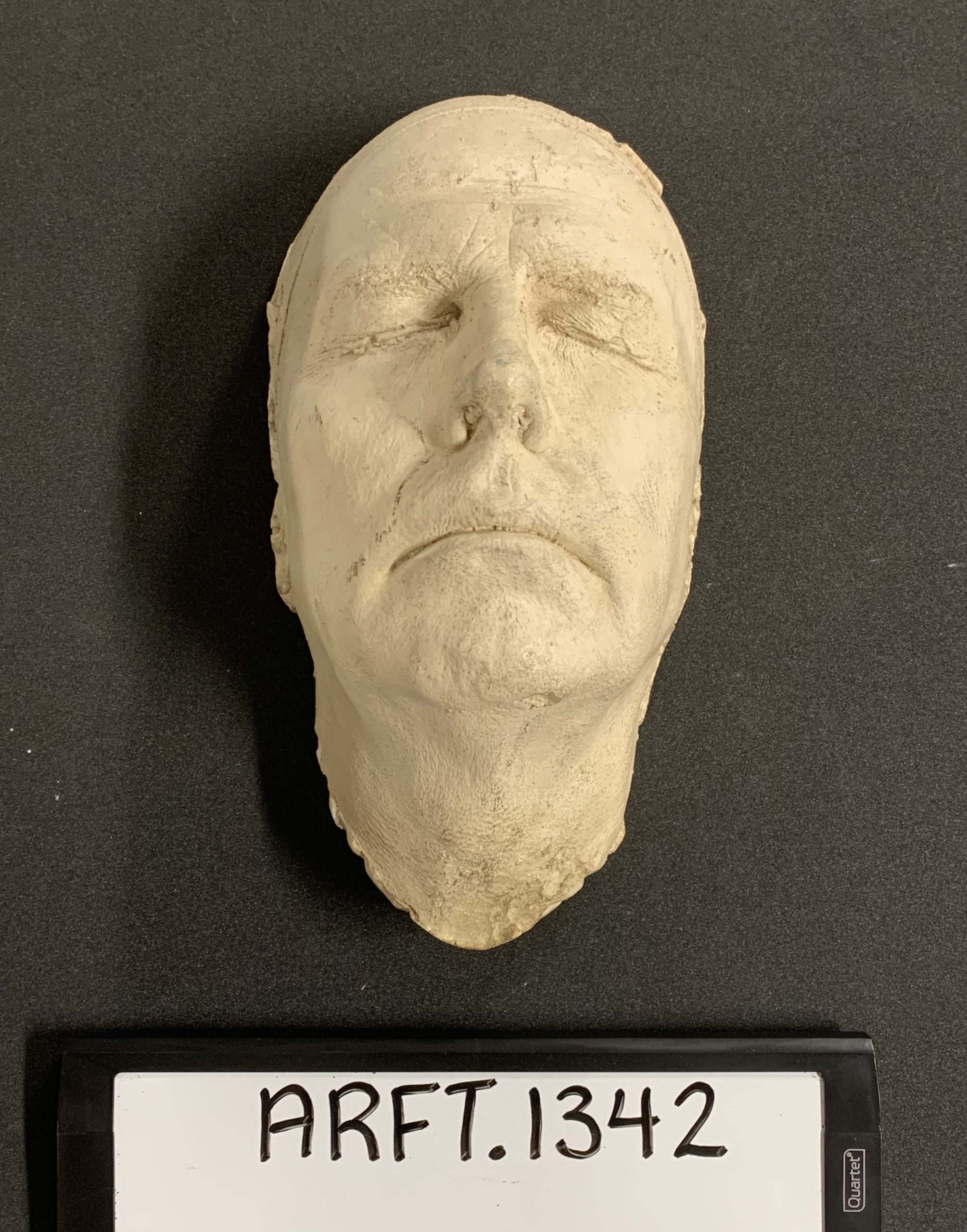
A sample photo from the project inventory, showing the plaster mask of Chancellor Franklin Murphy, 1957.
Figure 3: A sample photo from the project inventory, showing the plaster mask of Chancellor Franklin Murphy, 1957. Call number: RG 22/12.

Finally, I attached a small, hand-cut white paper tag to each object using simple white thread and labeled it with its corresponding Artifact ID number. Instead of ordering object tags from an archival supply company, I created the tags in-house using scrap paper to conserve resources. I inventoried as many objects as possible every day, and I reserved the final half-hour of my shift to upload photos, downloading them to a shared networked drive and organizing them into folders based on the objects’ current room locations. This consistent workflow not only ensured thorough documentation but also allows future users to track the overall timeline and progress of the inventory for similar projects.

After the inventory phase, I developed a comprehensive rehousing plan for the University Archives’ Artifact Collection that focused on standardizing storage materials in order to improve the long-term safety and accessibility of the collection. Developing this rehousing plan required balancing preventive conservation best practices, archival theory, spatial limitations, and institutional realities. Organizing by size improves efficiency and reduces handling risks, while material-based grouping mitigates chemical and environmental threats. On the other hand, contextual organization preserves provenance and research value, and standardized documentation ensures continued intellectual control. Balancing all of these concepts, the rehousing plan details first steps and priorities, lists existing storage solutions to follow, and models potential storage solutions for objects whose current housings need improvement. It also provides a list of standard box sizes so that storage solutions stay consistent moving forward. Designed with flexibility in mind, the plan is meant to support future growth, ensuring the collection can evolve without compromising curatorial integrity. Following this plan, I have now begun rehousing objects.

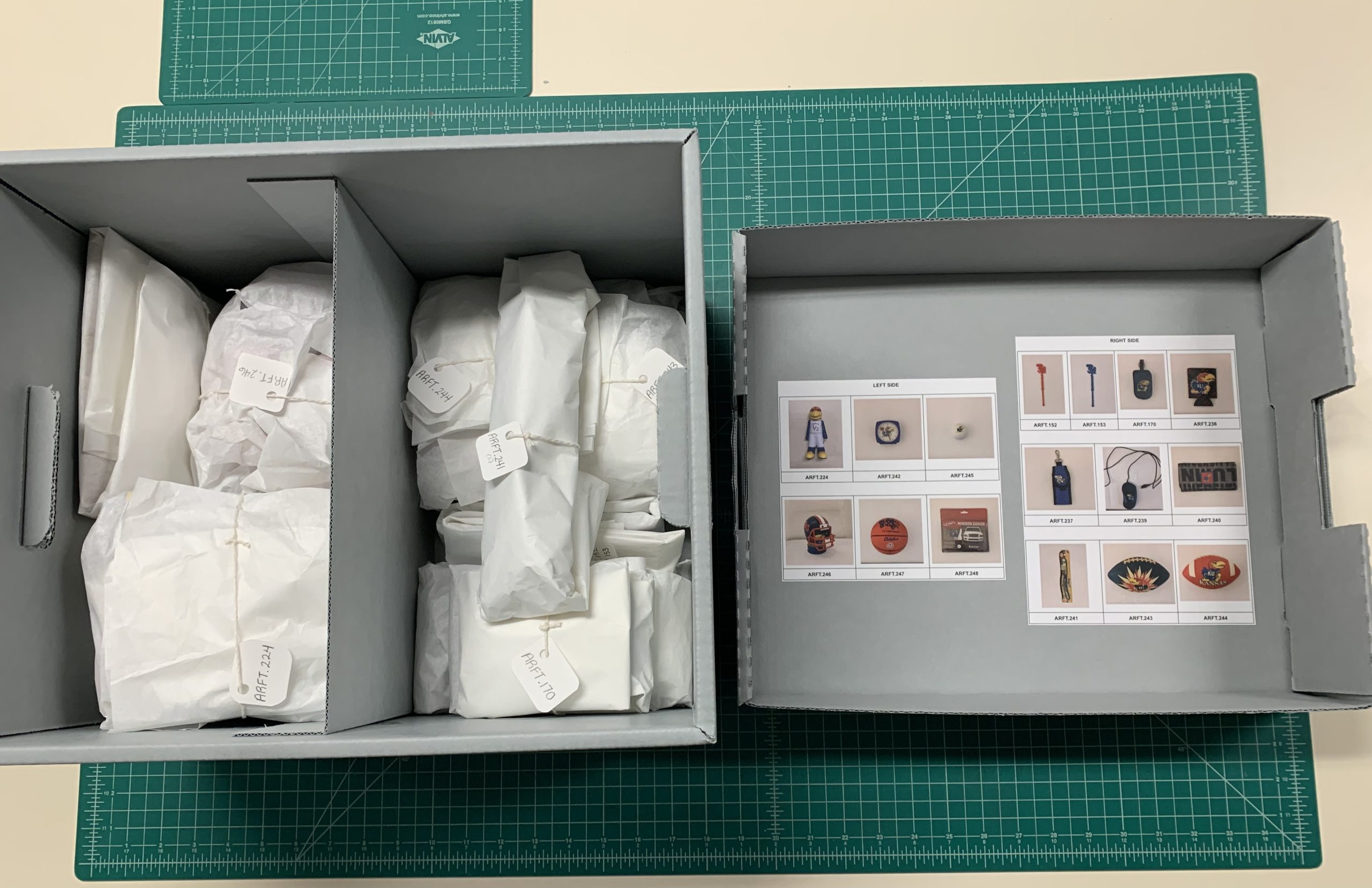
While rehousing Record Group 0/25: Jayhawks, I encountered an oversized box filled with plastic objects that were visibly deteriorating (see Figure 4). Several items exhibited yellowing and surface changes that suggested they were being affected by surrounding materials. In response, I removed all non-plastic objects from the box and rehoused them separately. The remaining plastics, particularly those showing signs of degradation, were wrapped individually in tissue and placed in a standard banker’s box designed to function as a containment unit rather than a highly customized enclosure. Photographs of each object were affixed to the lid, and labeled tags were tied to the exterior of each wrapped item to improve retrievability (see Figure 5). Because these objects possess relatively low research value, constructing individualized custom enclosures was not an efficient use of limited resources. Instead, I prioritized risk mitigation and containment. This solution reflects a central methodological principle of this project: rehousing does not aim for perfection, but for measurable improvement and increased standardization.
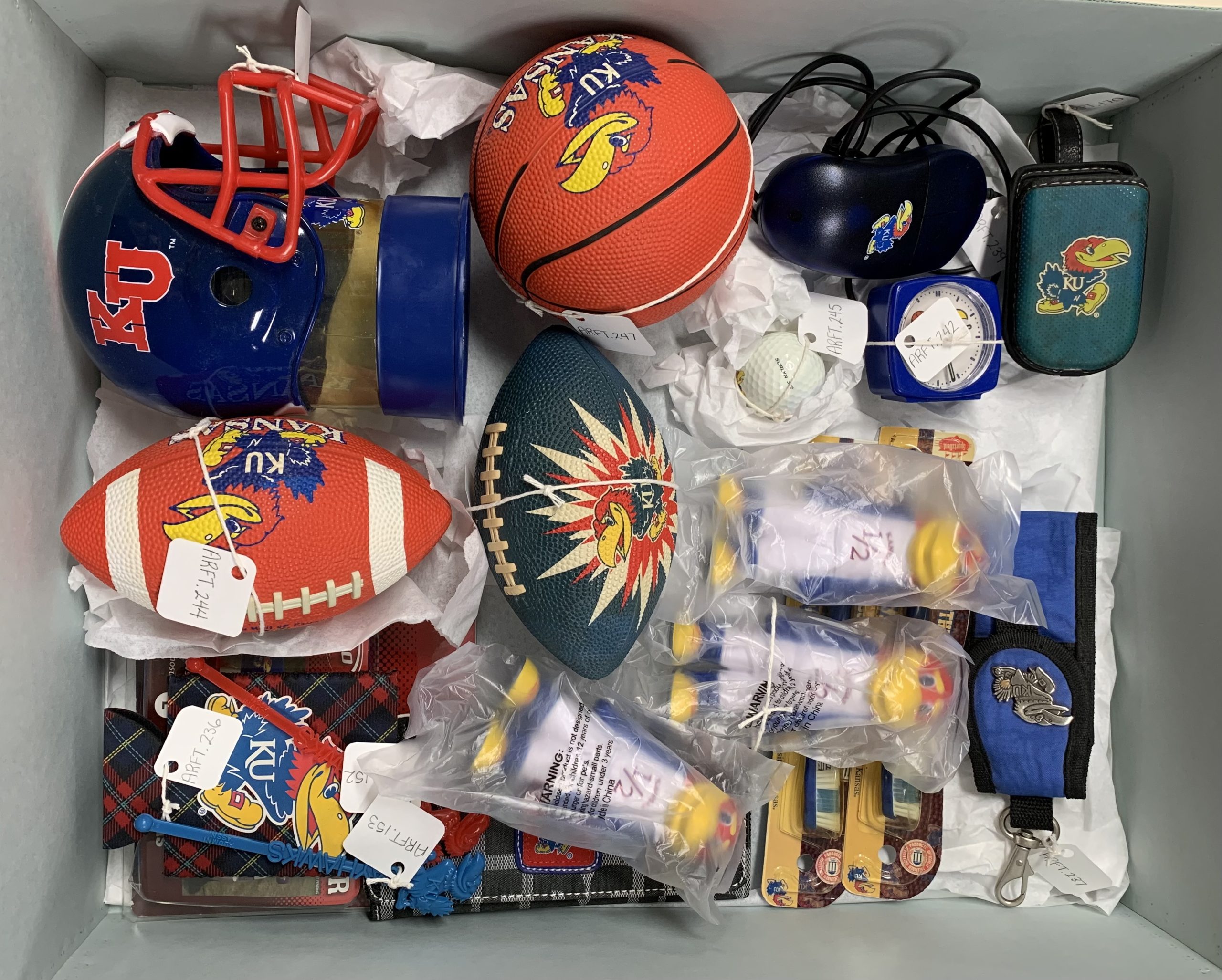
An assortment of off-gassing plastic artifacts are pictured together in a box before rehousing.
Figure 4: Off-gassing plastic artifacts before rehousing. Call number: RG 0/25.
Plastic artifacts pictured after rehousing, individually wrapped and numbered with a photographic key affixed to the inner lid of the box.
Figure 5: Plastic artifacts rehoused. Call number: RG 0/25.

Every storage decision reflects institutional realities, professional standards, and long-term stewardship commitments. By integrating collections management strategies with conservation principles, this project provides a flexible and sustainable framework for not only the continued care of the Artifact Collection but an example for any archive drawing on museological best practices to deal with 3D objects.

While I was able to complete an item-level inventory of the Artifact Collection, the rehousing stage of the project will likely extend beyond my time at KU. As a result, the rehousing plan developed here will serve as a guide for future staff, supporting consistent and standardized decision-making. In addition, I have outlined detailed workflows for the continued care of the collection. This project would not have been possible without the collaboration of the University Archives, Conservation Services, and Spencer’s Archival Processing Team.

A very special thanks to Letha Johnson for warmly welcoming me into the University Archives and for placing her trust in me as I engaged critically with the Artifact Collection. Her trust and collaboration were essential to the success of this project.

Brenna Hobbs, M.A. Museum Studies 2026, Graduate Assistant in Conservation Services

Throwback Thursday: Suitcase Avalanche Edition

August 17th, 2017

Each week we’ll be posting a photograph from University Archives that shows a scene from KU’s past. We’ve also scanned more than 34,800 images from KU’s University Archives and made them available online; be sure to check them out!

Today is Move-In Day, and new and returning Jayhawks are arriving on Mount Oread. This week’s post features a verbal description and visual depiction of what this looked like at the beginning of KU’s 1928-1929 academic year, according to the 1929 Jayhawker yearbook.

Happy greetings…hand shaking…taxis whizzing away loaded with newly arrived students…perspiring baggagemen swearing at an avalanche of trunks and suitcases…The sleepy town of Lawrence suddenly awakened to the realization that another nine months session had begun at K.U.

Page from the Jayhawker yearbook, 1929 Page from the Jayhawker yearbook, 1929

Selected pages from the 1929 Jayhawker yearbook. University Archives.
Call Number: LD 2697 .J3 1929. Click images to enlarge.

Subsequent pages in the yearbook describe the high points of the first week of freshman life at KU. Some events are familiar to modern students, for example participating in fraternity and sorority recruitment and learning about university customs and traditions. Other events – like taking a psychological examination, attending teas, and registering and enrolling for fall classes right before the beginning of the semester – would be foreign.

Page from the Jayhawker yearbook, 1929

Page from the Jayhawker yearbook, 1929 Page from the Jayhawker yearbook, 1929

Selected pages from the 1929 Jayhawker yearbook. University Archives.
Call Number: LD 2697 .J3 1929. Click images to enlarge.

Caitlin Donnelly
Head of Public Services

Heads in Boxes: Rehousing Plaster Masks for the Archives

May 10th, 2013

This week’s blog post comes from Museum Studies Graduate Student and Conservation Student Assistant Jami Roskamp.

There are always hidden treasures in the Archives; however, the containers they are kept in can be far from the treasure chests that these gems deserve.  One of the many interesting items that can be found in the University of Kansas Archives is a collection of plaster masks (call number: 22/12) originally from the Art Department Sculpture Studio.  Several of these plaster masks capture the likenesses of past chancellors and students.  Initially some of these masks were housed in cardboard boxes and wrapped in newsprint, while others were placed in file boxes that did not adequately accommodate the object’s size. 

Photograph of plaster mask prior to rehousing. Photograph of plaster mask fragments

The challenge: how to rehouse fragile plaster masks (some of which were in pieces)

Under the supervision of Whitney Baker, Conservator for KU Libraries, I was tasked with providing the plaster masks with more suitable forms of housing to extend preservation and accommodate their ranging sizes.  I conducted an item condition report on each of the masks–recording measurements for size, material, and damage, if the object had any–prior to rehousing the masks in new containers. 

Photograph of Jami Roskamp examining a plaster mask

Jami Roskamp examines a plaster mask in order to determine how best to rehouse it.

For the rehousing of the masks, they were placed in archival quality boxes that were padded with Ethafoam so the objects would be securely stored.  A few of the masks were in more fragile condition and needed to have further padding created for them to secure their pieces.  Now the plaster masks are placed in spacious new storage containers that effectively house and preserve them so that they will be protected for future Jayhawks to view.

Photograph of mask fragments rehoused. Photograph of new housing for plaster masks of former KU Chancellor Franklin D. Murphy

New housings for plaster masks: (left)  fragmented mask by or of “Nelson” and (right) mask of former KU Chancellor Franklin D. Murphy.

Jami Roskamp
Museum Studies Graduate Student and Conservation Student Assistant


A Nest for Metal Jayhawks

October 10th, 2012

Former conservation student assistant Haley Trezise reports on how she met the challenge of safely housing a group of metal Jayhawks.

I could hear the individual metal pieces sliding around inside before I even opened the box containing the metal Jayhawk paraphernalia.  There was a small metal pendant set aside in an envelope; however, the rest of the items in the collection were awkwardly arranged at the bottom of a tall, slender box.  Projects like this challenged me to find or make appropriate housing for Spencer items.

Photo of note and envelope accompanying the metal Jayhawk paraphernalia

Image of Metal Jayhawk #1     Image of Metal Jayhawk #2

The challenge: A note to the archivist and two of several metal Jayhawk items all to be housed together.
Spencer Library Call Number: RG 0/25

I worked as a conservation student employee and Museum Studies intern during my last two semesters at KU.  For one of my projects as an intern, I was asked to upgrade the housing for some metal Jayhawk paraphernalia.  The parameters: all material should stay together in one box, including the accompanying written documents.  I was provided a rather small, off-the-shelf box and told that all items should fit within that enclosure.

Image of a new housing for Jayhawks
A new nest for metal Jayhawks.  Spencer Library Call Number: RG 0/25

After considering various arrangements for best placement, I used  plastazote foam, an inert (non-damaging) material that is easily shaped, to cut indentions for each object. I took a picture of the  proper place for each item and placed it, along with the written information, in a sleeve inside the lid of the box.  The image of what is stored in the box was also attached to the outside of the box so that the archivists can see what is inside without opening the lid.

Photograph of exterior of box of the new Jayhawk Paraphernalia housing

Photos affixed to the exterior of the housing reveal at a glance the Jayhawk paraphernalia contained inside.
Spencer Library Call Number: RG 0/25. Click image to enlarge.

Haley Trezise
Former Conservation Student Assistant