The University of Kansas

Inside Spencer: The KSRL Blog

Books on a shelf

Welcome to the Kenneth Spencer Research Library blog! As the special collections and archives library at the University of Kansas, Spencer is home to remarkable and diverse collections of rare and unique items. Explore the blog to learn about the work we do and the materials we collect.

World War I Letters of Milo H. Main: June 11-17, 1918

June 11th, 2018

In honor of the centennial of World War I, this is the second series in which we follow the experiences of one American soldier: twenty-five year old Milo H. Main, whose letters are held in Spencer’s Kansas Collection. On Mondays we’ll post a new entry featuring selected letters from Milo to his family from that following week, one hundred years after he wrote them.

Milo Hugh Main was born in or near Pittsfield, Illinois, on November 21, 1892 to William and Rose Ella Henry Main. The family moved to Argonia, Sumner County, Kansas, in 1901. After his mother died in 1906, Milo remained in Argonia with his father and his two sisters Gladys (b. 1890) and June (b. 1899). His youngest sister Fern (b. 1905) was sent to live with relatives in Illinois.

As Milo reported to the Kansas State Historical Society in 1919, after graduating from high school he worked as a store clerk. He resigned in July 1917 and took a position at Standard Oil Company, possibly co-managing a gas station in Argonia.

Milo entered into military service on September 21, 1917. He served as a wagoner – a person who drives a wagon or transports goods by wagon – in Battery F, 130th Field Artillery. He was stationed at Camp Funston (September-October 1917) and Camp Doniphan (October 1917-May 1918). On May 19, 1918, he boarded the ship Ceramic in New York City and departed for Europe.

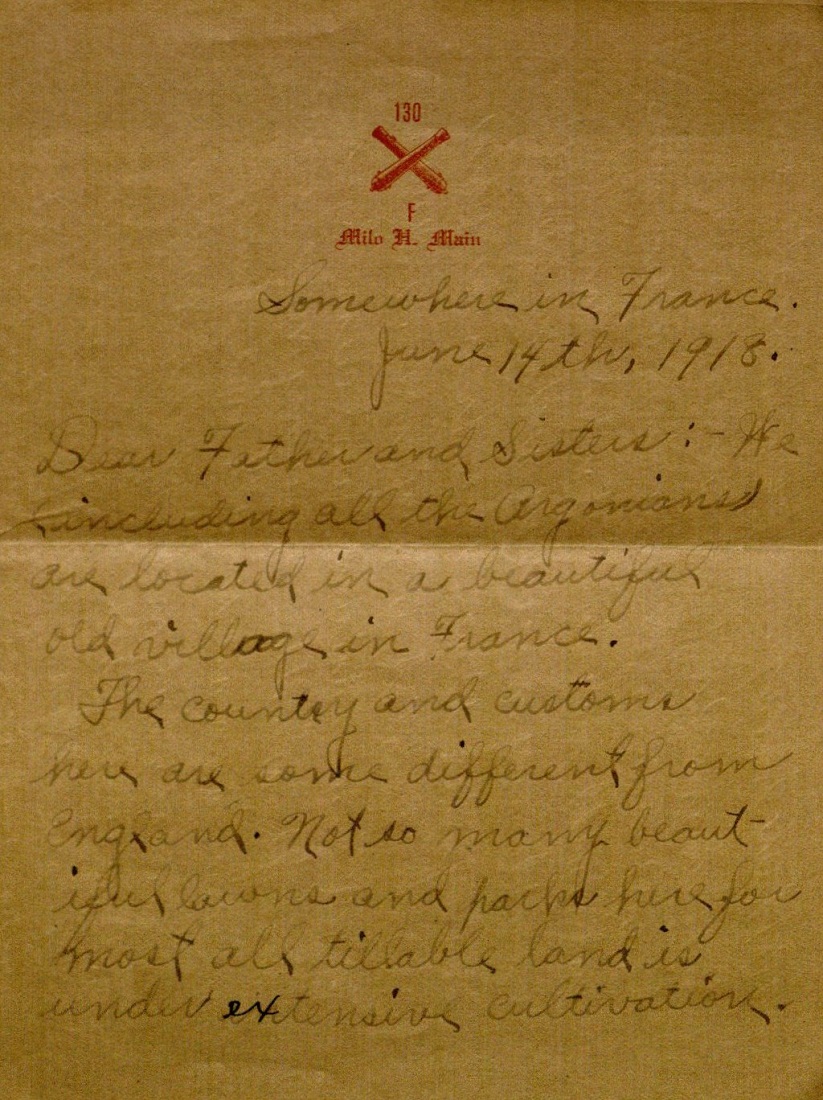
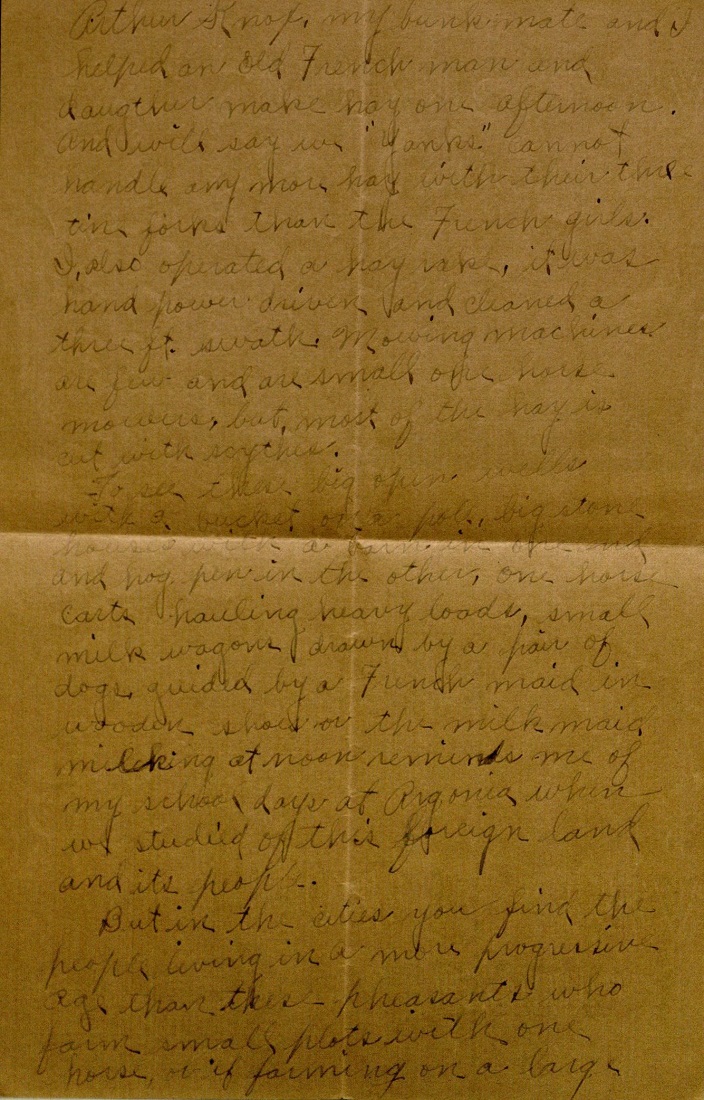
Milo wrote this week’s letter from “somewhere in France.” He describes the “country and customs,” especially comparing them with his previous observations of England and contrasting conditions on farms and in cities. “The home boys like all the others in our Battery are enjoying themselves as if they were on their annual vacation,” Milo says. “No reason to be dissatisfied, for we are in the best of health, plenty of good wholesome food, good climate (just a little cooler than Kans), and going thru an experience of a life time.”
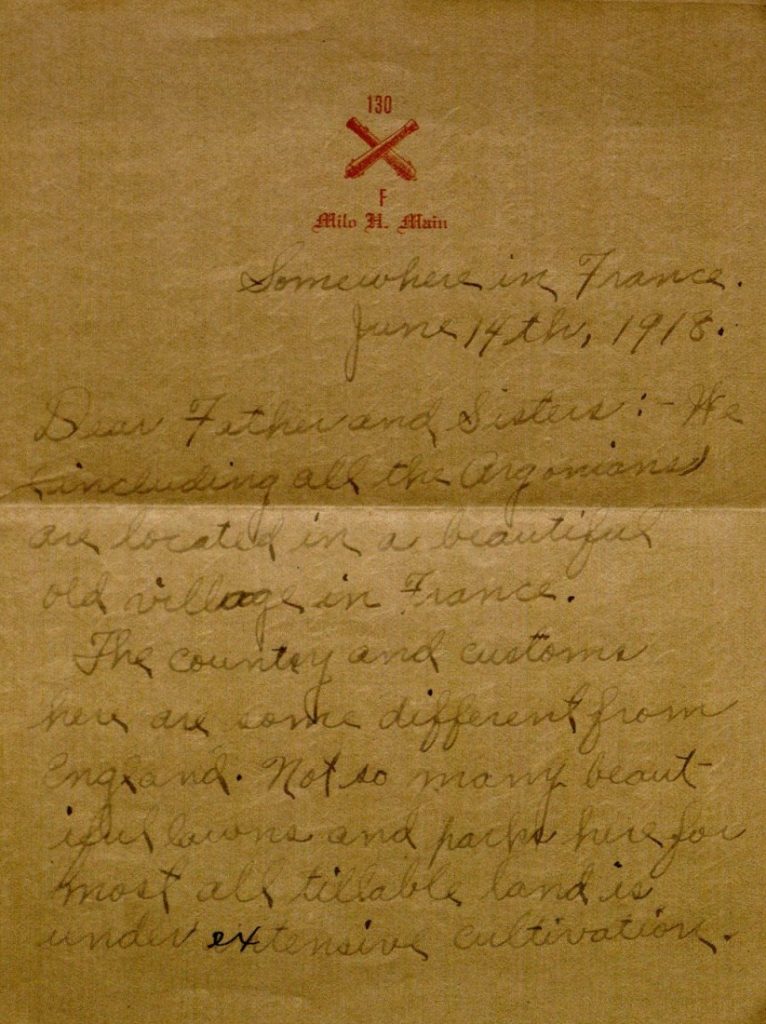
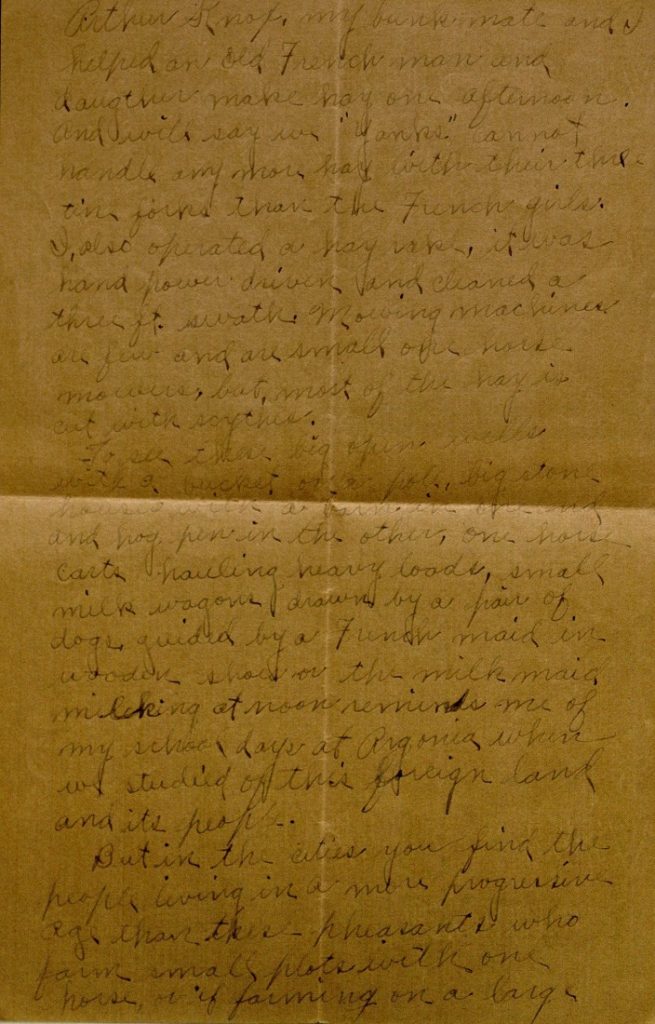
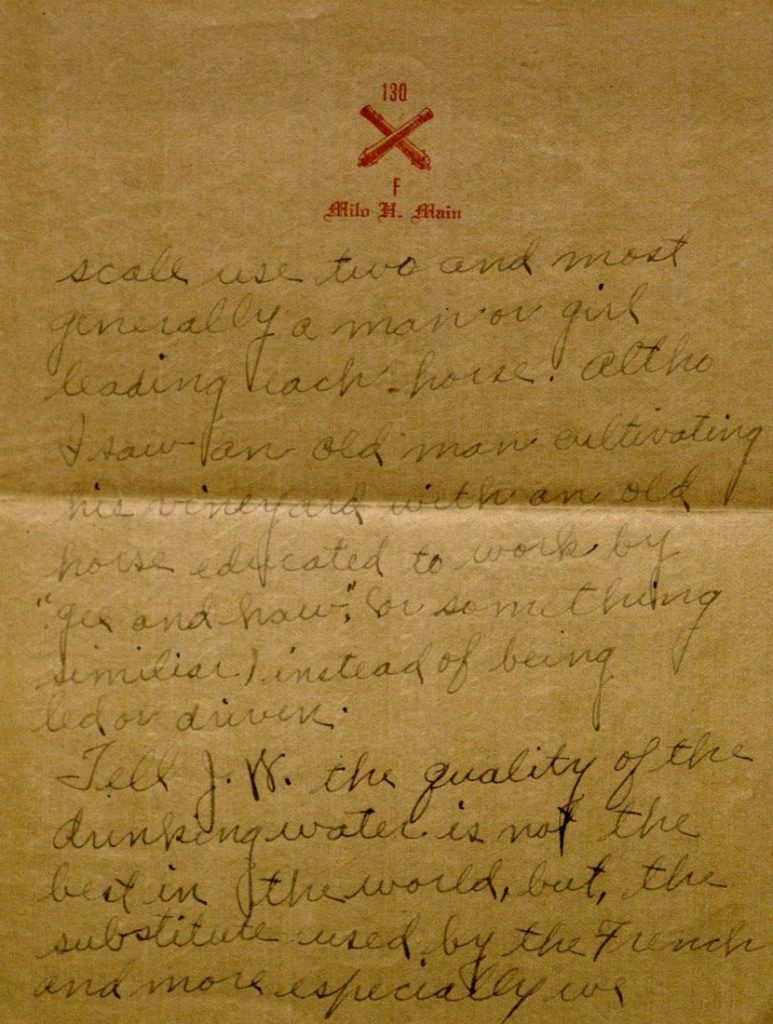
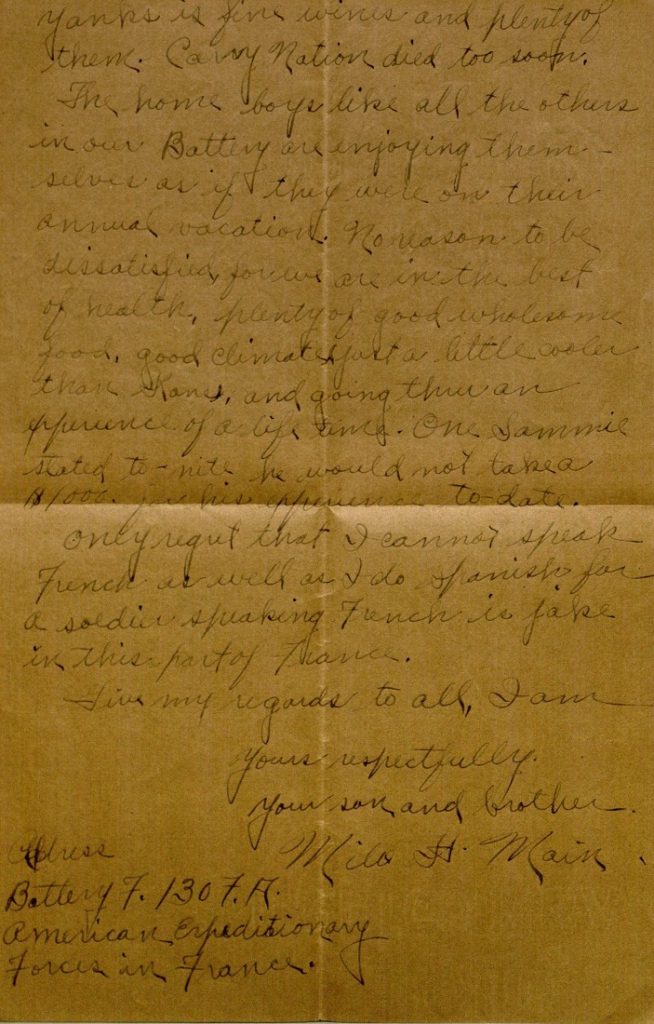
Image of Milo H. Main's letter to his family, June 14, 1918 Image of Milo H. Main's letter to his family, June 14, 1918

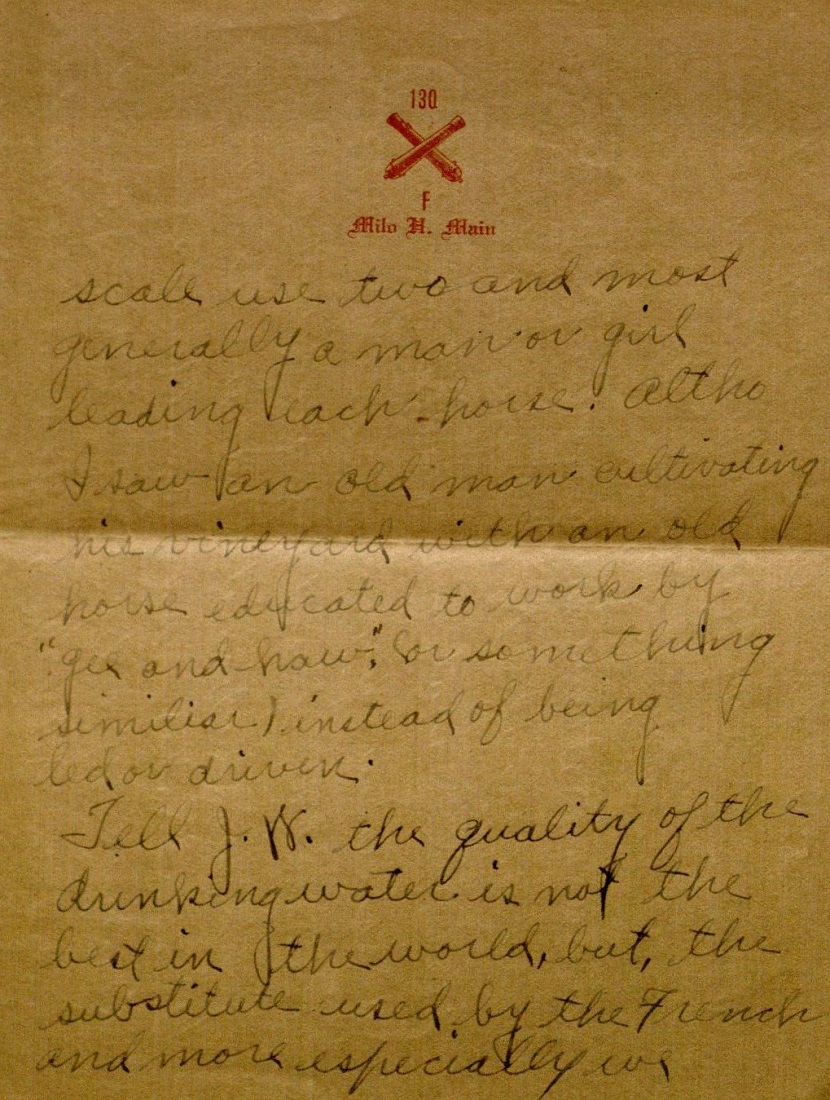
Image of Milo H. Main's letter to his family, June 14, 1918 Image of Milo H. Main's letter to his family, June 14, 1918

Click images to enlarge.

Somewhere in France.
June 14th, 1918.

Dear Father and Sisters: – We (including all the Argonians) are located in a beautiful old village in France.

The country and customs here are some different from England. Not so many beautiful lawns and parks here for most all tillable land is under extensive cultivation. Arthur Knox, my bunkmate and I helped an old French man and daughter make hay one afternoon. And will say we “Yanks” cannot handle any more hay with their three tine forks than the French girls. I, also operated a hay rake, it was hand power driven and cleaned a three ft. swath. Mowing machines are few and are small one horse mowers, but, most of the hay is cut with scythes.

To see these big open wells with a bucket on a pole, big stone houses with a barn in one end and hog pen in the other, one horse carts hauling heavy loads, small milk wagons drawn by a pair of dogs, guided by a French maid in wooden shoes or the milk maid milking at noon reminds me of my school days at Argonia when we studied of this foreign land and its people.

But in the cities you find the people living in a more progressive age than these pheasants who farm small plots with one horse, or if farming on a large scale use two and most generally a man or girl leading each horse. Altho I saw an old man cultivating his vineyard with an old horse educated to work by “gee and haw,” (or something similar) instead of being led or driven.

Tell J.W. the quality of the drinking water is not the best in the world, but, the substitute used by the French and more especially we Yanks is fine wines and plenty of them. Carry Nation died too soon.

The home boys like all the others in our Battery are enjoying themselves as if they were on their annual vacation. No reason to be dissatisfied, for we are in the best of health, plenty of good wholesome food, good climate (just a little cooler than Kans), and going thru an experience of a life time. One Sammie* stated to-nite he would not take a $1000. for his experience to-date.

Only regret that I cannot speak French as well as I do Spanish for a solider speaking French is jake** in this part of France.

Give my regards to all, I am

Yours respectfully.
Your son and brother.
Milo H. Main

Address
Battery F. 130 F.A.
American Expeditionary
Forces in France.

*”Sammie” or “Sammy” was British slang for a U.S. soldier in World War I; it was a reference to Uncle Sam.

**”Jake” was slang meaning “excellent, fine.” From 1914, American English, of unknown origin.

Meredith Huff
Public Services

Emma Piazza
Public Services Student Assistant

Throwback Thursday: Robert F. Kennedy Edition

June 7th, 2018

Each week we’ll be posting a photograph from University Archives that shows a scene from KU’s past. We’ve also scanned more than 34,800 images from KU’s University Archives and made them available online; be sure to check them out!

In April we shared a photograph of KU students in front of Strong Hall honoring Dr. Martin Luther King, Jr. after his assassination in 1968. This week’s photograph commemorates the fiftieth anniversary of a second assassination: that of Senator Robert F. Kennedy on June 5, 1968.

Kennedy announced his candidacy for the Democratic presidential nomination on March 16, 1968. He launched his campaign two days later with speeches at Kansas State University and KU.

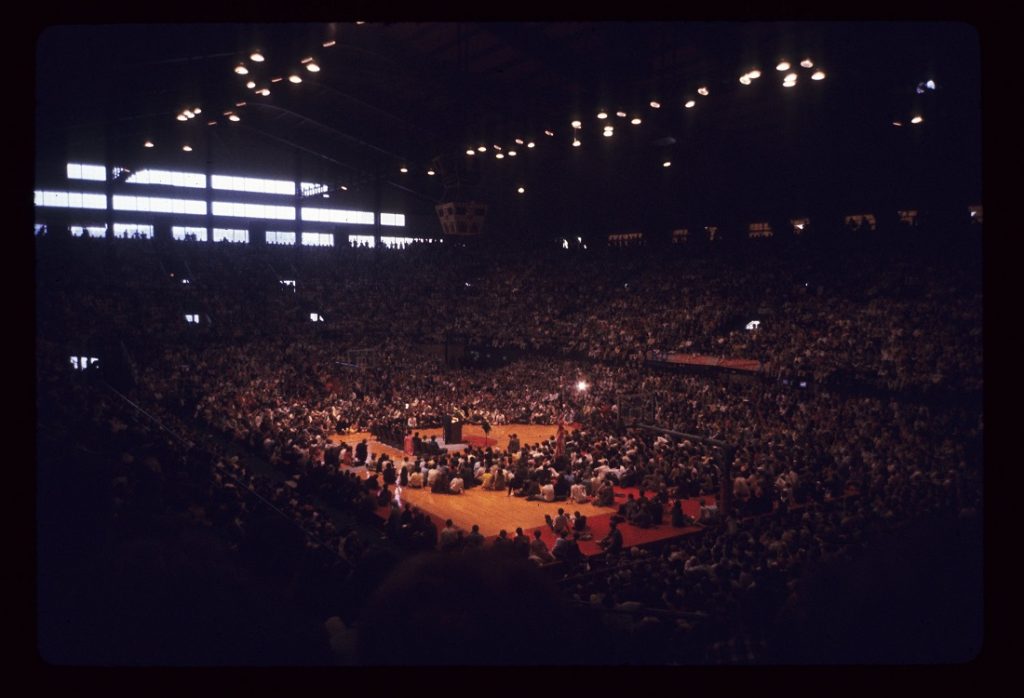
Photograph of Robert F. Kennedy speaking in Allen Fieldhouse, March 18, 1968

Robert F. Kennedy speaking in Allen Fieldhouse, March 18, 1968. University Archives Photos.
Call Number: RG 0/19 Robert F. Kennedy 1968: University General: Visitors (Photos).
Click image to enlarge (redirect to Spencer’s digital collections).

Kennedy’s speech in Allen Fieldhouse began at 1:30pm, and KU classes scheduled at that time were cancelled. “I don’t know whether you’re going to like what I’m going to say today but I just want you to remember, as you look back upon this day, and when it comes to a question of who you’re going to support – that it was a Kennedy who got you out of class,” he joked. The University Daily Kansan reported that the speech lasted sixty-five minutes; Kennedy apparently spent half that time delivering prepared remarks and the other half answering questions from students, who submitted them in writing to ushers they entered the Fieldhouse.

According to the Kansan, an estimated 20,000 people attended the event. (Approximately 15,800 students were enrolled on the Lawrence campus in Fall 1967.)

Instead of going directly to the podium [when he arrived at the Fieldhouse] Kennedy wandered around the basketball court shaking hands and waving to the students. It was a full minute-and-a-half before the initial applause faded out and he took his seat…

Kennedy’s normally flat, laconic speaking tone raised and nearly broke at times, as he spoke of his convictions concerning America’s problems and tried to battle the surges of applause, foot-stamping and screaming…

His final words were drowned by roars from the crowd as students surged toward him…

“It was the largest crowd we’ve ever had in Allen Field House,” said James E. Gunn, administrative assistant to the chancellor.

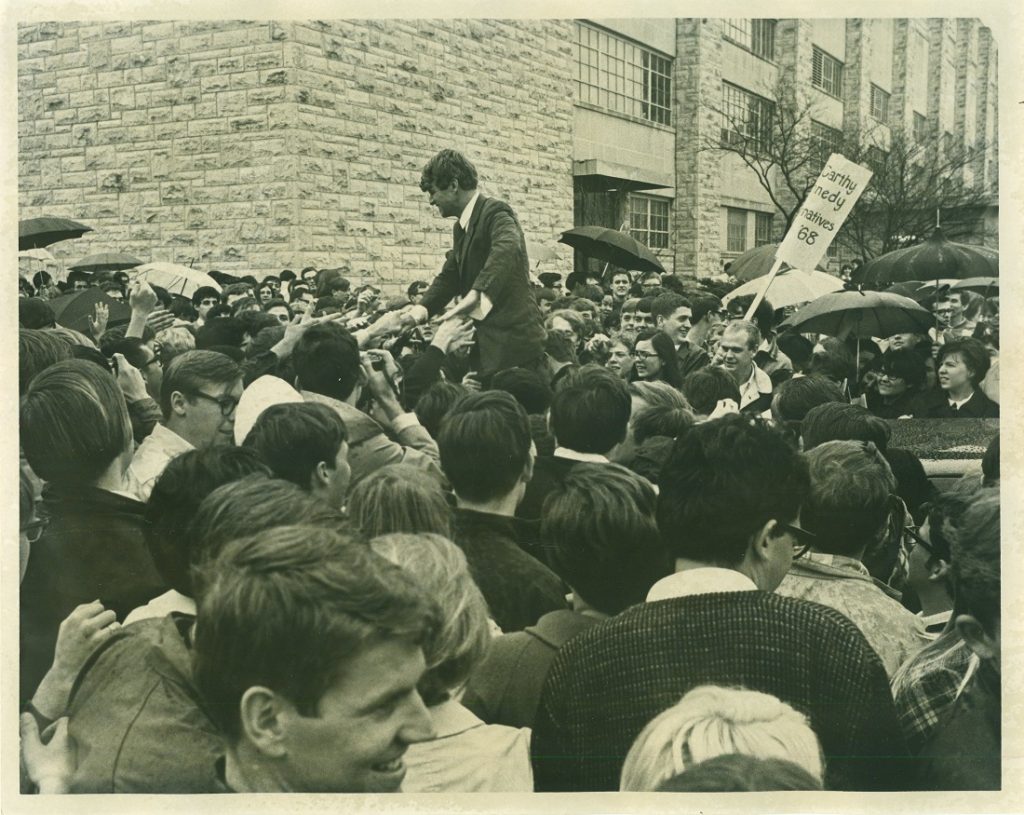
Photograph of Robert F. Kennedy with KU students outside Allen Fieldhouse, March 18, 1968

Robert F. Kennedy with KU students outside Allen Fieldhouse, March 18, 1968.
Lawrence Journal-World Photo Collection, University Archives Photos.
Call Number: RG LJW 0/19 Robert F. Kennedy 1968: University General:
Visitors (Photos). Click image to enlarge (redirect to Spencer’s digital collections).

The Kansan also described the scene as Kennedy departed.

By the time the senator tried to make his exit it seemed likely that KU’s enthusiasm would pull him apart. Throughout the speech the audience had crept closer to Kennedy like rising floodwater. Then, when he tried to make his exit, he discovered that he would haave to fight his way through 500 feet of human barricades…

East exits from the Field House were blocked by an estimated 20,000 people, as the Senator wedged his way through a screaming, solidly-packed mob.

Additional information about Kennedy’s KU visit are available online, including photographs (KU Libraries), a transcript of the speech (John F. Kennedy Presidential Library and Museum), and an audio recording of the speech (YouTube).

Film footage of the speech can also be viewed as part of the permanent exhibit in Spencer’s North Gallery.

Caitlin Donnelly
Head of Public Services

Waving Wheat Watch

June 6th, 2018

“In wheat Kansas can beat the world” – Topeka Daily Capital, October 12, 1888.

Venture outside the Kansas cities and you will find one of the state’s greatest assets: its farmland. During this time of year, many of the rolling fields are starting to turn gold as farmers prepare for Kansas’ upcoming wheat harvest. Kansas is the nation’s leader in the production of winter wheat – wheat planted in the fall and harvested during the late spring and summer – with eight to twelve million acres of winter wheat planted in the state every year.

As we look forward to the upcoming harvest season, let’s take a look at some photos of wheat harvest in Kansas from the early to mid twentieth century.

Photograph of a wheat harvest in Kansas, 1910s

Harvesting wheat in Kansas, 1910s.
Photograph by L. M. Ulmer, Abbyville, Kansas. Call Number: RH PH P2605.
Click image to enlarge (redirect to Spencer’s digital collections).


Photograph of a wheat harvest wheat near Jetmore, Kansas, 1919

Harvesting wheat near Jetmore, Kansas, 1919.
Call Number: RH PH P1488.2. Click image to enlarge.


Photograph of a wheat harvest in Thomas County, Kansas, circa 1922

Harvesting wheat in Thomas County, Kansas, circa 1922.
Photograph by George Gould, Colby, Kansas. Call Number: RH PH P1130.1.
Click image to enlarge (redirect to Spencer’s digital collections).


Photograph of two combines in a wheat field, St. John, Kansas, 1945-1949

Two combines in a wheat field, St. John, Kansas, between 1945 and 1949.
Photograph by William Gray. Call Number: RH PH P1101.
Click image to enlarge (redirect to Spencer’s digital collections).

Even as the times and technology change, one thing remains constant: Kansas continues to lead the way when it comes to wheat production!

Emily Beran
Public Services

World War I Letters of Milo H. Main: June 2-10, 1918

June 4th, 2018

In honor of the centennial of World War I, this is the second series in which we follow the experiences of one American soldier: twenty-five year old Milo H. Main, whose letters are held in Spencer’s Kansas Collection. On Mondays we’ll post a new entry featuring selected letters from Milo to his family from that following week, one hundred years after he wrote them.

Milo Hugh Main was born in or near Pittsfield, Illinois, on November 21, 1892 to William and Rose Ella Henry Main. The family moved to Argonia, Sumner County, Kansas, in 1901. After his mother died in 1906, Milo remained in Argonia with his father and his two sisters Gladys (b. 1890) and June (b. 1899). His youngest sister Fern (b. 1905) was sent to live with relatives in Illinois.

As Milo reported to the Kansas State Historical Society in 1919, after graduating from high school he worked as a store clerk. He resigned in July 1917 and took a position at Standard Oil Company, possibly co-managing a gas station in Argonia.

Milo entered into military service on September 21, 1917. He served as a wagoner – a person who drives a wagon or transports goods by wagon – in Battery F, 130th Field Artillery. He was stationed at Camp Funston (September-October 1917) and Camp Doniphan (October 1917-May 1918). On May 19, 1918, he boarded the ship Ceramic in New York City and departed for Europe.

In this week’s letters, Milo summarizes his journey to England and provides some observations about the country, especially how he perceived it to be different than the United States. “Many things of interest of our voyage and this country I would like to write about,” he says, “but owing to the censor will have to wait until I return to tell you.”

Image of Milo H. Main's letter to his family, June 2, 1918 Image of Milo H. Main's letter to his family, June 2, 1918

Image of Milo H. Main's letter to his family, June 2, 1918 Image of Milo H. Main's letter to his family, June 2, 1918

Click images to enlarge.

Somewhere in England.
6/2/1918

Dear Father and Sisters:-

I arrived safely overseas. Must say I enjoyed the trip from the time we left our Camp in Okla. until we landed at our present camp. And more too, I never got sea-sick, sick of the sea or fed the fish on our trip across the salt-water pond.

What short time I have been here I have had the pleasure of seeing much of this beautiful country. Was out walking this evening and I strolled over to one of the big estates near by. It is just as Raymond Flory* stated, “very well kept up and one of the very beautiful countries.” Every thing is kept “up-to-now” in the way of farms and highways but, the railroads with little toy like engines and coaches divided into sections seem so much different from the R.R. in the U.S.A. The heavy truck horses are generally driven tandom instead of abreast and on the left of the streets. In fact every think is a bit different here, even, the ladies are not as they are in the U.S.A. But the change of scenery and customs makes quite a novelty for we “Bloody Yanks” as the English call us. (The word “Bloody” being used over here instead of the familiar “Dam” as in the States.

To date I have not received any mail from the States. But by the time you receive this, I possibly will have.

When writing, please mention all the latest scandal “from me home town” and all news of interest.

Tell Mrs. Dyer I have not been able to visit with her sister yet, but hope to be able to before I return. Ray F. [probably Raymond Flory] is another “Yank” I have not seen, but tell his “Mary” not to fear him leaving her behind.

Many things of interest of our voyage and this country I would like to write about, but owing to the censor will have to wait until I return to tell you.

Above all, I have the best of health an a good appetite and hope this find all well at home.

Give my regards to all.

With love to all
I close
Your son and bro.

Milo H. Main.

Bat. F. 130 F. A.
American E. F. [Expeditionary Forces]
Via New York.

P. S. The Argonia Bunch is the same old gang and send best wishes to all.

OK

Julian Sher[illegible]

1st Lieut FA

*Raymond Henry Flory and Milo were likely childhood neighbors and may have been friends. The two had very similar histories: Raymond was born in Iowa on February 28, 1892. By 1900 his family was living in Sumner County, Kansas. Raymond’s mother died in 1906, and by 1910 he was living with his aunt and uncle in Wichita. Raymond’s father and brother, both named Benjamin, continued to live in Argonia, and area newspapers reported that he periodically visited them. Raymond enlisted in December 1917, reporting that he was living in Wichita and working as a truckman for the Missouri Pacific Railroad. He served in the 137th Aero Squadron, Aviation Section, Signal Corps – leaving New York on March 6, 1918, presumably bound for England.

Meredith Huff
Public Services

Emma Piazza
Public Services Student Assistant
Throwback Thursday: Doughnut Edition

May 31st, 2018

Each week we’ll be posting a photograph from University Archives that shows a scene from KU’s past. We’ve also scanned more than 34,800 images from KU’s University Archives and made them available online; be sure to check them out!

Tomorrow is National Doughnut Day! How will you celebrate?

Photograph of Joe's Bakery in Lawrence, Kansas, 1970s

Doughnuts at Joe’s Bakery, 1970s. University Archives Photos.
Call Number: RG 71/30 Joe’s Bakery 1970s Prints: Student Activities: Student Hangouts (Photos).
Click image to enlarge (redirect to Spencer’s digital collections).

Joe’s Bakery was formerly located at 616 W. Ninth Street in Lawrence. Popular among generations of KU students, the bakery opened in 1952 and closed in 2007.

Additional digitized photos of Joe’s are available online.

Caitlin Donnelly
Head of Public Services