Welcome to the Kenneth Spencer Research Library blog! As the special collections and archives library at the University of Kansas, Spencer is home to remarkable and diverse collections of rare and unique items. Explore the blog to learn about the work we do and the materials we collect.
This blog may contain archived web content. This blog may link to catalog records which no longer exist as of a software change in 2026.
Smokey Bear recently celebrated his 75th birthday. Rudolph Wendelin, a KU student in the late 1920s and early 1930s, worked for the United States Forest Service and created Smokey Bear artwork over the length of his career.
According to the Forest History Society that houses his archives, Wendelin was born in Ludell, Kansas, and attended the University of Kansas School of Architecture, as well as art schools in Milwaukee and Washington, D.C. After serving in World War II, Wendelin “was given responsibility for the Smokey Bear project and proceeded to create hundreds of Smokey representations that highlighted natural resources conservation and forest fire prevention.”
In honor of Mr. Wendelin and Smokey Bear, we would like to highlight some of the examples of his artwork that are housed in KU’s University Archives. His artistic promise can clearly be seen in the samples featured here.
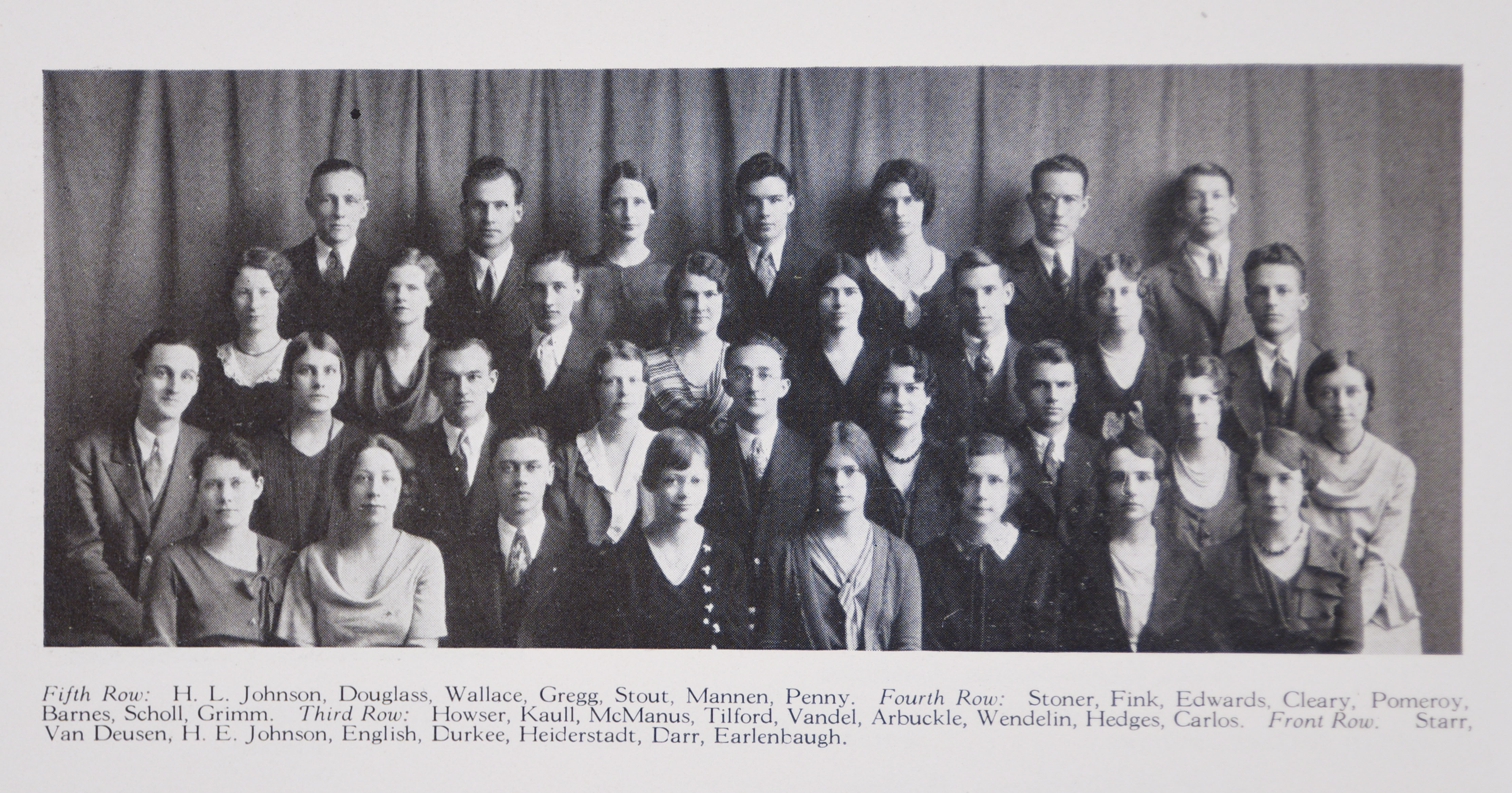
University of Kansas MacDowell Fraternity for students interested in the arts of painting, music, and literature, chosen by the faculty and an honorary committee. Rudolph Wendelin is in the second row, third from right. Photograph in the 1931 Jayhawker yearbook. University Archives. Call Number: RG 69/1/1931. Click image to enlarge.
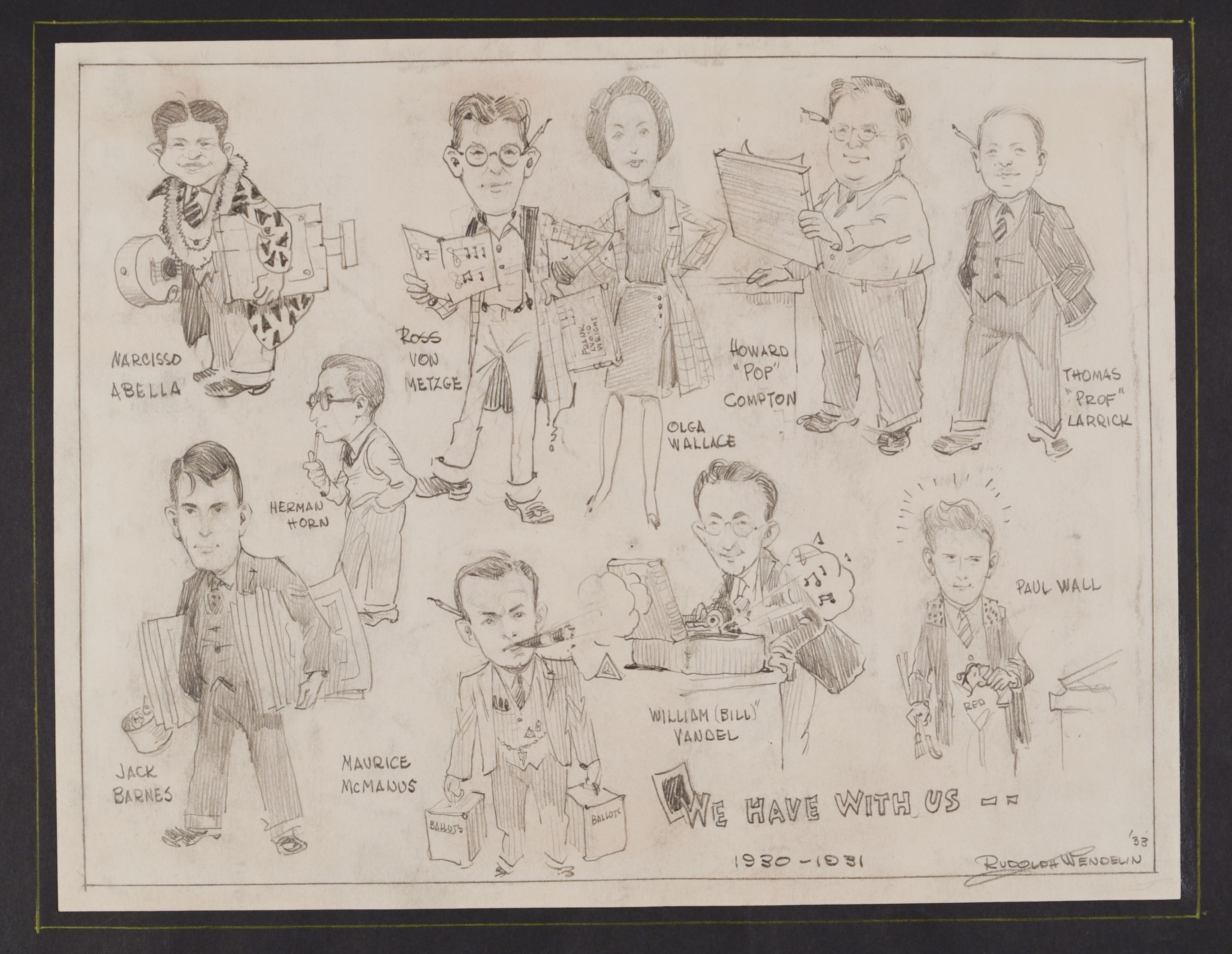
Rudolph Wendelin studied in the department of Architecture and Architectural Engineering. In a scrapbook from the School of Architecture and Architectural Engineering that spans the years 1913 through the early 1930s, there are many examples of Wendelin’s caricatures.
“We Have With Us . . . 1930-1931.” Pencil drawing by Rudolph Wendelin featuring faculty and student leaders from the School of Architecture and Architectural Engineering. University Archives. Call Number: SB/18. Click image to enlarge.
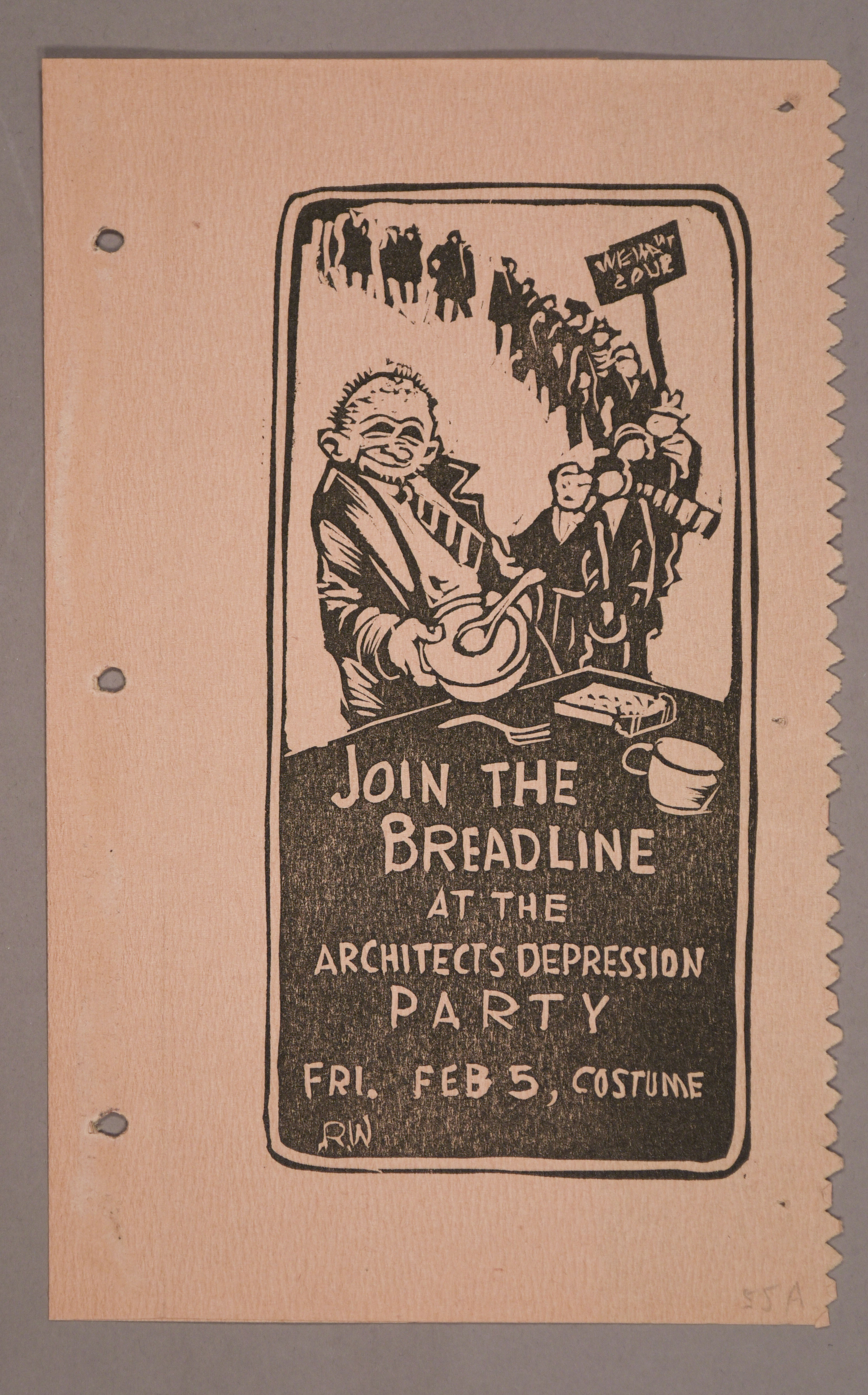
Wendelin captures student life, including the annual Architect’s Party. In 1932 the theme was “Depression.” The description in the scrapbook, most likely written by Wendelin, indicates that “costumes and decorations were in keeping with this feeling [of Depression] . . .” The event featured “singing and dancing by Bob Mann’s chorus, juggling of balls and jokes by Prof. Beal, and tap dancing by Ruth Pyle . . . Refreshments were served the hungry mob, and dancing followed–to depression music–the radio.”
“Join the Breadline at the Architects Depression Party.” Print by Rudolph Wendelin, 1932? University Archives. Call Number: SB/18. Click image to enlarge.
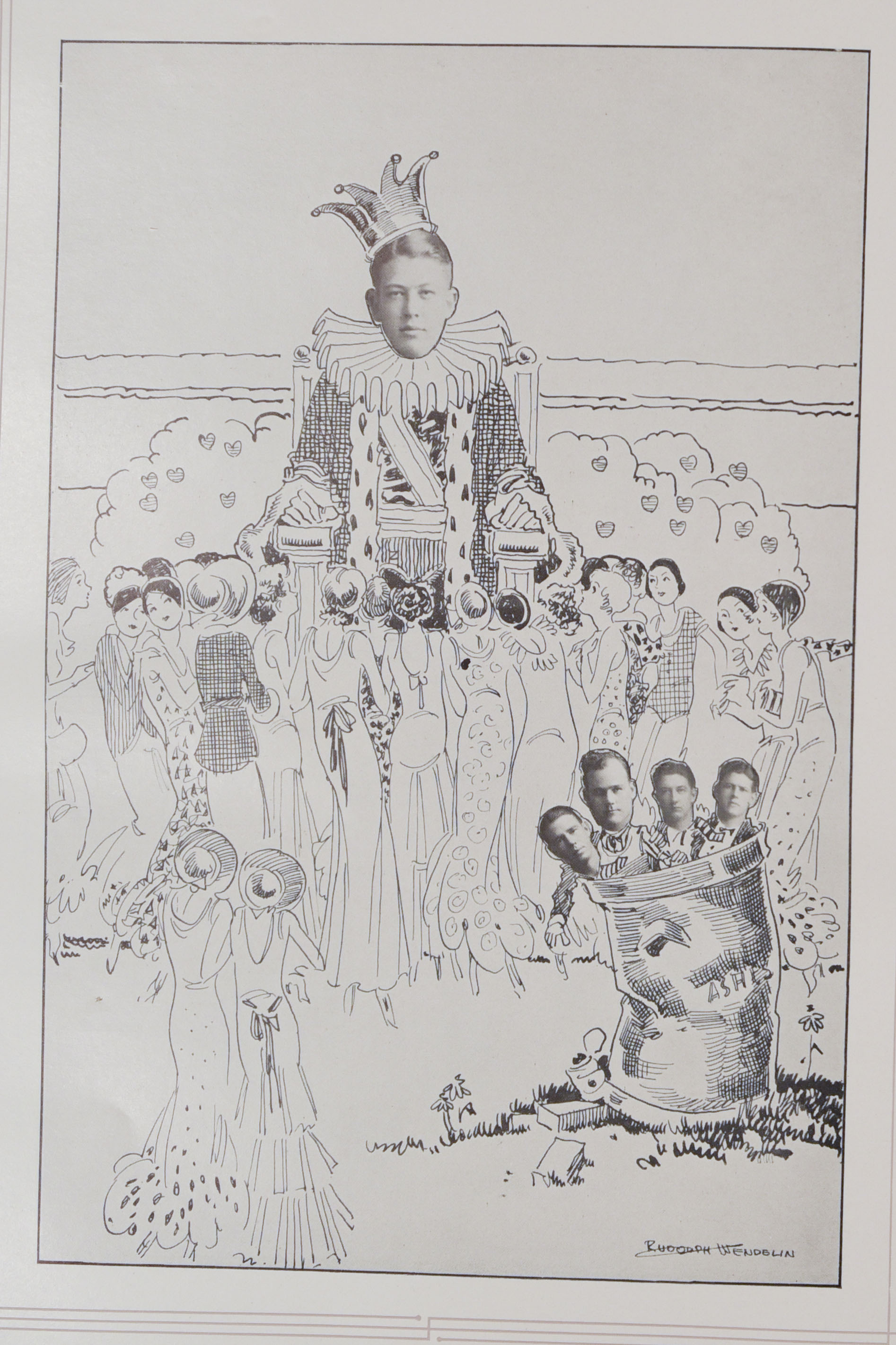
Wendelin’s work was also included in the Humor section at the end of the 1930, 1931, and 1932 Jayhawker yearbooks. In 1931 he depicted the “Hill’s Hottest He,” which features Sennett Kirk as the most desirable bachelor on campus.
The “Hill’s Hottest He.” Reproduction of a Rudolph Wendelin mixed media piece, featured in the 1931 Jayhawker yearbook. University Archives. Call Number: RG 69/1/1931. Click image to enlarge.
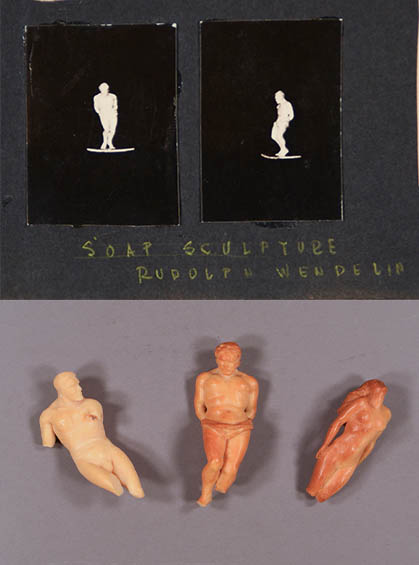
Rudolph Wendelin was also an accomplished sculptor. Early in his career, he used bars of Ivory soap to hone his craft. Rather amazingly, the Archives houses a collection of these tiny sculptures, dated 1929.
Above: Photographs of Rudolph Wendelin’s soap sculptures in the School of Architecture and Architectural Engineering scrapbook. Below: Three examples of surviving Ivory soap sculptures. The one in the center is most likely featured in the photographs above. University Archives. Call Numbers: SB/18 and RG 18/1 (artifacts). Click image to enlarge.
Each week we’ll be posting a photograph from University Archives that shows a scene from KU’s past. We’ve also scanned more than 34,800 images from KU’s University Archives and made them available online; be sure to check them out!
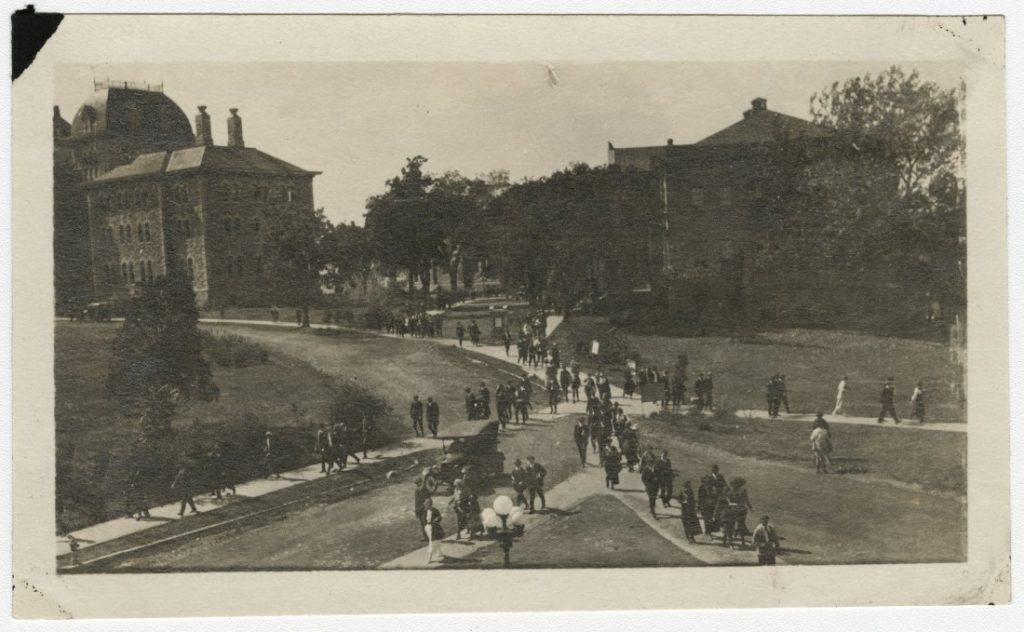
Students walking on campus, 1919. University Archives Photos. Old Fraser Hall – located approximately where modern Fraser Hall now stands – is on the left. Old Green (now Lippincott) Hall is on the right. Call Number: RG 0/24/P 1919 Prints: Campus: Panoramas (Photos). Click image to enlarge (redirect to Spencer’s digital collections).
To commemorate the 100th anniversary of the passing of the Nineteenth Amendment (which prohibits states and the federal government from denying the right to vote to U.S. citizens on the basis of sex), the Public Services staff at Kenneth Spencer Research Library are exploring the collections to create a list of materials in our holdings related to this historic event.
This summer, I served as a temporary Reference Specialist in Public Services. One of my primary projects in this role was to seek out women’s suffrage-related materials specifically within the University Archives division of the Library, which documents the history of the University of Kansas and its people.
This project required a good deal of patience and persistence, as it is not always clear whether a collection contains suffrage materials based solely on its title or even on its digital finding aid. As a result, often the best way to be certain of a potentially-promising collection’s contents was to go through them folder by folder, item by item.
My most exciting find came from the Kate Stephens Collection (PP 43). In Box 2, I came across seven letters written to Stephens by noted women’s suffrage leader Susan B. Anthony.
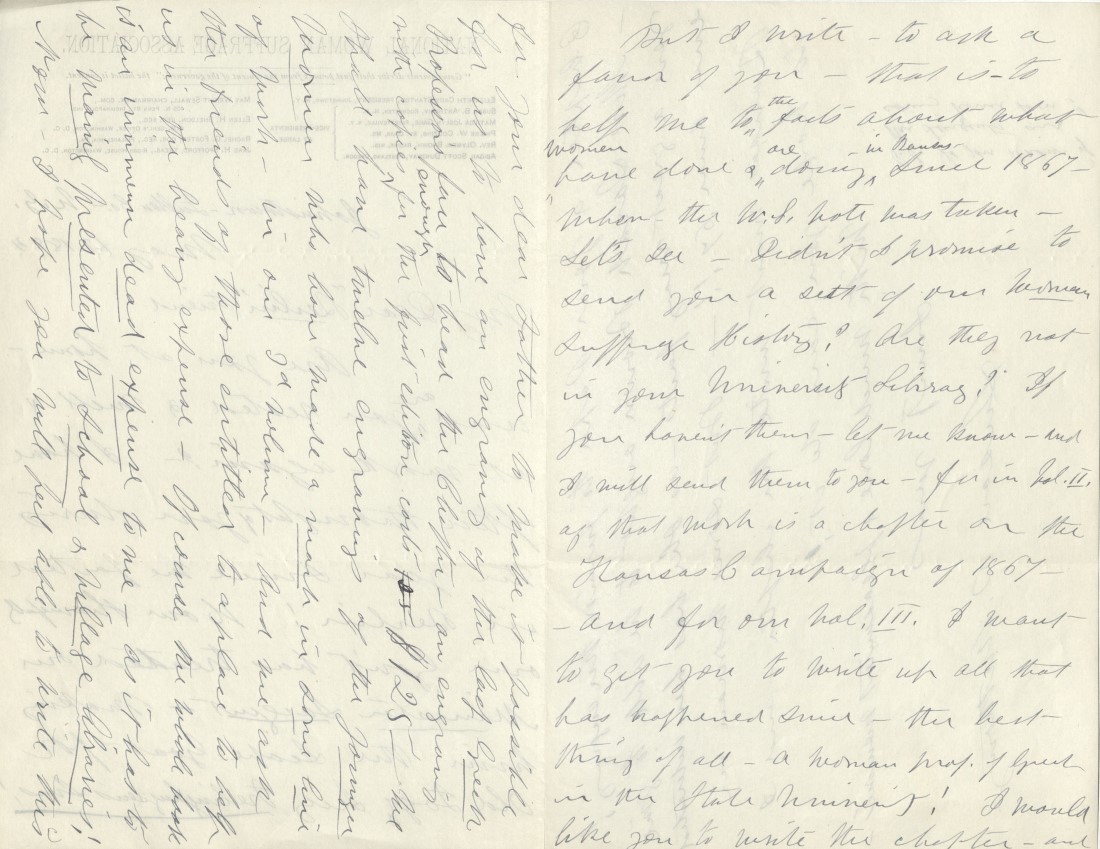
A letter from Susan B. Anthony to Kate Stephens, May 12, 1884. Call Number: PP 43, Box 2, Folder A-F. Click images to enlarge.
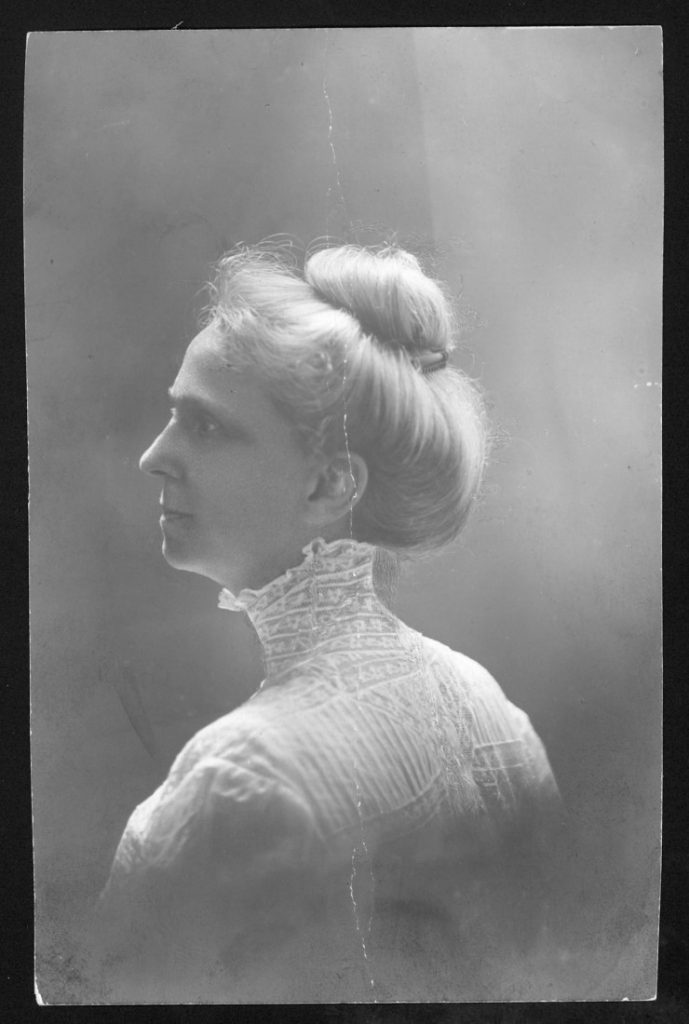
Stephens, a Professor of Greek at KU in the late 1870s and 1880s, was the first woman to serve as the Chair of a department at the university. Stephens was asked to resign from her position in 1885, a decision she appears to have attributed to her gender, her lack of religious affiliation, or possibly the recent death of her father, a prominent lawyer and judge. However, Stephens went on to become a prolific writer, editor, and proponent of women’s equality in higher education.
Top: A portrait of Kate Stephens taken during her Greek professorship at KU, 1880s. Bottom: A portrait of Stephens, undated. University Archives Photos. Call Number: RG 41/ Faculty: Stephens, Kate (Photos). Click images to enlarge.
Box 2 of Stephens’ collection contains correspondence, though further details (such as dates or senders of this correspondence) were not previously provided in the collection’s finding aid. As such, I was surprised and thrilled to find the box contained letters from Susan B. Anthony.
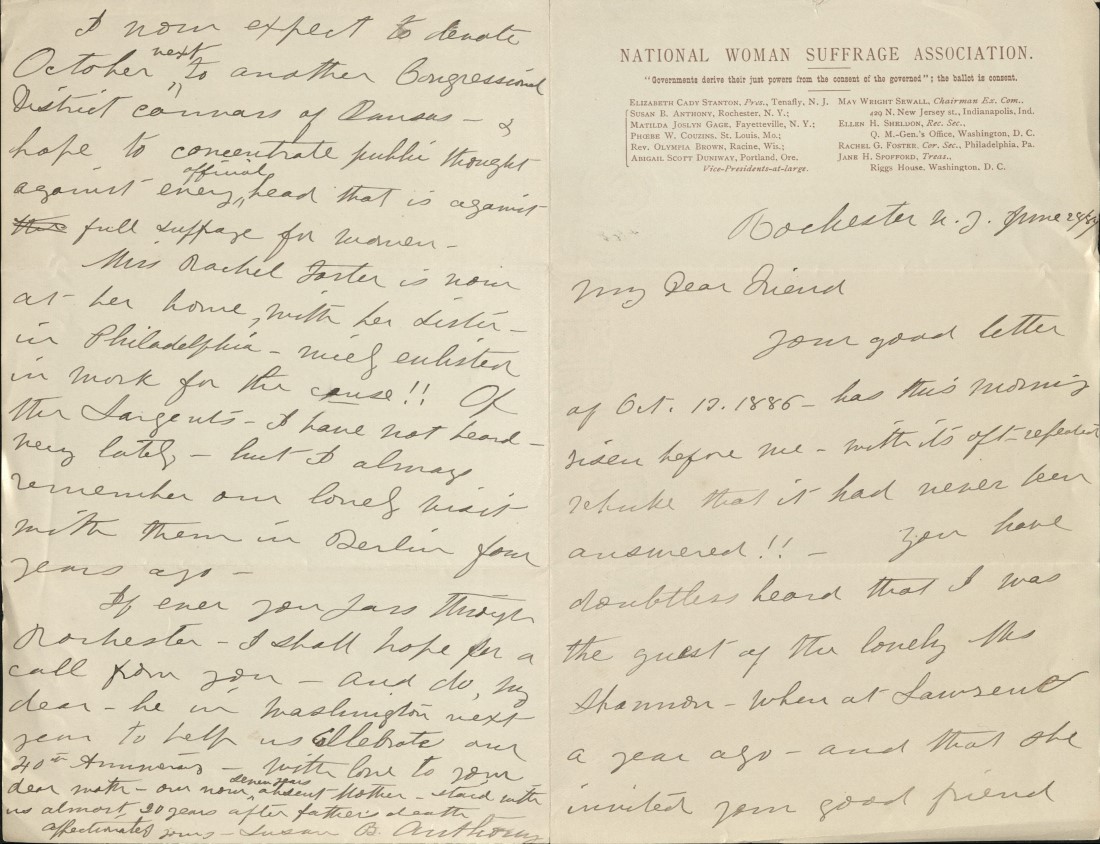
Written on letterhead for the “National Woman Suffrage Association” and dated between 1884 and 1888, the letters build on an existing relationship between the two women that appears to have begun years earlier when Stephens served as a translator for Anthony’s lectures in Berlin, Germany. In some instances, Anthony’s writing is social, such discussions regarding shared acquaintances or regarding Anthony’s niece, who she hoped to persuade to attend KU.
In other instances, the contents of Anthony’s letters relate directly to the fight for women’s right to vote. For instance, Anthony asks Stephens to write a chapter in the forthcoming third volume of History of Woman Suffrage (a task Stephens attempted but was not able to complete) and to help organize a Women’s Suffrage Convention in Lawrence (which was held on November 1-2, 1886).
Anthony’s letters also demonstrate her interest in Stephens’ career, expressing congratulations when Stephens becomes a full professor and speculating on the motivations for Stephens later being asked to resign. As to this last event, Anthony wrote to Stephens on June 28, 1887:
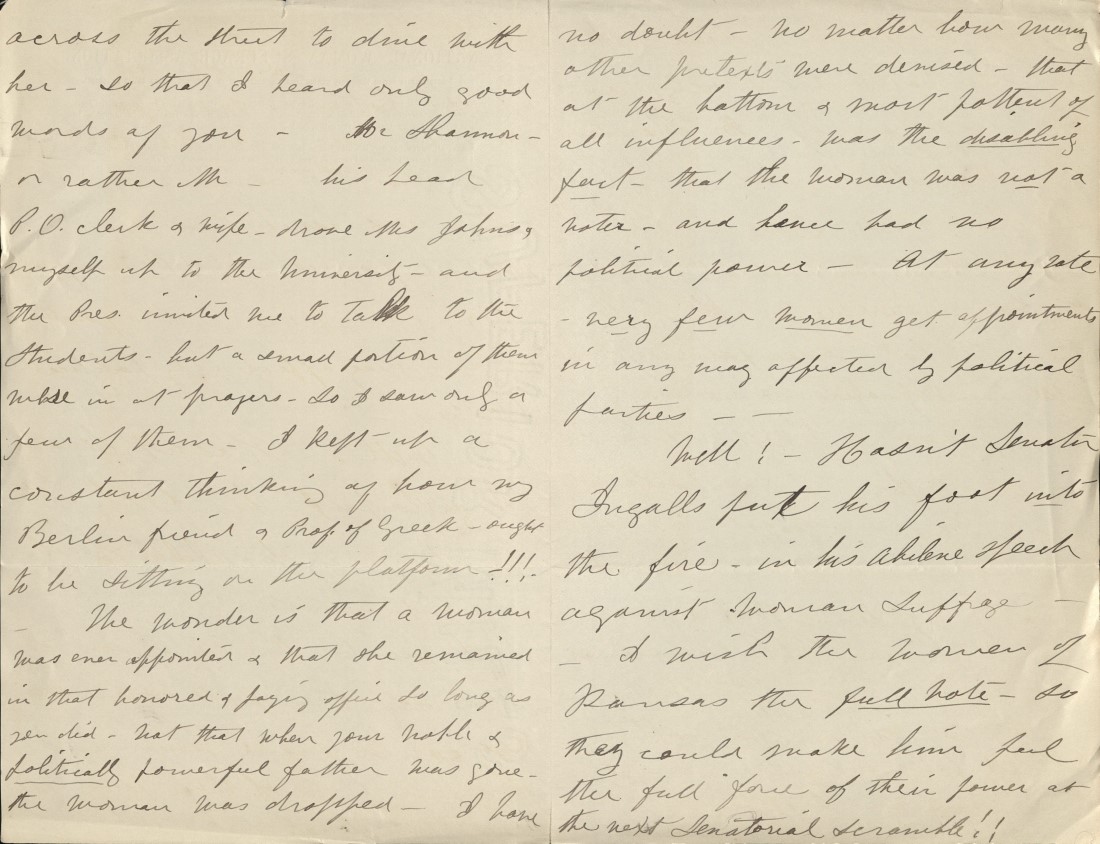
The wonder is that a woman was ever appointed & that she remained in that honored & […] office so long as she did – not that when your noble & politically powerful father was gone the woman was dropped – I have no doubt – no matter how many other pretexts were devised – that at the bottom & most pottent of all influences – was the disabling facts – that the woman was not a voter and hence had no political power […]
A letter from Susan B. Antony to Kate Stephens, June 28, 1887. Call Number: PP 43, Box 2, Folder A-F. Click images to enlarge.
As these letters from Anthony to Stephens were undocumented in the collection’s finding aid, there was previously no definitive way to learn of their existence. Their re-discovery has been noteworthy, not only for the commemoration of women’s suffrage, but also for prompting a revision of the collection’s cataloguing to help ensure future researchers can find and access them in years to come.
Sarah E. Polo Reference Specialist Public Services
Each week we’ll be posting a photograph from University Archives that shows a scene from KU’s past. We’ve also scanned more than 34,800 images from KU’s University Archives and made them available online; be sure to check them out!
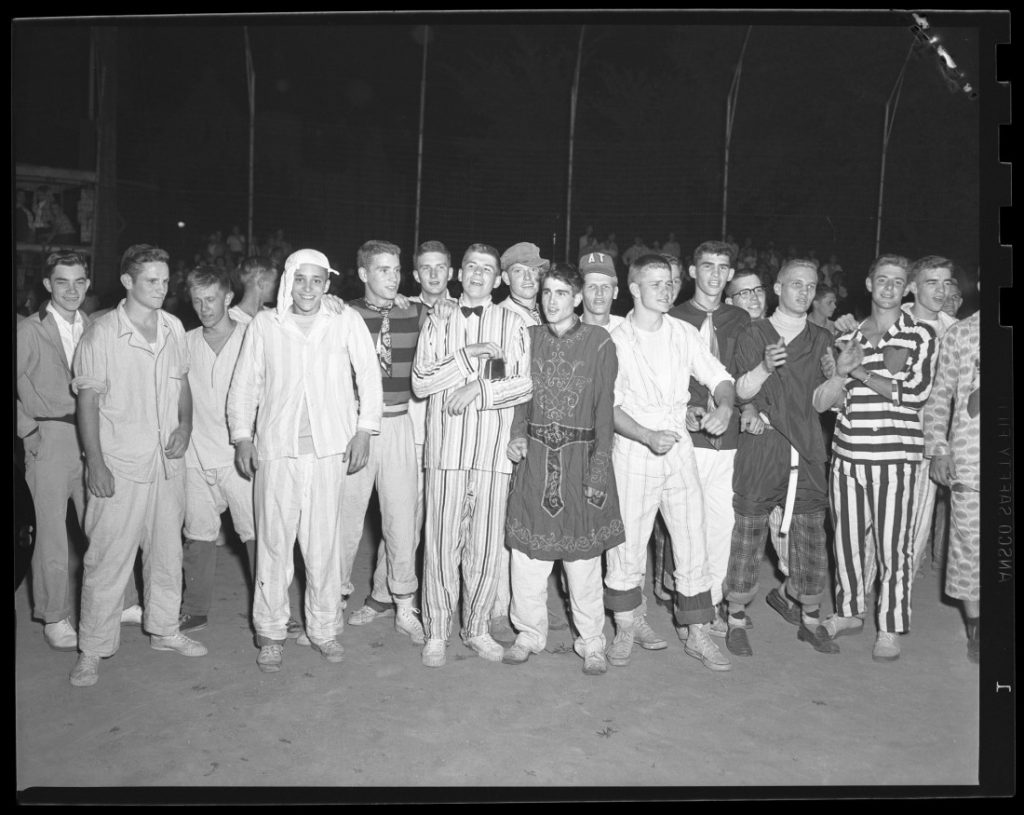
We’re looking forward to the first home game of the KU football season on Saturday. During the first half of the twentieth century, that event would have been celebrated with a Nightshirt Parade tomorrow night.
KU students in the Nightshirt Parade, 1951. University Archives Photos. Call Number: RG 71/17 1951 Negatives: Student Activities: Nightshirt Parade (Photos). Click image to enlarge (redirect to Spencer’s digital collections).
Nightshirt Parades became a venerable KU tradition. Typically, on the night before the first home game of the season, hundreds of students wearing nightshirts (usually over top of their clothing) would make their way north through campus to Sixth Street, then march east along Sixth until they reached Massachusetts Street. At this point, students would form “into one continuous serpentine line,” which amounted to a fair approximation of a conga line. Single file and holding the person in front of them, the students would weave their way down Massachusetts until they reached South Park where a bonfire would be held in anticipation of the next day’s game. At other times, the route was essentially reversed, with the procession beginning in the park and winding its way onto campus…
The onset of World War II marked the beginning of the end for the traditional Nightshirt Parade. Student enrollments dropped, and the annual procession filled in the depleted ranks by including coeds for the first time. When enrollments revived in the post-war years, the student body contained many veterans attending on the GI Bill. Serious, older, and less impressionable, these students were ill inclined to participate in or otherwise put up with anything they considered collegiate foolishness. They brought an end to the freshman cap tradition at KU, and saw little reason to don pajamas for a public event. Nonetheless, a version of the Nightshirt Parade continued well into the 1950s. However, the event had lost much of its original spontaneity and student enthusiasm for it dwindled.
The last Nightshirt Parade took place in 1957, replaced the following year with a “Traditions Rally.”
This summer I had the opportunity to be the first Ringle conservation intern in the Audiovisual Preservation Unit at the Kenneth Spencer Research Library. I worked with videotapes from the Channel 6 program, As Time Goes By, which was a public-access program created by and for senior citizens in Douglas County that aired from 1992 to 2000. Sherry Williams, the recently retired Kansas Collection Curator at Spencer, chose the show to be the pilot for this project because of its historic and cultural value. In the eight weeks of the internship, I gathered descriptive metadata on and housed 213 tapes and digitized 30 of these tapes. By the end of my time there, I really had a feel for Lawrence’s senior citizen community in the 1990’s!
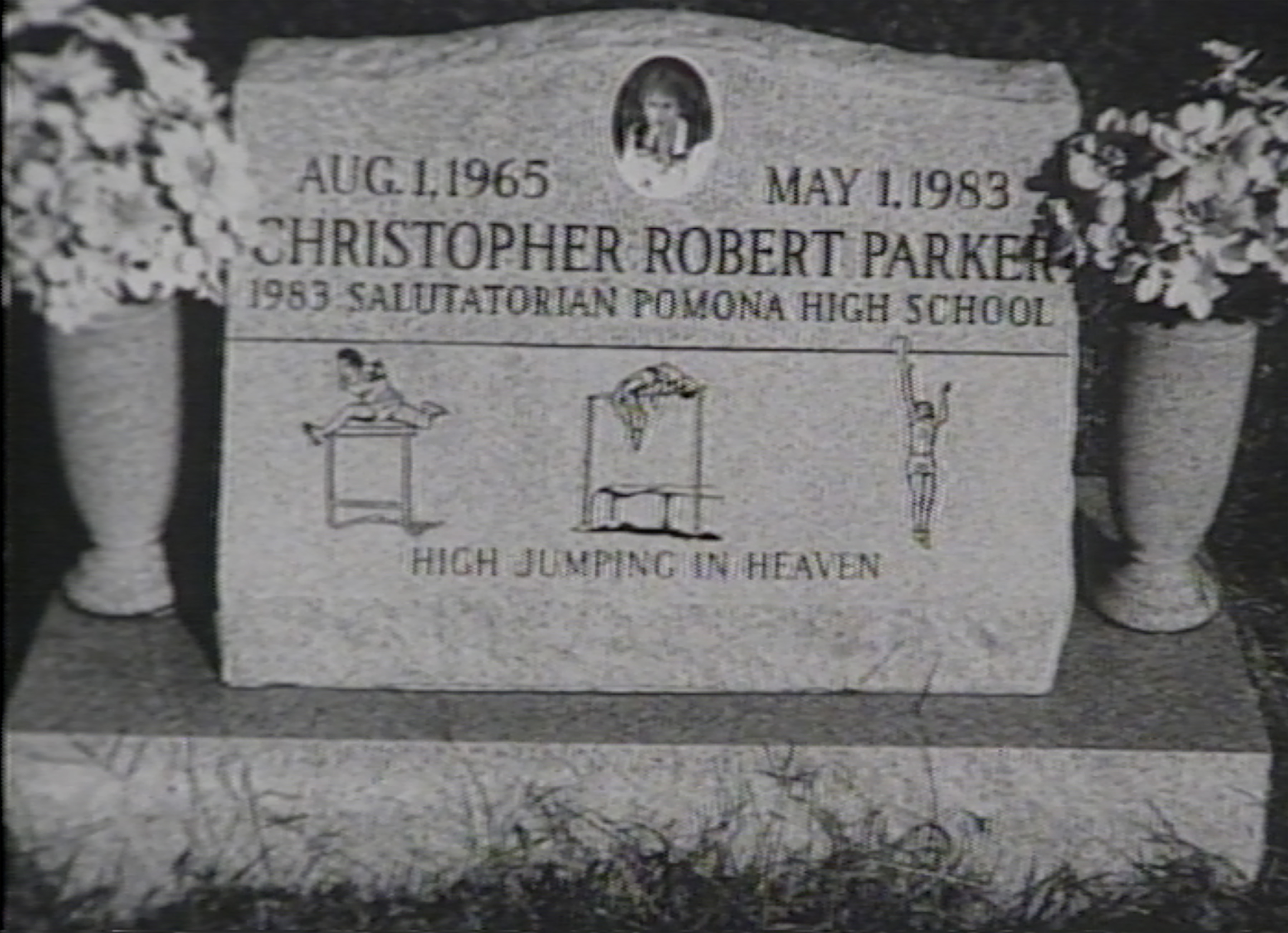
As a first timer in Kansas, I came into the project most excited to work with a large local access program that would surely teach me so much about the history and culture of Lawrence. I wasn’t disappointed. Some of my favorite episodes included a conversation with a Holocaust survivor who settled in Lawrence, a conversation with Indigenous seniors who attended the Haskell boarding school in the 1920s, and last but not least, an episode about the “unusual” tombstones in Douglas County and in America’s Heartland.
A still from episode 186 of As Time Goes By entitled “Commemorating Our Mortality.” The episode featured Jean Snedeger and John Gary Brown, two authors who wrote books about tombstones in Douglas County and America’s heartland, respectively. Click image to enlarge.
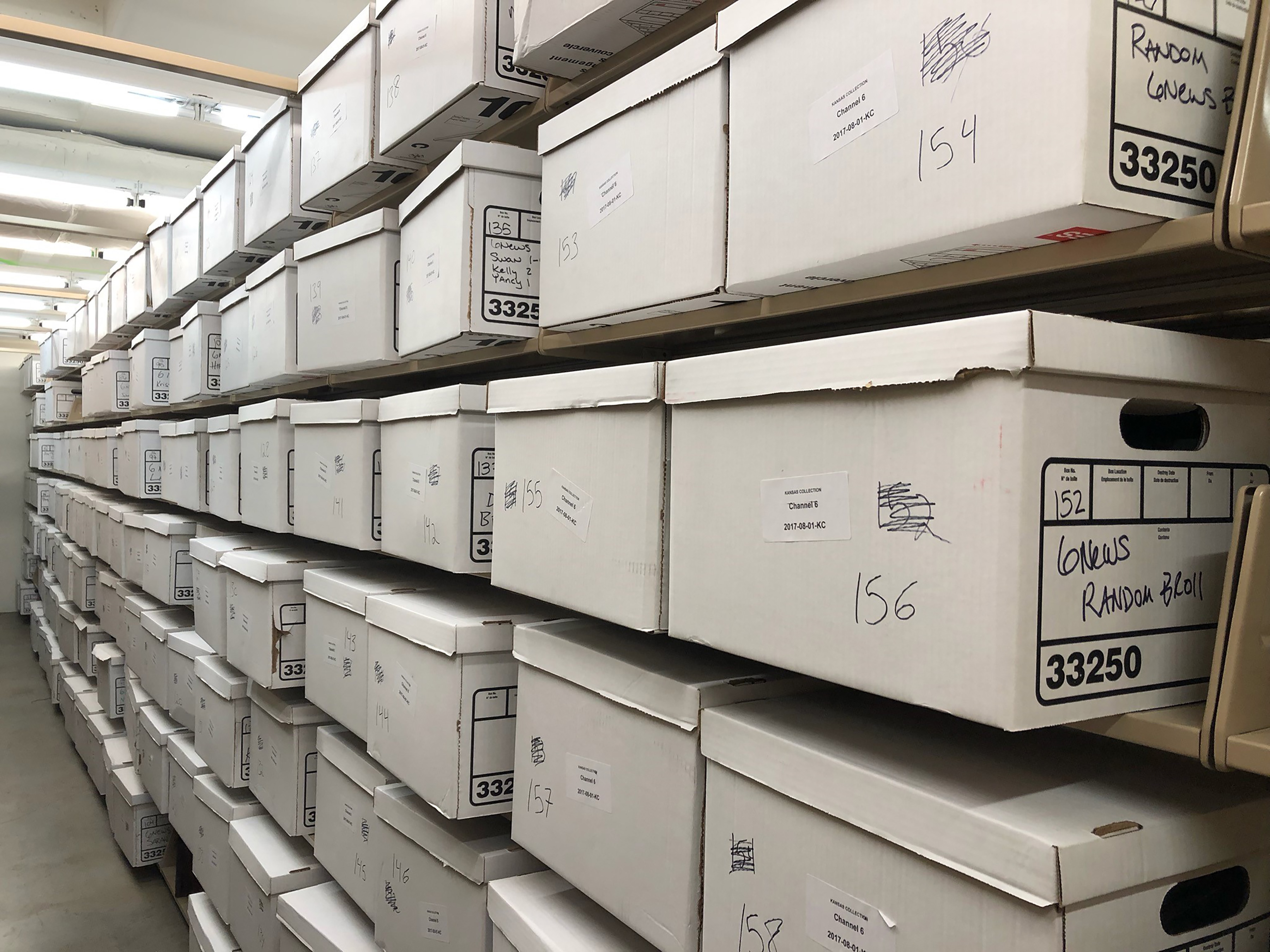
In 2017, after its 45 year run, Channel 6 was sold to Midco Communications and the question of if and how their videotapes would be preserved was posed to the Lawrence community. Sherry felt that Spencer would be an appropriate repository to store the collection in perpetuity. On the day Channel 6 was moving out of their building, Spencer staff gathered box after box of the nearly one thousand videotapes from the station and loaded them up in a van to be sent to their new permanent home at Spencer. I am amazed and inspired by their commitment to preserving the cultural heritage of Douglas County.
Boxes at Spencer Research Library containing materials from the former Channel 6 News station. Click image to enlarge.
Public-access programming can serve as a glimpse into communities during a certain point in time. In my time observing Lawrence in the 1990’s, through As Time Goes By, I learned about topics such as the history, buildings, fashion, public school system, museums, law enforcement, food, festivals, under-represented communities, and much more about Douglas County. It’s my hope that As Time Goes By will become highly accessible to members of the community in the near future.
Julia Davila Coppedge 2019 Ringle Intern, Conservation Services