The University of Kansas

Inside Spencer: The KSRL Blog

Books on a shelf

Welcome to the Kenneth Spencer Research Library blog! As the special collections and archives library at the University of Kansas, Spencer is home to remarkable and diverse collections of rare and unique items. Explore the blog to learn about the work we do and the materials we collect.

“We’re All Going to Jail, to Jail”: The University and Civil Rights in 1965

March 23rd, 2015

The 1960s were an iconic time in the United States, marked by social activism and cultural conflict. Lawrence was no exception, and the University of Kansas also experienced civil unrest throughout the decade. This is the first in a two-part series about two very tumultuous years for the university. The year 1965 saw a sit-in at Chancellor Wescoe’s office in Strong Hall. While it was perhaps the most well-known of the protests that year, the demonstration was just one of many to thrust students against authority, inequality, and war. What follows is a timeline of some of the events from that year.

Photograph of a group of Vietnam protestors in downtown Lawrence, 1965 February 21

Group of Vietnam protestors in downtown Lawrence, February 21, 1965.
Lawrence Journal-World Photo Collection, University Archives Photos.
Call Number: RG LJW 71/18 1965: Student Activities: Student Protests (Photos).
Click image to enlarge.

February 24: Civil Rights Housing Picket
Approximately thirty-five members of the Civil Rights Council (CRC) staged a picket just before a speech by noted civil libertarian Supreme Court Justice William O. Douglas. Picketers were not against Douglas but were opposed to KU’s complicity in housing discrimination. Douglas spoke to 2,000 in Hoch Auditorium on the role of international law in the nuclear age.

Photograph of Justice William O. Douglas speaking to the crowd inside Hoch Auditorium, 1965 February 24

Justice William O. Douglas speaking to the crowd at Hoch Auditorium, February 24,1965.
University Archives Photos. Call Number: RG 0/19 Douglas, William O.:
University General: Visitors (Photos). Click image to enlarge.

March 8-9: Fair Housing Sit-In and March
150 members of CRC, both black and white students, gathered in the corridor outside of Chancellor Wescoe’s office the morning of March 8th. The hope was to bring attention to the administration’s unspoken approval of discrimination in campus housing and approved organizations, like fraternities and sororities. The group came with a list of seven demands that the students wanted Wescoe to approve immediately. They included the abolishment of racially discriminatory practices of sororities and fraternities; a rule that the University Daily Kansan could no longer publish advertisements of racially discriminatory landlords and/or organizations; and the formation of a committee of students, faculty members, and administrators to resolve such grievances on campus.

Protestors came and went throughout the day, but as the doors were to be locked to the Chancellor’s suite, 110 of the participants refused to leave. Those that remained were arrested by Lawrence police and taken to county and city jails where they were charged with disturbing the peace and then released on bond. While Lawrence was not the center of the national civil rights movement, those 110 protestors arrested was the largest number besides a demonstration led by Reverend Martin Luther King, Jr. in Alabama. That night around 400 conducted a peaceful candlelight march near the Chancellor’s residence, singing “We Shall Overcome.”

The following day, the demonstrators returned with signs and stood in front of Strong Hall. Wescoe met with representatives from several groups and ultimately met the protesters’ demands. “The 1965 demonstration was perhaps the most successful civil rights protest ever in Lawrence,” said noted Lawrence historian, Rusty L. Monhollon. It did not fix all of the issues immediately, but it was the start of student equality.

Photograph of the civil rights sit-in protest in Strong Hall, 1965

Civil rights sit-in protest in Strong Hall, 1965. University Archives Photos.
Call Number: RG 71/18 1965: Student Activities: Student Protests (Photos).
Click image to enlarge (redirect to Spencer’s digital collections).

March 17: Blood Splashed on ROTC Posters
Charles Hook, president of the University’s Student Peace Union (SPU), slashed his left wrist and spattered his blood on a U.S. Navy bulletin board in the hallway of the Military Science Building on campus. It was a protest against U.S. foreign policy in Vietnam. Hook said the action was “purely spontaneous and an individual gesture” and intended to make the ROTC think about the consequences of their training. United States action in Vietnam would be the cause of several protests on campus and across the country during this time.

March 22-26: Vietnam Vigil at KU
Monday evening began a picket-vigil at the KU Military Science Building. Once again, Charles Hook led the demonstration against U.S. policy in Vietnam and military methods of accomplishing goals. The SPU would have at least one member stand vigil throughout the next several days and nights.

April 28: Park Plaza Fair Housing Picket
Members of the Congress of Racial Equality (CORE), National Association for the Advancement of Colored People (NAACP), and CRC picketed the office of Park Plaza South apartments in Lawrence for not allowing two African American students to rent from them. Led by KU professor Mildred Dickeman, a member of CORE, the picketers stand outside the office from 9 am to 5 pm demanding that the apartment complex implement a non-discriminatory policy.

May 11: Edward Teller H-Bomb Protest
Dr. Edward Teller was a University of California physicist widely regarded as “the father of the hydrogen bomb.” His speech discussed “The Responsibility of the Scientist” and the effects of nuclear war. Dr. Teller’s speech was picketed by twelve representatives of SPU at KU. They stood outside Hoch Auditorium and carried signs that said “Dr. Strange Teller?” and “Bombs for Peace?”

May 21: Third ROTC Review Picket
A group of twenty people representing the SPU picketed the annual ROTC Review in Memorial Stadium. They carried signs reading “The U.S. Talks Peace But Drops Bombs,” “Voluntary ROTC Is a Vote for War,” and “Do We Want Peace in Vietnam or a Piece of Vietnam?” According to Charles Hook, the group hoped to influence some of the cadets to drop out of the ROTC program. Two of the men wore suits and several others wore sports shirts with ties. They marched around the football field during the event. The ROTC Reviews were a popular event to picket and protest during the 1960s and into the 1970s.

Image of a flyer outlining the Student Peace Union's agenda and itinerary for the ROTC Review, undated

Flyer outlining the Student Peace Union’s agenda and itinerary for the ROTC Review, undated.
University Archives. Call Number: RG 67/38 Student Peace Union Records.
Click image to enlarge.

September 22: KU Committee to End War in Vietnam forms
The purpose of the committee was “to provide a nucleus for the channeling of student and faculty opposition to the U.S. policies in Vietnam.” Led by Errol Harris, professor of philosophy, the group planned to focus on educational programs like teach-ins and inviting well-known speakers to campus. One member stated that it is the responsibility of students to inform themselves about a situation for which they may be called upon to give their lives. This attitude would continue at KU for several years as the conflict in Vietnam escalated.

Photograph of Vietnam protestors with signs in front of a store on Massachusetts Street, 1965

Vietnam protestors with signs in front of a store on Massachusetts Street, October 16, 1965.
University Archives Photos. Call Number: RG 71/18 1965: Student Activities: Student Protests (Photos).
Click image to enlarge (redirect to Spencer’s digital collections).

December 6: General Taylor/Vietnam Demonstration
General Maxwell Taylor, former ambassador to South Vietnam, appeared for a press conference in the Regents Room of Strong Hall and then delivered a forty-five-minute talk in Hoch Auditorium. A capacity crowd of about 4,000 people attend the speech. Two different groups demonstrated in front of Hoch to protest certain aspects of the war in Vietnam. One was a silent vigil sponsored by the KU-Vietnam Committee and the other was a vocal protest sponsored by The United Campus Christ Fellowship.

Photograph of protests in advance of Maxwell Taylor's speech, 1965 December 5

Protests in advance of Maxwell Taylor’s speech, December 5, 1965.
Lawrence Journal-World Photo Collection, University Archives Photos.
Call Number: RG LJW 71/18 1965: Student Activities: Student Protests (Photos).
Click image to enlarge.

Photograph of General Maxwell Taylor speaking inside Hoch Auditorium, 1965 December 6

General Maxwell Taylor speaking inside Hoch Auditorium on December 6, 1965.
Lawrence Journal-World Photo Collection, University Archives Photos.
Call Number: RG LJW 0/19 Taylor, Maxwell: University General: Visitors (Photos).
Click image to enlarge.

JoJo Palko
University Archives Intern

KU Flashback: 150 Years Ago…

March 20th, 2015

…to March 21, 1865. A small group of men commissioned by the Kansas State Legislature meet in the Council Rooms of the City of Lawrence “to permanently locate the State University at some eligible point in or adjacent to the city of Lawrence.” The journal recording that historic event now resides in the University Archives.

Image of the Board of Regents journal, 1865-1872, page 4

The first entry in the first journal of the Board of Regents, March 21, 1865.
University Archives. Call Number: RG 1/2. Click image to enlarge.

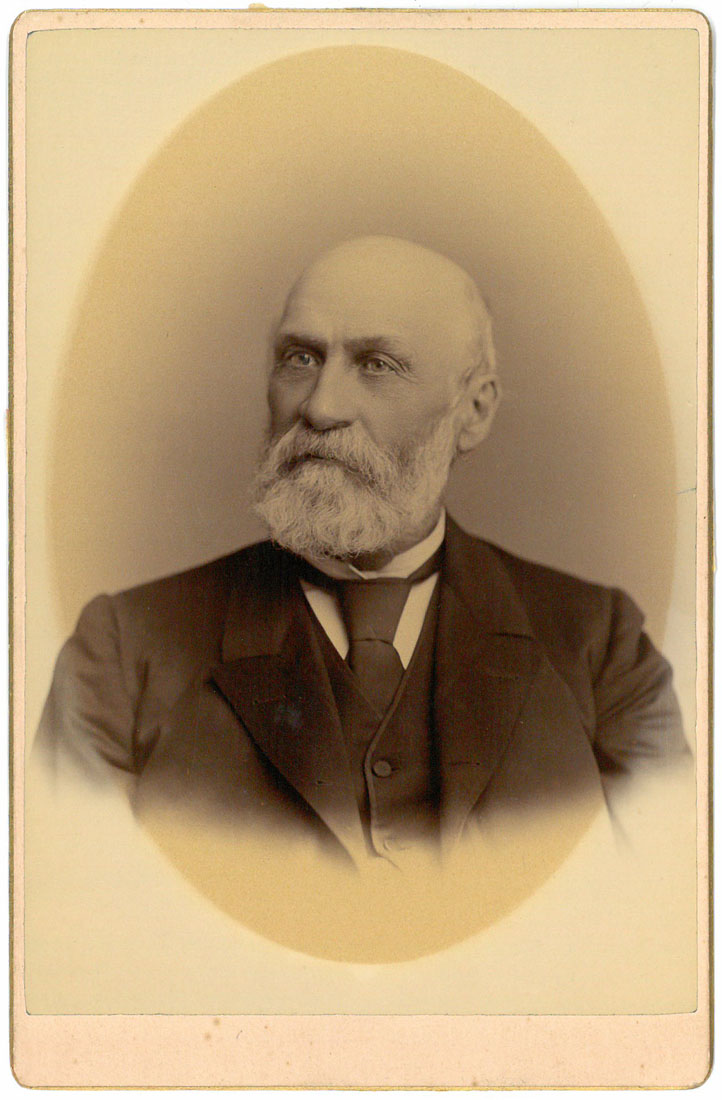
At that meeting, past Kansas governor Charles Robinson was appointed chairman pro tem and Reverend R. W. Oliver of the Episcopal Church was elected the first chancellor.

Photograph of Charles Robinson

Charles Robinson. University Archives Photos.
Call Number: RG P/ Charles Robinson (Photos).
Click image to enlarge.

Photograph of R. W. Oliver, chancellor, 1865-67

Robert W. Oliver, chancellor, 1865-67. University Archives Photos.
Call Number: RG 2/1 Chancellors: Oliver (Photos).
Click image to enlarge (redirect to Spencer’s digital collections).

The entire journal covering 1865 through 1872 can be found in the Archives Online community within KU ScholarWorks.

Becky Schulte
University Archivist

Get Rolling

February 2nd, 2015

Taking our cue from a 2009 Conserve-O-Gram (a free resource published by the National Park Service) titled “Flag Rolling and Storage,” staff in Conservation Services created an inexpensive and accessible textile storage system. The University of Kansas class and school banners are part of the collection materials found in University Archives. These banners are an important part of the history of the commencement ceremony at the university. The banners are visually interesting and also instructive artifacts as markers of KU’s changing awareness of brand identity.

1964 KU class banner

1964 KU class banner, used in graduation ceremonies

After photographing each banner, staff carefully rolled each item around an pH-neutral cardboard core.

Rolling textiles on core

Rolling a class banner on a core.

The rolling process began with a tissue paper-liner and ended with a cover of cotton muslin. Each cover was tied into place just beyond the edges of the banner and identified with a small tag showing an image of the item inside as well as its call number.

1964 KU class banner    Rolled textile storage

Left: Visual identification tag for 1964 class banner. Right: Many rolled items, ready for hanging.

There are several advantages to rolling textiles for long-term storage. There are no folds made in the fabric, reducing stress on the fibers and limiting the creation of breaks and tears. Each textile can be removed independently of the others (unlike housing several textiles in a single box) thus decreasing the number of times all the objects must be handled. And because hanging storage is vertically oriented, it takes up less space than shelves or drawers, and can be fitted on an unused wall or into an aisle.

Detail of rolled textile storage

Detail of hanging mechanism.

Once staff completed the rolling process, empty shelves were removed from two ranges in the Spencer stacks. A durable, link-style chain was suspended from the overhead shelving beams and secured into place using locking bolts. Metal electrical conduit was cut to the proper length and passed through the center of the cardboard tubes. S-hooks were hung at intervals along the chain to support the rolls.  The resulting storage has a slim profile, and provides quick and easy access to the collection materials.

Rolled textile storage

Overall view of rolled textile storage.

Roberta Woodrick
Assistant Conservator
Conservation Services

Hanging Around at Spencer

December 1st, 2014

An unused stretch of wall space on the first floor of Spencer has become the new home to about fifty paintings formerly housed in the Kansas Collection and University Archives stacks. Following a visit to the collection storage area at the Spencer Museum of Art, Conservation Services staff installed a similar gridwall panel system.

.Hanging storage at Spencer Library    Hanging storage at Spencer Library

Left: Wall space for hanging storage. Right: Installation of gridwall panels.

The panels are much like ones found in retail stores for displaying merchandise. They come in a variety of lengths and widths, which make them very adaptable to the existing environment in which they are placed. The walls on which the panels were mounted were a bit less cooperative, as evidenced by the number and wear on the bits used in drilling process.

Hanging storage at Spencer Library

Large collection of drill bits used during the installation process.

Staff first attached painted wooden boards to the wall to reinforce the plaster surface. This also ensured that the hooks used for hanging the gridwall panels could be accurately fixed in place.

Hanging storage at Spencer Library

Installed gridwall panels.

Once the installation was complete, staff fastened d-ring hangers with short, pan-head wood screws to the frames or stretcher bars on the verso of the paintings. Although a few of the paintings were already equipped with hooks and wires, it was deemed more secure and stable to use the d-ring hangers for hanging on the panels. The use of a d-ring on each side of the frame/stretcher bar allows the painting to be hung from a pair of hooks. In this manner, the painting will not slide from side to side as it would when hung on a wire over a single hanger.

Hanging storage at Spencer Library   Hanging storage at Spencer Library

Left: Attaching d-rings to painting stretcher bar. Right: Painting with d-ring attached to hook, then to panel.

The paintings were then arranged salon-style, using the panel space as efficiently as possible. The paintings are now much easier to page for patrons. This is also a better storage environment for the items, as they are no longer standing on one side of their frame/stretcher bar or resting against one another.

Hanging storage at Spencer Library  Hanging storage at Spencer Library

Left: Paintings hung in place. Right: Tyvek drapery to protect paintings from dust and light.

As a final preservation strategy, the paintings have been draped in Tyvek. This material, best known for its application in house construction, is an excellent, light-weight covering to protect the paintings from dust and abrasion. In addition, we created a visual map of all the paintings to aid in paging them for patrons with the least disruption to the Tyvek drapery.

Roberta Woodrick
Assistant Conservator
Conservation Services

KU and UK: A Shared Basketball Legacy

November 17th, 2014

Tensions are high this week as two of college basketball’s winningest and most storied teams, the University of Kansas Jayhawks and the University of Kentucky Wildcats, face off tomorrow in Indianapolis. During March Madness these schools are rivals, but younger generations may not realize that they share a history through the sixth winningest Division I coach of all time, the “Baron of the Bluegrass” Adolph Rupp.

Lexington, Kentucky, my hometown and home of the UK Wildcats, boasts Rupp Arena, named after legendary coach Adolph Rupp. It is the largest indoor arena ever built expressly for basketball, as well as the largest indoor sports arena in the country and sixth largest in the world. Its sheer size pays homage to Rupp’s tremendous and immutable impact on UK and college basketball, but he would not have reached this level of success without his beginnings at KU.

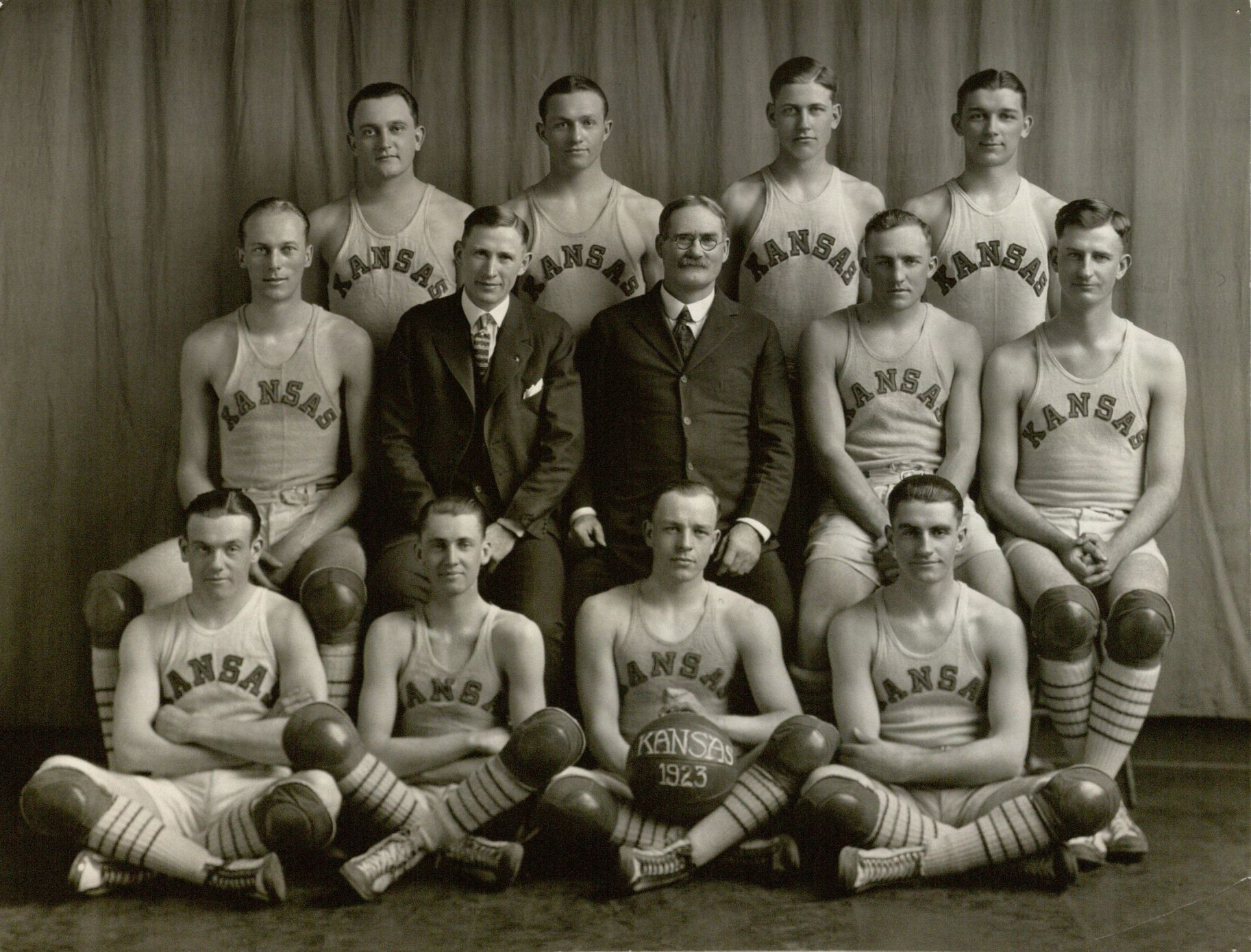
Adolph Rupp was born in Halstead, Kansas, in 1901. By the time he attended Halstead High School, James Naismith had moved to Kansas and introduced his newly invented game of basketball to the area. Rupp attended KU and, under direction from Naismith and head coach Forrest C. “Phog” Allen, played as a reserve from 1919 to 1923, including the 1922-1923 team that went undefeated in conference play and was voted national champions.

Photograph of KU men's basketball team with Adolph Rupp, Phog Allen, and James Naismith, 1922-1923

KU national champions basketball team, 1922-1923. Top left: Adolph Rupp.
Middle row, second and third from left: Phog Allen and James Naismith.
Call number: RG 66/13 1922-1923 Team Prints: Athletic Department: Basketball (Photos).
Click image to enlarge.

After college, Rupp spent several years coaching at high schools in Kansas, Iowa, and Illinois before taking a coaching job at UK in 1930. He remained head coach at Kentucky until being forced into retirement at age seventy due to university policy. Throughout his time at UK, his teams faced the Jayhawks many times, but Rupp remained cordial with his former coach and alma mater.

Photograph of Phog Allen and Adolph Rupp

Phog Allen (left) and Adolph Rupp (right), undated. Call number: 66/13 Rupp, Adolph (Photos).
Click image to enlarge.

Rupp died from cancer on December 10, 1977 in Lexington, Kentucky. Ironically, his former Wildcats played the Jayhawks that night in Allen Fieldhouse and reigned victorious. Rupp is most often associated with UK and commemorated by Kentuckians, but UK would not be on top of the basketball world without Rupp’s outstanding leadership fostered by his Kansas upbringing. His legacy is not lost on Kansans either; his high school hosts the Annual Halstead Adolph Rupp Basketball Tournament, now approaching its 45th year. Rupp’s family remained in the Lawrence area after he moved away and have provided insight into Rupp’s early life and basketball career. For more information about his home life in Halstead, see the article “His Hometown” in the Rupp section of the Courier-Journal, Monday, December 12, 1977 (call number: PP 221).

So in celebration of this week’s showdown, come to Spencer Research Library to read more about Adolph Rupp’s Kansas origins and subsequent time at rival UK (both the glory and controversies) in our collection of his personal papers (PP 221).

Megan Sims
Public Services and Processing Student Assistant
KU Museum Studies Graduate Student