The University of Kansas

Inside Spencer: The KSRL Blog

Books on a shelf

Welcome to the Kenneth Spencer Research Library blog! As the special collections and archives library at the University of Kansas, Spencer is home to remarkable and diverse collections of rare and unique items. Explore the blog to learn about the work we do and the materials we collect.

This blog may contain archived web content. This blog may link to catalog records which no longer exist as of a software change in 2026.

Appellation Spring

January 13th, 2015

Linnnaeus (whose citation at the end of a binomial is simply “L.”) invented a practical system for the classification of plants and animals; more importantly, he established a uniform method of referring to species by two Latin words–a reform that led eventually to binomial nomenclature. Although his classification system was superseded, his principles of nomenclature continue to provide the rules for application of names to thousands of species of animals and plants newly identified every year. Volume 1, Animalia, of the tenth edition of the Systema Naturae (1758), is one of the most important books in the history of science, for it marks the beginning of the modern zoological nomenclature and systematics. In it, Linnaeus first consistently applied binomial nomenclature to the whole animal kingdom.

Linneana B65 v.6:146

Image from Siren lacertina, 1766. Linneana B65 v.6:146, Special Collections

Unfortunately the great Linnaeus had little love for herps, thought them “disgusting,” and would have done well to adopt the classifcation system of John Ray. We quote, in rough translation, from the Systema: “Amphibia are loathsome because of their cool and colorless skin, cartilaginous skeleton, despicable appearance, evil eye, awful stench, harsh sound, filthy habitat, and deadly venom; and so God has not seen fit to create many of them.” Many of Linnaeus’s descriptions were based on those in books by Aldrovandus, Seba, Catesby, Jonstonus, and others. His use of the word “Amphibia” denoted not only all reptiles and amphibians, but also the cartilaginous fishes.

This work is the doctoral dissertation of one of Linnaeus’s students; it was the tradition of the day for a professor to write the thesis, but the student “respondent” had to defend it and pay for its publication.

Sally Haines
Rare Books Cataloger
Adapted from her Spencer Research Library exhibit and catalog, Slithy Toves: Illustrated Classic Herpetological Books at the University of Kansas in Pictures and Conservations

Collection Snapshot: Diet and Digestion Advice from the Late 1600s

January 5th, 2015

It’s that time of year when you may hear your friends and family vowing to eat better for 2015.  But who needs trendy “paleo” diets or post-indulgence rounds of pepto-bismol when you can consult a seventeenth-century manuscript instead?  Among the Spencer Research Library’s collections is a volume labelled “Elizabeth Dyke her Booke of Recaits 1668,” which contains approximately 725 medicinal and culinary recipes (or “receipts”).  There you’ll find these two succinct lists of things “good” and “ille” for the stomach:

List of "Things good" and "ille" for "the stomack" from a seventeenth century book of receipts.

Parsley and sage advice?: Dyke, Elizabeth. “Things good for the Stomack” and “Things Ille for the Stomack.”
Booke of Recaits [Receipts]. Great Britain, circa 1668. Call Number: MS D157. Click image to enlarge.

According to the manuscript, calamint, sage, and standing after eating meat are all beneficial, while “all sweet things,” “fryed meats,” eating “meat upon meat” (pace Dr. Atkins), and eating “to[o] many dishes at one time” can lead to digestive disorder.

Of course, some of the volume’s recipes are acquired tastes (see the instructions for black sheep’s pudding below), so you may want to take its advice with a grain of salt!

Opening in the Booke of Recaits featuring a recipe for Black Sheep's Pudding

“To make black sheeps pudings.” Book of Recaits [Receipts]. Great Britain, circa 1668. MS D157. Click image to enlarge.

Elspeth Healey
Special Collections Librarian

A 15th-Century Nativity

December 22nd, 2014

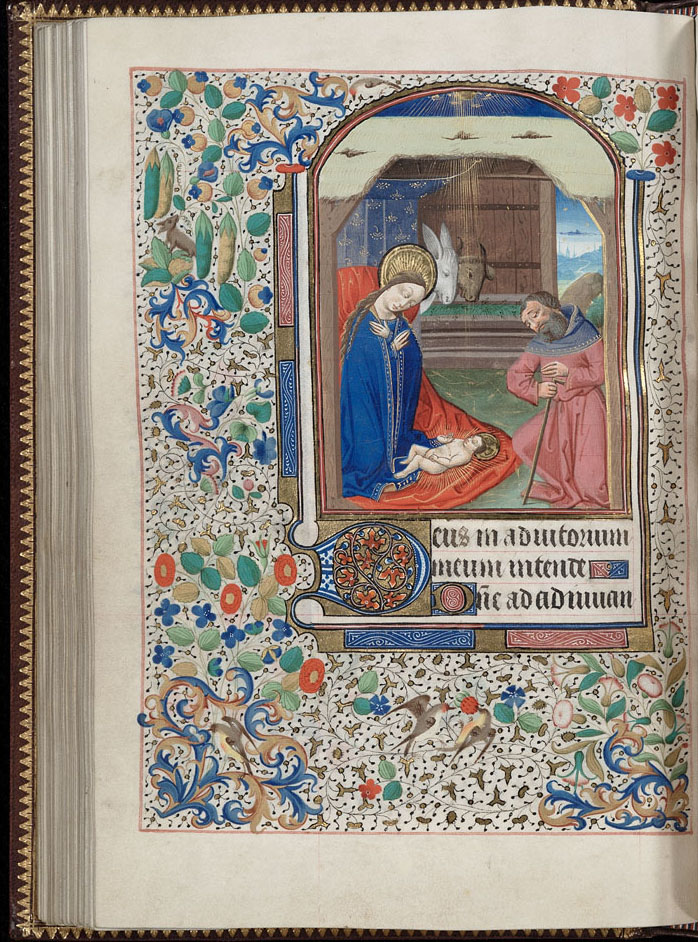
Enjoy a breathtaking image from the Vosper Hours (MS Pryce C1) during this week of Christmas. This highly decorated manuscript was created in 15th-century France as a book of hours, or Christian devotional book.

MS Pryce C1. Vosper Hours. Nativity Scene.

Vosper Hours. Nativity Scene. MS Pryce C1. Click image to enlarge.

For more information on this beautiful book, see Sharon L. Foster’s 1965 master’s thesis, “The Kansas University Hours of the Virgin”.

Whitney Baker
Head, Conservation Services

Manuscript Monday: Four from the 1400s

November 24th, 2014

Earlier this month Mitch Fraas at the University of Pennsylvania wrote a fascinating blog post in which he mapped data from Melissa Conway and Lisa Fagin Davis’s Directory of Institutions in the United States and Canada with Pre-1600 Manuscript Holdings (2014). Though, as Fraas notes, that the highest institutional concentrations of medieval and early modern manuscripts are found on the East and West Coasts, KU is responsible for one of the largest dots on the map in the middle of the country. In fact, the Kenneth Spencer Research Library ranks among the top fifteen institutions for holdings of pre-1600 manuscript codices (volumes), with its approximately 220 manuscript books, and fares even better when our over 2100 pre-1600 manuscript leaves, documents, and rolls are taken into account.

In light of these numbers, this week we’re highlighting four fifteenth-century manuscripts, each from a different country. Medievalists and early modern scholars take note; it’s worth making a stop in Lawrence, KS!

1. Vosper Book of Hours
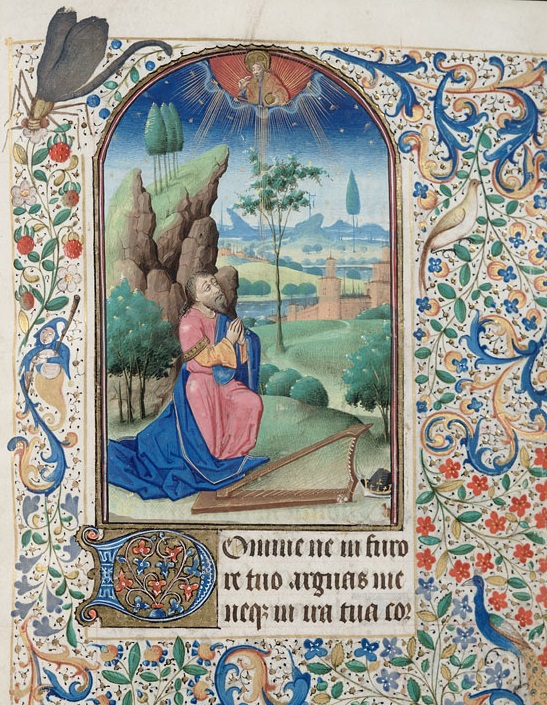
Detail from the miniature of David in prayer (f. 83r) from the Vosper Book of Hours, France, ca. 1470.

Detail from the miniature of David in prayer (f. 83r) from the Vosper Book of Hours, France, ca. 1470.
Call #: MS Pryce C1. Click image to view full page.

Spencer’s most ornately decorated manuscript is a late-fifteenth-century book of hours from Eastern France. Named in honor of Robert Vosper (1913-1994), a former director of KU Libraries, this devotional volume includes seventeen large miniatures (or paintings), as well as stunning foliate borders, featuring birds and insects. In the image above, the darkish, opaque wings of the dragonfly are actually silver which has tarnished with time.

2. Minden Codex
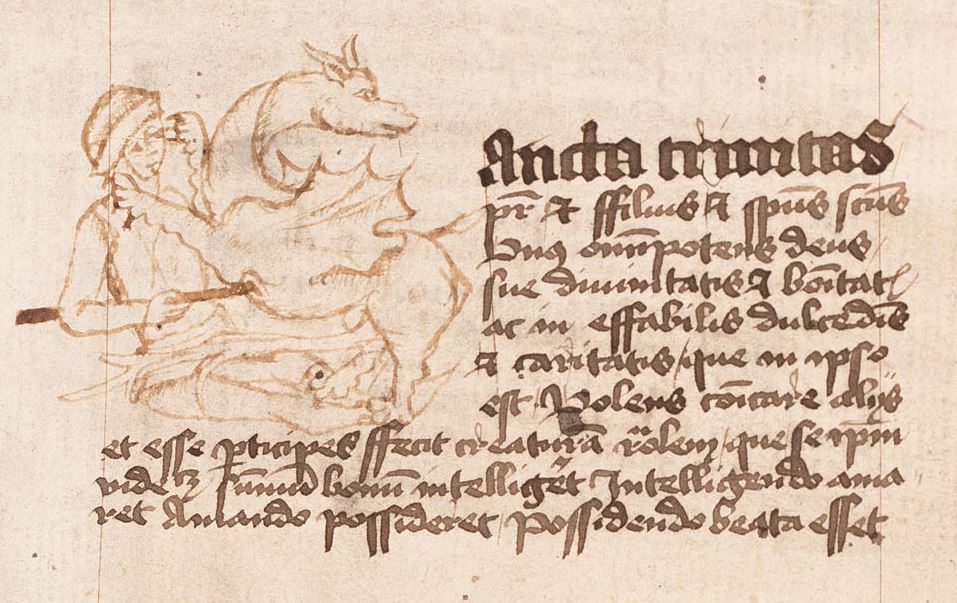
Historiated initial detail (St. George and the dragon) from the Minden Codex.

Detail from: Gallus’s Malogranatum (folio 2r), one of several texts in the Minden Codex. Germany, mid-to-late 15th century.
Call #: MS C164. Click Image to view full page.

The Minden Codex received its name from our catalogers because it once belonged to a Benedictine monastery in Minden, a city in the Westphalia region of Germany. It is a collection of more than fifteen religious texts that appear to have been copied out by different scribes in the mid-to-late 1400s and then bound together alongside a fragment of printed text. The codex begins with a portion of the first book of the Malogranatum, a dialogue intended as guidance for monks striving toward the perfection of their souls. This text is sometimes attributed to Gallus, an abbot of Königssaal (near Prague). The historiated initial in the detail above depicts Saint George slaying the dragon. Look closely and you’ll see that their entwined bodies form the letter “S” of the Latin word Sancta.

3. A Collection of Italian lyric poetry; primarily Petrarch’s Canzoniere
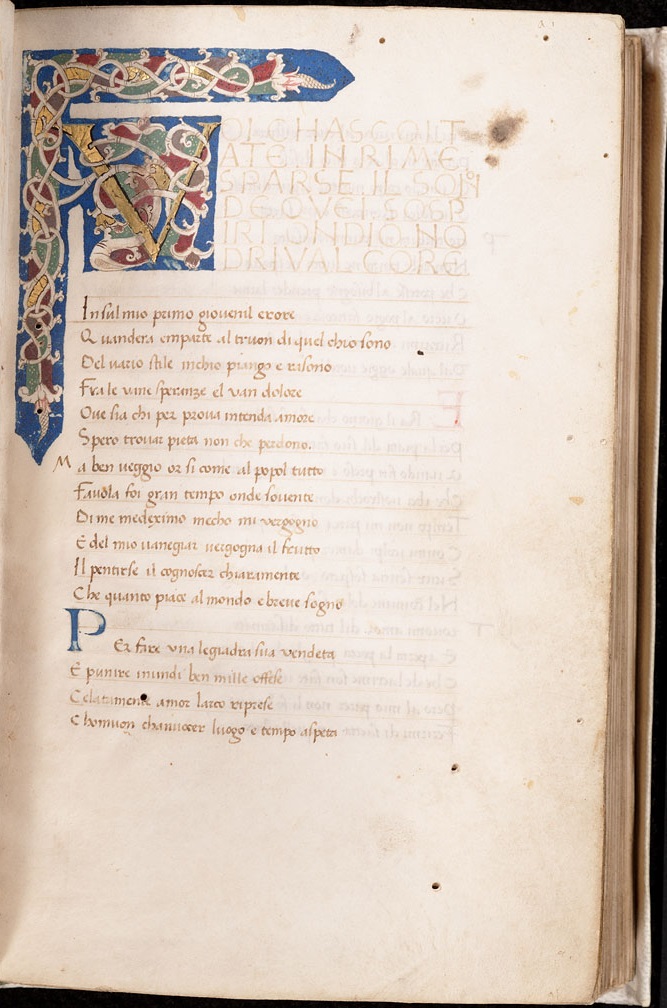
Opening of Petrarch's Canzoniere, featuring an illuminated initial containing white vine on a blue background, from A manuscript collection of Italian lyric poetry; primarily Petrarch’s Canzoniere. Italy, 15th century.

Opening of Petrarch’s Canzoniere in a collection of Italian lyric poetry. Italy, 15th century.
Call Number: MS C24. Click image to enlarge.

Though many of Spencer’s pre-1600 codices are religious in nature, the library also holds a wide range of secular texts, including classical and scientific works, legal and estate records, histories, and works of literature. The main text in this 15th century miscellany of Italian verse is Petrarch’s Canzoniere (Songbook), a sequence of poems that tells the story of the poet’s love for “Laura.” The text begins with Petrarch’s famous sonnet, “Voi ch’ascoltate in rime sparse il sono […],”  whose initial “V” is here illuminated and decorated with a white vine design.  Subsequent poems in the Canzoniere receive a simpler treatment: their smaller initials appear in alternating blue and red.  The manuscript book also includes poems by Jacopo Sanguinacci, Giusto de’ Conti, and others, as well as Latin sayings with Italian translations.

4. English Medicinal Recipe
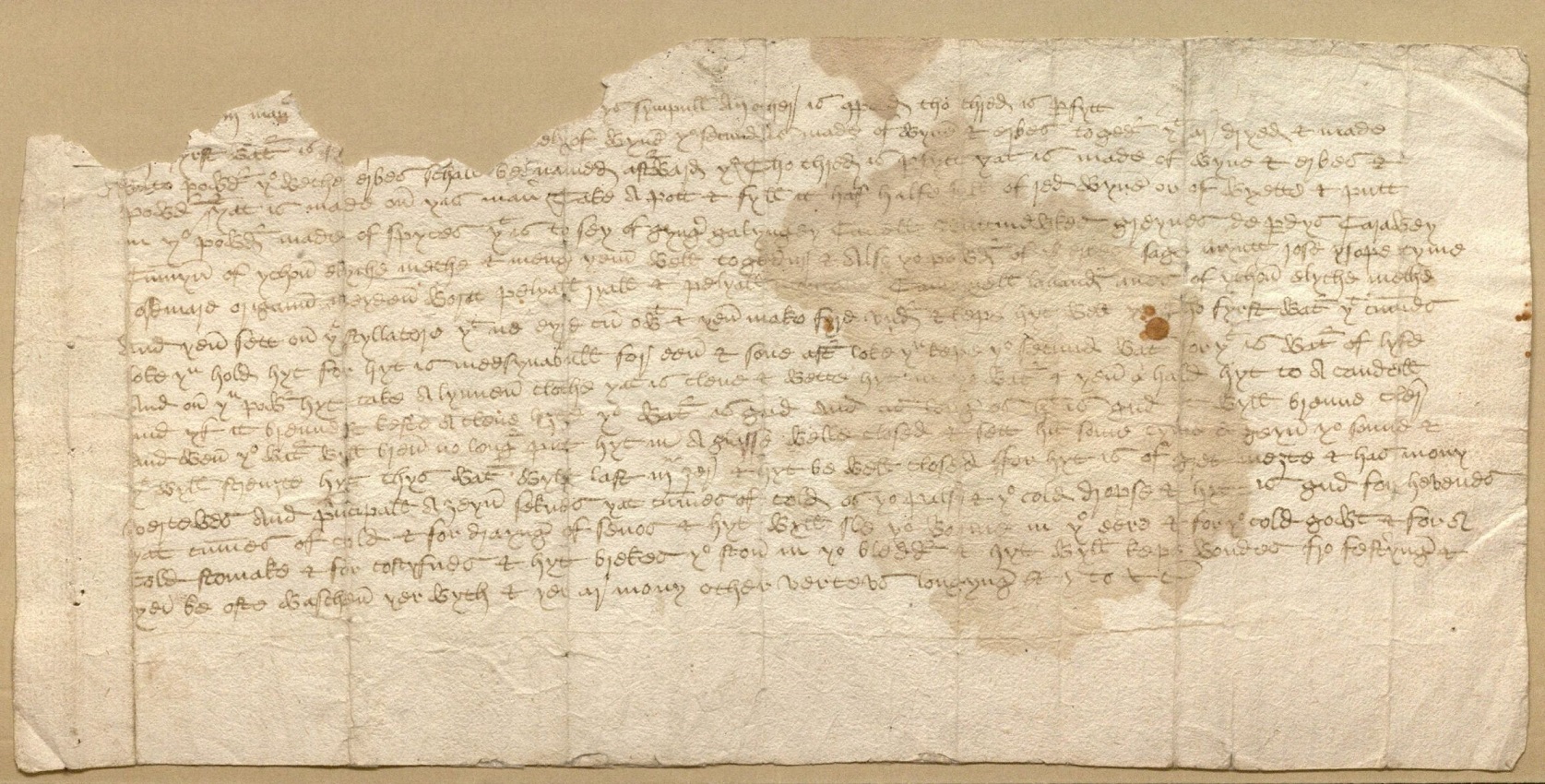
Medicinal Recipe in Middle English, England, ca. 1400s

Medicinal Recipe. England, ca. 1400s. (Phillipps 40717). Call #: MS P541  Click image to enlarge.

Feeling under the weather now that the temperature has dropped? This medicinal recipe dating form the 1400s provides directions for distilling a mixture of spices, herbs, and wine to treat a variety of illnesses and wounds. This single leaf, with its top three lines partly torn away, is notable in that it is one of the library’s comparatively few pre-1500 manuscripts in English (or Middle English, as the case may be). Though Spencer holds several thousand English estate documents (circa 1200-1900), including papers from the prominent North and Kaye families, those that date from before 1500 tend to be in Latin.  This recipe or “receipt” stands as an instructive example of unornamented, vernacular writing.  However, despite being in English, its script presents a challenge for modern eyes.  Try to read a line or two and you may soon find yourself yearning for the more familiar humanist letterforms of the Canzoniere above (MS C24). Finally, this modest leaf also boasts an interesting provenance: it was once a part of the library of Sir Thomas Phillipps (1792–1872), an obsessive nineteenth-century collector who built one of the largest private collections of manuscripts.

For those who may have caught a little of Phillipps’s manuscript-mania, Spencer has plenty more to explore. You will find records (and images) for many of our medieval and early modern manuscripts in the Digital Scriptorium, an online database with holdings from a variety of institutions. To browse Spencer’s contributions, simply click on “Advanced Search,” select Lawrence, University of Kansas, Kenneth Spencer Research Library, Special Collection from the “Current Location” field and hit “Search.” Or, for a another short narrative tour, take a peek at Lisa Fagin Davis’s great post on Kansas in her Manuscript Road Trip Blog.

Elspeth Healey
Special Collections Librarian
Collection Snapshot(s): Victorian Fashion Edition

November 4th, 2014

One of the wonderful things about class visits is that they often send you hunting through the far reaches of the library’s collections in search of interesting and relevant holdings.  A recent visit from ENGL 572: Women and Literature: Women in Victorian England led me to happen upon two very rare Victorian fashion periodicals among Spencer’s collections. These British weeklies offered up the latest styles (hint: full skirts are in) alongside commentaries and entertainments that the editors thought might interest their nineteenth-century female readership.

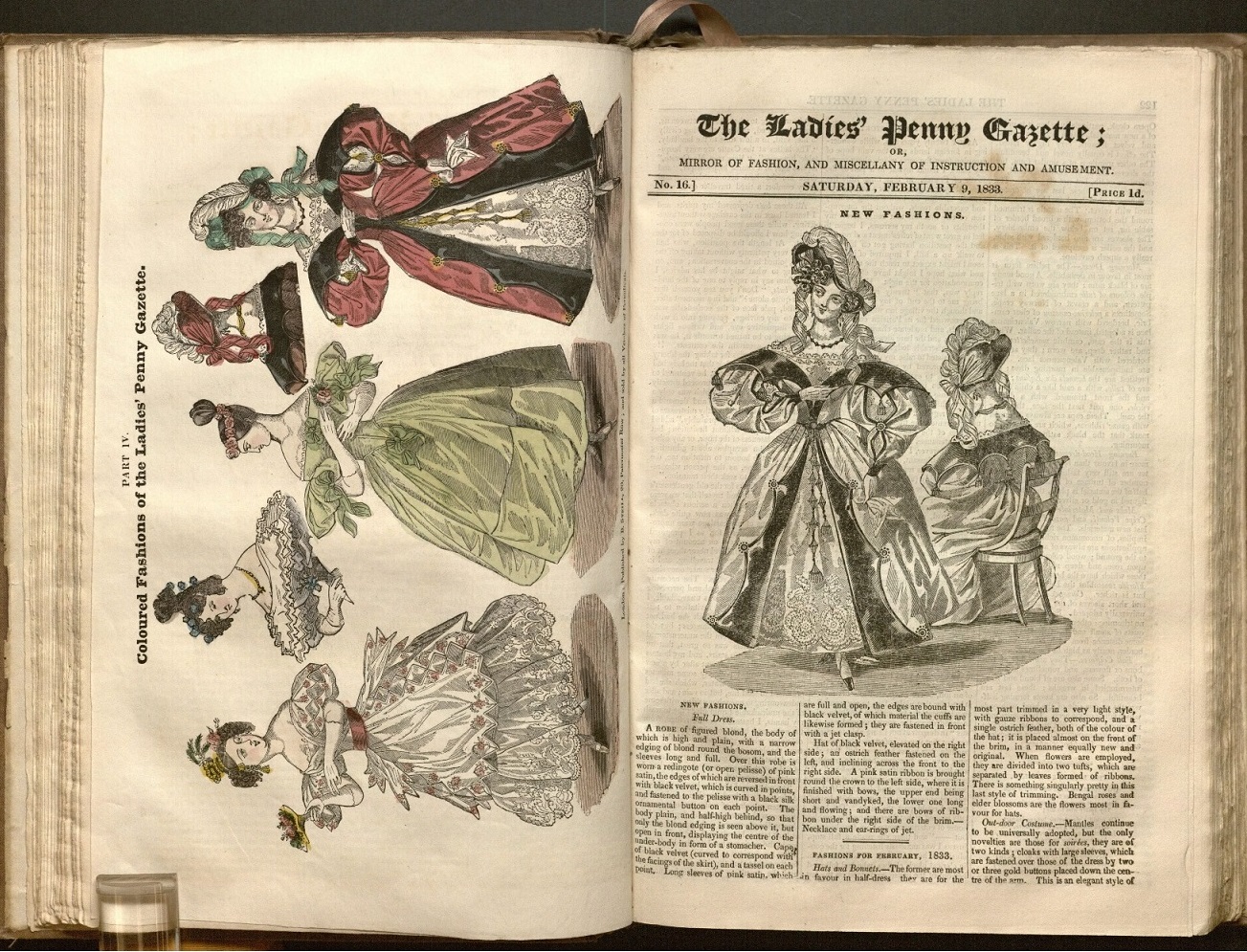
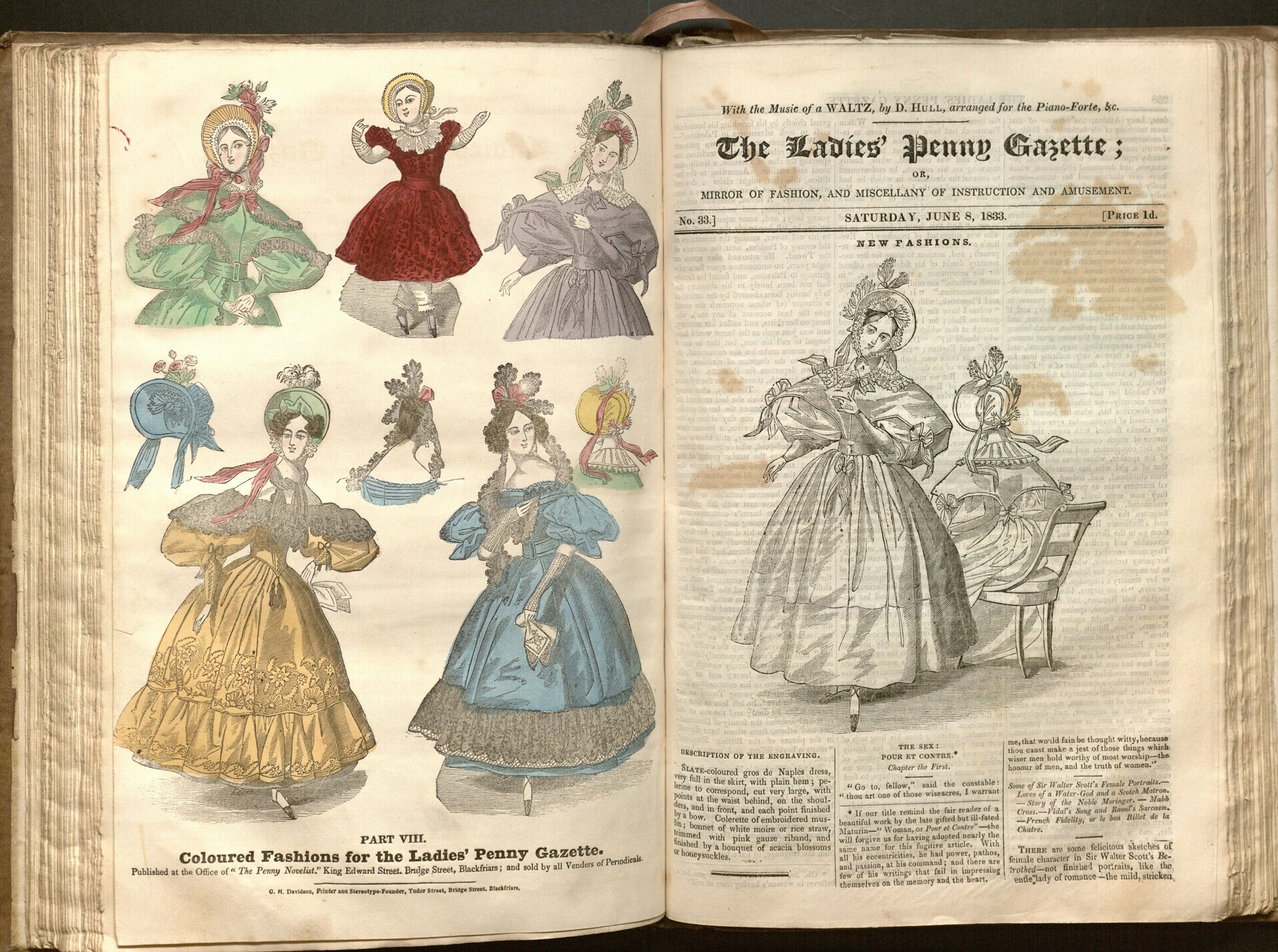
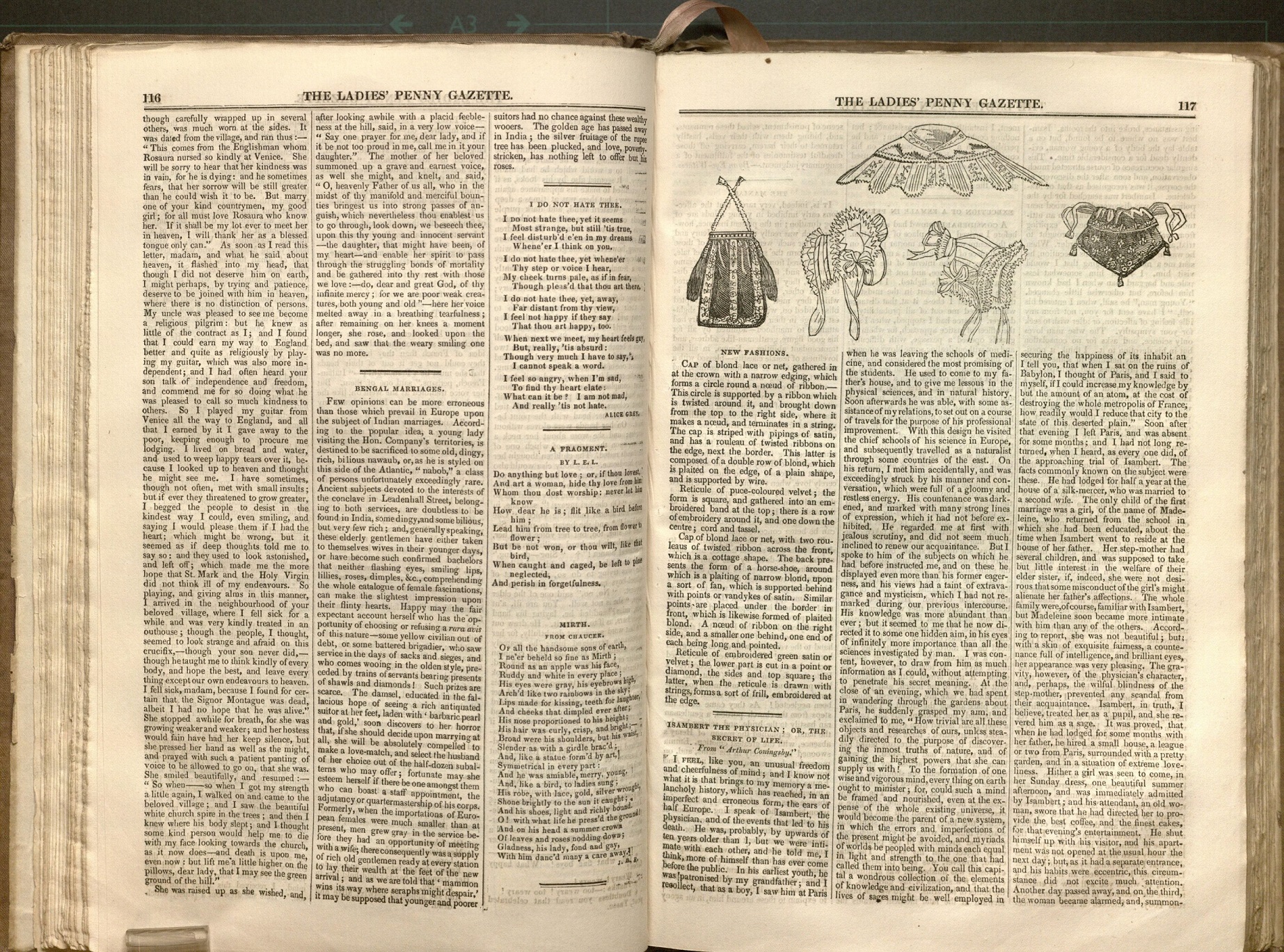
The Ladies’ Penny Gazette (published 1832-1834) dates from the period just before Queen Victoria’s  ascent to the throne in 1837. Subtitled the Mirror of Fashion, and Miscellany of Instruction and Amusement, this weekly combined fashion with articles on subjects of interest to women, theater reviews, sheet music, and literary pieces. Subscribers were treated each month to a bonus sheet of “Coloured Fashions of the Lady’s Penny Gazette,” in which the dresses were hand-colored, even if somewhat hastily so.  For those interested in literature, the Gazette offers some finds as well.  Next to a discussion of lace and caps on one side and an article on “Bengal Marriages” on the other is “A Fragment”  by the poet L. E. L.  (Letitia Elizabeth Landon).

Image of coloured fashion sheet and first page of The Ladies’ Penny Gazette (1833)

Image of coloured fashion sheet and first page of The Ladies’ Penny Gazette (June 8, 1833)

Opening from the February 2nd, 1833 issue of The Ladies' Penny Gazette, featuring L. E. L.'s "A Fragment"

Top and middle:  the “Coloured Fashions” supplements and first pages of issues No. 16 (1833 February 9) and No. 33 (1833 June 8) of The Ladies’ Penny Gazette; or, Mirror of Fashion, and Miscellany of Instruction and Amusement. Call #: D4551.  Bottom: an opening from issue No. 15 (1833 February 2) featuring L.E.L’s poem “A Fragment.”  Click images to enlarge.

Though brief by modern standards–at a lean eight pages an issue–The Ladies’ Penny Gazette made the most of its allotted space, presenting pithy, sometimes biting, commentary between its longer pieces.  One such quip, titled “Small Talk,” gives a sense of how the magazine’s conceptions of womanhood are more complicated than a label like “Victorian fashion magazine” might immediately suggest:

Small Talk — Small talk is administered to women as porridge and potatoes are to peasants–not because they can’t discuss better food, but because no better is allowed them to discuss. (No. 42,  August 10,  1833, page 30)

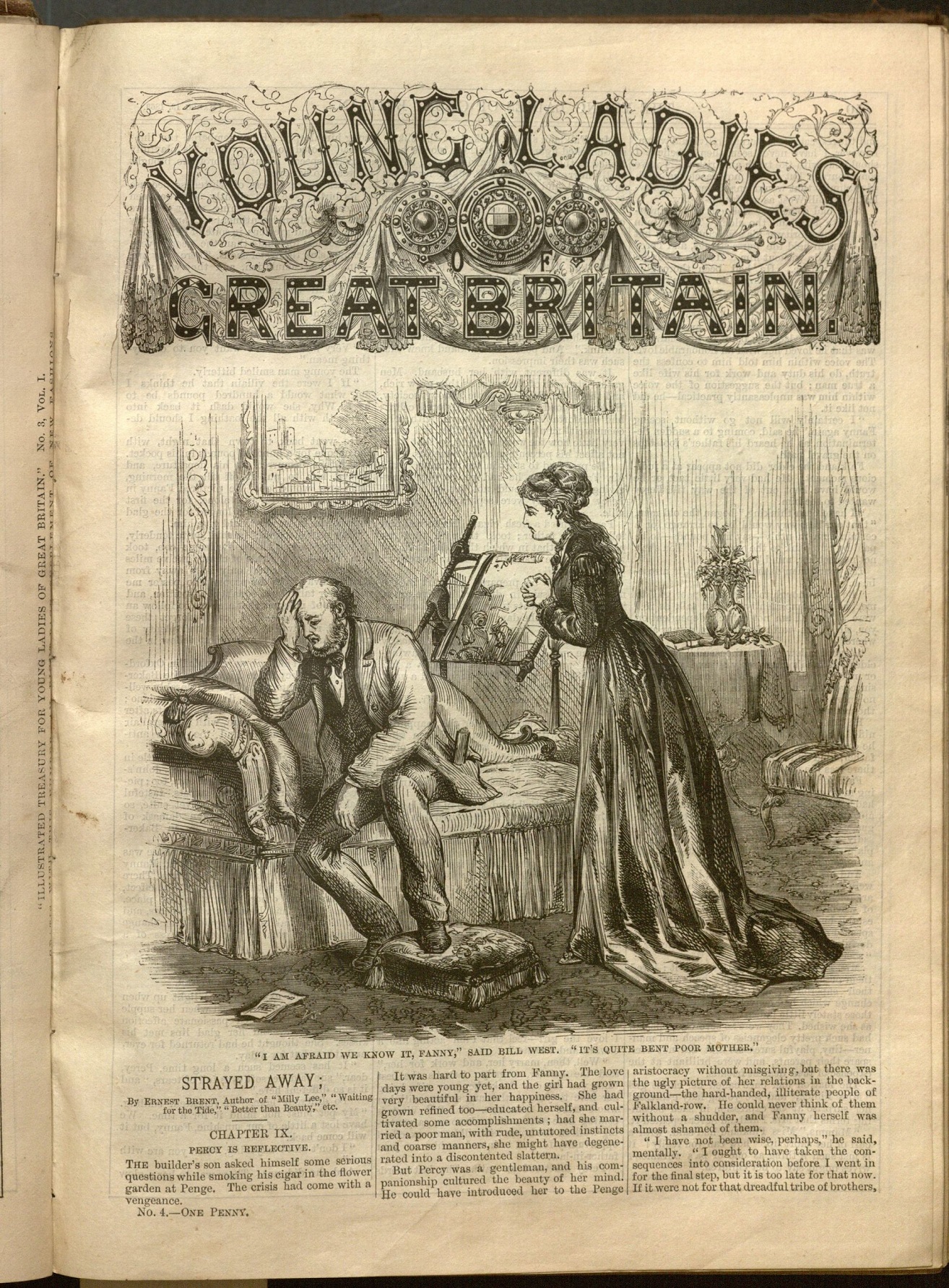
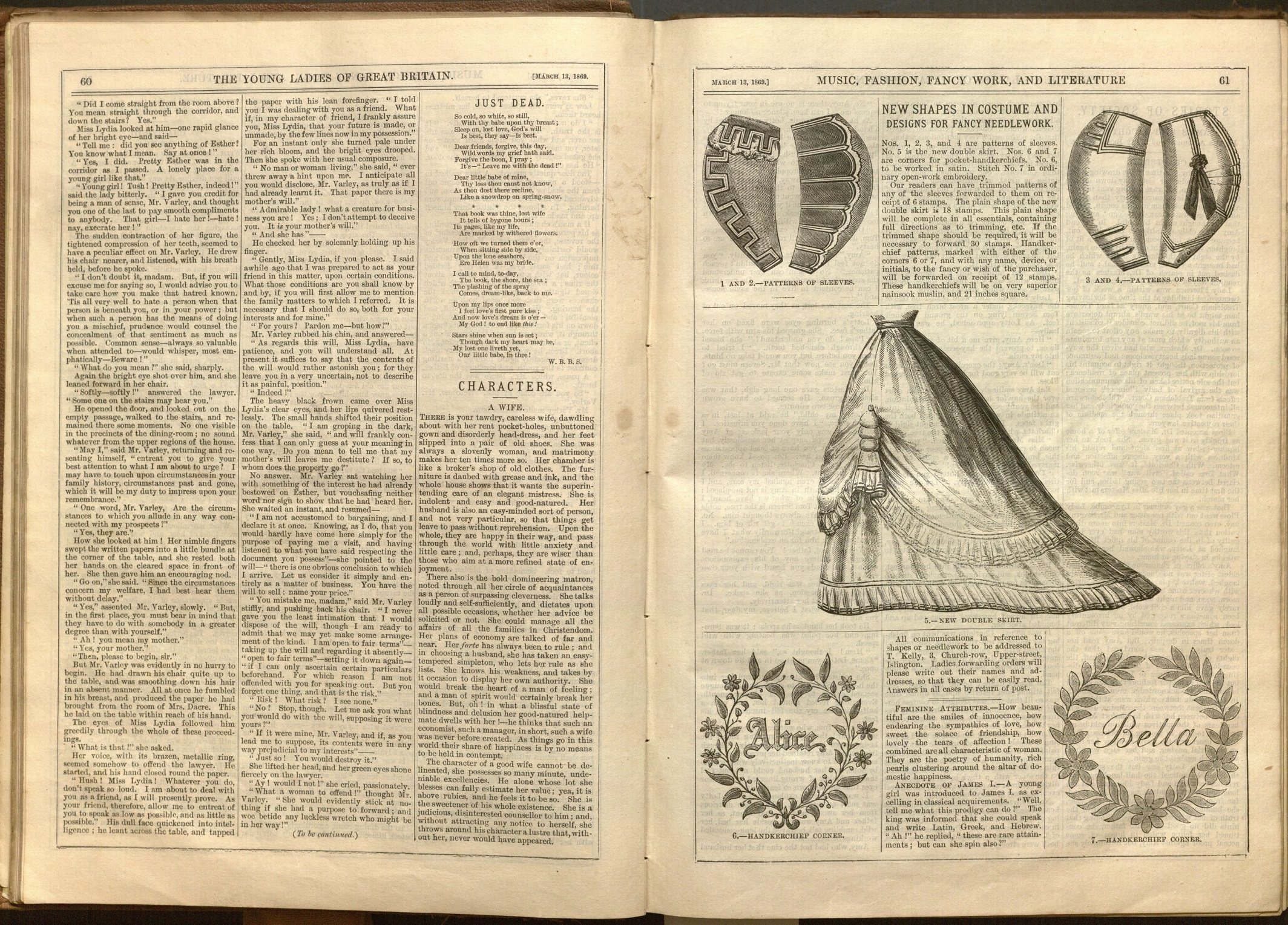
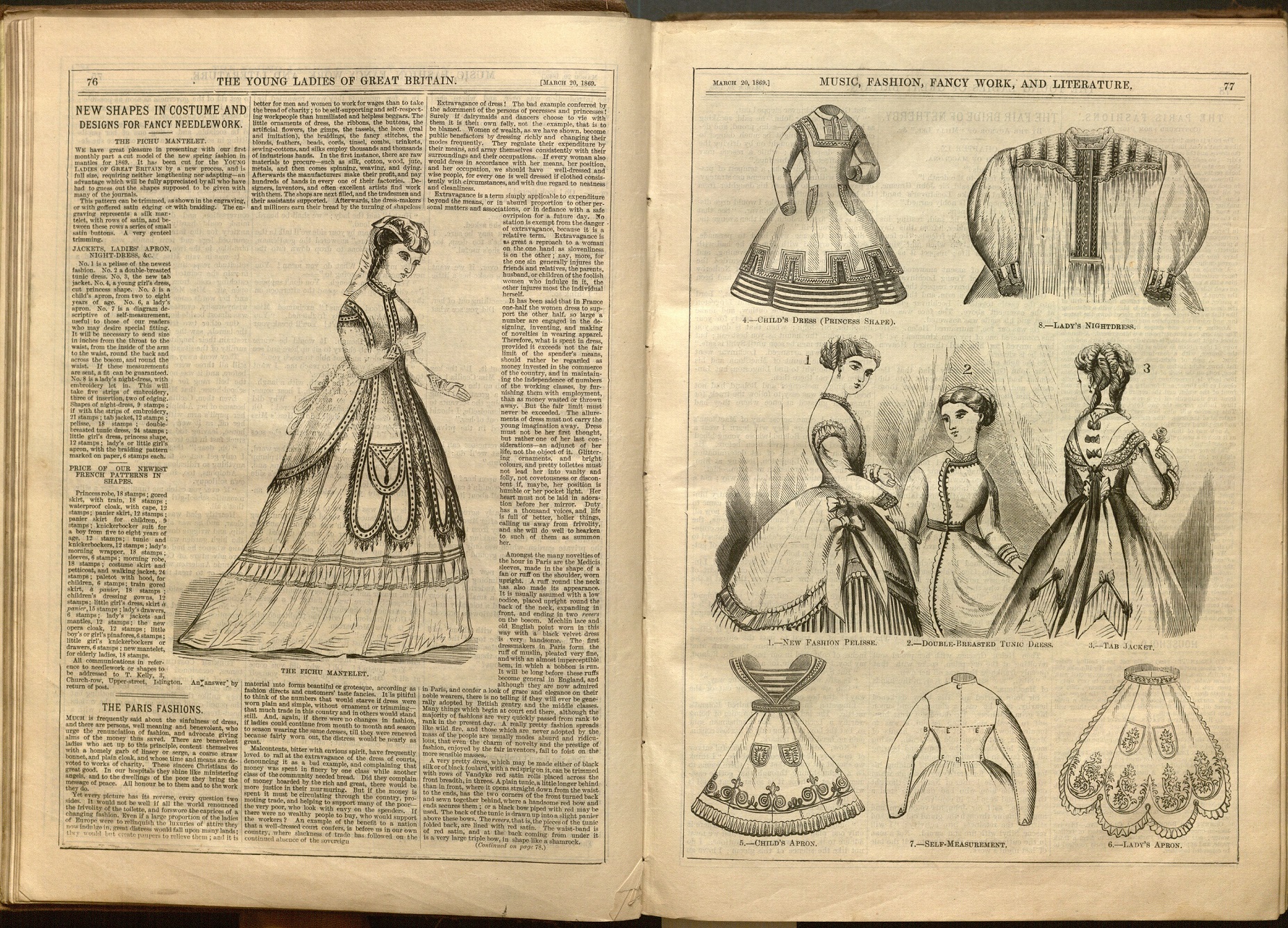
Young Ladies of Great Britain (also known by the longer title, Illustrated Treasury for Young Ladies of Great Britain) ran between 1869 and 1871 before continuing on until 1874 under slightly different titles and formats.  Though each issue touched on the newest fashions (in England and in Paris), the first page of the weekly was usually reserved for one of the pieces of fiction serialized in its sixteen pages, accompanied by an attention-grabbing  (and often melodramatic) illustration.  Priced also at a penny, the magazine targeted a  younger readership than The Ladies’ Penny Gazette, and in its mission to divert and educate, lacks the edge at times found in the earlier magazine.  A piece simply titled “Characters; A Wife”  (see the middle image below) offers a discussion of three “types” of wives: the tawdry, careless wife; the domineering matron; and “the good wife,” whose character “cannot be delineated, she possesses so many minute, undeniable excellencies.”  Men aren’t entirely spared from this typology; the husband who is drawn to the “domineering matron” is described as an “easy-tempered simpleton, who lets her rule as she lists.”

Cover illustration for Vol. 1, No. 4 (March 13, 1869)

Opening from Young Ladies of Great Britain featuring a discussion of wife "types" and (on the verso) fashion design

Opening from Young Ladies of Great Britain, featuring New Shapes in Costume and Designs for Fancy Needlework

Fashion for Victorian Brits: Illustrated Treasury for Young Ladies of Great Britain. 1.4 (1869 March 13) and 1.5 (1869 March 20). Call Number: O’Hegarty D390. Click Images to enlarge.

Whatever their circulation might have been in their day, these magazines are now quite scarce.  KU appears to hold the only library copy of The Ladies’ Penny Gazette in North America, (with copies also recorded at the British Library, Oxford, and the Koninklijke Bibliotheek in the Netherlands), and KU, New York Public Library and the British Library are the only places listed in WorldCat as holding physical copies of Young Ladies of Great Britain.  These weeklies are “rare birds” indeed, but the fascinating cultural texts they offer make them worth seeking out.

Elspeth Healey
Special Collections Librarian