The University of Kansas

Inside Spencer: The KSRL Blog

Books on a shelf

Welcome to the Kenneth Spencer Research Library blog! As the special collections and archives library at the University of Kansas, Spencer is home to remarkable and diverse collections of rare and unique items. Explore the blog to learn about the work we do and the materials we collect.

Imagination; Or, the Herp is in the Eye of the Beholder

September 29th, 2014

When it comes to creating an exhibition of illustrated books with a biological theme, a fabulous sea monster can be almost anything in the eye of the creator, and by power of suggestion, in the eye of the beholder. Some historians of biology have suggested that the basis-in-fact for the Scandinavian sea monster, Bishop Pontoppidan’s kraaken in this case, was a whale, so the image was used in a past show of whaling books in the Spencer Library. But Moby Dick‘s author, Herman Melville, as well as marine biologist Jacques-Yves Cousteau, thought it more likely that the real basis for the legends was the giant squid. For purposes of this post, it’s a sea serpent, but we intend to keep it in mind for our up-and-coming Squid Exhibit.

Erik Pontoppidan (1698-1764). The natural history of Norway. London: 1755. (Ellis Aves E333)

Image from Erik Pontoppidan (1698-1764). The natural history of Norway. London: 1755.
Call number: Ellis Aves E333, Special Collections.

The Danish original of this natural history was published in Copenhagen (1752-1754), and is of interest chiefly for its accounts of the myths connected with whales and other natural curiosities such as the fabeled kraaken.

Sally Haines
Rare Books Cataloger
Adapted from her Spencer Research Library exhibit and catalog, Slithy Toves: Illustrated Classic Herpetological Books at the University of Kansas in Pictures and Conservations

‘Dead Coloring’ Revived Again: John Gould’s Hand-Colored Bird Lithographs

September 22nd, 2014

Over the centuries a number of techniques for creating graphic images have outlived their original technology, successfully migrating to new imaging technologies. I was recently reminded of this while planning Kenneth Spencer Research Library’s exhibition, “Ornithological Illustration in the Age of Darwin: The Making of John Gould’s Bird Books” (open September 11-November 15, 2014 on weekdays 9-5 and Saturdays 9-1, except October 11).

John Gould, an English ornithologist, published illustrated books about birds from 1830 until his death in 1881. The Library has recently digitized its holdings of Gould’s 47 large-format volumes, as well as nearly 2000 preliminary drawings, watercolor paintings, tracings, lithographic stones, and proofs.

When searching the new digital John Gould Ornithological Collection (accessible at the University of Kansas Libraries website at http://lib.ku.edu/gould), I happened to compare the published hand-colored print of the Horned Lark or Otocoris alpestris with the black printing image on lithographic stone. “What a great example of dead coloring!” I exclaimed.

Image of Otocoris alpestris / Horned lark

Otocoris alpestris / Horned lark. Lithographic crayon on stone by
John Gould and Henry Constantine Richter.
Reference: ksrl_sc_gould_2387.tif.
Call number: Gould Drawing 2387. Click image to enlarge.

Image of Otocoris alpestris / Horned lark

Otocoris alpestris / Horned lark. Lithograph and watercolor by
John Gould and Henry Constantine Richter.
Reference: ksrl_sc_gould_gb_1_3 (n77).
Birds of Great Britain, 1st edition, volume 3, plate 18.
Call number: Ellis Aves H131. Click image to enlarge.

So what is dead coloring? It involves underpainting shapes in a neutral hue, then finishing the oil painting with transparent colored glazes, and was often used by late-18th-century English painters. Early painters in watercolor, a medium gaining popularity in England during the late 18th century, employed a similar approach.

However, dead coloring also had a place in European printmaking. Mezzotint and aquatint, new methods of intaglio printmaking capable of the tonal gradations necessary for dead coloring, were invented in the mid-17th century and increased in use thereafter. John James Audubon’s hand-colored aquatints of American birds published in the early 19th century were outstanding examples.

During the early 19th century yet another new printing technology, lithography, spread from Germany, where it had been invented in 1798, across Europe to England. Working with a waxy crayon on a block of lithographic limestone with a fine-textured surface was similar to drawing on rough-textured paper. The lithographic crayon caught on the tips of the grained stone surface, creating a random pattern of irregular dots. Viewed with the naked eye, the tiny dots merge into shades of gray.

Lithographic drawing was much easier to learn than mezzotint and aquatint and was the obvious choice for illustrating John Gould’s ornithological books. Elizabeth Gould (his wife), an amateur artist, rapidly mastered crayon lithography under the tutelage of Edward Lear, a younger but more experienced artist employed by Gould. She illustrated Gould’s books until her death in 1841, after which he employed a succession of professional artists.

Image of Melanopitta sordida

Melanopitta sordida. Watercolor and lithographic crayon drawing by
William Hart. Reference: ksrl_sc_gould_1264.tif.
Call number: Gould Drawing 1264. Click image to enlarge.

Image of Melanopitta sordida

Melanopitta sordida. Colored lithographic proof by
William Hart. Reference: ksrl_sc_gould_1265.tif.
Call number: Gould Drawing 1265. Click image to enlarge.

Artist William Hart executed his drawing of Melanopitta sordida in lithographic crayon and watercolor, thus rehearsing his final drawing on lithographic stone for printing and hand coloring. Colored by hand using watercolors, Gould’s lithographic prints are successful examples of dead coloring. By the time of Gould’s death in 1881, color printing was taking over the reproduction of graphic images, bringing the hand-colored lithographic revival of dead coloring to a close.

Karen S. Cook
Special Collections Librarian

Kangaroos on Machu Picchu?

August 29th, 2014

The late marsupialist John A.W. Kirsch was interviewed by a local (Peruvian) newspaper while on a collecting trip in South America back at the end of the 1960s. He described the kinds of animals he was looking for and was shocked to see the headline a few days later: KANGAROOS ON MACHU PICCHU.

While it’s true that the mammal group we call marsupials includes the kangaroos, wallabies, wombats, koalas, and bandicoots that are usually associated with Australia, and that the New World once did boast a rich and diverse marsupial fauna, most of the New World forms are now extinct and, sad to say, there are no kangaroos on Machu Picchu.

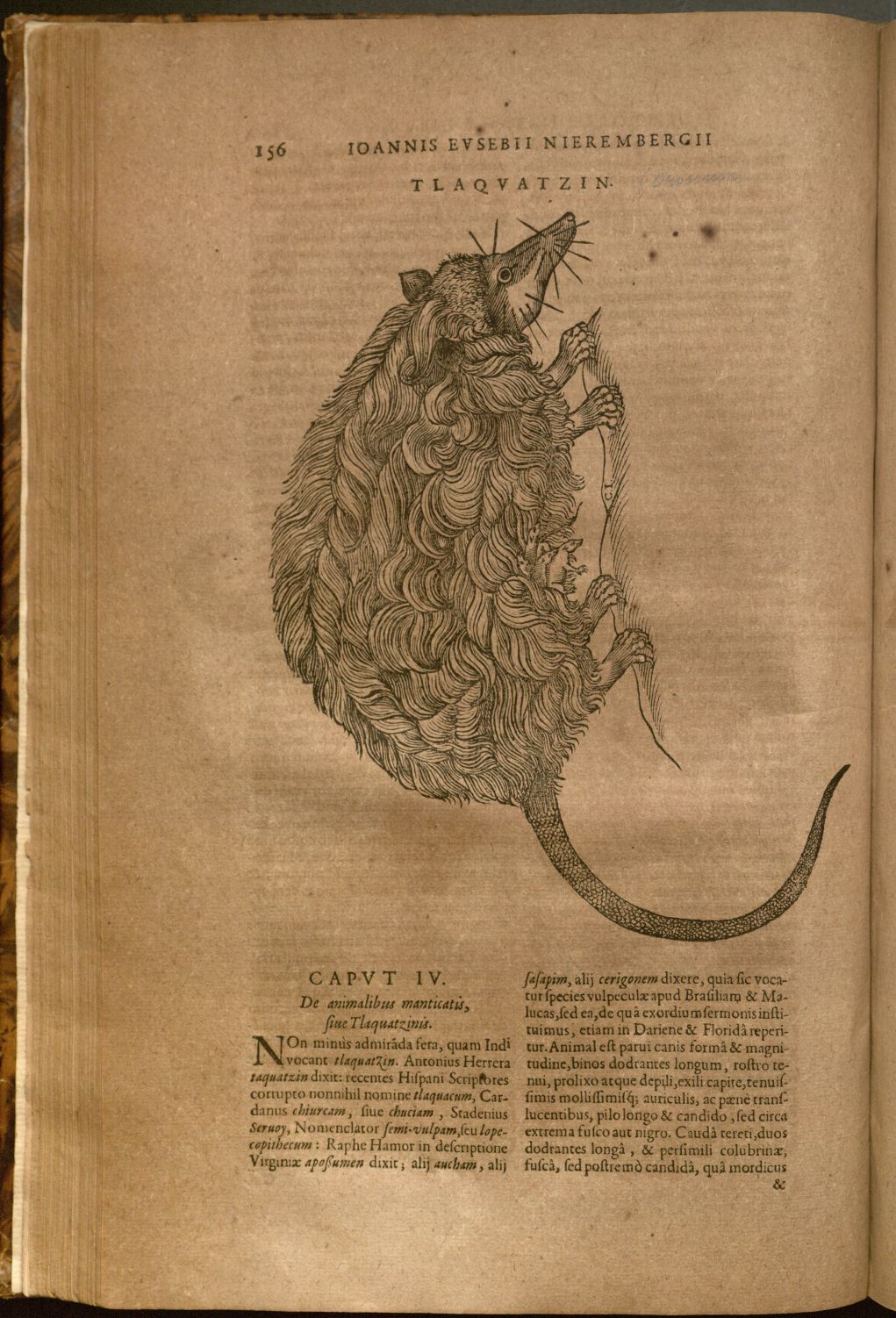
Image of an Opossum from Nieremberg's Historia naturae (1635).

Opossums (and yes, there are several pictured above): Juan Eusebio Nieremberg (1595-1658).  Historia naturae. Antverpiae: ex Officina Plantiniana Balthasaris Moreti, 1635. Call Number: Summerfield E1105. Click image to enlarge (and reveal the well-camouflaged opossum young.)

The marsupial heyday began to end circa three million years ago when a land bridge over the Isthmus of Panama provided for northern migration of animals including the ancestors of our familiar opossum, who dates back to around 35 million years ago and looks today pretty much the same as he did then. During the same period, some of the northern placental mammals migrated south over the same land-bridge. Thus, for example, it appears that the placental sabre-toothed tiger from the North began to compete with the marsupial sabre-toothed tiger and soon put him on the road to extinction. But the marsupials are survivors, nevertheless, and the American opossum, the only one of the family in North America, is just one of seventy some opossum species to survive; the ‘possum family is restricted to the New World, and except for Didelphis virginiana, whose range extends from southern Canada into Central America, the rest of the family is restricted to Central and South America.

Earlier travel accounts and herbals had described the plants and animals of the New World, but Juan Eusebio Nieremberg’s account was the first comprehensive natural history of the area, dealing primarily with Mexico and the West Indies. This illustration of the Virginia or American opossum is the earliest printed portrait of the earliest discovered (by Europeans, at least) marsupial anywhere.

Sally Haines
Rare Books Cataloger

Adapted from her Kenneth Spencer Research Library exhibit, The Haunted Forest: New World Plants & Animals (1992).

Collection Snapshot: A Book of Polish Costume

August 8th, 2014

A number of works in the Kenneth Spencer Research Library’s collection of Polonica are a good source for the study of Polish costume: the chromolithographs by Racinet, engraved colored plates by Jacquemin, colored and uncolored plates in the two volumes of Zaydler, and plates in the costume books by Kretschmer and Vecellio.

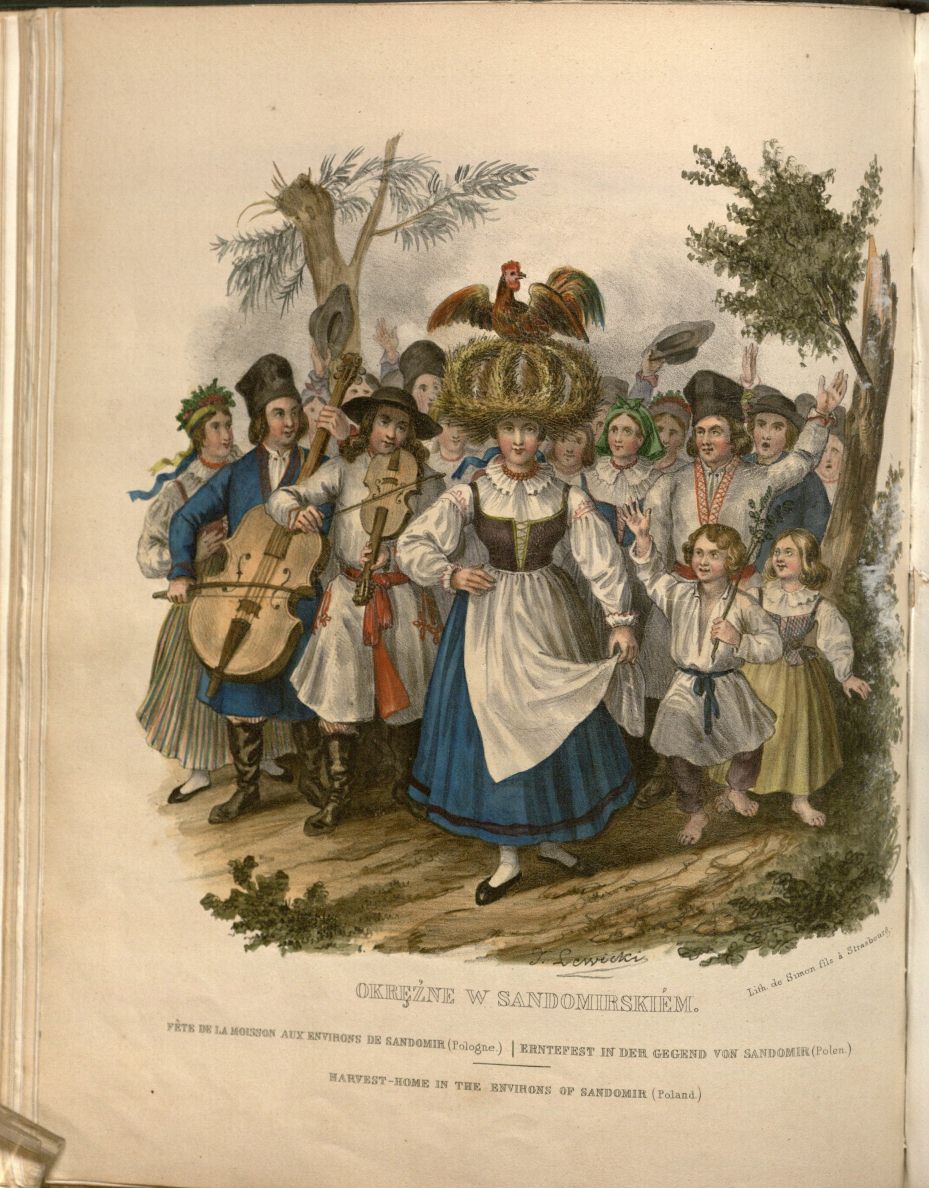
image of the plate "Harvest-home in the environs of Sandomir"

“Harvest-home in the environs of Sandomir” from Jozef Zienkowicz’s Les costumes du peuple Polonais.  A Paris: Librairie Polonaise; A Strasbourg: chez l’éditeur; A Leipzig: chez F.A. Brockhaus, 1841.  Call Number: D819. Click image to enlarge.

The colored lithographs of Zienkowicz’s Les costumes du peuple Polonais are particularly interesting: “Harvest-home in the environs of Sandomir” (above) illustrates the rich harvest tradition of a country that until recently was primarily agricultural. Poles today celebrate an annual Harvest Festival in early September.  In olden days the best girl reaper would bestow on the master of the house the gift of a wreath of wheat and rye adorned with flowers, fruits, and ribbons; feasting and merry-making followed the ceremony. Although folk costumes are not now in general use in Poland and are worn mostly for festivals and national celebrations, Poles in rural areas wear folk dress on church holidays and for family celebrations such as weddings.

Sally Haines
Rare Books Cataloger

Adapted from her Kenneth Spencer Research Library exhibit, Poland: A Thousand Springtimes.

Creating Authority: Printing with Anglo-Saxon Type

July 17th, 2014

This week’s post comes from Amanda Luke, a recent KU graduate and a Reference Specialist at Watson Library.  Amanda is currently working toward her Master of Library Science (MLS) degree at Emporia State University.

There is a special connection between Anglo-Saxon typeface and the religious controversy that defined late sixteenth-century England. With the Church of England only decades old and tensions between Catholics and Protestants higher than ever, church officials sought to establish ties between the new Church and earlier English history. One connection manifested itself through church manuscripts from the Middle Ages. Some of these religious texts appeared in Old English, the “vulgar” or common tongue of the Anglo-Saxons, who occupied England before the Norman conquests in the eleventh century. Matthew Parker (1504-1575), Archbishop of Canterbury, was the one of the earliest proponents of Anglo-Saxon scholarship. Parker hoped that having these Anglo-Saxon manuscripts translated and printed would lend legitimacy to the new Church through ties to early English religious doctrine.

Parker’s chief interest lay in a series of Latin and Old English texts by Ælfric, an abbot who lived circa 950 – 1010. Copies of these documents had been found at the Worcester and Canterbury cathedrals (Evenden 81). These texts, which Parker’s secretary John Joscelyn likely translated, touched on the subject of the Eucharist and seemed to challenge the Catholic belief in transubstantiation, or the literal transformation of bread and wine into the body and blood of Christ (Evenden 81). This rejection of Catholic doctrine was vital for Parker because it provided evidence that the current Catholic thinking was not always present in England.

Image of the title page of A Testimonie of Antiquitie (1566) Legend discussing Old English Characters in John Joscelyn's edition of AElfric's A Testimonie of Antiquitie (1566)

Left: Title page; Right: Old English characters explained.  From: Aelfric, Abbot of Eynsham. A Testimonie of Antiquitie
ſhewing the auncient fayth in the Church of England touching the ſacrament of the body and bloude of the Lord
[…].
London: Iohn Day, [1566?]. Call Number: Clubb A1566.1 Click images to enlarge.

To disseminate this claim he employed a London-based Protestant printer named John Day for an unprecedented task: the development of a typeface which included all of the special characters present in the Anglo-Saxon manuscripts. The development of this Anglo-Saxon type, often just called Saxon type, was an enormous financial risk for Parker. It was estimated by modern scholar Peter Lucas that the typeface would have cost the vast sum of £200 to create (Evenden 82). The typeface which Day cast was 16 point, or slightly smaller than a great primer, a 17 point type (Clement 209). It contained fourteen lower and ten upper case Old English characters not found in the Latin alphabet (see above). It is fascinating to note the several forms of the diphthong “th” in the alphabet (eth ð and thorn þ), as well as the presence of a symbol for the word “and.”

The earliest book containing the Anglo-Saxon typeface was printed by John Day in 1566 at Parker’s request. The volume was titled A Testimonie of Antiquitie ſhewing the auncient fayth in the Church of England touching the ſacrament of the body and bloude of the Lord here publikely preached, and alſo receaued in the Saxons tyme, aboue 600. yeares agoe, and was attributed to Ælfric, the author of the text that influenced Parker. As its long title suggests, this text is a translation of an Easter sermon which touches on the communion. It was especially important to Parker because it supported his mission to legitimize the doctrines of the Church of England. The creation of the Saxon typeface to accompany the translation was, according to scholar Richard Clement, a means of further legitimizing obscure texts. He writes, “Parker’s men began to examine the manuscripts and were impressed by the visual impact of the Anglo-Saxon texts which almost jumped off the page and proclaimed their antiquity and authority to the reader” (Clement 206). Use of the Saxon typeface also helped to differentiate the Old English text from the Latin and English used in the book.

Clubb_A1566_1_f35_withred

Passage on the transubstantiation (with red underlinings added). Aelfric, Abbot of Eynsham. A Testimonie of Antiquitie …].
London: Iohn Day, [1566?]. Call Number: Clubb A1566.1  Click image to enlarge.

In the image above, the volume is opened to folio 35, which contains a central moment in the Easter sermon. A printed note in the margin reads “No transubstantiation,” highlighting one of the major doctrinal connections Parker was trying to make between the historical church and the Church of England. The text in Saxon type appears on the left, and the translation appears on the right. Even if you cannot read Old English, words such as “blode” and “Christ” can be made out (see the words underlined in red).   Thus the facing page format supported the preface’s claim that everything in the translation was true and accurate.

The use of the Saxon typeface in A Testimonie of Antiquitie opened the door for the expansion of Anglo-Saxon scholarship.  To explore the subject further, visit Spencer and use its Clubb Collection of Books Printed with Anglo-Saxon Type.

Amanda Luke
KU Alumna and Reference Specialist, Watson Library

Works Cited

Clement, Richard W. “The Beginnings of Printing in Anglo-Saxon, 1565-1630.” Papers of the Bibliographical Society of America.91.2 (1997): 192-244. Print.

Evenden, Elizabeth. Patents, Pictures, and Patronage: John Day and the Tudor Book Trade. Burlington: Ashgate, 2008. Print.