The University of Kansas

Inside Spencer: The KSRL Blog

Books on a shelf

Welcome to the Kenneth Spencer Research Library blog! As the special collections and archives library at the University of Kansas, Spencer is home to remarkable and diverse collections of rare and unique items. Explore the blog to learn about the work we do and the materials we collect.

This blog may contain archived web content. This blog may link to catalog records which no longer exist as of a software change in 2026.

Physical/Digital Archives: Teaching with Spencer Manuscripts

April 2nd, 2019

This week’s post is by Dr. Whitney Sperrazza, Digital Humanities Postdoctoral Research Fellow at KU’s Hall Center for the Humanities.

Digital methods offer a new way to teach with and in the archives. I designed my Fall 2018 course, “Digital Feminist Archives,” around this conviction, aiming to build a class that worked at the intersection of archival and digital practices.

For sixteen weeks, twelve students from a wide range of KU departments (English, Women, Gender, and Sexuality Studies [WGSS], History, Humanities, Museum Studies, and Theater) met at the Spencer Research Library to study, transcribe, and develop projects on one object from the library’s holdings: Elizabeth Dyke’s Booke of Recaits (dated 1668).
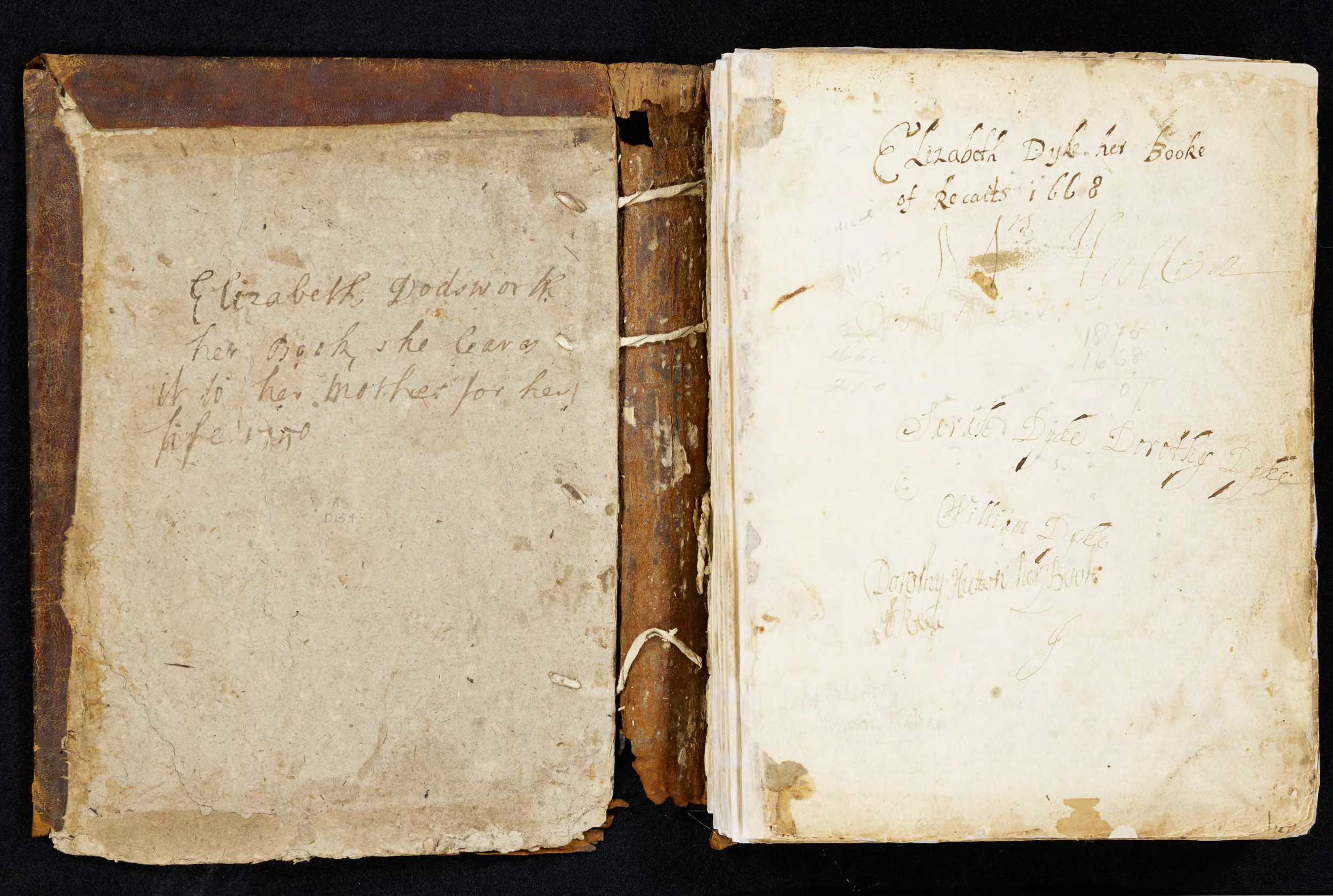
 

Image of ownership inscriptions in the front board and first page of "Elizabeth Dyke, her Booke of Recaits 1668" (MS D157)

Family Ownership inscriptions in “Elizabeth Dyke, her Booke of Recaits 1668.” England, approximately 1668.
Call Number: MS D157, Opening 2. Click image to enlarge.

Early Women’s Recipes

Are you interested in learning more about early Western remedies for headaches? What about the effectiveness of rose water in preventing plague (56)? Did you know that pickled cucumbers were made frequently in seventeenth-century English households (86) and that powdered hazelnuts were used to stanch bleeding (43)? Or, as Elspeth Healey asks in her blog post on the manuscript, are you simply looking for some seventeenth-century dietary advice?
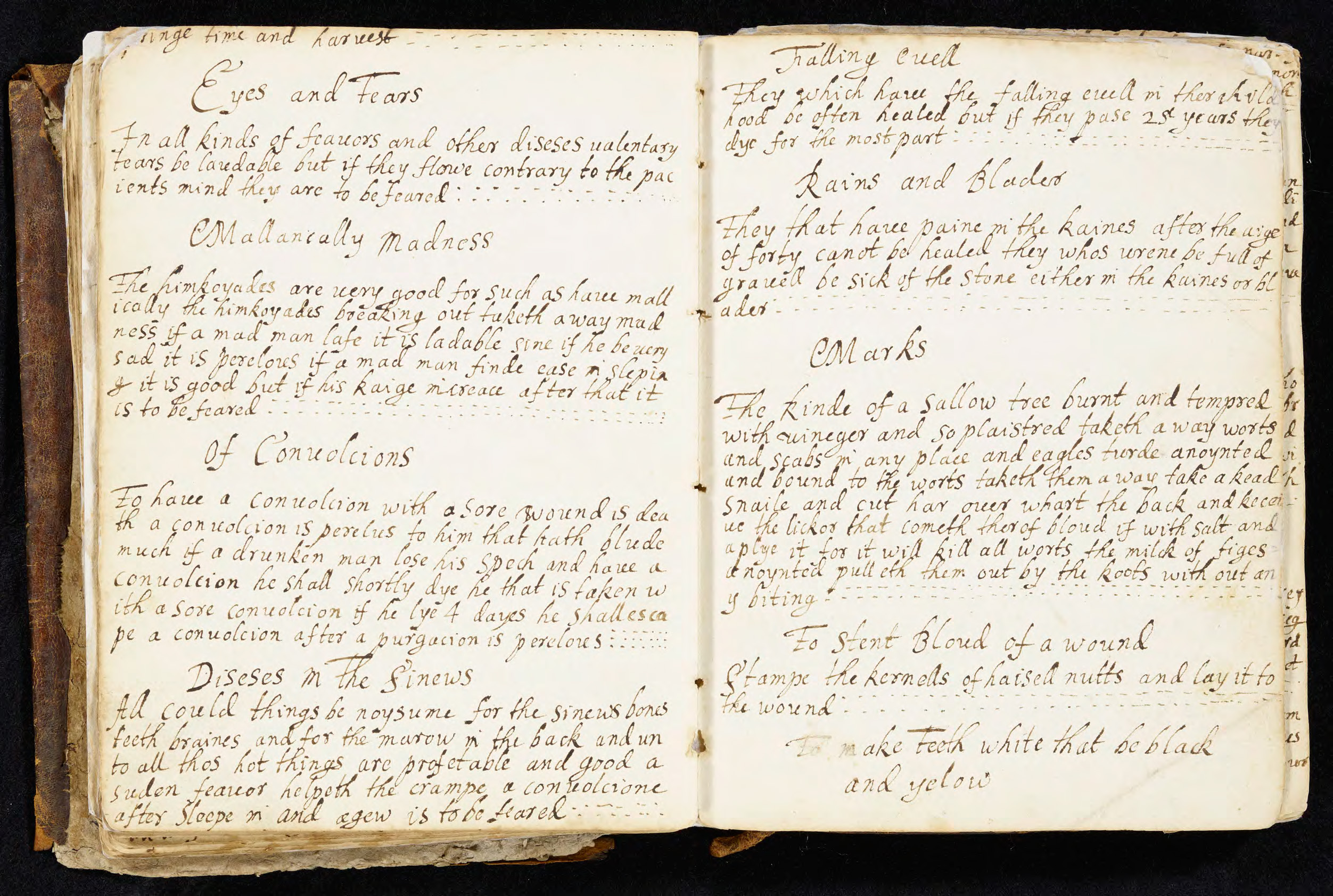
Image of remedy using hazelnuts to stanch bleeding in Elizabeth Dyke, her Booke of Recaits 1668." (MS D157)

Hazelnuts to stanch bleeding? From “Elizabeth Dyke, her Booke of Recaits 1668.” England, approximately 1668.
Call Number: MS D157, Opening 43. Click image to enlarge.

This is just a taste of the wealth of information we collected from Dyke’s Booke of Recaits, which contains over 700 culinary and medicinal recipes. But the manuscript is so much more than a recipe archive. It is a document of familial and social networks and a record of cultural practices.

On the manuscript’s opening page (see photo above), several women catalogued their ownership of the book—Sarah Dyke, Dorothy Dyke, Elizabeth Dodsworth—suggesting that the text was passed down through the family’s female line. Like many surviving recipe books from the period, the titles of the recipes themselves also include names of women and men, either to note the original creator of the recipe (“Lady Rivers’ recipe for orange or lemon cakes”) or to mark the recipe’s effectiveness (“A very good green salve and ointment proved often times by goodwife Wesens”).

The Spencer Library acquired the manuscript in 1977 from UK bookseller, Henry Bristow Ltd, and it was recently featured in an exhibition titled, “Histories of the English Language” (Summer 2017). While the manuscript has long been available for visitors to the Spencer, it is now available as part of the KU Libraries digital collections and as a fully searchable (original spelling only) transcription on the “Digital Feminist Archives” course site.

Collaborative Close Reading

I designed the course syllabus to build gradually toward the students’ final digital projects, so the first eight weeks were dedicated to close study and transcription of the manuscript’s content. The students became experts on this archival object through their transcription work and their conversations with each other on the manuscript’s content and structure.

The students each transcribed and encoded a section of manuscript pages and, one day per week, we structured the class as a large-scale text encoding project meeting. Students came to class with examples and questions from their assigned pages and we dedicated these class sessions to collective conversation about encoding standards and transcription problems. We started with basic observations—things like, “this is what Dyke’s r looks like”—but the conversations quickly became more complicated and critically rich: should we include content that’s been crossed out? how should we note text that’s been lost due to page damage?
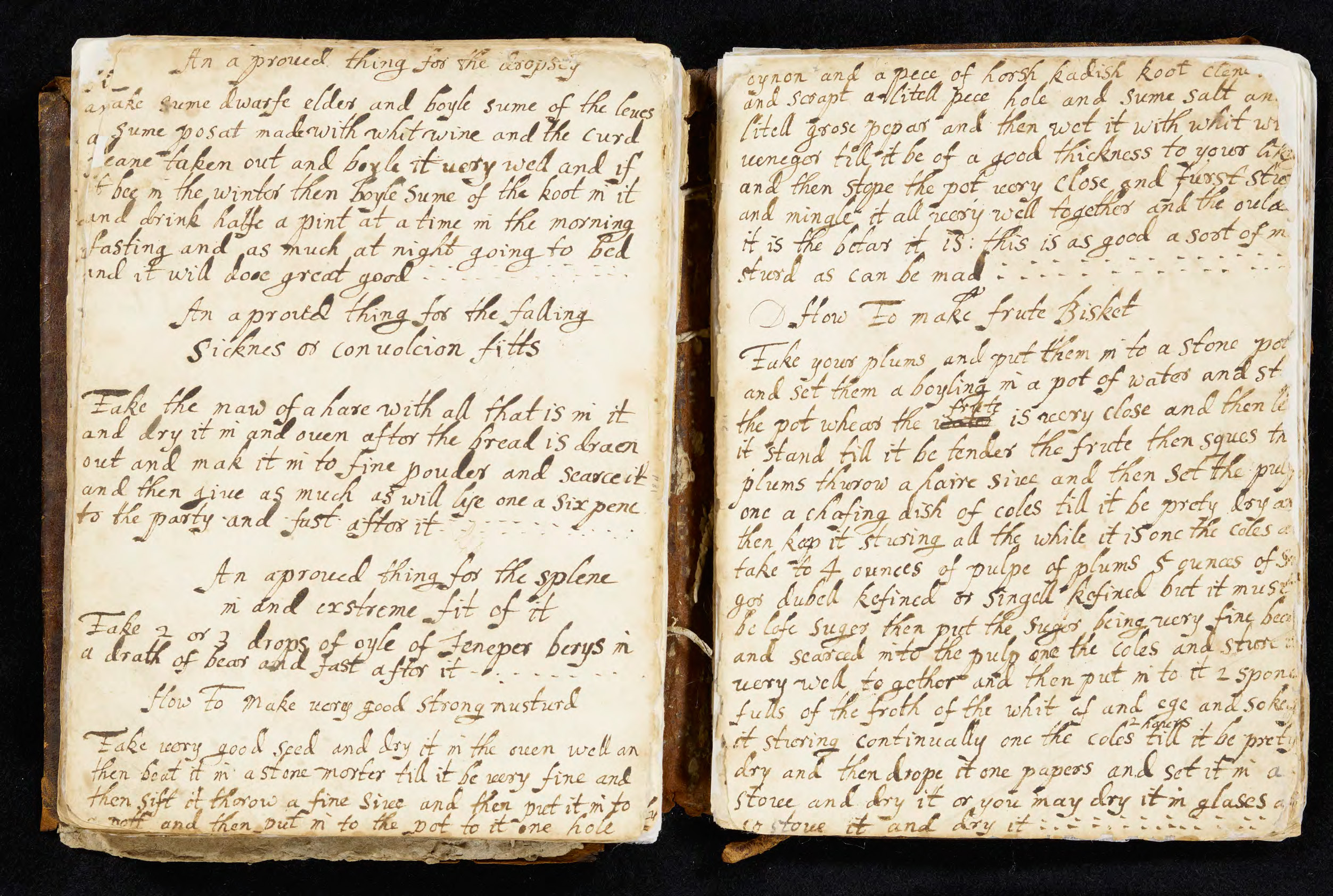
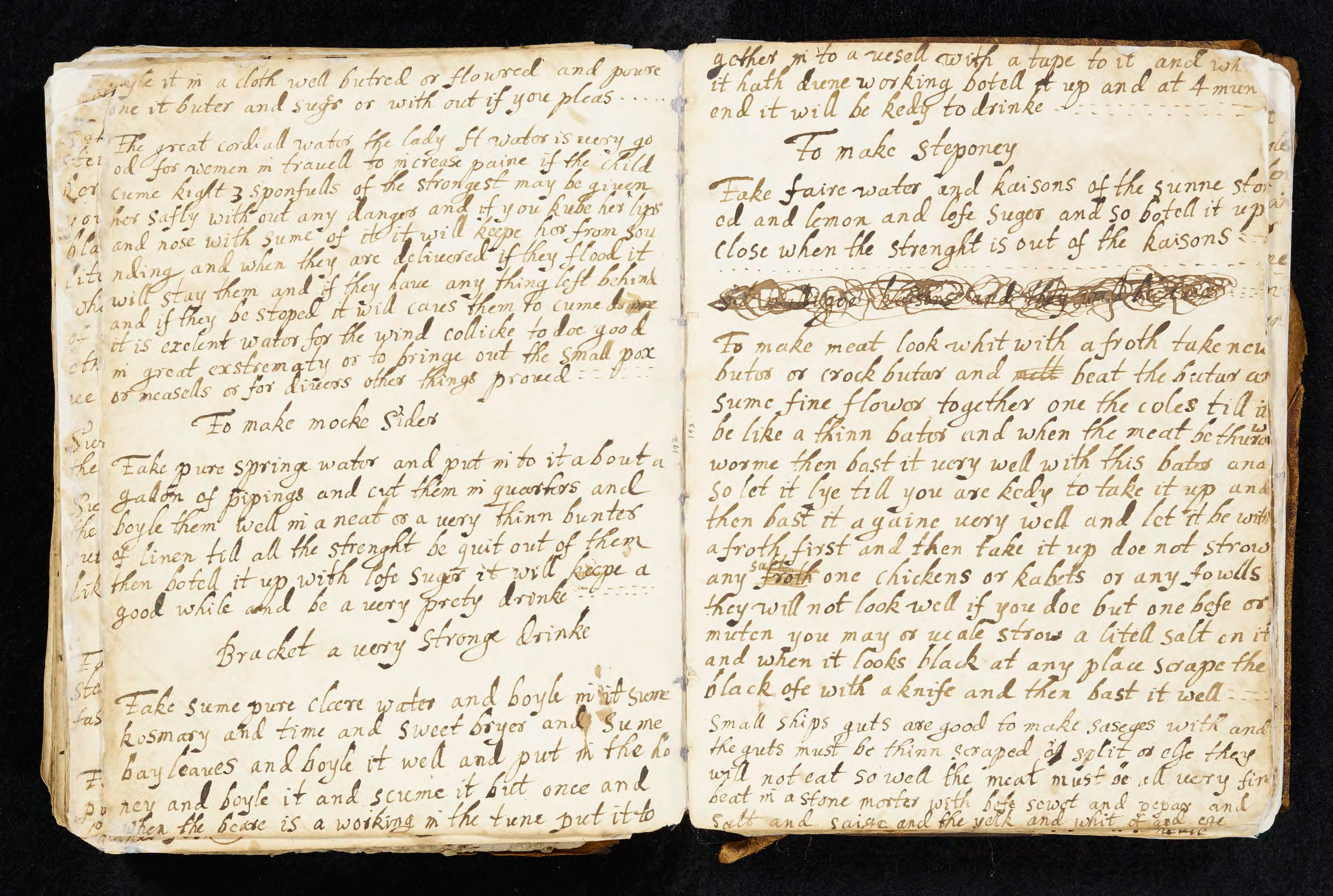
Examples of loss of text in Elizabeth Dyke's Booke of Recaits (MS D157)

Photograph of crossed out text in Elizabeth Dyke's "Booke of Recaits" (MS D157)

Example of lost text (top) and crossed out text (bottom) in “Elizabeth Dyke, her Booke of Recaits 1668.” England, approximately 1668.
Call Number: MS D157, Openings 95 and 99. Click images to enlarge.

As an instructor, it was thrilling to participate in these student-driven discussions and listen as the students grappled with the critical and methodological decisions that go into transforming a physical object into digital content. Our focus was on the process rather the product, and part of that process was working together to really know this archival object. In addition to giving students insight into the logistics of digital project development, these lab sessions became opportunities for collaborative reading of the manuscript’s content as students shared interesting passages, unexpected recipe titles, and common ingredients.

Interdisciplinary Networks

The students’ collective transcription work became the basis for their final project development. Through their projects, the students animated this archival material. One group transformed Dyke’s medicinal recipes into a crowd-sourced ailments and remedies platform modeled on WebMD (WebED).
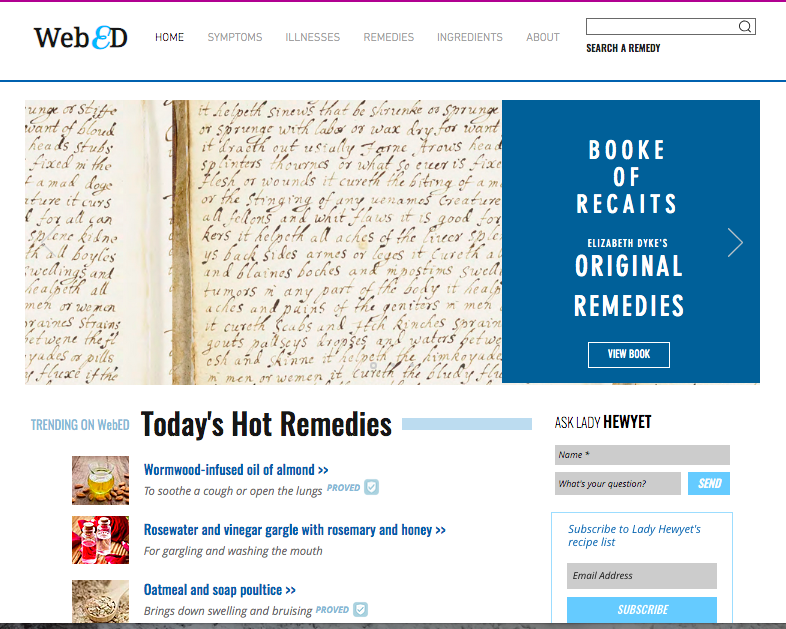
Screenshot of WebEd, a crowd-sourced ailments and remedies platform modeled on WebMD.

WebEd, a student project centered on Elizabeth Dyke’s Booke of Recaits for ENGL 590 | ENGL 790 | HUM 500 | WGSS 701: Digital Feminist Archives, Fall 2018. Click image to enlarge.

One group tried their hand at making some of the recipes, using Dyke’s directions to capture the historical experience (Cooking 17th-Century Recipes). Another group developed teaching resources and updated versions of the recipes to explore how Dyke’s recipes remain relevant for today’s audiences (Using Early Modern Recipes Today). Finally, one group mapped the availability of several of Dyke’s ingredients, tracking how the ingredients would have been traded across different parts of the world (Mapping Elizabeth Dyke’s Recipes).
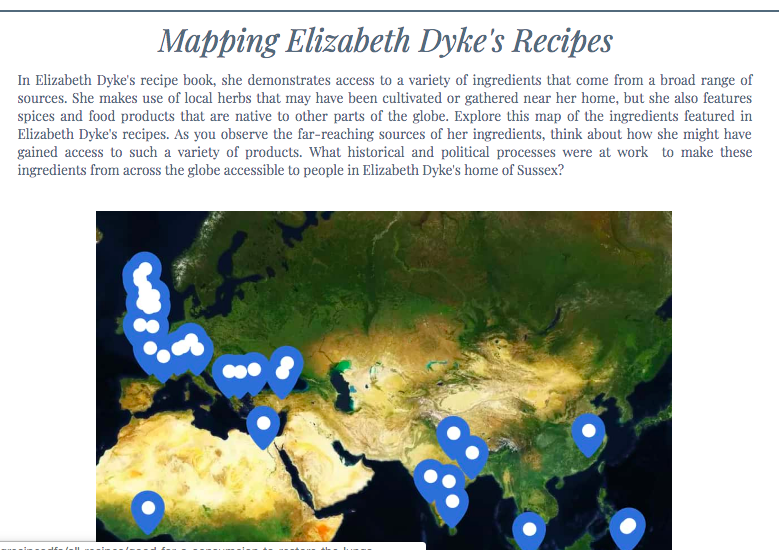
Screenshot of "Mapping Elizabeth Dyke’s Recipes" site.

“Mapping Elizabeth Dyke’s Recipes,” a student project for ENGL 590 | ENGL 790 | HUM 500 | WGSS 701: Digital Feminist Archives, Fall 2018. Click image to enlarge.

The students’ transcription work and project development built on ongoing digital work on early modern recipes (for instance, the Early Modern Recipe Online Collective and The Recipes Project), connecting the students’ original research to wider networks across the country. Most crucial, though, were the lessons we gained from the interdisciplinary networks at work in the classroom. With this archival object as our focal point, we all found ways to draw on and expand our particular areas of interest and expertise.

Digital projects require significant time, labor, and resources. If I learned anything from designing and leading this course, it’s that one semester is not long enough for such an endeavor. We merely scratched the surface of what’s possible with such a rich archival object and, hopefully, our efforts will be a starting point for much more work to come.

Whitney Sperrazza
Digital Humanities Postdoctoral Research Fellow
Hall Center for the Humanities

[Thank you to everyone at KU who worked hard to make this class possible and offered support for the students’ work at various stages: Elspeth Healey, Brian Rosenblum, Whitney Baker, Jocelyn Wehr, Erin Wolfe, Jonathan Lamb, and Scott Hanrath. And, of course, my sincerest gratitude to the “Digital Feminist Archive” students, all of whom brought so much energy to this process: Brianna Blackwell, Gwyn Bourlakov, Mallory Harrell, Yee-Lum Mak, Jodi Moore, Sarah Polo, Elissa Rondeau, Kate Schroeder, Phoenix Schroeder, Suzanne Tanner, Rachel Trusty, and Chris Wright.]
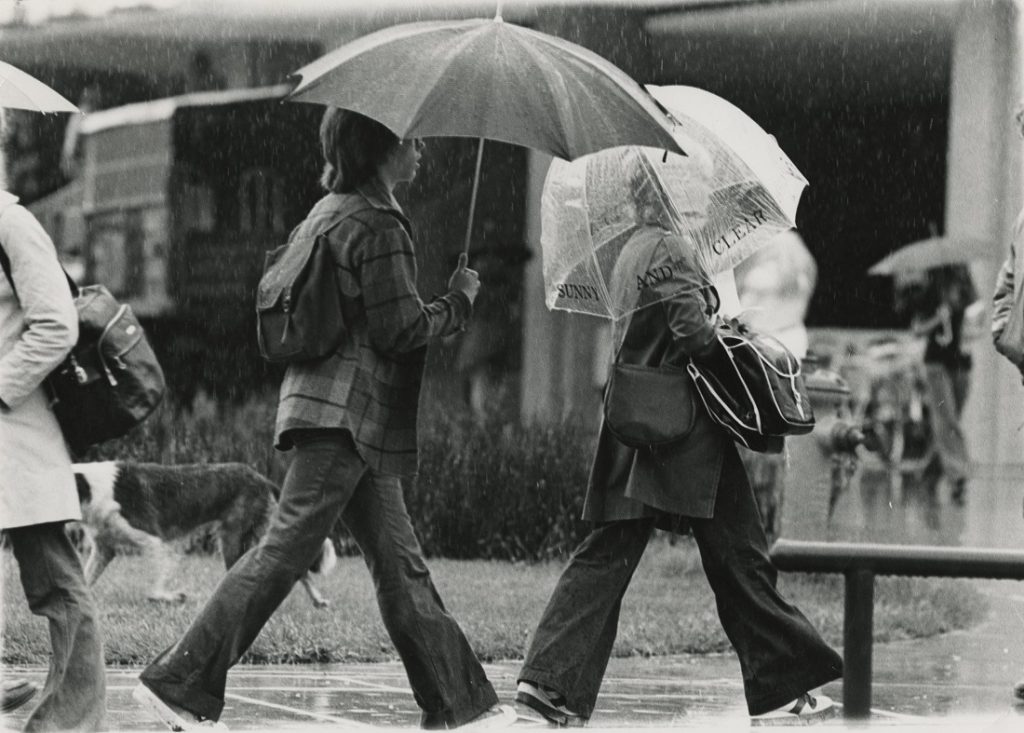
 

Throwback Thursday: Rainy Day Edition, Part II

March 28th, 2019

Each week we’ll be posting a photograph from University Archives that shows a scene from KU’s past. We’ve also scanned more than 34,800 images from KU’s University Archives and made them available online; be sure to check them out!

Photograph of KU students walking in the rain, 1976-1977

KU students walking in the rain, 1976-1977. University Archives Photos.
Call Number: RG 0/24/1 Rain 1976/1977 Prints: Campus: Areas and Objects (Photos).
Click image to enlarge (redirect to Spencer’s digital collections).

Caitlin Donnelly
Head of Public Services

Expanded and Renovated Audiovisual Preservation Labs at Kenneth Spencer Research Library

March 26th, 2019

2018 was an eventful year at Kenneth Spencer Research Library. In addition to the celebration of the building’s 50th anniversary, the Conservation Services department relocated from Watson Library into a newly constructed lab space on the second floor of Spencer. The dedicated space built for Conservation Services allowed the Audiovisual (AV) branch of the team to expand its operations within Spencer by moving into spaces formerly used by Conservation. By expanding the AV footprint within the building, we would be able to add equipment to create a film inspection/video digitization lab separate from the current audio digitization lab (which previously doubled as the film and video lab). Over the course of approximately three months, beginning in September 2018, several meetings took place between Conservation Services staff, the KU architect and KU Facilities to determine how the rooms needed to be adapted for their new uses, as well as what equipment belonged where.

Audio Preservation Lab in Spencer Research Library, prior to renovation.
The Audio Preservation Lab in Kenneth Spencer Research Library, prior to renovation. Click image to enlarge.
Audio Preservation Lab in Spencer Research Library, prior to renovation.

Another view of the Audio Preservation Lab in Kenneth Spencer Research Library, prior to renovation. Click image to enlarge.

In the audio digitization lab in particular, several changes occurred that completely changed the look of the work space. The room was painted in the building’s original “Spencer Green” hue, and carpeted with its original 1970’s carpet. Ultimately, we all decided that the carpet and paint job had to go, and that new lighting was necessary. Furthermore, we had to decide where the best locations for power outlets would be, and the land-line telephone connections had to be de-commissioned.

In order to replace the carpet and re-paint the room, every single shelf, table and piece of electronic equipment in the room had to be temporarily disassembled and moved to a storage location. My team of student workers and I devised a strategy of labeling all of the cords and ports on our pieces of equipment so that disassembly and re-assembly would go quickly. Once everything was removed from the Audio Lab, Facilities came in and ripped out the carpet. At this time, the electricians started replacing all of the lighting fixtures in both the Audio and Video Labs. They also installed dimmer switches, allowing us to control the levels of light we need depending on the day’s workflow.

Video Preservation Lab in Spencer Research Library, prior to renovation.

The Film and Video Preservation Lab in Kenneth Spencer Research Library, prior to renovation. Click image to enlarge.
Video Preservation Lab in Spencer Research Library, prior to renovation.

Alternate view of the Film and Video Preservation Lab in Kenneth Spencer Research Library, prior to renovation. Click image to enlarge.

In the Video Lab, the renovations to the light fixtures included breaking out the light switches to allow for independent control of lights in the front of the room as well as the back. Additionally, several new electrical outlets were installed in the ceiling and along the north wall of the room. Shelving was removed to allow us to bring in a Steenbeck flatbed motion picture film editing machine. My team and I then set up two film inspection stations and have begun to acquire video digitization and playback equipment.

For the Audio Lab, we chose new paint colors, including for an accent wall, which I think is a really nice bit of the renovation. We also installed new tile flooring, which is ideal for an audiovisual lab such as ours. The tile can be kept much cleaner than carpet, reducing the amount of particulate matter in the lab environment which could be harmful to sensitive media collections. Finally, once the shelving was re-attached to the walls, we were able to quickly re-populate the lab thanks to our labeling strategy.

The renovated Audio Preservation Lab at Spencer Research Library.
The renovated Audio Preservation Lab, complete with new tile floor, accent wall, and enhanced lighting. Click image to enlarge.
The renovated Video Preservation Lab in Spencer Research Library.

The renovation of the Film and Video Preservation Lab is nearing completion. New features include enhanced lighting and additional electric outlets. Click image to enlarge.

At this time, the Audio Lab is completely set up and our digitization efforts have re-commenced, and our film inspection stations, including the Steenbeck, are fully operational. The video component of the Film/Video Lab is still under construction; most of the necessary video elements have been purchased and are being built out. I am grateful for the support from KU and the Libraries for this project, which has allowed us to create updated lab spaces to the specifications I requested, and to purchase the equipment my team needs to perform archival quality work on Spencer Library’s audiovisual collections. The enthusiasm of my student workers should also be noted as I truly would not have been able to envision the working conditions within the new work spaces without them. The renovated lab spaces heavily influence and are heavily influenced by the work that the students do on a day-to-day basis and I cannot stress enough how important they are to the digitization and organization efforts we undertake in the department.

Chris Bañuelos
Audiovisual Preservation Specialist
Conservation Services

Throwback Thursday: Let’s Do This Edition

March 21st, 2019

Each week we’ll be posting a photograph from University Archives that shows a scene from KU’s past. We’ve also scanned more than 34,800 images from KU’s University Archives and made them available online; be sure to check them out!

Good luck, Jayhawks, in today’s tournament game against Northeastern. We hope the fun continues with a second-round game this weekend!

Photograph of Phog Allen with the KU men's basketball team, 1935-1936

Phog Allen with the KU men’s basketball team, 1935-1936. University Archives Photos.
Call Number: RG 66/13 1935/1936 Team: Athletic Department: Basketball (Photos).
Click image to enlarge (redirect to Spencer’s digital collections).

Caitlin Donnelly
Head of Public Services

World War I Letters of Milo H. Main: March 11-24, 1919

March 18th, 2019

In honor of the centennial of World War I, this is the second series in which we follow the experiences of one American soldier: twenty-five year old Milo H. Main, whose letters are held in Spencer’s Kansas Collection. On Mondays we’ll post a new entry featuring selected letters from Milo to his family from that following week, one hundred years after he wrote them.

Milo Hugh Main was born in or near Pittsfield, Illinois, on November 21, 1892 to William and Rose Ella Henry Main. The family moved to Argonia, Sumner County, Kansas, in 1901. After his mother died in 1906, Milo remained in Argonia with his father and his two sisters Gladys (b. 1890) and June (b. 1899). His youngest sister Fern (b. 1905) was sent to live with relatives in Illinois.

As Milo reported to the Kansas State Historical Society in 1919, after graduating from high school he worked as a store clerk. He resigned in July 1917 and took a position at Standard Oil Company, possibly co-managing a gas station in Argonia.

Milo entered into military service on September 21, 1917. He served as a wagoner – a person who drives a wagon or transports goods by wagon – in Battery F, 130th Field Artillery. He was stationed at Camp Funston (September-October 1917) and Camp Doniphan (October 1917-May 1918). On May 19, 1918, he boarded the ship Ceramic in New York City and departed for Europe.

In his letter of March 16th, Milo writes about having “a light touch of the” flu, driving across France to his new post, and “renting a furnished room with two big feather beds and a stove.”

Image of Milo H. Main's letter to his family, March 16, 1919 Image of Milo H. Main's letter to his family, March 16, 1919

Image of Milo H. Main's letter to his family, March 16, 1919 Image of Milo H. Main's letter to his family, March 16, 1919

Image of Milo H. Main's letter to his family, March 16, 1919

M. Main.
Bat. F. 130 F.A.
35 Divn. A.E.F.

March 16th 1919.
Bonnetable, France.

Dear Father and Sisters:-

Have recieved four letters from you during the past week.

Well, we are here in southern France, but have not gone thru the classification camp at Le Mons yet. It will probably be our next move as it is only 40 kilometers from here.

Will be at least 30 days before we get out of this Frog eating Land of France.

Yes, I had a light touch of the “Flu” but, I took the champagne in time to prevent any serious illness. Sure am feeling fine now. Have seen all the boys here recently and all are well.

I was quite fortunate in my trip from Ernecourt to Bonnetable. Came overland in the 130 F.A. Auto Convoy. Four days in making the trip. Sure saw all the best wheat and wine districts of France. We ate and slept in good hotels thru-out the journey. Four days making the trip, always stopped in a good city for the nite. Saw more keen women those four days than ever before except in Paris.

Have the Col.’s mess, (10 officers, staff) in a French home here. The madam is cooking. The best mess ever. I am a there on putting away this real food. I even serve it Frog style now. Sure a fine home we have mess in. Also a fair daughter of 22 yrs.

Will enclose a card of one of the better lookers.

Three of we O.M. boys rented a furnished room with two big feather beds and a stove in it. Gas light too. Col. ordered all men in Bat. [Battalion] not to room out like this. But we are not under the direct command of anyone so are keeping it quiet. The officers wanted me to wait table every day, but no, I convinced them that I would not be able to care for everything properly alone so they retained my side pal from Texas who takes it day about yet with me. Not much to do in dining room for 10, but I don’t like to work any more. My day off, I lie in the feathers, (not hay), until 10:A.M.

Will close by assuring you not to take any stock in Gov. Allen, nor any of his newspapers,

I am
Your son,
Milo Main.

Meredith Huff
Public Services

Emma Piazza
Public Services Student Assistant