Welcome to the Kenneth Spencer Research Library blog! As the special collections and archives library at the University of Kansas, Spencer is home to remarkable and diverse collections of rare and unique items. Explore the blog to learn about the work we do and the materials we collect.
This blog may contain archived web content. This blog may link to catalog records which no longer exist as of a software change in 2026.
Check the blog each Friday for a new “That’s Distinctive!” post. I created the series because I genuinely believe there is something in our collections for everyone, whether you’re writing a paper or just want to have a look. “That’s Distinctive!” will provide a more lighthearted glimpse into the diverse and unique materials at Spencer – including items that many people may not realize the library holds. If you have suggested topics for a future item feature or questions about the collections, feel free to leave a comment at the bottom of this page.
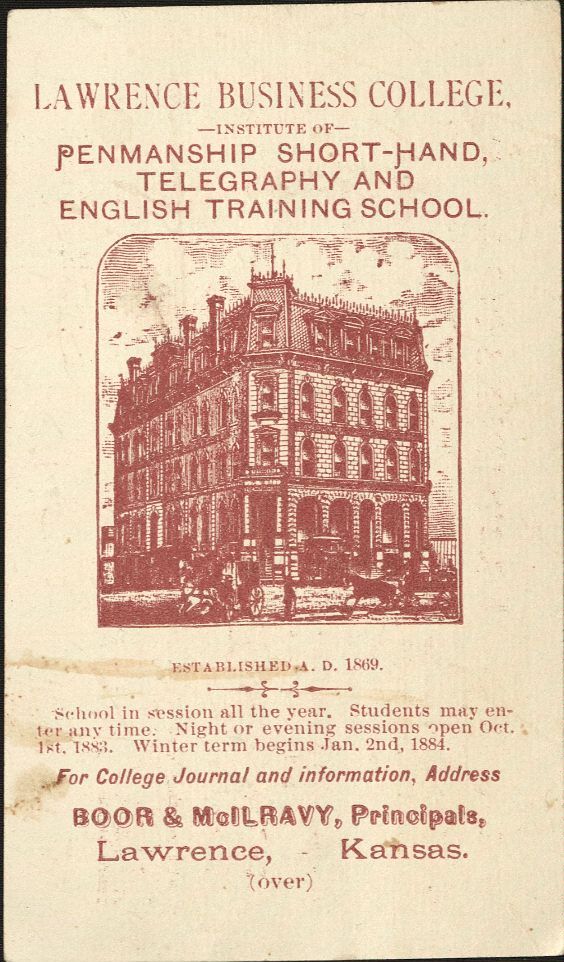
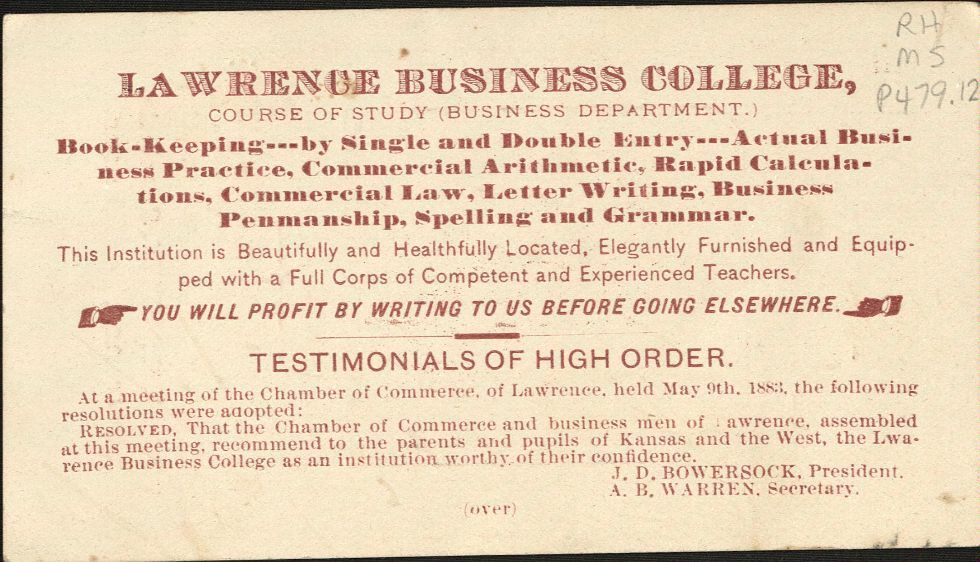
This week on That’s Distinctive! I’m sharing a small and simple collection of business cards from Lawrence. The Lawrence business card collection features business cards from mostly the 1880s. The two featured today are from the Lawrence Business College and J. House.
An online exhibit from the Lawrence Public Library notes that the Lawrence Business College was “established in 1869 by W.H. McCauley [and]…was the first business college in Kansas. The school was located in the Lawrence National Bank building on the third and fourth floors.” While the business college no longer exists, it is widely unknown when and why it shut its doors. Some personal accounts from attending the college can be found in the John L. Kilworth papers at the library.
|
The front (top) and back (bottom) of a business card for the Lawrence Business College, 1883-1884. Business Cards, Lawrence, Kansas. Call Number: RH MS P479. Click images to enlarge.
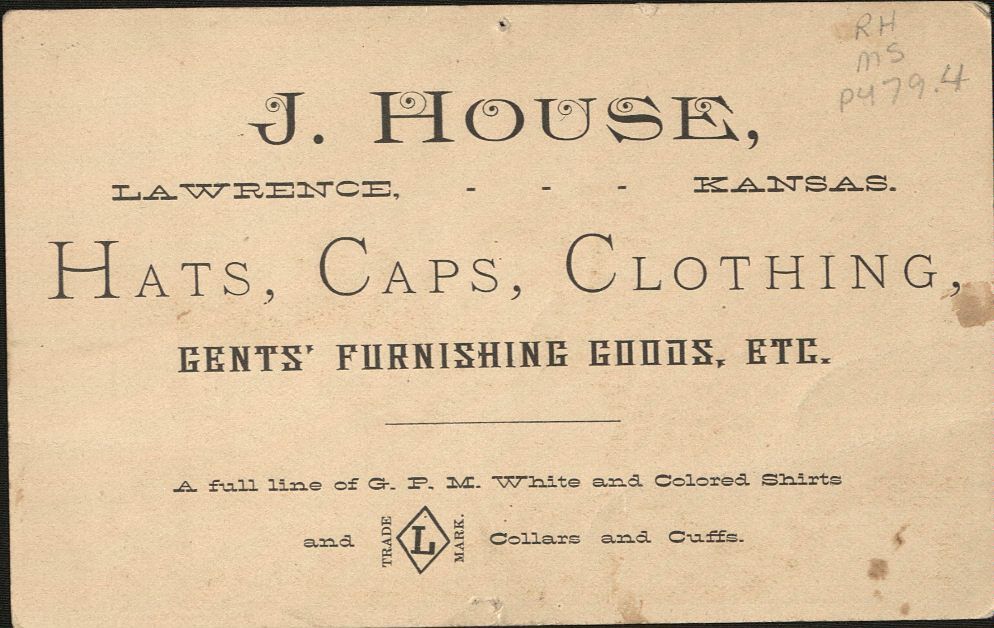
J. House was a clothing business operated for several decades by Jacob House at 729 Massachusetts Street in downtown Lawrence. The building is marked by a plaque as having survived Quantrill’s Raid in 1863. Jacob House, his wife Ricka, and their seven children resided at 805 Ohio Street for many years before relocating to 701 Tennessee in 1904. House’s 1913 obituary in the Lawrence Daily Journal-World declared that “no man in Lawrence stood higher in the esteem of the public” than him. The article noted that House was born in Austria in 1833. After emigrating to the United States in 1854 and living in a variety of places, he settled in Lawrence and opened his business in 1862. House was in his store at the time of Quantrill’s Raid; he was taken by a group of raiders and “kept as a prisoner and guide all day. He was forced to show them from place to place and everywhere he saw the dead bodies of his friends and acquaintances.”
|
The front (top) and back (bottom) of a business card for the J. House clothing business, undated. Business Cards, Lawrence, Kansas. Call Number: RH MS P479. Click images to enlarge.
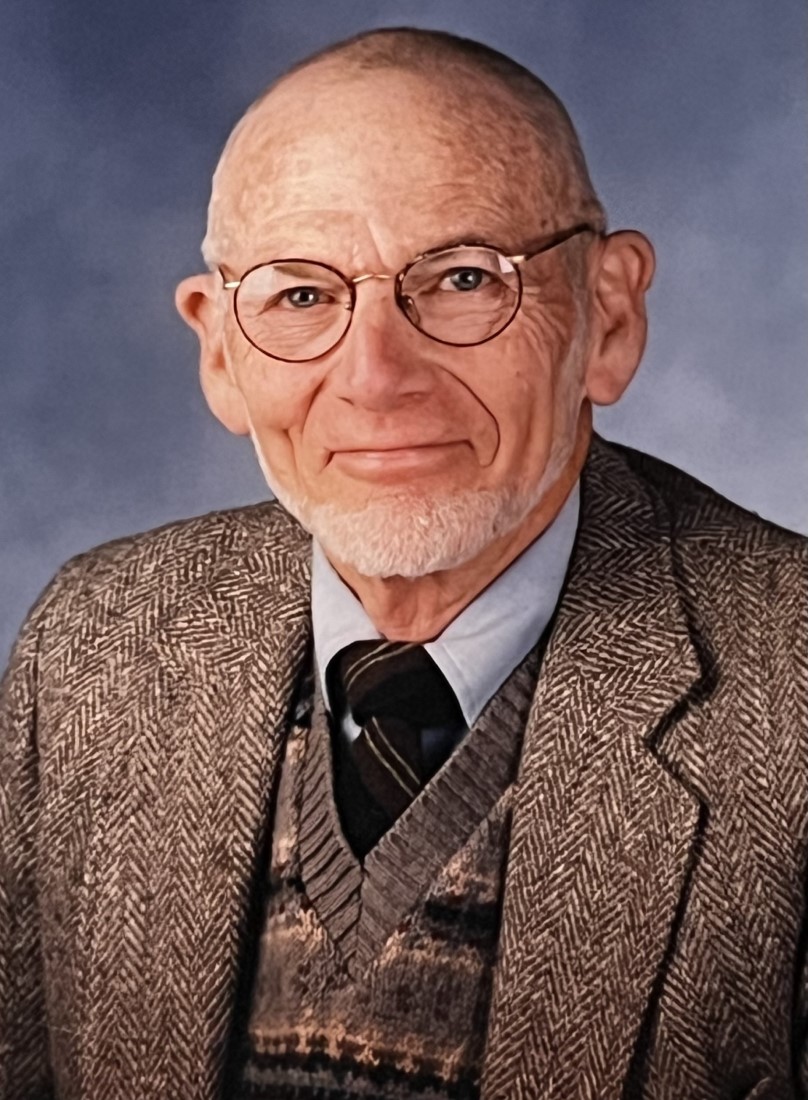
Kenneth Spencer Research Library has many faces working behind the scenes to maintain its collections and provide patrons with access to these materials. William Lawrence “Bill” Mitchell was one of these many faces, working with the Department of Special Collections. He served in various capacities at KU Libraries from 1967 to 1999. Both William and his wife Virginia Jean Mitchell died in March of this year.
Bill Mitchell in 1998, a year before his departure from KU Libraries. University Archives. Call Number: RG 41/ Faculty: Mitchell, William L. (Photos). Click image to enlarge.
William Mitchell was born on June 2, 1932, in Kansas City, Missouri, the son of William M. and Donna L. Mitchell. Before he joined the University of Kansas, Mitchell served in the United States Coast Guard from 1952 to 1956. He received his bachelor’s degree from KU in 1959 and then received his master’s degree in library science from the University of Illinois in 1960.
Mitchell’s work in libraries started before his master’s degree. Joining KU Libraries in 1957 as a student assistant for special collections, Mitchell worked his way through various library positions. He became a cataloger with KU in 1971 and eventually became chief cataloger. Mitchell’s work was well received; he earned membership in Beta Phi Mu, an honor society that recognizes high achievement in library science and librarianship. He was promoted to the rank of Librarian III in 1967, a marker of his distinguished career as a librarian.
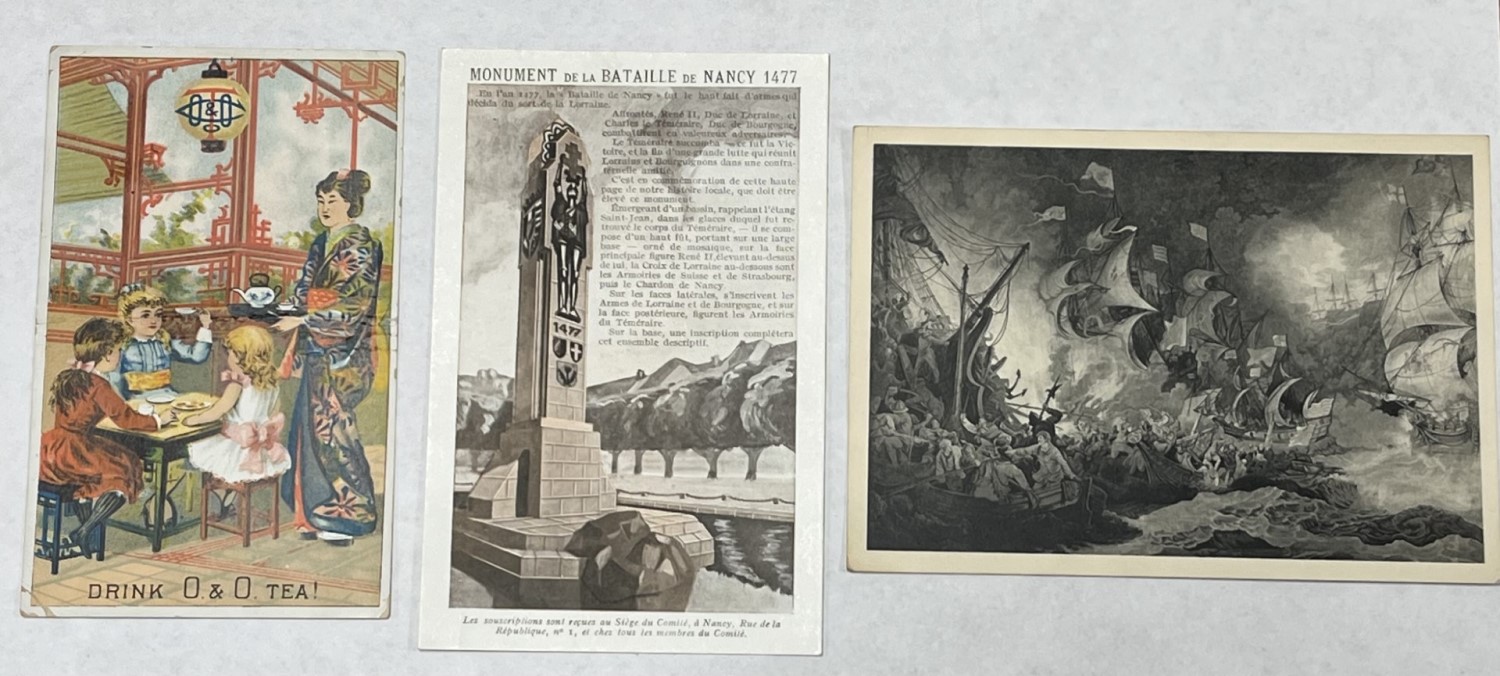
Special Collections weren’t Mitchell’s only interest. He often encouraged work with bibliography and advocated for the conservation of unstable library materials. He led several courses on conservation for KU’s Museum Studies program and, on occasion, spoke with history of the book classes. His interests in conservation covered a wide variety of materials, from the proper preservation of textual materials and bindery techniques to film preservation. He often kept interesting paper ephemera he came across – usually from other bookstores or vintage postcards – to preserve the history of his travels and work. Many of these postcards and syllabi can be found in his personal papers collection.
Several of Mitchell’s collected postcards. Personal Papers of William (Bill) Mitchell. Call Number: PP 649, Box 1, Folder 1. Click image to enlarge.
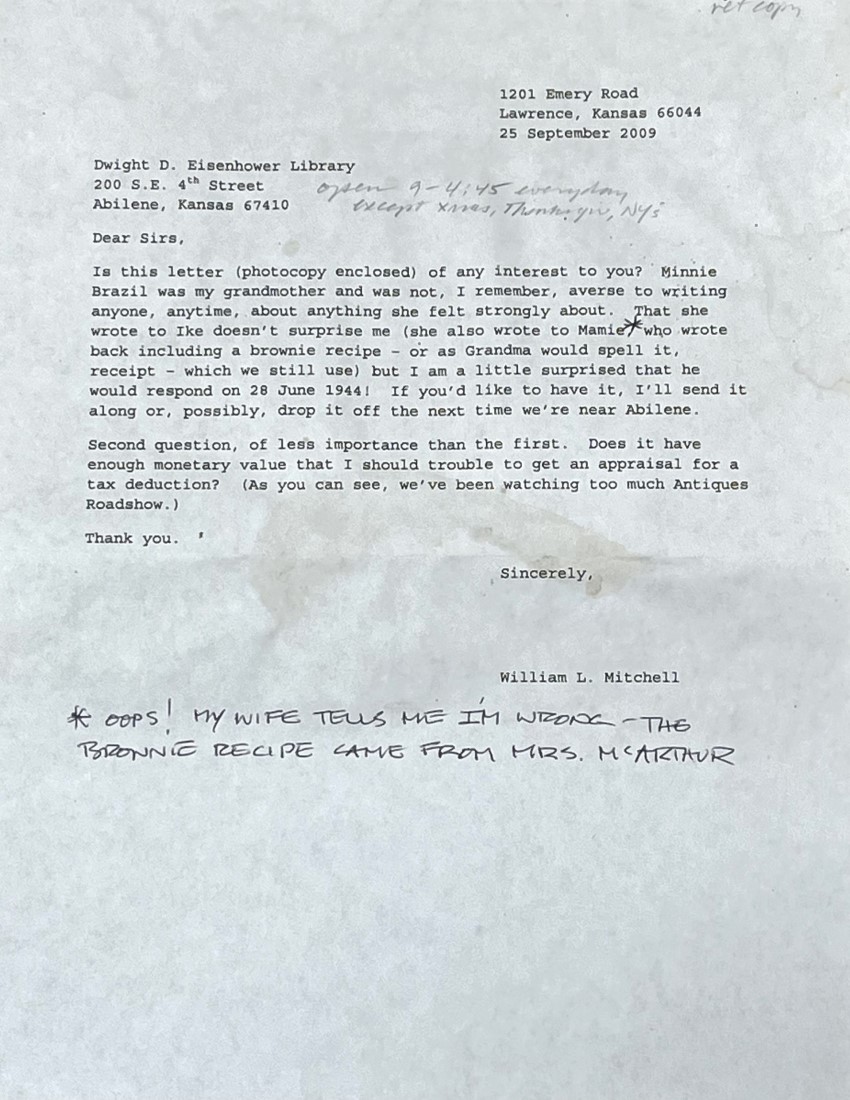
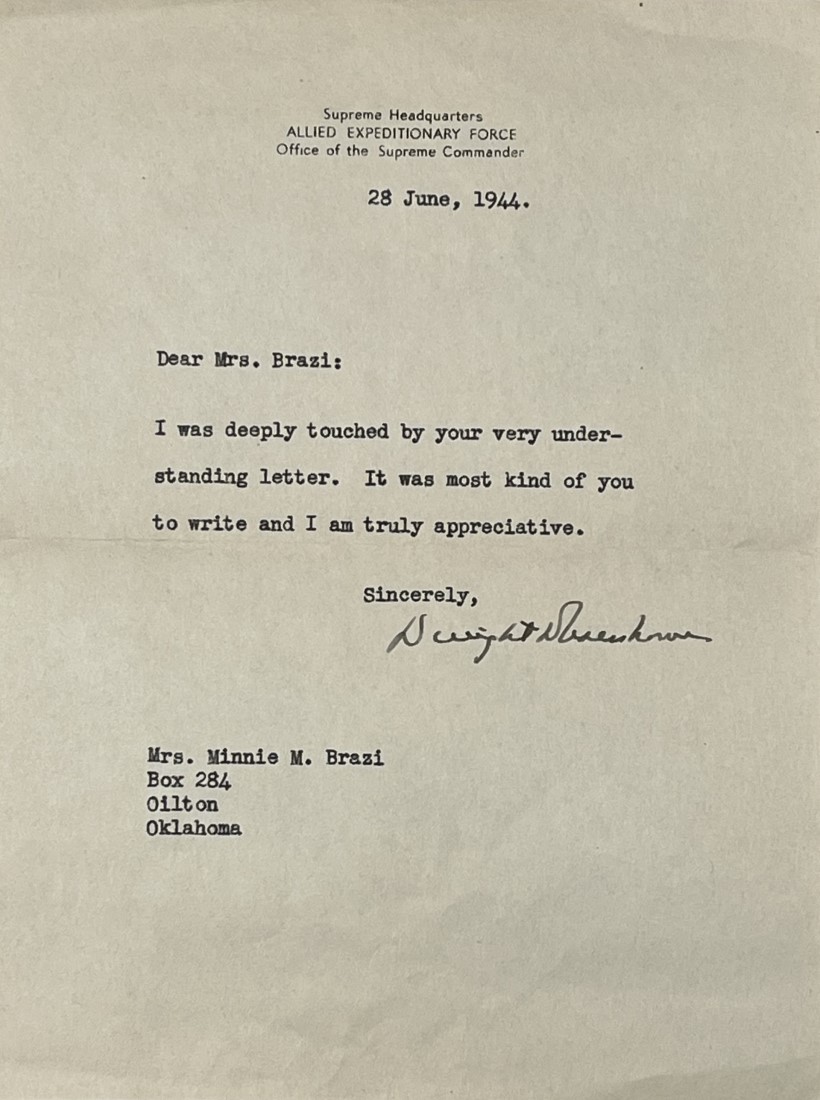
Mitchell’s love of preservation extended beyond KU and into surrounding communities. He consulted with several other libraries in the state, including at Kansas State University, Baker University, Saint Mary College, and the Wichita Public Library. He worked with the Dwight D. Eisenhower Presidential Library to save a letter from General Dwight Eisenhower that was sent to a family member. Mitchell presented at several library conferences and attended various conservation group meetings to bring further awareness on the necessity of conservation efforts.
Bill Mitchell’s letter to the Dwight D. Eisenhower Presidential Library discussing a letter that Eisenhower sent to Mitchell’s grandmother, Minnie Brazil (or Brazi). Personal Papers of William (Bill) Mitchell. Call Number: PP 649, Box 2, Folder 31. Click image to enlarge.
A 1944 letter from Dwight D. Eisenhower to Minnie Brazi (or Brazil), Bill Mitchell’s grandmother. D-Day was June 6, three weeks before Eisenhower wrote this document. Personal Papers of William (Bill) Mitchell. Call Number: PP 649, Box 2, Folder 31. Click image to enlarge.
Lawrence, Kansas, also had a special place in Mitchell’s life. He was a vocal historical building advocate, writing many letters to the Lawrence Journal-World with his concerns for historic Lawrence buildings regarding new proposed commercial developments. He wrote to the Lawrence Preservation Alliance and worked alongside the organization to protect a historic livery stable that was threatened by commercial development. But he was perhaps the most interested in preserving the history of West Hills, a neighborhood northwest of the University of Kansas campus. Many of his writings surround this neighborhood, from notes on traffic to rezoning laws allowing commercial enterprises to develop in the West Hills neighborhood.
William Mitchell retired from Spencer Research Library in 1999, though the Mitchells remained in Lawrence after retirement. Both Bill and Jean Mitchell supported Kenneth Spencer Research Library and the Helen Foresman Spencer Museum of Art; William’s papers were donated to the library in 2013, and Jean’s quilts and textiles are housed at the museum. Mitchells’ legacy continues on with The Bibliographical Society of America’s William L. Mitchell Award, given to researchers whose research focuses on eighteenth century English or English colonial periodicals.
Check the blog each Friday for a new “That’s Distinctive!” post. I created the series because I genuinely believe there is something in our collections for everyone, whether you’re writing a paper or just want to have a look. “That’s Distinctive!” will provide a more lighthearted glimpse into the diverse and unique materials at Spencer – including items that many people may not realize the library holds. If you have suggested topics for a future item feature or questions about the collections, feel free to leave a comment at the bottom of this page.
While it is technically no longer October, Halloween was earlier this week on Tuesday, so it only feels right to share one last “spooky” item. This week I have chosen to highlight a timeless classic: Grimm’s Fairy Tales by Jacob and Wilhelm Grimm, better known as the Brothers Grimm. Born in the 1780s, the Grimm Brothers published the first edition of their Kinder- und Hausmärchen (Children’s and Household Tales) in 1812. As scholar Jack Zipes explains, “between 1812 and 1857, seven editions of their tales appeared, each one different from the last, until the final, best-known version barely resembled the first.” Spencer Research Library holds many different editions, translations, and adaptations of the Grimm Brothers’ tales, including this edition from 1917 that contains illustrations and decorations by Louis Rhead. With their “stories and tales of elves, goblins, and fairies,” the brothers have captivated the minds of readers for centuries.
The front cover, title page, and selected pages from Grimm’s Fairy Tales: Stories and Tales of Elves, Goblins and Fairies, 1917. Call Number: Children C248. Click images to enlarge.
Happy Halloween all you screechers, screamers, and hollerers! We’ve also been celebrating over here at Kenneth Spencer Research Library in the best we know how: combing the KU Libraries online catalog and finding what cursed history we can find. We asked our student workers to recommend their picks for items that best represent the spirit of Halloween. They went beyond the safety of the Reading Room and braved the stacks to bring us these unsettling tomes and relics, but not everything is what it seems. Here are a few of our favorites!
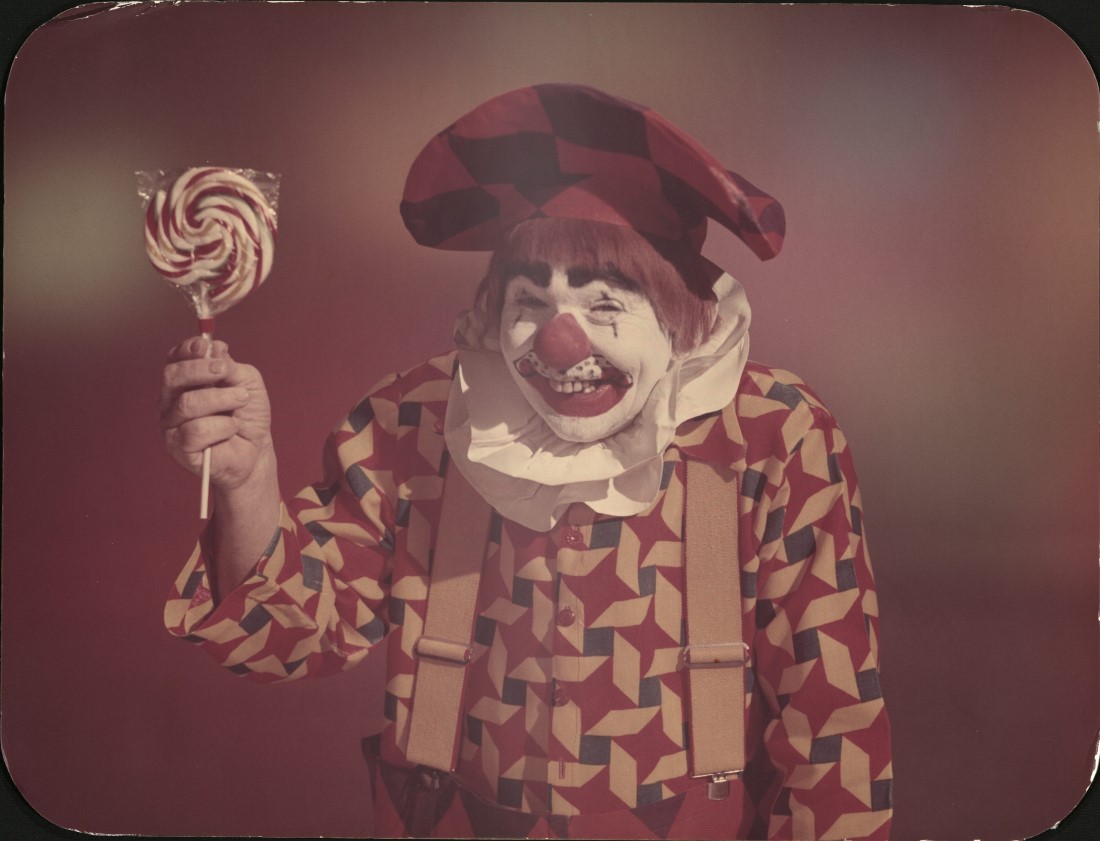
Our very first recommendation comes from the Centron Corporation, a film production company founded right here in Lawrence, Kansas. Perhaps best known for their work in educational films, the company also had a hand in the cult classic horror film Carnival of Souls. Elly Masteller found this lovely portrait in the Centron Corporation records collection. This cheerful gentleman was used in a film to help encourage literacy and creative writing among children. Remember kids, he can’t get you if your nose is in a book!
Production still of a clown from Reaching Your Reader, undated [circa 1985]. Centron Corporation Records. Call Number: RH MS Q514. Click image to enlarge.
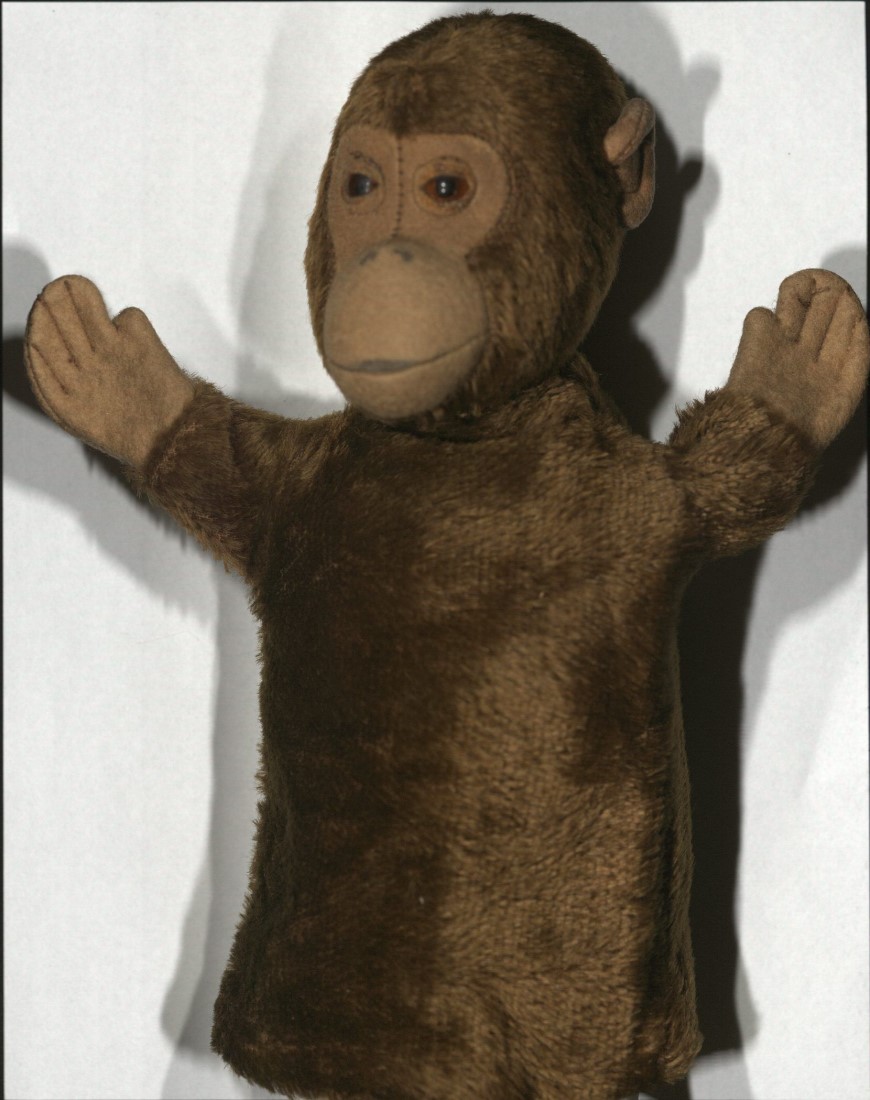
Kathryn Sauder sent in our next recommendation, another artifact, but this time from the Thomas Woodson Poor papers. Poor was an Olympic high jumper who competed for the University of Kansas from 1921 to 1925 and placed fourth in the high jump at the 1924 Summer Olympics in Paris, France. Poor is also known for his lifelong crusade in helping children receive the polio vaccine after the tragic death of his daughter, Melinda Sue, from polio. One of the toys he used to do so was this monkey puppet, and while the puppet may look demonic, it helped save lives! Absolutely heartwarming, not chilling, but perhaps maybe do not look into its eyes for too long.
Monkey puppet, undated [circa 1955-1956]. Thomas Woodson Poor Papers. Call Number: RH MS 1568. Click image to enlarge.
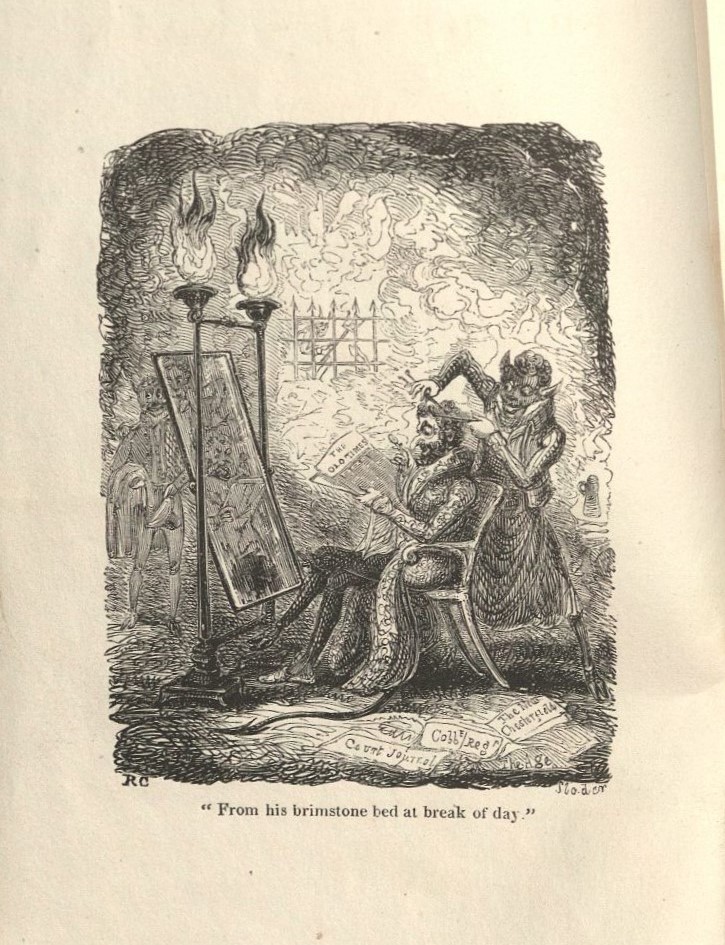
Literary giant Samuel Taylor Coleridge brings us our next spooky item, recommended by Nile Russo: a copy of The Devil’s Walk, or alternatively titled The Devil’s Thoughts. The Devil cuts a dapper shape as he gets himself dressed in his Sunday’s best for a walk around the town. In this poem, the Devil offers commentary about passersby, questioning perhaps if mankind might be the scariest creature of all.
The illustration accompanying the title page of The Devil’s Walk: A Poem by Samuel Taylor Coleridge and Robert Southey, 1830. Call Number: B4254. Click image to enlarge.
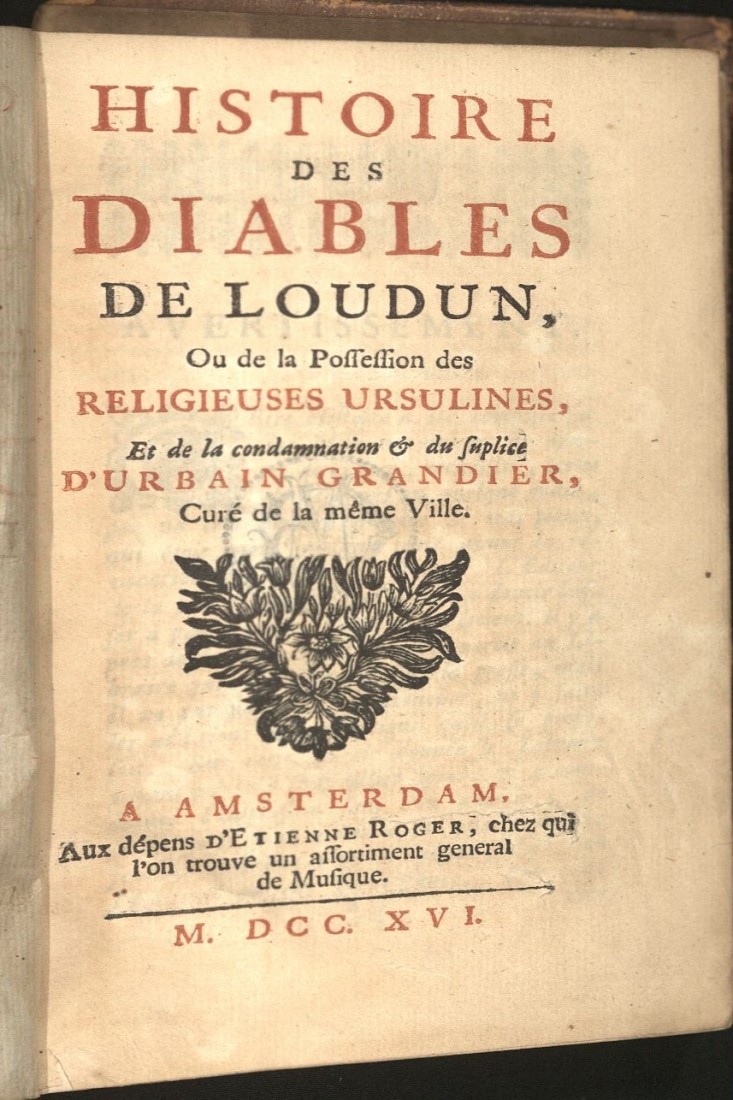
Molly Leonard recommended perhaps the most soul-wrenching item among our recommendations this year: a copy of Historie des diables de Loudun. This is a book about the Loudun possessions, a piece of history about an Ursuline convent being taken over by unusual behavior and visions attributed to demonic possession. In the end, through the intervention of Cardinal Richelieu, a local priest and decrier of Richelieu’s policies named Urbain Grandier was tried and executed for witchcraft in connection with the possessions. Again, and we can’t reiterate this enough, mankind might just be the scariest monster of all.
Title page of Histoire des diables de Loudun, 1716. Call Number: B12841. Click image to enlarge.
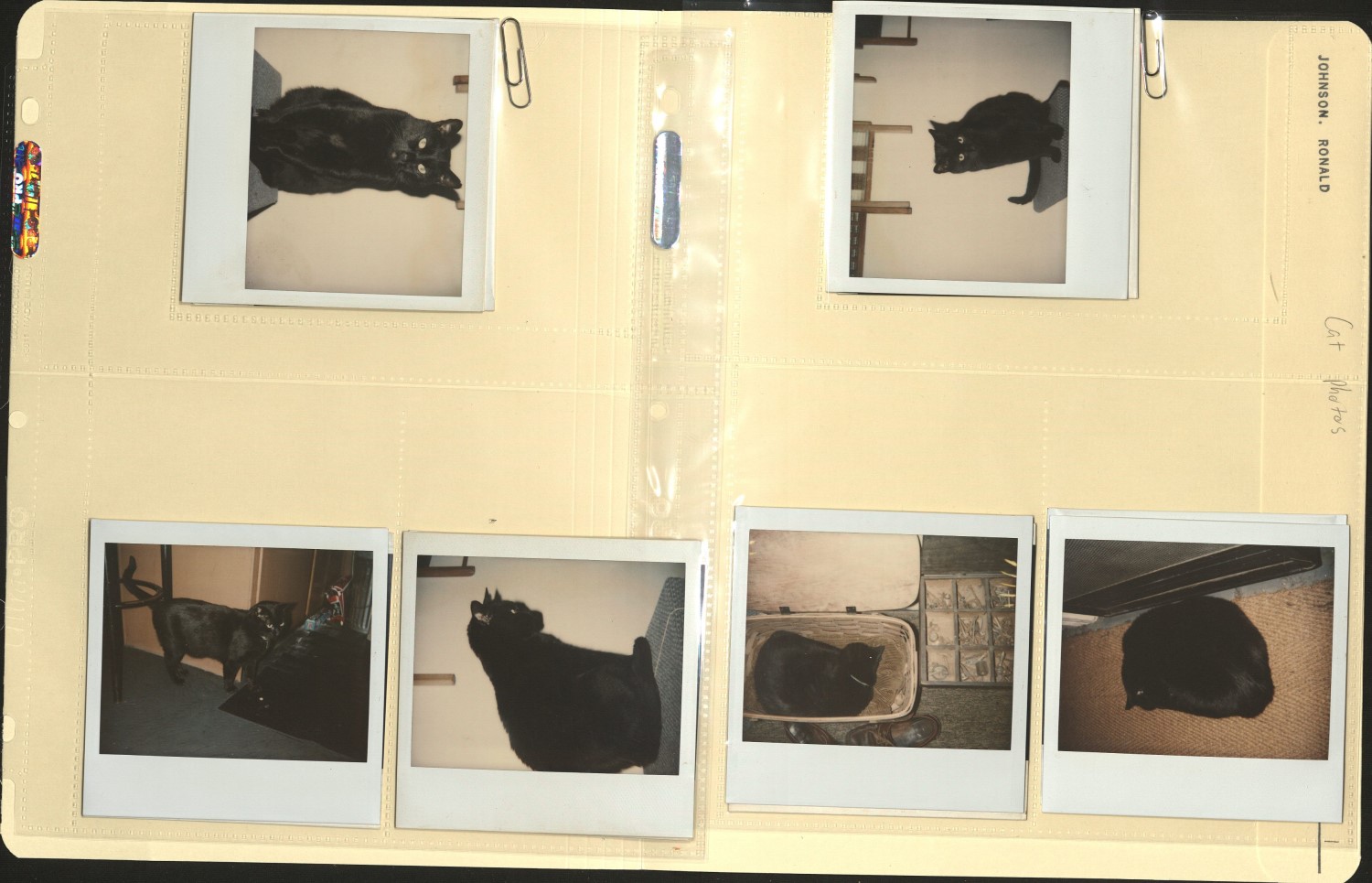
And finally, Ian Strasma reminds us that Halloween isn’t only about creepy clowns, puppets and possessions, and dashingly dressed demons with this recommendation: a black cat found lurking in the Ronald Johnson collection (literary estate papers). The cat may be cute, but be careful that you do not cross him!
“Cat photos,” undated [but timeless]. Ronald Johnson Collection (Literary Estate Papers). Call Number: MS 336. Click image to enlarge.
Best of luck out there as you begin finishing up semester and don’t be afraid to check out the many – completely safe, we promise – collections here at Kenneth Spencer Research Library!
Check the blog each Friday for a new “That’s Distinctive!” post. I created the series because I genuinely believe there is something in our collections for everyone, whether you’re writing a paper or just want to have a look. “That’s Distinctive!” will provide a more lighthearted glimpse into the diverse and unique materials at Spencer – including items that many people may not realize the library holds. If you have suggested topics for a future item feature or questions about the collections, feel free to leave a comment at the bottom of this page.
To continue our spooky journey through Spencer’s collections, this week I share Samhain or “All Hallowe’en.”: A Romantic Irish Cantata. As noted in the Concise Oxford Companion to Irish Literature, “Samhain had an important place in Celtic mythology as a time when the normal order is suspended to allow free passage between the natural and supernatural worlds.” As defined by Merriam-Webster, a cantata is “a composition for one or more voices usually comprising solos, duets, recitatives, and choruses and sung to an instrumental accompaniment.” This particular cantata was written and composed in 1902 expressly for the Dublin Musical Festival, or Feis Ceoil. Established in 1897, “Feis Ceoil Association promotes excellence in the learning and performance of music across all ages, levels and disciplines…Today, Feis Ceoil is an event of major significance in the development of musical talent in Ireland.” The festival now comprises 180 competitions with a diverse range of ages from seven years old and up.
Dr. Annie Patterson (1868-1934), who wrote the cantata, “composed sacred and secular cantatas, orchestral works and songs based on Irish themes. She also wrote poetry, essays, short stories as well as professional articles and books on music.” Working with Rev. Houston Collisson – the cantata’s composer – and others, Patterson co-founded the Feis Ceoil in 1897 as part of the broader Gaelic revival in Ireland.
No matter what you believe or how you celebrate, I wish everyone a safe and very happy Halloween! Next week we will share one last item in the spirit of October before returning to regular postings.
|
|
The front cover and first two pages of Samhain or “All Hallowe’en.”: A Romantic Irish Cantata, 1902. Call Number: O’Hegarty D613. Click images to enlarge.