The University of Kansas

Inside Spencer: The KSRL Blog

Books on a shelf

Welcome to the Kenneth Spencer Research Library blog! As the special collections and archives library at the University of Kansas, Spencer is home to remarkable and diverse collections of rare and unique items. Explore the blog to learn about the work we do and the materials we collect.

Folded and Sewn: A Bookbinding Workshop

June 12th, 2014

Staff and students from Conservation Services recently led a workshop for the College of Liberal Arts and Sciences Mini College program, in which individuals attend a week of lectures, classes, and events on the KU campus. This year we led a group of 21 eager students in our workshop, “Folded and Sewn.”

Four structures featured in bookbinding workshop

Clockwise from upper left: sewn pamphlet, stapled pamphlet, accordion book,
Venetian blind book. Click images to enlarge.

The students in this workshop made four simple structures that were created with folding and sewing–no adhesives required. We started with an accordion book, then made a Venetian blind structure that featured a picture of James Naismith on one side and the windows of Watson Library on the other. Next we moved to folded pamphlets: first a stapled one with text about caring for books, and finished with a sewn version featuring images of historic Jayhawks (courtesy of the University Archives).

Kyle Sederstom, Roberta Woodrick, and Whitney Baker, staff of Conservation Services, took turns leading the class. Step-by-step images were also projected on an overhead screen. In addition, we enlisted three conservation student assistants and our summer conservation intern to roam the room and help participants as needed.

Conservation Services staff and students at bookbinding workshop

Conservation Services staff and students who led the Mini College workshop.

The Mini College participants finished the structures in record time! We had provided two copies of each structure, so there was time for students to review and make a second book. Other students perused examples of pamphlets and accordion structures provided on a front table.

Bookbinding workshop

The workshop featured a leader for each bookbinding structure, as well as projected images of each step.

We had a wonderful time hosting this workshop and hope to offer it again in the future.


Whitney Baker
Head, Conservation Services

Researchers Wanted!

June 6th, 2014

Ask any special collections librarian or archivist about her favorite collection item, and she may hem and haw (how can you pick just one favorite?!?). However, ask that same librarian about interesting items or collections that she wishes more researchers would use, and invariably she will rattle off a frighteningly long list.

This week, in the spirit of summer discovery, we present two intriguing selections that scream “researchers wanted!”

1.  Papers of William Poel, ca. 1895-1934 (MS 31)

As admirers of William Shakespeare know, this April marked the 450th anniversary of the playwright’s birth.  And while Spencer doesn’t have a manuscript by the Bard gathering dust on a shelf (no manuscripts in his hand are known to survive), the library does hold papers for William Poel (1852-1934), an actor, writer, and theater director known for his attempts to revive the conventions of the Elizabethan stage at the dawn of the twentieth century. The collection includes correspondence with figures from the theater world (actors, writers, critics, and others), a small number of scripts, prompt books, and journals, and ephemera such as playbills and review clippings.  Pictured below is Poel’s heavily annotated prompt copy for Fratricide Punished, a German version of Hamlet of ambiguous relation to Shakespeare’s play.  Also pictured are a theater program and a lecture announcement, examples of Poel ephemera.

Picture of Poel's Fratricide Punished Prompt book, open to the list of characters and a pasted in print announcement. Plan of playscene in Poel's Fratricide Punished prompt book.
Lecture announcement for a lecture series on Shakespeare. Image of exterior of program for Poel's production of Marlowe's Faustus
Top: Poel’s prompt book for Fratricide Punished , ca. 1924. MS 31:D4; Bottom: an announcement for a series of lectures by Poel on Shakespeare, 1900, and the program for a production of Marlowe’s Faustus directed by Poel, 1904. MS 31, F6. Click images to enlarge.

2. Don Quixote, el Castellano viejo, undated (before 1860).

This mysterious bound manuscript came to Spencer from the library of the well-known nineteenth-century art historian, bibliophile, and Hispanist, Sir William Stirling Maxwell (1818-1878).  A portion of Stirling Maxwell’s vast library was sold at auction and 1958, enabling KU to acquire a significant number of early printed Spanish volumes, including important editions that now form the basis of Spencer’s Cervantes Collection, and this manuscript.  As far as we know, the author of this manuscript has not been identified, though the text concerns Cervantes’s famed character Don Quixote.   A note pasted toward the front gives further provenance, describing it as a “curious manuscript” sold as part of the auction of the library of “the late Don Justo de Sancha” by Sotheby’s in December of 1860.  Though the hand is later than Cervantes’s time, scholars of Spanish literature might find much to pique their interest in this 205-page manuscript.  The pictures below include the table of contents, which offers readers an idea of the matter covered.

Image of the title page (in a different hand?) giving the title, Don Quixote, el Castellano viejo Image of prologue with pasted in provenance note for Don Quixote, el Castellano viejo. Image of the first page of the table of contents of Don Quixote, el Castellano viejo Image of the final page of Don Quixote, el Castellano viejo.

Bookplate of William Stirling-Maxwell Image of the beginning of Chapter 2 in Don Quixote, el Castellano viejo.

Don Quixote, el Castellano viejo, undated (before 1860). MS C73. Click images to enlarge.

For more information on these and any of our other manuscript holdings, please don’t hesitate to contact us.  After all, the summer is an ideal time to start a new research project.

Elspeth Healey
Special Collections Librarian

Anger

May 23rd, 2014

Aesop’s fables are directly descended from the 11th century Physiologus of Theobaldus and other medieval bestiaries, or treatises on birds and beasts who were blessed with certain moral, physical, and mental attributes.They were largely the creations of early Christian teachers and were a mix of natural history and Gospel Truth with snippets of folk-lore, travellers’ tales, and dimly understood scientific ideas thrown in, served up with all the authority of the Church behind them. They have continued to be popular long after they ceased to be used for religious instruction, and as has oft been pointed out, there’s a lot of “zoology” in them, and thus, they do deserve a niche in the history of science.

Howitt, Samuel. A New Work of Animals, 1818. Call number Ellis Aves E102. Kenneth Spencer Research Library, University of Kansas.

Howitt, Samuel. A New Work of Animals, 1818. Call number Ellis Aves E102. Kenneth Spencer Research Library, University of Kansas.
Text excerpt (top) and accompanying plate (bottom) from Howitt, Samuel. A New Work of Animals, 1818.
Call number Ellis Aves E102. Click images to enlarge.

Among the chief emblems of the original Physiologus were numerous herps including the sun lizard, viper, serpent, sea-tortoise, crocodile, frog, and salamander. In this fable about porcupine and snakes, there’s no bias against snakes; both herp and mammal behave badly.

Sally Haines
Rare Books Cataloger
Adapted from her Spencer Research Library exhibit and catalog, Slithy Toves: Illustrated Classic Herpetological Books at the University of Kansas in Pictures and Conversations

¿Habéiss oído hablar del medicamento comprar levitra online, entrega en 24 horas? La gente no podía imaginar su vida sin este medicamento, que les brinda confianza y la capacidad de pasar un tiempo inolvidable con su querida pareja.

Legacy of the White City: Revisiting the World’s Columbian Exposition of 1893

May 16th, 2014

The 1893 Chicago World’s Fair, or the Columbian Exposition, served to showcase the transformation of America’s international presence from the wild frontier to a dominant world power. It also signaled Chicago’s rise to fame from the ashes of its Great Fire of 1871. Among the Fair’s major themes were architecture, women’s representation, diversity, and technology. From May 1 to October 31 of 1893, the World’s Columbian Exposition attracted 27 million visitors—a quarter of America’s population at the time.

More than 120 years after the Columbian Exposition, the Fair’s American legacy can be seen in this exhibit. We invite you to explore this period of rapid change, innovation, culture, and ingenuity.

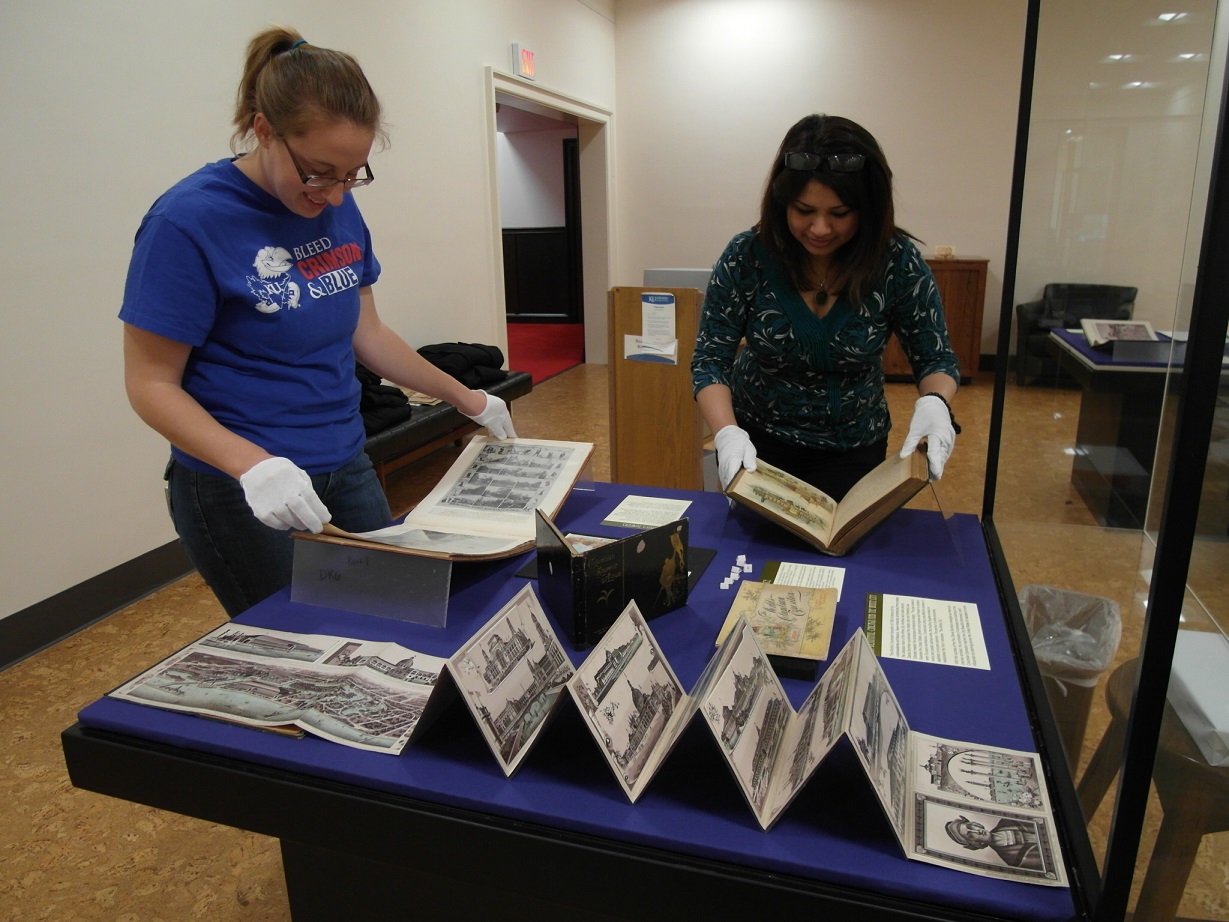
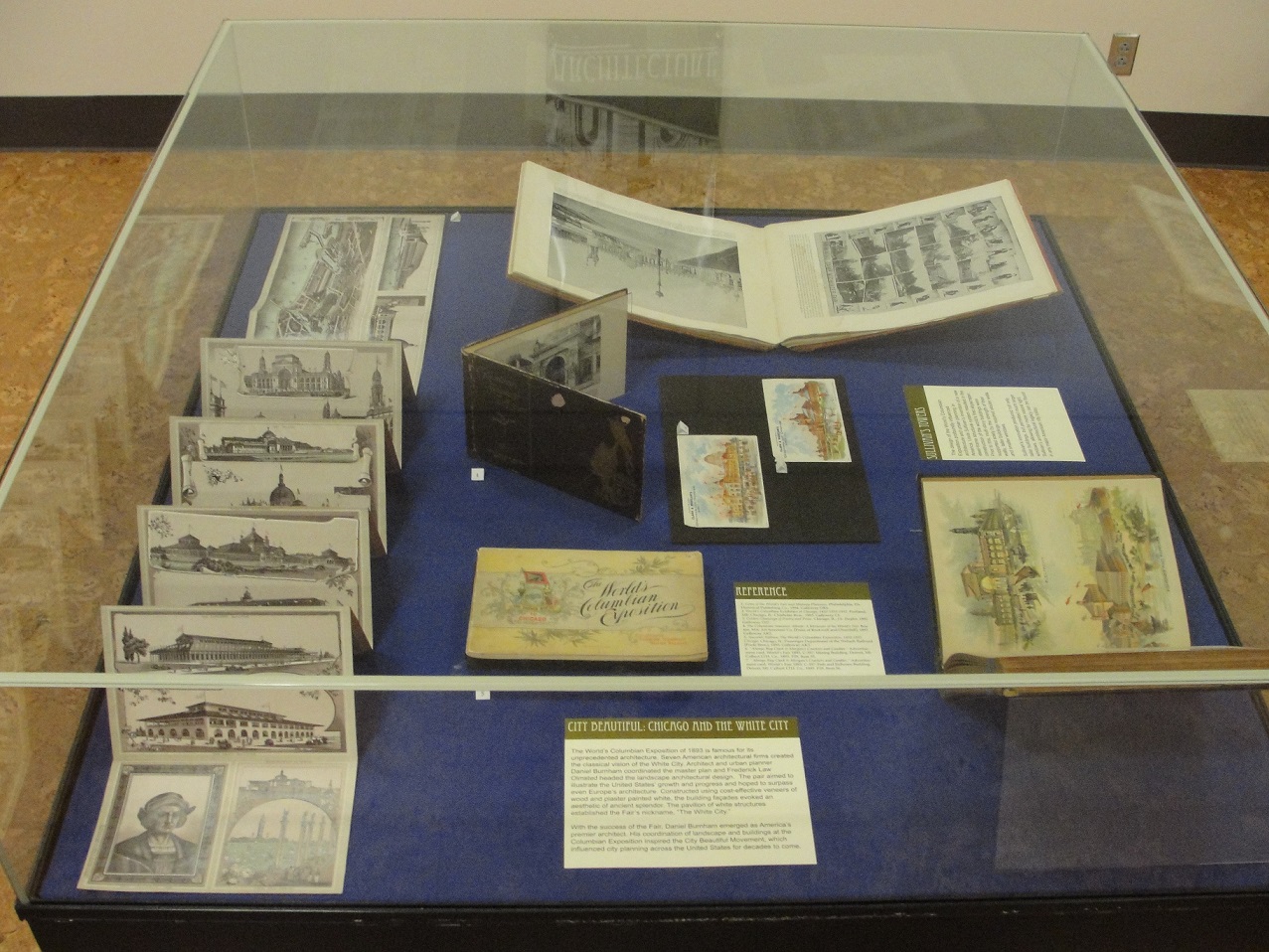
Image of museum studies graduate students installing the exhibition.  Image of installed case on architecture at the Fair

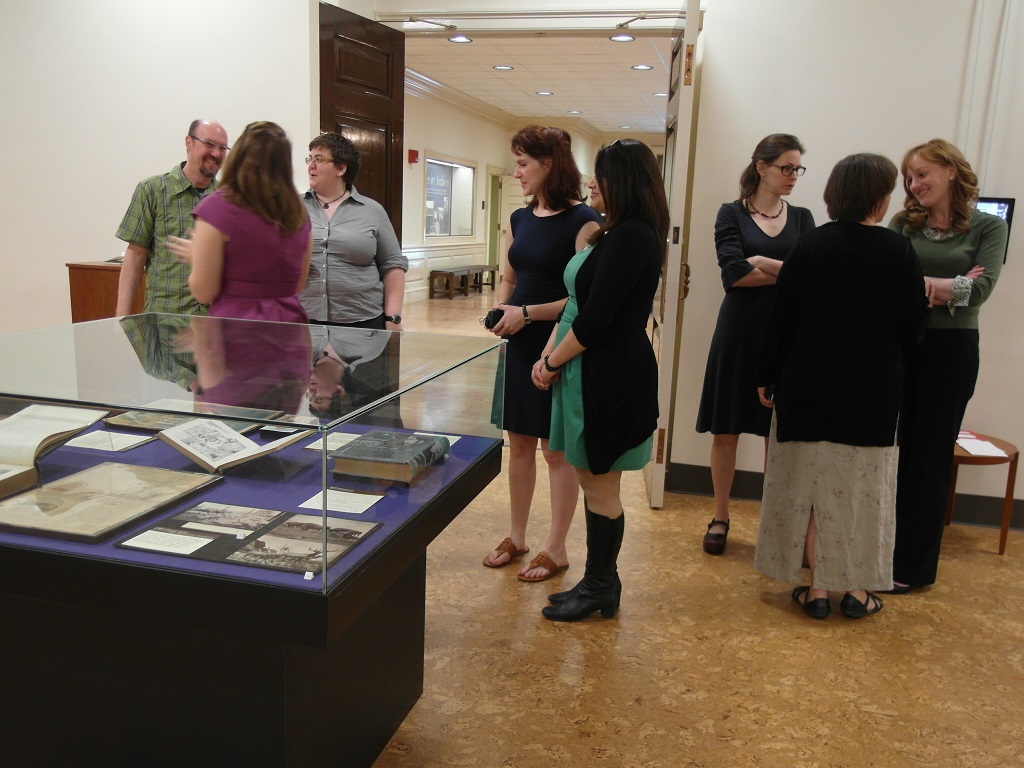
Image of people at the exhibition opening.

Top: Installing a case Bottom: Conversations at the exhibition opening

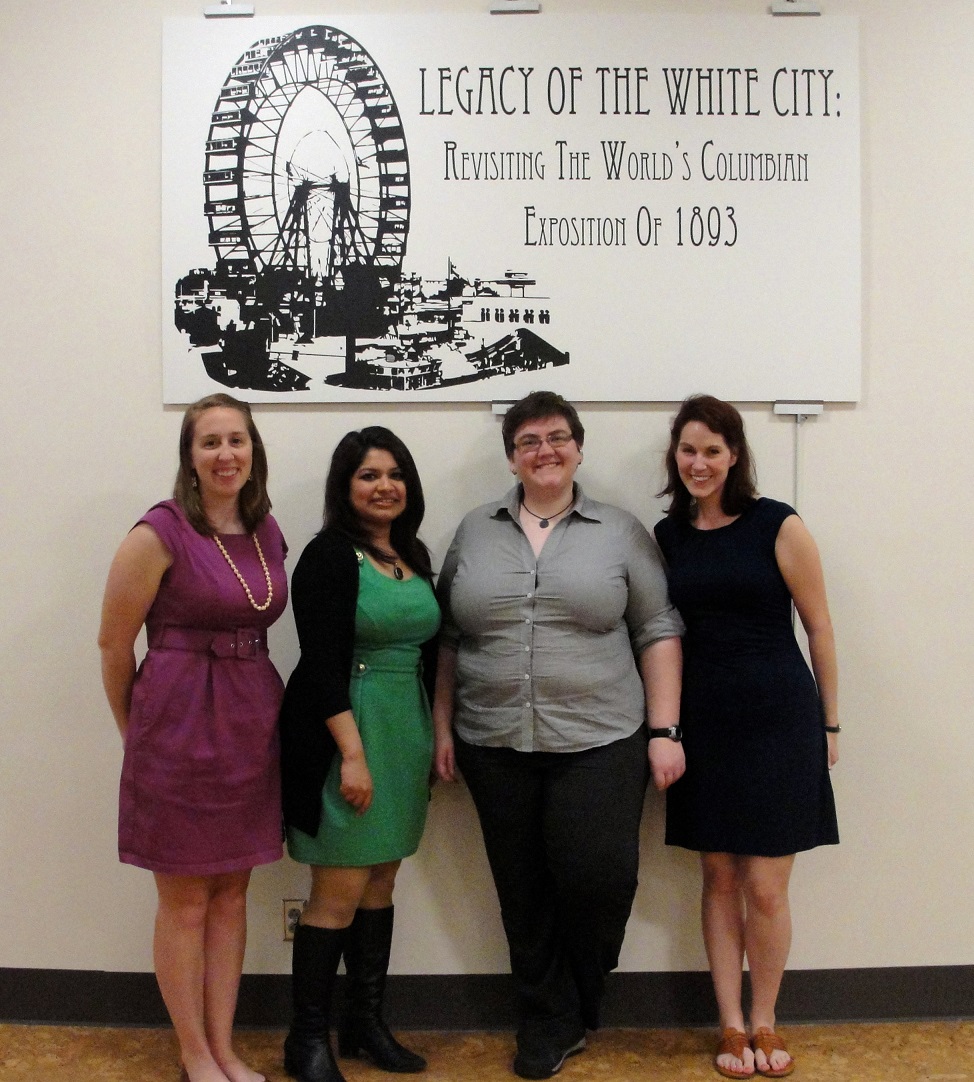
This exhibition, which opened on May 8th, 2014, features original literature from the Fair.  Most displayed objects originate from Spencer’s Thomas D. and Sharon Perry Galloway Collection. The exhibit was designed and executed by students Rachel Gibson, Alissa Meehan, Meg Schwend, and Sabrina Shafique as part of a an exhibition planning and design course (MUSE 703).

Image of the four exhibition curators in front of the exhibition sign

Exhibition curators (from left to right): Alissa Meehan, Sabrina Shafique, Rachel Gibson, Meg Schwend.

Meg Schwend
Museum Studies Graduate Student

KU Students Studying Hard, 1950-1985

May 14th, 2014

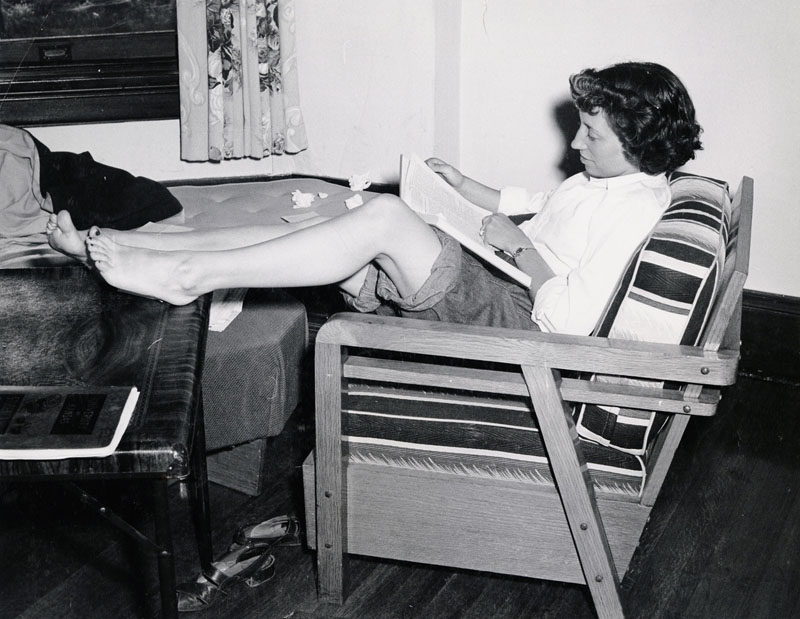
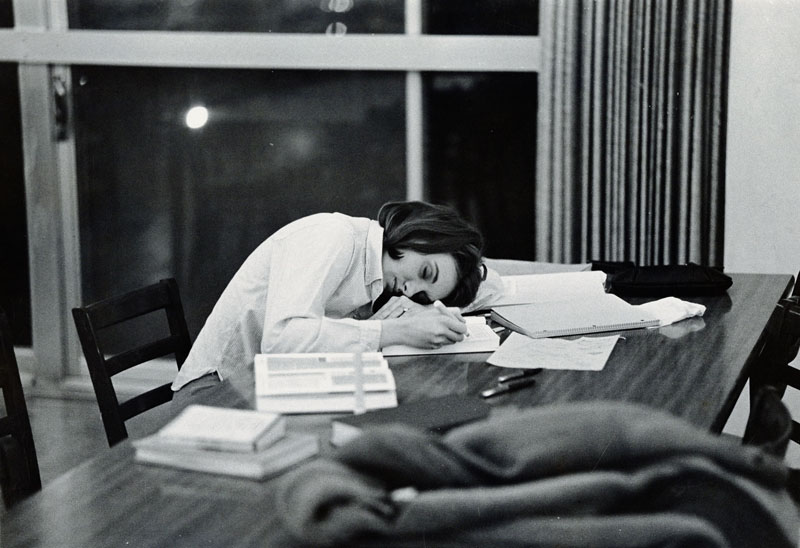
Spring has finally, truly arrived on Mount Oread, which has meant the eagerly-awaited return of warmer weather and the not-so-eagerly-awaited return of final exams. The Student Activities record group in University Archives contains a number of photographs showing the bowed heads of generations of anxious KU students poring over their work.

While it’s unclear, in almost all cases, whether these pictures were taken during final exams, this time of year seems like the most appropriate time to feature some of these fun images here at “Inside Spencer.”

Good luck to all KU students on their final exams!

Photograph of group of female students studying, 1950s.

Group of students studying, 1950s. University Archives Photos.
Call Number: RG 71/0/1950s Prints: Student Activities (Photos).
Click image to enlarge.

Photograph of student with typewriter outside, 1950s.

Student with typewriter, 1950s. University Archives Photos.
Call Number: RG 71/0/1950s Prints: Student Activities (Photos).
Click image to enlarge.

Photograph of student studying with bare feet, 1950s.

Bare feet, 1950s. University Archives Photos.
Call Number: RG 71/0/1950s Prints: Student Activities (Photos).
Click image to enlarge.

Photograph of student asleep while studying, 1967-1968.

Asleep while highlighting, 1967-1968. University Archives Photos.
Call Number: RG 71/0/1967-1968 Prints: Student Activities (Photos).
Click image to enlarge.

Photograph of student studying under trees, 1969-1970.

Studying in the shade, 1969-1970. University Archives Photos.
Call Number: RG 71/0/1969-1970 Prints: Student Activities (Photos).
Click image to enlarge.

Photograph of a student sleeping with note, 1970s.

“I’m too nervous to sleep in my room,” 1970s. University Archives Photos.
Call Number: RG 71/0/1970s Prints: Student Activities (Photos).
Click image to enlarge.

Photograph of a student studying on a stump, 1975-1976.

Studying on a stump, 1975-1976. University Archives Photos.
Call Number: RG 71/0/1975-1976 Prints: Student Activities (Photos).
Click image to enlarge.

Photograph of student studying on top of backpack, 1976-1977.

Backpack as table, 1976-1977. University Archives Photos.
Call Number: RG 71/0/1976-1977 Prints: Student Activities (Photos).
Click image to enlarge.

Photograph of a panicked student looking up, October 1978.

Panic, October 1978. University Archives Photos.
Call Number: RG 71/0/”A Day in the Life of KU, October 13, 1978″
Prints: Student Activities (Photos). Click image to enlarge.

Photograph of student studying with calculator and printouts, 1979-1980.

Calculator and computer printouts, 1979-1980. University Archives Photos.
Call Number: RG 71/0/1979-1980 Prints: Student Activities (Photos).
Click image to enlarge.

Photograph of student studying behind grate, 1979-1980.

Creative (and uncomfortable?) study location, 1979-1980. University Archives Photos.
Call Number: RG 71/0/1979-1980 Prints: Student Activities (Photos).
Click image to enlarge.

Photograph of two students studying on stairs, 1980-1981.

Studying on stairs, 1980-1981. University Archives Photos.
Call Number: RG 71/0/1980-1981 Prints: Student Activities (Photos).
Click image to enlarge.

Overhead photograph of student studying, 1981-1982.

Sprawled out, 1981-1982. University Archives Photos.
Call Number: RG 71/0/1981-1982 Prints: Student Activities (Photos).
Click image to enlarge.

Photograph of student working in his room, 1982-1983.

Student working in his room, 1982-1983. University Archives Photos.
Call Number: RG 71/0/1982-1983 Prints: Student Activities (Photos).
Click image to enlarge.

Caitlin Donnelly
Head of Public Services