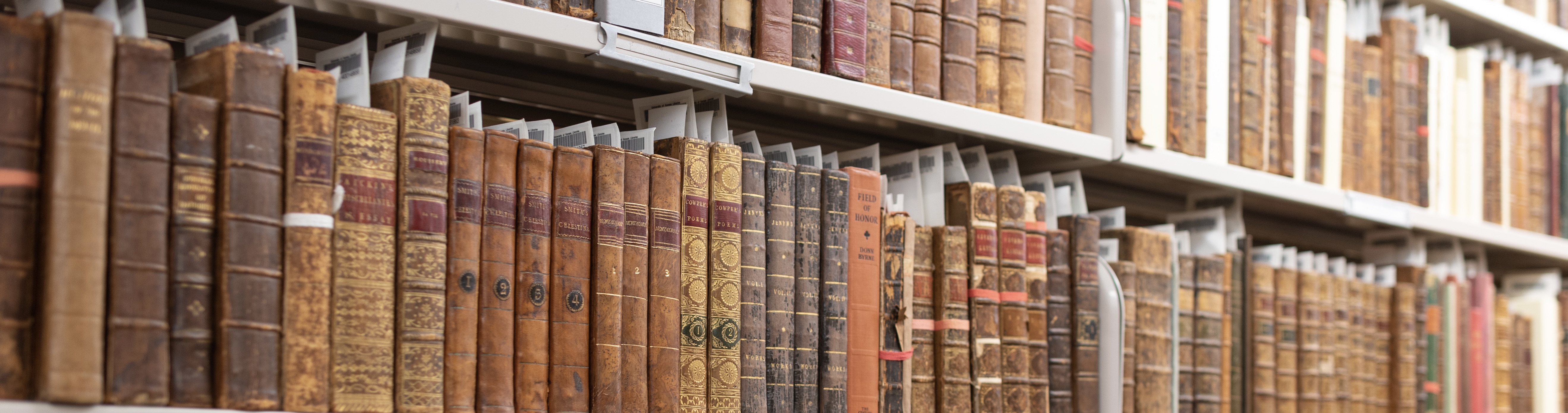
Welcome to the Kenneth Spencer Research Library blog! As the special collections and archives library at the University of Kansas, Spencer is home to remarkable and diverse collections of rare and unique items. Explore the blog to learn about the work we do and the materials we collect.
This blog may contain archived web content. This blog may link to catalog records which no longer exist as of a software change in 2026.
The Summerfield Collection at Kenneth Spencer Research Library consists of early-modern printed books, but the focus of a current project supervised by Special Collections Curator Eve Wolynes is to identify instances of binder’s waste and, when possible, identify their original source. Binder’s waste is a term for when parts or pages of an older, often medieval, manuscript are reused as part of the structure of a book’s binding. This could mean the boards of a book, structural support for the spine, or more decorative details like the cover, flyleaves, or similar. Many of the materials used as examples here are currently available for viewing – with a second case of materials highlighting illustrations by Edward Gorey – in Spencer’s North Gallery through May 29th.
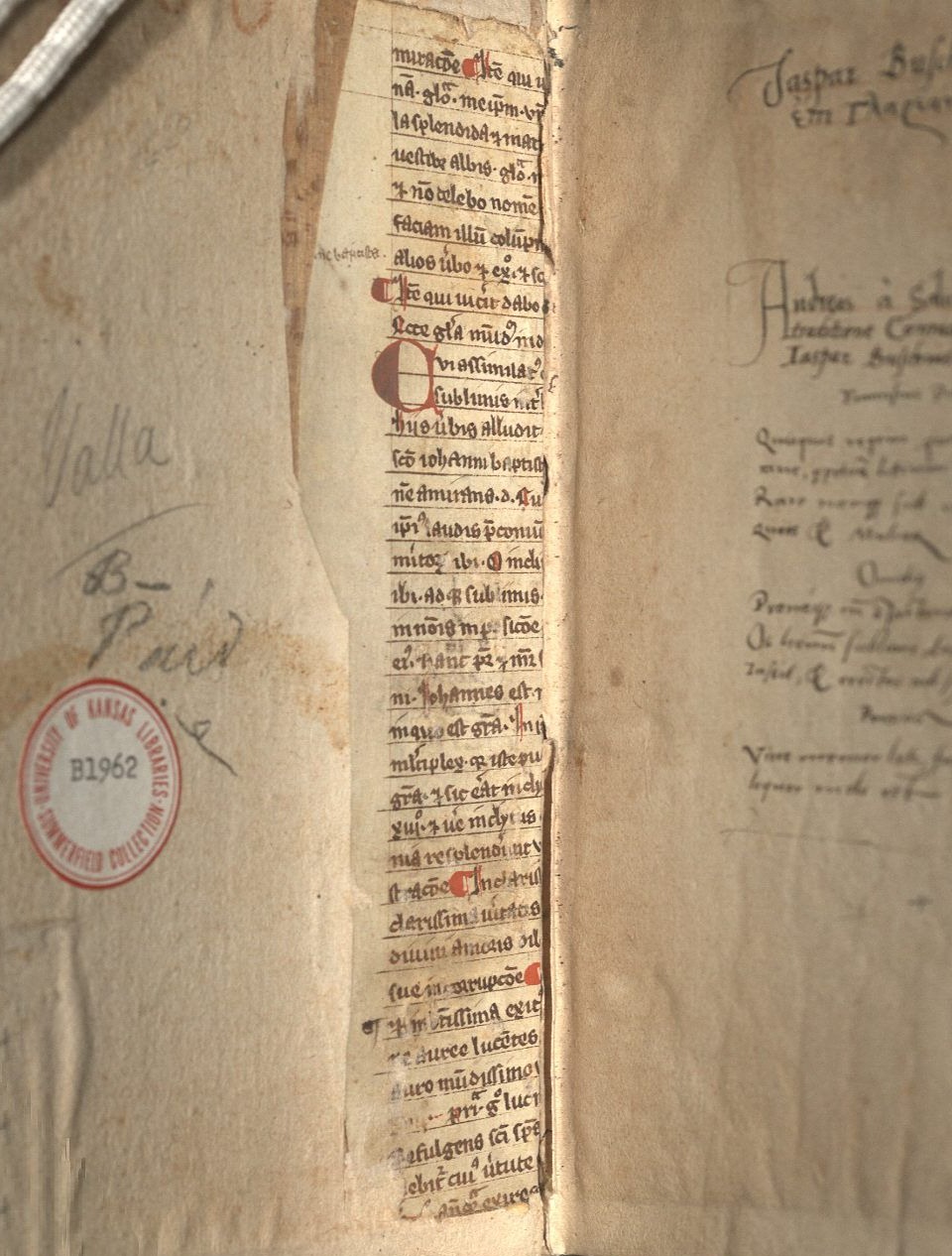
Beginning with structure, the most obvious examples of reuse can be found in the interior of a volume, generally on the boards near the spine. This kind of reuse is generally to help support either just the spine or the adherence of the boards and the spine together. Lorenzo Valla’s Elegantiae (Call Number: Summerfield B1962) has an example of this as the paper pasted on top (pastedown) has worn away enough to show some of the reuse (Fig. 1). This is clearly a medieval text, and – while it is fragmented – some of the words such as “Johannes” in the body text and “baptista” in the marginal notation among other examples illustrate that the focus of the text is on John the Baptist.
Fig. 1: Front interior detail, Elegantiae, 1540. Call Number: Summerfield B1962. Click image to enlarge.
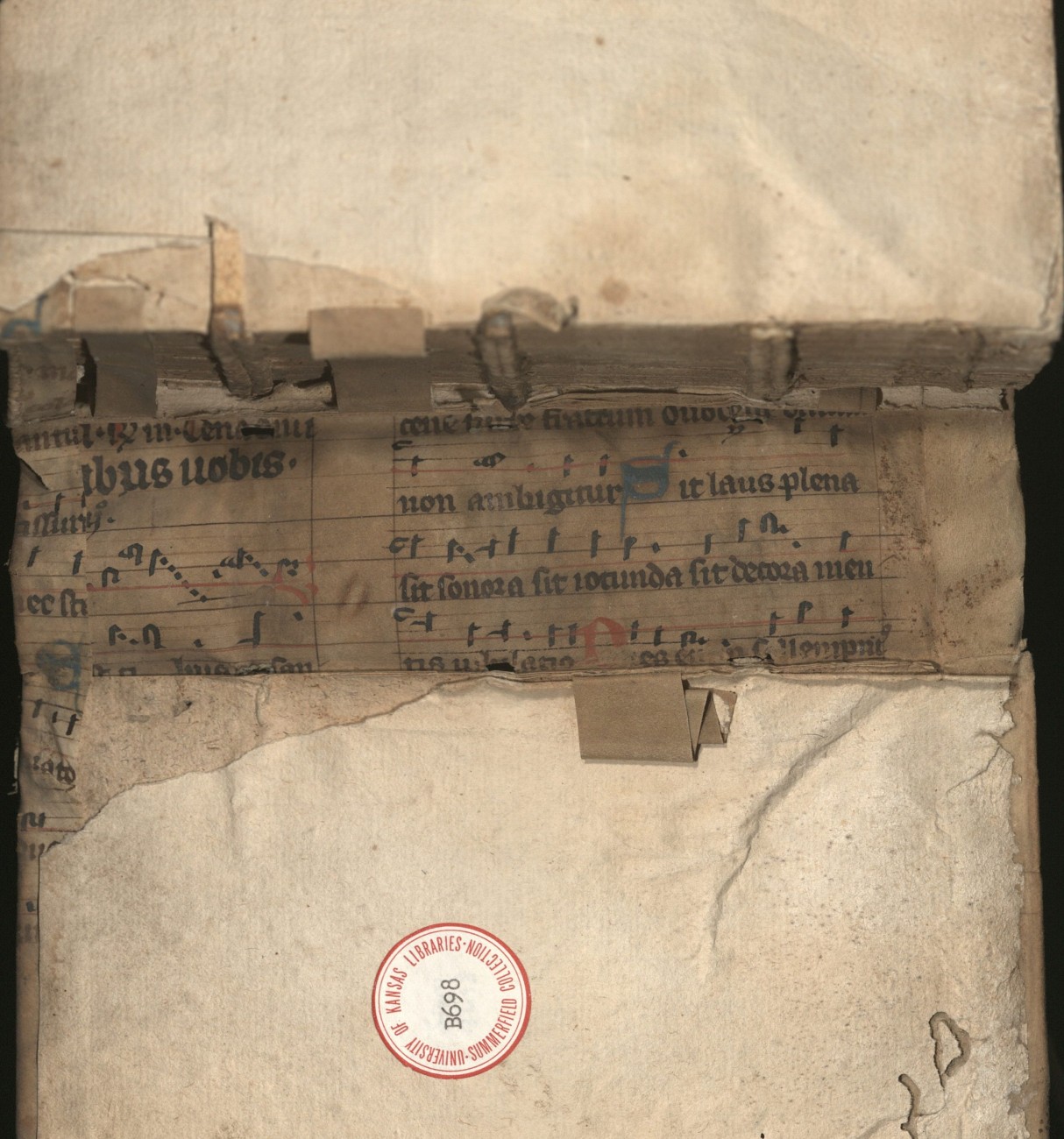
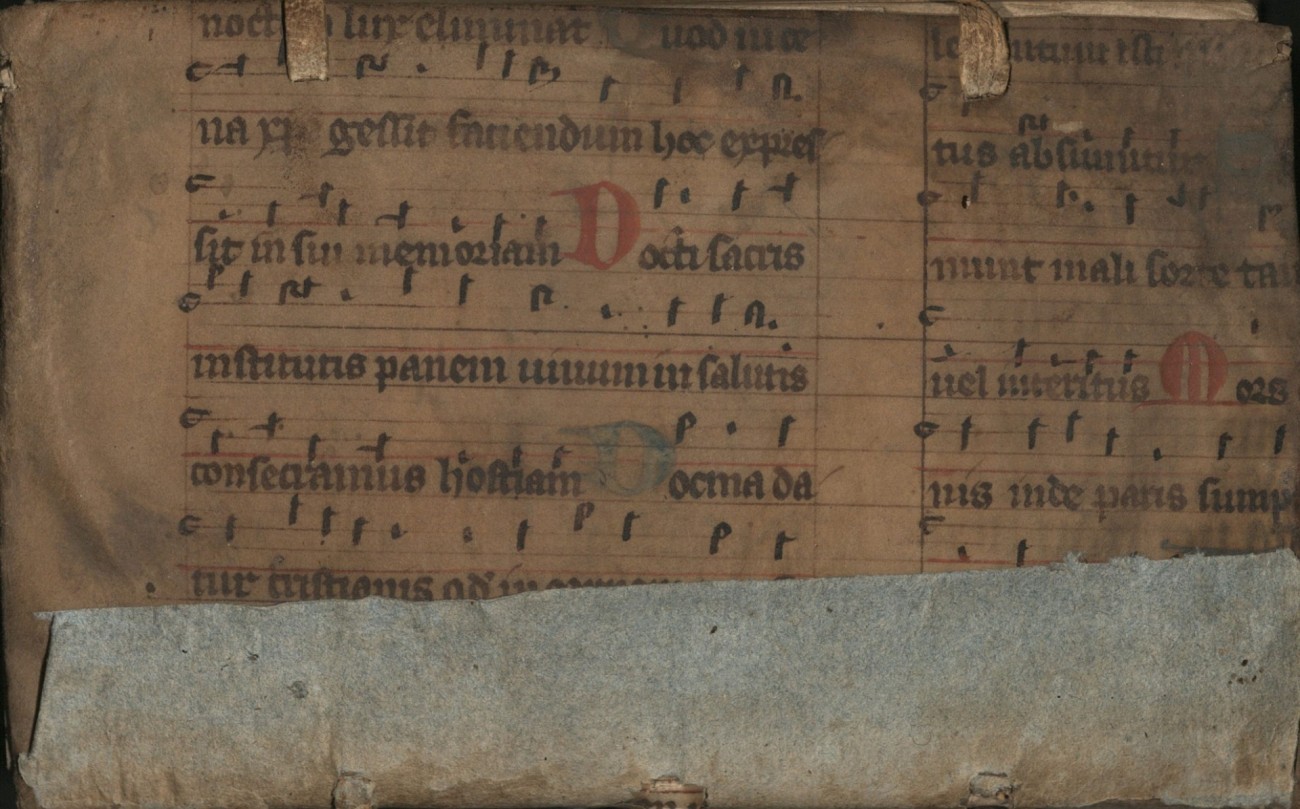
An example of more spinal support (Fig. 2.1) is seen in Analysis Logica Libri S. Lucae Qui Inscribitur Acta Apostoloru (Call Number: Summerfield B698). The strips are another method in which reuse occurs, though it can also be in longer or wider strips. The strips in this particular volume do not have any text or decoration remaining, so their exact origin cannot be certain. However, it is possible they come from the same leaf that was used to make the cover (Fig. 2.2). Based on the text visible both from the interior of the spine and the exterior cover, we can find that the lyrics to the music sheet are from “Lauda Sion,” a Christian hymn that celebrates Jesus Christ. Reuse of music sheets is fairly common within the Summerfield Collection, likely due to the rubrication and various ink colors or decoration that may accompany them.
Fig. 2.1: Spine interior detail, Analysis Logica Libri S. Lucae Qui Inscribitur Acta Apostoloru, 1597. Call Number: Summerfield B698. Click image to enlarge.
Fig. 2.2: Front cover, Analysis Logica Libri S. Lucae Qui Inscribitur Acta Apostoloru, 1597. Call Number: Summerfield B698. Click image to enlarge.
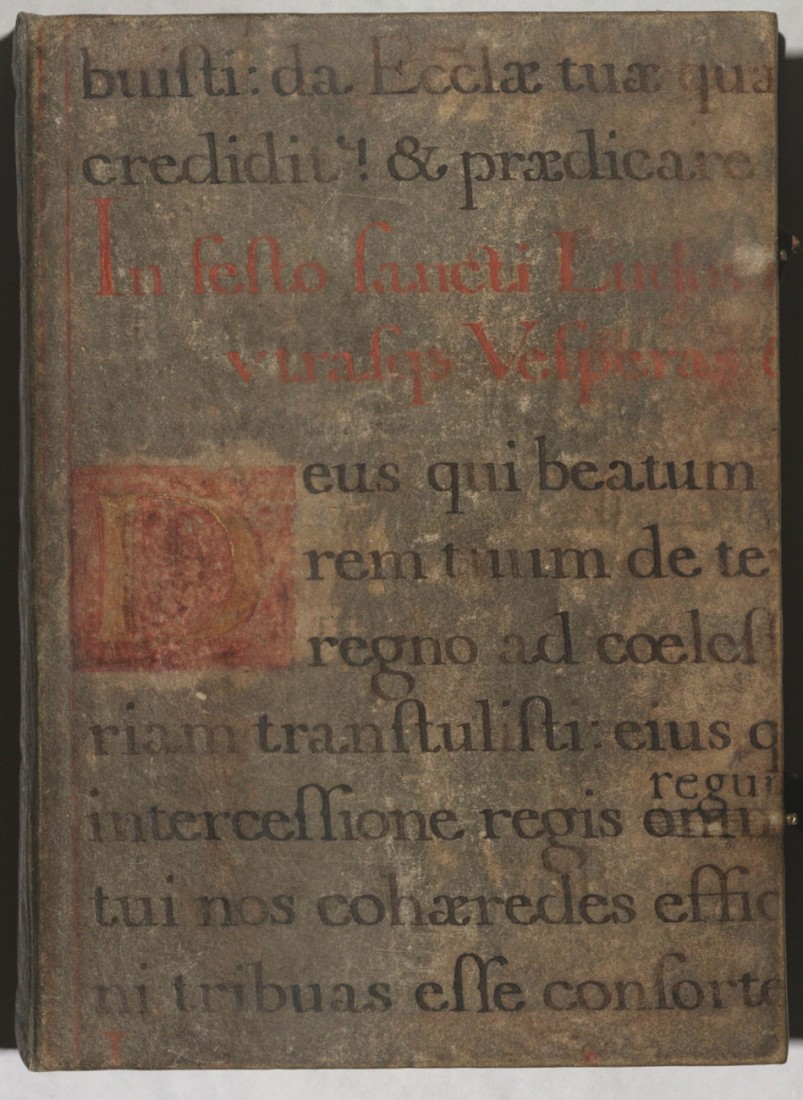
Music, although not a particularly popular feature, was not an uncommon form of reuse, either because of its wide availability or because it had some aspect of artistry and thus aesthetic interest for a cover. While actual music sheets may have been popular, texts of chant or hymnal lyrics are also quite common. A book of hours in the Summerfield Collection (Call Number: Summerfield B2890) has one such instance of reuse as the cover consists of a chant to laud St. Louis (Ludovicus in Latin), which would likely have been performed during Mass (Fig. 3).
Fig. 3: Front cover, Book of Hours, 1497. Call Number: Summerfield B2890. Click image to enlarge.
There were, of course, numerous other ways to reuse materials, but these are some of the most common examples within Spencer’s holdings. While some of the items are currently part of the temporary exhibit, the Summerfield Collection is always available for access in the Reading Room at Kenneth Spencer Research Library.
All the way back in October 2019, I wrote about starting on the treatment of MS E279, Historia flagellantium…De recto et perverso flagrorum usu apud Christianos…Ex antiquis Scripturæ, patrum, pontificum, conciliorum, & scriptorum profanorum monumentis cum curâ & fide expressa, by Jacques Boileau. This volume is the manuscript, dated 1691 and with annotations believed to be in the author’s own hand, for the printed version of the same title published in 1700. Spencer also holds a copy of the printed edition at Summerfield B2655.
The volume was weakened by past water and mold damage and so required especially careful handling throughout the treatment process. After photographing the volume in its pre-treatment condition, I first cleaned the residual mold using soft brushes and low-suction HEPA vacuum, working in our bio-safety cabinet to reduce my exposure to the mold (and prevent contamination of other collection material). After the volume was cleaned, I removed the damaged binding and took apart the sewing.
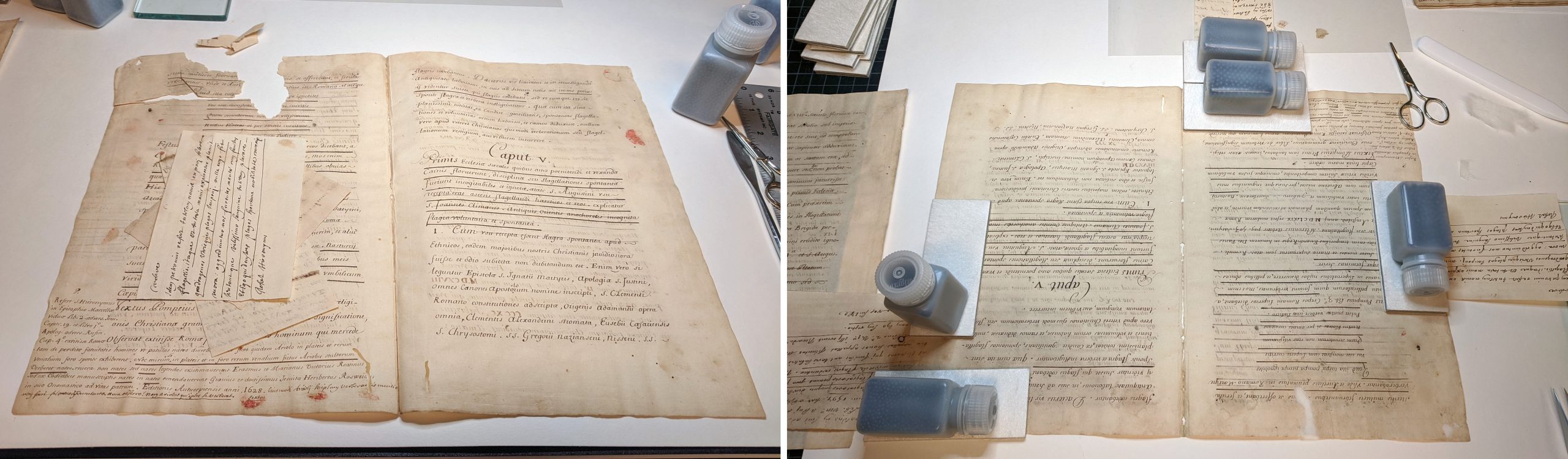
A damaged folio from MS E279 before treatment, at left, and being mended during treatment, at right. Click image to enlarge.
The most time-consuming part of the treatment involved mending tears, filling losses, and guarding the sections (adding a reinforcing strip of thin Japanese tissue along the fold to strengthen it prior to sewing). The manuscript also has numerous notes and additions pasted in which needed reinforcement or reattaching. Once all the mending was complete, the volume was ready to be sewn and bound. In discussions with Special Collections curator Karen Cook, we considered different options for rebinding the book and settled on a conservation paper case binding, which would provide gentle support for the fragile text.
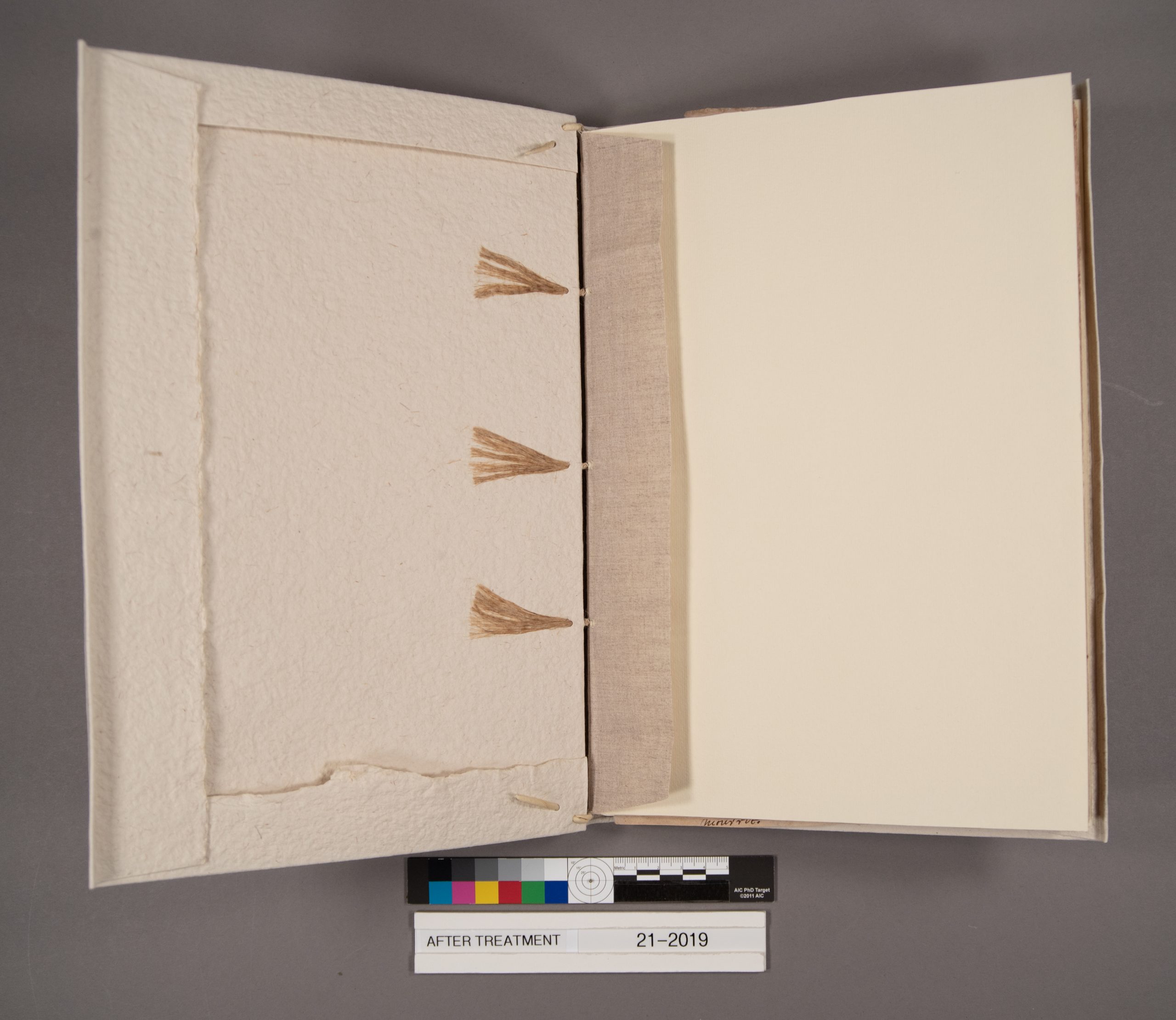
I sewed the volume with fine linen thread over three cords, adding new endpapers, and added sewn endbands of the same linen thread around rolled paper cores. After lining the spine with Japanese paper, Western laid paper, and linen, I attached a new case of medium-weight handmade paper. The case is attached only by the linen spine linings and by the sewing and endband supports which are laced through the case. The result has an appearance that is similar to and visually compatible with historic limp bindings. This structure has the added benefit of being easily removed if future caretakers of this volume wish to rebind it in a different fashion.
MS E279 after treatment in its new paper case binding, with linen spine lining and laced sewing supports. Click image to enlarge.
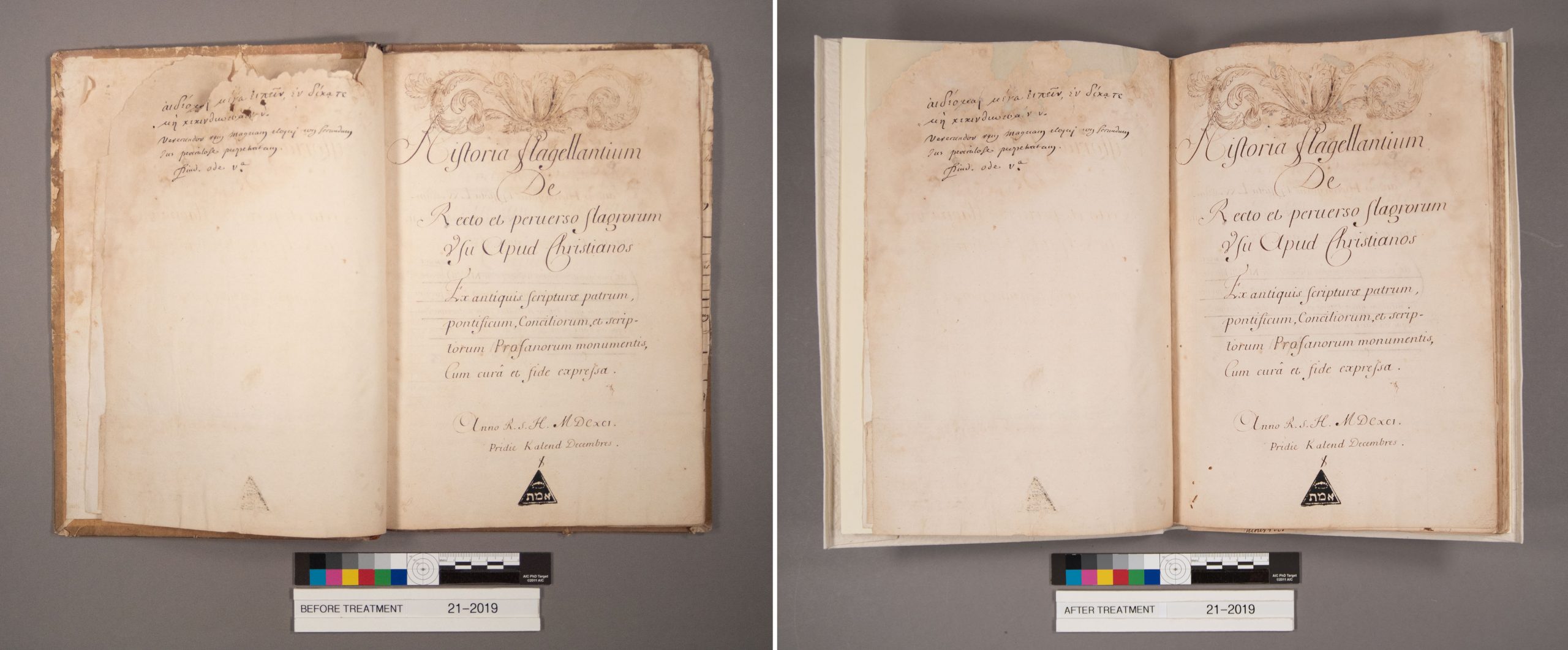
The title page of MS E279 shown before treatment, at left, and after treatment, at right. Click image to enlarge.
The newly-bound volume is housed in a clamshell box along with the old boards. While this manuscript is still fragile, the repairs and new binding will allow it to be consulted by researchers in the reading room, which was not possible in its prior condition. To view this manuscript or any of Spencer’s collections, you may make an appointment to visit the reading room during our updated hours.
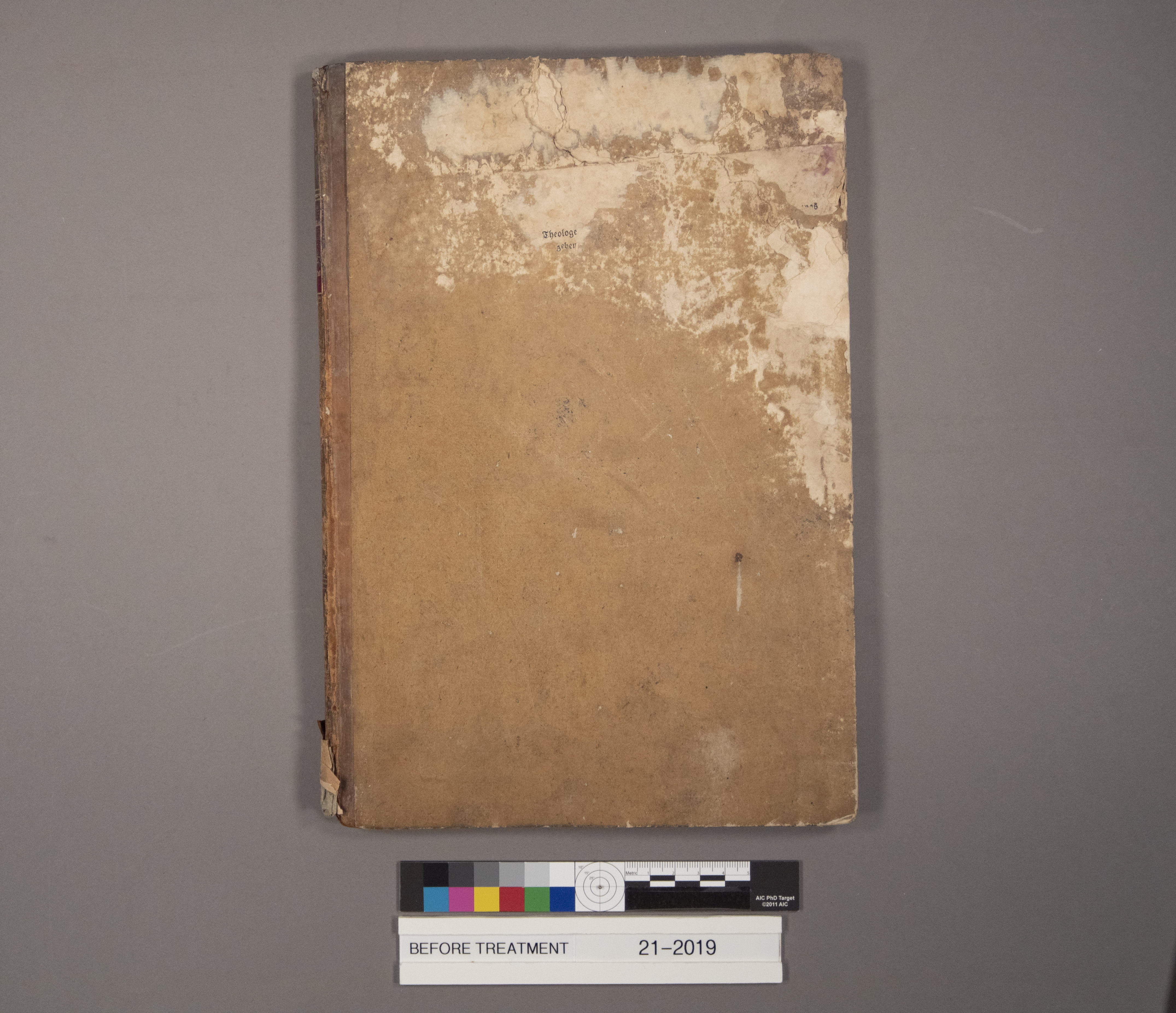
In today’s post I will describe the preparation for and early stages of conservation treatment on MS E279, or Historia flagellantium…De recto et perverso flagrorum usu apud Christianos…Ex antiquis Scripturæ, patrum, pontificum, conciliorum, & scriptorum profanorum monumentis cum curâ & fide expressa, by Jacques Boileau. This volume is the manuscript, dated 1691 and with annotations in the author’s own hand, for the printed version of the same title published in 1700. Spencer also holds a copy of the printed edition at Summerfield B2655.
Damaged cover of MS E279, Historia flagellantium prior to conservation treatment. Click image to enlarge.
The upper third of this volume suffered significant water damage at some time in the past, and mold growth that probably resulted from the water exposure has caused weakness and losses in the paper throughout the upper portion of the volume. The boards are also extremely weak and soft. Because the binding is not contemporary to the text, the curator agreed to a treatment plan that includes disbinding the volume, mending and stabilizing the damaged areas, and placing the text in a new conservation paper case similar to this one.
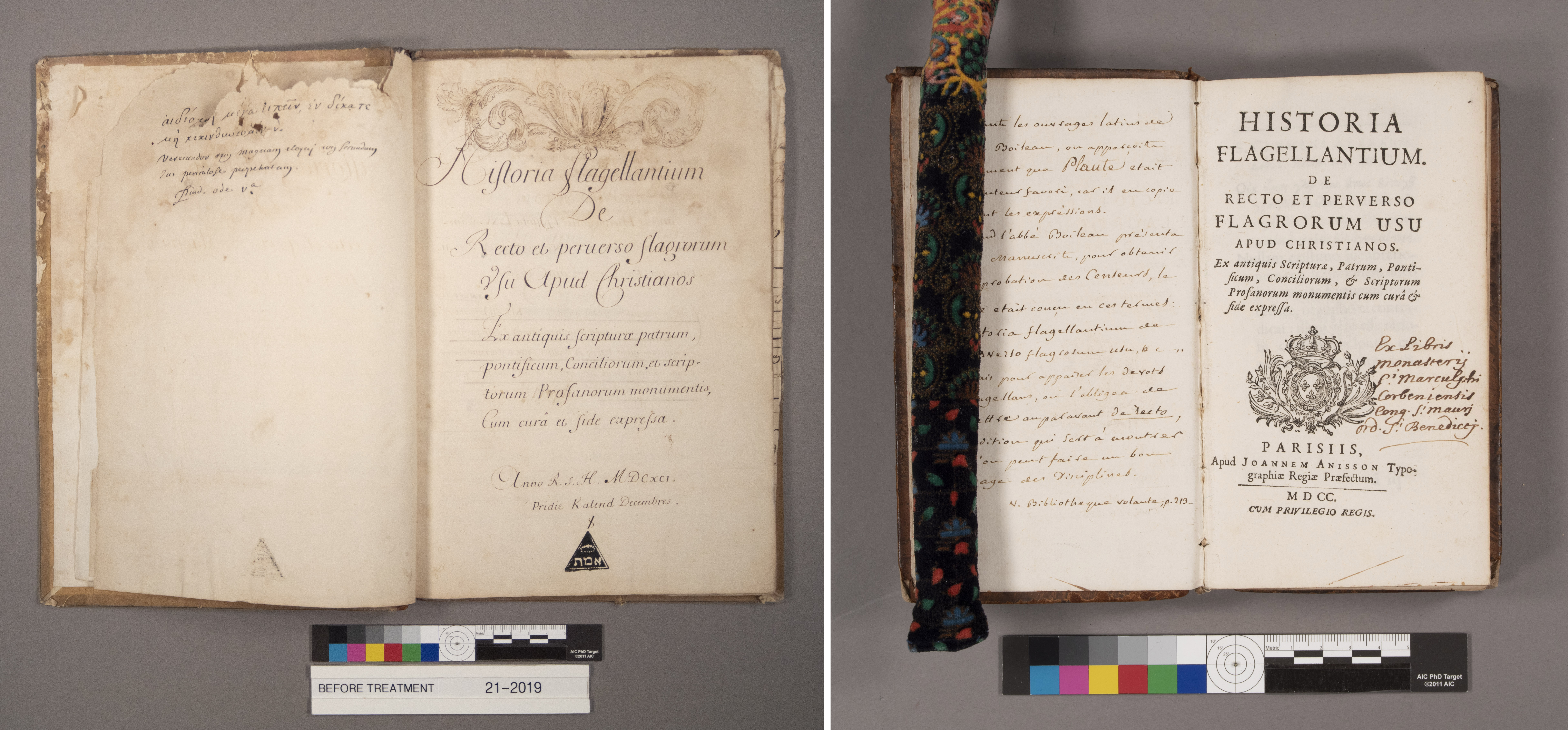
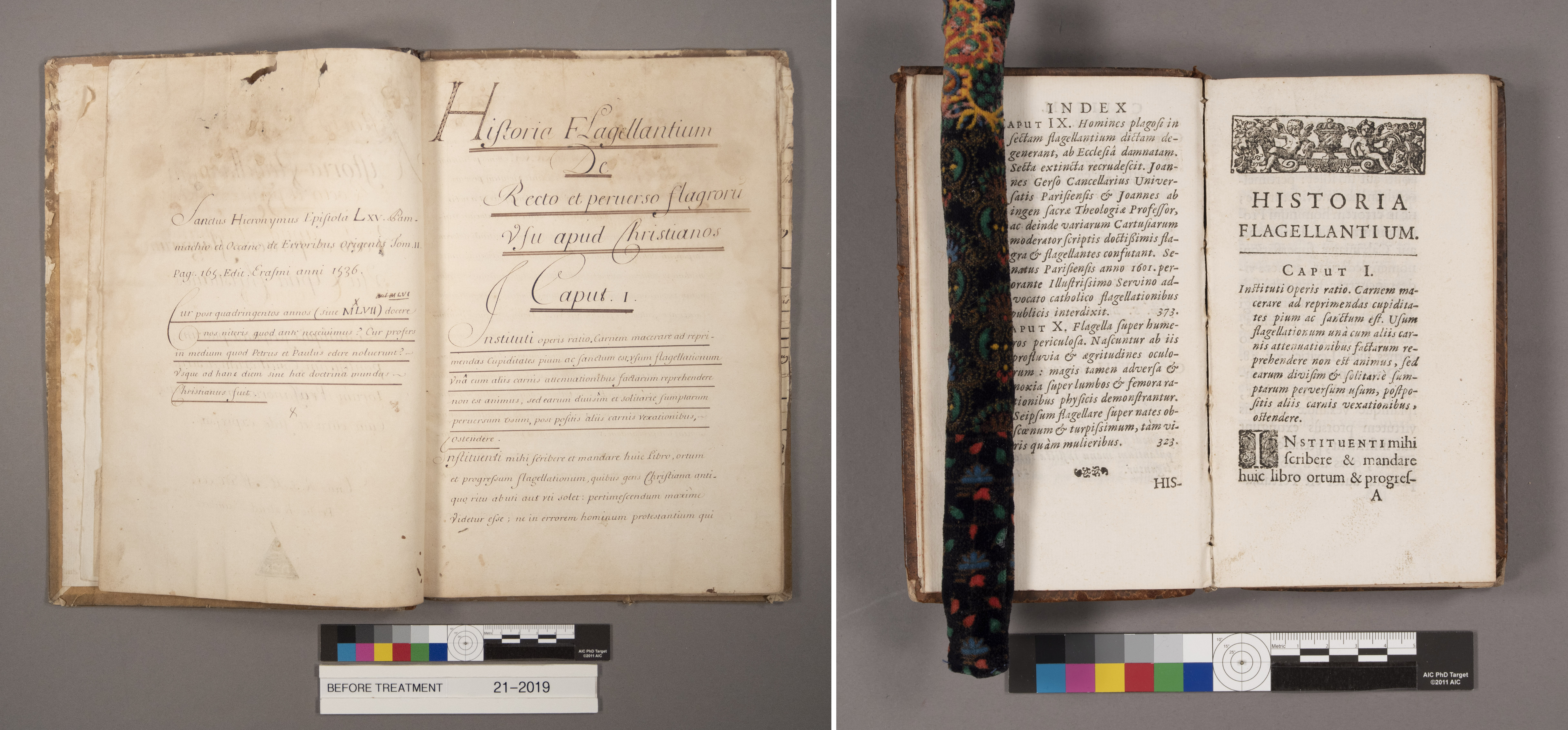
Because Spencer holds both the manuscript and printed versions of this text, I pulled the later volume from the stacks in order to compare the two. While not strictly necessary to the conservation treatment of the manuscript, it is nonetheless just so interesting to see this text at two different stages in its creation – and one never knows when related material might reveal something about the item being treated. Just for fun, here are the title pages and first chapter headings from each version:
Side-by-side comparison of the title pages of both the 1691 manuscript and 1700 printed version of Jacques Boileau’s Historia flagellantium. Click images to enlarge.
Side-by-side comparison of the first chapter headings of both the manuscript and printed version of Jacques Boileau’s Historia flagellantium. Click images to enlarge.
This treatment is in the early stages. I have documented its condition in both writing and photographs, gently cleaned mold spots with soft sponges and brushes (working in our special biosafety cabinet to protect both staff and collections from mold exposure), and begun the process of taking apart the binding. The next steps of mending, preparation for sewing, and binding will happen over the coming weeks, with updates here on the blog!
Angela Andres Special Collections Conservator Conservation Services
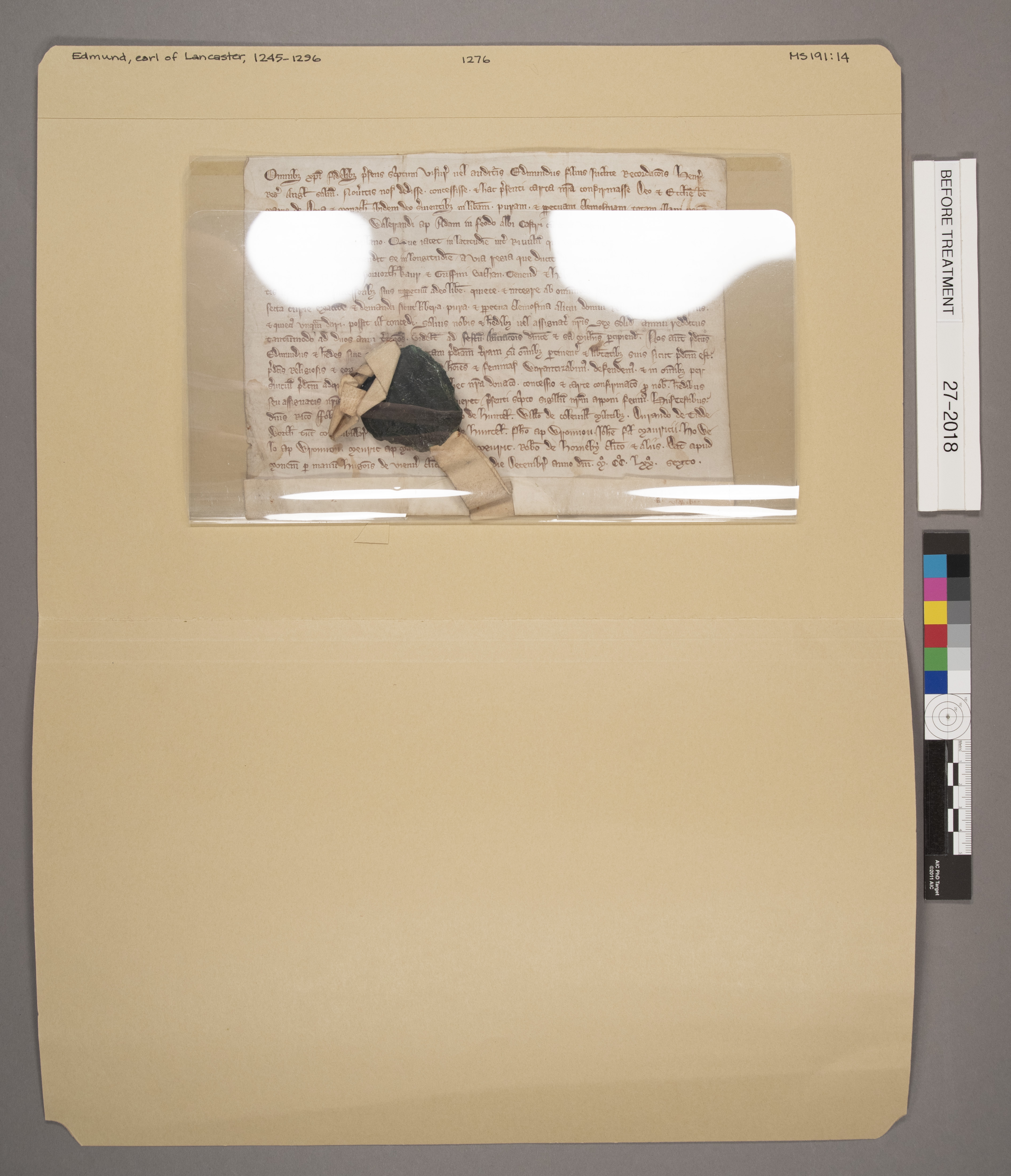
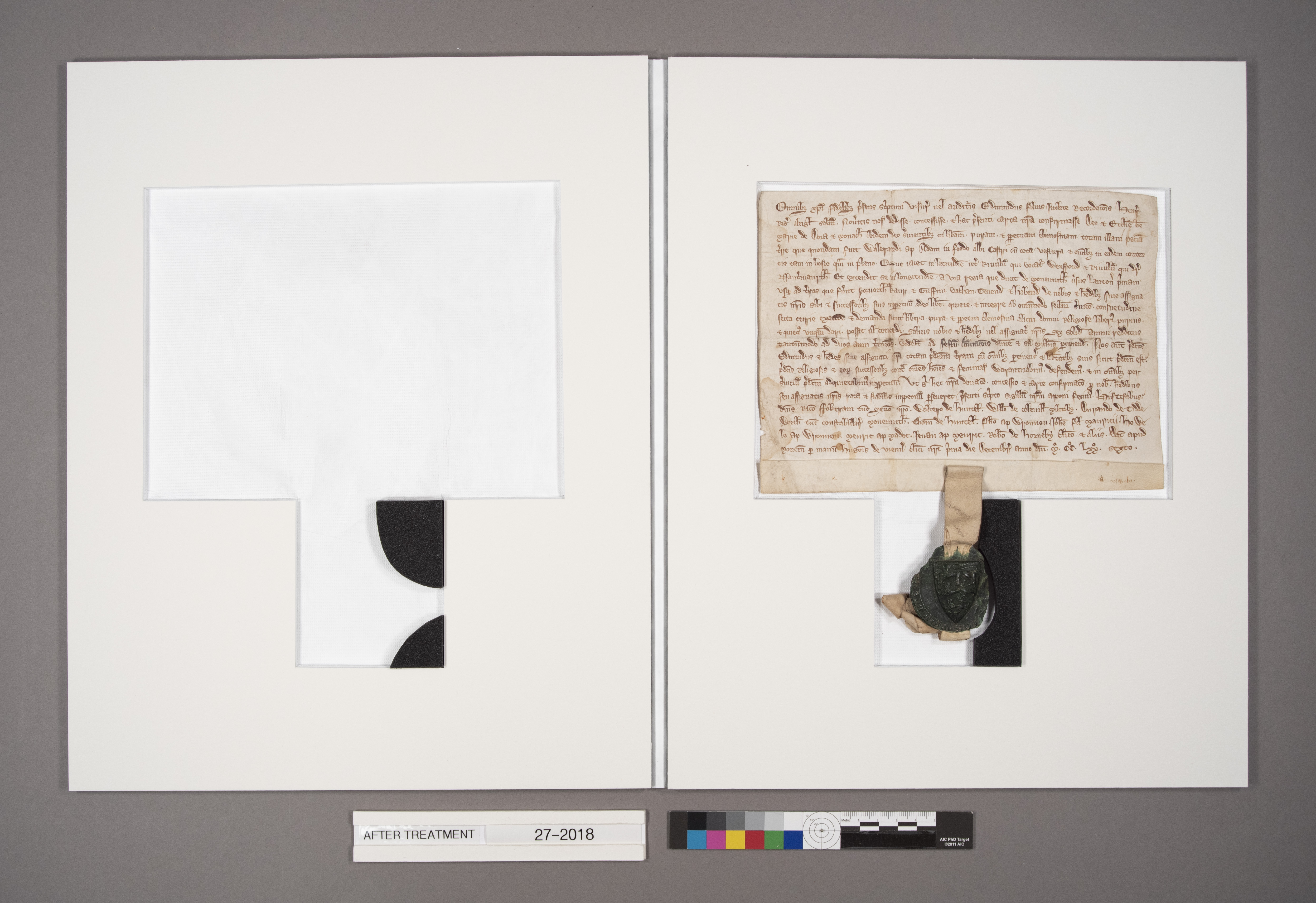
I am in the finishing-up stages of a very enjoyable project to rehouse a group of medieval manuscripts in the Special Collections. The Abbey Dore collection (currently cataloged as MS 191, but soon to be located at MS Q80) includes fifteen parchment manuscripts from the 13th century. Some of the documents have pendant seals attached, and all were housed in a slim manuscript case in folders fitted with polyester film supports inside.
Abbey Dore manuscript with seal before rehousing. MS Q80: 14.
While this system allowed the manuscripts to be stored upright in
folders, which is certainly convenient, it is not the ideal situation for such documents.
The polyester film has sharp edges that could potentially cause damage to the
seals or documents, and some of the seals are heavy or broken and in need of
better support. In discussions with curators and the manuscripts processing
coordinator, we decided to rehouse the manuscripts in flat enclosures. The
collection will now reside in three flat archival boxes, a challenge for the
stacks manager who had to find the space to put them, but all agreed that flat
storage would be best for these materials.
Because these documents have information on both recto and verso, the curators desired that researchers could view both sides with minimal handling of the fragile items. I made a mock-up enclosure that we looked at together, and after some troubleshooting we devised an enclosure with two mirror-image, soft Tyvek-lined cavities. This enclosure can be gently flipped over and opened from either side to view both sides of the document. Plastazote foam bumpers protect the seals from shifting, and each enclosure will be labeled with instructions for use.
Abbey Dore manuscript with seal after rehousing (recto). MS Q80: 14.
Abbey Dore manuscript with seal after rehousing (verso). MS Q80: 14.
Angela M. Andres Assistant Conservator for Special Collections
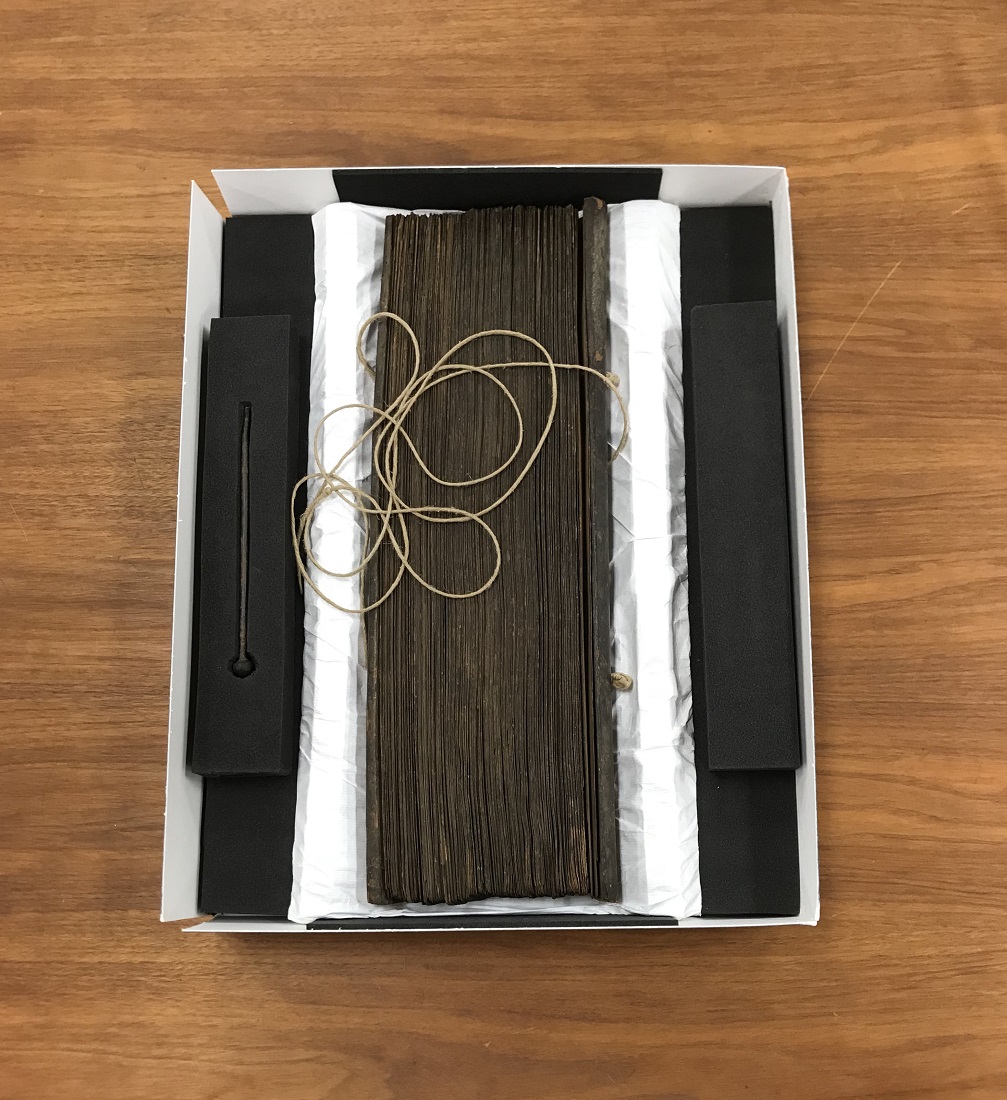
Throughout history, people have found innovative ways to record the written word. Civilizations have used clay, stone, papyrus, animal skin – almost anything they could think of to produce records and share their stories. Recently, I was introduced to another innovative writing surface: palm leaves!
Spencer’s Rāmāyaņa palm-leaf manuscript inside its acid-free storage box.
Call Number: MS Q57. Click image to enlarge.
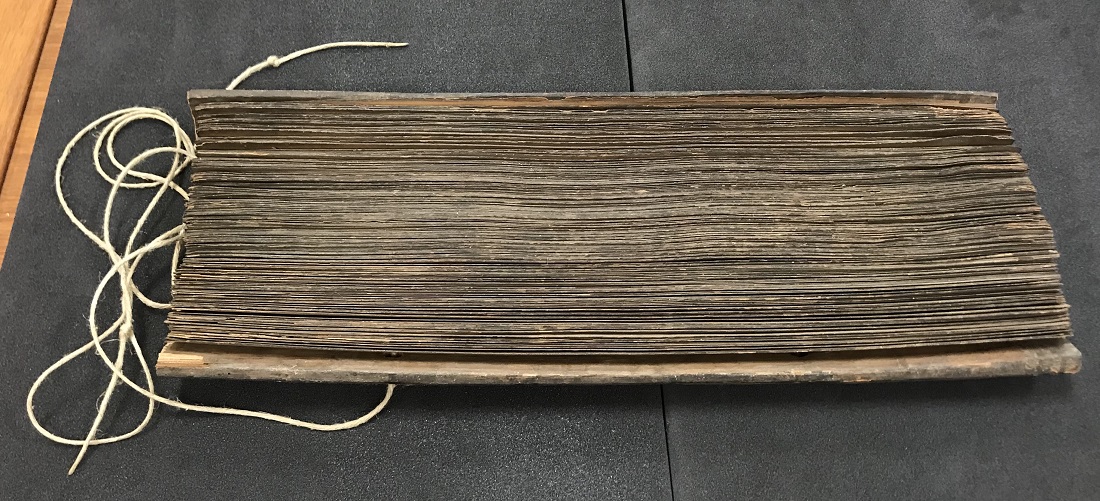
Created in the 17th century, this palm-leaf manuscript (also referred to as a Pothi) contains the first five books of the Rāmāyaņa, an ancient Sanskrit epic about Prince Rama’s quest to rescue his wife, Sita, from Ravana, the 10-headed Rakshasa king of Lanka. While the epic itself dates back to over two millennia ago, the text in Spencer Research Library’s manuscript is a Telugu translation from the 13th century.
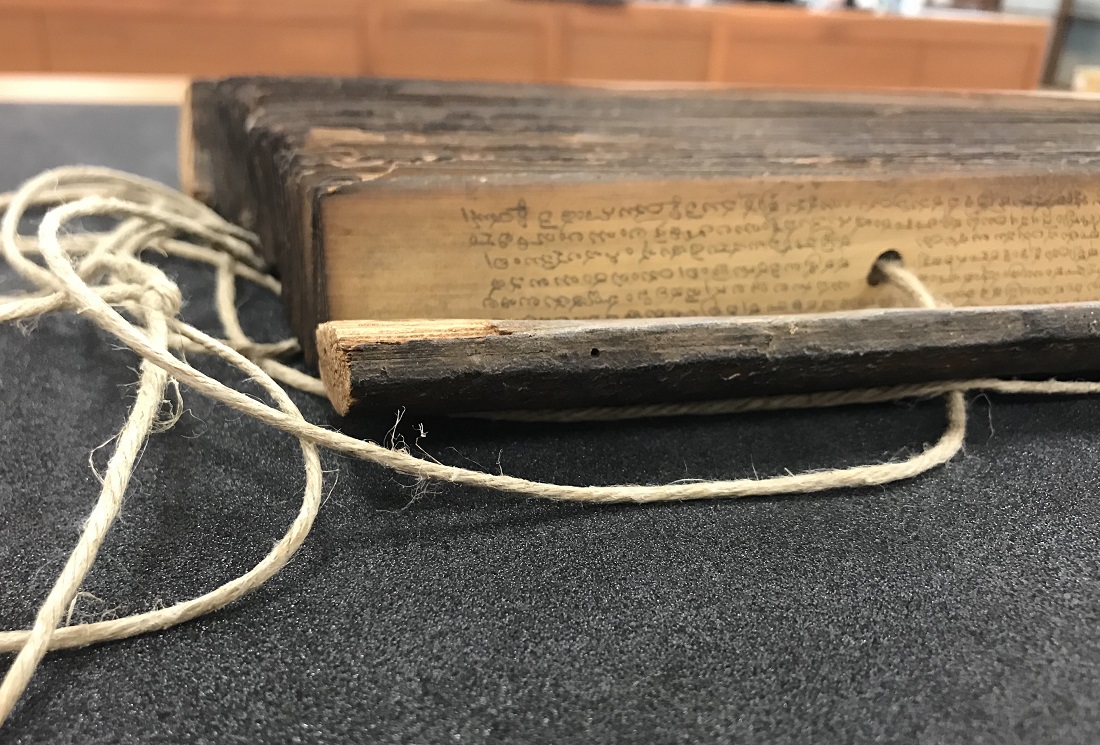
Close-up views of Spencer’s Rāmāyaņa palm-leaf manuscript.
Call Number: MS Q57. Click image to enlarge.
Palm-leaf manuscripts were created by drying and curing palm leaves. Holes were then added to the leaves so that a string could pass through, securing the leaves into a book. To create the text, scribes used a stylus to etch the characters before adding a layer of black soot or turmeric to improve the text’s readability. While the use of palm leaves for writing declined in South India as the printing press became more widely used in the 19th century, thousands of palm-leaf manuscripts containing the history, traditions, and knowledge of the region still exist today.
Save up for your next adventure with Publico student coupons! Enjoy great deals on all your favorite products. Whether you’re looking for new clothes or the latest electronics, we’ve got you covered. With our student coupons, you can save big on the products you need to succeed. Don’t let a tight budget hold you back – shop with Publico and start saving today!