The University of Kansas

Inside Spencer: The KSRL Blog

Books on a shelf

Welcome to the Kenneth Spencer Research Library blog! As the special collections and archives library at the University of Kansas, Spencer is home to remarkable and diverse collections of rare and unique items. Explore the blog to learn about the work we do and the materials we collect.

Celebrating Halloween, KU Style

October 31st, 2013

If you still have yet to carve a pumpkin – or you want to have an especially snazzy jack-o’-lantern this year – consider taking a cue from the KU students pictured below. These photos were taken for the University Daily Kansan on or around Halloween in 1968, which was incidentally just over a week before the brand-new Kenneth Spencer Research Library was dedicated on November 8.

Photograph of KU students carving a pumpkin, 1968.

Photograph of KU students carving a pumpkin, 1968.

Photograph of KU students carving a pumpkin, 1968.

University of Kansas students carving a “KU” jack-o’-lantern, 1968.
Call Number: RG 71/0/1968-1969 Prints: Student Activities (Photos).
Click images to enlarge.

For additional information about the history of Halloween, check out this Library of Congress article, “Halloween: The Fantasy and Folklore of All Hallows.”

Caitlin Donnelly
Head of Public Services

Floating through Homecoming

October 3rd, 2013

The tradition of Homecoming, or welcoming back alumni to the University, conjures up images of crisp fall weather, football teams battling on the gridiron, dancing couples, and . . . floats! For many years KU groups have created floats from chicken wire, wood, crepe paper, and other materials to display in the Homecoming parade.

Photograph of students constructing a homecoming float.

Students construct a Homecoming float in 1969.
Call number: 71/1 /1969/0347. University Archives. Click image to enlarge.

The theme of the floats most typically involves the Homecoming football game–Jayhawk victoriously represented and opponent mascot whimpering in defeat–but not always.

Photograph of a homecoming float.     Photograph of a homecoming float.

Homecoming floats from 1937 (left) and the 1950s (right).
Respective call numbers: 71/1/1937/005 and 71/1/1950s/0110, University Archives. Click images to enlarge.

Enjoy some pictures from the University Archives of Homecoming floats of the past. For more images see the University’s Archives digital collections.

Photograph of a homecoming float.  Photograph of a homecoming float.

A snowman float (?!) from 1946 (left) and a cowboy Jayhawk from 1980 (right).
Respective call numbers: 71/1/1946/0076 and 71/1/1980/0518. University Archives. Click images to enlarge.

Whitney Baker
Head, Conservation Services

A Find in Fraser

September 20th, 2013

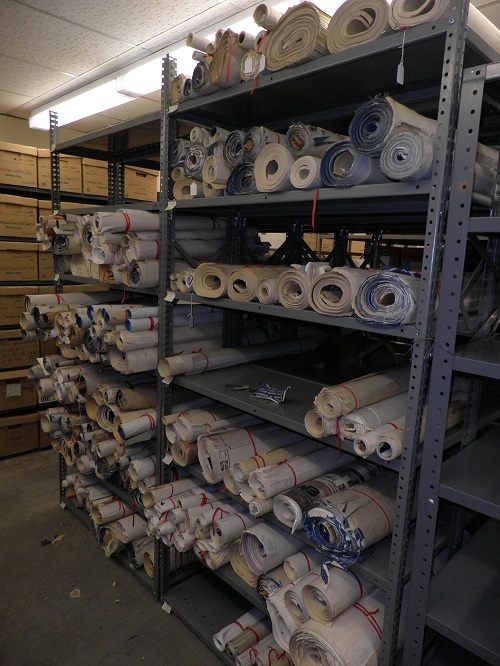
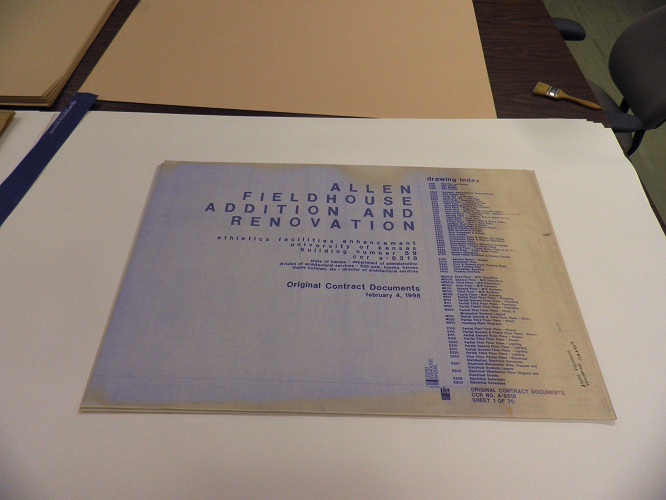
This summer I was the Stannard Conservation Lab Intern at the University of Kansas. I worked on many projects, but the most challenging one was treating a large collection of architectural plans. University Archives already has many architectural plans of KU campus buildings, so it was a surprise when more original plans were found in the attic of Fraser Hall. The plans had been rolled up, tied with string, and left for years in the attic. They were stacked on top of each other and very dirty, some showing signs of bird droppings and cobwebs. Due to this rough storage environment, some of the plans were severely damaged, although most were in fairly stable condition. The plans were moved from Fraser’s attic to University Archives until a more appropriate and permanent storage situation could be found.

Photograph of architectural plans temporarily stored in University Archives.
Rolled architectural plans temporarily stored in
University Archives. Click image to enlarge.

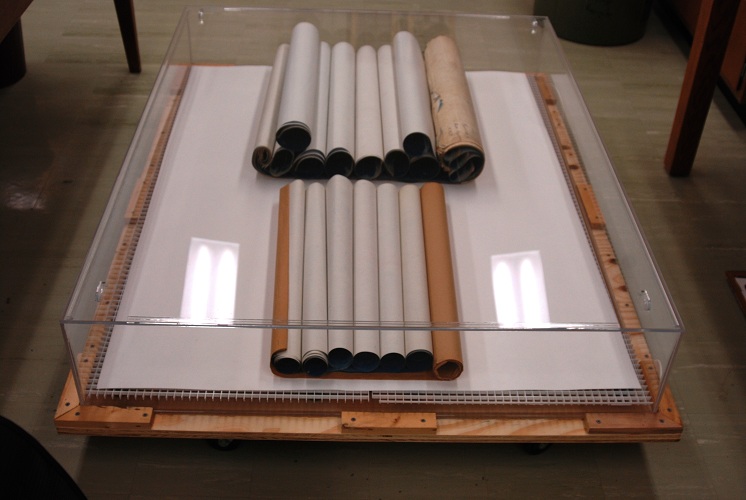
It is best for architectural plans to be stored flat, not only for their preservation but also to save space. Since the plans were stored rolled for so long, they needed to be humidified and flattened before they could be stored in horizontal files in the Archives. This required some creative thinking by the KU conservation team because a humidity chamber had to be specially made to accommodate these large plans.

The construction of the humidity chamber was finished when I started my internship, so I was able to start right in on developing the work procedure for humidifying and flattening the plans. I developed a documentation process to keep track of the plans that were treated and instituted an efficient work flow to keep the project rolling.

Photograph of the humidity chamber.
The specially-built humidity chamber at KU’s Conservation Lab.
Click image to enlarge.

The rolled plans were sorted by what building they depicted and then moved to the work room in their respective groups. Next, the drawings were prepared for humidification: staples were removed and important information about the plans – including title and date – were recorded in a database. The plans were then humidified and flattened. Lastly, the plans were placed in labeled folders and stored in the Archive’s new horizontal storage cases. The work procedure I developed allowed the other interns to continue the flattening and filing process even after my internship ended.

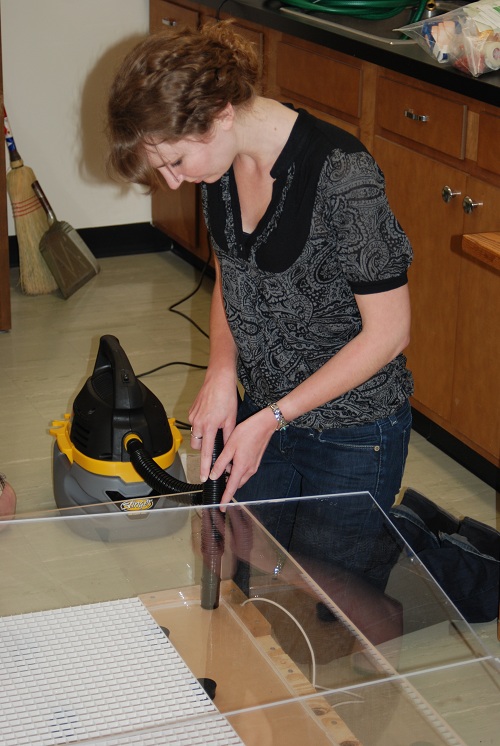
Photograph of Summer Conservation Intern Erin Kraus.
Summer Conservation Intern Erin Kraus removes
water from the humidity chamber with a wet vac.
Click image to enlarge.

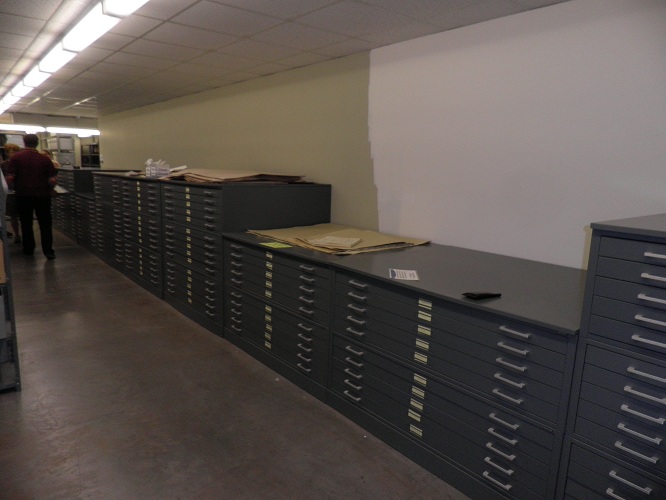
Photograph of horizontal storage cases.
New horizontal storage cases in University Archives.
Click image to enlarge.

These historic plans were an important discovery because they can still be useful to architects today when improvements are being made to buildings. The conservation of the plans so far turned out beautifully, so it was very satisfying to see the progress made on the project.

Photograph of humidified and flattened plans.
Architectural plans after humidification and flattening.
Click image to enlarge.

The conservation lab at KU was a great place to spend my summer and I learned a lot from this project. Having an internship in Kansas allowed me to not only spend time in my home state, but to also get to know all of the wonderful people at the Stannard Conservation Lab. Thanks for a great summer!

Erin Kraus
2013 Conservation Summer Intern

On a Roll

September 12th, 2013

Conservation Services is working on a project to better store our rolled collection material. During the assessment of rolled collections, University Archivist Becky Schulte and Assistant University Archivist Letha Johnson presented us with a fat, canvas roll. It wasn’t labeled on the outside, so we had to unroll it to determine what it was.

Unrolling a mural that once hung in the Kansas Union, University of Kansas, 1950s.  Rolling a mural that once hung in the Kansas Union, University of Kansas, 1950s.

Unrolling (left) and re-rolling on an alkaline buffered core (right) a mural that once hung in the Kansas Union.
Call number 0/22/54/i 1950s, University Archives. Click images to enlarge.

Turns out, it is a mural depicting scenes from prairie life in the days of the “Wild West.” There are cowboys rounding up a herd of cattle, settlers waving goodbye to a group of covered wagons and a stagecoach, and two Native Americans watching the scene. The faces of Spanish explorers who once searched the plains for El Dorado, the city of gold, peer out from the clouds in the middle of the mural.

Detail of a mural once hung in the Kansas Union, University of Kansas, 1950s.     Detail of a mural once hung in the Kansas Union, University of Kansas, 1950s.

Details from the mural. Stagecoach with Spanish explorer in the clouds (left) and Native Americans observing the scene (right). Call number 0/22/54/i 1950s, University Archives. Click images to enlarge.

The mural was painted by H. C. Crain in 1952 and measures 46 feet, 9 inches long and 5 feet tall. In the 1950s it adorned a wall in the Trail Room on the second floor of the Memorial Union. Not much else is known about its origins.

Photograph of a mural in the Kansas Union, University of Kansas, 1950s.     Photograph of a mural in the Kansas Union, University of Kansas, 1950s.

Photograph of a mural in the Kansas Union, University of Kansas, 1950s.

Images of the mural when it hung in the Kansas Union cafeteria, 1950s. Left section (above left), middle section (above right), and right section (below). Call number 0/22/54/i 1950s, University Archives. Click images to enlarge.

Staff in Conservation Services transported the mural to Spencer Library’s North Gallery in order to unroll it for photography and re-roll it on an alkaline-buffered tube. The completed roll will be covered with a muslin dustcover and labeled with an image of the mural to prevent unnecessary handling. As we improve rolled storage in Spencer Library, we will eventually hang this rolled item, along with others, on specially designed racks.

Whitney Baker
Head, Conservation Services

“This is a Fun Locality for Botanizing”: Francis H. Snow and KU Students in Colorado

August 30th, 2013

Soon after my arrival at Spencer Research Library, a patron request provided me the opportunity to poke around some of the photographs contained within KU’s University Archives. I was especially excited by a collection of approximately forty-five photographs showing Professor Francis H. Snow with a group of students on a summer collecting expedition to Colorado in the late 1800s.

Photograph of Specimen Mountain Party, No. 3, August 19, 1889 [1891?].
Specimen Mountain Party, No. 3, August 19, 1889 [1891?].
Call Number: RG 17/40/1889 Prints: Biological Sciences (Photos).
Click image to enlarge.

Long a prominent fixture on campus during KU’s early years, Snow (1840-1908) was a professor of mathematics and sciences, 1866-1890; the university’s fifth chancellor, 1890-1901; and a professor of natural history/director of the natural history museum, 1901-1908. His reports to the regents “furnish ample evidence that the direct study of nature was a vital part of his instruction,” wrote Clyde Kenneth Hyder in his biography, Snow of Kansas. His classes “appealed to the impulse to collect, often compelling, whether the objects collected be patchboxes, African violets, or insects” (142-143). Moreover, between 1876 and 1907, Snow – frequently accompanied by his students and sometimes even his family – led twenty-six summer collecting expeditions: eight in Colorado, six in New Mexico, six in Arizona, four in Kansas, and two in Texas. As Hyder noted, “those who accompanied Snow on these expeditions included some who afterwards became distinguished scientists” (153). Future journalist and author William Allen White participated in one of the expeditions during his time as a KU student. The thousands of specimens Snow and his students collected and classified during these trips – including insects, birds, reptiles, and plants – were brought back to Lawrence and preserved as part of the university’s “cabinet of natural history,” now the Natural History Museum.

Photograph of Lily Mountain and Park from Eagle Cliff, June 26, 1889 [1891?].
Lily Mountain and Park from Eagle Cliff, June 26, 1889 [1891?].
Will Franklin, [James Frank?] Craig, Harry Riggs (standing).
Call Number: RG 17/40/1889 Prints: Biological Sciences (Photos).
Click image to enlarge.

Photograph of the Big Thomson and Terminal Moraine, July 2, 1889 [1891?].
The Big Thomson and Terminal Moraine, July 2, 1889 [1891?].
Call Number: RG 17/40/1889 Prints: Biological Sciences (Photos).
Click image to enlarge.

Snow’s expeditions are well-documented in various primary and secondary sources at Spencer, but only one or two were photographed. Notes on the back of the images I examined indicate that they were taken in Estes Park, Colorado, but there is some confusion as to whether they were taken during the expedition there in 1889 and/or during the collecting trip to Manitou Park, Colorado, two years later. Either way, the photographs provide a glimpse into camp life and the collectors’ activities against the backdrop of dramatic and beautiful mountain landscapes. (I’m also left wondering how the female students managed to trek around – collecting samples, hunting, and fishing – in those long, voluminous skirts!)

Photograph of E. C. Franklin. Top of Windy Gulch, 1889 [1891?].
E. C. Franklin. Top of Windy Gulch, 1889 [1891?].
Call Number: RG 17/40/1889 Prints: Biological Sciences (Photos).
Click image to enlarge.

Photograph of "The Girls Bridge," August 19, 1889 [1891?].
“The Girls Bridge,” August 19, 1889 [1891?].
Helen Sutliff, [James Frank?] Craig, J. S. Sutliff,
Will [William Suddards] Franklin, Eva Fleming, Harry Riggs,
woman “not of our party but a K.U. girl I think.”
Call Number: RG 17/40/1889 Prints: Biological Sciences (Photos).
Click image to enlarge.

Photograph of group off for Specimen Mountain, July 22, 1889 [1891?].
Off for Specimen Mountain, July 22, 1889 [1891?].
In front, S. C. [Schuyler Colfax?] Brewster, Fred Funston,
Will Brewster, Herb Hadley, Ed Franklin, Harry Riggs, Billy the Burro,
Will [William Suddards] Franklin, [James Frank?] Craig.
Call Number: RG 17/40/1889 Prints: Biological Sciences (Photos).
Click image to enlarge.

Photograph of group on Long's Peak Trail, August 6, 1889 [1891?].
On Long’s Peak Trail, just beyond Keyhole
looking towards the Trough, August 6, 1889 [1891?].
V. L. Kellogg, Ed Franklin, Will [William Suddards] Franklin,
[Alvin Lee] Wilmouth?, Eva Fleming, [James Frank?] Craig,
S. C. [Schuyler Colfax?] Brewster, ?Will Brewster, Hadley,
Dr. Snow. Call Number: RG 17/40/1889 Prints:
Biological Sciences (Photos). Click on image to enlarge.

For additional information about the 1889 collecting expedition, see Professor Snow’s wonderful letter to his wife and family, dated August 2nd. The original document, from which the title of this blog post was drawn, is held within KU’s University Archives (RG 2/6/6, Chancellor’s Office. Francis H. Snow. Correspondence, 1883-1885. Letters, 1862-1903.); Hyder included almost all of the letter in his Snow of Kansas.

Caitlin Donnelly
Head of Public Services