The University of Kansas

Inside Spencer: The KSRL Blog

Books on a shelf

Welcome to the Kenneth Spencer Research Library blog! As the special collections and archives library at the University of Kansas, Spencer is home to remarkable and diverse collections of rare and unique items. Explore the blog to learn about the work we do and the materials we collect.

This blog may contain archived web content. This blog may link to catalog records which no longer exist as of a software change in 2026.

KU Anniversaries: A Cause for Celebration

July 23rd, 2014

As the University of Kansas approaches its 150th anniversary in the fall of 2015, one might be wondering how the university celebrated its previous milestones. For more recent anniversaries there was a trend of looking to the future, while the earlier ones looked to the past. What path will this anniversary follow? My guess would be a little bit of both, but only time will tell.

The Quarter-Centennial: 25th Anniversary 1890/91

KU celebrated 25 years of its history with a gathering of alumni, school and state officials, and the publication of a book (two practices that would continue for most anniversaries). The book, written by M.W. Sterling, sold for $1.00 and covered several aspects of the university’s first 25 years. One memorable section recalled some practical jokes. During commencement a grinning skeleton descended from a hole in the rafters, dancing and shaking to the band’s music. On its toe was stuck a piece of paper that read the Latin word ‘prex’. What does ‘prex’ mean you may ask? The faculty.

The Semi-Centennial: 50th Anniversary 1915/16

The 50th anniversary for KU fell during international warfare, with the United States on the brink of joining the battle. This would not be the last time that KU’s anniversary would come during a World War; only 25 years later for the Diamond Jubilee the world would be at war again. With funding restricted and bigger issues to handle, the university senate understandably decided the $4,000 price tag for a celebration in May 1916 would not be possible. Chancellor Strong said the celebration would be postponed until “ways and means” could be provided. However, the following year would prove just as restrictive and the celebration never came to be.

The Diamond Jubilee: 75th Anniversary 1940/41

Following the lack of celebration 25 years earlier, KU made up for it in a grand, five-day celebration in 1941 that took three years of planning. This included a university-wide exposition, the reopening of Dyche Museum (now the Museum of Natural History), the publication of Across the Years on Mount Oread by Robert Taft, with over 300 photographs of the campus from the previous 75 years, a song contest, symposiums, class and group reunions, dinners and entertainments which included a Coronado Entrada and Kansas Cavalcade. To make sure that the returning alumni would feel right at home again on campus, 60 young women dressed in 1866 period gowns to help visitors around campus. Plus, old fashioned hitching posts were erected and the main mode of transportation was by horse and carriage.

Photograph of representative members of the previous 75 classes at the November 9th conclave. Photo of One of the 60 young women dressed in appropriate 1866 period fashion.

Representative members of the previous 75 classes at the November 9th conclave (left) and One of the 60 young women dressed in appropriate 1866 period fashion (right). University Archives. Call Number: RG 0/6 (Photos), 1941. Click to enlarge.

Women posing in a section of the diorama in the newly reopened Dyche Museum, 1941 Photograph of a group of women showing off the horse-drawn carriages and hitching posts used for the celebration.

Some of the ladies posing in a section of the diorama in the newly reopened Dyche Museum (left); A group of women showing off the horse-drawn carriages and hitching posts used for the celebration (right). University Archives. Call Number: RG 0/6 (Photos), 1941. Click to enlarge.

Photograph of a participant in the Coronado Entrada on campus overlooking the football stadium.

A participant in the Coronado Entrada on campus overlooking the football stadium. Call Number: RG 0/6 (Photos), 1941. Click image to enlarge.

Centennial: 100th Anniversary 1965/66

To be expected, the centennial celebration was a multi-day affair just like the 75th (minus the historical gowns and hitching posts). Whereas the previous anniversary celebrated the past, this one looked to the future and was highlighted by the Inter-Century Seminar, “Man and the Future.” The seminar brought together great intellectuals who discussed and lectured on the challenges of the next one hundred years. On the other hand, Clifford S. Griffin undertook a massive compilation of the past 100 years of history in his book: The University of Kansas, A History. While thoroughly covering KU’s history, Griffin kept in mind the Centennial’s theme of “progrediamur” (let us progress) and discussed the possibilities of the university’s future.

Photograph of medallion designed by Elden Tefft, for the 1966 centennial.

Designed by Elden Tefft, the medallion showcases the Lawrence campus silhouette along the bottom. The column on the left is composed of 26 symbols: three Jayhawks; a salamander, trilobite, bee and others denote scientific accomplishments; the wheat and sunflower for Kansas; 10 points of the star signify the nine schools and college. Call Number: RG 0/5 (photos): 1966

Photograph of the official dinner for the Inter-Century Seminar, 1966

The official dinner for the Inter-Century Seminar. Call Number: RG 0/5 (photos): 1966

Quasquicentennial: 125th Anniversary 1990/91

In response to the Centennial’s Inter-Century Seminar, the 125th anniversary hosted a similar session, “Looking forward: KU and the Challenges of the Future”. The participants took into account what was predicted 25 years earlier and offered their opinions. According to one prediction from the 1966 seminar by Arthur C. Clarke, British scientist and science fiction writer, man will have established a permanent base on Mars by 2066. That doesn’t sound as crazy now as I’m sure it did just 25-50 years ago.

JoJo Palko
University Archives Intern

World War I and KU: A Reflection on the 100 year Anniversary

July 3rd, 2014

June 28, 2014 marked the unofficial 100 year anniversary of the beginning of World War I. On that day 100 years ago, Archduke Franz Ferdinand of Austria was assassinated. That tragic moment put into motion the dominoes that would fall one month later, resulting in a war that would last four years and forever change the course of history. As the world looks back on this event, I wanted to find what connections the University of Kansas had to the Great War. Simply put: there are a lot. For this entry, I will focus on the beginnings of KU’s involvement with the war. From the Student Army Training Corps (SATC)—a forerunner of the ROTC on campus—to the first American army officer killed, KU becomes forever linked with the Great War.

Student Army Training Corps barracks, KU Campus. University Archives, Kenneth Spencer Research Library. Call number 0.22.89.

Overview of the SATC barracks that were constructed on campus. The barracks cost $180,000 and helped house the influx of 2,500 soldiers. University Archives, call number 0/22/89 1918. Click image to enlarge.

Student Army Training Corps classes, KU Campus. University Archives, Kenneth Spencer Research Library. Call number 29.0.

Group of SATC classes pose in front of Fowler Shops with the instructors in the center. Classes included carpentry, machinery, auto shop, blacksmith, telegraphy, and radio. University Archives, call number 29/0 1918.
Click image to enlarge.

The University of Kansas Graduate Magazine issues during 1917-1919 offer valuable insight about campus life before, during, and after the United States joined the war. One topic of contention was the SATC. Wanting to make itself fully available for the service of the country, while also still providing quality education to its students, the university administration struggled to produce a compromise. The result was a majority of War Department approved courses combined with a required course on “war aims” to understand the multitude of causes of the conflict. The photographs below are just a sampling of what these courses, including Red Cross classes for women, looked like on campus almost 100 years ago.

McCook Field, KU Campus. University Archives, Kenneth Spencer Research Library. Call number 29.0.

SATC Commander Scher talks with a group at McCook Field in 1918.
University Archives, call number 29/0 1918. Click image to enlarge.

Telegraphers. University Archives, Kenneth Spencer Research Library. Call number ksrl_ua_29.0_telegraphers_1918

SATC telegraph class members practice wigwagging (sending messages by moving two flags according to a code) on the University’s campus. University Archives, call number 29/0 1918. Click image to enlarge.

Of the 9 million war casualties, 129 were KU men and women. Of those 129, Dr. William T. Fitzsimmons was the first American army officer killed in the war. Fitzsimmons was born in Burlington, Kansas, graduated from the University of Kansas in 1910, and received his M.D. in 1912. A lieutenant in the Medical Reserve Corps, he was stationed in France at an allied hospital base. On the night of September 4, 1917, Fitzsimmons’ unit was bombed by airplanes. His death saddened and shocked the university community, bringing what seemed like a distant war immediately closer to home.

William T. Fitzsimmons. University Archives, Kenneth Spencer Research Library. Call number 0.22.54.

Portrait of William T. Fitzsimmons, the first KU (and American) officer to be killed in World War I.
University Archives, call number 0/22/54 1918. Click image to enlarge.

JoJo Palko
University Archives intern


KU Students Studying Hard, 1950-1985

May 14th, 2014

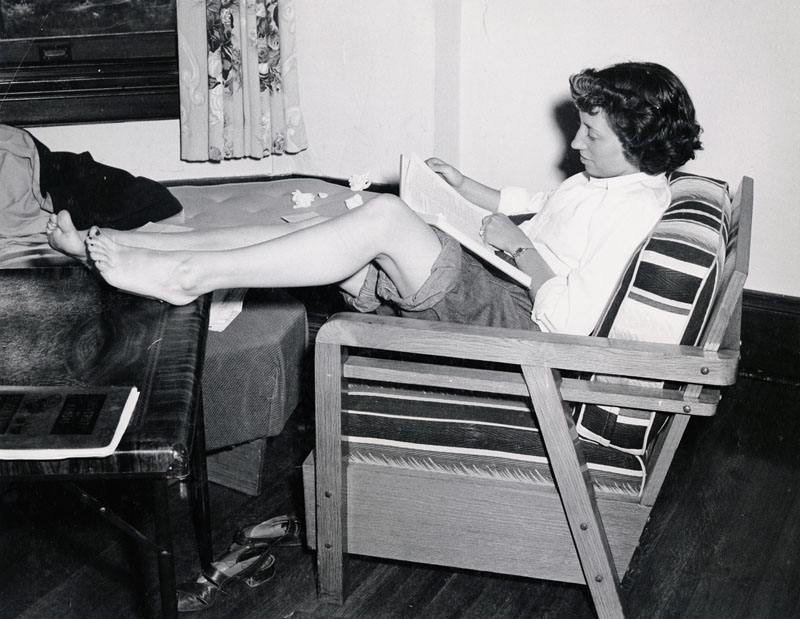
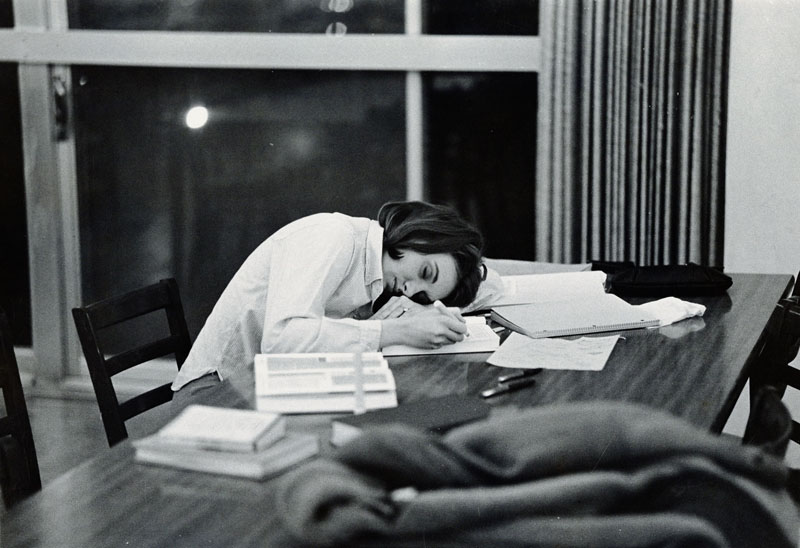
Spring has finally, truly arrived on Mount Oread, which has meant the eagerly-awaited return of warmer weather and the not-so-eagerly-awaited return of final exams. The Student Activities record group in University Archives contains a number of photographs showing the bowed heads of generations of anxious KU students poring over their work.

While it’s unclear, in almost all cases, whether these pictures were taken during final exams, this time of year seems like the most appropriate time to feature some of these fun images here at “Inside Spencer.”

Good luck to all KU students on their final exams!

Photograph of group of female students studying, 1950s.

Group of students studying, 1950s. University Archives Photos.
Call Number: RG 71/0/1950s Prints: Student Activities (Photos).
Click image to enlarge.

Photograph of student with typewriter outside, 1950s.

Student with typewriter, 1950s. University Archives Photos.
Call Number: RG 71/0/1950s Prints: Student Activities (Photos).
Click image to enlarge.

Photograph of student studying with bare feet, 1950s.

Bare feet, 1950s. University Archives Photos.
Call Number: RG 71/0/1950s Prints: Student Activities (Photos).
Click image to enlarge.

Photograph of student asleep while studying, 1967-1968.

Asleep while highlighting, 1967-1968. University Archives Photos.
Call Number: RG 71/0/1967-1968 Prints: Student Activities (Photos).
Click image to enlarge.

Photograph of student studying under trees, 1969-1970.

Studying in the shade, 1969-1970. University Archives Photos.
Call Number: RG 71/0/1969-1970 Prints: Student Activities (Photos).
Click image to enlarge.

Photograph of a student sleeping with note, 1970s.

“I’m too nervous to sleep in my room,” 1970s. University Archives Photos.
Call Number: RG 71/0/1970s Prints: Student Activities (Photos).
Click image to enlarge.

Photograph of a student studying on a stump, 1975-1976.

Studying on a stump, 1975-1976. University Archives Photos.
Call Number: RG 71/0/1975-1976 Prints: Student Activities (Photos).
Click image to enlarge.

Photograph of student studying on top of backpack, 1976-1977.

Backpack as table, 1976-1977. University Archives Photos.
Call Number: RG 71/0/1976-1977 Prints: Student Activities (Photos).
Click image to enlarge.

Photograph of a panicked student looking up, October 1978.

Panic, October 1978. University Archives Photos.
Call Number: RG 71/0/”A Day in the Life of KU, October 13, 1978″
Prints: Student Activities (Photos). Click image to enlarge.

Photograph of student studying with calculator and printouts, 1979-1980.

Calculator and computer printouts, 1979-1980. University Archives Photos.
Call Number: RG 71/0/1979-1980 Prints: Student Activities (Photos).
Click image to enlarge.

Photograph of student studying behind grate, 1979-1980.

Creative (and uncomfortable?) study location, 1979-1980. University Archives Photos.
Call Number: RG 71/0/1979-1980 Prints: Student Activities (Photos).
Click image to enlarge.

Photograph of two students studying on stairs, 1980-1981.

Studying on stairs, 1980-1981. University Archives Photos.
Call Number: RG 71/0/1980-1981 Prints: Student Activities (Photos).
Click image to enlarge.

Overhead photograph of student studying, 1981-1982.

Sprawled out, 1981-1982. University Archives Photos.
Call Number: RG 71/0/1981-1982 Prints: Student Activities (Photos).
Click image to enlarge.

Photograph of student working in his room, 1982-1983.

Student working in his room, 1982-1983. University Archives Photos.
Call Number: RG 71/0/1982-1983 Prints: Student Activities (Photos).
Click image to enlarge.

Caitlin Donnelly
Head of Public Services

Collection Snapshot: Chancellor Fraser’s Saber and Belt

April 25th, 2014

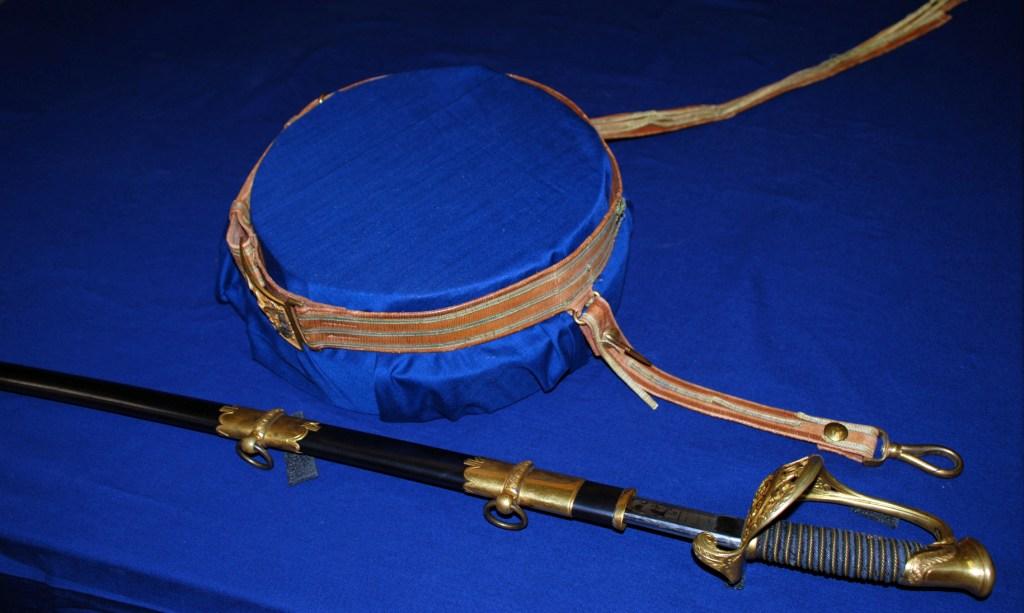
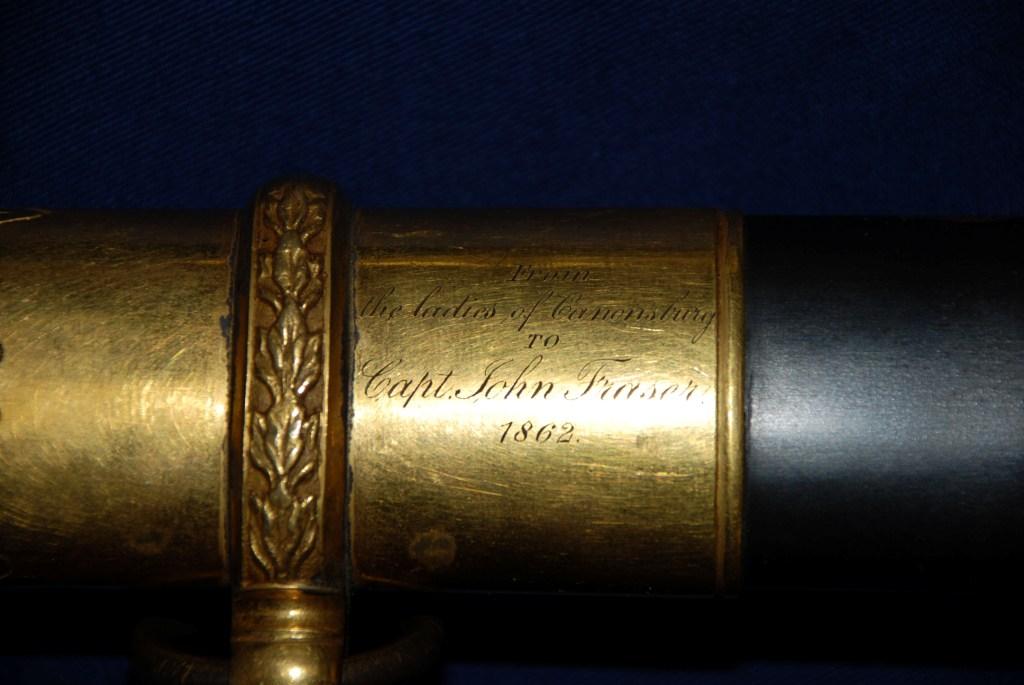
John Fraser, KU’s second Chancellor, served as a general in the Union Army during the Civil War.  Displayed here are his dress saber and saber belt.  The saber was an 1862 gift from “the ladies of Canonsburg,” Pennsylvania, in appreciation of his service.

Chancellor Fraser's saber and belt

Saber inscription
Saber belonging to John Fraser. Records of  the Office of the Chancellor: John Fraser. Call Number: RG 2/2: Saber

For additional images, please click to enlarge:

Belt detailSaber detail

Becky Schulte
University Archivist

Liberal Arts Education: The Key to a Happy Valentine’s Day?

February 15th, 2014

The value of a liberal arts education is – and has long been – a topic of substantial discussion. With Valentine’s Day upon us, we wanted to highlight a perhaps little-known benefit of liberal arts courses and majors: they can help you attract or catch a love interest. Such was the “tongue-and-cheek” argument of a pictorial feature that appeared in the April 1970 edition of Kansas Alumni. Seven photographs told a story that unfolded throughout the publication, accompanied by captions extolling the benefits of a liberal arts education that were taken from “none other than” the Catalog of the College of Liberal Arts and Sciences. Prints of six of the images – the first six pictures below – are held within University Archives as part of its collection of Student Activities records and photographs (Record Group 71).

Photograph of a female KU student reading anthropology, 1970

The introduction to “Pictorial: The Liberal Arts” from Kansas Alumni, April 1970.
University Archives. Call Number: RG UA Ser 64/0/2. Click any image to enlarge.

Photograph of a female KU student reading book about voodoo, 1970

While the lower right corner was cropped out of the published picture, the
original print shows that KU Libraries can also help you catch the
object of your affection! University Archives. Call Number: RG 71/0/1969-1970
Prints: Student Activities (Photos). This citation applies to all images in this
post unless otherwise noted.

Photograph of a  female KU student reading about spells, potions, and enchantments, 1970

Photograph of a female KU student with an offering, 1970

Photograph of a female KU student mixing a love potion, 1970

Photograph of a female KU student using love potion, 1970

Photograph of a female KU student with the object of her affection behind a stack of books, 1970

The caption for the final image in the story – as it appeared in
Kansas Alumni
– doesn’t seem to bode well for the guy behind the books!
University Archives. Call Number: RG UA Ser 64/0/2.

Happy Valentine’s Day!

Caitlin Donnelly
Head of Public Services

Student Activities Photographs RG 71/0 1969/1970 Prints