The University of Kansas

Inside Spencer: The KSRL Blog

Books on a shelf

Welcome to the Kenneth Spencer Research Library blog! As the special collections and archives library at the University of Kansas, Spencer is home to remarkable and diverse collections of rare and unique items. Explore the blog to learn about the work we do and the materials we collect.

Romeo and Juliet: Creative Reimaginings

May 23rd, 2017

Spencer Research Library certainly has the staples for any Shakespeare-phile: a complete Second Folio, a partial First Folio, individual books, and works from his contemporaries Thomas Heywood, Ben Jonson, Philip Sidney, and others. Printed in ages past, these works demonstrate the long history and enduring fascination scholars and bibliophiles alike maintain concerning the works of the Bard and the many social issues he addresses in them. But more importantly, KSRL also possesses works that demonstrate Shakespeare’s lasting influence and application through creative reimaginings.

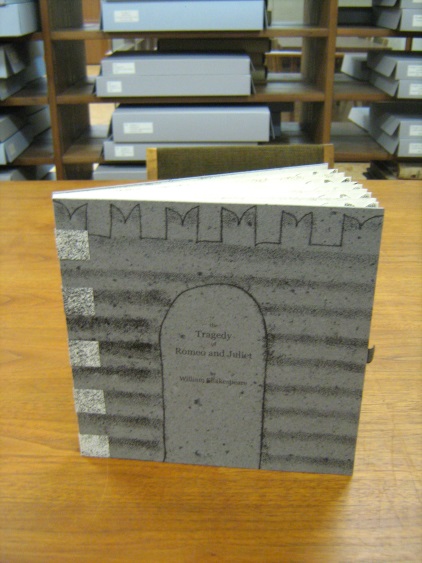
The cover of Emily Martin’s interpretation of
The Tragedy of Romeo and Juliet
.
[Iowa City]: Naughty Dog Press, 2012.
Call Number: D7385. Click image to enlarge.

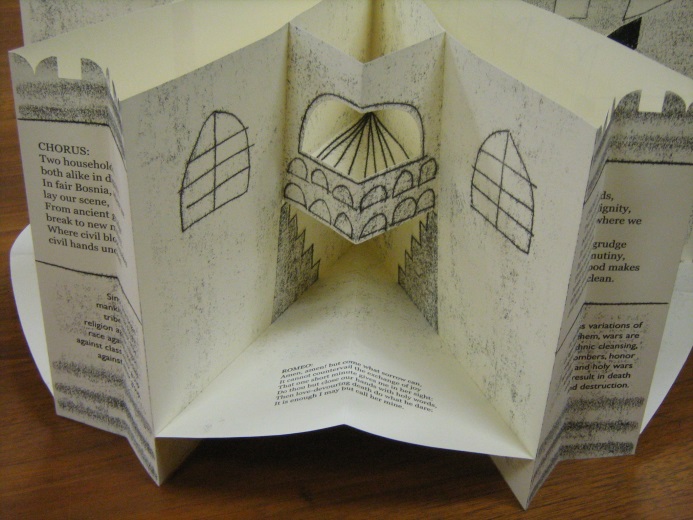
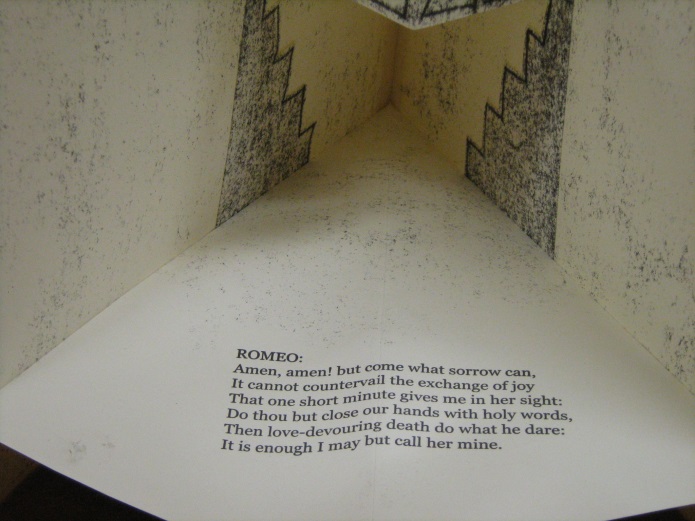
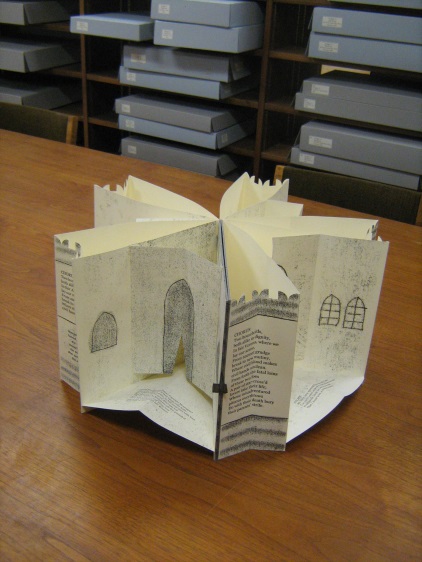
One such reimagining was crafted by Emily Martin. Created for a designer bookbinding competition for the Bodleian Libraries and Designer Bookbinders in 2013, the carousel book adapts one of Shakespeare’s best-known tragedies, The Tragedy of Romeo and Juliet. With five main “views” to embody each of the play’s five acts, the carousel book pays homage to the play’s central ideas and its modern application. Martin creates corresponding pop-ups for each act and uses key lines from Juliet, Romeo, and the Prince (for Act V) to illustrate and remind readers of the important events from each act.

View of The Tragedy of Romeo and Juliet by Emily Martin

View of The Tragedy of Romeo and Juliet by Emily Martin

Views of Emily Martin’s interpretation of
The Tragedy of Romeo and Juliet (2012).
Call Number: D7385. Click images to enlarge.

In between each of the main views, Martin emphasizes “the timelessness of the play through repetition of the chorus and insertion of modern equivalents for Verona,” as Martin explains in the colophon for the book. These modern equivalents include: Bosnia, Israel, Rwanda, and America. In correspondence, Martin adds that these locations, “were ‘scenes of strife’ at the time, I used countries rather than cities for name recognition and to expand out from small locations to large. I felt the need to remind readers the play is still timely by connecting to current conflicts.” Martin also includes her own commentary under each repetition of the chorus, articulating the many ways that Shakespeare’s central themes can be reimagined and updated far beyond Shakespeare’s time.

View of The Tragedy of Romeo and Juliet by Emily Martin

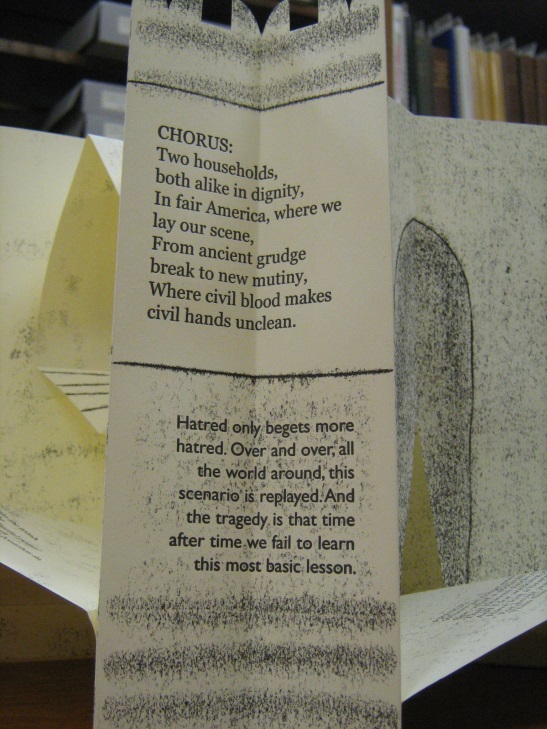
A close-up of Emily Martin’s interpretation of
The Tragedy of Romeo and Juliet (2012).
The top section is the first four lines of the play’s prologue.
Note that Martin has changed “fair Verona” to “fair America.”
The bottom text is Martin’s commentary.
Call Number: D7385. Click image to enlarge.

Even though The Tragedy of Romeo and Juliet is advertised as a tale of two “star-crossed lovers,” Martin comments, “I was struck more by the universality of feuding more than the romance.” Romeo and Juliet individually must combat the trials of a forbidden love, and their families exemplify the enduring consequences of unabashed hatred of others for no deeper reason than one’s name. Despite Romeo and Juliet’s tragic deaths, the feud shows no signs of ending. Martin describes this plot point as a reason for the book’s carousel design. She states, “circular format emphasizes the repetitive aspect of the feuding, it doesn’t end, it just begins again.”

View of The Tragedy of Romeo and Juliet by Emily Martin

View of Emily Martin’s interpretation of
The Tragedy of Romeo and Juliet (2012).
Call Number: D7385. Click image to enlarge.

This piece, like many others in Spencer Library’s collection, demonstrates the many ways that the old and new, the past and present can come together. Martin’s reimagining masterfully blends “details specific to Verona,” (including illustrations to match the settings in each act) with new elements that make Shakespeare’s famous tragedy come alive again.  Even though it invokes new ideas to bring the star-crossed lovers into the 21st century, it is still maintains the integrity of their tragic tale and breathes new life into their multi-faceted story. As the Prince decrees, “For never was a story of more woe / Than this of Juliet and her Romeo.” Martin uses this timeless tale of woe and turns it into a well-crafted political commentary, exemplifying the ways that Shakespeare speaks to not only Shakespeare-philes, but also anyone looking to bridge disciplines and time periods in meaningful ways.

Melissa Kleinschmidt
Public Services Student Assistant and 2017 KU graduate (Master’s of Arts, English)

Collection Feature: The 1502 Strassburg Vergil’s Opera

April 17th, 2017

Of the sixteenth century Vergils in the Robert Aitchison Collection of Vergil’s Works in Special Collections at the Spencer Research Library, the 1502 Opera, printed at Strassburg by Johannes Gruninger (also known as Reinhart), is the most impressive and the oldest. It is illustrated with 214 charming woodcuts which reveal many aspects of Renaissance life from field and farm to city and tower. These illustrations, certainly the first to create so illustrious a progeny, form the basis for practically all the Vergilian illustrations of the sixteenth century as they may be seen in the 1517 and 1529 Opera of Lyon, the Giuntine Opera of 1537, and the 1546 Opera of Venice.

Aitchison D2. Kenneth Spencer Research Library, University of Kansas Libraries

Publii Virgilii Maro[n]is opera. Strassburg, J. Gruninger, 1502.
Call number: Aitchison D2. Click image to enlarge.

Aitchison D2. Kenneth Spencer Research Library, University of Kansas Libraries  Aitchison D2. Kenneth Spencer Research Library, University of Kansas Libraries

Woodcuts and text from the 1502 Opera. Click images to enlarge.

Written by L.R. Lind
Adapted from The R. T. Aitchison Collection of Vergil’s Works at the University of Kansas Library, Lawrence

New Finding Aids Available: Part II

April 4th, 2017

Finding aids are documents created by a repository’s staff members as a point of access for an archival or manuscript collection. To understand more about how finding aids helps researchers navigate collections of manuscripts, organizational records, personal papers, letters, diaries, and photographs, check out our Finding Aids 101 blog post. Here’s a list of some of Kenneth Spencer Research Library’s newest finding aids, so see which collections interest you!

A photograph of members belonging to the Alpha Phi Alpha Fraternity at a banquet from the Dorothy McField collection of sorority and fraternity papers. African American Experience Collection, Spencer Research Library.

A photograph of members belonging to the Alpha Phi Alpha Fraternity at a banquet
from the Dorothy McField collection of sorority and fraternity papers.
African American Experience Collection. Call number: RH MS P944.3. Click image to enlarge.

The first page of a listing of titles for Éigse Eireann ["Poetry Ireland"] from the Catholic Bulletin collection. Special Collections.

The first page of a listing of titles for Éigse Eireann [“Poetry Ireland”]
from the Catholic Bulletin collection. Special Collections.
Call number: MS 329, Box 2, Folder 45. Click image to enlarge.

A photograph of two cowboys on horseback from the Wallace, Kansas photographs collection. Kansas Collection.

A photograph of two cowboys on horseback from the Wallace, Kansas photographs collection.
Kansas Collection. Call number: RH PH 60, Folder 1. Click image to enlarge.

The title page from Eugène Farcot’s Literary Manuscript Un Voyage Aérien; Dans Cinquante Ans. Special Collections.

The title page from Eugène Farcot’s Literary Manuscript Un Voyage Aérien; Dans Cinquante Ans.
Special Collections. Call number: MS K32. Click image to enlarge.

May 7th and 8th from the five year Diary of Maude Egbert, note her entry on May 8, 1945 or Victory in Europe Day (V-E Day). Kansas Collection.

May 7th and 8th from the five year Diary of Maude Egbert, note her entry on May 8, 1945
or Victory in Europe Day (V-E Day). Kansas Collection.
Call number: RH MS B77. Click image to enlarge.

Other new finding aids:

Mindy Babarskis
Reference Specialist
Public Services

Goin’ Courtin’ at Spencer Research Library

February 14th, 2017

There is so much uncertainty in the world of dating and relationships. Countless questions abound: Am I interested in this person? Who should make the first move? How soon is too soon to talk to the other person after a date? Should you play it cool and aloof or be more earnest about conveying your feelings for someone? How long should you wait to define the relationship or discuss being exclusive with your partner? Does wanting to have that discussion make you seem needy or confident? The list goes on and all of your friends, all of the dating articles available to you, and every show on television seem to have conflicting opinions. Wouldn’t it be nice if there was a guidebook – a collection of dos and don’ts when it comes to dating so you would know what to do or expect? Well, look no further than the collections at Spencer Research Library!

Book chapter, "Etiquette of Courtship and Marriage," 1896

First page of the chapter entitled “Etiquette of Courtship and Marriage.”
Social Life; or, The Manners and Customs of Polite Society by Maud C. Cook.
Kansas City, Mo.: S.D. Knapp & Co., 1896. Call Number: C23427. Click image to enlarge.

Published in 1896 in Kansas City, Missouri, Social Life; or The Manners and Customs of Polite Society by Maud C. Cook is just one of several 19th and early 20th century etiquette books housed at Spencer. In addition to the etiquette of courtship and marriage, Social Life also details the proper etiquette for everything from correspondence to childcare and so much more. While some of the content may no longer be directly applicable in today’s society, many of the tenets regarding courtship and marriage are rather insightful.

“Intuition, our own selfhood, is nature’s highest teacher, and infallible; and tells all by her ‘still, small voice within,’ whether and just wherein they are making love right or wrong.”

Modern translation: Trust your instincts. No one knows you better than you know yourself. From choosing a partner to guiding the progression of your relationship, if something feels wrong, trust that feeling.

Book illustration, "A Polite Escort," 1896

Illustration, “A Polite Escort,” in Social Life; or,
The Manners and Customs of Polite Society
by Maud C. Cook, 1896.
Call Number: C23427. Click image to enlarge.

“Again the young lady who willfully, knowingly, deliberately draws on a man to place hand and heart at her disposal simply for the pleasure of refusing him and thus adding one more name to her list of rejected proposals is utterly unworthy the name of woman.”

Modern translation: Be kind. Don’t lead someone on or pretend you have feelings for them when you don’t. Be honest about your feelings and intentions, whatever they may be.

“Differences must needs arise, which cannot be adjusted too soon.”

Modern translation: Communicate. Address problems and differences calmly and in a timely manner. If something has upset you, speak up, just do so respectfully.

Book illustration, "Declined with Regrets," 1896

Illustration, “Declined with Regrets,” in Social Life; or,
The Manners and Customs of Polite Society
by Maud C. Cook, 1896.
Call Number: C23427. Click image to enlarge.

“She should never captiously take offense at her fiancé’s showing the same attention to other ladies that she, in her turn, is willing to accept from other gentlemen, and she should take the same pains to please his taste in trifles that he does to gratify her slightest wish.”

Modern translation: Don’t be hypocritical when it comes to your partner’s actions. It is unfair for you to be upset over behavior that is similar to your own.

“See or correspond with each other often. Love will not bear neglect. Nothing kills it equally. In this it is most exacting. It will not, should not, be second in anything. ‘First or nothing,’ is its motto.”

Modern translation: It is not a badge of honor to ignore someone, especially if you care about them. Spend time with the one you love and do your best to stay connected.

Happy Valentine’s Day!

Emily Beran
Library Assistant
Public Services

Authors’ Rights and the Relativity of Luckombe’s Plagiarism

January 23rd, 2017

Public Services Student Assistant Megan Fox considers printing history and changing notions of authorship in a favorite volume from the stacks.

Philip Luckombe, an eighteenth-century English printer and author, compiled the information in his book The History and Art of Printing with the express intention for it to be a reference to the general public about the history of printing from 1400 to roughly 1660 and the basic processes of historic printing. As he states in the introduction, “The entire motive which induces the Editor to this publication, is to promote the Theory and Practice of the Art of Printing… books on this subject are extremely scarce.”  Luckombe’s book contains many interesting features beyond its content, including an ornamental border on all the pages and numerous examples of typefaces. Additionally, Luckcombe includes illustrations printed by letterpress, rather than metal engravings, which were common at the time but which use a different printing technique. Luckcombe observes, “As this work treats of the Letter-Press only, we think it needless to apologize for not decorating it with Copper-Plates [engravings], judging it not pertinent in work of this kind to make use of the workmanship of any other authors than compositors.” However, a previous owner of the Spencer Research Library’s copy of The History and Art of Printing may have wished Luckombe had included more illustrations; he or she has pasted an extra illustration of printers in the printshop the end of the text.

Title page of Luckcombe's The History and Art of Printing (1771) To the public from Luckcombe's History and Art of Printing (1771)

Left: The title page of Philip Luckombe’s The History and Art of Printing. London: printed by W. Adlardand J. Browne for J. Johnson, 1771. Clubb C1771.1 Right: The beginning of Luckombe’s “To the Public” preface. Click images to enlarge.

Luckombe describes all of this in his introductory “To The Public” note before the body of the text. In doing so, he also explains that the majority of the content is not actually his own, but rather “from whole works we have made copious extracts, several of which are in the author’s own words, though not pointed out as such.” As a college student, this line in the introduction struck me as ridiculous. If I tried to copy huge sections of others’ work in one of my papers with only a short note in the introduction stating I am doing so – and without even naming all of the authors from whom I am borrowing – plagiarism identification software such as SafeAssign would flag it immediately.  I would get a zero on the assignment and perhaps fail the class; I might even face university sanctions. In the twenty-first century a huge emphasis is placed on the value of authorship, and citing your work is paramount to good writing and scholarship. However, as Luckombe demonstrates, this was not always the case. Plagiarism, it seems, used to be acceptable.

Caslon's Specimen of Printing Types from Luckombe's The History and Art of Printing (1771)

Section title to Luckombe’s reproduction of William Caslon’s typefaces. Caslon is one of the few people Luckombe credits in his compilation of information about the history of printing.

Luckcombe’s use of others’ work brings to the forefront the interesting question of authorship and copyright in the eighteenth century. The idea that authors “own” their words after publication and distribution was developed through European print culture, which separated the idea of owning a physical copy of a book and owning said book’s intellectual or artistic content in order to establish author’s “rights” (Feather 520-21). It was only in the eighteenth century that the idea of an ‘author’ as a career became feasible in Britain – periodicals and novels began to be produced for the general literate public, and writers no longer necessarily needed a patron to live off their writing (Hammerschmidt 1). As authorship became a plausible career, copyright protections began to be codified into law, making it harder for contemporary works to be copied the way Luckcombe copies large sections of historical texts. One example is the Statute of Anne in 1710, which allowed authors to sell their copyright to publishers for a 14 year term, with the option of renewal. These laws were also enacted to protect publishers and their arrangements to sell artistic and intellectual content, but as a result of this a greater appreciation of authorship developed.

Luckombe was capitalizing on the fact that the works he was borrowing from, mostly published between 1440 and 1600, fell outside of copyright. Luckombe does not detail how he gained access to these works and was able to reprint them, but the mere fact of their inclusion, largely without attribution, demonstrates the difference between eighteenth-century and modern-day understandings of authorship and plagiarism. Some of Luckcombe’s contemporaries may have disapproved of this, but his compilation of other authors’ original writings still indicates how the general mindset of the culture viewed it as acceptable.

In addition to their fascinating content, older books such as The History and Art of Printing also can offer us a powerful reminder that nothing in society is static. The mindsets we regard as unalterable now may be perceived as simply a twenty-first century oddity by future generations. Concepts of plagiarism and authorial property were not the same in Luckombe’s time as they are today, and they will continue to evolve in the future.

Megan Fox
Public Services Student Assistant

Works Cited

Feather, John. “Copyright and the Creation of Literary Property.” Companion to the History of the Book. Eds. Simon Eliot and Jonathan Rose. Hoboken, NJ: Wiley-Blackwell, 2009. 520-530. Print.

Hammerschmidt, Soren. “Introduction: Between Geniuses and Brain-Suckers. Problematic Professionalism in Eighteenth-Century Authorship.” Authorship Vol 4.1 (2015) p 1-4.

Luckombe, Philip. The History and Art of Printing. London: printed by W. Adlard and J. Browne for J. Johnson, 1771. Clubb C1771.1