The University of Kansas

Inside Spencer: The KSRL Blog

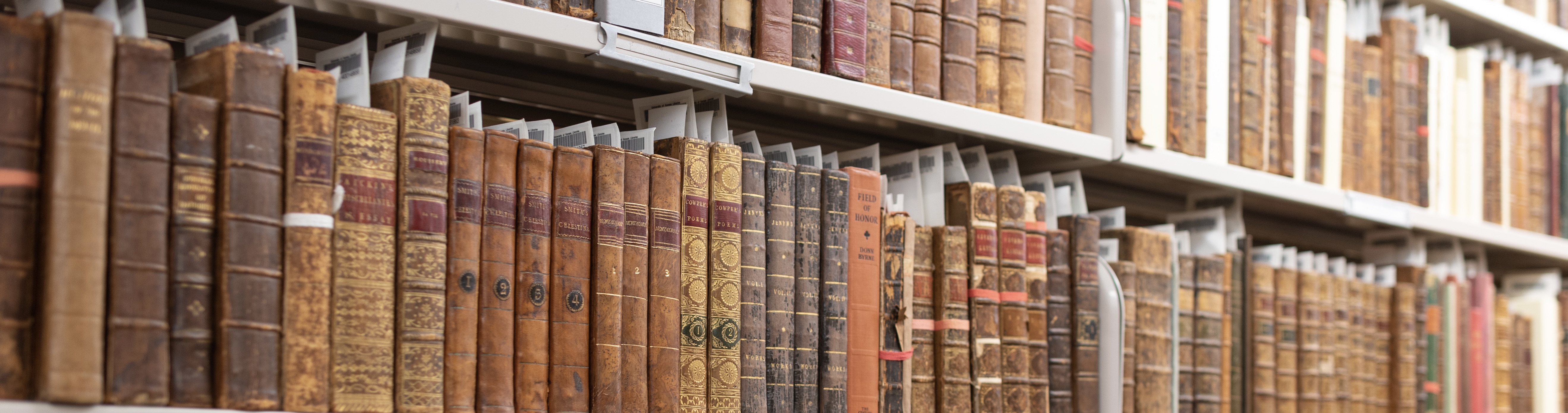
Books on a shelf

Welcome to the Kenneth Spencer Research Library blog! As the special collections and archives library at the University of Kansas, Spencer is home to remarkable and diverse collections of rare and unique items. Explore the blog to learn about the work we do and the materials we collect.

Housing Quick Pics: The Right Fit

December 19th, 2016

This year I spent some time upgrading the housings for Spencer’s N-size (very large!) items. I reviewed their current state with a curator and we identified those items that were most in need of housing improvement. Among these items was a very long and narrow broadside with a correspondingly long title: State procession from the Queen’s palace to the western door of Westminster Abbey, on the 28th of June, the day of Her Majesty’s coronation [1838?].

At the time of our review, this item was stored in a very large folder just like its neighbors in the N section. Unlike the other N’s, however, which are mostly oversize maps, this very skinny piece only occupies a small amount of the folder interior. It’s too big to fit in any of our map cases, but it didn’t feel quite right floating about inside the large folder, and it seemed quite unwieldy to retrieve and transport.

n21_before

We decided to rehouse this item in a more efficient and user-friendly manner by fitting out the inside of a standard cubic-foot box with an archival cardboard tube that rests on two cradle supports on either side and can be easily lifted out of the box.

n21_box

I rolled the broadside around the tube (followed by a protective layer of polyester film) and placed the tube back into the box. When this item is paged, it will be much easier for staff to carry – no more juggling a huge floppy folder. The item can be easily unrolled in the reading room when needed, and just as easily rolled back up onto the tube. And because the box is a standard size, it will fit well into existing shelf space.

n21_completed

Angela Andres
Special Collections Conservator
Conservation Services

Rainer Maria Rilke

December 5th, 2016

Rainer Maria Rilke is one of the most beloved German-language poets of the twentieth century. So in honor of his 141st birthday yesterday, we’re highlighting some of our amazing books by Rilke from Spencer Library’s Special Collections.

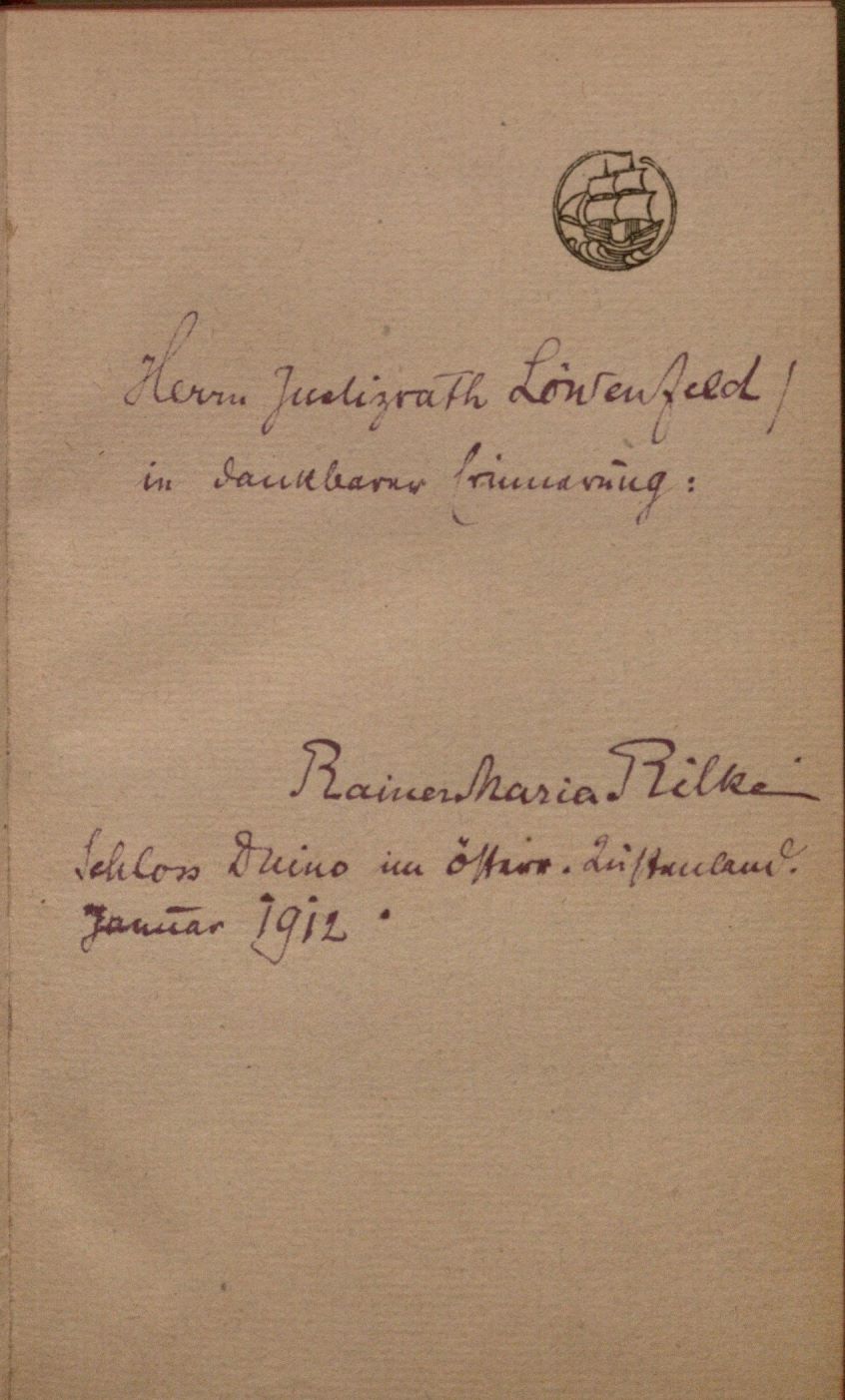
Duineser Elegien (English: Duino Elegies), which is considered one of his masterpieces, was begun in 1912 at Duino Castle near Trieste, Italy. The inscription by Rilke pictured below was probably created as he was beginning to write these poems.

Inscription by Rainer Maria Rilke, "Herrn Justizrath Löwenfeld in dankbarer Erinnerung...Schloss Duino...Januar 1912” located on the front page from volume 1 of his work, Die Aufzeichnungen des Malte Laurids Brigge, Leipzig : Insel-Verlag, 1910. Special Collections, call number: Rilke X18.
Inscription by Rainer Maria Rilke: “Herrn Justizrath Löwenfeld in dankbarer Erinnerung…Schloss Duino…Januar 1912”
located on the front page from volume 1 of his work, Die Aufzeichnungen des Malte Laurids Brigge, Leipzig: Insel-Verlag, 1910. Special Collections, call number: Rilke X18. Click image to enlarge.

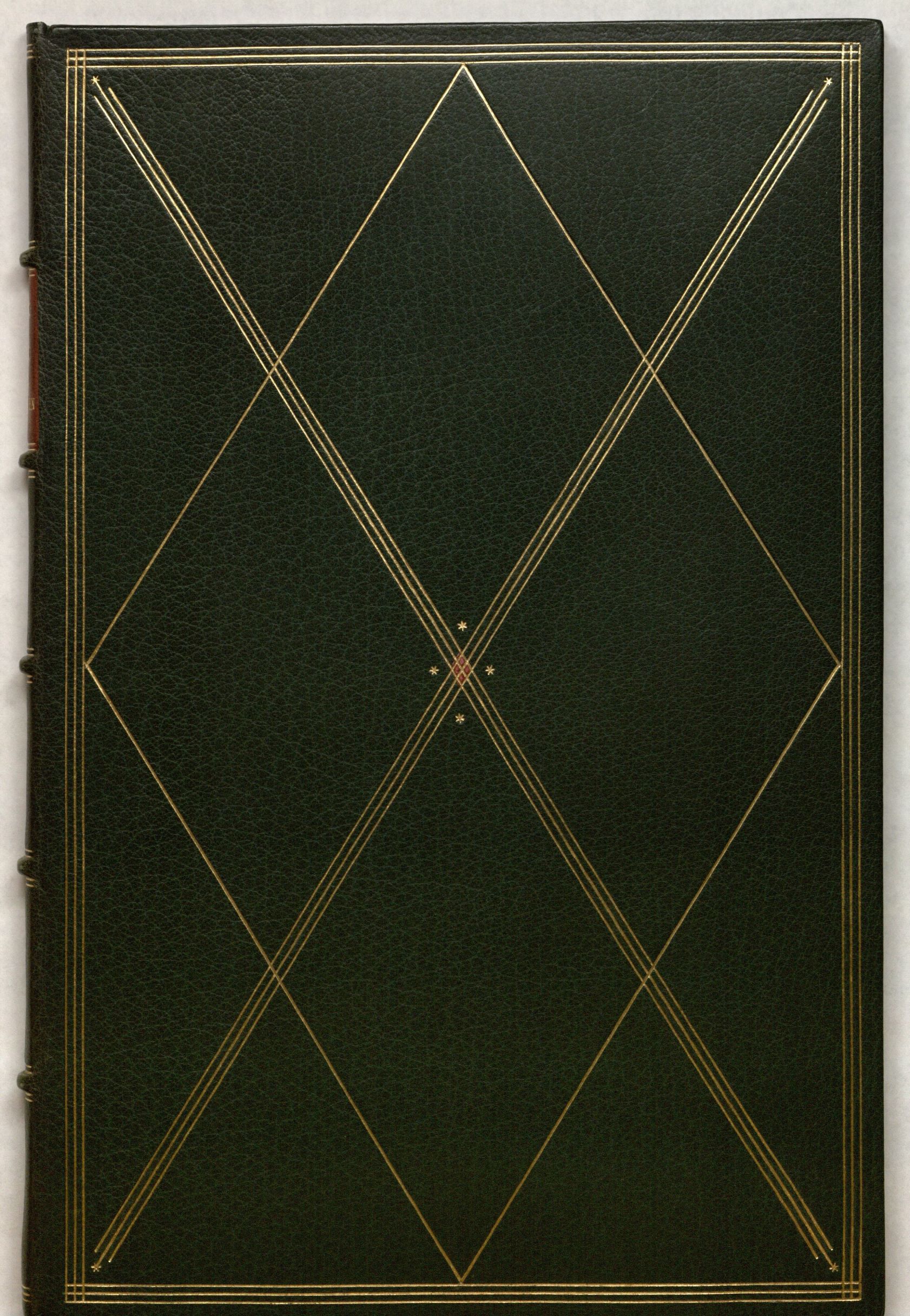
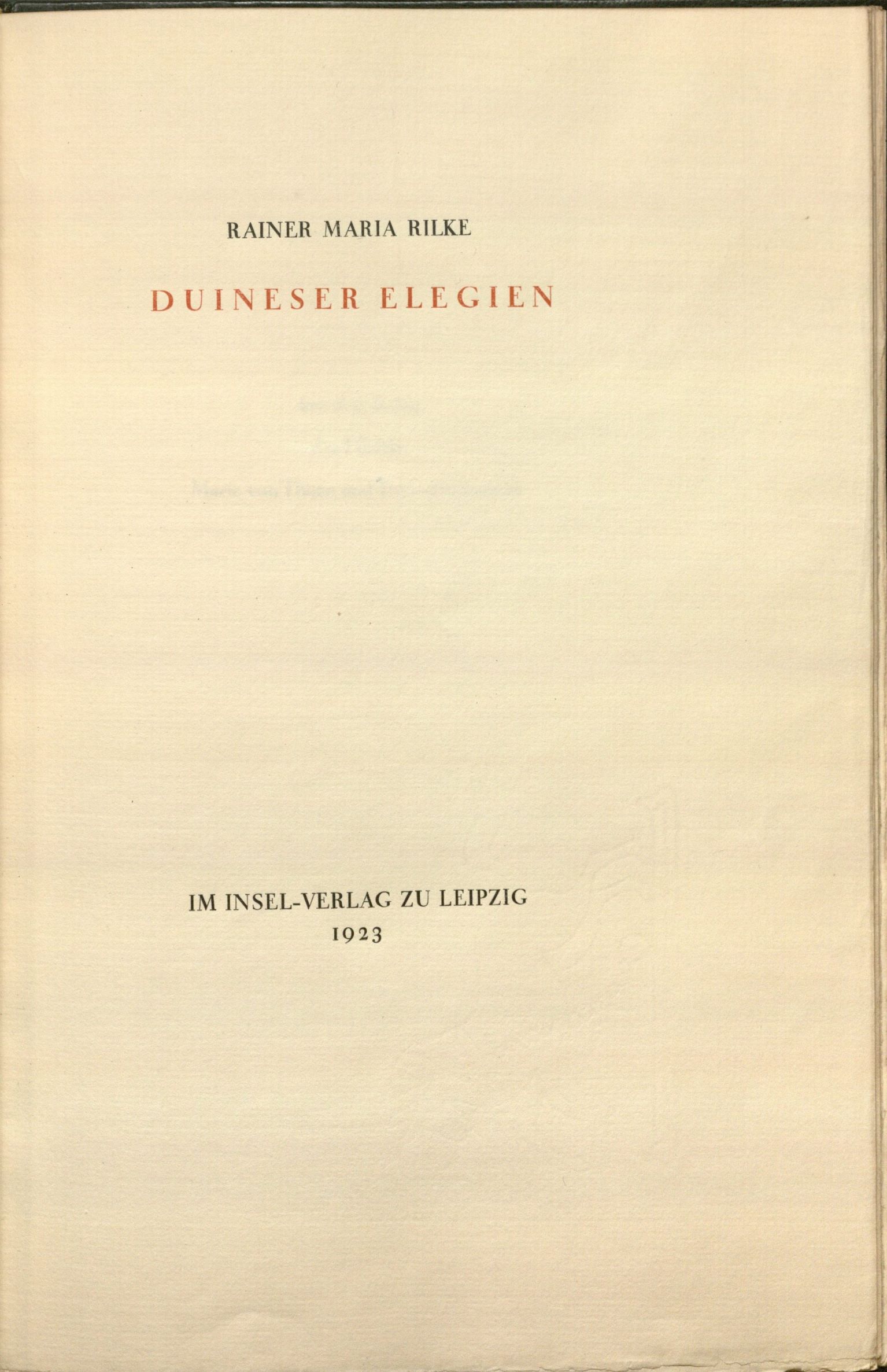
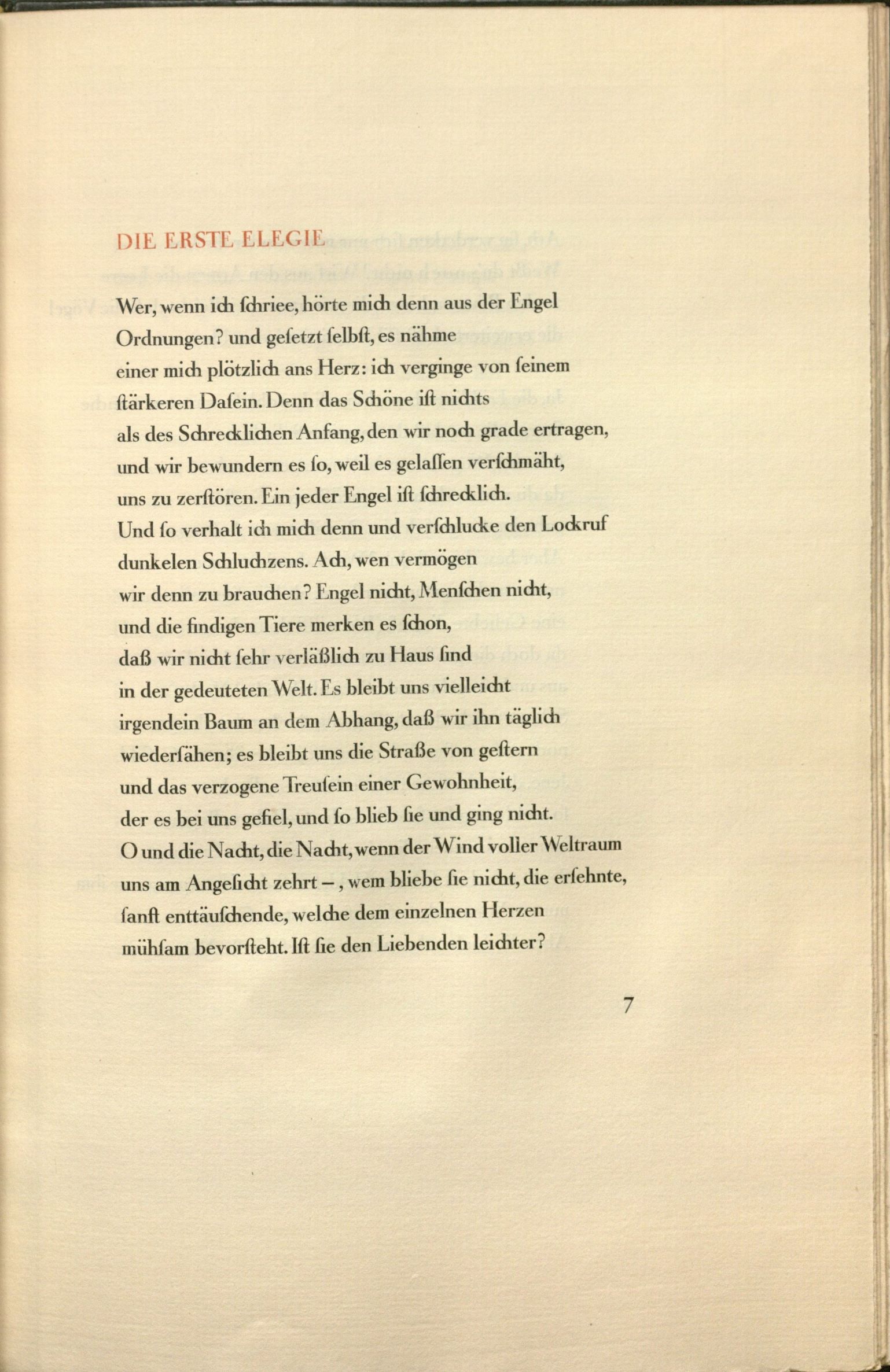
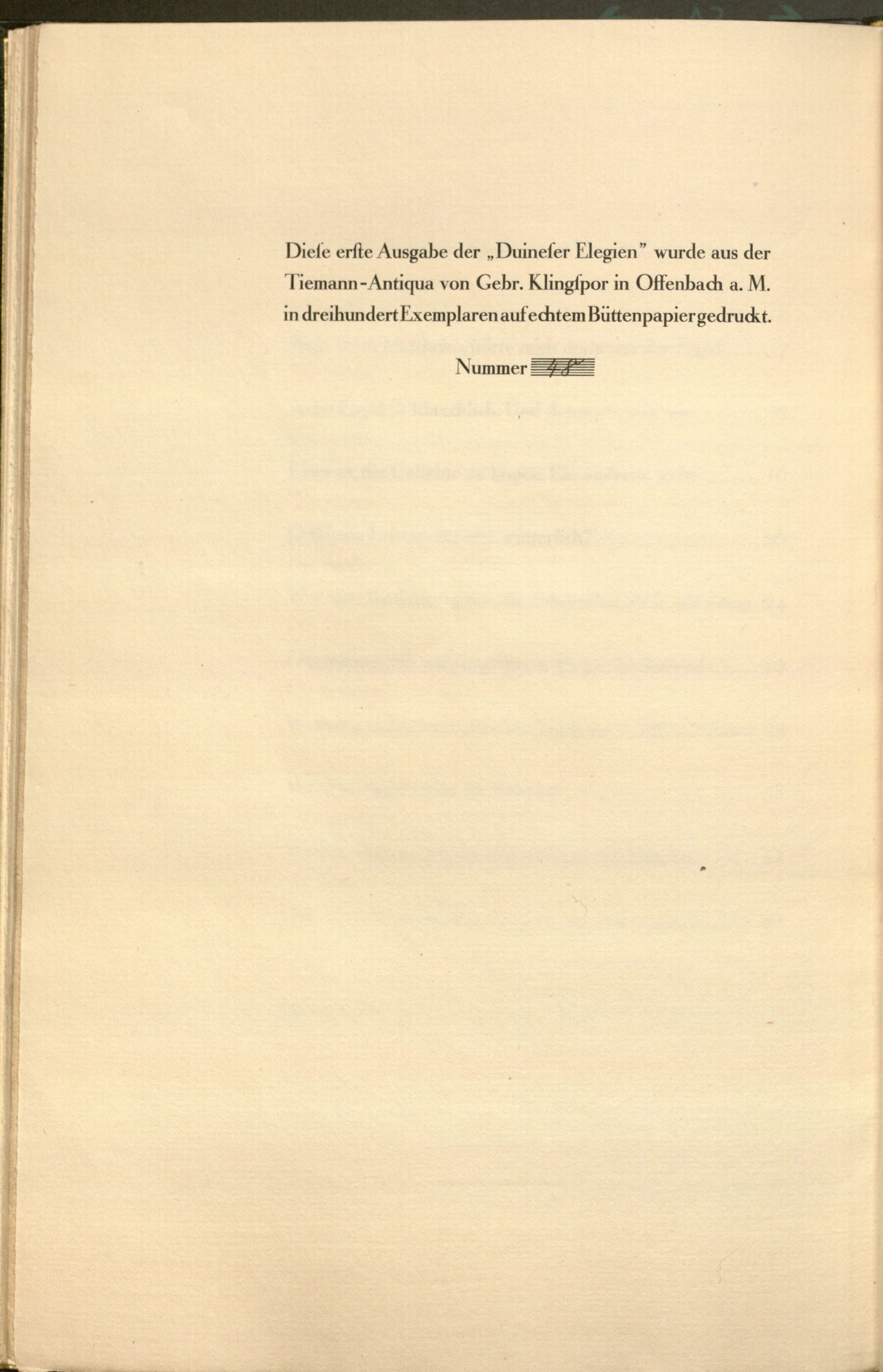
The first edition of Duineser Elegien was published in 1923 in Leipzig. Here is Spencer Library’s copy of this first edition printed on handmade paper with the beginning of “Die Erste Elegie” (English: “The First Elegy”).

Rainer Maria Rilke’s Duineser Elegien, Leipzig: im Insel-Verlag, 1923: cover. Special Collections, call number: Rilke Z50.   Rainer Maria Rilke’s Duineser Elegien, Leipzig: im Insel-Verlag, 1923: title page with unicorn watermark. Special Collections, call number: Rilke Z50.
Rainer Maria Rilke’s Duineser Elegien, Leipzig: im Insel-Verlag, 1923: “Die Erste Elegie”. Special Collections, call number: Rilke Z50.   Rainer Maria Rilke’s Duineser Elegien, Leipzig: im Insel-Verlag, 1923: back page stating that this is the first edition, copy 48 of 300 printed on handmade paper. Special Collections, call number: Rilke Z50.
Pictured from top left to bottom right: Rainer Maria Rilke’s Duineser Elegien, Leipzig: Im Insel-Verlag, 1923: cover, title page with unicorn watermark (below and the the right of Leipzig), “Die Erste Elegie” and back page stating that this is the first edition and copy 48 of 300 printed on handmade paper. Special Collections, call number: Rilke Z50. Click images to enlarge.

Rilke’s works were translated into English, helping to bring his poetry to an international audience. Here is the beginning of “The First Elegy” from Duino Elegies translated into English by J.B. Leishman and Stephen Spender and published by Leonard and Virginia Woolf’s Hogarth Press in 1939.

Rilke’s Duino Elegies, with part of the “The First Elegy” in the original German with the English translation by J.B. Leishman and Stephen Spender placed side by side. Special Collections, call number: Rilke Y26.

Rilke’s Duino Elegies, beginning of “The First Elegy” with German and English translation
by J.B. Leishman and Stephen Spender placed side by side.
Special Collections, call number: Rilke Y26. Click image to enlarge.

Mindy Babarskis
Reference Specialist
Public Services

Dancing Cheek to Cheek: A dos-à-dos binding

November 28th, 2016

This book from Special Collections is really two volumes in one, in what is called a dos-à-dos binding, from the French, “back to back.” As the name implies, these two books share the same back covers, so that no matter how it is held, the reader opens to a front page of text. Geoffrey Glaister in The Encyclopedia of the Book (New Castle, DE: 1996) notes that this style was particularly popular in England in the period from 1600-1640.

Dos-a-dos binding. Call number A234. Kenneth Spencer Library, University of Kansas         Dos-a-dos binding. Call number A234. Kenneth Spencer Library, University of Kansas

  Dos-à-dos Binding with green textile tie. Call number A234. Click images to enlarge.

As noted by Matt Roberts and Don Etherington in Bookbinding and the Conservation of Books, these books were “usually small and frequently of a complementary nature.” This is true in the case of this dos-à-dos volume, although there are in fact three titles contained within:

1. The New Testament of our Lord and Sauiour Iesus Christ : London: 1620.

2. The Psalter or Psalmes of David. London : Companie of Stationers, 1625.

3. The whole booke of Psalmes. London : Companie of Stationers, 1620.

This small object would have been handy to take to church to have relevant texts close at hand.

Dos-a-dos binding. Call number A234. Kenneth Spencer Library, University of Kansas         Dos-a-dos binding. Call number A234. Kenneth Spencer Library, University of Kansas

Left: New Testament. Right: Psalter or Psalmes. The Whole Book of Psalmes follows this text. Click images to enlarge.

The volume is bound in leather, with gold-tooled patterns. The edges are gauffered, which is a decorative effect achieved by placing a heated tool or roll on the edges of the paper.

Dos-a-dos binding. Call number A234. Kenneth Spencer Library, University of Kansas

Gauffering on the fore-edge of the paper, made by using a heated tool. Click image to enlarge.

Whitney Baker
Head, Conservation Services

Manuscript Monday Quick Pics: John Beach’s Selection of Airs and Marches

November 21st, 2016

Today I want to share a quick before-and-after of a treatment I recently completed on MS E23, John Beach’s Selection of Airs, Marches, etc., with Instructions for the Violin, German Flute, Clarionett, Hautboy, French Horn, Bass Viol, Bassoon, Piano Forte, & Guitar (whew!). A patron request brought this volume to a curator’s attention, and the curator in turn sent it my way.

This book, a collection of manuscript musical pieces, had been lovingly assembled and clearly experienced significant use in its lifetime. The volume required stabilization in a number of areas in order to support use and handling. Its boards were both detached, its spine was missing, sewing threads were broken, and many of the gatherings, which had been made by adhering separate sheets together near the spine fold, were detached or damaged along that spine seam. In addition, there was a good deal of particulate matter (dirt) accumulated in the spine folds.

The treatment involved taking down the sewing, cleaning and mending the gatherings, and sewing it back up over new cords, which were pasted under the pastedowns to reattach the boards. I also added a replacement paper spine piece to protect the spine and give the book a more complete appearance. In its improved condition, this book can be safely used by researchers without the risk of further damage.

Music manuscript from Kenneth Spencer Research Library, University of Kansas Libraries. Call number E23.

ME E23, before treatment. Click image to enlarge.

Music manuscript from Kenneth Spencer Research Library, University of Kansas Libraries. Call number E23.

MS E23, after treatment. Click image to enlarge.

Music manuscript from Kenneth Spencer Research Library, University of Kansas Libraries. Call number E23.

Hand-drawn illustration in MS E23, possibly copied from printed sheet music. Click image to enlarge.

Angela Andres
Special Collections Conservator
Conservation Services

Meet the KSRL Staff: Karen Cook

November 14th, 2016

This is the tenth installment in what will be a recurring series of posts introducing readers to the staff of the Kenneth Spencer Research Library. Karen Cook is the Special Collections Librarian responsible for curating rare books and manuscripts from Continental Europe, Asia, Africa, and Australasia.

Karen Cook, Special Collections Librarian, Spencer Research Library.
Karen Cook, Special Collections Librarian,
Spencer Research Library.

Where are you from?

Although I was born in New York City, my hometown is Cooperstown, a small village located in at the foot of Otsego Lake in the lovely Appalachian foothills of upstate New York. It was founded by James Fenimore Cooper’s father in 1786 but is best known as the home of the National Baseball Museum and Hall of Fame (founded 1939).

What does your job at Spencer entail?

As a Special Collections Librarian in Kenneth Spencer Research Library (KSRL), I curate rare books and manuscripts from Continental Europe, Asia, Africa, and Australasia. My subject specialties are the graphic arts, maps, and the history of science. My main responsibilities are collection development, reference, instruction, and exhibitions.

How did you come to work at Spencer Research Library?

My academic background is in art history (BA) and geography (specializing in maps and their history) (MS & PhD). My first career was as a cartographer, but a move to London, England led to work as a librarian in the British Library Map Library. After a decade there, I returned to the USA in 1996 and came to KU, intending to learn computer mapping and return to my earlier career. At the same time, though, I began working part-time in KSRL, where the staff were so welcoming and the work so interesting that I decided to enroll in the library science graduate program program at Emporia State University (ESU). During three years of part-time graduate study at ESU I worked as the Operations Manager of the T.R. Smith Map Collection in Anschutz Library. Just as I finished the ESU program in 2001, a librarian position opened up in KSRL’s Special Collections, and I’ve been here ever since.

What is one of the most interesting items you’ve come across in Spencer’s collections?

The Consolidator, a satirical fantasy written by Daniel Defoe and published in 1705, criticizes the evils of life on Earth by contrasting it with an imaginary utopian civilization of Moon dwellers. The English narrator travels to China and thence by rocket ship to the Moon, where a Lunar philosopher shows him warfare and famine happening on Earth through magic glasses. The Lunarians debate how to depict this information and decide to produce a separate thematic map of each of these phenomena. This narrative, written a century before thematic maps would become common, has led me to research Defoe’s sources of information about mapmaking.

What part of your job do you like best?

The best part of my job is the variety of interesting tasks that I do, all centered around the history of books (and maps).

What are your favorite pastimes outside of work?

Research and writing about the history of cartography is a major interest. Less academic pastimes are gardening and botanical illustration.

What piece of advice would you offer a researcher walking into Spencer Research Library for the first time?

Register and go into the reading room. Tell the librarian/archivist on duty what you are interested in and ask for suggestions or a referral to someone who handles that subject specialty.

Karen Cook
Special Collections Librarian
Special Collections