The University of Kansas

Inside Spencer: The KSRL Blog

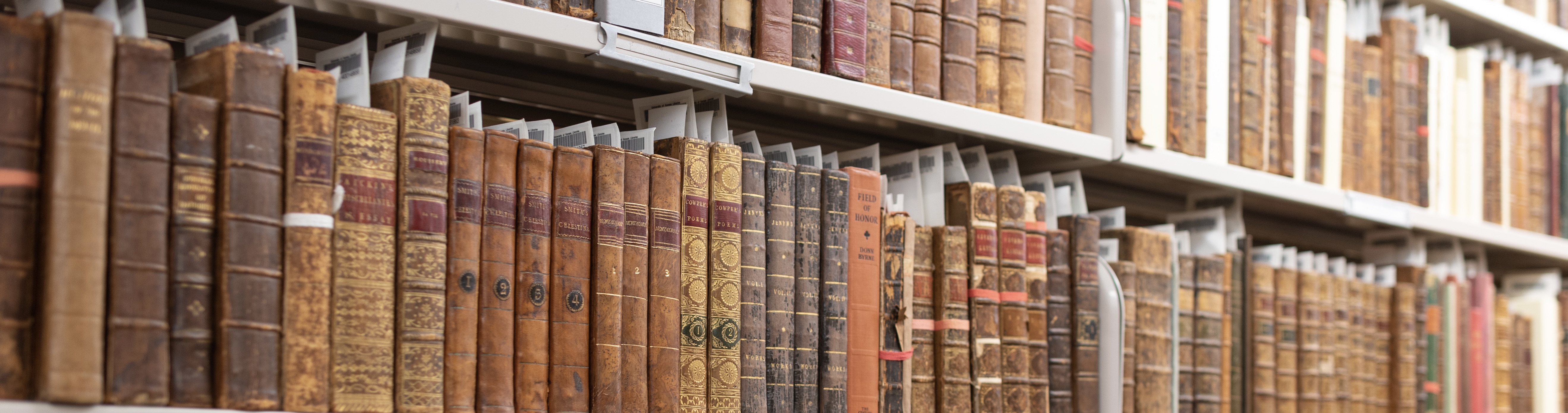
Books on a shelf

Welcome to the Kenneth Spencer Research Library blog! As the special collections and archives library at the University of Kansas, Spencer is home to remarkable and diverse collections of rare and unique items. Explore the blog to learn about the work we do and the materials we collect.

Charlton Hinman, Optical Collation, and the Big Grey Machine

January 12th, 2026

Charlton Hinman was a looker. Of course, that was true of so many of Fredson Bowers’ students – they tended to be lookers. We won’t make any comment on the relative attractiveness of Charlton Joseph Kadio Hinman or Bowers’ students, but we refer instead to the tradition of close examination and description of books that Bowers codified and Hinman continued here at the University of Kansas. On the north side of the Marilyn Stokstad Reading Room at Kenneth Spencer Research Library is the Hinman Collator, a hulking grey machine that stands as a reminder of (and a tool for) precisely that kind of work. Our colleague Caitlin Klepper wrote a post about the collator previously, but we thought we might delve more in-depth here.

Black-and-white photograph sitting in front of a large piece of equipment and looking through an eyepiece.
Professor Charlton Hinman working at the Hinman Collator, circa 1960-1975. University Archives Photos. Call Number: RG 41/ Faculty and Staff: Hinman, Charlton (Photos). Click image to enlarge (redirect to Spencer’s digital collections).

Modern descriptive bibliography – the close physical examination and description of books – begins with Fredson Bowers’ book Principles of Bibliographical Description (1949). Bowers was a professor of English at the University of Virginia, and Charlton Hinman was Bowers’ first PhD student there. Both Hinman and Bowers had analytical minds with similar bents, which served them well in the Second World War. They were involved in cryptography and code breaking, with Bowers again leading Hinman as his commanding officer. Following their service, Bowers returned to Virginia, publishing the aforementioned Principles.

Black-and-white photograph of a man standing in front of a large machine while a second man sits and looks through the eyepiece.
Fredson Bowers supervises a student with the Hinman Collator, undated. Image courtesy of Special Collections, University of Virginia Library. University of Virginia Visual History Collection. Call Number: RG-30/1/10.011. Click image to enlarge (redirect to UVA’s digital collections).

Hinman’s dissertation, The Printing of the First Quarto of Othello, led to his first position as a research fellow at the Folger Shakespeare Library, where he collated copies of the first folio of Othello. It was Hinman’s time as a fellow at the Folger that inspired his creation of the collation machine. Collation – or, the work of examining and describing the physical evidence in a copy of a book – is time consuming. Hinman’s work was even more intensive, as he sought to find all of the different states of the pages down to the most minor corrections or insertions made by the printer in the course of printing the book. Looking at each page of text line by line is an almost impossible task. Hinman hints at this problem in his preliminary essay about the machine, which was titled “Mechanized Collation: A Preliminary Report” and printed in the Papers of the Bibliographical Society of America in 1947.

Color photo of a man with glasses sitting at desk covered in books and papers.
Charlton Hinman working at his desk (with the collator behind him), circa 1960-1975. University Archives Photos. Call Number: RG 41/ Faculty and Staff: Hinman, Charlton (Photos). Click image to enlarge (redirect to Spencer’s digital collections).

Hinman’s time in the military helped point the way to a solution, supposedly through military reconnaissance use of photography. He described the idea of taking two pictures of the same area and rapidly alternating them to spot differences. He didn’t claim he had done it as part of his cryptography work; rather, he claimed he heard about it while in the military. However, the process Hinman described was never used for reconnaissance purposes. While the military did use aerial photography, they didn’t use any method that alternated two images in a similar way to the function of the Collator. In his article “‘The Eternal Verities Verified’: Charlton Hinman and the Roots of Mechanical Collation” (Studies in Bibliography, 2000), Steven Escar Smith writes that “using World War II technology, it simply would not have been possible to photograph the same patch of ground twice from exactly the same altitude and position.” According to Smith, Hinman seems to have acknowledged that the story wasn’t entirely true, but it’s not clear whether he actually discouraged its telling.

Arthur M. Johnson, Hinman’s partner who took over building and selling collators around 1956, may have been the one to accurately describe how Hinman got the idea for the collator. Johnson wrote that Hinman had studied something that Johnson called an “astronomer’s microscope.” It used the same principle of “blink comparison” to compare images of the night sky, most famously by Kansan (and KU alumnus) Clyde W. Tombaugh in his observation of Pluto. Although it’s not known whether Hinman ever saw or used a blink comparator, he knew of the one at the observatory at UVA when he was a PhD student there. This was the true technological ancestor of Hinman’s machine.

Black-and-white photograph of a man looking through an eyepiece connected to a larger machine.
Clyde W. Tombaugh at a blink comparator, undated. Image courtesy of New Mexico State University Library Archives and Special Collections, Clyde W. Tombaugh papers, image 04070052. Click image to enlarge.

These kinds of devices are simpler than the Hinman Collator in that one can use flat images of similar size – not possible with books. Hinman’s great improvement and contribution, then, was the creation of a machine that could deal with books of different sizes, thicknesses, and even formats. Hinman had a long career as a professor of English, first at Johns Hopkins University (1945-1960) and then at the University of Kansas (1960-1975), where he eventually became a University Distinguished Professor of English. Approximately 50 collators survive. The collator at Spencer (A9 in Steven Escar Smith’s 2002 census of existing Hinman Collators, published in Studies in Bibliography) is one of two that remain that Hinman himself used; the other is at the Folger Library. The effect of the collator is reproduced in this short video by Sam Lemley. Bibliographer J.P. Ascher has also made a good video about how one might use the collator, utilizing the machine at the University of Virginia.

Hoping to actually use Spencer’s machine, we ventured to the Reading Room before opening. We powered it on, and, to our delight, the 400-pound machine came to life. Unfortunately, this was not to be, as we discovered that the “blink” feature, the key function, is not currently working. Thanks to the efforts of our colleague Molly Bauer, we are slowly learning what might be wrong and what the fix might be. Look for a follow-up post in the spring about our efforts, as well as digital alternatives to optical collation that bibliographers can use today.

Color photograph of multicolored wires bundled together in a larger metal box.
Wiring inside the Hinman Collator at Spencer Research Library. Click image to enlarge.

The Hinman Collator, for now, stands as a testament to the ongoing work of descriptive an analytical bibliography here at the University of Kansas. Much like its creator, the machine is complicated and devoted to a very specific purpose – close looking at material objects we regularly take for granted.

Jason W. Dean and Adrienne Sanders
Rare Materials Cataloging Librarians

Happy Holidays from Spencer Research Library!

December 19th, 2025
Sepia-toned photograph of five people standing around a car, one trying to tie a Christmas tree to the roof.
Lawrencians securing a Christmas tree to the top of their car, November 25, 1984. Lawrence Journal-World Photograph Collection. Call number: RH PH LJW. Click image to enlarge (redirect to Spencer’s digital collections).

Spencer Research Library will be closed from December 22nd through January 2nd and will reopen on January 5th. We look forward to seeing you in 2026 and sharing more stories about our collections, staff, and services.

Visit the KU Libraries website for more information on winter recess across the libraries.

Caitlin Klepper
Head of Public Services

Letters From Home: Hope and Dreams of Reunion in Wartime

November 10th, 2025

James “Jimmie” Coffin (1914-1998) enlisted in the Army Air Corps following the attack on Pearl Harbor on December 7, 1941. From recruitment in Champaign-Urbana, Illinois, his postcards and letters begin soon after in spring 1942, writing from Jefferson Barracks outside St. Louis. A month later, he found himself back in Illinois at the Air Corps Technical School at Chanute Field. By September of that year, his station had changed to the Army Air Base in Walla Walla, Washington, with the 99th Bombardment Group (BG). His stay in Walla Walla was short, as he quickly found himself on his way to the front lines.

Scenes from the military post with the text "Keep 'em flying, Jefferson Barracks, Missouri."
James Coffin’s postcard from Jefferson Barracks, Missouri. James and Fern Nelson-Coffin Collection. Call Number: RH MS 1501. Click image to enlarge.
This image has handwritten text.
James Coffin’s postcard to Fern Nelson from Salt Lake City, September 1942. “I’m on my way again,” he writes, “destination undisclosed.” James and Fern Nelson-Coffin Collection. Call Number: RH MS 1501. Click image to enlarge.

The 99th BG trained with B-17s and moved initially to North Africa, assigned to the Twelfth Air Force. From there, strategic bombing missions were carried out against targets in Tunisia, Sardinia, Sicily, and Italy. By December 1943, the 99th was transferred to the Fifteenth Air Force station in Italy, where they remained until the end of the war.

For the most part, Jimmie Coffin’s letters at Spencer were addressed to his future wife, Fern Berniece Nelson (1914-2018), with a few letters from Fern to Jimmie preserved in the collection as well. His letters from the front lines focus on the personal rather than the military actions going on. Censorship prohibited writing about missions – not even mentions of the weather were permitted. He writes about what he’s fed, new movies he’s had the chance to see, and responses to the many inquiries of her letters. But most importantly, he repeats how much he misses her and misses home.

This image has handwritten text with a lip mark in lipstick.
A tender and heartfelt letter from Fern to Jimmie, dated Christmas Eve, 1943. James and Fern Nelson-Coffin Collection. Call Number: RH MS 1501. Click image to enlarge.

As the war progressed, Jimmie’s letters moved from the North African Theater of Operations for the U. S. Army (NATOUSA) to Italy. The collection of letters ends in 1945 with the conclusion of the war. Coffin stayed in the service for several years thereafter, receiving his discharge in 1952 as a Technical Sergeant (T/SGT). After leaving the service, he led a career as a pharmacist.

The James and Fern Nelson Coffin collection (Call Number: RH MS 1501) offers a powerful, intimate window of the human experience of war. The letters show the enduring power of love and the pain of separation. They serve as a poignant reminder of the lifelines of family and home amidst global conflict. This collection is but one example of countless stories, both documented and untold, that bridged the long distances of the home front and front lines. May their words ensure the hopes and dreams of reunion not be forgotten.

Happy Veterans Day.

Phil Cunningham
Kansas Collection Curator

Expanding Speculative Horizons: Exploring KSRL’s Speculative Fiction Collections

November 4th, 2025

Last month, the J. Wayne and Elsie M. Gunn Center for the Study of Science Fiction hosted the fourth annual Sturgeon Symposium, “Expanding Speculative Horizons,” to showcase contemporary speculative fiction scholarship and writing and to present the Theodore Sturgeon Award. I was able to attend the first day of the Symposium and began thinking about the relationship between the Kenneth Spencer Research Library and the speculative fiction community.

KSRL holds a variety of speculative fiction collections in Special Collections, and my colleagues in the manuscripts processing department have had the joy of working on these collections. I’ve chosen a small slice of this material—four of Spencer’s collections—to spotlight here to the variety that exits in speculative fiction.

Theodore Sturgeon (MS 303, MS 254), the namesake of the Symposium and Award, was a speculative writer who wrote ten novels, including More than Human (1953), but is perhaps best remembered for his many short stories. Sturgeon’s speculative fiction often explored social issues and pushed back on societal norms; his 1953 short story “The World Well Lost” won the Gaylactic Spectrum “Hall of Fame” award in 2000, for example. Sturgeon’s writings covered a variety of genres, and several other speculative fiction creatives can be found in this collection, including Octavia Butler; Ray Bradbury; Judith Merril; Roy Thomas, a Marvel Comics editor and author; and Gene Roddenberry, the creator of Star Trek, to name a few.

Theodore Sturgeon's Royal "Quiet De Luxe" typewriter.
Theodore Sturgeon’s typewriter. Papers of Theodore Sturgeon. Call #: MS 359, box 2

Mary Rosenblum (MS 362) was a finalist for the Theodore Sturgeon award in 1998 with “The Good Juror,” a story she co-authored with James Sarafin, and was also a finalist for the Nebula Award in 2008 for her novelette “Night Wind.”[1] But what interested me about the Rosenblum collection was how Rosenblum explored speculative fiction horizons through an environmental lens. In her novel Drylands, Rosenblum wrote about the dangers of climate change and the exploitation of resources in a post-apocalyptic setting. While speculative fiction is no stranger to exploring alternate histories and cautionary futures, Rosenblum’s Drylands was one I had never heard of before. It had been a Locus First Novel Award nominee, and I was pleasantly surprised to find her collection while researching KSRL’s speculative fiction holdings.

Typescript with some copy-editing markup for Mary Rosenblum's story "Second Chance"
Opening page of “Second Chance” by Mary Rosenblum, annotated with editorial and copyediting marks. Mary Rosenblum papers, Call #: MS 362, Box 2, Folder 19.

Spencer Library doesn’t just have speculative fiction writers; much of Terry Lee’s original speculative fiction artwork can also be found here (MS 391). Lee is a KU graduate and a former font designer for Hallmark. He won a Chesley Award in 1988 for his cover artwork for the January 1987 issue of Amazing Stories.

Acrylic painting by Terry Lee featuring a woman with hair in the air and translucent colored waves around her.
Acrylic painting by Terry Lee for “Aymara” by Lucius Shepard, which served as the cover illustration for the August 1986 issue of Isaac Asimov’s Science Fiction
Magazine
. Terry Lee papers. Call #: MS Qa 56, Box 1, Folder 5.

Finally, Spencer holds the papers of William F. Wu (MS 367). Wu is a speculative fiction writer whose works have been published in Amazing Stories, Analog, and Isaac Asimov’s Science Fiction Magazine, amongst others, and has been nominated for the Nebula, World Fantasy, and Hugo awards. Wu’s academic interest in Asian American representation in popular culture led to him writing The Yellow Peril: Chinese Americans in American Fiction, 1850-1940 (1982), which had its origins as his doctoral dissertation. From convention materials to correspondence to comic books, William Wu’s collection provides researchers with a wealth of speculative fiction materials.

Outline (left) and draft for Perihelion (right) by William F. Wu, the sixth book in the Isaac Asimov's Robot City (1988). Asimov's introduction for the volume appears at the top of the draft.
Outline (left) and draft for Perihelion (right) by William F. Wu, the sixth book in the Isaac Asimov’s Robot City (1988). Asimov’s introduction for the volume appears at the top of the draft. William F. Wu papers. Call # MS 367, Box 13, Folders 12 and 13.

Speculative fiction continues to be an ever-evolving field of literature, with new and exciting visions and interpretations of reality arriving each year. I’m already excited for next year’s Sturgeon Symposium and Theodore Sturgeon Award presentation. But in the meantime, there’s still other speculative fiction horizons to explore at Spencer Research Library!

Want to explore further? Check out these other speculative fiction collections:

  • Kij Johnson papers, MS 377, Kenneth Spencer Research Library, University of Kansas.
  • John Kessel papers, MS 358, Kenneth Spencer Research Library, University of Kansas.
  • Round Robin collection, MS P769, Kenneth Spencer Research Library, University of Kansas.
  • A. E. van Vogt Collection, MS 322, Kenneth Spencer Research Library, University of Kansas.

Molly Bauer
Manuscripts Processor


[1] The winner of the 2008 Nebula Award in the novelette category was another writer whose papers reside at Spencer Research Library, John Kessel. He won for his novelette “Pride and Prometheus.”

How to Spot a Poison Book

October 28th, 2025
Illustration of two skeletons in formal ball dress entitled "The Arsenic Waltz. The New Dance of Death. (Dedicated to the Green Wreath and Dress-Mongers.)" Punch, or The London Charivari, February 8, 1862.
“The Arsenic Waltz. The New Dance of Death. (Dedicated to the Green Wreath and Dress-Mongers.)” Punch, or The London Charivari, February 8, 1862. Call Number: AP 101. P8. Click image to enlarge.

In 1775, the chemist Carl Wilhelm Scheele developed a striking shade of green that proliferated in the Western markets, creating a cultural phenomenon that could be — and in some cases was — deadly. Scheele’s green, a brighter and cheaper pigment to produce than previously popular shades, was one of many arsenical compounds that was used in soap, clothing, wallpaper, and even food for much of the nineteenth century. But the arsenic present in Scheele’s green (and pigments like it) can still be unsafe when handled for extended periods, which means a book that contains this Victorian Era pigment could pose its own risks today.

A book covered in vibrant green, arsenic-positive paper. Die Staatsforstwirthschaftslehre. Berg, Karl. Leipzig, 1850. Call Number: Howey C1895.
A book covered in vibrant green, arsenic-positive paper. Die Staatsforstwirthschaftslehre. Berg, Karl. Leipzig, 1850. Call Number: Howey C1895. Click image to enlarge.

Step One: Publication Date

At the beginning of the nineteenth century, bookbinders began constructing their own covers separately from the main textblock of each book. This, along with the introduction of a new cover material called bookcloth, allowed Victorian Era book covers to be elaborately dyed and decorated with an array of pigments; Scheele’s green and Paris green (or emerald green, or copper acetoarsenite) being the most arsenic-rich among them. Tracking these new developments, arsenical bookbindings are most likely to be found between the years 1820 and 1880, when the pigments began to be phased out slowly and irregularly across different regions. Because of this, any green book published in the nineteenth century could be a contender.

Three volumes from various Spencer collections. Books A (green) and C (blue) tested positive for arsenic; book B (green) did not.
Three volumes from various Spencer collections. Books A and C tested positive for arsenic; book B did not. Call Numbers: Book A, Children 1256. Book B, Children 1599. Book C, B12009. Click image to enlarge.

Step Two: Pigment

Arsenical pigmentscan take many forms, but they are most associated with the vibrant, almost neon shade of green that is shown in the first image, of Die Staatsforstwirthschaftslehre. In some cases, arsenical green stands out like a poison dart frog, but in other cases it’s not so clear. Many of the arsenical titles we’ve identified in KU’s collections align with this typical green pigment, but there have also been some surprises, such as the bright blue book in the image above, or greens that appear to be Scheele’s or emerald but chemically are not. This is where X-Ray Fluorescence (XRF) technology comes in.

The conservation lab's XRF machine set up to test a 19th-century book for the presence of heavy metals.
The conservation lab’s XRF machine set up to test a 19th-century book for the presence of heavy metals. Click image to enlarge.
An arsenic-positive spectrum produced from an XRF test.
An arsenic-positive spectrum produced from an XRF test. Click image to enlarge.

Step Three: XRF Technology

Due to all these variables, the only sure way to identify a poison book is to test it. In the Spencer Research Library’s conservation lab, we’ve been using XRF technology to test KU’s 19th-century books as part of a larger effort protecting patrons against potentially toxic heavy metals. This machine produces a spectrum graph that allows us to identify which elements are present in an item. Through this process, we’ve identified a number of “poison books” which can now be properly labeled, contained, and served in the reading room with appropriate precautions assuring that the information in a potentially harmful book remains accessible while the patron handling it remains safe.

By Reece Wohlford, Heavy Metals in Bookbinding Project Student Assistant