The University of Kansas

Inside Spencer: The KSRL Blog

Books on a shelf

Welcome to the Kenneth Spencer Research Library blog! As the special collections and archives library at the University of Kansas, Spencer is home to remarkable and diverse collections of rare and unique items. Explore the blog to learn about the work we do and the materials we collect.

This blog may contain archived web content. This blog may link to catalog records which no longer exist as of a software change in 2026.

A Look Back at Day on the Hill 

September 30th, 2026

This coming Tuesday, October 6th, will see the return of Day on the Hill, KU’s storied music festival that was sponsored by Student Union Activities (SUA) from 1989 to 2007. With the newly digitized University Daily Kansas (UDK) and some artifacts and photos from University Archives, we can piece together a history of “one of the best college music festivals in the nation,” as the manager of the band Soul Coughing described Day on the Hill in 1998. 

Starting in 1978, many outdoor day-long music events in spring and summer were held at KU near Allen Fieldhouse or on Campanile Hill under various names such as Day on the Green, Day on the Green Hill, Wheatstock (in homage to Woodstock), Summer on the Hill, and Jayhawk Jamboree. These events featured local or regional bands, which kept costs low and made the event free for both students and locals. By the 1980s, the Jayhawk Jamboree’s title had officially changed to its nickname to Jayhawk Jam, but it was cancelled in 1987 and 1988 because SUA did not have enough money to host it. 

Concert information against a light green background, with a graphic of three guitar handles standing vertically with two cornstalks.
A poster for Wheatstock, a precursor to KU’s Day on the Hill, 1979. University Archives Records, Student Activities: Student Union Activities. Call Number: RG 71/23. Click image to enlarge.

In 1989, SUA decided to use the budget it had left over at the end of the year and teamed up with the Student Senate, the Association of University Residence Halls, and radio station KJHK to host a new all-day concert event called Day on the Hill. It was part of the Student Senate’s Celebrate Diversity program and it included cultural performances, local bands, Love Tractor from Athens, Georgia, and Too Much Joy from New York. Forty-seven local bands had sent in cassette tapes of their music to be considered by a committee from SUA and KJHK. Students were hired to work the event for $20, and 1,500 people attended. 

The next year, 3,000 people attended to watch more local bands, Buffalo Tom, and Toad the Wet Sprocket with reportedly beautiful weather and buckets of fried chicken. In 1991, complaints about the lack of diversity and the selection process for local bands resulted in a bigger committee and the inclusion of hip-hop groups in the lineup for the first time. 

Left: A University Daily Kansan ad for the first Day on the Hill, April 1989. Right: A UDK photo from the 1991 Day on the Hill concert. University Archives. Call Number: UA Ser 69/2/1. Click images to enlarge.

The year 1992 changed everything for Day on the Hill. In February, SUA offered the little-known band Pearl Jam $3,000 to be the headliner for the event that year on May 2nd. Their album Ten had been released the summer before, but it wasn’t until their second single “Even Flow” was released in March 1992 that the band’s popularity and album sales began to rise quickly.  

Black text - most prominently the name "Pearl Jam" - with a nine-square orange, pink, and black graphic against a white background.
The promotional poster for the 1992 Day on the Hill concert. University Archives Records, Student Activities: Student Union Activities. Call Number: RG 71/23. Click image to enlarge.

When word got out that Pearl Jam was playing a free outdoor concert at KU, high school and college students from around the region drove to Lawrence to join KU students and locals at the show. Crowd estimates range from 18,000 to 30,000; the latter number would have been Pearl Jam’s biggest show to date. A mosh pit formed in the crowd, and during an extended version of the song “Porch” singer Eddie Vedder climbed up the scaffolding of the stage, swung across the rafters, hung upside down while grabbing the mike, and finished singing the song while sitting on top of the roof, a stunt Vedder would repeat many times at outdoor shows. 

Pearl Jam’s Eddie Vedder swinging across the rafters at the 1992 Day on the Hill concert. Dyche Hall is visible in the background on the left. Photo by Danny Beck, courtesy of the Pearl Jam Concert Chronology website. Click image to enlarge.

Pearl Jam’s appearance at KU became a legendary story for those lucky enough to have attended. It also, in many ways, set students’ expectations very high when it came to future Day on the Hill shows. As voiced in the UDK later in the 1990s, many students asked why SUA could not bring in bigger bands or questioned SUA’s choices when they were usually working with a budget of $20,000 to $30,000. Members of SUA had to repeatedly explain that the Pearl Jam show had been a great stroke of luck. The 1992 concert remained Day on the Hill’s highest attendance for its entire run. 

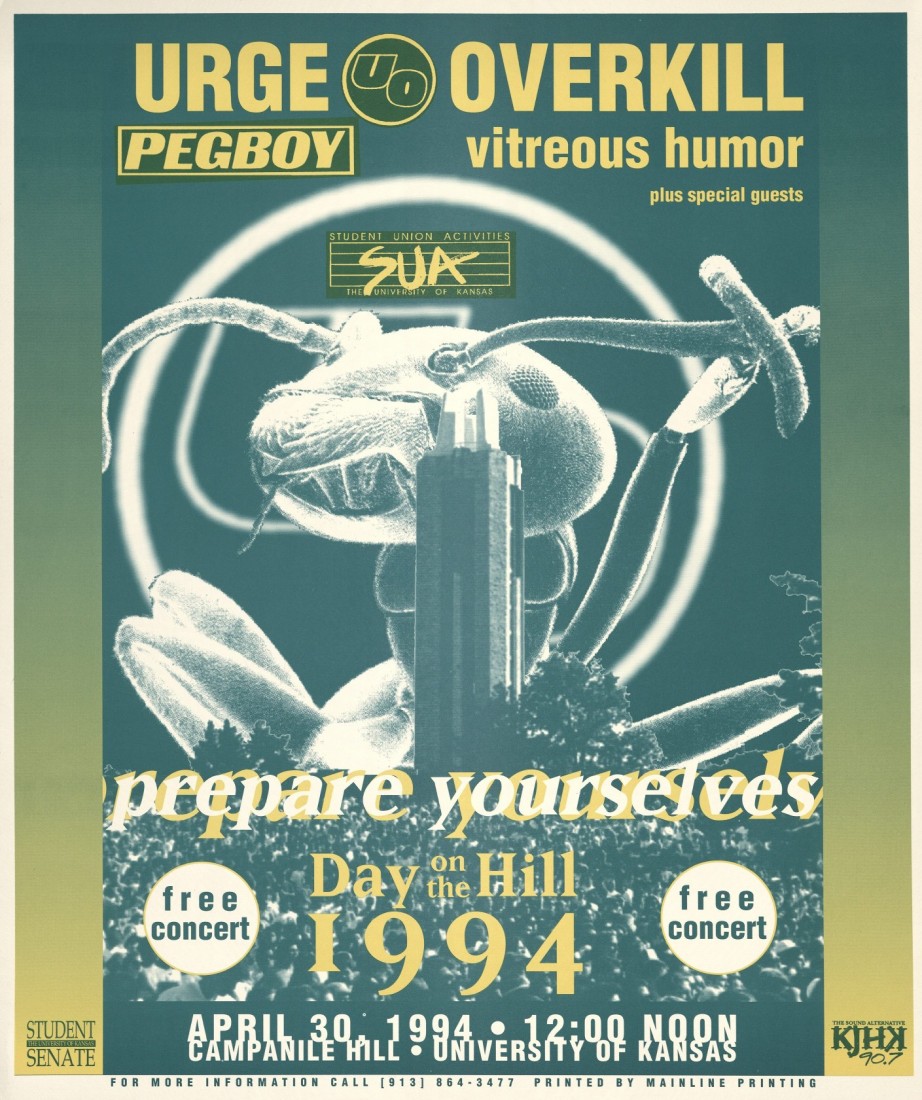
In 1993, SUA decided to host a battle of the bands to choose local performers for Day on the Hill, adding another hurdle after cassette tape submissions. The concert was called the Farmers’ Ball, and it continued throughout the 1990s. Heavy rain led to a very muddy show with headliners the Gin Blossoms and Reverend Horton Heat in 1993, and the mud came again in 1994 with Urge Overkill. 
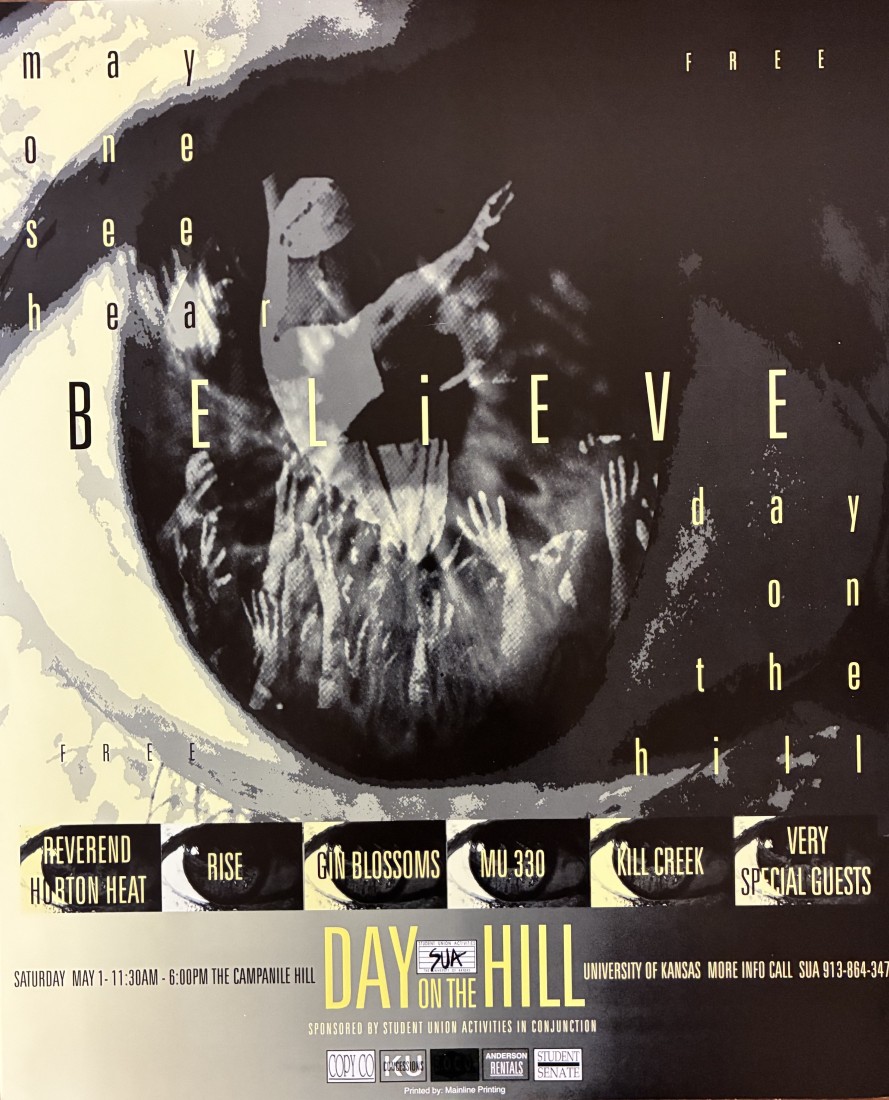
Posters from the 1993 (left) and 1994 (right) Day on the Hill shows. University Archives Records, Student Activities: Student Union Activities. Call Number: RG 71/23. Click images to enlarge.
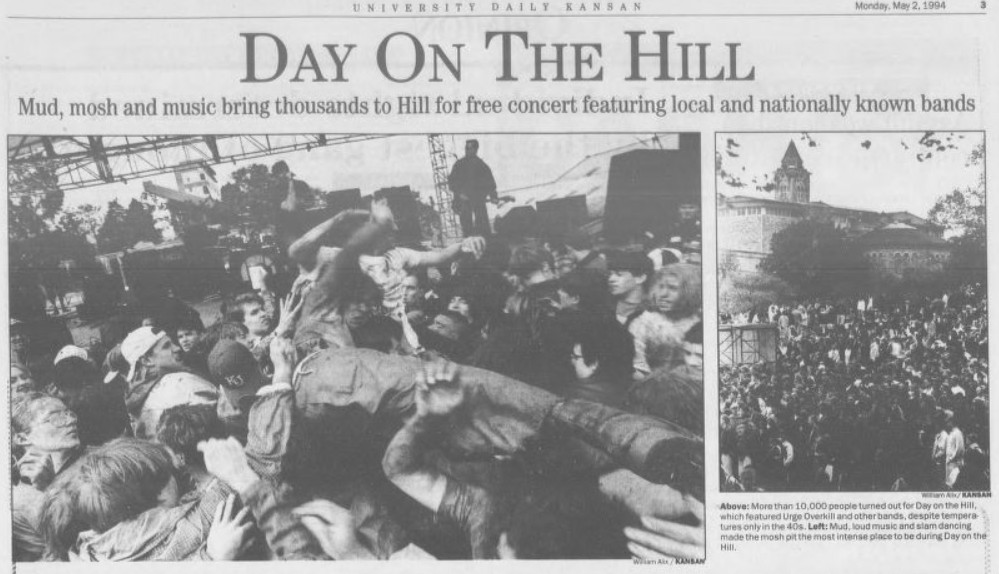
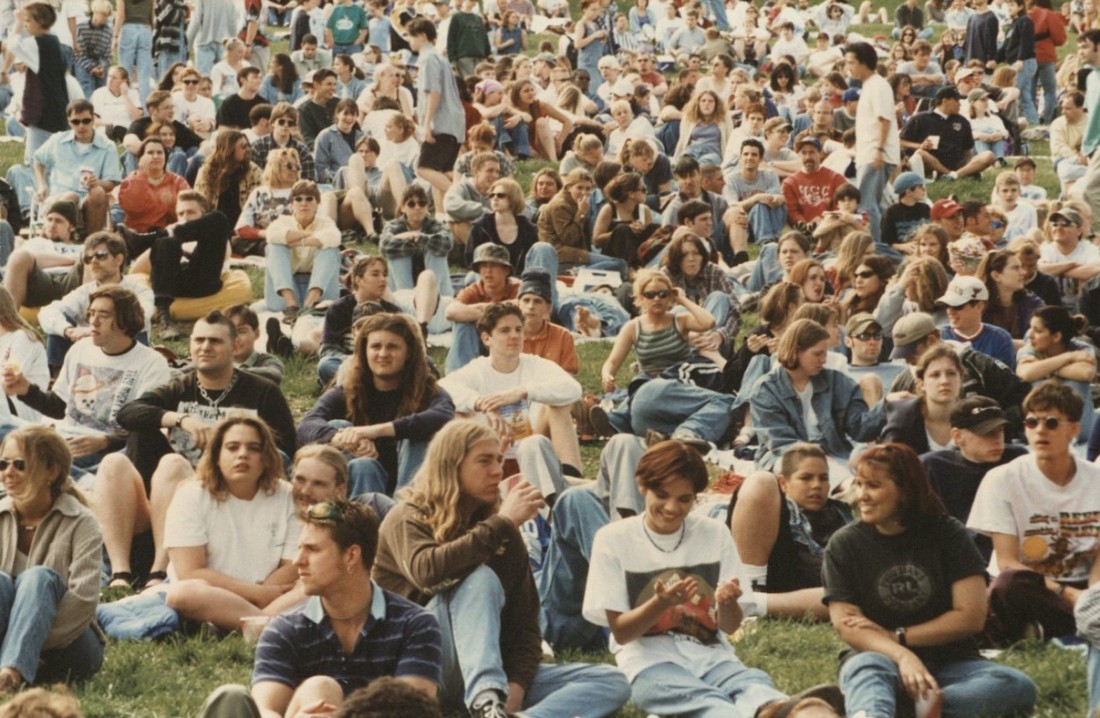
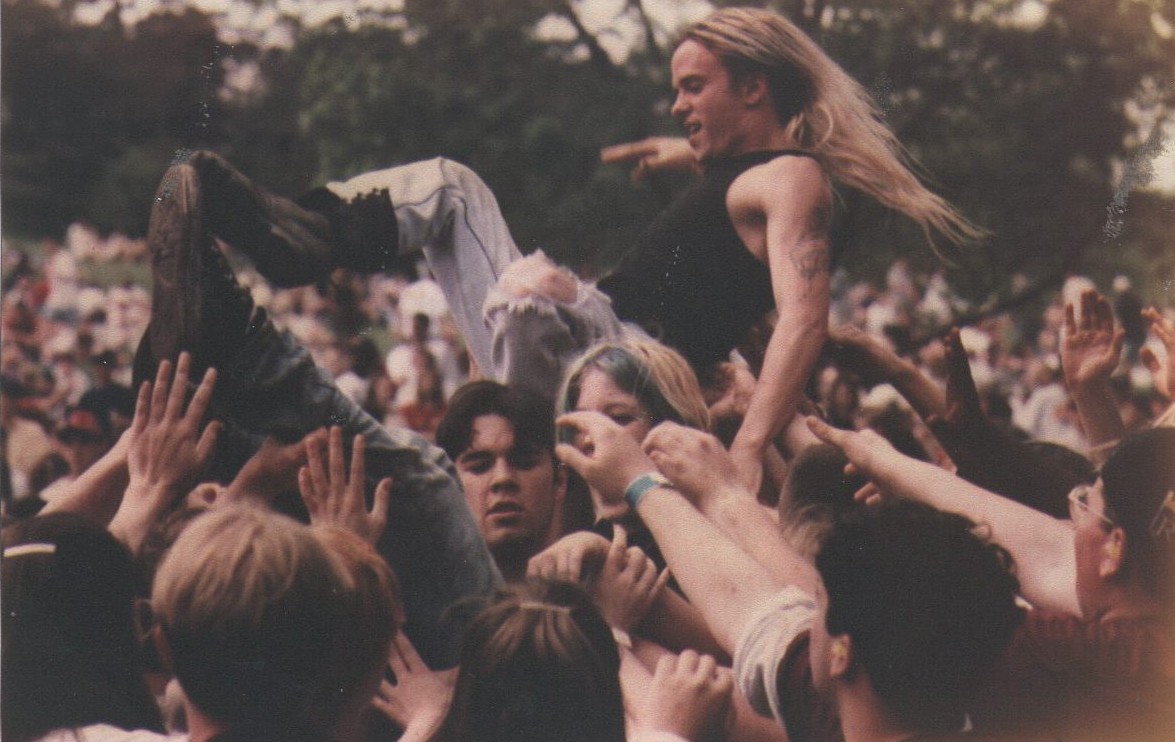
This image has text with two black-and-white photos: one of a mosh pit and one of a large crowd.
University Daily Kansan coverage of the 1994 Day on the Hill concert. University Archives. Call Number: UA Ser 69/2/1. Click image to enlarge.

Leading up the 1995 show, someone started a hoax that the band Phish was going to be the headliner and posted fake flyers around campus, leading to disappointment when Matthew Sweet was announced as the real headliner. Also that year, a few students decided to load a couch into a truck and bring it to the hill to sit on during the event. For many years later, students brought couches and other furniture, hauling them up the hill to enjoy a comfortable view. 
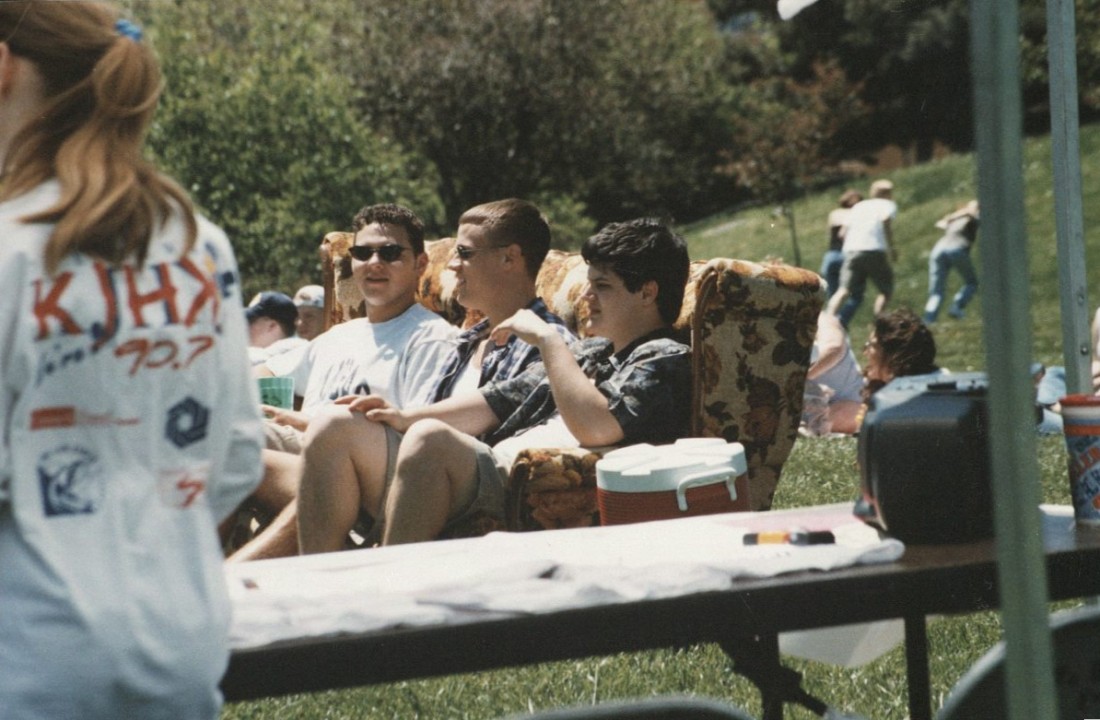
Color photo of three young men sitting outside on a brown floral couch.
Students enjoying Day on the Hill from a comfy couch, 1990s. University Archives Photographs, Student Activities: Student Union Activities. Call Number: RG 71/23 1990s Prints. Click image to enlarge.

The late ’90s brought new changes including games and carnival-like activities, and the show ended at 6pm rather than at 9pm or later. Despite its budget struggles, SUA was able to book Urge Overkill, They Might Be Giants, Soul Coughing, the Urge, and HUM. 
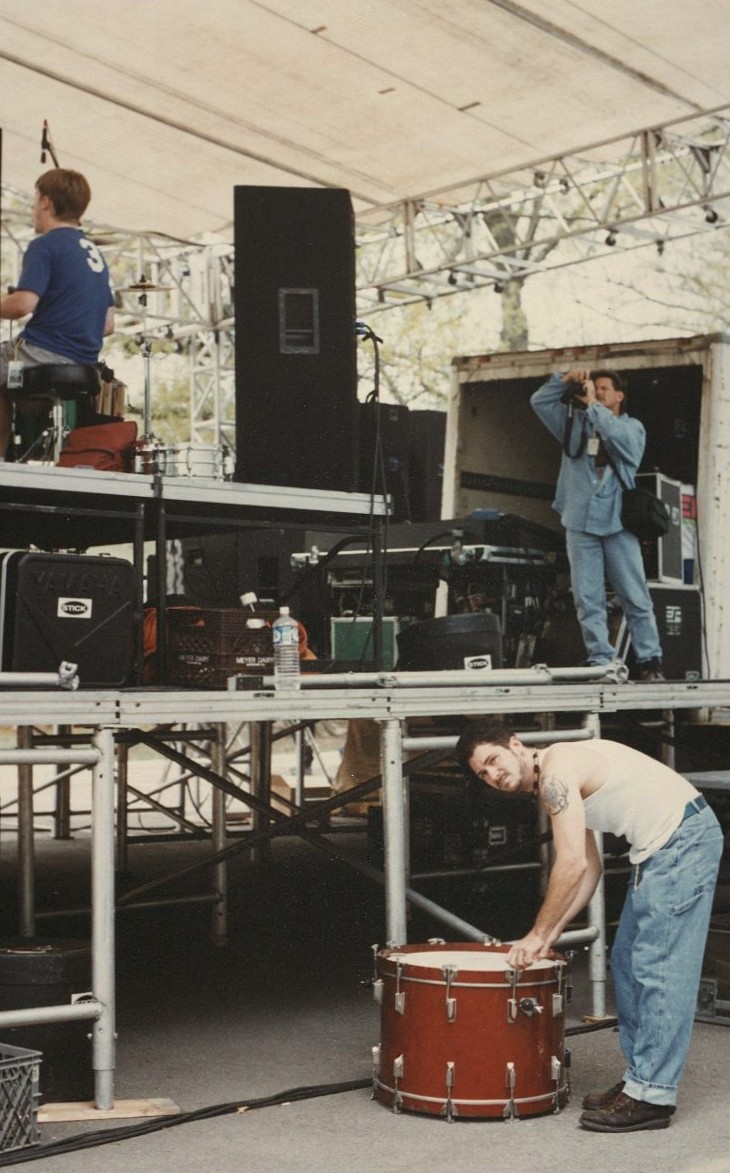
Scenes from Day on the Hill concerts, 1990s. University Archives Photographs, Student Activities: Student Union Activities. Click on images to enlarge.
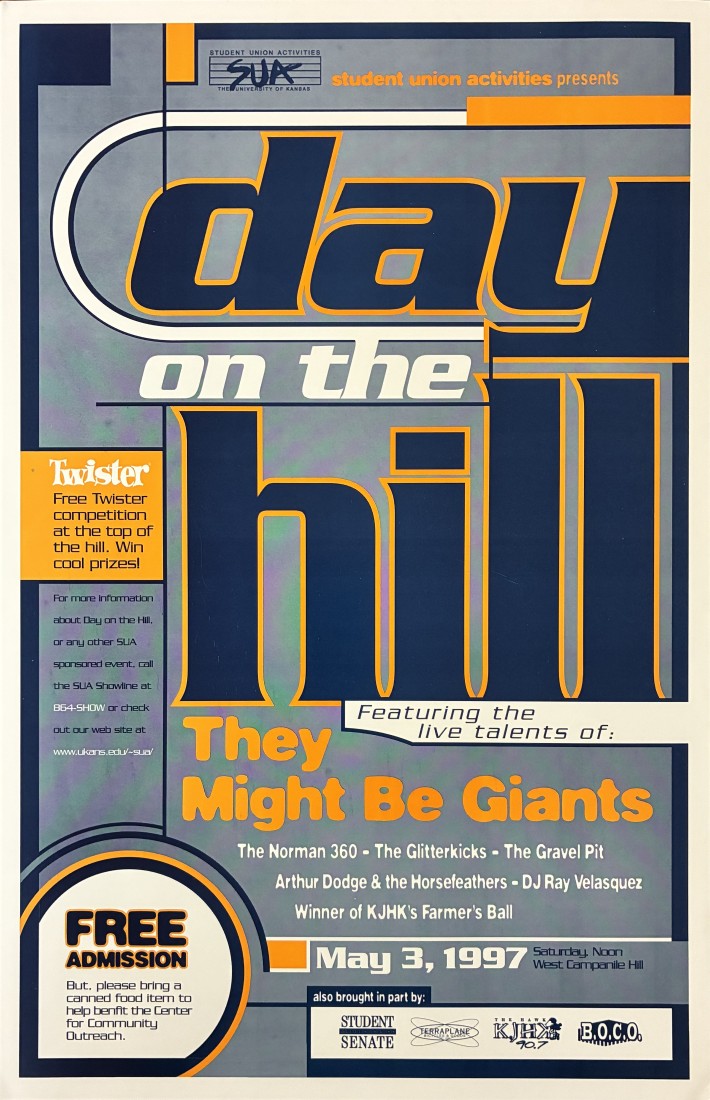
Concert information in a color scheme of cream, orange, and blue.
The promotional poster for the 1997 Day on the Hill concert. University Archives Records, Student Activities: Student Union Activities. Call Number: RG 71/23. Click image to enlarge.
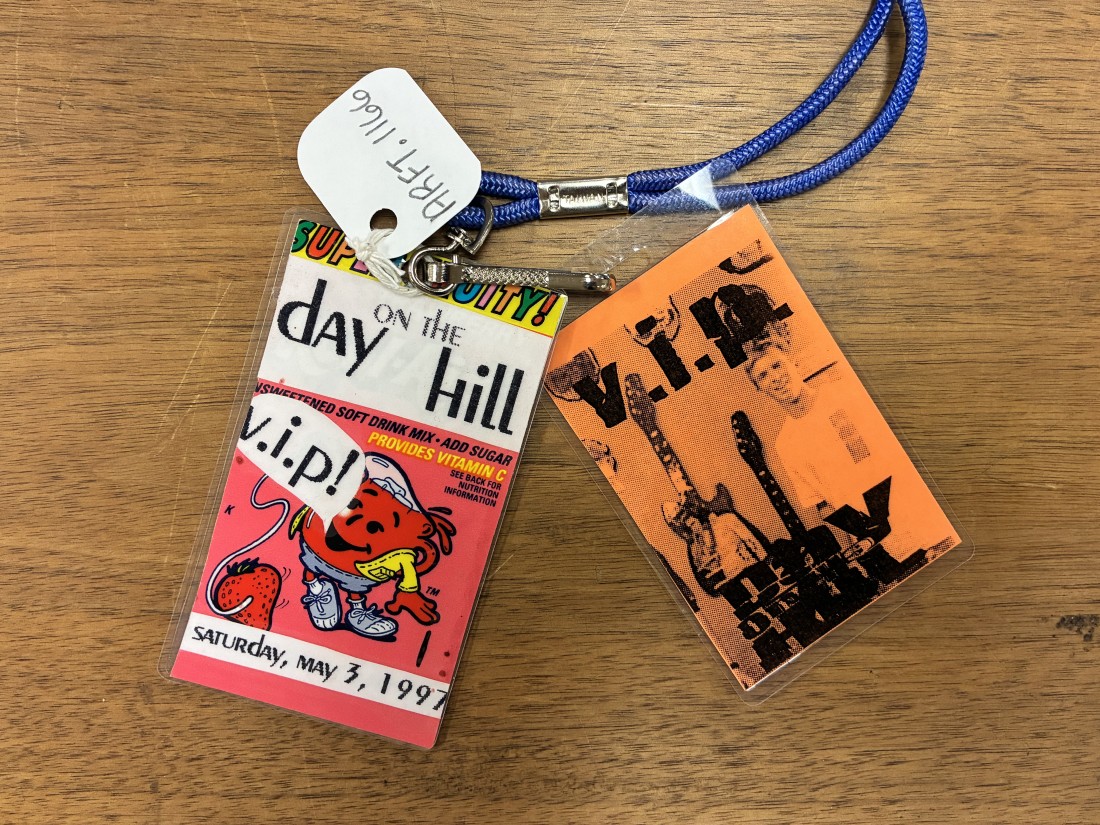
Photo of two VIP badges. One is orange with a background image of a young man and guitars. The other features the Kool-Aid Man.
Day on the Hill badges, 1997. University Archives Records, Student Activities: Student Union Activities. Call Number: RG 71/23. Click image to enlarge.

In 2002, SUA decided to return to Day on the Hill’s roots as an event for local bands only. The show was also rescheduled a week later because of rain and moved to a parking lot near the football stadium. The low turnout that year prompted SUA to cancel Day on the Hill for the next three years. 

With a new student activity fee in 2006, Day on the Hill returned with headliners Sharon Jones & the Dap-Kings and Spoon. In 2007, it was moved to the Leid Center’s lawn with G. Love & Special Sauce and the Faint. In the UDK, there are no reports about that last show or why SUA stopped it entirely. 

Enjoy these lineups (compiled from the UDK) and links to some videos on YouTube. Many thanks to those who digitized their recordings and preserved these glimpses of what was possible on KU’s campus when determined, resourceful students were able to pull off ground-breaking, free shows that celebrated the very important role that music plays in young people’s lives. 

  • 1989: Pathetic Excuse, The Mahoots, The Works, The Moving Van Goghs, Love Tractor, Too Much Joy 
  • 1990: The Witch Doctors, 2-Mile Death Plunge, Chris Beneke, Joe Worker, The Fluid, Sin City Disciples, Buffalo Tom, DJ Sir Light, Toad the Wet Sprocket 
  • 1991: Now See Hear, Two Guitars and a Short Guy, Zoom, Mutt Finicky, Az-One, DOPE (Disciples of Peace and Equality), Paris 
  • 1992: Big B, Cicada Rhythm Band, Zoom, Trademark, Tribe After Tribe, Let’s Go Bowling, Pearl Jam (full set and another view) 
  • 1993: Rise, Kill Creek, MU330, Crash Vegas, Gin Blossoms, Reverend Horton Heat 
  • 1994: Bubble Boyz, Pegboy, Vitreous Humor, Urge Overkill 
  • 1995: Lou’s Revenge, Bastard Squad, Tenderloin, Matthew Sweet 
  • 1996: Champion Guts to Glory Obstacle course, Justin Case, Sick, Poster Children, The Floyds 
  • 1997: Chebella!, Arthur Dodge and the Horsefeathers, The Glitterkicks, Norman 360, The Gravel Pit, They Might Be Giants  
  • 1998: 2 Player Option, Fear & Whiskey, The Believe It Or Nots!, The Creature Comforts, Soul Coughing  
  • 1999: Sarsky, Frogpond, Son Venezuela, Panel Donor, Poster Children, HUM 
  • 2000: Proudentall , The Jesse Jackson 5, Rex Hobart and the Misery Boys, The Co-op, The Urge 
  • 2001: Preferred Villain, Brent Barry and the Secondhands, The Youngblood Brass Band, Pomeroy, The Daybirds, Fastball 
  • 2002: Hardaway, Thulium, No Lessons, Hotsauce, Emilia Dahlin, The Anniversary 
  • 2006: Ghosty, Kelpie, The Belles, Superargo, DJ’s Hot Lunch Sharon Jones & the Dap-Kings, Spoon 
  • 2007: The Roseline, Pomeroy, G. Love & Special Sauce, The Faint 

Kate Stewart
Curator of the Wilcox Collection of Contemporary Political Movements
Collections to Celebrate International Transgender Day of Visibility 

March 27th, 2026

The International Transgender Day of Visibility was started in 2009 by transgender activist Rachel Crandall Crocker. When she came out as trans in 1997, she was fired. Over ten years later, she realized that the transgender community needed a day of advocacy and celebration beyond Transgender Day of Remembrance that would be “a day to focus on the living.” Every year, it is celebrated on March 31st with events and social media campaigns to highlight the courage of transgender people and provide support for the community. 

Spencer Research Library has acquired a diverse array of material that documents the lives of transgender people – especially in Kansas and the Midwest – and their creative works. For example, Bruce McKinney was an LGBTQ activist in Wichita, and his large collection of personal papers (Call Number: RH MS 1164) in the Kansas Collection documents many organizations, including the Wichita Transgender Alliance. Other collections that include material on local organizations include Les-Bi-Gay-Trans collected material (Call Number: RH MS 900), the papers of Kristi Parker (Call Number: RH MS 1348), and the papers of Arla Jones and Kimberly Kreicker (Call Number: RH MS 1452). 

In the Wilcox Collection, zines from the Solidarity Revolutionary Center and Radical Library make up the majority of material by and about the transgender community. The following sample is illustrative of the art and writing produced by transgender zine-makers, many of them from the Midwest. 

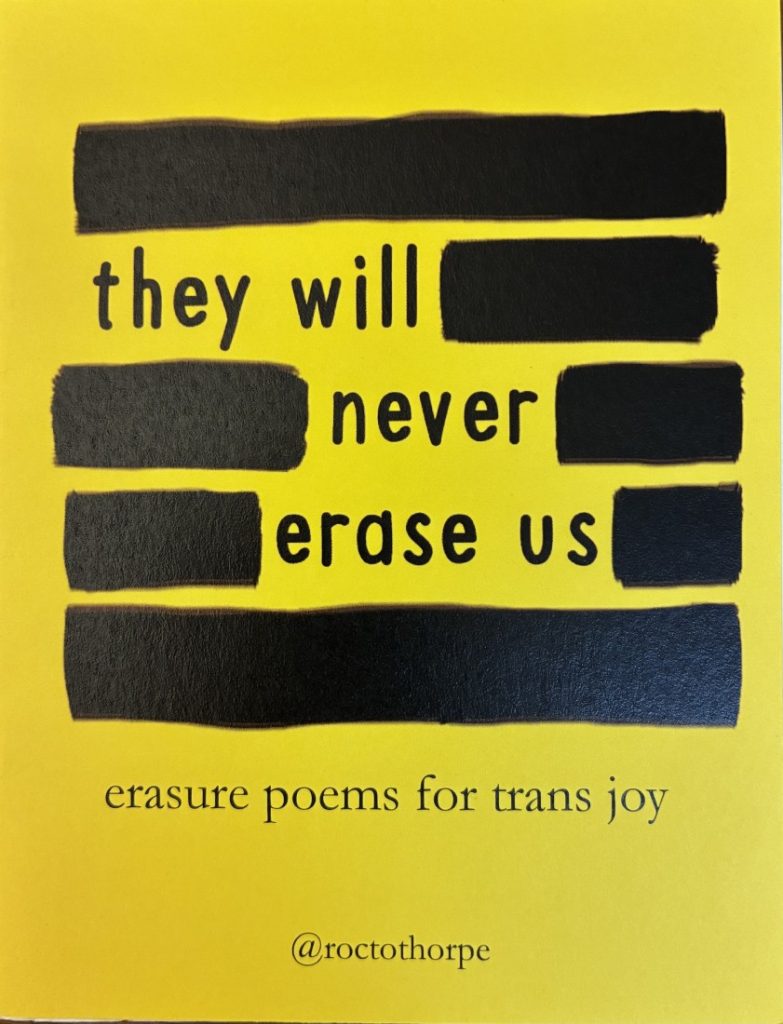
Front cover of the zine, which has a yellow background with text in black surrounded by very thick black lines.

They Will Never Erase Us: Erasure Poems for Trans Joy by @roctothorpe includes blackout poems based on transphobic hate comments. The original comment is included along with a poem that transforms the comment into a defiantly, positive message.

Call Number: Uncataloged


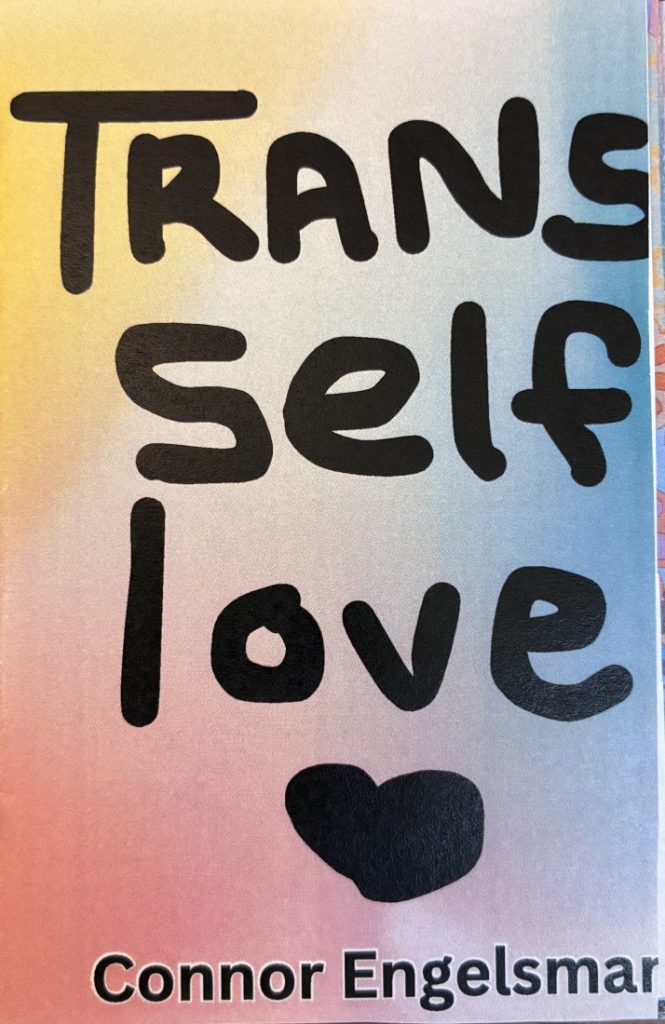
Front cover of the zine, which has the title and the author's name in black text with a large black heart, all against a multicolored background.

Trans Self Love by Connor Engelsman (2023) is a mini-zine that encourages trans people to embrace and love their bodies.

Engelsman has produced many other trans-related zines in the Wilcox Collection including How to Change Your Gender Marker (Call Number: RH WL B3857), Orgs That Serve Trans Ppl in KS (Call Number: RH WL B3864), and Self Care is Resistance (Call Number: RH WL B3862).

Call Number: RH WL B3859


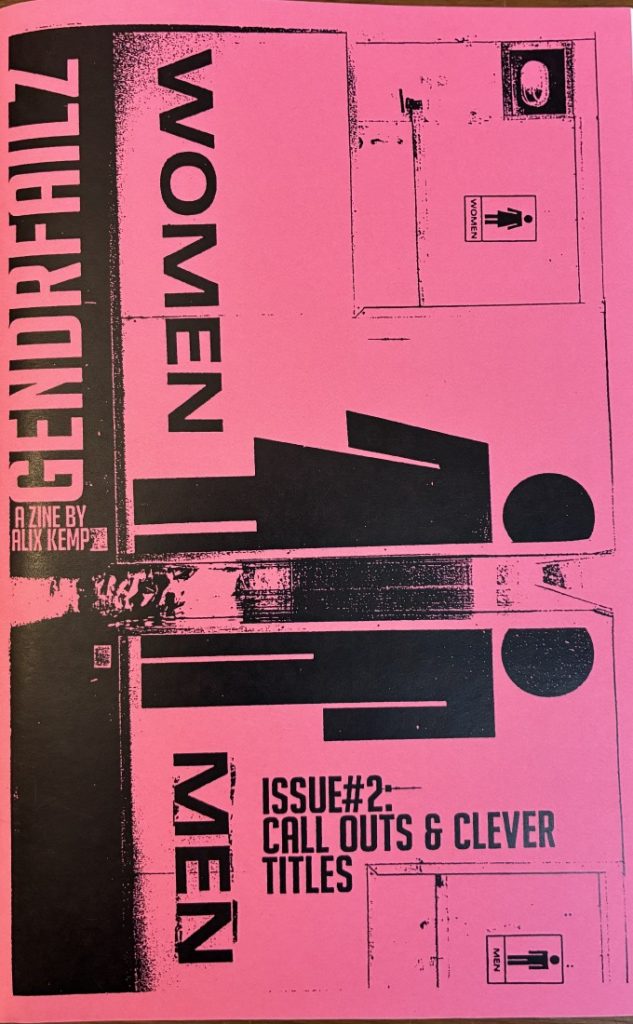
Front cover of the zine, which has a bright pink background and, in black text, the title, the author's name, "Issue #2: Call Outs & Clever Titles," and portions of men's and women's bathroom signs.

The library has two issues of Gendrfailz (2009), a zine edited by activist Alix Kemp that includes many stories from transgender people about their experiences legally changing their names and sex and challenges with the medical system.

Call Number: RH WL C13225


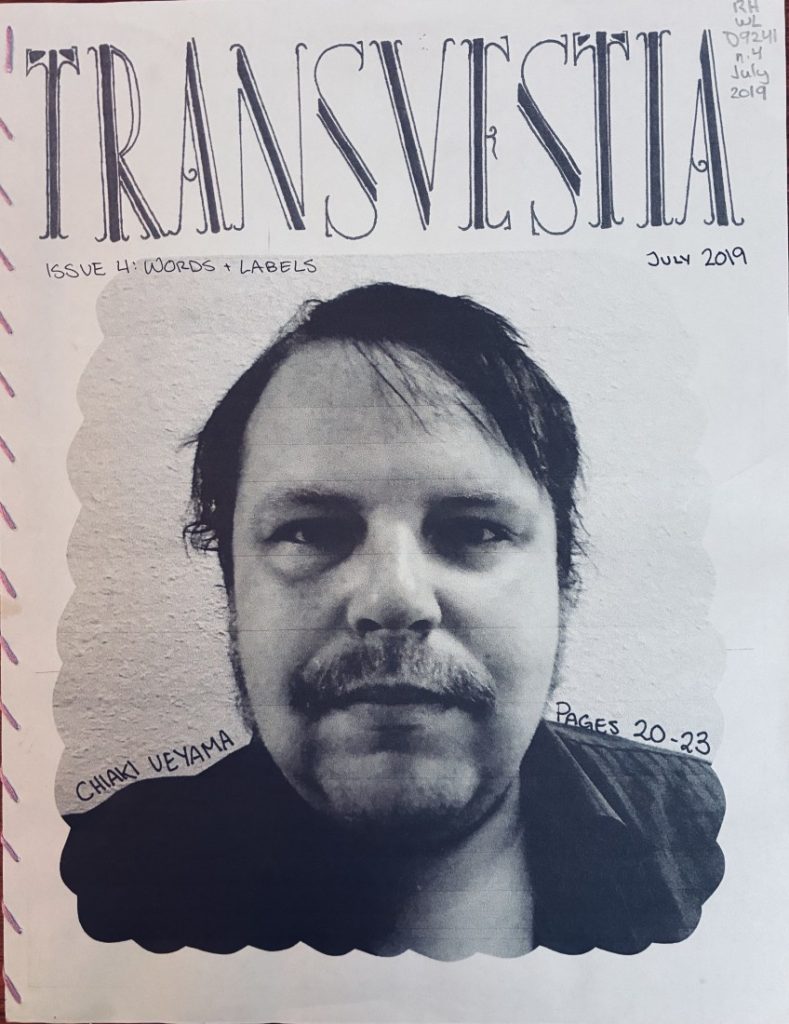
Front cover of the zine, which has a white background with black text, plus a black-and-white headshot of a man.

Issue 4 of Transvestia, Words + Labels, edited by Jackson Stoner (2019) is a compilation of essays and art on the theme of how trans and nonbinary people use words and labels to define themselves and it also addresses the issue of label policing.

Call Number: RH WL D9241


Front cover of the zine, which has black text against a light gray and lightly patterned background

Trans Health Science & You: How Research Affects Our Lives (2018) was produced by the Wisconsin Transgender Health Coalition. Its essays address medical research, data and safety, and how to participation in research on trans people as a form of activism.

Call Number: RH WL C13167


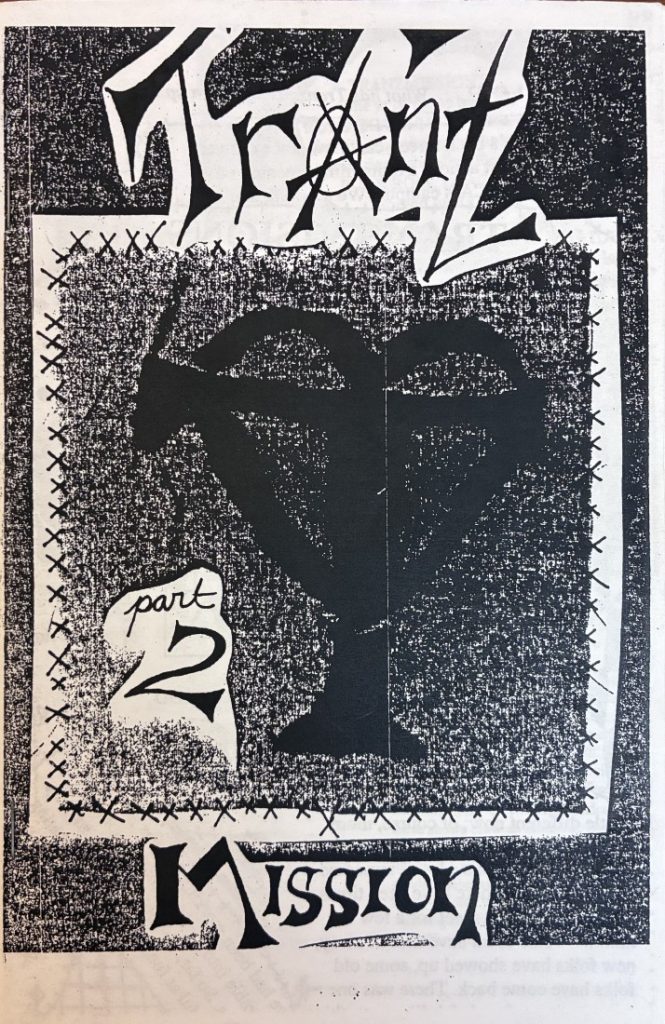
Front cover of the zine, which has text in black and the image of a heart in the background.

The North Carolina-based zine Tranz Mission (200?) states that it is “a group dedicated to the end of socially enforced non-consensual gender tyranny.” It includes artwork, personal stories, tips for allies, comics, and dreams about gender.

Call Number: RH WL C13229


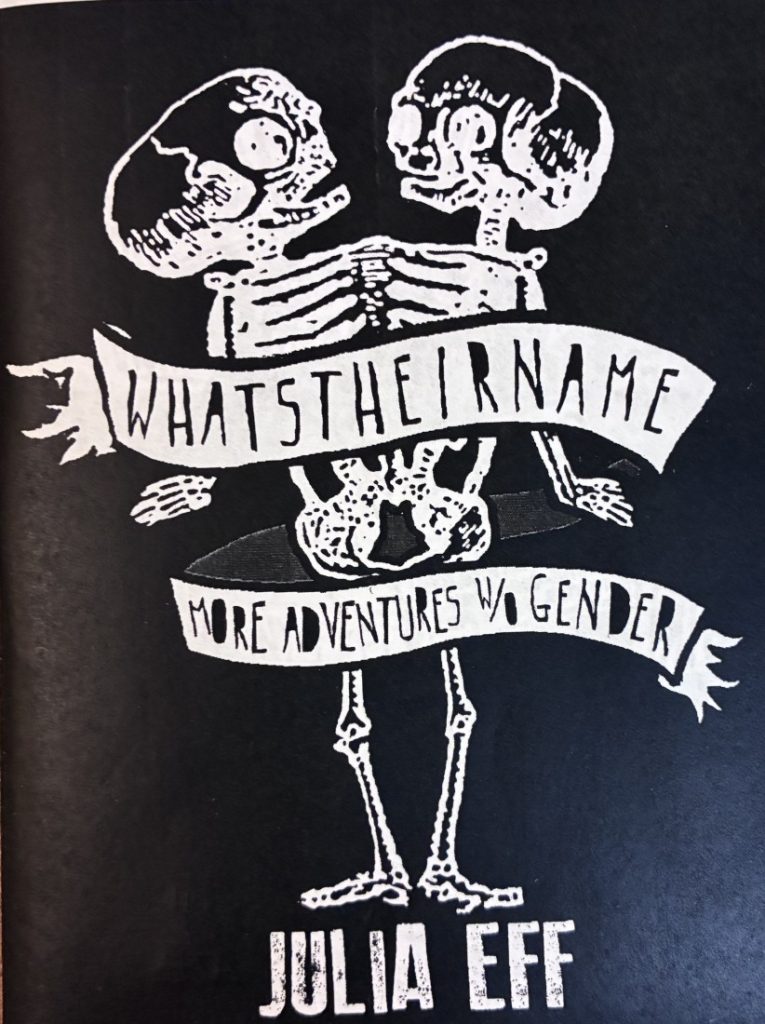
Front of the zine, which has a black background, the title in black text against white banners, and white skeletons.

Whatstheirname: More Adventures w/o Gender (2013) by Julia Eff is a personal look into Eff’s experiences as a nonbinary person. It includes their handwritten, diaristic essays, illustrations, and collages.

Call Number: RH WL A743


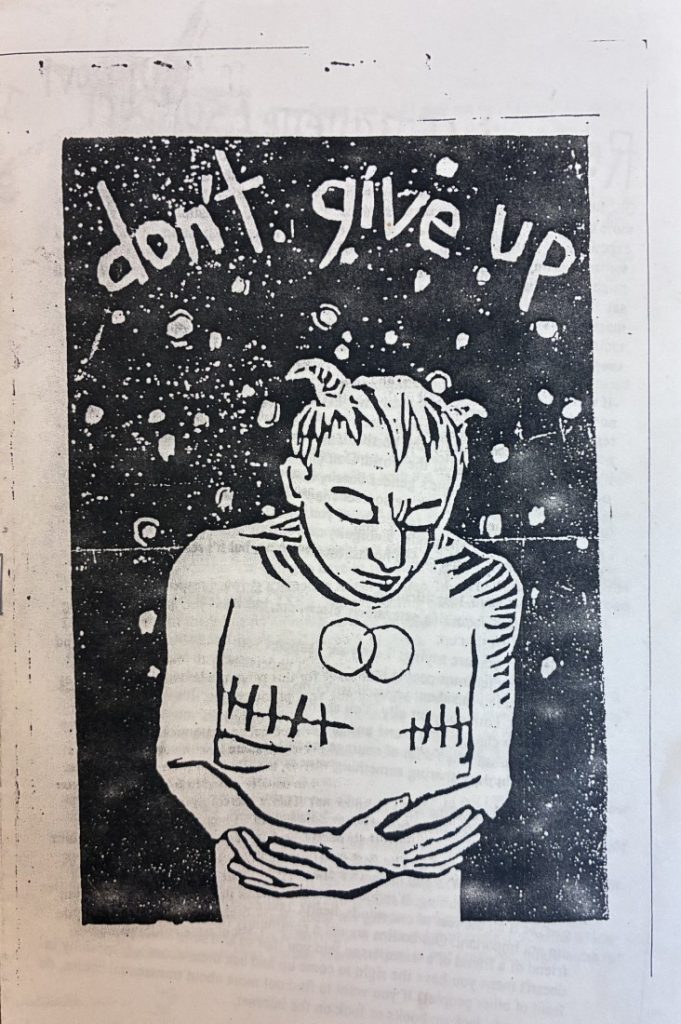
Front cover of the zine, which has a white background with a black inset that has the title in white text and a black-and-white sketch of person folding their arms.

Lastly, Don’t Give Up (between 2000 and 2009) is an anonymously-written zine includes useful etiquette guidelines for cisgender people when interacting with transgender people.

Call Number: RH WL C12639


If you’d like to explore more unique collections and items by and about transgender people – or if you have suggestions for acquisitions or items to donate – get in touch with the Curator of the Wilcox Collection of Contemporary Political Movements, Kate Stewart, at kate.stewart@ku.edu. 

Kate Stewart
Curator of the Wilcox Collection of Contemporary Movements

Spencer’s Growing Zine Collection

January 28th, 2026

Zines are self-published writing and art, often made by collage with illustration, photos, and clippings from other publications, and printed like a pamphlet or small book. Zine production began the 1930s with sci-fi fanzines, but in the 1980s and ‘90s, the widespread availability of the copy machine and Kinko’s 24-hour stores spurred many disaffected young people to express their personal and political opinions, often anonymously, in zines that were distributed locally and nationally via word of mouth and the postal service. Although the internet later replaced much of the ways young people previously communicated with each other, zine production has continued and has been made easier with new digital tools and home printers.

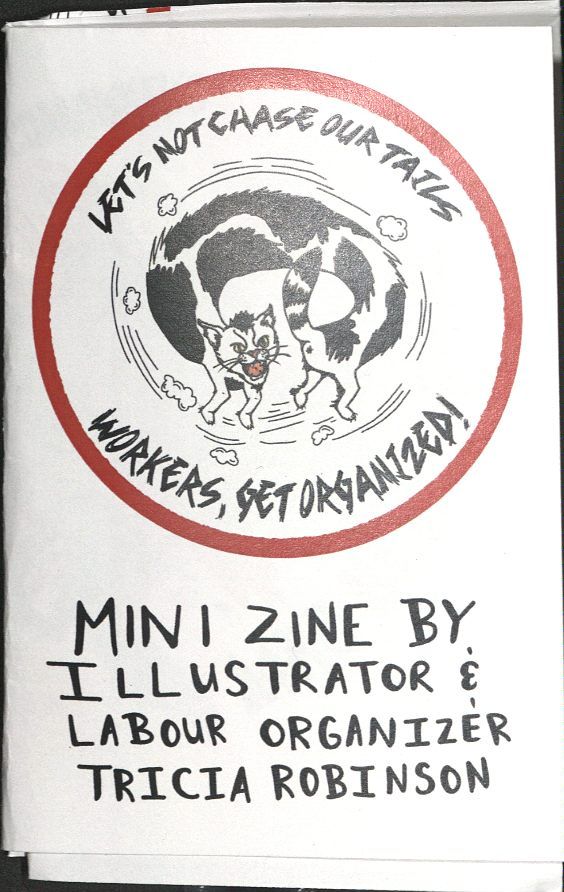
Bibliographic information in black text against a white background with a sketch of an angry cat chasing its tail.
Front cover of Let’s Not Chase Our Tails: Workers, Get Organized! by Tricia Robinson, circa 2025. Call Number: Uncataloged. Click image to enlarge.
Bibliographic information in cream and green text against a cream background with a sketch of a woman and a speech bubble.
Front cover of I Strongly Recommend the Library, circa 2025. Call Number: Uncataloged. Click image to enlarge.
Bibliographic information in black text against a light blue background with an illustration of a man throwing something.
Front cover of Palestine, Mon Amour by Alfredo M. Bonnano, circa 2025. Call Number: Uncataloged. Click image to enlarge.

In 2016, Kenneth Spencer Research Library received a large donation of about a thousand left-wing, radical zines from the Lawrence-based Solidarity Revolutionary Center Library. The books remaining in the library are now housed at the Ecumenical Campus Ministries building near campus. Before they were donated to Spencer, many of these zines were scanned and made available on the Internet Archive.

Since adding the Solidarity Library zines to the Wilcox Collection of Contemporary Political Movements in 2016, interest in the collection has grown among KU students, KU faculty, and community members. Several classes come to Spencer each semester to learn about the collection, view a selection of zines, and complete a primary source analysis activity with one zine. These class visits help prepare students to tackle a creative, unique assignment to make their own zines. Students also tour the Makerspace at Anschutz Library, where they can utilize the tools and materials needed to write, illustrate, assemble, and print copies of their zines for classes and/or for fun. Additionally, Spencer also hosted attendees of Lawrence’s annual Paper Plains Zine Festival last September for a tour of the library and to view some of our zines up close. Library staff were thrilled to see this group of zine creators and collectors show so much excitement and joy for our zine collection.
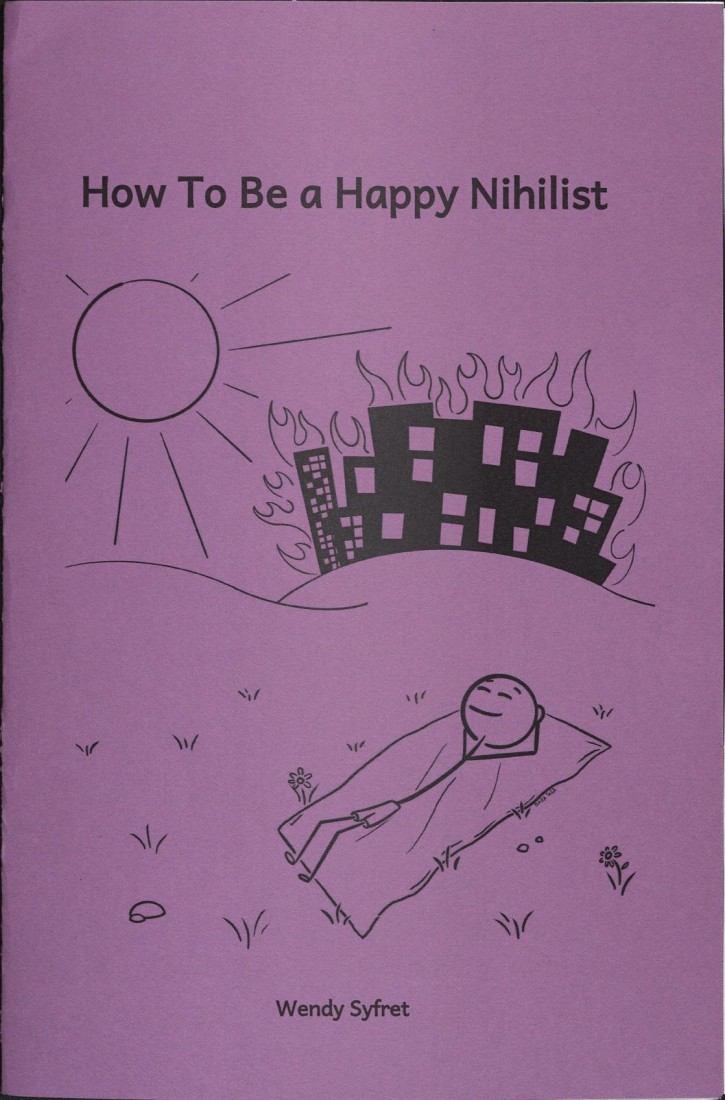
Bibliographic information in black text against a purple background with a sketch of a person laying under the sun on a blanket while a city burns behind them.
Front cover of How to Be a Happy Nihilist by Wendy Syfret, circa 2025. Call Number: Uncataloged. Click image to enlarge.
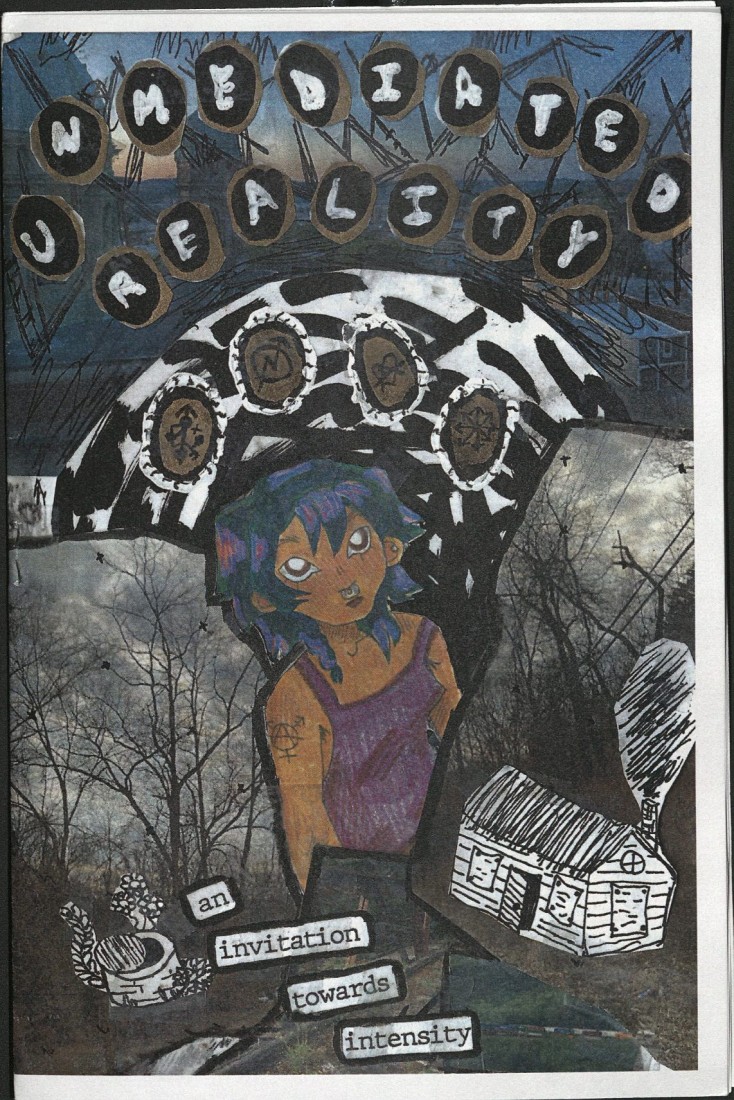
Bibliographic information in black and white text against a multicolored, illustrative background that includes a woman, a cabin, and trees.
Front cover of Unmediated Reality: An Invitation Towards Intensity, circa 2025. Call Number: Uncataloged. Click image to enlarge.
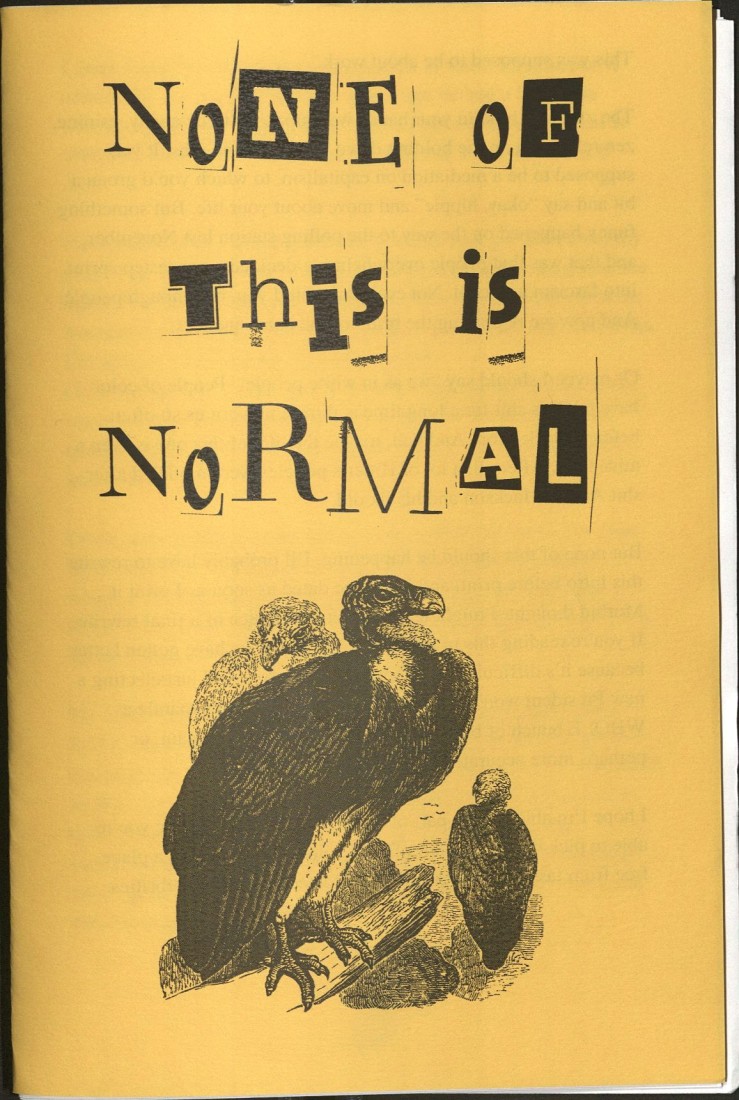
Bibliographic information in black text against a yellow background with an illustration of a large bird or hawk.
Front cover of None of This is Normal, circa 2025. Call Number: Uncataloged. Click image to enlarge.

Due to the popularity of the zine collection, it seemed like a good idea to acquire more recently published zines that address current topics students might be interested in. Last fall, we purchased about a hundred new zines (many of them created in 2025 and purchased on Etsy). While some of the zines are reprints of older publications, the more recent ones address topics such as political attacks on transgender people, resistance to fascism and state violence, the labor movement, the war in Gaza, the American tech oligarchy, artificial intelligence, the COVID-19 pandemic, and mutual aid. The zines are in the process of being cataloged; when that work is completed, information about them will be available via the KU Libraries online catalog, and the zines themselves will be available for classes and for research in our Reading Room.

Throughout this post is a sample of ten covers from our most recent purchase of zines. If you have suggestions for further purchases or donations of zines for the Wilcox Collection or if you would like to view these in our reading room, get in touch with Spencer staff!

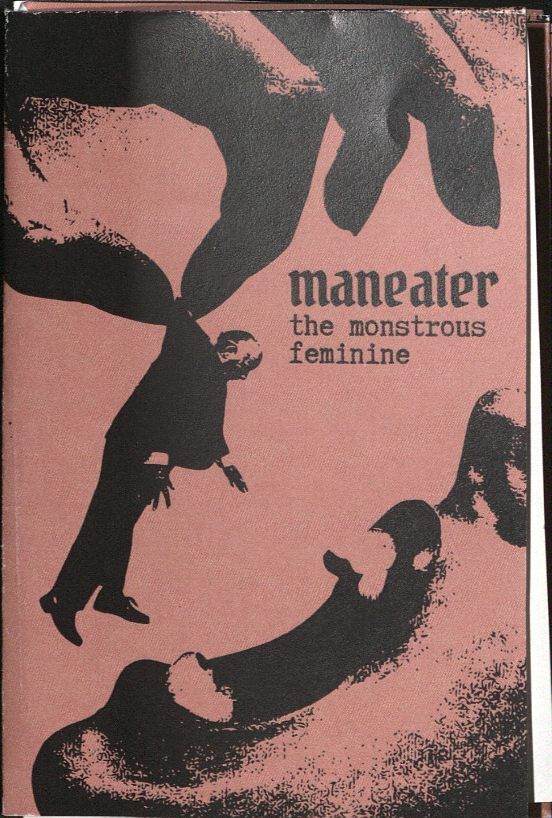
Bibliographic information in black text against a light pink background with an illustration of fingers dropping a small man into an open mouth.
Front cover of Maneater: The Monstrous Feminine, circa 2025. Call Number: Uncataloged. Click image to enlarge.
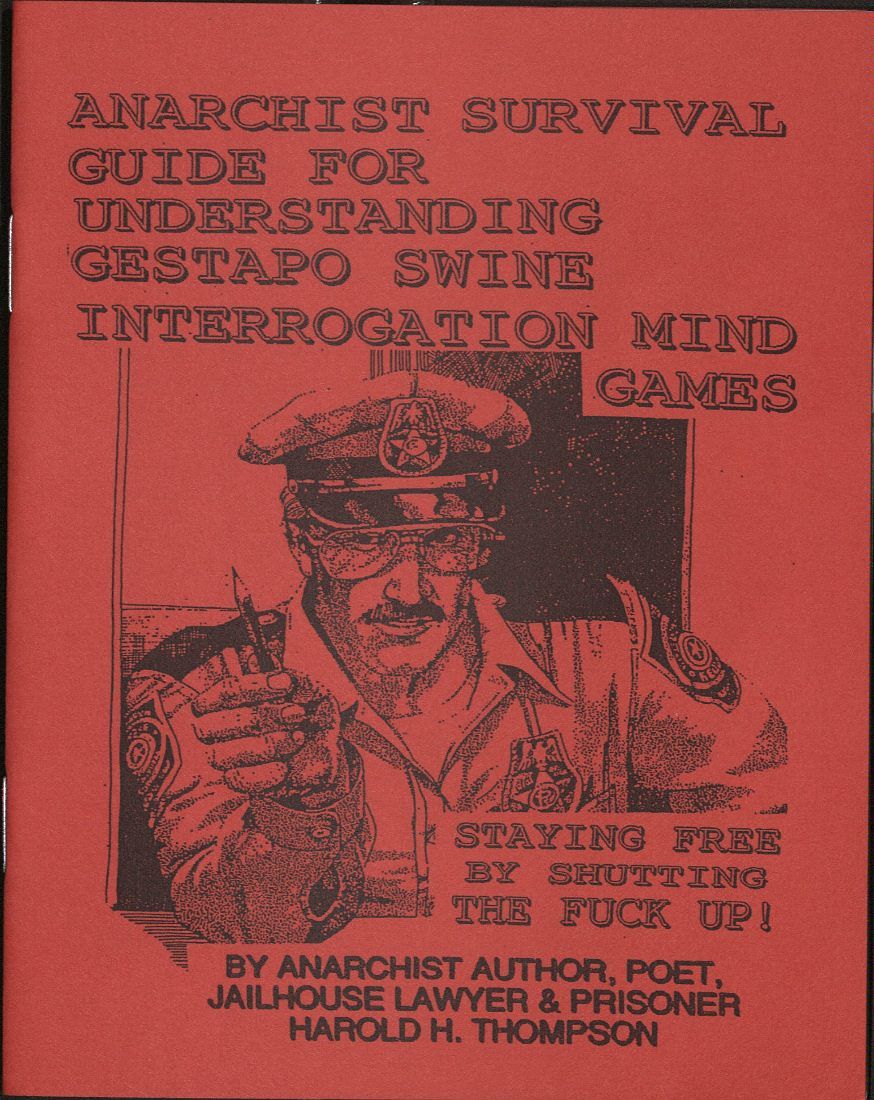
Bibliographic information in black text against a red background with a sketch of a male law enforcement officer holding out a pencil.
Front cover of the zine Anarchist Survival Guide for Understanding Gestapo Swine Interrogation Mind Games by Harold H. Thompson, circa 2025. Call Number: Uncataloged. Click image to enlarge.
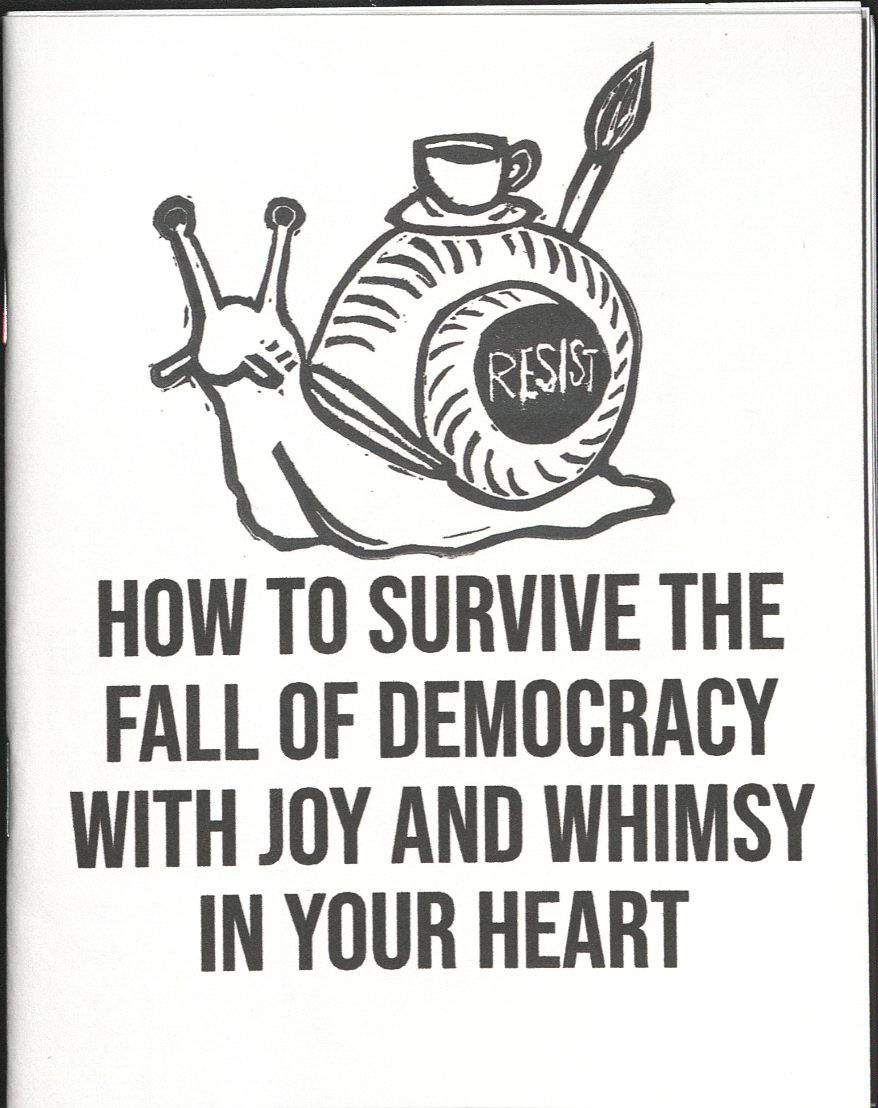
Bibliographic information in black text against a white background with a sketch of a snail that has a coffee cup on top of its shell and the word "resist" written on the shell's side.
Front cover of How to Survive the Fall of Democracy with Joy and Whimsy in Your Heart, circa 2025. Call Number: Uncataloged. Click image to enlarge.
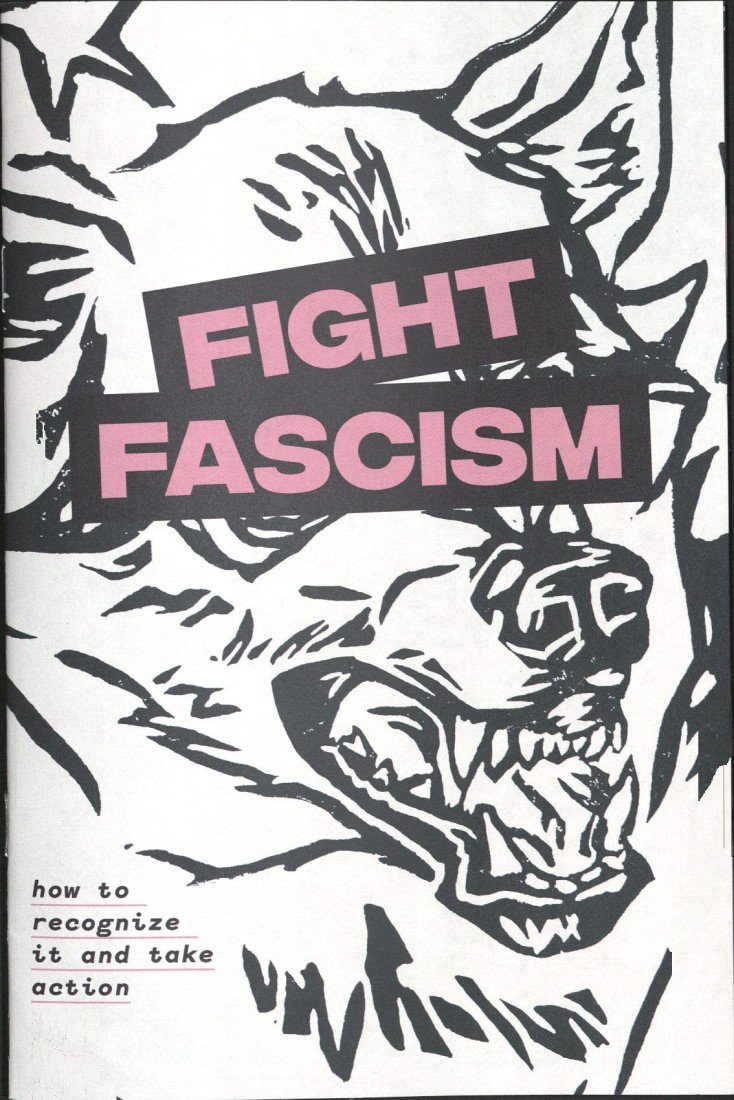
Bibliographic information in pink and black text against a white background with a sketch of a growling animal.
Front cover of the zine Fight Fascism: How to Recognize It and Take Action, circa 2025. Call Number: Uncataloged. Click image to enlarge.

Kate Stewart
Curator of the Wilcox Collection of Contemporary Political Movements
Maureen Tuohey and Theo McKay
Public Services Student Assistants

Celebrating Banned Books Week at Spencer

October 9th, 2025

This week week, October 5-11, is Banned Books Week, an advocacy initiative started by the American Library Association’s Intellectual Freedom Committee in 1982 at the suggestion of the Association of American Publishers, who were facing many censorship efforts by the religious right at the time. Libraries across the country celebrate this week with banned book displays and events that bring attention to the fact that our freedom to read is still under attack. KU’s Watson Library currently has a display of banned books, and KU students can check the Libby app for a list of e-books and audiobooks that are commonly challenged.

Spencer Research Library holds many classic books that are often challenged or banned in schools, including first and special editions of Fahrenheit 451, The Adventures of Huckleberry Finn, Lady Chatterley’s Lover, and Naked Lunch. Beyond novels, Spencer also collects material for the Wilcox Collection of Contemporary Movements that would otherwise be banned in many contexts or far outside a typical public or school library’s collecting policies.

The Wilcox collection was started by Laird Wilcox, a student at KU in the 1960s who was interested in politics and concerned about free speech. He started collecting flyers, newsletters, and books from organizations on the political margins, including communist groups and right-wing leaders. As the chair of KU’s Student Union Activities Minority Opinions Forum, he brought several controversial speakers to campus, including neo-Nazi activist George Lincoln Rockwell. The 1964 event caused heated debate among students and faculty about free speech and what was appropriate on college campuses. (The Wilcox Collection includes photographs and cassette tapes from this event and Wilcox’s interview with Rockwell.) Wilcox’s experiences at KU as a student activist led him to collecting political material he feared would be banned or otherwise unavailable. He continued collecting until his death in 2023.

Black-and-white photograph of three young men and an older woman.
Winners of the KU Libraries’ Taylor (now Snyder) Book Collecting Contest, 1964. Laird Wilcox is on the far left, next to Elizabeth M. Taylor (the sponsor of the contest). Laird’s winning collection later became part of Spencer’s Wilcox Collection. University Archives Photos. Call Number: RG 32/40 photographs. Click image to enlarge (redirect to Spencer’s digital collections).

To find these kind of publications, Wilcox used directories like the Guide to Subversive Organizations and Publications, which was issued by the U.S. House of Representatives’ Committee on Un-American Activities (known as HUAC) and revised several times throughout the 1950s and early ‘60s. This directory included summaries of organizations with citations to HUAC’s own committee reports and records. Although this directory and others like were often used by librarians to censor their own collections, Wilcox used it essentially as a catalog. He also purchased books published by right-wing organizations and individuals on their beliefs that schools, government bodies, or other organizations were brainwashing Americans, especially children, with left-wing propaganda like Communist-Socialist Propaganda in American Schools by Verne P. Kaub. These were also useful for tracking down material, as they often included lists of titles and directions on how to (ironically) acquire them to review for censorship efforts in local communities. Wilcox also collected books, periodicals, and ephemera by organizations devoted to free speech that tracked censorship like Censorship News to help make collecting decisions and acquire material that is now available at Spencer.

This image has text.
The front cover of the Guide to Subversive Organizations and Publications (and Appendixes), 1961. Call Number: RH WL C601. Click image to enlarge.
This image has text.
The front cover of Communist-Socialist Propaganda in American Schools, 1967. Call Number: RH WL B3573. Click image to enlarge.

By corresponding and meeting with booksellers and people who belonged to these groups, Wilcox expanded his circle of contacts to acquire more “subversive” books and material. He was able to facilitate acquisitions of unpublished manuscript materials from key figures in both left-wing and right-wing movements like Willis Carto (founder of the Liberty Lobby) and other collectors such as Albert and Angela Feldstein (who specialized in left-wing buttons, stickers, and posters). The Wilcox Collection now includes many formats beyond books such as photographs, audiovisual material, and more.

In his later life, after developing a reputation as an expert on propaganda and free speech, Wilcox wrote his own books on political extremism and compiled bibliographies of propaganda and books of quotations on censorship, propaganda, and freedom of speech. These publications are also available at Spencer in the Wilcox Collection.

The former Curator of the Wilcox Collection, Becky Schulte, wrote about Laird Wilcox, the history of the collection, and her efforts to expand it in a presentation to the Society of American Archivists in 2016, titled “Curating the Controversial: The Wilcox Collection of Contemporary Political Movements, University of Kansas.”  She details the acquisition of the collection of James Mason, a key figure in white supremacist movements, and both the difficulties and professional satisfaction involved in curating such a collection.

The librarian Mary Jo Godwin said that “a truly great library contains something in it to offend everyone,” a quote that is now widely circulated on social media during Banned Books Week and in other discussions of censorship. Due to the decades of tireless effort by both Laird Wilcox and Becky Schulte, we can say that the Spencer Research Library is among the best of truly great libraries.

Kate Stewart
Curator of the Wilcox Collection of Contemporary Political Movements
Meet the KSRL Staff: Kate Stewart

September 23rd, 2025

This is the latest installment in a recurring series of posts introducing readers to the staff of Kenneth Spencer Research Library. Today’s profile features Kate Stewart, who joined Spencer Research Library in August 2025 as the Curator of the Wilcox Collection of Contemporary Political Movements.

Headshot photograph of a woman with glasses.
Kate Stewart, Curator the Wilcox Collection of Contemporary Political Movements. Click image to enlarge.
Where are you from?

I was born in Stillwater, Oklahoma, and when I was five, we moved to Merriam, Kansas, where I spent the rest of my childhood. Since I left at 18 for Vassar College, I have moved around a lot all over the country. Most recently, I was living in Tucson and before that, Washington, D.C. It is really great to be back in the area that I think of as home! My older brother and a lot of my high school friends went to KU, so I have many fond memories of hanging out in Lawrence in the ‘90s. Fun fact: I went to Day on the Hill for the first time in 1993 when I was in 8th grade! Unfortunately, that was the year after the infamous Pearl Jam show, but I did get to see MU330 and many other bands in Lawrence.

How did you come to work at Spencer Research Library?

I have been working in archives for almost twenty years, mostly in temporary positions that focused on political and oral history collections. When I saw this job posting, I knew it was my dream job. Not only is it exactly the kind of work I want to do, but I also have been wanting to move back to the area for the past few years. I feel incredibly lucky to be here every day.

What does your job at Spencer entail?

I’m the Curator of the Wilcox Collection of Contemporary Political Movements, which has a large number of books, ephemera, and manuscript collections related to left- and right-wing movements in the United States. In particular, it is the premier archive for researchers studying right-wing extremism and one of the only ones in the U.S. that collects that kind of material. My primary job duty is to acquire new items and collections in this area, which means I get to shop online for rare books and ephemera and work with people interested in donating their personal and organizational collections to the Spencer Library. I will also be teaching instruction sessions related to the Wilcox collection for KU classes and researching stories about how politics and libraries are interconnected.

How did you come to work in libraries/archives/special collections?

My mom, aunt, and grandfather were all librarians, so I grew up hanging out in libraries quite a bit, especially when I was in college. After getting a master’s in history at the University of Iowa, I decided to get my master’s degree in library and information science there too and join the family business. As a student, I got to work at the Iowa Women’s Archives, which was a terrific first job for me in this field. From there, I have had many different jobs (including five temporary ones) in archives or libraries, including the American Folklife Center at the Library of Congress, the U.S. Senate, and the Arizona State Museum at the University of Arizona. I have also worked as a freelance writer, ghostwriter, and editor for many years as well, which has been a great joy.

What part of your job do you like best?

Walking through the building, especially the stacks, when I’m alone and it’s dark. I always feel like I’m in the suspenseful part of a horror movie, and it’s quite an adrenaline rush. But when it comes to my actual job duties, I really love working with students. It’s so much fun to blow their minds about what we have at the library and that it’s all here for them.

What do you have on your desk?

I have some duplicate zines from the collection Spencer acquired from the Solidarity Library, including one titled Winning Office Politics Quickly that has been making me laugh. I have a lot of books from Watson Library about the FBI for an article I’m working on about the scandalous publication of Max Lowenthal’s book on the FBI in 1950, which I have been wanting to write for many years. I have also started bringing in ephemera from my own past to decorate my office, and I am glad to get some of it out of my moving boxes and into a good home.

What is one of the most interesting items you’ve come across in Spencer’s collections?

While looking at zines for classes that are coming in this semester, I came across a famous one called Sniffin’ Glue. It was created in 1977 in London by Mark Perry, a punk fan and musician. It has some really great illustrations and photos from that time of bands like the Ramones and the Clash.

This image has text and a collage of black-and-white photographs.
The front cover of Sniffin’ Glue, July 1977. Call Number: RH WL D9321. Click image to enlarge.
What are some of your favorite pastimes outside of work?

A lot of my life outside of work is consumed by reading about politics and participating in political organizations, although I don’t know if I should call that a pastime since it isn’t exactly enjoyable a lot of the time, especially these days. When I really want to relax, I take a long hike or go to a baseball game (I am a Royals and Nationals fan). I am also an obsessive music fan (and musician) and love to play card games.

Kate Stewart
Curator of the Wilcox Collection of Contemporary Political Movements