The University of Kansas

Inside Spencer: The KSRL Blog

Books on a shelf

Welcome to the Kenneth Spencer Research Library blog! As the special collections and archives library at the University of Kansas, Spencer is home to remarkable and diverse collections of rare and unique items. Explore the blog to learn about the work we do and the materials we collect.

Throwback Thursday: Kick Off Edition

September 4th, 2014

Each week we’ll be posting a photograph from University Archives that shows a scene from KU’s past. We’ve also scanned more than 1,700 images from KU’s University Archives and made them available online; be sure to check them out!

This week, we celebrate the start of the 2014 football season on Saturday with this image of the old scoreboard at Memorial Stadium. You can learn more about the history of this building at the KU Places Directory and the KU History website.

Photograph of KU football scoreboard, 1938

KU football scoreboard at Memorial Stadium, 1938. University Archives Photos.
Call Number: RG 66/14 Games 1938 Prints: Athletic Department: Football (Photos).
Click image to enlarge (redirect to Spencer’s digital collections).

Caitlin Donnelly
Head of Public Services

Brian Nomura
Public Services Student Assistant

Summertime in University Archives: Artifacts, Books, and Photographs, Oh My!

August 25th, 2014

As an intern in the University Archives at the Kenneth Spencer Research Library this summer, I experienced and accomplished many projects and duties. It feels like just yesterday that I received an interesting and varied list of assignments at the beginning of June. Where did the summer go? Let me show you.

Photograph of University Archives intern JoJo Palko at the desk

University Archives Intern JoJo Palko. Click image to enlarge.

Part of the story starts back in the fall of the 2013. I was hired as a research assistant for the publication of KU’s 150th anniversary book, Toward the Blue, working out of the University Archives. Fast forward to May and we are selecting the photographs and images to be used in the book. By the end of May, the other research assistant, the editors, and I had compiled a selection of over 200 images from the archives. So what was waiting for me when I started my internship? You guessed it—those photographs (funny how that worked). Over the course of a few weeks, I entered the metadata for each image. Fortunately for me (and you) these photographs are little treasures from the university’s past and I really enjoyed going through every single one. I have selected a few to share here.

Photograph of two KU football fans, 1973

Indeed, Kansas is for lovers! Two football fans show their
spirit in true 70s fashion. University Archives Photos.
Call Number: RG 71/66/14 1973 Prints: Student Activities: Football (Photos).
Click image to enlarge.

 Photograph of the hill and campanile during a football game, 1975-1976

View of the hill and campanile during a
football game, 1975-1976. University Archives Photos.
Call Number: RG 71/0 1975-1976 Prints: Student Activities (Photos).
Click image to enlarge.

Photograph of Grupo de Kansas, 1970

Grupo de Kansas, a group of KU students, arriving in Costa Rica, 1970.
University Archives Photos. Call Number: RG 12/1 1970 Prints: International
Programs: Study Abroad (Photos). Click image to enlarge.

Photograph of Chancellor Chalmers with new Baby Jay at Homecoming, 1971

Chancellor Laurence Chalmers with new Baby Jay at Homecoming, 1971.
University Archives Photos. Call Number: RG 2/13 1971 Prints: Chancellors:
Chalmers (Photos). Click image to enlarge.

One other project that took up most of my time was to reorganize, house, and label the archive’s artifacts and to update the database and spreadsheet to make it more efficient for anyone to look up these items in the future. I started the process with a large book truck full of items that were not labeled, not housed, and not in any order that made sense. I panicked. How was I supposed to go through this truck plus the other two boxes full of items? Luckily, my supervisor, University Archivist Becky Schulte, calmed me down and told me to take it one step at a time. I managed to figure out what record group every object belonged in, found a box for those that needed it, labeled them, and entered the information into the databases. That was the end of a very long first step. The second step was just as much fun. There are three rooms that house the University Archive’s artifacts. In order to make room for the new additions, an entire reorganization of the rooms needed to occur. On the positive side, for those few weeks I did not need to work on my upper body at the gym. On the negative side, artifacts continued to come out their hiding places (behind doors) and others were found that needed labels or boxes. As I put the finishing touches on this project, I am really satisfied with how everything turned out and I loved seeing all the interesting “stuff.” Check out the images below to see the final results!

Photograph of University Archives artifacts room

Photograph of University Archives artifacts room

Photograph of University Archives artifacts room

The three above photos show University Archives artifact rooms after
the completion of my reorganization project. Click images to enlarge.

Photograph of Bolshevik Jayhawk Statue

Photograph of Bolshevik Jayhawk Statue in box

This Bolshevik Jayhawk Statue – also shown in its new housing created by the Libraries’
Conservation Department – was sent to the School of Journalism in 1921 by a
former KU student who found it in a Bolshevik Prison camp. University Archives Artifacts.
Call Number: RG 23/0 School of Journalism (Artifacts). Click images to enlarge.

Besides the larger artifacts and metadata projects, I was kept busy throughout the summer with other tasks. One of the most interesting involved a transfer of items from KU’s Theater Department. Moses Gunn, renowned African American actor, attended KU for his graduate degree. It was here that Moses first performed the role of Othello, a character he would play throughout his career. Moses also went on to co-found the Negro Ensemble Company, receive an Emmy nomination, appear in movie and television roles, and perform in many Off Broadway productions. His collection of items that arrived at the University Archives was a glimpse into this great man’s life. Included were many awards and accolades, theater posters and photographs, art work and artifacts. Two of the artifacts were a bust of Moses and a partial mask with a long black wig attached that he wore in the role of Titus Andronicus. The artwork was beautiful and insightful: most depicted Moses in character on stage, or simply the stage set. All in all, ninety-eight items were received, each one adding to the history of Moses Gunn.

Photograph of a bust of Moses Gunn

Bust of Moses Gunn. Click image to enlarge.

Photograph of a mask worn by Moses Gunn in the role of Titus Andronicus

Mask worn by Moses Gunn in the role of Titus Andronicus.
Click image to enlarge.

Throughout my internship I completed several reference and research requests (another one was just handed to me). By completed, I do not mean that I was able to find the information every time, because I quickly learned that sometimes the record or document in question does not exist in the archives. It took me a few of these dead-ends to come to terms with the fact that there are time periods, events, and people missing, with records never being created or donated. However, when I would find the desired document that was one of the best feelings. Most of the requests came from Jayhawk Generations—people wanting to know if their relative attended KU. Others were from researchers wanting to know about a specific topic, or from community members looking for photographs of family members. One of the most personally satisfying research requests was for any information relating to World War I that the archives held. Being a favorite history topic of mine and with the centennial anniversary underway, this was a great topic for me to explore and find all of the related material.

Another aspect of my time here was to learn about a few online archives systems. For this assignment, Assistant University Archivist Letha Johnson showed me the digital ways of archives. One such system was Archives Online. For several weeks I would spend a little bit of time every day entering data and uploading documents to KU’s ScholarWorks website. The documents were mostly weekly newsletters or updates from different KU departments. So now there are 271 new items on this system relating from a week in KU Athletics or the Dole Institute of Politics. Another system that I received an overview about was Archive-It, a site that the archive uses to capture certain websites at a certain time in order to preserve institutional memory and history. The last one was ArchivesSpace, a system that the Kenneth Spencer Research Library is just starting to implement. If time and manpower allow, this database could became the main system for accession records management for the entire library.

Speaking of records management, I was also able to learn about this aspect of the behind the scenes workings of the archive. Records and transfers would come into the University Archives constantly throughout the summer. I worked on one of these transfers with the Moses Gunn records, but then a couple of smaller projects also helped me become familiar with the processing of a university record. Another out of sight aspect of the archives that I received a glimpse into is the wonderful world of conservation. I believe it was my first or second week here that I got a crash course in emergency conservation procedures. There was a large rain storm the night before and in the morning the staff discovered some leaks down in the basement. What else is an intern for than to help out in these types of situations? Working with Assistant Conservator Roberta Woodrick to drape giant plastic sheets over the shelves to protect the items was a fun (because it only lasted an hour) way to get acquainted with conservation work. I also received a grand tour of the conservation workspace from Whitney Baker, Head of Conservation Services, and got to see some of the projects their students were working on at the time.

Finally, I will wrap up by saying that I thoroughly enjoyed my time here (if that wasn’t apparent already!). I never felt that I was just another warm body to be used to make copies all summer. There was always something to do, and not once was I bored. The staff is wonderful, helpful, and always willing to teach me their magical ways of knowing how everything works. I have gained a greater appreciation for just how much they put in to making the institution succeed, and for a couple of months I was glad to be a part of that team.

JoJo Palko
University Archives Intern

A Brief History of the Shane-Thompson Photography Studio

July 11th, 2014

Spencer Research Library’s Kansas Collection is home to the Shane-Thompson Photograph Collection, which documents a fascinating family of photographers and the images they took of the town and its residents. The studio was successful for seventy-five years, despite a tragic event that should have ended it.

Photograph of Captain James Boucher Shane

James Boucher Shane. Shane-Thompson Photograph Collection.
Call Number: RH PH 500. Click image to enlarge.

James B. Shane was born in Kentucky in 1840. In the early months of the Civil War he enlisted as a sergeant in the Union 16th Regiment, Kentucky Infantry. Shane served until July 1865 despite suffering serious injuries during the Atlanta Campaign of 1864: his hearing was significantly damaged by his close proximity to cannonade and he lost a leg after a rifle ball shattered his left knee.

After the war, Shane returned to Kentucky, intending to resume his legal studies. Quickly discovering that his severe hearing loss would put him at a serious disadvantage in the courtroom, he had to abandon law as a career. Having read many accounts of westward expansion, Shane left Kentucky and headed to Kansas in 1866. He eventually settled in and around what later became Dickinson County, living there for twelve years and at various times farming, teaching school, working for the railroad as a land agent, and holding various elected positions in local government.

Photograph of James Shane's railroad photography car

James Shane’s railroad photography car. Shane-Thompson
Photograph Collection. Call Number: RH PH 500.
Click image to enlarge.

In 1878 Shane moved his family to Lawrence, Kansas, to provide his ten children with access to better schools. The following year, Shane spent three weeks with a specialist in Chicago, receiving treatments for his worsening hearing loss. The doctor had several framed photographs of famous men displayed on his office walls, and this gave Shane the idea to have his picture taken. While visiting with the photographer, Shane took an interest in the work of photography and paid the photographer $50.00 for two weeks of lessons. By the end of this time, Shane was hooked. He gave the photographer $200.00 to purchase a photography “outfit” for him and then bought a railroad car for $100.00 to use as his gallery. He returned to Lawrence with a new profession, although unfortunately his hearing was no better.

Photograph of a train depot in Lawrence, Kansas

Train depot in Lawrence, Kansas. Shane-Thompson Photograph Collection.
Call Number: RH PH 500. Click image to enlarge.

Photograph of a Salvation Army group

Salvation Army group. Shane-Thompson Photograph Collection.
Call Number: RH PH 500. Click image to enlarge.

Shane took his railroad car photo gallery around northeast Kansas and into Iowa. Eventually his wife wanted him stay closer to home, so he parked the car on Massachusetts Street in north Lawrence and bought a house on Louisiana Street. When his business outgrew the railroad car, Shane traded it for a gallery at 829 Massachusetts Street, where Brown’s Shoe Fit is today. It appears that business was quite good because within a few years Shane opened two other galleries in Lawrence, including one at 615 Massachusetts, which currently houses Quinton’s Bar and Deli. Shane also built a little processing shed made of corrugated iron next to the building at 1009 Massachusetts (now Louise’s Bar). He used this shop to re-touch and develop negatives.

 Photograph of a train wreck

Train wreck. Shane-Thompson Photograph Collection.
Call Number: RH PH 500. Click image to enlarge.

Photograph of Lawrence, Kansas, police officer Sam Jeans

Lawrence, Kansas, police officer Sam Jeans.
Shane-Thompson Photograph Collection.
Call Number: RH PH 500. Click image to enlarge.

Shane was working in his processing shed on the morning of February 25, 1902. He was taking a break and standing in the entrance of the shed when two local young men out on their lunch break walked by. They said something to Shane and he believed it to be taunting. He had lately been having quite a bit of trouble with local boys taunting and bullying him. In an attempt that Shane said was meant to scare these two, he raised the revolver he kept in his pants pocket and fired, believing he would shoot over their heads. His arm caught on the bar of the awning that covered the doorway, and the bullet hit Edgar Katherman in the back. The young man fell face forward onto the sidewalk, killed instantly, his hands still in his pockets. It is unknown if Katherman had been one of the boys picking on Shane.

Photograph of Juno Belle Shane Thompson

Juno Belle Shane Thompson. Shane-Thompson
Photograph Collection. Call Number: RH PH 500.
Click image to enlarge.

Two weeks after Shane’s arrest, his daughter Juno Belle returned to Lawrence from Virginia to operate the gallery. She was a photographer, too, and a graduate of the Illinois College of Photography. She had been employed in a studio in Virginia that, according to a write-up in the March 8, 1902, Daily World announcing her arrival back in Lawrence, was one of the leading studios in that state.

Photograph of Herbert Thompson

Herbert Thompson’s senior picture in the
KU Jayhawker yearbook, 1910. University Archives.
Call Number: LD 2697 .J3 1910. Click image to enlarge.

While her father was being held without bail, Juno Belle ran the studio alone. She continued to do so after he was convicted and sent to the Kansas State Penitentiary in Lansing. Herbert Thompson became her business partner after their marriage sometime around 1907, and she taught him all she knew about photography. Together they ran the studio until Herbert’s death in 1929, after which Juno Belle again ran the studio alone until her death in 1953.

In prison, Shane was a model prisoner and put in charge of the photography studio. He was sentenced to hang, but the punishment was never carried out. In late 1912, at the age of nearly 72, his health began to decline. His daughters Myrtle, Vara, Neva, and Ella successfully petitioned the governor for their father’s parole. Shane was eventually pardoned in August 1913. He lived in Abilene with his brother for several months before returning to Lawrence, where he lived in the Savoy Hotel. He died there on December 28, 1913.

Photograph of the Eldridge Hotel, Lawrence, Kansas

Eldridge Hotel, Lawrence, Kansas. Shane-Thompson Photograph Collection.
Call Number: RH PH 500. Click image to enlarge.

Photograph of a Native American family

Native American family. Shane-Thompson Photograph Collection.
Call Number: RH PH 500. Click image to enlarge.

Considering that Shane, Juno Belle, and Herbert Thompson operated a photography business in Lawrence for seventy-five years, and given the number of photographs and negatives in the current collection, it is believed that the Library does not have all of the photos ever taken by the studio. The collection contains photographs of Lawrence businesses, schools, events, activities, portraits and groups made by Capt. Shane, but the bulk of the collection consists of portrait photography by Juno Belle and Herbert between 1903 and 1923.

Kathy Lafferty
Public Services
KU Students Studying Hard, 1950-1985

May 14th, 2014

Spring has finally, truly arrived on Mount Oread, which has meant the eagerly-awaited return of warmer weather and the not-so-eagerly-awaited return of final exams. The Student Activities record group in University Archives contains a number of photographs showing the bowed heads of generations of anxious KU students poring over their work.

While it’s unclear, in almost all cases, whether these pictures were taken during final exams, this time of year seems like the most appropriate time to feature some of these fun images here at “Inside Spencer.”

Good luck to all KU students on their final exams!

Photograph of group of female students studying, 1950s.

Group of students studying, 1950s. University Archives Photos.
Call Number: RG 71/0/1950s Prints: Student Activities (Photos).
Click image to enlarge.

Photograph of student with typewriter outside, 1950s.

Student with typewriter, 1950s. University Archives Photos.
Call Number: RG 71/0/1950s Prints: Student Activities (Photos).
Click image to enlarge.

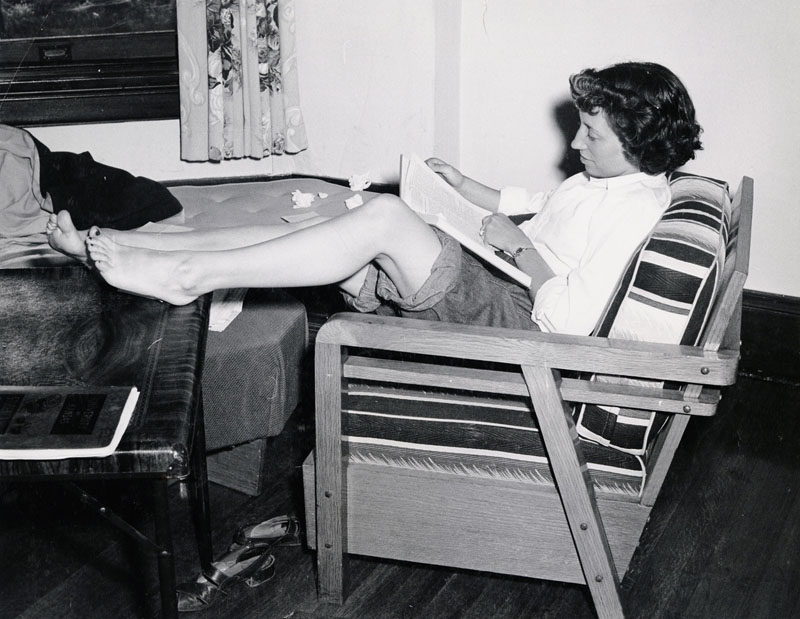
Photograph of student studying with bare feet, 1950s.

Bare feet, 1950s. University Archives Photos.
Call Number: RG 71/0/1950s Prints: Student Activities (Photos).
Click image to enlarge.

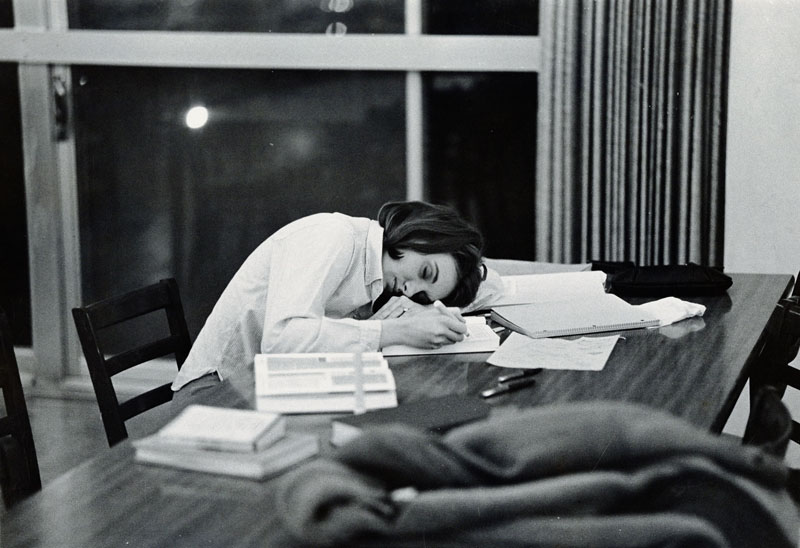
Photograph of student asleep while studying, 1967-1968.

Asleep while highlighting, 1967-1968. University Archives Photos.
Call Number: RG 71/0/1967-1968 Prints: Student Activities (Photos).
Click image to enlarge.

Photograph of student studying under trees, 1969-1970.

Studying in the shade, 1969-1970. University Archives Photos.
Call Number: RG 71/0/1969-1970 Prints: Student Activities (Photos).
Click image to enlarge.

Photograph of a student sleeping with note, 1970s.

“I’m too nervous to sleep in my room,” 1970s. University Archives Photos.
Call Number: RG 71/0/1970s Prints: Student Activities (Photos).
Click image to enlarge.

Photograph of a student studying on a stump, 1975-1976.

Studying on a stump, 1975-1976. University Archives Photos.
Call Number: RG 71/0/1975-1976 Prints: Student Activities (Photos).
Click image to enlarge.

Photograph of student studying on top of backpack, 1976-1977.

Backpack as table, 1976-1977. University Archives Photos.
Call Number: RG 71/0/1976-1977 Prints: Student Activities (Photos).
Click image to enlarge.

Photograph of a panicked student looking up, October 1978.

Panic, October 1978. University Archives Photos.
Call Number: RG 71/0/”A Day in the Life of KU, October 13, 1978″
Prints: Student Activities (Photos). Click image to enlarge.

Photograph of student studying with calculator and printouts, 1979-1980.

Calculator and computer printouts, 1979-1980. University Archives Photos.
Call Number: RG 71/0/1979-1980 Prints: Student Activities (Photos).
Click image to enlarge.

Photograph of student studying behind grate, 1979-1980.

Creative (and uncomfortable?) study location, 1979-1980. University Archives Photos.
Call Number: RG 71/0/1979-1980 Prints: Student Activities (Photos).
Click image to enlarge.

Photograph of two students studying on stairs, 1980-1981.

Studying on stairs, 1980-1981. University Archives Photos.
Call Number: RG 71/0/1980-1981 Prints: Student Activities (Photos).
Click image to enlarge.

Overhead photograph of student studying, 1981-1982.

Sprawled out, 1981-1982. University Archives Photos.
Call Number: RG 71/0/1981-1982 Prints: Student Activities (Photos).
Click image to enlarge.

Photograph of student working in his room, 1982-1983.

Student working in his room, 1982-1983. University Archives Photos.
Call Number: RG 71/0/1982-1983 Prints: Student Activities (Photos).
Click image to enlarge.

Caitlin Donnelly
Head of Public Services

Liberal Arts Education: The Key to a Happy Valentine’s Day?

February 15th, 2014

The value of a liberal arts education is – and has long been – a topic of substantial discussion. With Valentine’s Day upon us, we wanted to highlight a perhaps little-known benefit of liberal arts courses and majors: they can help you attract or catch a love interest. Such was the “tongue-and-cheek” argument of a pictorial feature that appeared in the April 1970 edition of Kansas Alumni. Seven photographs told a story that unfolded throughout the publication, accompanied by captions extolling the benefits of a liberal arts education that were taken from “none other than” the Catalog of the College of Liberal Arts and Sciences. Prints of six of the images – the first six pictures below – are held within University Archives as part of its collection of Student Activities records and photographs (Record Group 71).

Photograph of a female KU student reading anthropology, 1970

The introduction to “Pictorial: The Liberal Arts” from Kansas Alumni, April 1970.
University Archives. Call Number: RG UA Ser 64/0/2. Click any image to enlarge.

Photograph of a female KU student reading book about voodoo, 1970

While the lower right corner was cropped out of the published picture, the
original print shows that KU Libraries can also help you catch the
object of your affection! University Archives. Call Number: RG 71/0/1969-1970
Prints: Student Activities (Photos). This citation applies to all images in this
post unless otherwise noted.

Photograph of a  female KU student reading about spells, potions, and enchantments, 1970

Photograph of a female KU student with an offering, 1970

Photograph of a female KU student mixing a love potion, 1970

Photograph of a female KU student using love potion, 1970

Photograph of a female KU student with the object of her affection behind a stack of books, 1970

The caption for the final image in the story – as it appeared in
Kansas Alumni
– doesn’t seem to bode well for the guy behind the books!
University Archives. Call Number: RG UA Ser 64/0/2.

Happy Valentine’s Day!

Caitlin Donnelly
Head of Public Services

Student Activities Photographs RG 71/0 1969/1970 Prints