The University of Kansas

Inside Spencer: The KSRL Blog

Books on a shelf

Welcome to the Kenneth Spencer Research Library blog! As the special collections and archives library at the University of Kansas, Spencer is home to remarkable and diverse collections of rare and unique items. Explore the blog to learn about the work we do and the materials we collect.

Charlton Hinman, Optical Collation, and the Big Grey Machine

January 12th, 2026

Charlton Hinman was a looker. Of course, that was true of so many of Fredson Bowers’ students – they tended to be lookers. We won’t make any comment on the relative attractiveness of Charlton Joseph Kadio Hinman or Bowers’ students, but we refer instead to the tradition of close examination and description of books that Bowers codified and Hinman continued here at the University of Kansas. On the north side of the Marilyn Stokstad Reading Room at Kenneth Spencer Research Library is the Hinman Collator, a hulking grey machine that stands as a reminder of (and a tool for) precisely that kind of work. Our colleague Caitlin Klepper wrote a post about the collator previously, but we thought we might delve more in-depth here.

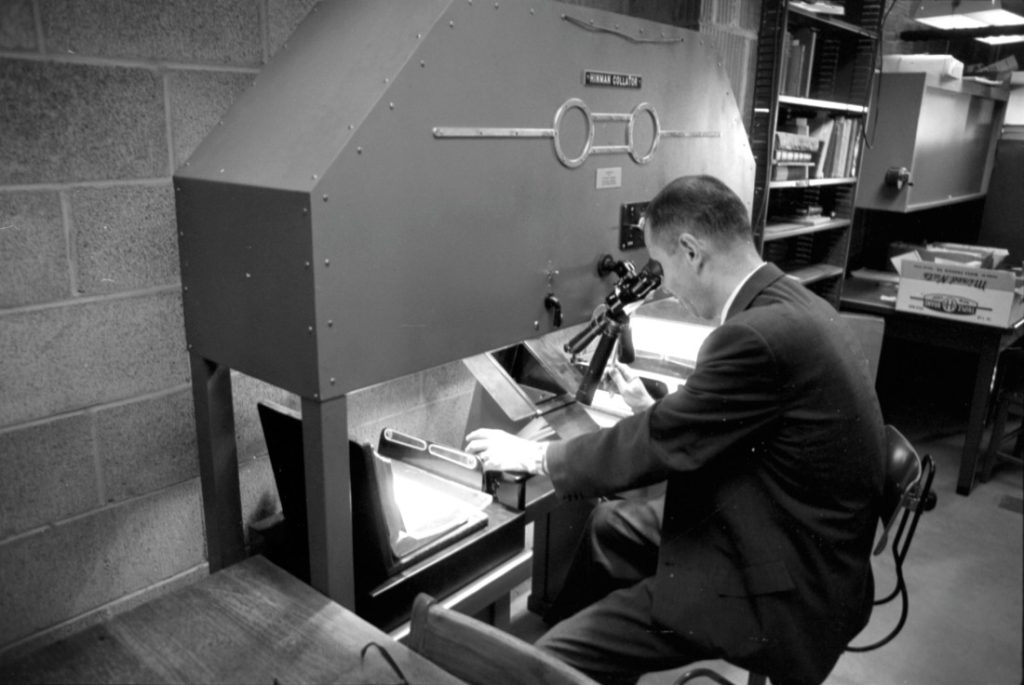
Black-and-white photograph sitting in front of a large piece of equipment and looking through an eyepiece.
Professor Charlton Hinman working at the Hinman Collator, circa 1960-1975. University Archives Photos. Call Number: RG 41/ Faculty and Staff: Hinman, Charlton (Photos). Click image to enlarge (redirect to Spencer’s digital collections).

Modern descriptive bibliography – the close physical examination and description of books – begins with Fredson Bowers’ book Principles of Bibliographical Description (1949). Bowers was a professor of English at the University of Virginia, and Charlton Hinman was Bowers’ first PhD student there. Both Hinman and Bowers had analytical minds with similar bents, which served them well in the Second World War. They were involved in cryptography and code breaking, with Bowers again leading Hinman as his commanding officer. Following their service, Bowers returned to Virginia, publishing the aforementioned Principles.

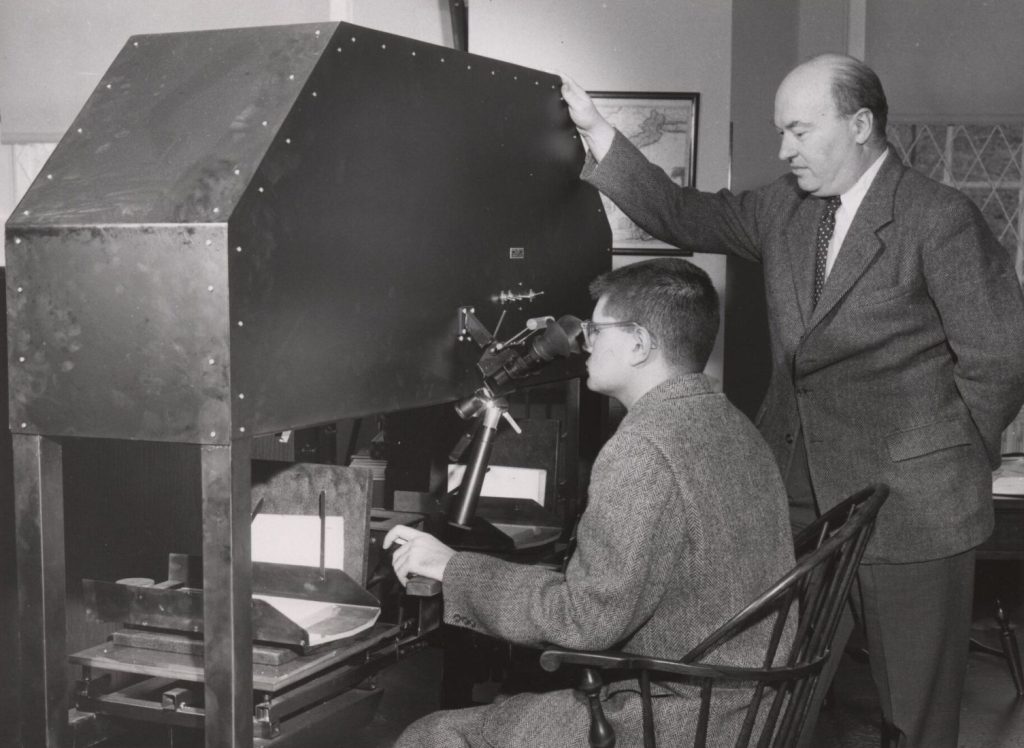
Black-and-white photograph of a man standing in front of a large machine while a second man sits and looks through the eyepiece.
Fredson Bowers supervises a student with the Hinman Collator, undated. Image courtesy of Special Collections, University of Virginia Library. University of Virginia Visual History Collection. Call Number: RG-30/1/10.011. Click image to enlarge (redirect to UVA’s digital collections).

Hinman’s dissertation, The Printing of the First Quarto of Othello, led to his first position as a research fellow at the Folger Shakespeare Library, where he collated copies of the first folio of Othello. It was Hinman’s time as a fellow at the Folger that inspired his creation of the collation machine. Collation – or, the work of examining and describing the physical evidence in a copy of a book – is time consuming. Hinman’s work was even more intensive, as he sought to find all of the different states of the pages down to the most minor corrections or insertions made by the printer in the course of printing the book. Looking at each page of text line by line is an almost impossible task. Hinman hints at this problem in his preliminary essay about the machine, which was titled “Mechanized Collation: A Preliminary Report” and printed in the Papers of the Bibliographical Society of America in 1947.

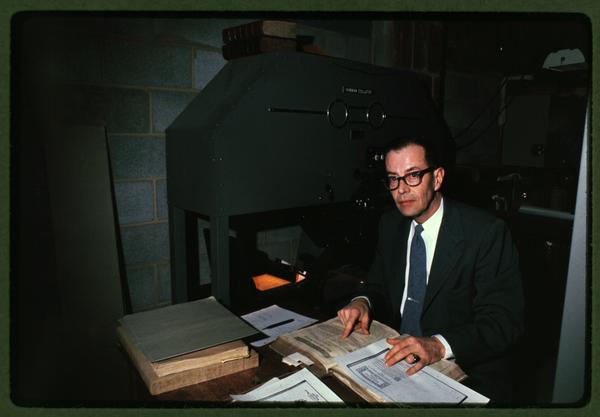
Color photo of a man with glasses sitting at desk covered in books and papers.
Charlton Hinman working at his desk (with the collator behind him), circa 1960-1975. University Archives Photos. Call Number: RG 41/ Faculty and Staff: Hinman, Charlton (Photos). Click image to enlarge (redirect to Spencer’s digital collections).

Hinman’s time in the military helped point the way to a solution, supposedly through military reconnaissance use of photography. He described the idea of taking two pictures of the same area and rapidly alternating them to spot differences. He didn’t claim he had done it as part of his cryptography work; rather, he claimed he heard about it while in the military. However, the process Hinman described was never used for reconnaissance purposes. While the military did use aerial photography, they didn’t use any method that alternated two images in a similar way to the function of the Collator. In his article “‘The Eternal Verities Verified’: Charlton Hinman and the Roots of Mechanical Collation” (Studies in Bibliography, 2000), Steven Escar Smith writes that “using World War II technology, it simply would not have been possible to photograph the same patch of ground twice from exactly the same altitude and position.” According to Smith, Hinman seems to have acknowledged that the story wasn’t entirely true, but it’s not clear whether he actually discouraged its telling.

Arthur M. Johnson, Hinman’s partner who took over building and selling collators around 1956, may have been the one to accurately describe how Hinman got the idea for the collator. Johnson wrote that Hinman had studied something that Johnson called an “astronomer’s microscope.” It used the same principle of “blink comparison” to compare images of the night sky, most famously by Kansan (and KU alumnus) Clyde W. Tombaugh in his observation of Pluto. Although it’s not known whether Hinman ever saw or used a blink comparator, he knew of the one at the observatory at UVA when he was a PhD student there. This was the true technological ancestor of Hinman’s machine.

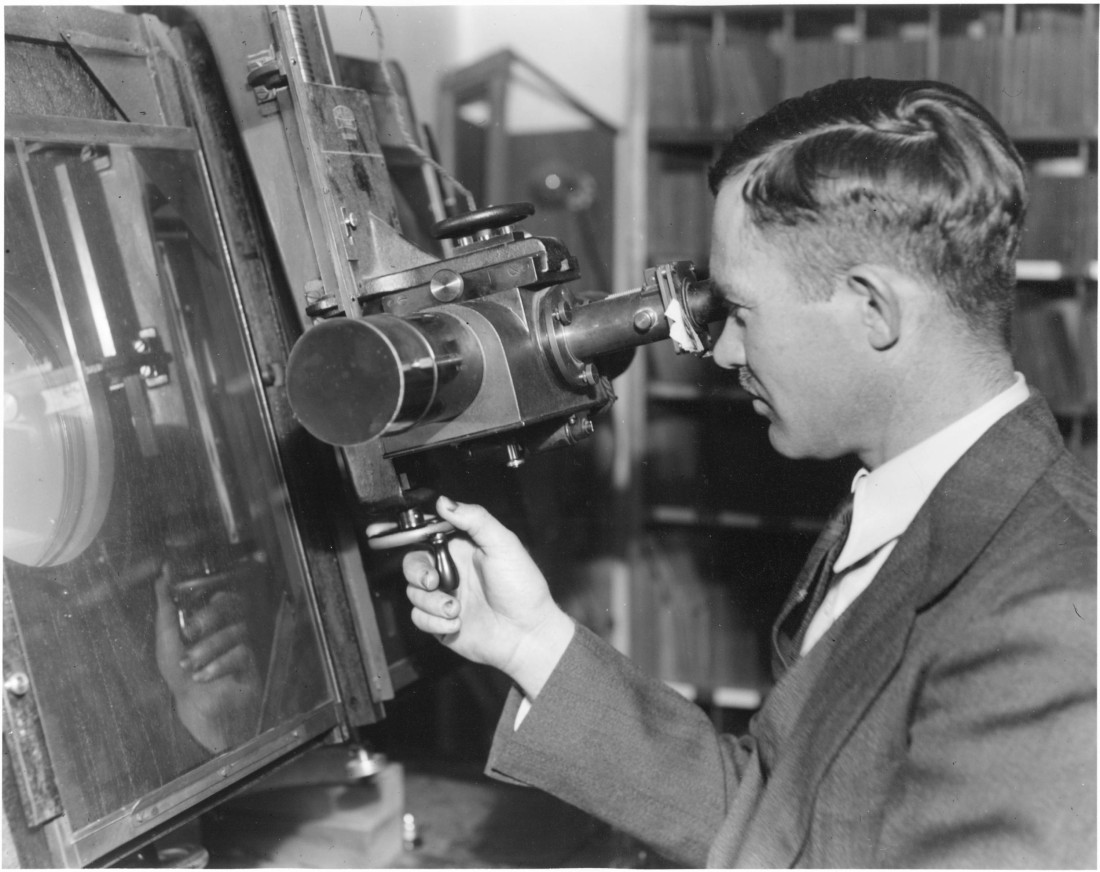
Black-and-white photograph of a man looking through an eyepiece connected to a larger machine.
Clyde W. Tombaugh at a blink comparator, undated. Image courtesy of New Mexico State University Library Archives and Special Collections, Clyde W. Tombaugh papers, image 04070052. Click image to enlarge.

These kinds of devices are simpler than the Hinman Collator in that one can use flat images of similar size – not possible with books. Hinman’s great improvement and contribution, then, was the creation of a machine that could deal with books of different sizes, thicknesses, and even formats. Hinman had a long career as a professor of English, first at Johns Hopkins University (1945-1960) and then at the University of Kansas (1960-1975), where he eventually became a University Distinguished Professor of English. Approximately 50 collators survive. The collator at Spencer (A9 in Steven Escar Smith’s 2002 census of existing Hinman Collators, published in Studies in Bibliography) is one of two that remain that Hinman himself used; the other is at the Folger Library. The effect of the collator is reproduced in this short video by Sam Lemley. Bibliographer J.P. Ascher has also made a good video about how one might use the collator, utilizing the machine at the University of Virginia.

Hoping to actually use Spencer’s machine, we ventured to the Reading Room before opening. We powered it on, and, to our delight, the 400-pound machine came to life. Unfortunately, this was not to be, as we discovered that the “blink” feature, the key function, is not currently working. Thanks to the efforts of our colleague Molly Bauer, we are slowly learning what might be wrong and what the fix might be. Look for a follow-up post in the spring about our efforts, as well as digital alternatives to optical collation that bibliographers can use today.

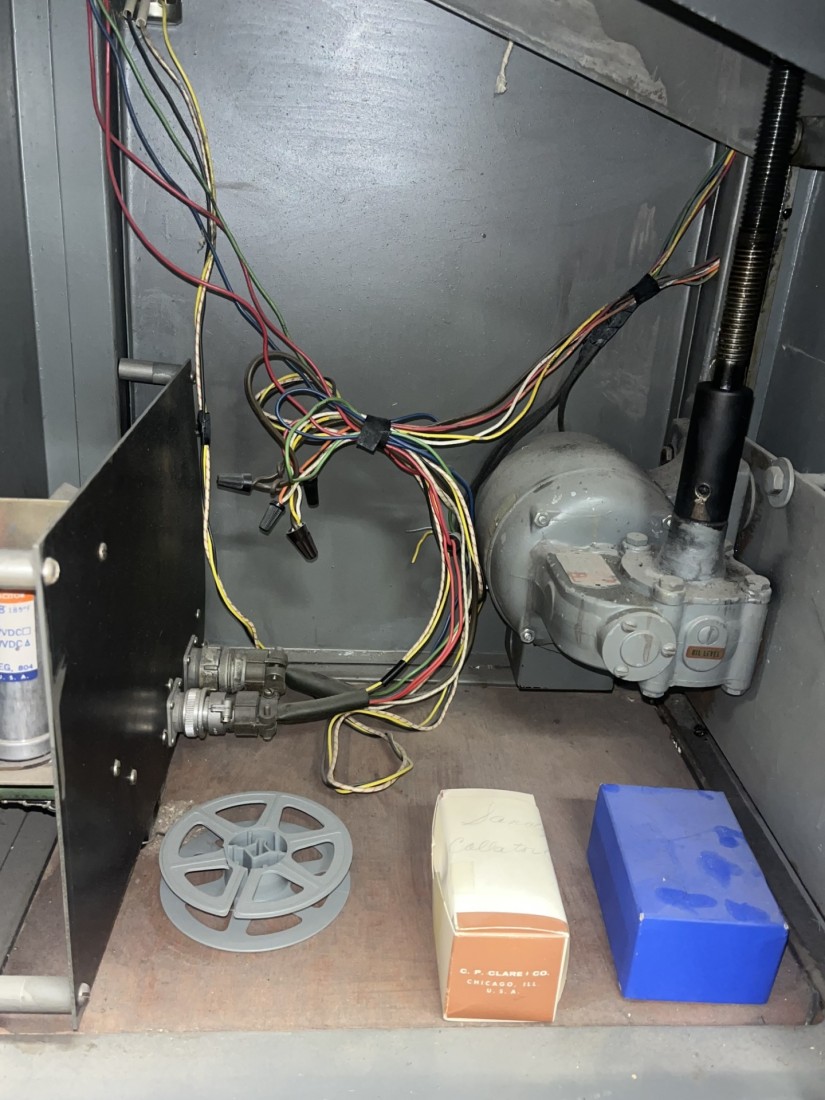
Color photograph of multicolored wires bundled together in a larger metal box.
Wiring inside the Hinman Collator at Spencer Research Library. Click image to enlarge.

The Hinman Collator, for now, stands as a testament to the ongoing work of descriptive an analytical bibliography here at the University of Kansas. Much like its creator, the machine is complicated and devoted to a very specific purpose – close looking at material objects we regularly take for granted.

Jason W. Dean and Adrienne Sanders
Rare Materials Cataloging Librarians

“Snap Shots of My University Life”: The Student Scrapbook of Nola Ayers 

March 7th, 2025
This image has text.
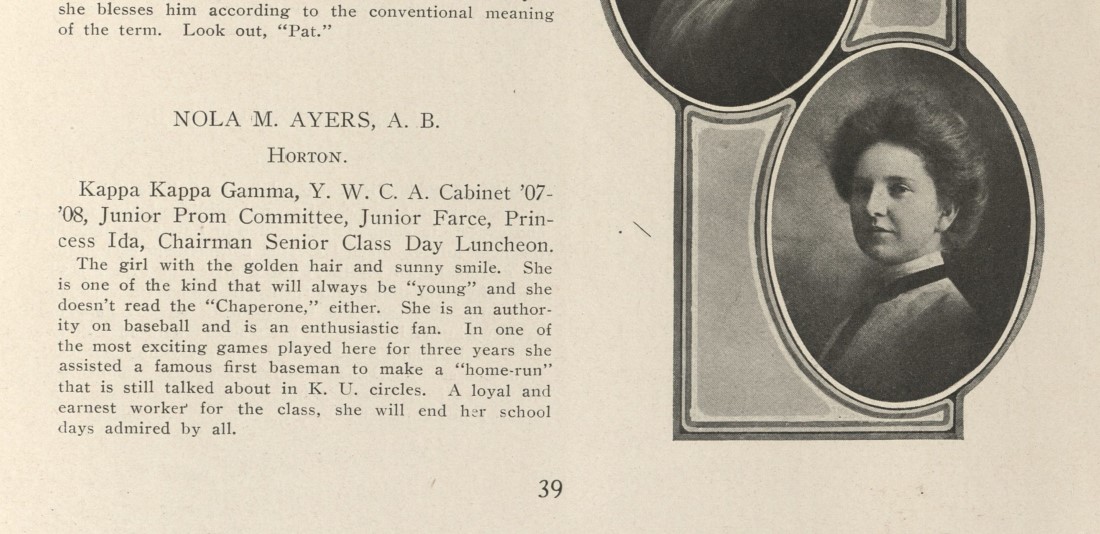
Nola Ayers’s senior picture and a description of her KU life in the 1909 Jayhawker yearbook. University Archives. Call Number: LD 2697 .J3. Click image to enlarge.

Nola Mary Ayers was born in Horton, Kansas, in 1886. She arrived in Lawrence in the fall of 1905 to enter the University of Kansas and graduated from KU with a bachelor’s degree in 1909. Nola documented her college years by creating a scrapbook, as did many other university students at the time. 

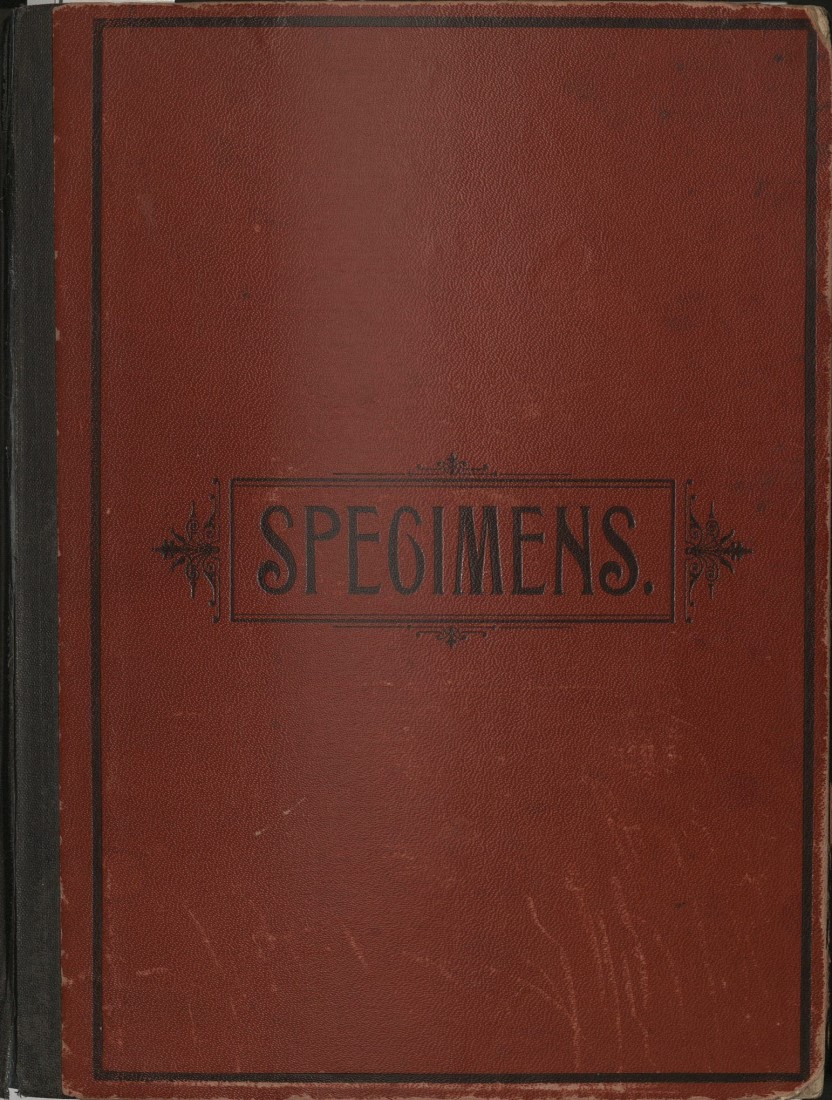
Typically, students purchased a large scrapbook from one of the bookstores near the university. Nola broke with tradition by using a blank “Specimens” science notebook to paste in mementos of her life at KU. 

Red book cover with the word "Specimens" in black text.
The front cover of Nola Ayers’s scrapbook, 1905-1909. Call Number: SB 71/99/8. Click image to enlarge.

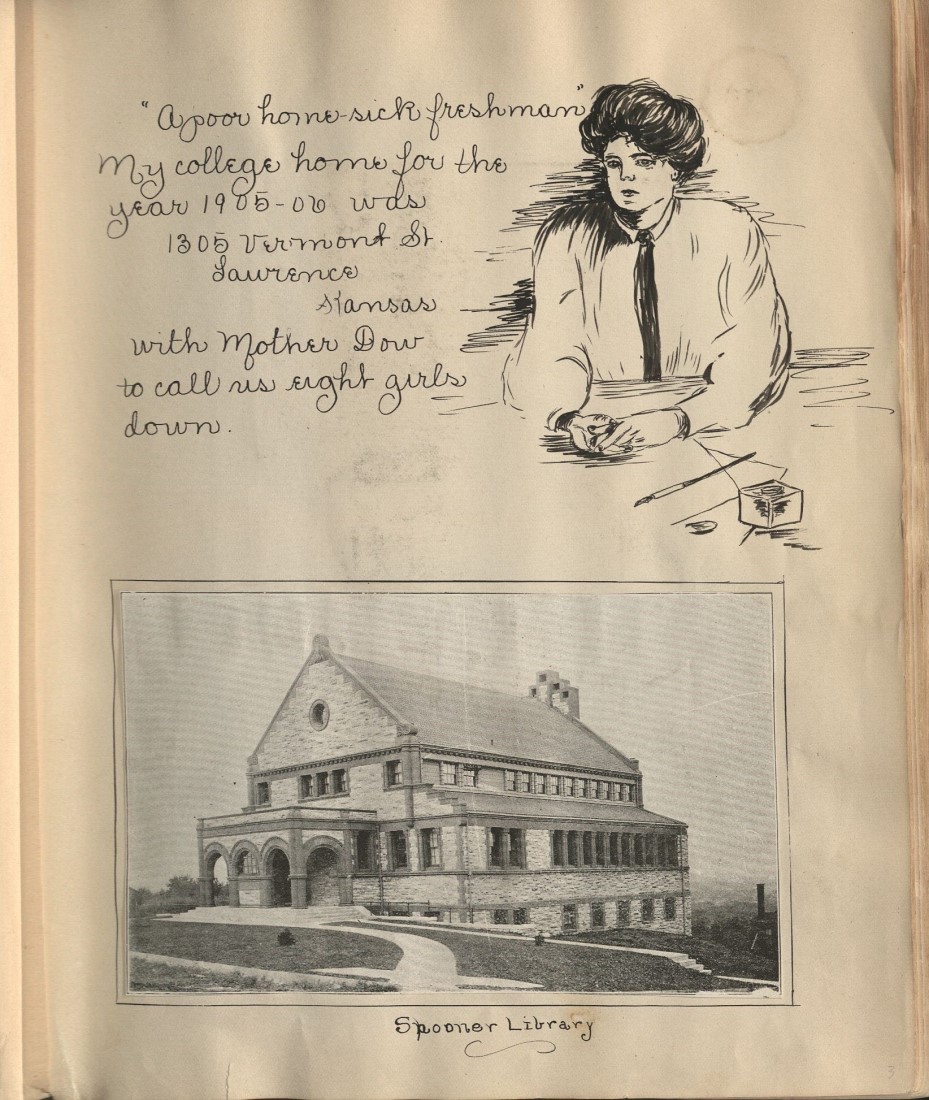
Nola’s scrapbook was also unique because she was an artist and decorated her album with original pen and ink drawings. One of the first drawings in the scrapbook is a self-portrait where she describes herself as a “poor home sick freshman” whose “college home for the year 1905-06 was 1305 Vermont St. Lawrence, Kansas with Mother Dow to call us eight girls down.” This house on Vermont is still standing in the Oread neighborhood. In the years before dormitories, many students lived in boarding houses near campus; many of these large multi-story houses still exist. 

This image has text accompanied by a black-and-white sketch of a woman sitting at a desk. There is also a photograph of Spooner Library.
Nola Ayers’s scrapbook entry about being “a poor home-sick freshman,” 1905. Call Number: SB 71/99/8. Click image to enlarge.

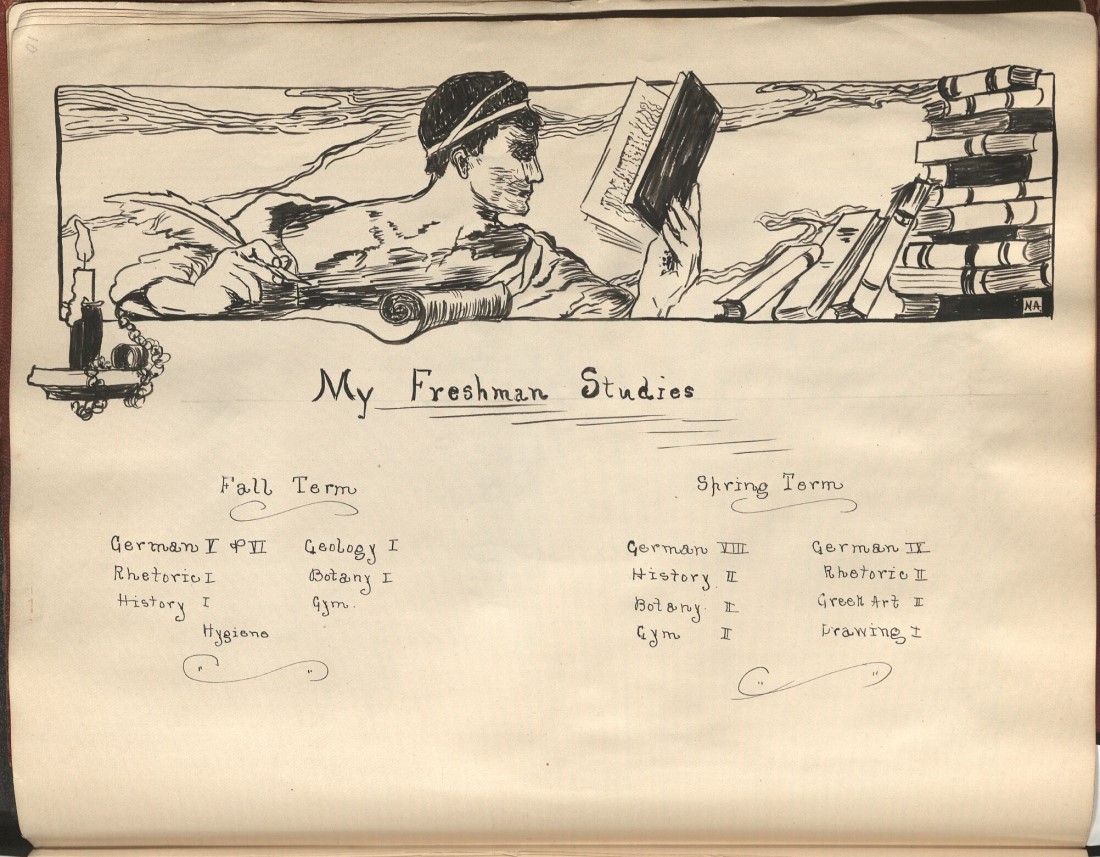
Nola documented her studies in her scrapbook. As seen in the image below, she took “Hygiene” and “Gymnasium” during her freshman year – courses that all KU students in the early twentieth century were required to enroll in. Nola also studied rhetoric, German, geology, solid geometry, and botany. Her scrapbook reflects her love of drawing, and her coursework included drawing, ornament design, and Greek art. 

List of classes taken by Nola Mary Ayers in the fall and spring terms of her freshman year. There is a black-and-white sketch of a man reading and writing.
Nola Ayers’s freshman-year courses listed in her student scrapbook, circa 1906. Call Number: SB 71/99/8. Click image to enlarge.

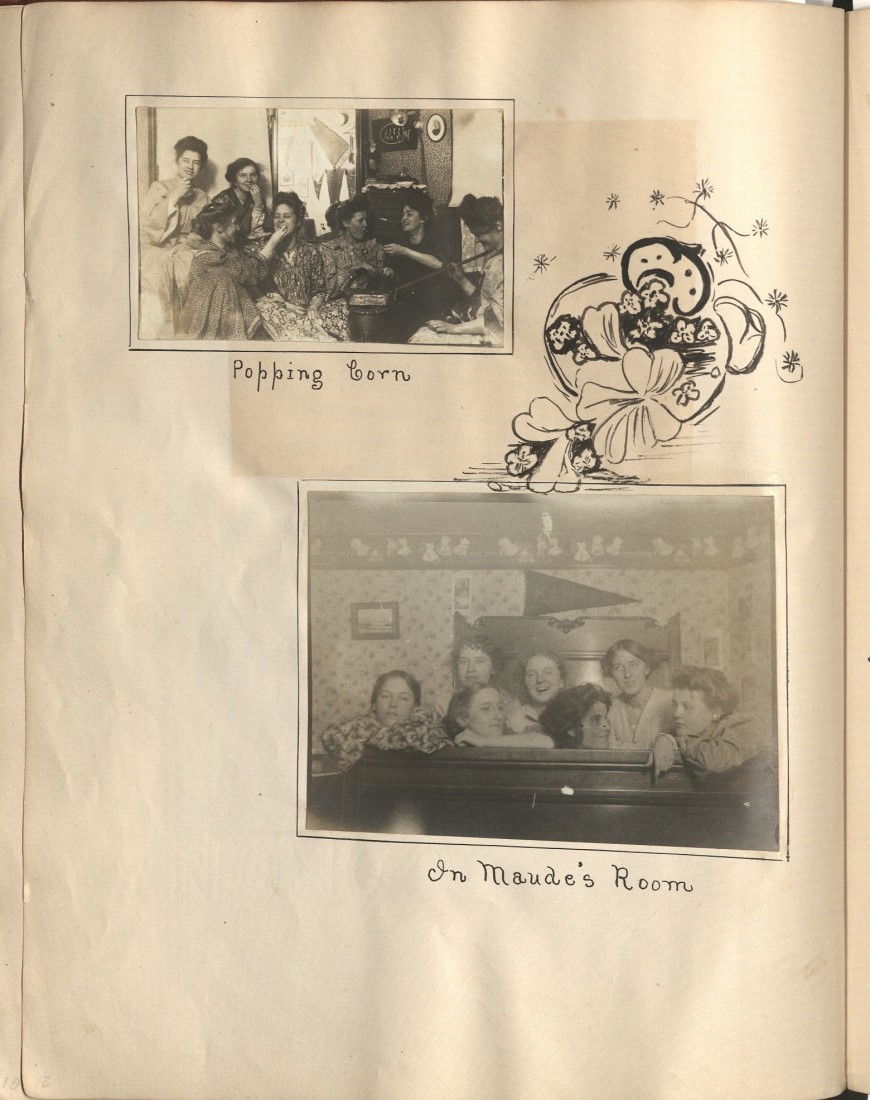
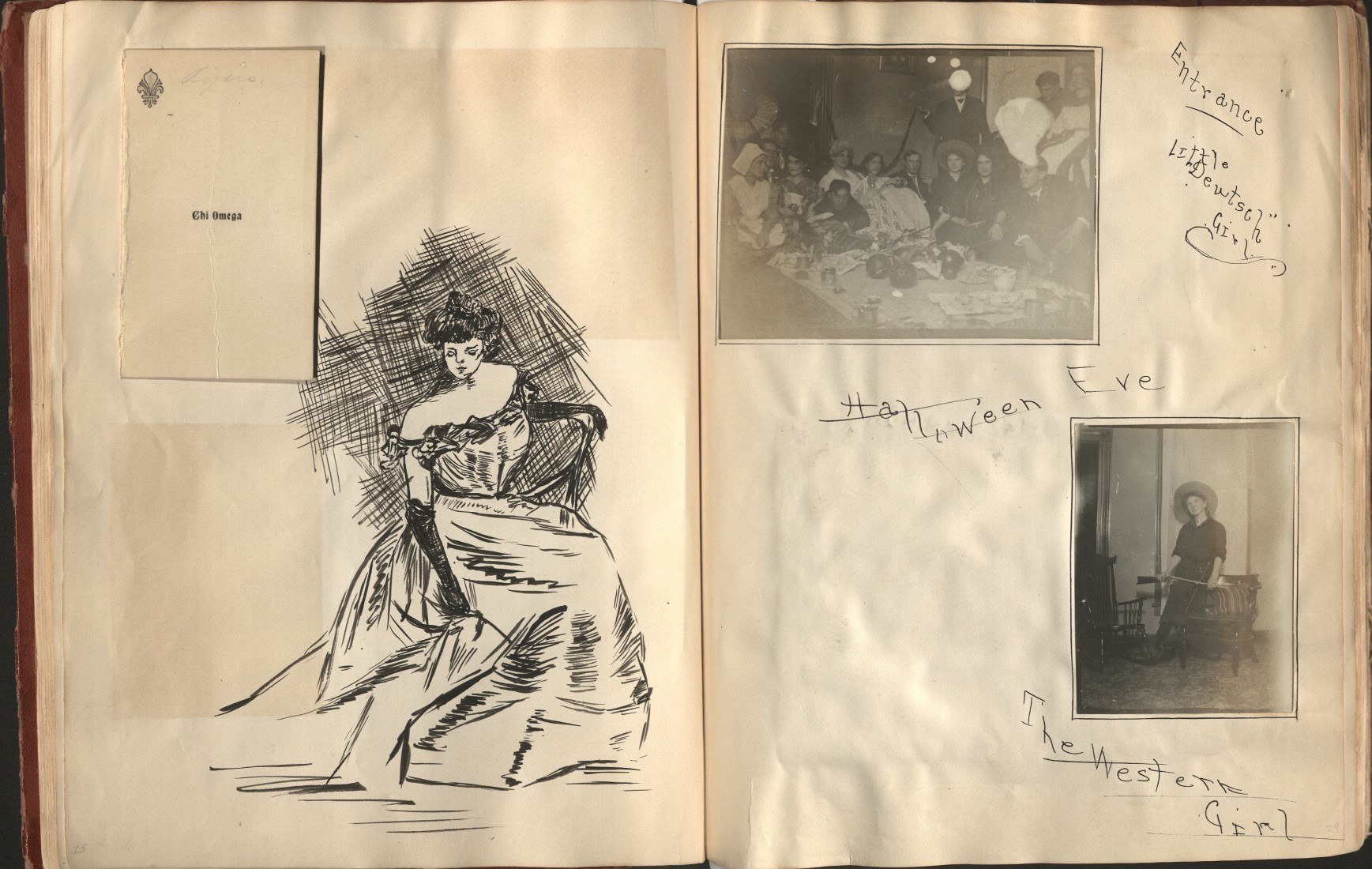
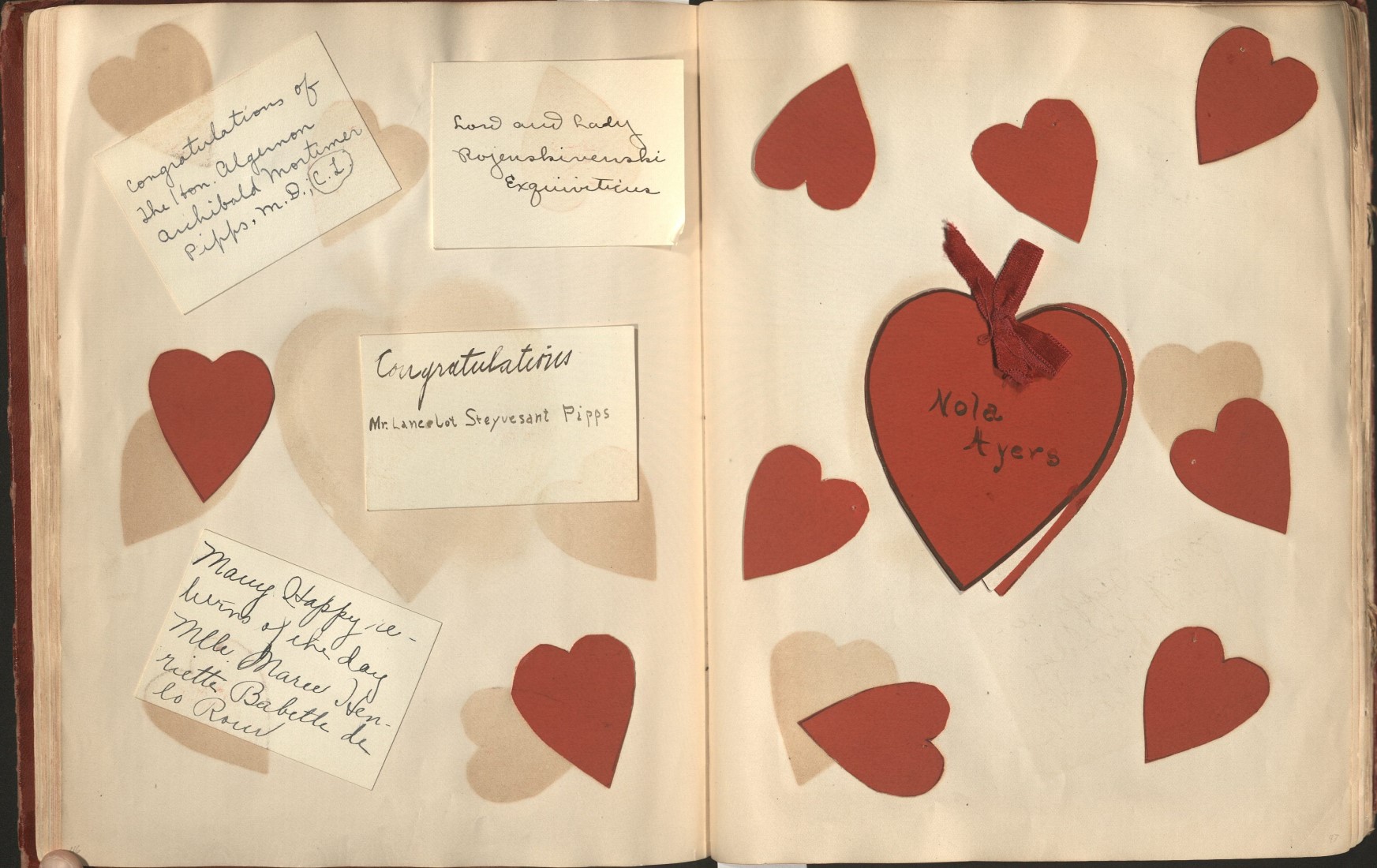
Besides coursework, friendships with other students are well represented in the pages of Nola’s scrapbook. She documented slumber parties with other girls, popcorn making, a Halloween party where she dressed as the “Western Girl,” and events at her sorority, Kappa Kappa Gamma. Nola celebrated Valentine’s Day with a party and red hearts pasted into her scrapbook. 

Two black-and-white photos attached to a larger piece of off-white paper. One shows a group of girls making and eating popcorn. The other shows a group of girls laying on a bed "in Maude's room."
|
Two-page scrapbook page. On the left is a dance card and a black-and-white sketch of a girl in an evening gown. On the right are two black-and-white photos: a group at a Halloween party and Nola Mary Ayers dressed as "the Western Girl."
|
Two-page scrapbook page with Valentine's notes and red paper hearts.
Selected pages from Nola Ayers’s scrapbook showing her hanging out and celebrating holidays with friends, 1905-1909. Call Number: SB 71/99/8. Click images to enlarge.

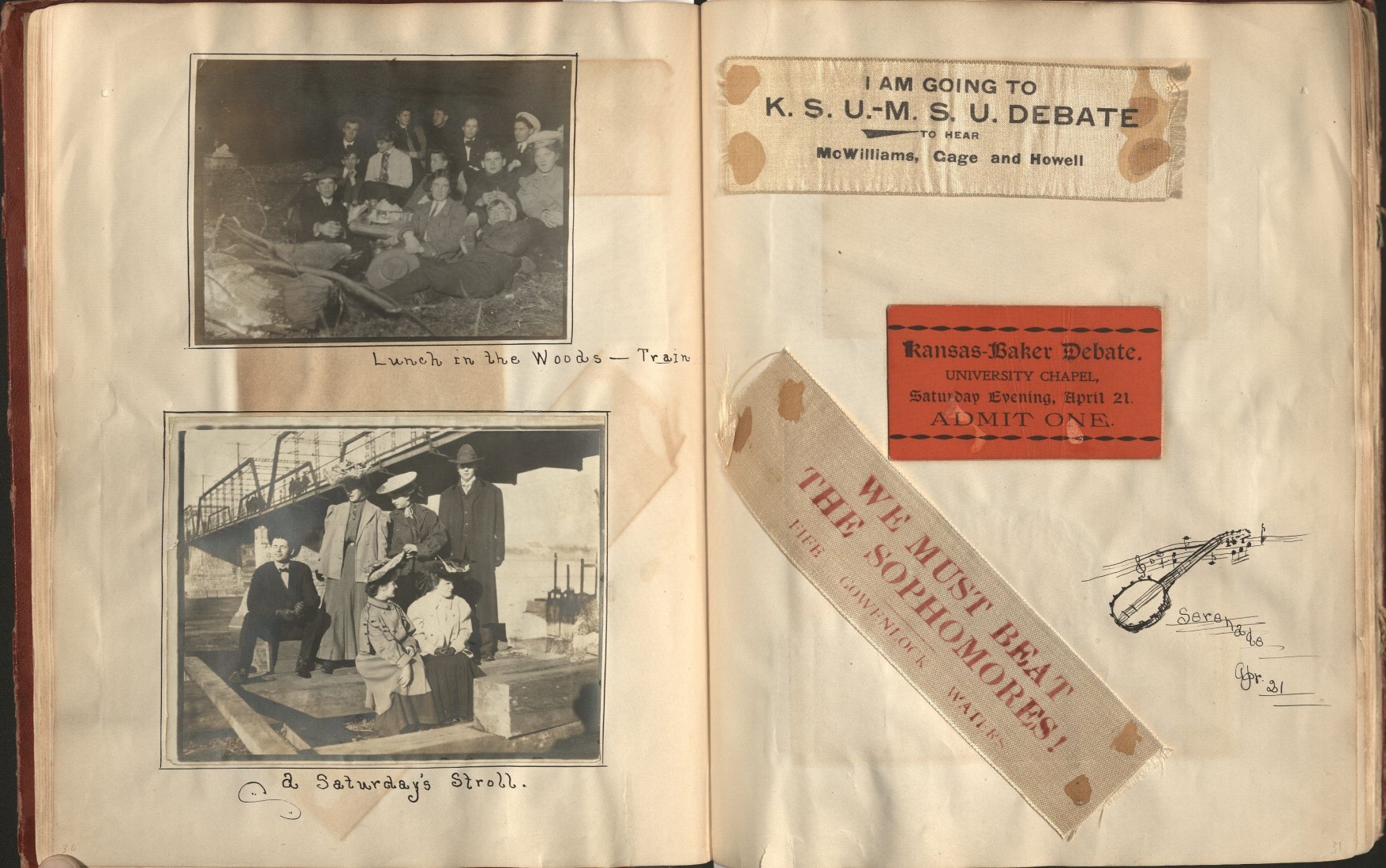
As evidenced by her scrapbook, Nola partook many of the outdoor activities KU students enjoyed in the early twentieth century: walking, boating on the Kaw River, picnicking in the countryside, and attending sporting events. According to the 1908 Jayhawker yearbook, Nola was an “authority on baseball” and an “enthusiastic fan.” Indeed, she pasted photos of the KU baseball team into her scrapbook. Nola also included items related to the KU debate team. Debate was almost as popular as athletic sports during the early twentieth century, and students would travel to other cities like Topeka to support the KU team. 

Two-page scrapbook page with photographs of students enjoying "lunch in the woods" and "a Saturday's stroll." There are also two items from KU debate team events.
A two-page spread in Nola Ayers’s scrapbook, circa 1906. Call Number: SB 71/99/8. Click image to enlarge.

According to a newspaper article, Nola was crowned Queen of the May at the second annual May Fete in 1909. She was a member of Allemania (German Club) and attended their events. She appeared to have attended many dances, plays, and concerts while a student, as documented by the many programs decorating her scrapbook. Plays and concerts were held on campus and in downtown Lawrence at the Bowersock Opera House. 

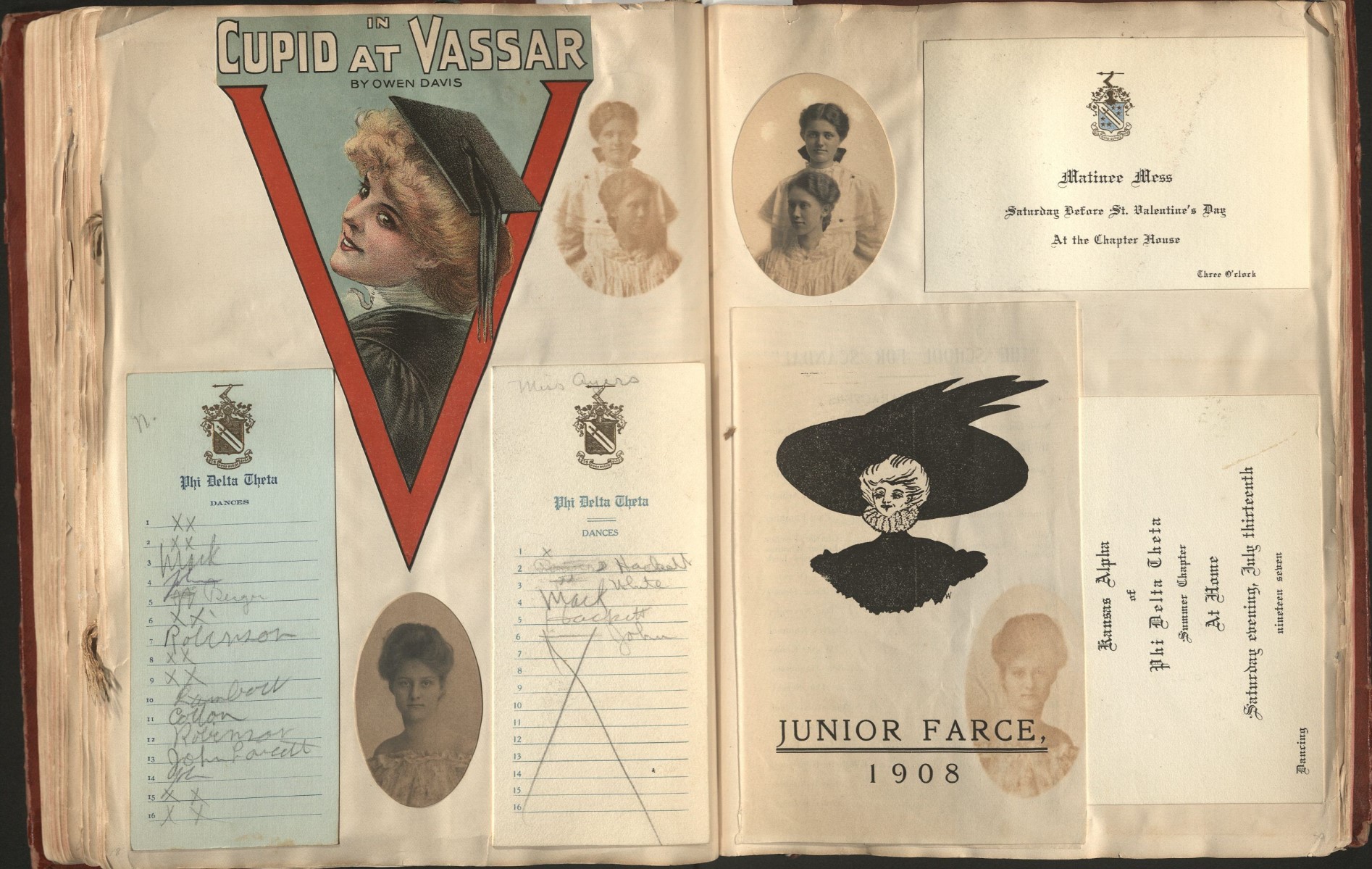
Two-page scrapbook page with invitations, dance cards, photographs, and a dance program.
A page of invitations and dance cards in Nola Ayers’s KU student scrapbook, circa 1907-1908. Call Number: SB 71/99/8. Click image to enlarge.
Scrapbook page with two black-and-white photographs: the Kappa Kappa Gamma House at the University of Colorado, and a group of women in graduation caps and gowns.
The bottom photo on this page might show Nola Ayers with her housemates, circa 1909. During her junior and senior years at KU, Nola lived at 1400 Tennessee Street in Lawrence. Call Number: SB 71/99/8. Click image to enlarge.

Nola Ayers married KU alumus Benjamin P. Young in 1910. According to a newspaper article announcing their wedding, the couple settled in Halstead, Kansas, where Ben was a high school principal. Ben and Nola relocated to Ithaca, New York, by 1923 and appear to have lived there for the rest of their lives. They had two children. Ben died in 1958; Nola passed away in 1973 at age 86.

Becky Schulte
Retired University Archivist and Curator of the Wilcox Collection

That’s Distinctive!: Halloween Party Dance Card

October 18th, 2024

Check the blog each Friday for a new “That’s Distinctive!” post. I created this series to provide a lighthearted glimpse into the diverse and unique items at Spencer. “That’s Distinctive!” is meant to show that the library has something for everyone regardless of interest. If you have suggested topics for a future item feature or questions about the collections, you can leave a comment at the bottom of this page. All collections, including those highlighted on the blog, are available for members of the public to explore in the Reading Room during regular hours.

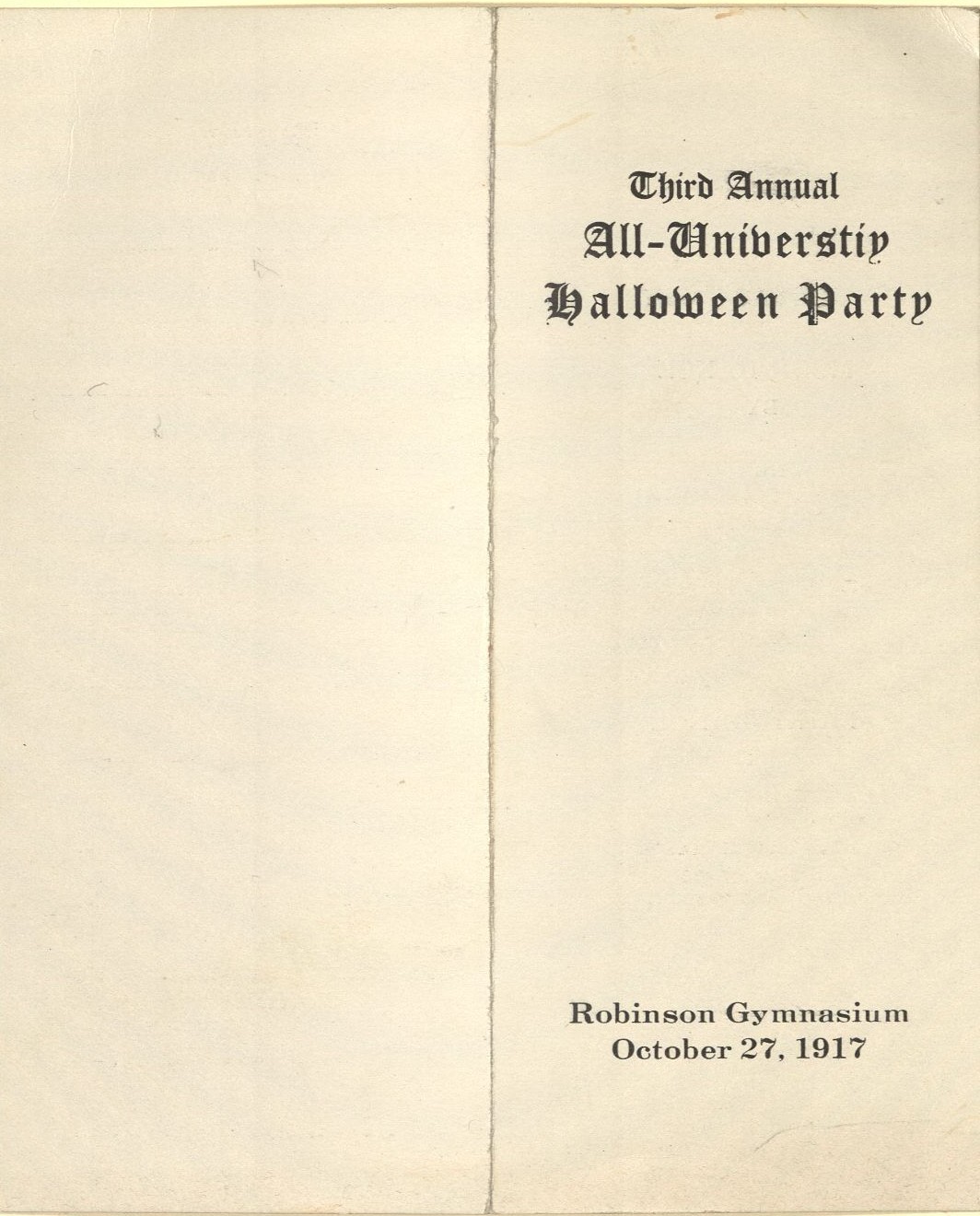
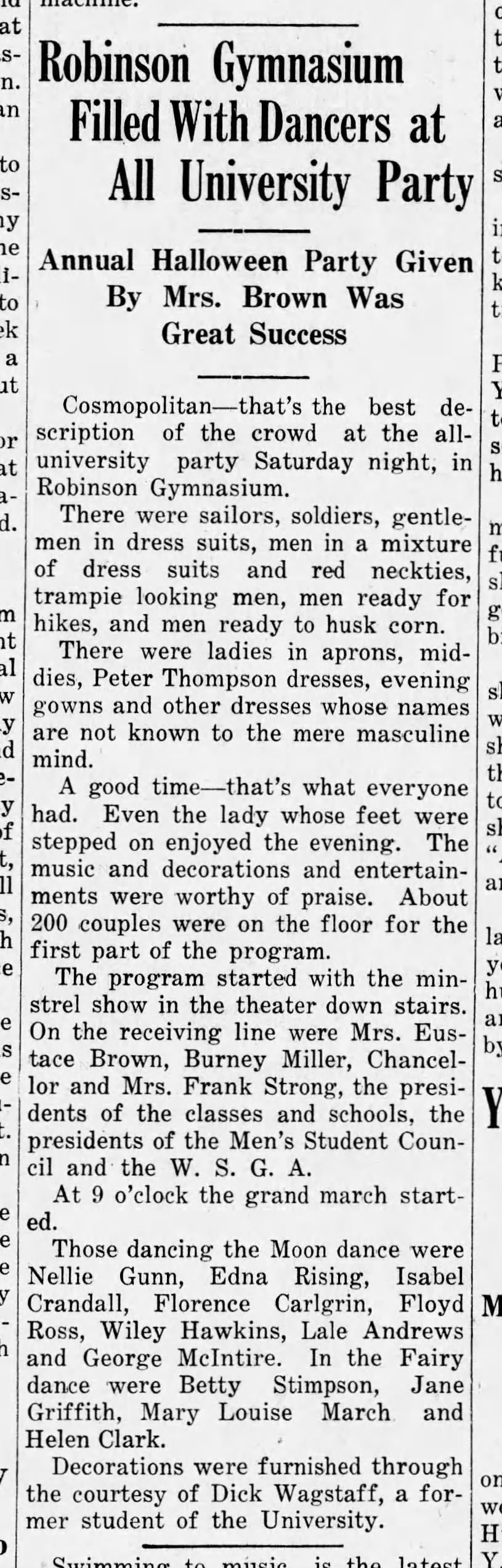
This week on That’s Distinctive! we continue on our journey of spooky items. Today I am sharing yet another item from the Herd family papers. With the collection spanning the time frame of 1817 to 2013, there is just about anything a person could be looking for. The item shown today is a dance card from KU’s third annual all-university Halloween party. It took place in 1917, six months after the U.S. entered World War I. The card shows that it was held in Robinson Gymnasium, which was located where Wescoe Hall now stands. The current Robinson Center is just east of Allen Fieldhouse.

This image has the text of the name, place, and date of the Halloween party.
|
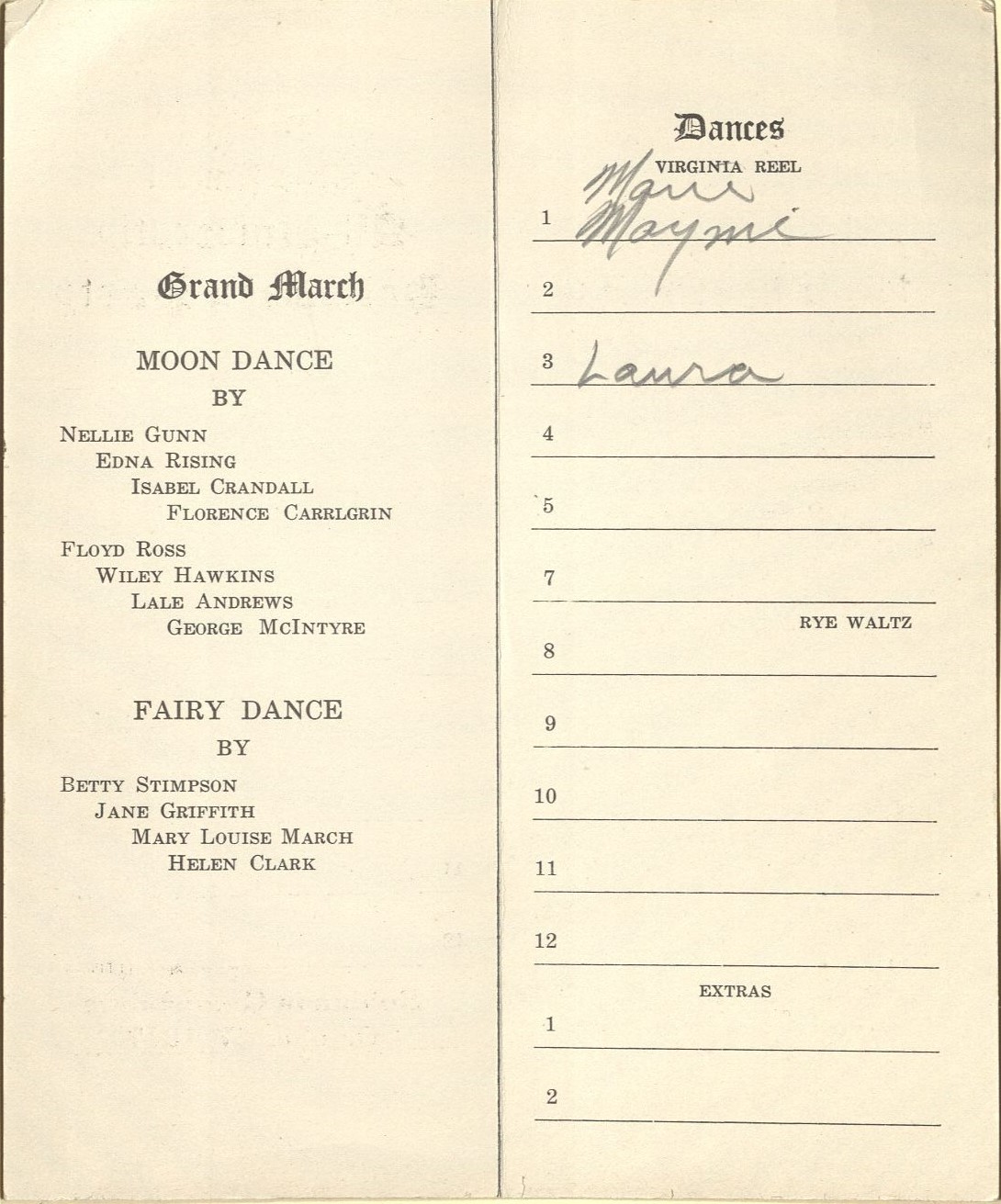
The left-side page in this image has the text of the female students who participated in the Moon Dance and Fairy Dance in the Grand March. The page on the right has blank numbered lines for listing dance partners.
Pages from an All-University Halloween Party dance card, 1917. Herd Family Papers. Call Number: RH MS 1374. Click images to enlarge.
This image contains text.
|
This image contains text.
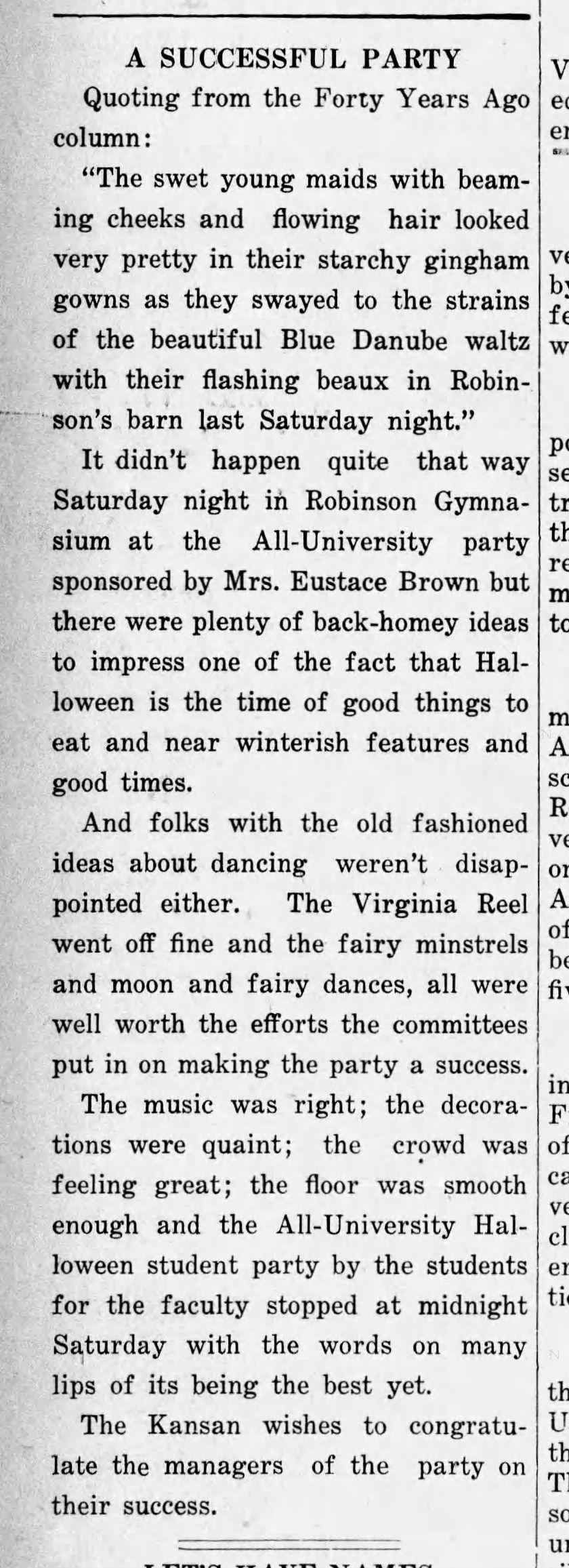
Two articles about the party in the University Daily Kansan, October 29, 1917. Florence (Mrs. Eustace) Brown was the “advisor of women” at KU (and sometimes cited as the school’s first Dean of Women), 1914-1918. Courtesy Newspapers.com. Click images to enlarge.

Tiffany McIntosh
Public Services

That’s Distinctive!: KU Libraries Photos

September 20th, 2024

Check the blog each Friday for a new “That’s Distinctive!” post. I created this series to provide a lighthearted glimpse into the diverse and unique items at Spencer. “That’s Distinctive!” is meant to show that the library has something for everyone regardless of interest. If you have suggested topics for a future item feature or questions about the collections, you can leave a comment at the bottom of this page. All collections, including those highlighted on the blog, are available for members of the public to explore in the Reading Room during regular hours.

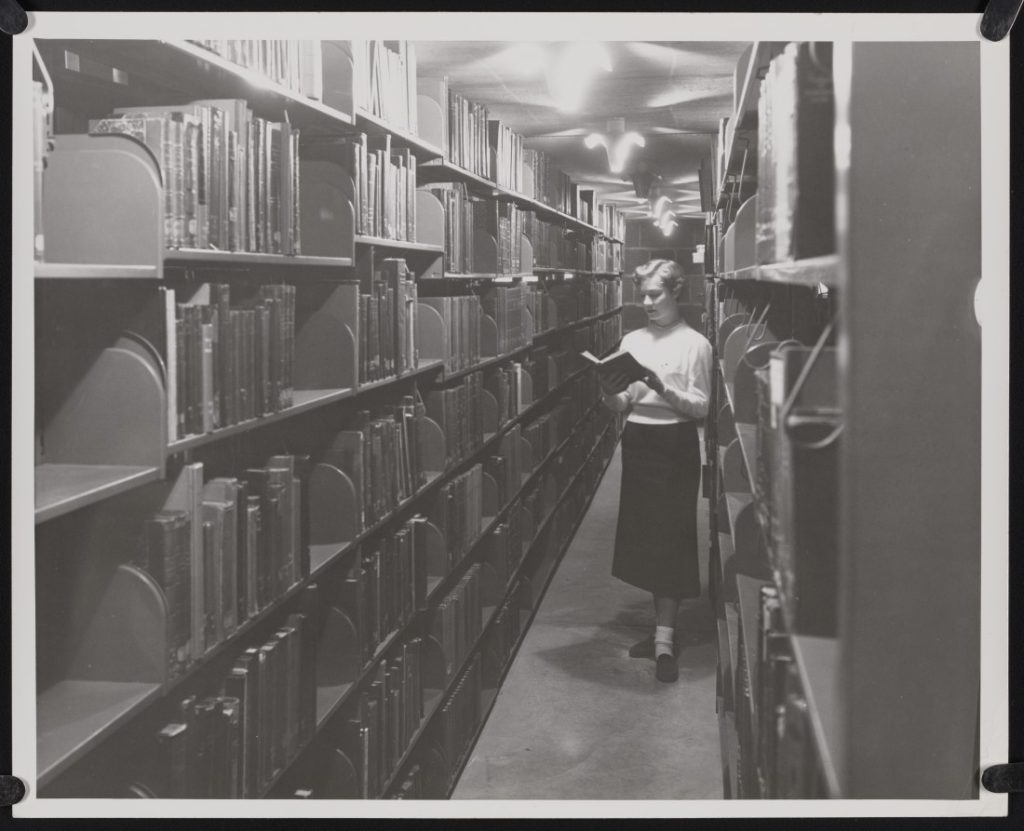
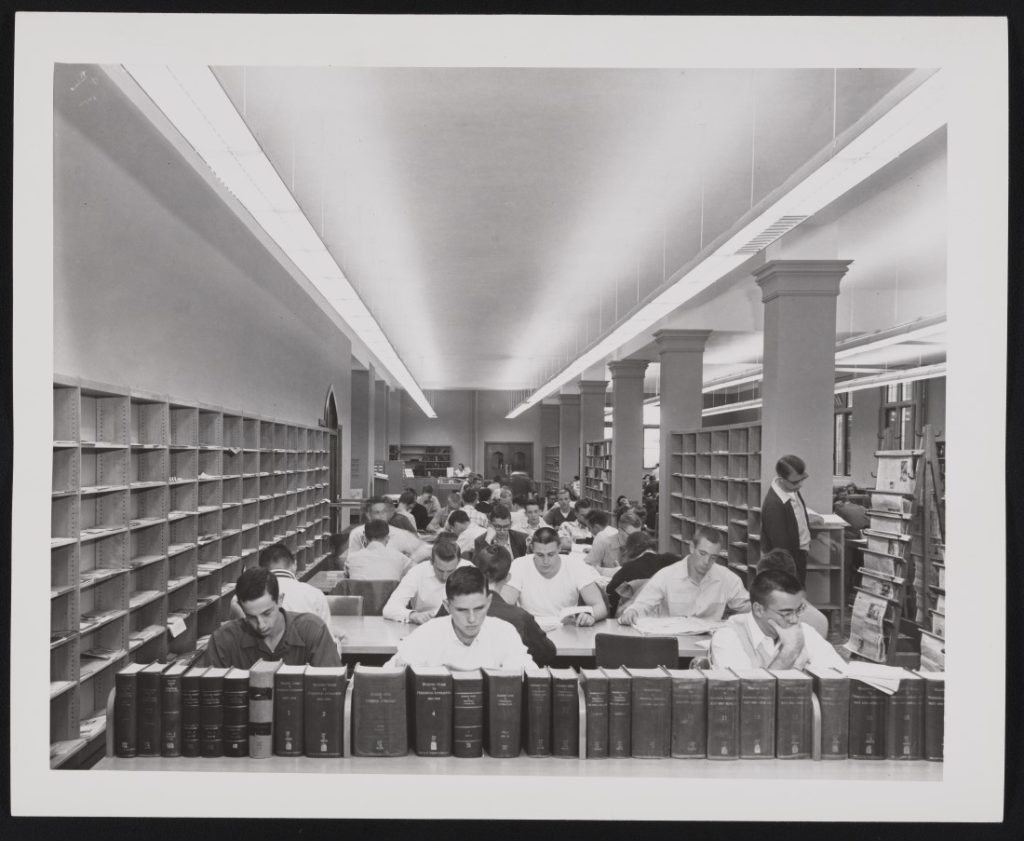
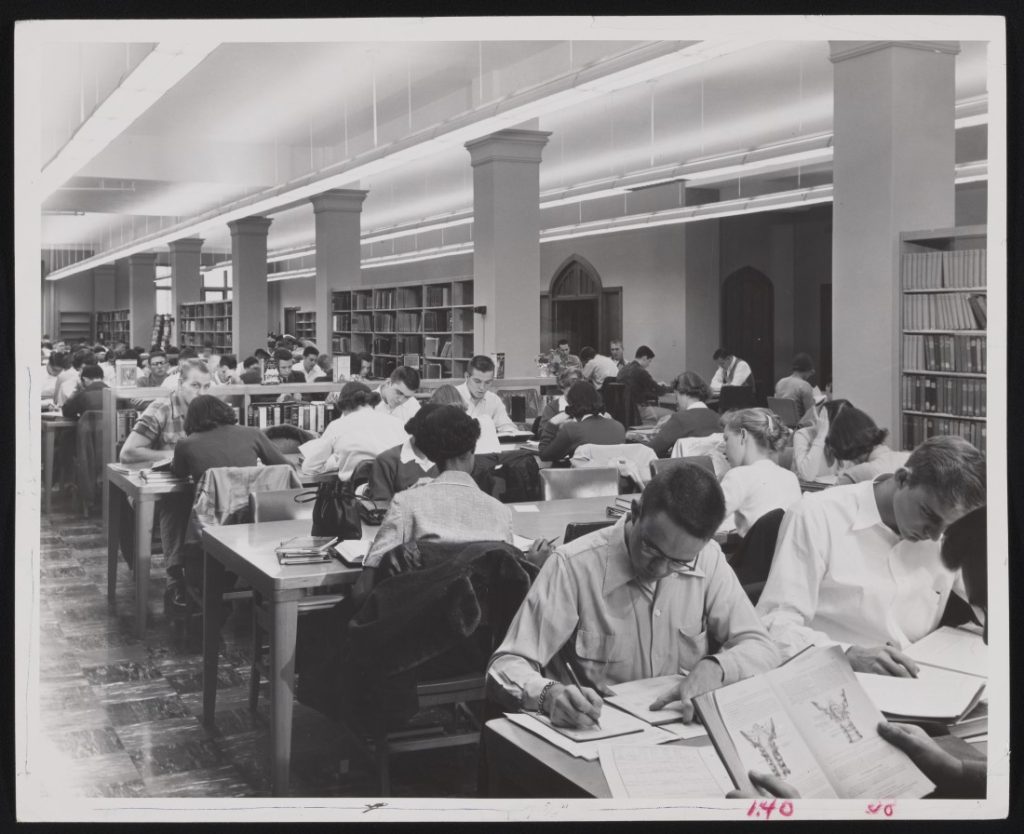
This week on That’s Distinctive! I am sharing some photographs from University Archives. Housing all things KU related, University Archives collects and preserves manuscripts, maps, blueprints, artifacts, photos, and more. The collection houses over a million photographs alone. As with last week’s post, this week’s images come from the library’s digital collections, which can be found on the “Find Collections” page of Spencer’s website. While not nearly all of the photos from University Archives are digitized, there are a ton to browse in the online collection.

The images shared this week show various scenes from inside KU Libraries. KU Libraries consist of six locations across campus: Watson (which is turning 100 years old), Anschutz, Spencer, Spahr Engineering, Art & Architecture, and Music & Dance. With over 5.6 million items on campus and even more available online, the libraries offer a wide variety of materials that serve users – especially KU students, faculty, and staff – and help them reach their goals. The Libraries’ mission is to “advance research, teaching, and learning at the intersection of people and ideas.” So while I boast that Spencer has something for everyone, every library on campus has something to offer.

Black-and-white photograph of a women standing and reading between two rows of floor to ceiling bookshelves.
Library bookstacks, probably in Watson Library, 1954. University Archives Photos. Call Number: RG 32/0 1954 Prints: University of Kansas Libraries (Photos). Click image to enlarge
(redirect to Spencer’s digital collections).
Black-and-white photograph of students sitting and reading at long tables. There are books in the foreground and bookshelves around the parameter of the room.
|
Black-and-white photograph of students sitting and reading at long tables.
Two views of the Undergraduate Reading Room at Watson Library, 1955. University Archives Photos. Call Number: RG 32/0 1955 Prints: University of Kansas Libraries (Photos). Click image to enlarge (redirect to Spencer’s digital collections).
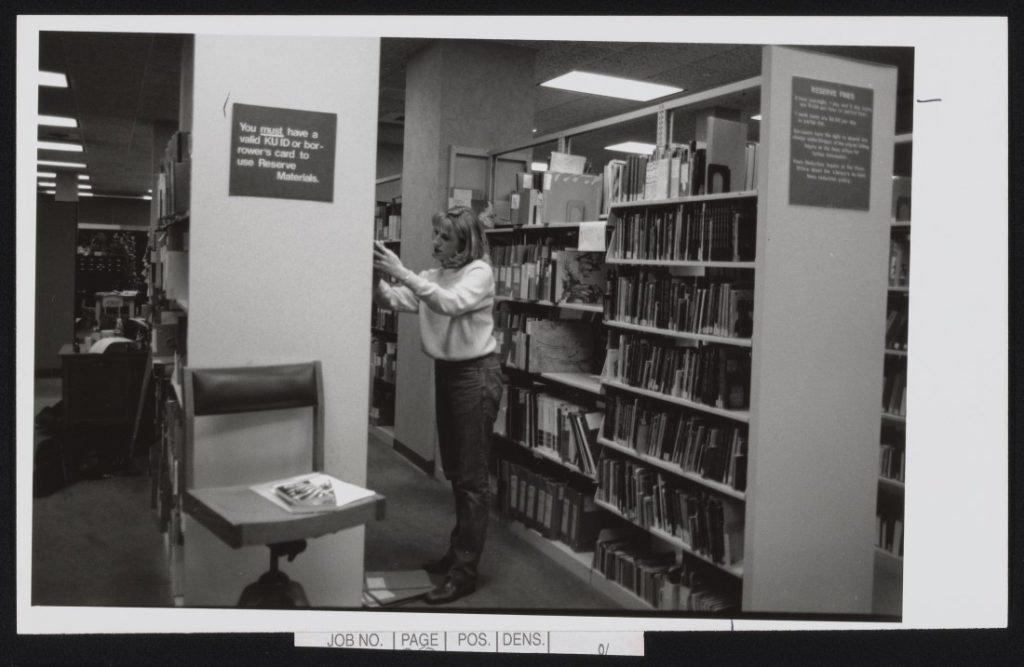
Black-and-white photograph of a woman looking at volumes on a bookshelf.
Bookshelves for reserve materials, probably in Watson Library, 1996. University Archives Photos. Call Number: RG 32/0 1996 Prints: University of Kansas Libraries (Photos). Click image to enlarge (redirect to Spencer’s digital collections).

Tiffany McIntosh
Public Services

Douthart and Grace Pearson Scholarship Halls at 70

September 11th, 2024

This weekend, alumni will gather to celebrate the 70th anniversary of Douthart and Grace Pearson Scholarship Halls on the KU campus. While Douthart was slated from the beginning as a scholarship hall, it appears that Grace Pearson was originally conceived as a “general” women’s residence hall and was added to the scholarship hall system a few years after it opened.

At the time it was built, Douthart Hall was the fourth women’s scholarship hall and ninth total in the system. The location had previously been the site of Carruth Hall, the former residence of Chancellors Snow through Lindley, and after 1940 a small student residence hall. An August 1953 KU News Bureau report noted that Douthart was “the gift of the late Miss Lela Douthart and the late Mrs. Ava Douthart Chronister of Kansas City, Kansas, and of Burt Chronister of Kansas City, Kansas. Douthart Hall will be built at the northwest corner of 14th and Louisiana streets.”

Construction of a concrete foundation for a building, with a brick building in the background.
1954 construction of Grace Pearson Hall, with newly-built Douthart Hall in the background. University Archives Photos. Call Number: RG 0/22/26, University General: Buildings: Grace Pearson Hall (Photos). Click image to enlarge.
Group of women posed for a formal portrait.
The first residents of Douthart Hall, 1954-55. University Archives Photos. Call Number: RG 56/6, Housing: Douthart Hall (Photos). Click image to enlarge.

J.R. Pearson and his wife Gertrude Sellards Pearson generously donated funds for various residence halls at the University of Kansas. Grace Pearson Hall, named in honor of J.R. Pearson’s mother, was built as a reverse copy of Douthart Hall and was situated between Douthart and the KU Faculty Club on Louisiana Street. It was designed to be a 48-student women’s dormitory but, as a KU News Bureau report from 1953 noted, “The new hall will not be a scholarship hall, but whether it will be used for freshman or upper class women has not been determined.” Within a few years it had become a men’s hall and is currently co-ed.

Group of formally-dressed men posing in front of their residence hall.
Residents of Grace Pearson Hall, 1978-79. University Archives Photos. Call Number: RG 56/5, Housing: Grace Pearson Hall (Photos). Click image to enlarge.

Scholarship halls were designed to provide an economical place to live on campus, with residents assuming cooking and cleaning duties to cut costs and foster a cooperative sense of community living. Residents were selected on the basis of need, scholarship, and character. A 1954 KU News Bureau report stated that the first residents received room and board “for about $300 a year less than the outlay for comparable accommodations” and also received $300 scholarships when admitted to a scholarship hall. Originally each scholarship hall also housed a housemother, later replaced by a scholarship hall director.

Woman washing dishes.
Resident of Douthart Hall washing dishes, 1987. University Archives Photos. Call Number: RG 56/6, Housing: Douthart Hall (Photos). Click image to enlarge.

We hope that the former and current residents of Douthart and Grace Pearson Halls who gather in Lawrence this weekend have a wonderful time reminiscing about their experiences living on the Hill.

Brick building, Douthart Hall, on the University of Kansas campus.
Douthart Hall (left) and Grace Pearson Hall (right), 1956. University Archives Photos. Call Number: RG 0/22/16, University General: Buildings: Douthart Hall (Photos). Click image to enlarge.

Whitney Baker
Head, Conservation Services (and former Douthart Hall resident)