The University of Kansas

Inside Spencer: The KSRL Blog

Books on a shelf

Welcome to the Kenneth Spencer Research Library blog! As the special collections and archives library at the University of Kansas, Spencer is home to remarkable and diverse collections of rare and unique items. Explore the blog to learn about the work we do and the materials we collect.

A Philosophy and a Photograph: Frank Snow’s Gift to a Modern Historian

February 19th, 2016

On Sunday, PBS will air the final episode of a six-part miniseries called Mercy Street, set at a Union hospital in Alexandria, Virginia, during the Civil War. This is the second of two blog posts that will explore a Spencer connection to that program; it’s an excerpt from a longer piece to be published later this year. Both entries have been guest written by Spencer researcher Charles Joyce. Mr. Joyce is a labor attorney in Philadelphia, Pennsylvania, and also a long-time collector and dealer of Civil War photography.

In my previous blog post, I introduced readers to an early KU professor and Chancellor of KU, Francis Snow, and linked his life to the PBS miniseries Mercy Street. The physical bridge between the two takes the shape of a seven by five and one-half inch albumen photograph that I purchased in an eBay auction, shown below. Images of U. S. Colored Troops, as they were officially designated, in such a grouping are themselves relatively rare, but what makes this image truly remarkable is that each soldier is identified on the pasteboard mount by a penciled notation, written in a very distinctive hand.

Photograph of African American soldiers from L'Ouverture Hospital, circa 1864

African American Union soldiers from L’Ouverture Hospital, in Alexandria, Virginia,
probably taken between early December 1864 to early April 1865. The men – a corporal,
eight infantryman, a drummer, and a fifer – appear to have been arrayed as an
Honor Escort for a deceased private. From left to right they are Tobias “Toby” Trout,
William DeGraff, John H. Johnson, Jerry Lyles (or Lisle), Leander Brown, Samuel Bond,
Robert Deyo, Adolphus Harp, Stephen Vance, George H. Smith, Adam Bentley, and
Reverend Chauncey Leonard. Private collection of Charles Joyce; used with permission. Click image to enlarge.

Close-up of soldiers' names

Close-up of the soldiers’ names, written by Francis Snow at the bottom of the mount.
Private collection of Charles Joyce; used with permission. Click image to enlarge.

The tools used to determine who these men were – and to posit a reason why this image was made in the first place and how it finally ended up in the personal effects of a University of Kansas Chancellor – were found chiefly in two repositories: The National Archives in Washington, D.C., and the Records of the Office of the Chancellor at Kenneth Spencer Research Library.

President Lincoln’s Emancipation Proclamation made the enlisting of black men into the Union Army a reality, and by the end of the Civil War roughly 179,000 black men (10% of the Army) had served as soldiers, with another 19,000 having served in the Navy. The War Department created a Bureau of Colored Troops to oversee, in as orderly a fashion as possible, the induction and service of the black soldiers. Because of the Bureau, records kept of those men were both systematic and fairly scrupulous, as illustrated by the documents below. Moreover, soldiers who survived the fighting – especially if they had been wounded or ill during their service – usually filed for a federal pension. This process generated reams of additional bureaucratic paperwork. While undoubtedly maddening for the claimant, these records are invaluable to the modern-day researcher. Today, the service and pension records of the USCTs are mostly digitized and available using online pay-for-use services like Ancestry.com or Fold.com; copies of records can usually also be obtained for a fee by an online request or personal visit to the National Archives.

Image of NARA Toby Trout service record

A page from Tobias (Toby) Trout’s service file.
Original document held by the National Archives and
Records Administration. Copy in the private collection of
Charles Joyce; used with permission. Click image to enlarge.

Image of NARA Toby Trout record of effects

This document shows the belongings – or personal effects –
Toby Trout left behind when he died at L’Ouverture Hospital of
“gangrene of the lungs.” His effects included a fife, possibly the one
he’s holding in the photograph above. Original document held by
the National Archives and Records Administration. Copy in the private
collection of Charles Joyce; used with permission. Click image to enlarge.

Image of NARA George Smith service file

A page from George Smith’s service file, which describes a gunshot wound
to his right hand received at the Battle of the Crater. The injury disabled him for life and
can be seen in the photograph above. Original document held by the
National Archives and Records Administration. Copy in the private collection of
Charles Joyce; used with permission. Click image to enlarge.

My research into these records revealed that six of the soldiers in the photograph were wounded at the hellish Battle of the Crater on July 30, 1864. Encountering wounded soldiers from the battle, Francis Snow recorded in his diary on August 9th that “no visitor at L’Ouverture Hospital would for a moment cherish the shadow of a doubt concerning the bravery of the Negro troops on Sat. July 30th. The charge is utterly false that the battle was lost on account of their ‘cowardly behavior.’” The “calamity,” he insisted, was instead “due to some blunder on the part of officers high in command.”

The service and pension records of the men in the photograph also reveal telling details of their lives before the war. For example, Adolphus Harp had been flogged in the groin by his master with a rawhide whip when he was thirteen years old; fifty years later, he had to explain to pension doctors why the scar was still there. Robert Deyo was court-martialed for desertion (but acquitted) and Jerry Lyles (or Lisle) was similarly tried for breaking his musket over the head of one of his fellows during a drill. Wounded during the Crater fight, he was released from the hospital only to be readmitted some months later, now suffering from the effects of “secondary syphilis.”

Service and pension records tell us this much, but it remains puzzling why the image was made and how it came to be found in Chancellor Snow’s private papers. Fortunately, KU’s University Archives at Spencer Research Library retains many of Snow’s letters, journals, and diaries of the Civil War period, including a memorandum book he kept as a Christian Commission delegate stationed at Alexandria. This established that one of his duties included ministering to the spiritual and physical needs of sick and wounded USCTs. And, while there is no account of him dealing directly with any of the men in the photograph – other than the Hospital’s Chaplain, Reverend Chauncey Leonard – Snow’s writings, including the examples shown below, are those of a young man who viewed African Americans as fully worthy of their freedom.

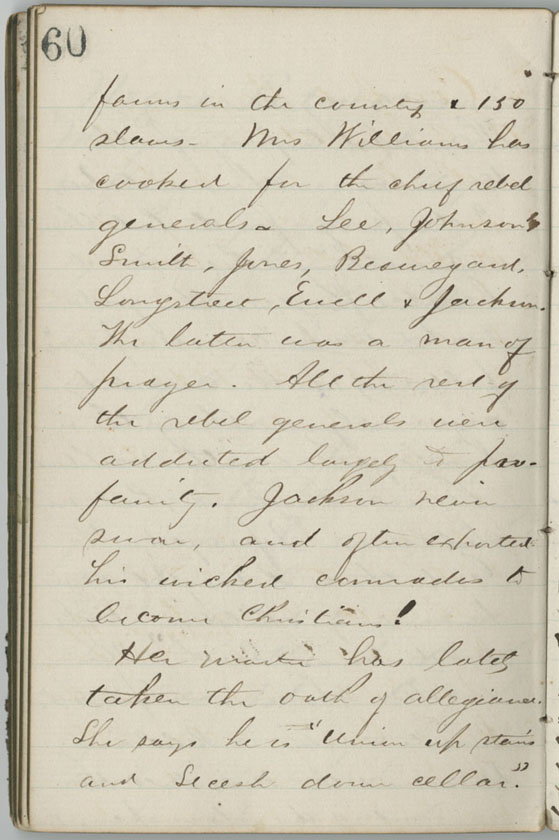
Image of Francis Snow's "Negro Patriotism" entry in journal, 1864

Image of Francis Snow's "Negro Patriotism" entry in journal, 1864

Image of Francis Snow's entries about African Americans in journal, 1864

Some of Francis Snow’s thoughts and observations about African Americans
in the journal he kept while working for the U.S. Christian Commission
in Alexandria, 1864. University Archives. Call Number: RG 2/6/6. Click images to enlarge.

Plainly, Snow’s brief month-long sojourn affected him greatly. So, when an image was made of a group of black soldiers, Snow not only received a copy, but took the time to write each man’s name down – again in his own unmistakable hand – and kept the photograph for the rest of his days, until unearthed in another century, at a time when questions of race and justice nonetheless continue to confound us.

Charles Joyce
Guest Blogger and Spencer Researcher
Philadelphia, Pennsylvania

The Quandary of Young Francis Snow

January 20th, 2016

On Sunday, PBS aired the first of a six-part miniseries called Mercy Street, set at a Union hospital in Alexandria, Virginia, during the Civil War. This is the first of two blog posts that will explore a Spencer connection to that program. Both have been guest written by Spencer researcher Charles Joyce. Mr. Joyce is a labor attorney in Philadelphia, Pennsylvania, and also a long-time collector and dealer of Civil War photography.

Any connection between the University of Kansas and the PBS series Mercy Street would probably be considered unlikely at best. However, a fascinating historical link does exist in the form of Francis Huntington Snow (1840-1908), who, after the Civil War, became a prominent scientist and served as KU’s fifth chancellor.

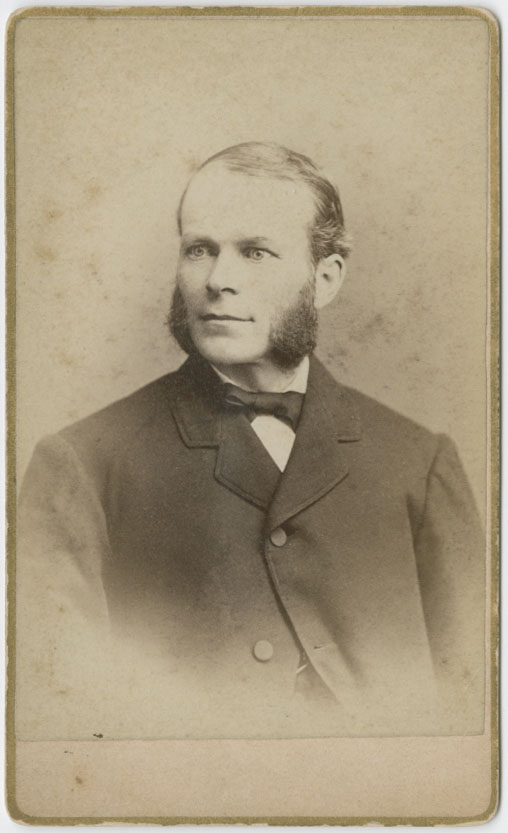
Photograph of Francis Snow, undated

An undated photograph of Francis Snow taken in Lawrence.
Snow arrived at KU in 1866; he taught mathematics and
natural sciences and was one of the school’s first three faculty members.
Snow served as KU’s chancellor from 1890 to 1901.
University Archives Photos. Call Number: RG 2/6 Undated Prints:
Chancellors: Francis Snow (Photos). Click image to enlarge.

In July 1863, Snow was a young Massachusetts divinity student facing a knotty ethical dilemma. The son of ardent abolitionists, Snow shared in his parents’ zeal to see the war transform into a crusade for the emancipation of four million enslaved African Americans. However, he believed his religious conviction and pacifist views prohibited him from actually taking up arms for the cause. Snow was drafted on July 18, 1863, and he recorded his thoughts on the matter in his diary, held at Spencer Research Library.

Could I be sure of a place where no fighting would be required, no amount of danger would deter me from going…[as] I might be of some service to the wounded on the battlefield or in the hospital. But a drafted man has no choice of position, and I, too, should be liable to be called to musket duty. So I can’t go.

Snow weighed his options for opting out of service, as allowed by the draft law. Believing that “[g]etting a substitute would be worse in my opinion than going myself,” Snow decided to pay the commutation fee of $300.

One year later, as soon as he finished his final exams at the Andover Theological Seminary, Snow hit upon a way to serve the Union cause and stay true to his moral precepts. He volunteered as a delegate with the U.S. Christian Commission, established by the YMCA, then just ten years old. The organization’s purpose was to promote the spiritual and physical welfare of Union soldiers and sailors. Francis Snow was posted at Alexandria, Virginia, for six weeks (August-September 1864) and tasked with caring for sick and wounded men at several of the military hospitals there. (He later served another five weeks with the Commission, March-May 1865.)

Image of Francis Snow's journal, "Duties of Delegates," August 1-September 14, 1864

“Duties of Delegates” of the U.S. Christian Commission. Francis Snow journal, August 1-September 14, 1864.
University Archives. Call Number: RG 2/6/6. Click image to enlarge.

Image of Francis Snow's journal, "Delegates to the Hospitals," August 1-September 14, 1864

Instructions for Commission delegates serving in hospitals,
from Francis Snow’s 1864 journal. Other Commission delegates
served with regiments in camps and on battlefields.
University Archives. Call Number: RG 2/6/6. Click image to enlarge.

Snow was unpaid, except for expenses, and he was required to keep a journal detailing his service on behalf of the Commission. In this, he recorded that during his stay in Alexandria, he visited with over 2700 hundred wounded soldiers, wrote 128 letters for them, read scripture, sang hymns, and led them in prayer many hundred times more.

Image of Francis Snow journal, cover, March 25-May 1, 1865

The cover of one of Francis Snow’s two Commission journals.
Included is Snow’s account of being at Appomattox Court House,
Virginia, on April 9, 1865, when General Lee surrendered to General Grant.
University Archives. Call Number: RG 2/6/6. Click image to enlarge.

Image of a travel pass included in Francis Snow's journal, 1864

A travel pass glued in to Francis Snow’s 1864 journal, instructing
“guards [to] pass F. H. Snow to and from the Hospital at will until further orders.”
University Archives. Call Number: RG 2/6/6. Click image to enlarge.

Image of a list of soldiers in Francis Snow's journal, 1864

Snow’s 1864 journal included a ten-page list of soldiers with whom he interacted.
Here he noted information about each man, especially the nature of his injury and his religious affiliation.
Many of the men listed on this page were African American soldiers; their regiment was listed as “USCT,”
or U.S. Colored Troops. University Archives. Call Number: RG 2/6/6. Click image to enlarge.

One of Snow’s assignments in Alexandria took him to L’Ouverture Hospital, specially constructed to care for sick and wounded African American soldiers, who were kept segregated from their white comrades. Here he befriended the Hospital’s Chaplain, the Reverend Chauncey Leonard, who signed his journal on a page he apparently maintained for “autographs.”

Image of the first page of Francis Snow's letter to his sister, 1864

Image of the second page of Francis Snow's letter to his sister, 1864 Image of the third page of Francis Snow's letter to his sister, 1864 

Image of the fourth page of Francis Snow's letter to his sister, 1864

A letter from Francis Snow to his sister describing
his hospital experiences in Alexandria, August 8, 1864.
“There are now only 9 delegates here to thus attend to the 5000 sufferers,”
he wrote, “and I can assure you we find our time fully occupied.
O Mattie you can form no conception of the amount and intensity
of the suffering among these poor fellows.”
University Archives. Call Number: RG 2/6/6. Click image to enlarge.

Snow’s interest in and empathy with the black population of Alexandria, which had swelled during the war years, was also manifest in other, less official duties, like teaching a Sunday School class of black children. Indeed, when his tour with the Commission ended in early September, Snow “found it hard to get away” from those men, women, and children. He gave the Reverend Leonard $20 to “lay out for the boys” at L’Ouverture.

Photograph of African American soldiers from L'Overture Hospital

African American soldiers from L’Ouverture Hospital, circa 1864.
Photograph in the private collection of Charles Joyce; used with permission.
Click image to enlarge.

Sometime thereafter, probably toward the end of 1864, an unknown artist took a photograph of Leonard with a group of black soldiers who were convalescing from war wounds and sickness at L’Ouverture. Someone sent a copy of the image to Francis Snow; he carefully wrote down each man’s name in the margins of the image and kept it all of his life. The photograph was found in a box in Snow’s personal library some 145 years later, and I purchased it in an online auction. More research on the soldiers in the photograph led to the holdings of the Spencer Library, including Snow’s original diary and Christian Commission journals. More on that in the next entry…

Charles Joyce
Guest Blogger and Spencer Researcher
Philadelphia, Pennsylvania

“Why Did You Come to KU?” and Other Questions from the 1895 Senior Quiz

October 7th, 2015

The 1895 KU yearbook – called Annus Mirabilis (Wonderful Year) – includes a fun senior quiz, shown below. It’s unclear whether the answers listed were actually provided by members of the Class of 1895 or whether they were jokes written by the yearbook staff and attributed to their classmates. Especially humorous are the responses to the question “what does Miss Watson [the first and longest-serving professional librarian at KU] say when you whisper in library?”


Image of KU yearbook, Annus Mirabilis, senior quiz, page 1, 1895Image of KU yearbook, Annus Mirabilis, senior quiz, page 2, 1895

Image of KU yearbook, Annus Mirabilis, senior quiz, page 3, 1895Image of KU yearbook, Annus Mirabilis, senior quiz, page 4, 1895

A senior quiz in the 1895 KU yearbook, Annus Mirabilis.
University Archives. Call Number: LD 2697 .J3 1895.
Click images to enlarge.

Caitlin Donnelly
Head of Public Services

Achievement of a Dream: The Birth of the University of Kansas

September 18th, 2015

Achievement of a Dream: The Birth of the University of Kansas, Spencer Library’s newest exhibit, opened on September 11, 2015.

The exhibit, developed in conjunction with the celebration of the 150th anniversary of the University, was curated by University Archivist Rebecca Schulte and Assistant Archivist Letha Johnson, with assistance from KU 150 Research Archivist JoJo Palko. It highlights original documents, photographs, and memorabilia that tell the story of the early years of the University from its beginnings in 1865 to the turn of the twentieth century. Exhibition items include Chancellor John Fraser’s Civil War-era Union lieutenant’s uniform and sword, early student activity photographs, and the diploma of KU’s first graduate, Flora Richardson. Whitney Baker, Head of Conservation Services at KU Libraries, and Angela Andres, Library Preservation Assistant, provided display support and conservation guidance.

Photograph of Flora Richardson

Flora Richardson, valedictorian of KU’s first graduating class (1873).
University Archives Photos. Call Number: P/ Richardson, Flora: People (Photos).
Click image to enlarge (redirect to Spencer’s digital collections).

List of degrees conferred, 1873

“Degrees Conferred. Commencement 1873, on Examination, Class of 1873.”
University Archives. Call Number: LD 2693 .U55 1873.
Click image to enlarge. See more documents from KU’s first
commencement
at Archives Online, part of KU ScholarWorks.

There had been many female students at the University of Kansas since it first opened in 1866 as a preparatory school, but only one has the double distinction of first graduate and class valedictorian: Flora Richardson. Flora graduated with the first class in 1873, earning a Bachelor of Arts. At commencement she spoke at length on the “Uses of Superstition.” She argued that superstition, though allegedly “hurtful to man’s progress,” actually furthered intellectual inquiry by inspiring reverent curiosity about the world. The speech was a success; the Daily Kansan Tribune lauded her performance, declaring that “the young lady came forward tastefully and elegantly attired in white, and delivered her oration in a firm, though pleasant voice.”

Flora’s remarkable collegiate career included joining the Oread Literary Society and being a founding member of the Kappa chapter of the “I.C. Sorosis” sorority, which in 1888 changed its name to Pi Beta Phi. She even created KU’s first entomological collection, a 140-specimen group including everything from cockroaches to walking sticks, as a pupil of Professor (and later Chancellor) Francis Huntington Snow.

 Image of Flora Richardson's KU diploma, 1873

Flora Richardson‘s diploma from the University of Kansas, 1873.
This was the first diploma ever awarded by KU.
Generously loaned to University Archives from Flora Richardson’s family.
Click image to enlarge (redirect to Spencer’s digital collections).

Flora’s diploma, the first ever awarded by KU, is now on display at Spencer Research Library as part of Achievement of a Dream: The Birth of the University of Kansas. The exhibit is free and open to the public in the Spencer Exhibit Space, located on the library’s third floor. The library is open Monday through Friday, 9:00am to 5:00pm; during the fall and spring semesters, when KU classes are in session, it is also open on Saturday, 9:00am to 1:00pm. For other closings and hours during semester breaks and holidays, see our Exception Dates.

JoJo Palko
KU 150 Research Archivist
University Archives

Bob Timmons, June 1924-August 2015

August 25th, 2015

The University of Kansas lost another leader three weeks ago on August 4, track & field and cross country coach Bob “Timmie” Timmons. A U.S. Marine who spent time deployed in the South Pacific during World War II, he earned his bachelor’s and master’s degrees in education from the University of Kansas. Timmons then joined the KU track team’s coaching staff in 1964 and became head coach in 1966. He led the Jayhawk track team to four NCAA titles, 13 Big Eight indoor titles, and 14 outdoor titles before his retirement in 1988. During that time he coached several Olympic athletes, including runners Billy Mills and Jim Ryun. In 2011 he was inducted into the National Track & Field Hall of Fame.

 Photograph of Coach Bob Timmons with two National Championship trophies

Coach Bob Timmons with two National Championship trophies.
University Archives Photos. Call Number: RG 66/22 Prints:
Athletic Department: Coaches: Bob Timmons (Photos).
Click on image to enlarge (redirect to Spencer’s digital collections.)

Photograph of Coach Bob Timmons instructing a shot-put athlete during practice

Coach Bob Timmons instructs a shot-put athlete during practice.
University Archives Photos. Call Number: RG 66/22 Prints:
Athletic Department: Coaches: Bob Timmons (Photos).
Click image to enlarge.

After his retirement, Timmons developed the Rim Rock Farm cross country course on his property north of Lawrence. In 2005, he and his wife Pat donated the course, one of the best in the country, to KU.

Coach Timmons is remembered for his attention to detail and his desire to promote education and character-building through college athletics. Current KU Athletic director Sheahon Zenger said, “KU has lost a true treasure. Coach Timmons was one of the all-time greats. His legacy though does not end with championships and medals. His real legacy is how much he cared about his student-athletes and the University of Kansas.”

Photograph of Coach Timmons holding up a time card to signal to athletes

Coach Timmons holds up a time card to signal to athletes.
University Archives Photos. Call Number: RG 66/22 Prints:
Athletic Department: Coaches: Bob Timmons (Photos).
Click image to enlarge.

JoJo Palko
KU 150 Research Archivist
University Archives