The University of Kansas

Inside Spencer: The KSRL Blog

Books on a shelf

Welcome to the Kenneth Spencer Research Library blog! As the special collections and archives library at the University of Kansas, Spencer is home to remarkable and diverse collections of rare and unique items. Explore the blog to learn about the work we do and the materials we collect.

Tramping on Mount Oread: Poet Harry Kemp

April 21st, 2015

How many freshmen can boast that their arrival on campus was covered by the national press? Though neither a star athlete nor the child of a public figure, poet Harry Kemp (1883-1960) won this distinction through his knack for self-promotion. Kemp’s unconventional arrival at KU by boxcar in January of 1906 launched him from anonymity to the front page of the New York Tribune —  “TO COLLEGE UNDER FREIGHT CAR / Student Leaves New-York with 3 cents–Working Way at University of Kansas. Another headline in the Kansas City Star proclaimed Kemp a “Tramp Poet,” and the moniker stuck (though he was known as the vagabond poet and hobo poet as well). During his six years of studies at KU, Kemp immersed himself in books, built a reputation as a poet and writer, and befriended nearby William Allen White, the newsman and “Sage of Emporia.”

And as the years passed, Kemp continued to make headlines, including as the “other man” in Upton Sinclair’s divorce and for attempting  in 1913 to “tramp” to England as a stowaway aboard a steamer, something that earned him a brief stay in a British jail and further celebrity on both sides of the pond. Of course, Kemp garnered attention for his literary output as well. He published books of verse–including The Cry of Youth (1914), Chanteys and Ballads (1920), and Don Juan’s Note-book (1929)–and a bestselling semi-fictionalized memoir, Tramping on Life: An Autobiographical Narrative (1922), in which KU appears as “Laurel University” in “Laurel, Kansas.” Kemp livened up already the already lively literary circles of Greenwich Village and was associated with the Provincetown Players, electing ultimately to settle in Cape Cod.

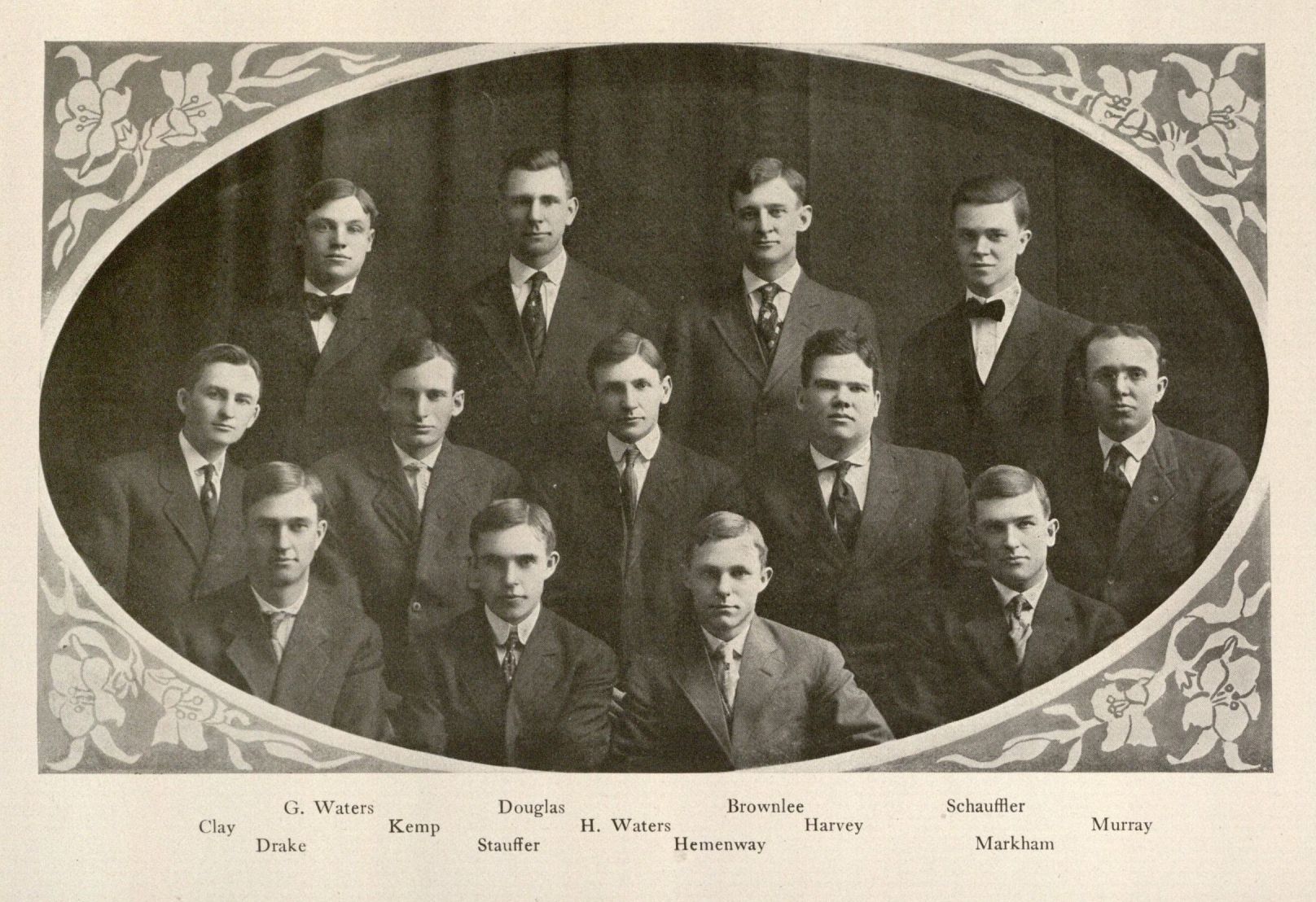
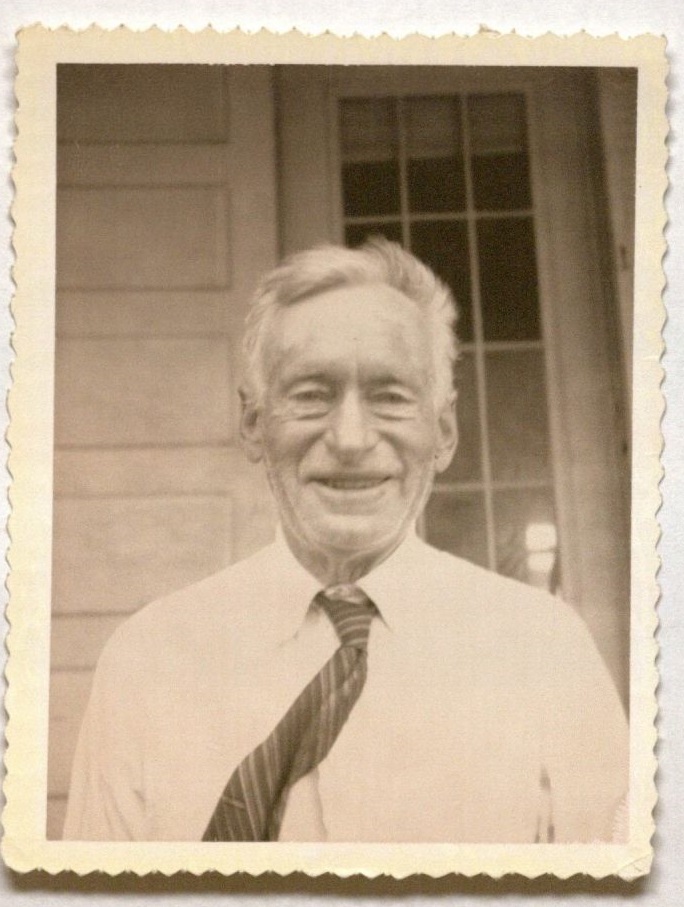
Potrait of the KU Scoop Club, 1909, featuring Harry Kemp. Photograph of Harry Kemp circa the 1950s

Youth and Old Age: Harry Kemp (middle row, second from left) with fellow members of the Scoop Club
(for news reporters) in the 1909 Jayhawker yearbook, Call #: LD 2697.J3 1909,
and in a photograph from the the 1950s, Personal Papers of Harry Kemp. Call #: PP 75, Box 3.
Click images to enlarge.

Though Louis Untermeyer had once spoken of Kemp alongside Carl Sandburg, Vachel Lindsay, and Edgar Lee Masters, by the end of his life, the Tramp Poet’s reputation had already begun to fade. Nevertheless, Kemp continued to write and elevate his eccentricities to an art.  From his shack in Provincetown, Massachusetts, he would sign his poems (and sometimes even compose them) with a seagull feather.  In honor National Poetry Month, we remember today one of the most eccentric and free-spirited poets to emerge from KU, Harry Kemp, and share three of his poems below.

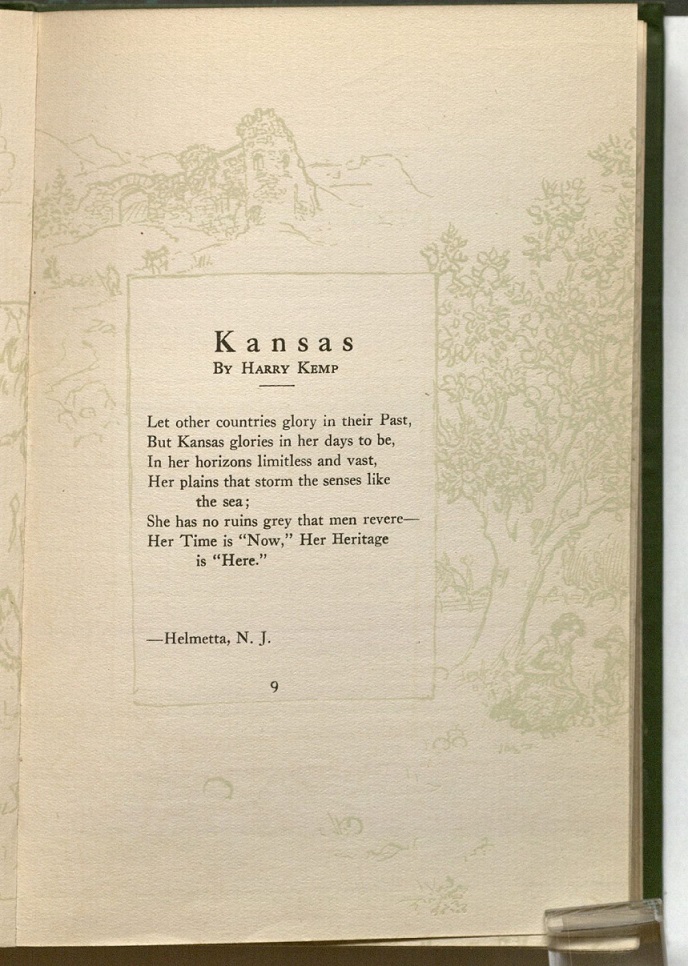
Harry Kemp's "Kansas" from Sunflowers: A Book of Kansas Poems (1914)

Kemp, Harry. “Kansas” in Sunflowers: A Book of Kansas Poems. Willard Wattles, Editor.
Lawrence, KS:  World Company, 1914. Call #: KAC C71. Click image to enlarge.

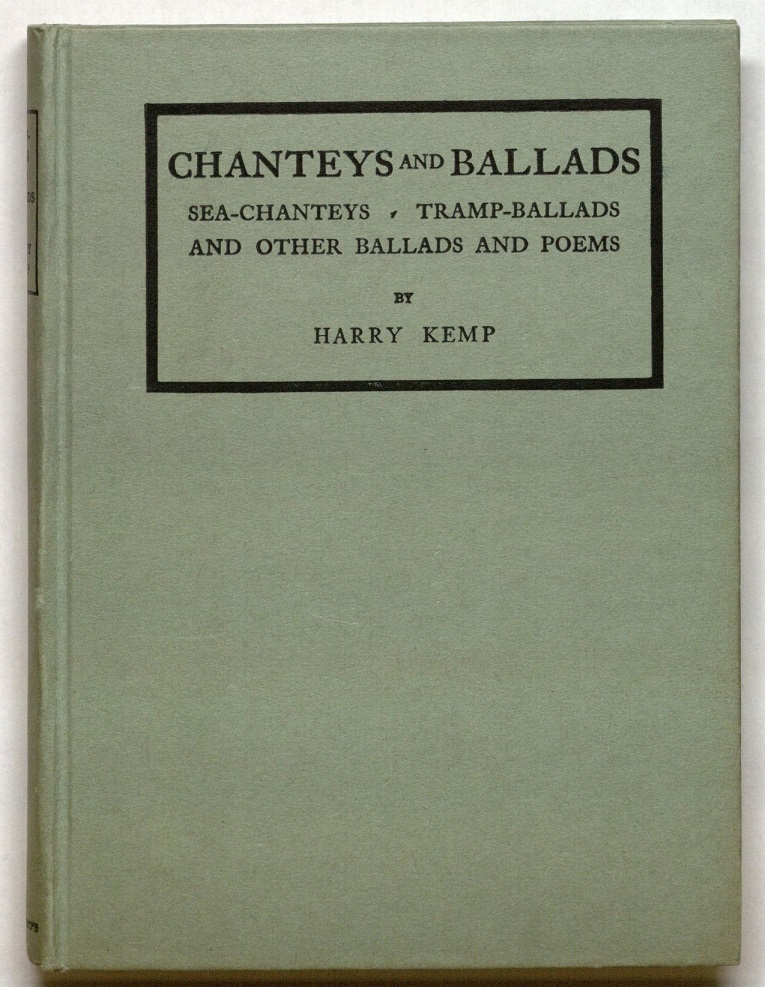
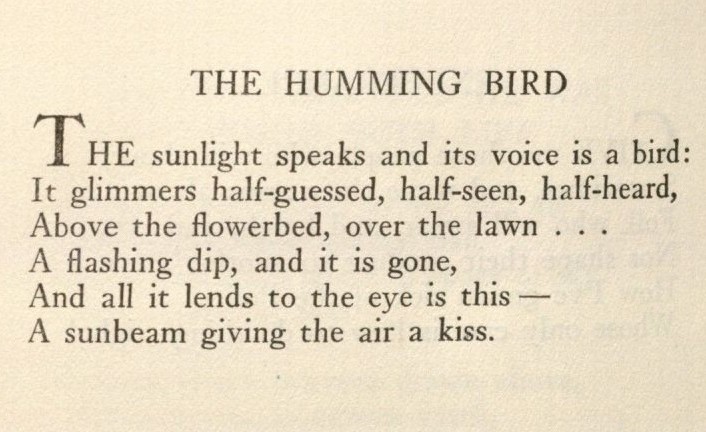
Cover of Kemp's Chantey's and Ballads (1920) "The Humming Bird" by Harry Kemp from Chanteys and Ballads (1920)

Kemp, Harry. “The Humming Bird,” from Chanteys and Ballads, Sea-chanteys, Tramp-ballads and Other
Ballads and Poems
. New York, Brentano’s [c1920]. Call #: PP 75, Box 1. Click images to enlarge.

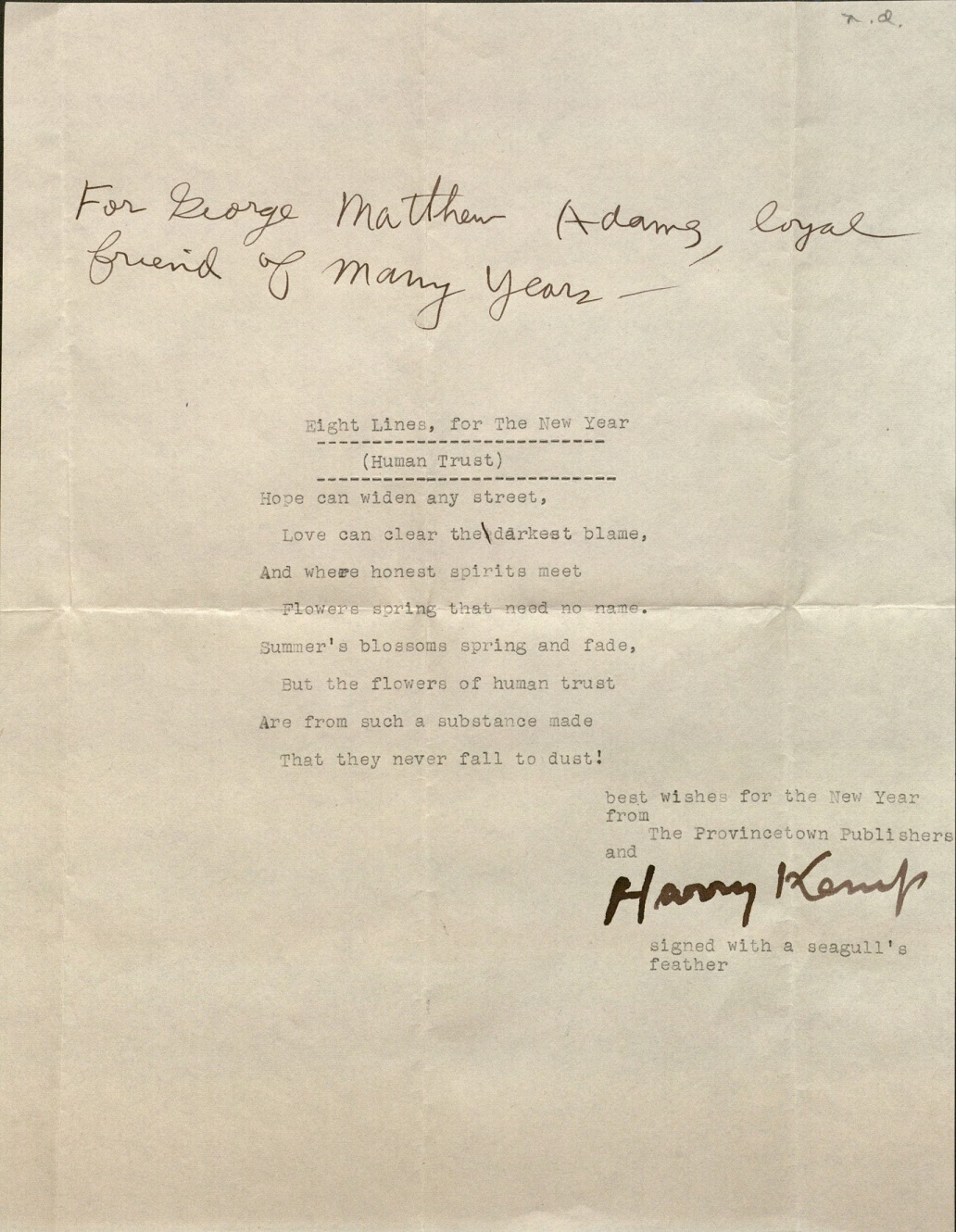
Typescript poem ("Eight Lines, for the New Year") by Harry Kemp, with manuscript inscription.

Kemp, Harry.  “Eight Lines, For the New Year (Human Trust),” undated.
Personal Papers of Harry Kemp. Call # PP 75, Box 3. Click Image to enlarge.

For more on Harry Kemp, his poetry, and his wild life, see William Brevda’s Harry Kemp, the Last Bohemian or drop by Spencer and begin exploring his personal papers.

Elspeth Healey
Special Collections Librarian

Exhibiting Free Speech: The Wilcox Collection at 50

March 16th, 2015

This post is written to highlight the current exhibit at Spencer Library: Free Speech in America: The Wilcox Collection at 50. A reception will be held on March 25 at Spencer Library to celebrate the Wilcox Collection.

Fifty years ago Laird Wilcox was a student at the University of Kansas. He had started collecting political literature in his teen years, fueled in this interest by his diverse family leanings and volatile discussions over family meals. He wanted to understand what motivated people to believe the things they did and act on those beliefs.

In 1964 Laird entered and won the Elizabeth Taylor Book Collecting Contest sponsored by the KU Libraries. The Libraries purchased his collection in 1965 (then four filing cabinets of materials). Today the Wilcox Collection of Contemporary Political Movements is one of the largest assemblages of left and right wing U.S. political materials anywhere. There are thousands and thousands of pamphlets, books, newsletters, audio recordings, and political ephemera such as bumper stickers, posters, flyers, organizational membership mailings, and book catalogs, relating to some 10,000 organizations at the fringes of the political spectrum. There is also a growing component of manuscript collections as well, including Laird Wilcox’s personal papers.

1964 Contest Winners Laird Wilcox, Lawrence Morgan, and Jerry L. Ulrich, with Elizabeth M. Taylor.

The winners of the Taylor Book Collecting Contest, KU Libraries, 1964. Laird Wilcox, far left, and Elizabeth M. Taylor (sponsor of the contest), second from left. University Archives. Call Number: RG 32/40. Click image to enlarge.

Laird Wilcox in Wilcox Collection stacks, University of Kansas Libraries

Laird Wilcox standing in the Wilcox Collection stacks, Kenneth Spencer Research Library, KU, 1996. University Archives. Call number: RG P/LW. Click image to enlarge.

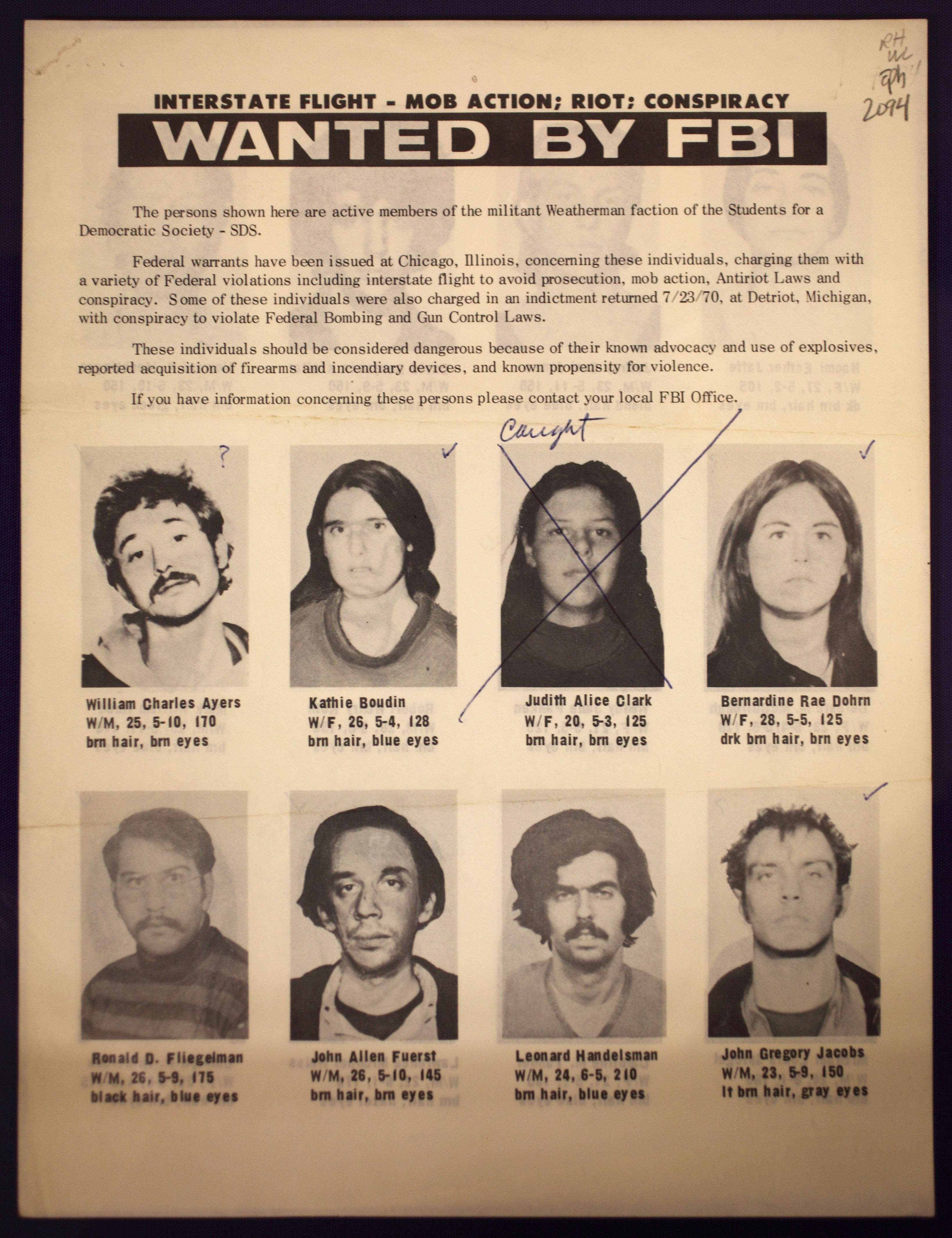
In 2015 an exhibit was mounted in Spencer Research Library to commemorate the 50th anniversary of the Wilcox Collection. The exhibit includes examples of books, newsletters, and ephemera, and highlights some of the many books that have resulted from research in the collection. Materials from the collection include items from a scrapbook that Laird kept as chair of the Student Union Association Minority Opinions Forum, a FBI wanted poster with photos of Bernadine Dohrn and William Ayers from the ephemera file of the Weather Underground, and examples of Laird’s many publications.

Flyer from Wilcox Collection depicting American flag

Poster for a documentary film shown at KU in 1964 focusing on the Committee on Un-American Activities (HUAC). From the Laird Wilcox scrapbook. Kansas Collection. Call number: RH WL MS Q5. Click image to enlarge.

Wanted poster from Wilcox Collection, University of Kansas Libraries

FBI wanted poster from the ephemera file of the Weather Underground which operated as an underground urban guerilla force. Kansas Collection. Call number: RH WL EPH 2094. Click image to enlarge.

One of the strongest features of the Wilcox Collection is ephemeral materials, including bumper stickers, buttons, and flyers. Because of their “throw-away” nature ephemera are often overlooked as an information source, but can provide the original message of the creator in a way that is often concise and colorful.  On display are materials from the National Youth Alliance, Community Churches of America, the American Education Lobby, the Lesbian/Gay Labor Alliance, the Student Mobilization Committee to End the War in Vietnam, T.R.A.I.N. (To Restore American Independence Now), Phyllis Schlafly’s Eagle Forum, Phoebe Courtney’s Tax Fax, and The Fact Finder published by Harry Everington. There are more than 200,000 pieces of ephemera in the Wilcox Collection.

Ephemeral materials from Wilcox Collection, Spencer Research Library, University of Kansas

Representative ephemera from the Wilcox Collection. Kansas Collection. Call number: RH WL EPH. Click image to enlarge.

The Wilcox Collection is a prime example of one of the world-class collections that reside within the Kenneth Spencer Research Library. Researchers from many parts of the globe have traveled to the KU campus to view this collection, an opportunity that is easily available to KU’s students and faculty.

Rebecca Schulte
University Archivist and Curator, Wilcox Collection

Sherry Williams
Curator of Collections and Curator, Kansas Collection


In Commemoration: Bloody Sunday, March 7, 1965

March 9th, 2015

This weekend’s three-day commemoration of the 50th anniversary of “Bloody Sunday” recognized one of the pivotal events of the Modern Civil Rights Movement.  The occasion drew President Barack Obama, the First Lady and their daughters, former President George W. Bush and Mrs. Laura Bush, as well as a delegation of bipartisan Congressional representatives to Selma, Alabama.

On Sunday, March 7, 1965, about 600 civil rights activists marched in silence from Brown Chapel AME Church in Selma, Alabama for the Montgomery state capitol building to memorialize the shooting death of Jimmy Lee Jackson by a state trooper at a peaceful voting rights rally in Marion, Alabama and to protest against the intransigent opposition to African Americans registering to vote.  The opposition to voting rights was especially strong in Selma, Alabama, where half of the population was African American and had not been allowed to vote since the late nineteenth century. Immediately after crossing the Edmund Pettus Bridge, the marchers were halted by heavily armed state troopers and local police who ordered them to turn back. When they refused, the troopers and police, in full view of news media and other photographers, mercilessly beat and tear-gassed the marchers. Today, this tragic event in our nation’s history is often referred to as “Bloody Sunday.” A week later, in a televised speech, President Lyndon B. Johnson asked for a voting rights bill, and on August 6, Congress passed the
1965 Voting Rights Act.

Spencer Research Library’s Kansas Collection includes sources that document the region’s support for Bloody Sunday’s civil rights workers and their efforts. We share a selection of these documents.

ITEMS FROM THE AFRICAN AMERICAN EXPERIENCE COLLECTIONS

The Wichita Chapter of the NAACP was an early leader in the Modern Civil Rights Movement’s strategy of breaking down the color line through non-violent, direct action.   The Chapter’s Youth Council organized the movement’s first lunch counter sit-in on July 19, 1958.  A month later, the Youth Council in Oklahoma City, Oklahoma conducted their sit-in.

On March 20, 1965, the Topeka Branch of the NAACP organized and led a Sympathy March for the civil rights activists in Selma, Alabama.

Samuel C. Jackson served as the president of the Topeka Chapter of the NAACP, which had been first established in 1913. Born in Kansas City, Kansas, Jackson earned his law degree from Washburn University Law School and was a WWII veteran. During the fall of 1965, President Lyndon B. Johnson appointed him to the first U.S. Equal Employment Opportunity Commission. Four years later, he was appointed General Assistant Secretary of the U.S. Department of Housing and Urban Development by President Richard M. Nixon.
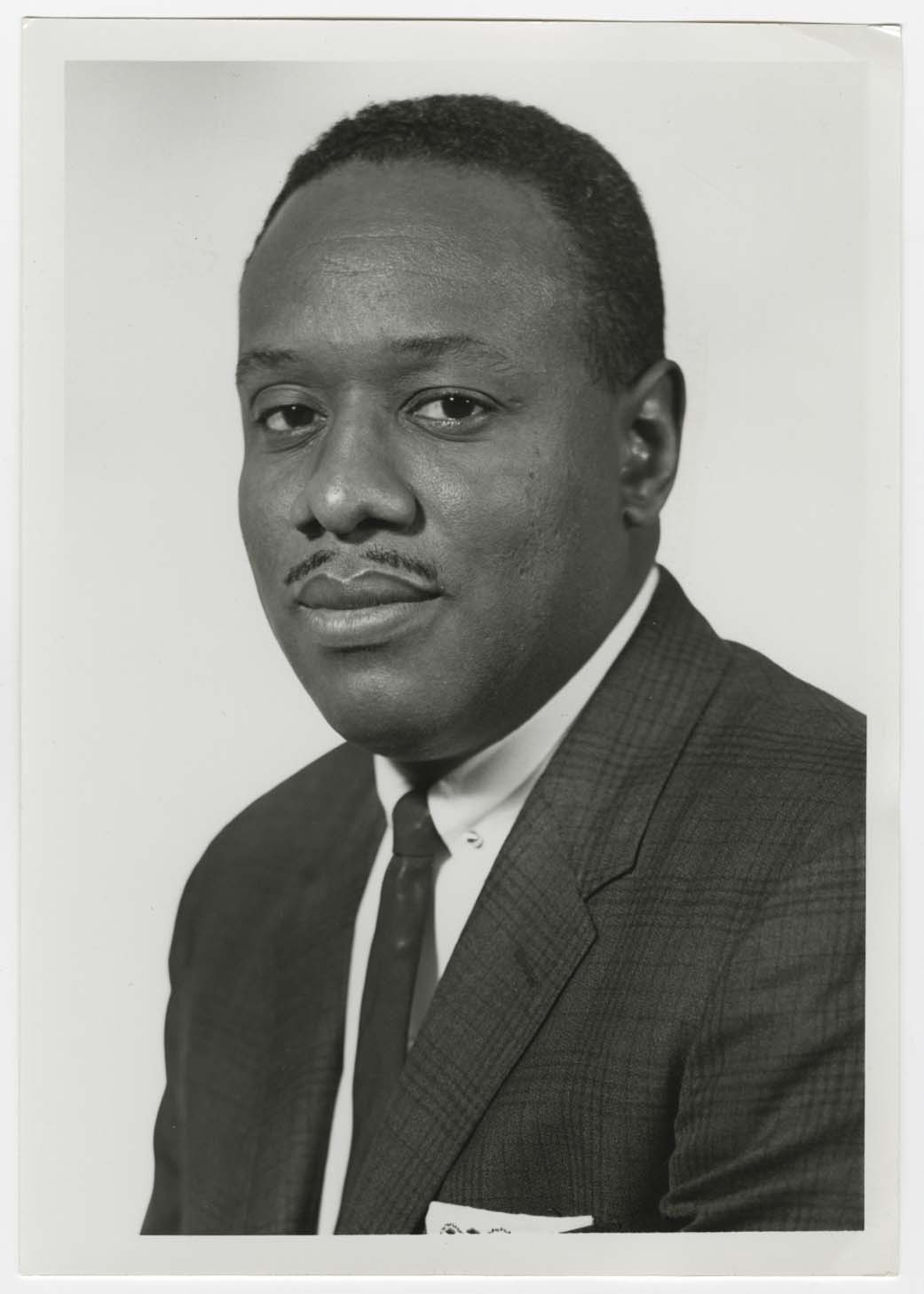
 Portrait of Samuel C. Jackson

Photograph: Samuel C. Jackson portrait. Samuel C. Jackson Collection, Call Number: RH MS-P 557, Box 1, Folder 4.
Click image to enlarge.

The Topeka Branch of the NAACP distributed this flyer to mobilize community participation and support for the Sympathy March.
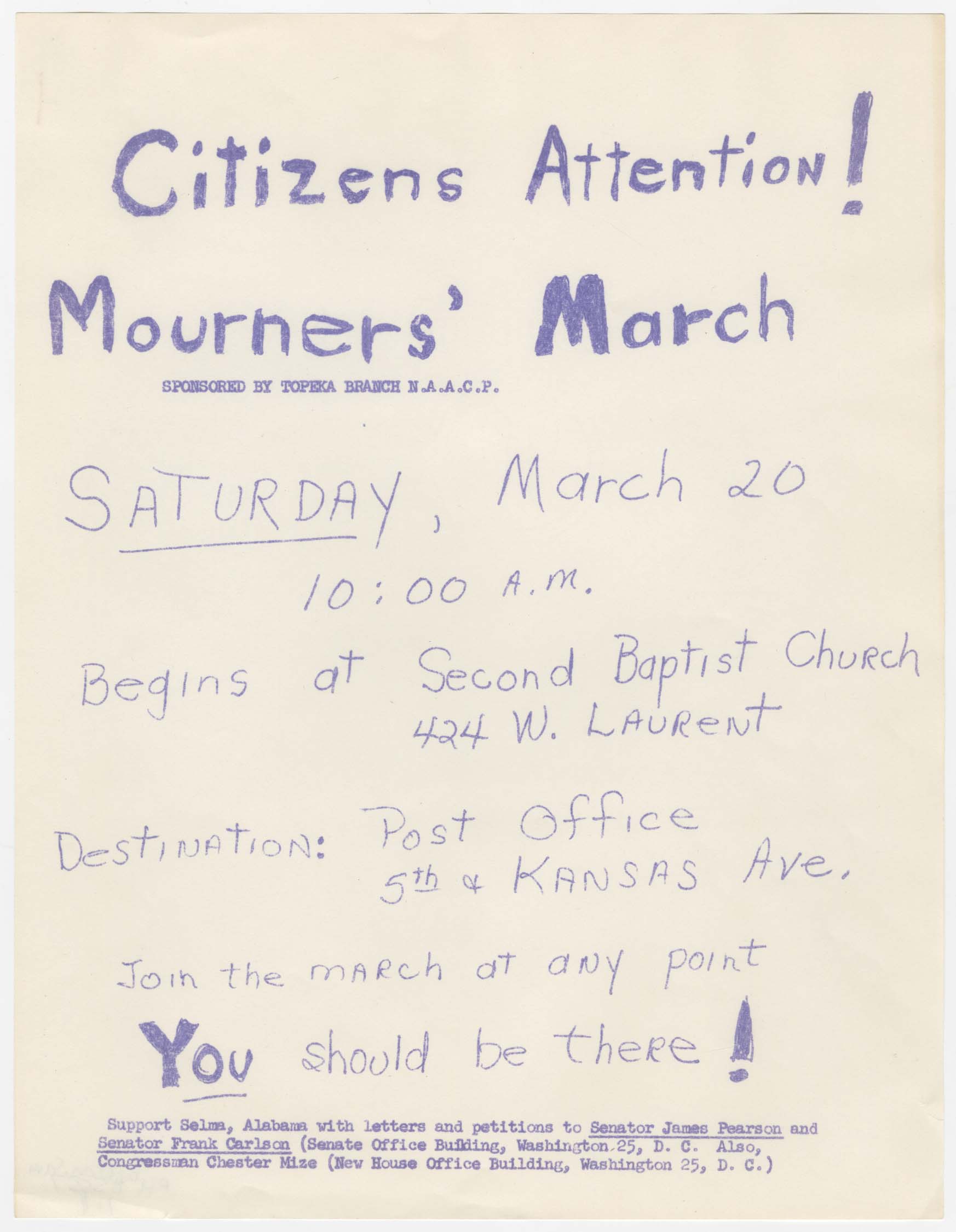
 Citizen’s Attention flyer

Citizen’s Attention flyer. Samuel C. Jackson Collection.
Call Number: RH MS 557, Box 1, Folder 11. Click image to enlarge.

On Saturday morning, March 20, 1965, about 150 marchers began their journey from Second Baptist Church on 424 N.W. Laurent Street in Topeka, Kansas and walked across the Topeka Avenue Bridge, wearing black armbands and carrying signs that read “Topeka NAACP Deplores Selma’s Brutality,” “Mourners March,” and “Police Brutality Must Go.”
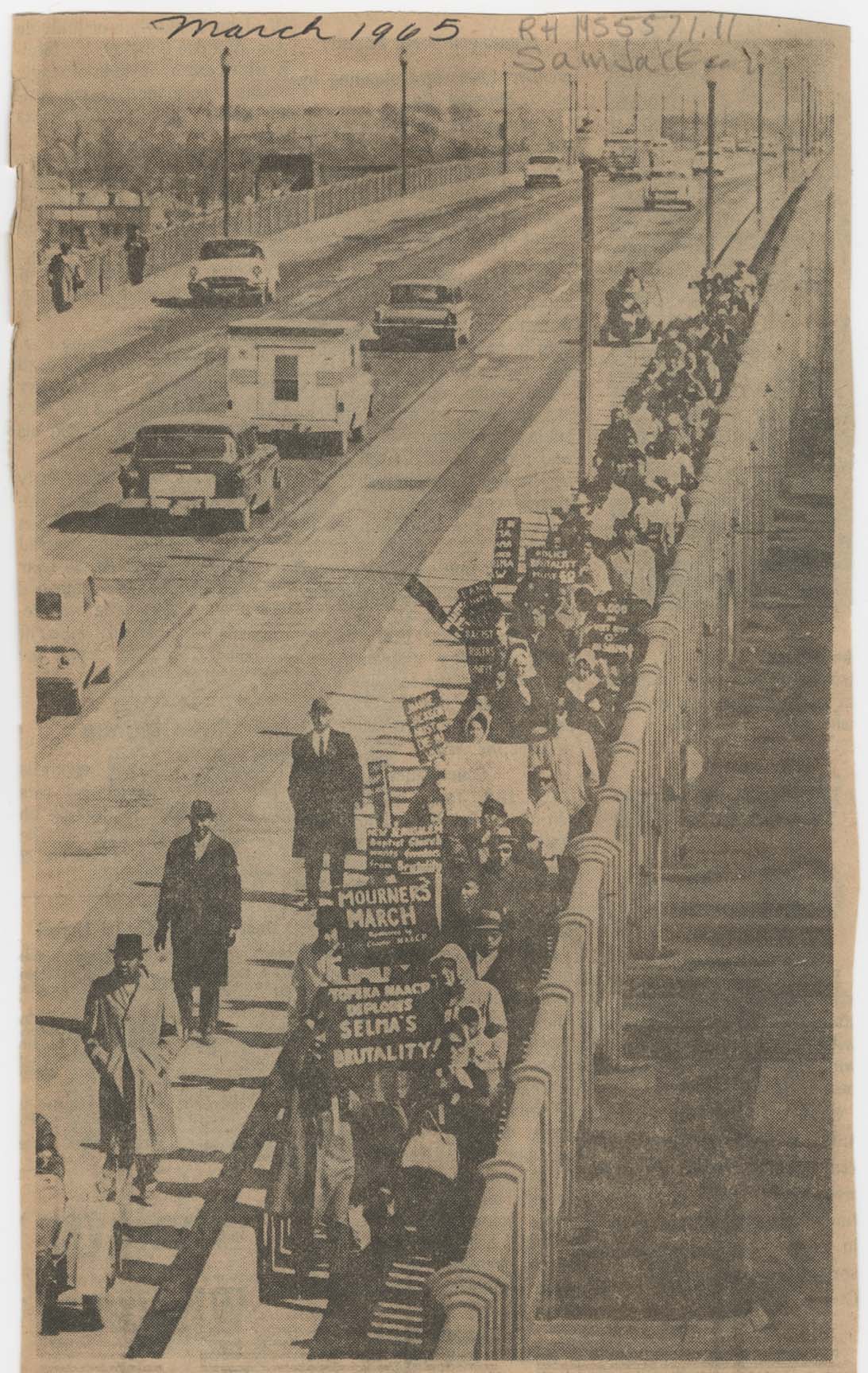
Newspaper clipping of “Topeka Rights March.”

Newspaper clipping of “Topeka Rights March.” Samuel C. Jackson Collection.
Call Number: RH MS 557, Box 1, Folder 11. Click image to enlarge.

The Sympathy March continued through the streets of Topeka, Kansas.

Civil Rights Marchers.  Topeka, KS, 1965.

Civil Rights Marchers.  Topeka, KS, 1965. J. B. Anderson Collection.
Call Number: RH MS-P 1230 Box 1, Folder 31.  Click image to enlarge.

When the Sympathy March reached the downtown area of Topeka, about 100 more participants joined them as the demonstration moved toward South Kansas Avenue to the Topeka Post Office where they placed in the mail hundreds of letters and petitions to the Kansas Congressional Delegation, urging them to support upcoming civil rights legislation.
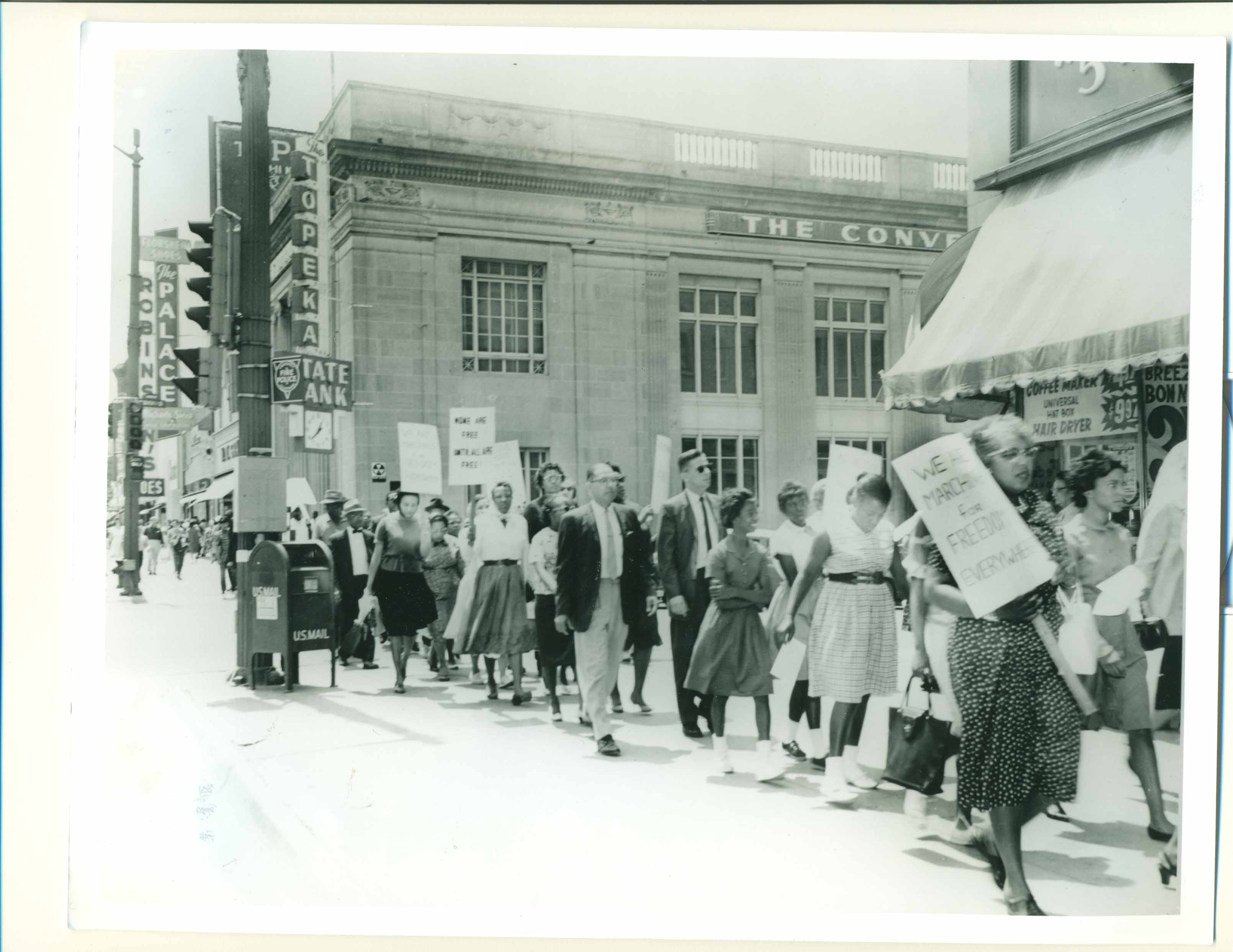
Sympathy March, Topeka, March 1965

Sympathy March, Topeka, March 1965.  J.B. Anderson Collection.
Call Number: RH MS-P 1230 Box 1, Folder 31.  Click image to enlarge.

In the Greater Kansas City area and in Independence, Missouri, local chapters of the Congress of Racial Equality (CORE) and the NAACP led silent marches throughout the day on Sunday, March 14, 1965. More than 1,200 people participated in these demonstrations.
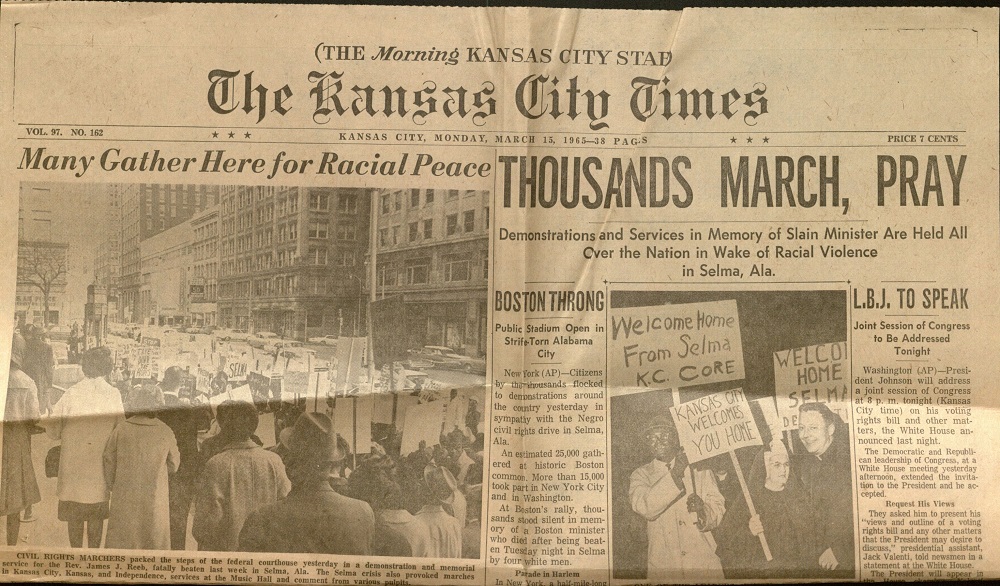
Greater Kansas City Marches. March 14, 1965

Greater Kansas City Marches. March 14, 1965. Greater Kansas City Council on Religion and Race Collection.
Call Number: RH MS 786, Box 8, File 12.  Click image to enlarge.

At the Music Hall in Kansas City, Missouri, the Greater Kansas City Council on Religion and Race, an organization of clergy and lay members of all faiths dedicated to the advancement and attainment of interracial justice and charity, sponsored a community memorial service for the Reverend James J. Reeb, who was murdered by white vigilantes in Selma, Alabama on March 11, 1965. He had traveled to Selma a few days after “Bloody Sunday” to support the area’s civil rights workers. A Unitarian Universalist minister and a social worker, The Reverend Reeb was born in Wichita Kansas and resided in Russell, Kansas as a youth.
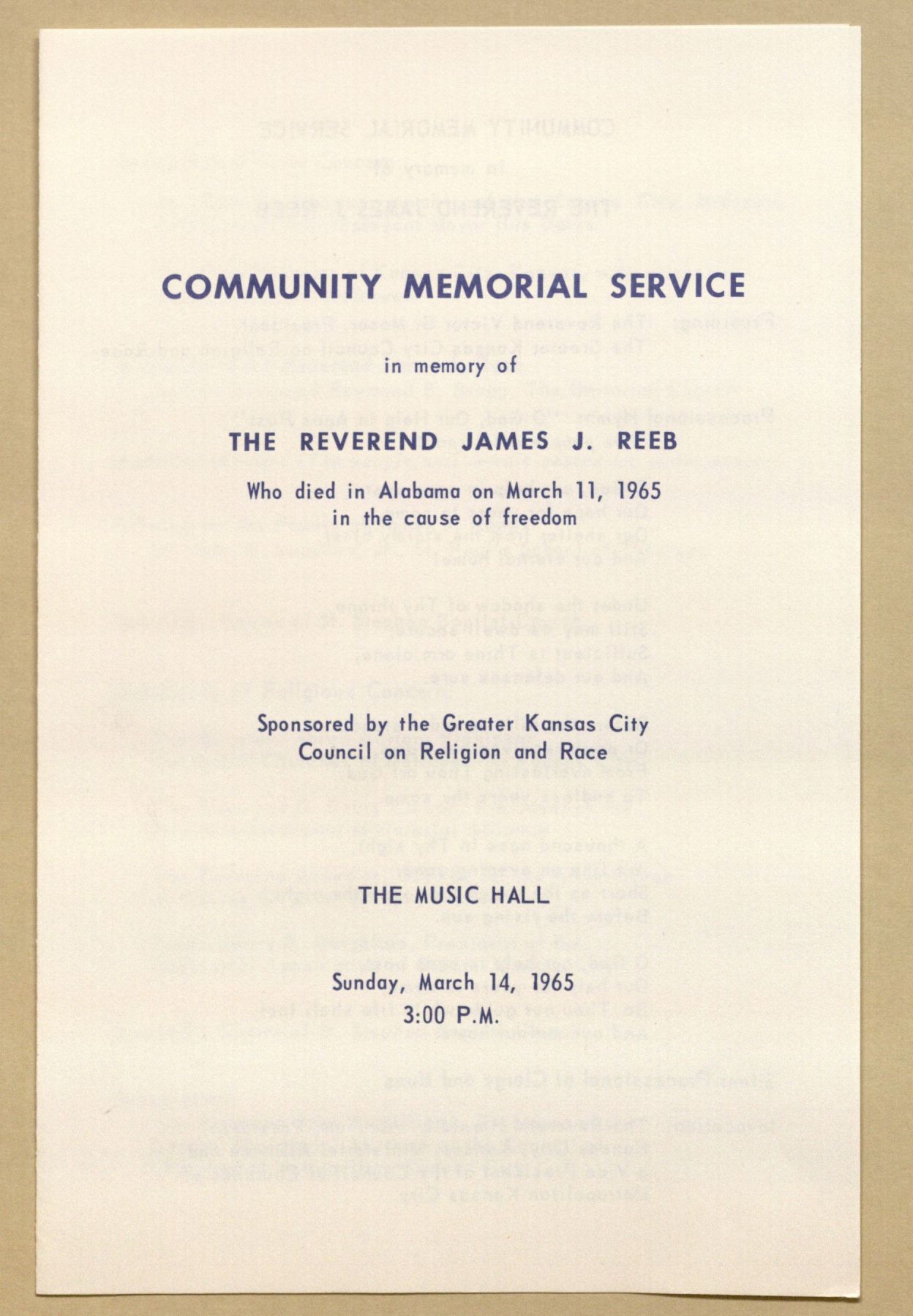
Second Reeb Memorial Program, March 14, 1965.

Reeb Memorial Program. Greater Kansas City Council on Religion and Race Collection.
Call Number: RH MS 786, Box 8, File 12. Click image to enlarge.

The KU Libraries is a co-sponsor of the African and African American Studies Department’s public program Selma: A Film Screening and Panel Discussion on March 25, 2015, at 5:30p.m. in Wescoe Hall, Room 3140.

Deborah Dandridge
Field Archivist and Curator
African American Experience Collections

Throwback Thursday: Alpha Kappa Alpha Edition

February 5th, 2015

Each week we’ll be posting a photograph from University Archives that shows a scene from KU’s past. We’ve also scanned more than 1,700 images from KU’s University Archives and made them available online; be sure to check them out!

This week we’re highlighting photographs of an historic KU organization found within Spencer’s African American Experience Collections. Additional materials about Alpha Kappa Alpha – primarily donated by former members – can be found in Spencer’s Kansas Collection by searching our online finding aids. Records and photographs documenting the Delta’s Chapter’s history at KU can also be found in University Archives at call number RG 67/128

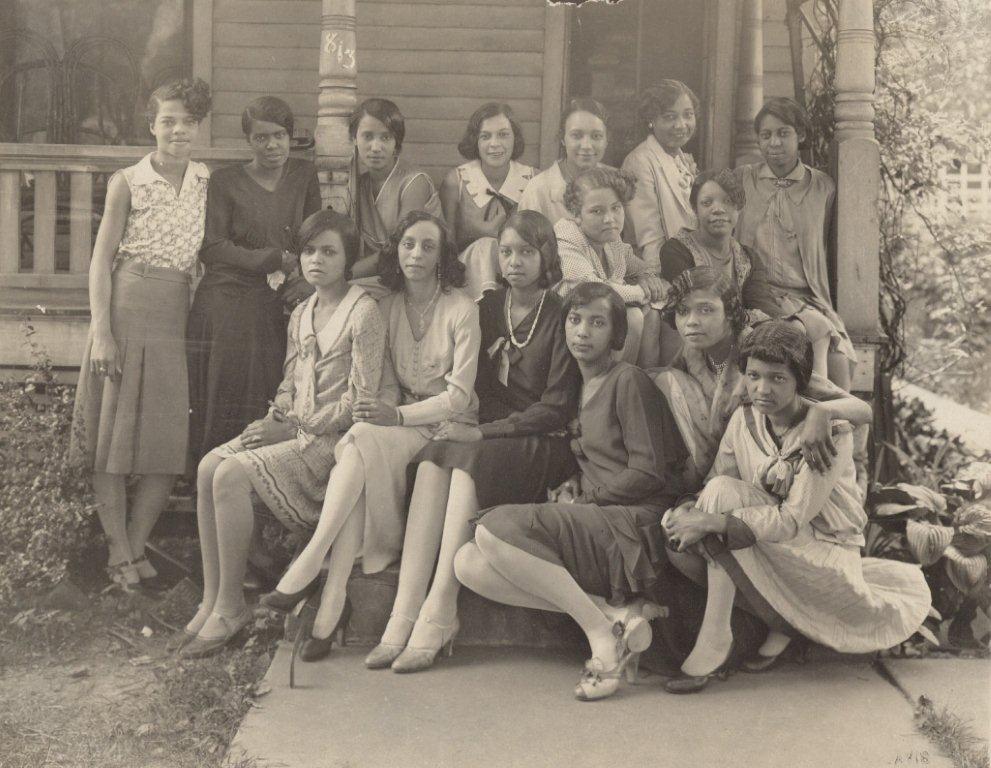
Photograph of the Alpha Kappa Alpha, Delta Chapter, 1930

Alpha Kappa Alpha, Delta Chapter, 1930. Dorothy Hodge Johnson Collection.
Call Number: RH MS-P 549. Click image to enlarge.

The Delta Chapter of Alpha Kappa Alpha Sorority, Incorporated celebrates its first 100 years at the University of Kansas during the weekend of February 13-15, 2015. It is the first African American Greek-letter organization chartered at KU.

Their national organization, Alpha Kappa Alpha (AKA), which began in 1908 at Howard University, is our nation’s first sorority organized by African American college and university women. Today AKA includes members from diverse racial and ethnic identities.

On Friday, February 13, 2015, from 1p.m. to 3p.m., Spencer Research Library will present a display of the Delta Chapter’s archives at the Oread Hotel. It will include these historical photographs (and the one above) from the Kansas Collection’s African American Experience Collections:

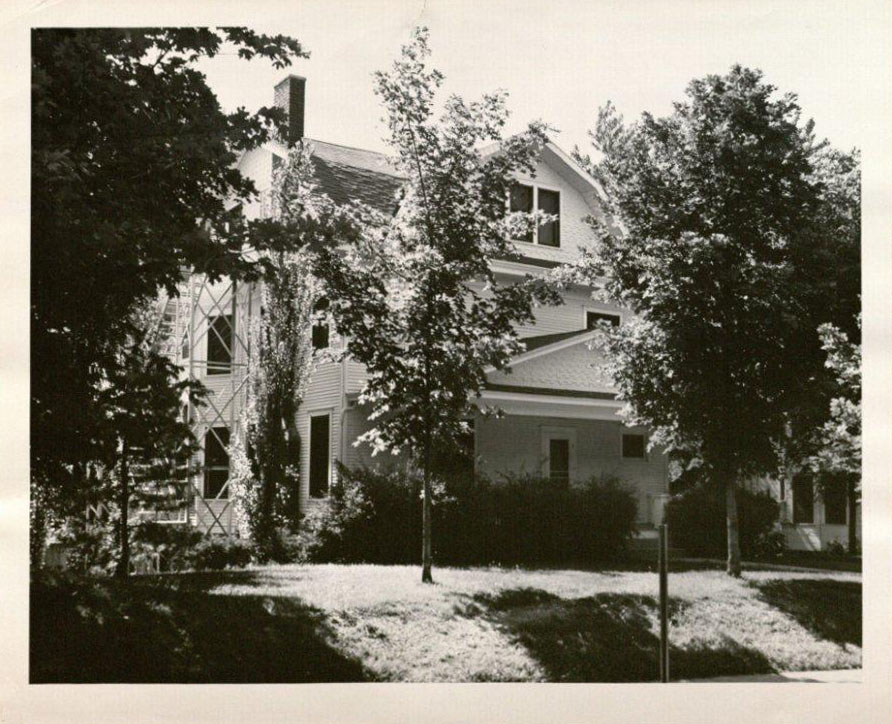
Photograph of the Alpha Kappa Alpha, Delta Chapter house, circa 1940-1949

AKA Delta Chapter house at 1101 Indiana in Lawrence, circa 1940-1949.
Dorothy Hodge Johnson Collection. Call Number: RH MS-P 549. Click image to enlarge.

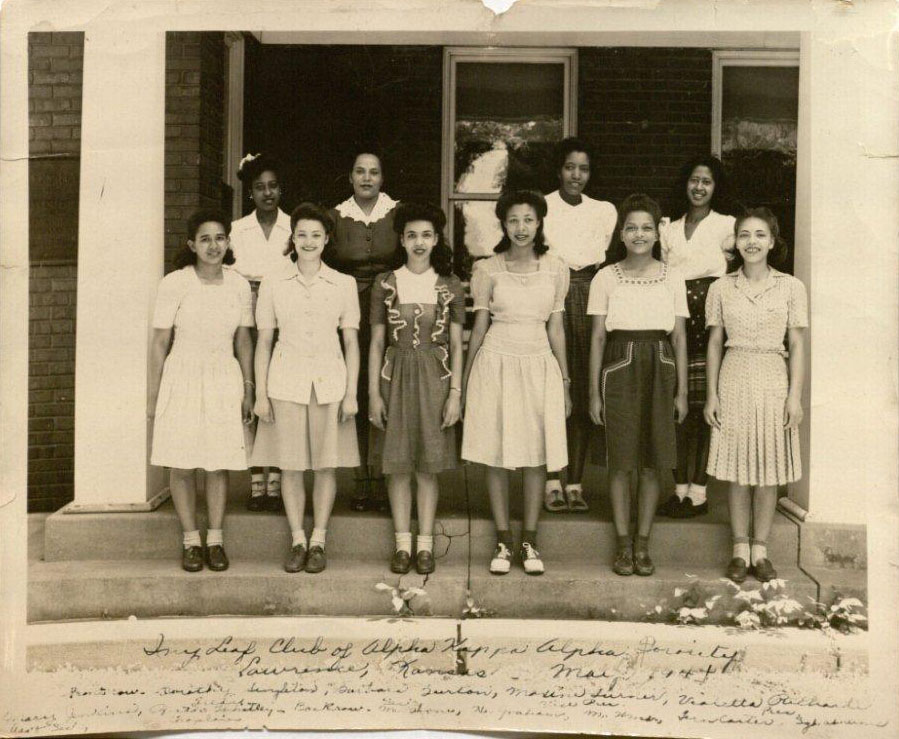
Photograph of the Alpha Kappa Alpha, Delta Chapter Ivy Leaf Pledge Club, 1944

AKA Delta Chapter Ivy Leaf Pledge Club, 1944. Photograph by Duke D’Ambra.
Julia V. (Richards) Harris Collection. Call Number: RH MS-P 1179. Click image to enlarge.

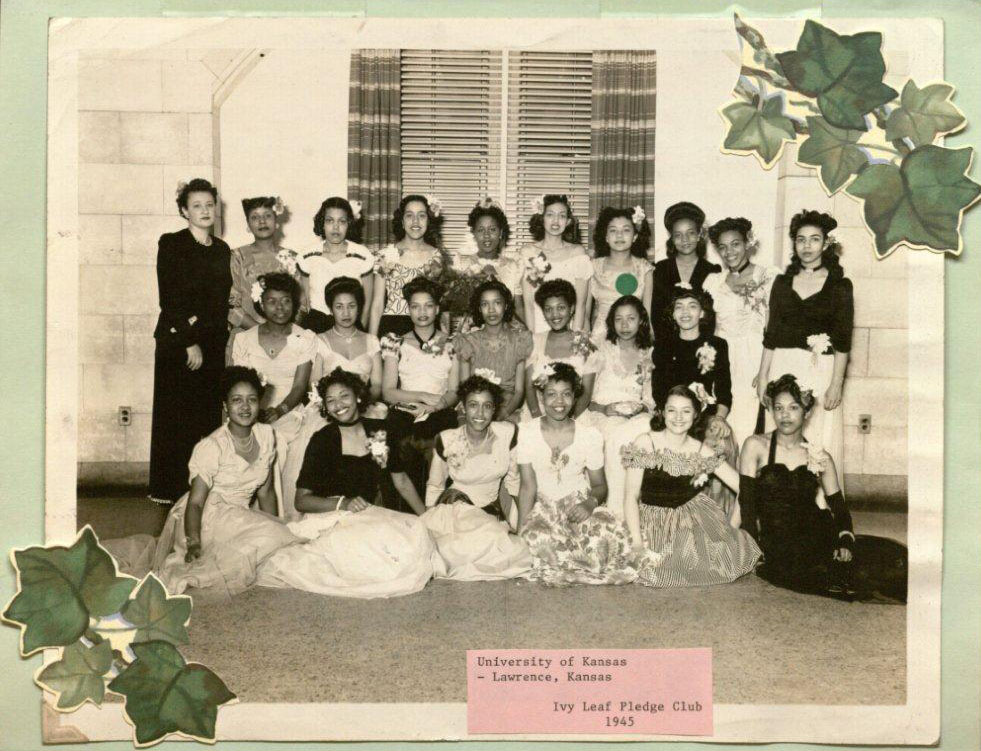
Photograph of the Alpha Kappa Alpha, Delta Chapter Ivy Leaf Pledge Club, 1945

AKA Delta Chapter Ivy Leaf Pledge Club, 1945. Photograph by Duke D’Ambra.
Julia V. (Richards) Harris Collection. Call Number: RH MS-P 1179. Click image to enlarge.

Deborah Dandridge
Field Archivist and Curator
African American Experience Collections

Kansas Christmases Past

December 18th, 2014

Several archival collections in our Kansas Collection contain images showing Christmas scenes from the nineteenth and twentieth centuries. We’ve selected a few to show here; we hope they help get you in the holiday spirit!

Photograph of a room interior with Christmas tree, 1896

Room interior with Christmas tree and presents, 1896.
Leavenworth Public Library Photograph Collection.
Call Number: RH PH 72. Click image to enlarge.

Photograph of Louise and Margaret Walbridge at the Christmas tree, circa 1897

Louise and Margaret Walbridge sitting under the Christmas tree
with their toys, Profile Ranch, Russell County, Kansas, circa 1897.
Louis Chester Walbridge Collection. Call Number: RH PH 21. Click image to enlarge.

Photograph of 7th Battery dining hall set for Christmas Dinner, Fort Riley, Kansas, 1906

7th Battery dining hall set for Christmas dinner, Fort Riley, Kansas, 1906.
Joseph Judd Pennell Photograph Collection. RH PH Pennell.
Click image to enlarge (redirect to Spencer’s digital collections).

Photograph of Douglass Grade School, Manhattan, Kansas, Christmas 1945

Douglass Grade School, Manhattan, Kansas, Christmas 1945.
James E. Butler Collection. Call Number: RH MS-P 507. Click image to enlarge.

Photograph of John A. Hodge with his grandson, Johnnie L. Hodge, Christmas 1949

John A. Hodge with his grandson, ten-year-old Johnnie L. Hodge, Christmas 1949.
The pair are examining Owen Wilson’s new “knockdown” electric train cars.
Photograph by Dowdal H. Davis, son-in-law. Dorothy Hodge Johnson Collection.
Call Number: RH MS-P 549. Click image to enlarge.

Photograph of the winner of Christmas decoration contest, Topeka, Kansas, circa 1950s

Winner of Christmas decoration contest, Topeka, Kansas, circa 1950s. Photograph by Joe Douglas.
Joe Douglas Collection. Call Number: RH PH 90. Click image to enlarge.

Photograph of Christmas decorations on Massachusetts Street at 7th, Lawrence, Kansas, undated

Christmas decorations on Massachusetts Street at 7th, Lawrence, Kansas, undated.
Lawrence Photo Collection. Call Number: RH PH 18H.
Click image to enlarge (redirect to Spencer’s digital collections).

Caitlin Donnelly
Head of Public Services