The University of Kansas

Inside Spencer: The KSRL Blog

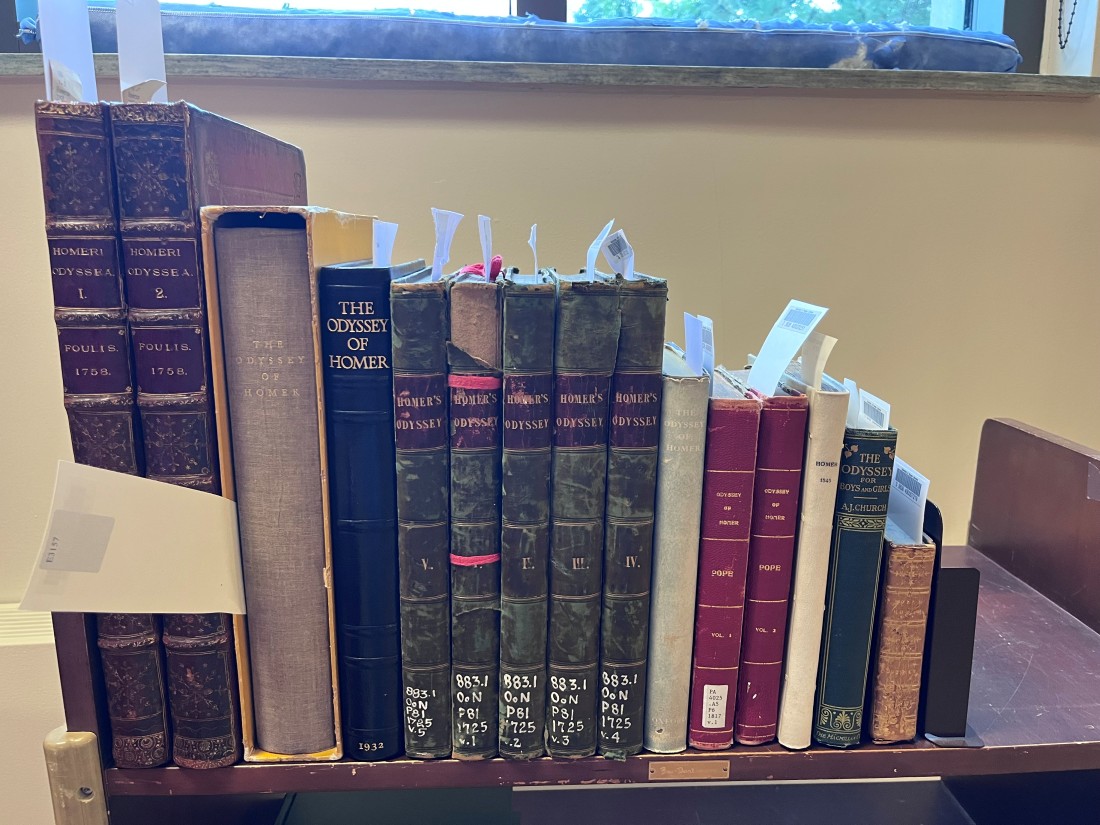
Books on a shelf

Welcome to the Kenneth Spencer Research Library blog! As the special collections and archives library at the University of Kansas, Spencer is home to remarkable and diverse collections of rare and unique items. Explore the blog to learn about the work we do and the materials we collect.

Entre los Estantes: Latina/o Collection Items

April 6th, 2026

As I work to develop the Spencer’s new Latina/o Collections*, I wanted to take a moment and look back at the interesting materials that are already sitting within our library stacks and viewable in our Reading Room today! All the materials presented allow us to briefly see how Latina/os have gathered and built community within different places across Kansas.

Take a look at some of those materials below.

Aztlán de Leavenworth, volume 1

First published May 5, 1970, Aztlán de Leavenworth was a bilingual Chicano prisoner newspaper edited and published at Leavenworth Federal Penitentiary in Kansas. It features poet and activist raúlrsalinas’ famous poem “A Trip Through the Mind Jail.” Other members of the publication team included Albert Mares, Ruben Estrella, Alfredo Arellanes, Ricardo Mena, and Beto Palomino. Inspired by Aztec history and iconography, the newspaper is named after Aztlán, the ancestral home of the Aztecs, and features images of Tizoc and designs inspired by Aztec art.

Left: The front cover of Aztlán de Leavenworth, 1970. Right: The page of Aztlán de Leavenworth featuring “A Trip Through the Mind Jail,” 1970. Call Number: RH H79, volume 1. Click images to enlarge.

KACMAA Special Report, 1981

This 1981 special report was created by Kansas’ Advisory Committee in Mexican American Affairs (KACMAA). As explained in the report’s introduction, it “optimistically highlights important accomplishments and measurable in Hispanic’s social, economic, and political life” but also “clarifies the work that remains to be done.” While the KACMAA originally concentrated on projects to promote people of Mexican heritage, the organization evolved to include all Hispanics and Latinos across the state and is now known as the Kansas Hispanic and Latino American Affairs Commission.

Line drawing of an Aztec symbol with the text "...we are People of the Sun / La Bella Raza De Bronce / we are more than being..."
The front cover of the KCMAA’s 1981 Special Report. Call Number: RH D6100. Click image to enlarge.
Music groups in Emporia

Taken some time in 1932, these photographic prints from the Oral History Project Regarding the Hispanic Community of Emporia, Kansas (Call Number: RH PH 182) allow us to see some of Emporia’s early musical groups. The first photo shows members of the Mexican band Orquesta de Leora posing with their instruments, while the second features the women who made up the Coro de Santa Catalina, or St. Catherine’s Choir. St. Catherine’s Catholic Church still exists to this day and continues to offer Catholic services to Spanish speakers in Emporia.

Left: Photograph of Orquesta de Leora, 1932. Right: Photograph of St. Catherine’s Choir, 1932. Oral History Project Regarding the Hispanic Community of Emporia, Kansas. Call Number: RH PH 182, Box 1, Folders 11 and 19. Click images to enlarge.

MEChA & HALO Pamphlets

Records of a Latina/o focused group at the University of Kansas have existed since the 1970s. However, before it was LASU (Latin American Student Union), KU’s Latino student group went by many names. It first went by the name AMAS (Association of Mexican American Students), and then it was MEChA (Movimiento Estudiantil Chicano de Aztlán). The group took the name HALO (Hispanic American Leadership Organization) when it was re-established in the 1980s, and it finally became LASU to further expand its inclusion of all students of Latin American heritage or background.  

The name of the organization with a black-and-white sketch of an Aztec symbol, all against the Mexican tri-color flag as a background.
|
The name of the organization with a Jayhawk, all against a white background.
Top: MEChA pamphlet, circa 1970. Bottom: HALO pamphlet, circa 1997. KU Student Organization Records: Hispanic American Leadership Organization. Call Number: RG 67/593, Box 1, Folders 1970s and 1997. Click images to enlarge.

Rebekah Ramos
Curator of Latina/o Collections

Sources

“A Trip Through the Mind Jail: A Textual History of raúlrsalinas’ Magnum Opus” by Santiago Vidales Martínez in Textual Cultures 14.1 (2021): 208–229. DOI: https://doi.org/10.14434/tc.v14i1.32858

Kansas Hispanic & Latino American Affairs Commission website, “Our Mission and Our Origins from KACMAA to KHLAAC.”

KU Latin American Student Union website, “LASU History.”

*While many terms exist to identify people in the United States of Latin American origin and/or ancestry (i.e. Hispanic, Chicano, Latino, Latina/o, Latinx, Latine) at Spencer Research Library we chose to use “Latina/o” for the collection’s title. As the collection grows and evolves, the term used might change.

Collections to Celebrate International Transgender Day of Visibility 

March 27th, 2026

The International Transgender Day of Visibility was started in 2009 by transgender activist Rachel Crandall Crocker. When she came out as trans in 1997, she was fired. Over ten years later, she realized that the transgender community needed a day of advocacy and celebration beyond Transgender Day of Remembrance that would be “a day to focus on the living.” Every year, it is celebrated on March 31st with events and social media campaigns to highlight the courage of transgender people and provide support for the community. 

Spencer Research Library has acquired a diverse array of material that documents the lives of transgender people – especially in Kansas and the Midwest – and their creative works. For example, Bruce McKinney was an LGBTQ activist in Wichita, and his large collection of personal papers (Call Number: RH MS 1164) in the Kansas Collection documents many organizations, including the Wichita Transgender Alliance. Other collections that include material on local organizations include Les-Bi-Gay-Trans collected material (Call Number: RH MS 900), the papers of Kristi Parker (Call Number: RH MS 1348), and the papers of Arla Jones and Kimberly Kreicker (Call Number: RH MS 1452). 

In the Wilcox Collection, zines from the Solidarity Revolutionary Center and Radical Library make up the majority of material by and about the transgender community. The following sample is illustrative of the art and writing produced by transgender zine-makers, many of them from the Midwest. 

Front cover of the zine, which has a yellow background with text in black surrounded by very thick black lines.

They Will Never Erase Us: Erasure Poems for Trans Joy by @roctothorpe includes blackout poems based on transphobic hate comments. The original comment is included along with a poem that transforms the comment into a defiantly, positive message.

Call Number: Uncataloged


Front cover of the zine, which has the title and the author's name in black text with a large black heart, all against a multicolored background.

Trans Self Love by Connor Engelsman (2023) is a mini-zine that encourages trans people to embrace and love their bodies.

Engelsman has produced many other trans-related zines in the Wilcox Collection including How to Change Your Gender Marker (Call Number: RH WL B3857), Orgs That Serve Trans Ppl in KS (Call Number: RH WL B3864), and Self Care is Resistance (Call Number: RH WL B3862).

Call Number: RH WL B3859


Front cover of the zine, which has a bright pink background and, in black text, the title, the author's name, "Issue #2: Call Outs & Clever Titles," and portions of men's and women's bathroom signs.

The library has two issues of Gendrfailz (2009), a zine edited by activist Alix Kemp that includes many stories from transgender people about their experiences legally changing their names and sex and challenges with the medical system.

Call Number: RH WL C13225


Front cover of the zine, which has a white background with black text, plus a black-and-white headshot of a man.

Issue 4 of Transvestia, Words + Labels, edited by Jackson Stoner (2019) is a compilation of essays and art on the theme of how trans and nonbinary people use words and labels to define themselves and it also addresses the issue of label policing.

Call Number: RH WL D9241


Front cover of the zine, which has black text against a light gray and lightly patterned background

Trans Health Science & You: How Research Affects Our Lives (2018) was produced by the Wisconsin Transgender Health Coalition. Its essays address medical research, data and safety, and how to participation in research on trans people as a form of activism.

Call Number: RH WL C13167


Front cover of the zine, which has text in black and the image of a heart in the background.

The North Carolina-based zine Tranz Mission (200?) states that it is “a group dedicated to the end of socially enforced non-consensual gender tyranny.” It includes artwork, personal stories, tips for allies, comics, and dreams about gender.

Call Number: RH WL C13229


Front of the zine, which has a black background, the title in black text against white banners, and white skeletons.

Whatstheirname: More Adventures w/o Gender (2013) by Julia Eff is a personal look into Eff’s experiences as a nonbinary person. It includes their handwritten, diaristic essays, illustrations, and collages.

Call Number: RH WL A743


Front cover of the zine, which has a white background with a black inset that has the title in white text and a black-and-white sketch of person folding their arms.

Lastly, Don’t Give Up (between 2000 and 2009) is an anonymously-written zine includes useful etiquette guidelines for cisgender people when interacting with transgender people.

Call Number: RH WL C12639


If you’d like to explore more unique collections and items by and about transgender people – or if you have suggestions for acquisitions or items to donate – get in touch with the Curator of the Wilcox Collection of Contemporary Political Movements, Kate Stewart, at kate.stewart@ku.edu. 

Kate Stewart
Curator of the Wilcox Collection of Contemporary Movements
Inaugural Bergeron-Souza Exhibition: Aging, Art and Activism: Reimagining Our Aging Futures through Creative Representations and Personal Narratives

March 25th, 2026

During Fall of 2025, my Dean in KU’s School of Social Welfare forwarded an announcement to our faculty from Kenneth Spencer Research Library, calling for submissions to the newly established Bergeron-Souza Exhibit Program. At the time, I had only visited the library once for a special event and had come away with some mild curiosity about what other archival materials one might access there.

I immediately had an idea about using this guest curation opportunity to showcase artwork from a digital archive I had been managing for several years, the Untold Stories of Aging exhibition of aging-focused artwork from intergenerational creators. I was intrigued by the possibility of showing the work in a display setting that would focus not only on the pieces’ artistic merit, but also on their commentary on aging as a universal human experience. By putting contemporary artwork into conversation with archival materials, I envisioned bringing to life a deeper and richer narrative about the ways in which artistic representations of aging motivate us to envision our own futures in more expansive ways and inspire us to action – individual and collective – to realize those futures.

What followed was a loosely guided and ever evolving process of uncovering what the research library had to offer. I, along with my PhD Graduate Research Assistant Zhiqi Yi, perused over 100 boxes worth of material as well as dozens of individual artifacts sourced from various collections. There were the 20 or so boxes documenting the extensive efforts of long-time activist Mildred Harkness, who seemed to have her hands in all things aging within Kansas over the span of several decades. There were the seemingly endless boxes from the Jayhawk Area Agency on Aging. There were dozens of memoirs, artistic works, books, and essays penned and created by older adults that we requested, never really sure where they would lead.  

This image has text.
Silver Haired Legislature guidebook of activist Mildred Harkness, 1981. Papers of Mildred Harkness. Call Number: RH MS 1548, Box 2, Folder 44. Click image to enlarge.
This image has text.
Silver Haired Legislature nametag of activist Mildred Harkness, 1981. Papers of Mildred Harkness. Call Number: RH MS 621, Box 2, Folder 18. Click image to enlarge.

Some discoveries were more impactful than others. Having viewed the artistic drawings of Elizabeth “Grandma” Layton over the past decade, it was a tremendous joy to find that the library had archived over a dozen boxes of her personal documents, photographs, news clippings, exhibition flyers, and reprinted artwork. I read her memoir alongside her personal documentation, interweaving a rich storyline between the individual artifacts. Having begun drawing at the age of 68, Layton’s drawings document her struggles with and victory over mental illness. She often credited her discovery of blind contour drawing with having healed her life-long depression, illustrating the rich potential of artistic exploration and creation in the lives of older adults.  

Photos of Elizabeth Layton, blind contour drawing in process, undated. Don Lambert Collection of Elizabeth Layton Papers. Call Number: RH MS 1538, Box 12, Folder 6. Click images to enlarge.

Drawings titled “Fear” (left) and “Nike, Winged Victory” (right) in Elizabeth Layton’s memoir Signs Along the Way, 2013. Call Number: RH C12442. Click images to enlarge.

Similarly, I was delighted to stumble across several emeritus faculty who had contributed to KU’s aging-focused curricula over the years. This includes Shirley Patterson, who had her social work students interview older adults in the local community and create poems and brief essays based on their experiences. Additionally, Janet Hamburg of KU’s Department of Theatre and Dance taught “Dance for Seniors” and developed movement-based interventions for individuals living with Parkinson’s disease. These rich discoveries had to somehow be narrowed down to what could fit into a handful of display cases, and choosing amongst artifacts turned into a tall order, indeed. We will have to return to explore new topics another day!

Selected pages from “Aging, Strength, and Creativity Revisited” by Shirley Patterson, 1978. Personal Papers of Shirley L. Patterson. Call Number: PP 607, Box 2, Folder 26. Click images to enlarge.

From this year-long process, the resulting exhibition opened on February 23, 2026, and is organized into six sequential display cases of archival materials. The exhibit also includes 15 contemporary art works, both in display cases and along the exhibition walls, through which the exhibition themes are interwoven and illustrated in vibrant and moving detail.

The overarching narrative of the exhibition explores societal discourses around aging, illustrating that the ways in which we talk about a thing, person, or experience come to shape our ability to imagine and engage with the object of conversation. In this case, audience members are asked to grapple with societal conversations around aging and later life, considering the impact of how we construct and envision this universal, life-long experience and how those constructions shape our hopes and plans for our own aging present and futures. Historical discourses are captured in artifacts dating back to 1780, representing older citizens as making up a vulnerable and needy population. Documents from aging activists, creative essays, portraits, poetry, and much more provide contrasting and nuanced constructions of aging, balancing more varied images of later life based on agency, growing or evolving self-knowledge, hardships and joys brought by new phases of life, and more.

A special event next Tuesday, March 31, 2026 (5:30-7:00pm) will feature a mini-presentation on the making of the exhibition and will be attended by several of the exhibit’s contributing artists, who will mingle with attendees and informally share the meaning of their work. Come and join us to explore your own hopes for the future!

Sarah Jen
Associate Professor and PhD Program Director
KU School of Social Welfare

Preservation of Lawrence’s Union Pacific Depot

March 11th, 2026

In 1984, the Union Pacific Railroad (UPR) made the decision to abandon its Union Pacific Depot in Lawrence and announced that they would demolish the building due to potential liabilities. The Depot had once been a shining gateway to Lawrence, with a tall steeple and busy railway line, but in the years prior, the passenger service had been discontinued, and the Depot building itself had fallen into disrepair. 

Blue-tinted photograph of a large one-story building with a prominent steeple.
Cyanotype photo of the Union Pacific Depot, undated [circa 1889-1930]. Lawrence, Kansas Photographs Collection. Call Number: RH PH 18, Box 1, Folder A6. Click image to enlarge.

Lawrence residents swiftly jumped into action to campaign for the preservation of the building. Citizens from the recently formed Lawrence Preservation Alliance, fresh of the success of their first project to save a historic home at 947 Louisiana St, jumped into action to preserve this Lawrence landmark. Members from the Lawrence Preservation Alliance, University of Kansas Rowing Club, and other concerned citizens banded together to form the “Save the Depot Task Force.” With the original plan to use the Depot as a headquarters for the rowing team, they were able to negotiate with the UPR to stall the demolition and began coordinating and raising funds for potential restoration. 

There was one sticking point: the UPR was unwilling to permit the Depot to stay in its current location due to the building’s proximity to the railway line. With no other options, the Save the Depot Task Force began its “Move It or Lose It” campaign. The group hired a contractor to conduct a study to see if it would be possible to move the entire building in either one or two pieces on a hydraulic lift to a nearby lot. 

This image has text.
Save the Depot brochure, “Move It or Lose It,” undated [circa 1987]. Call Number: RH P1482. Click image to enlarge.

After years of negotiation and much back and forth, in 1990 the UPR agreed to let the Depot stay where it was, with the provision that the City of Lawrence would provide a protective iron fence protecting the building from the railway tracks. In the end, the UPR sold the Depot to the city for $1. 

Renovations began under architect John Lee officially in 1991, with construction happening in three phases & ongoing fundraising assistance from the “Save the Depot” task force. The Union Pacific Depot was officially rededicated as a community center in 1996. 

Learn more about the restoration of Lawrence’s Union Pacific Depot at our short-term exhibit in Spencer’s North Gallery! The exhibit is free and open to the public in the North Gallery through March 31, 2026. 

Centi Newby
Public Services Associate

The Story of “Self-Portrait”: Spencer’s Unpublished Henry Miller Manuscript

February 25th, 2026

American author Henry V. Miller (1891-1980) is a divisive literary figure, one who has amassed a dedicated cult following, and yet, whose presence in scholarly discourse has traditionally been somewhat limited. Miller is most widely known for his years in Paris, which resulted in the notorious Tropic of Cancer (1934), famously banned for obscenity in the United States for nearly three decades. Despite his popular characterization as a writer who magnified the obscene and grotesque, it’s not uncommon to find Miller falling into extended, heartfelt reveries covering a profound range of subjects, a contrast that contributes to his reputation as an eclectic writer.

This image has text.
The front cover of Tropic of Cancer by Henry Miller, 1961. Call Number: B2849. Click image to enlarge.

Spencer Library holds a wide range of Henry Miller’s published works, such as an edition of Plexus (1963) limited to two thousand copies. However, the item that might be of most interest to the Miller enthusiast is a small collection of his papers (Call Number: MS P216). This collection primarily consists of typewritten onionskin manuscripts dating from the 1930s, as well as handwritten letters composed during the 1950s. I found the typewritten pieces particularly intriguing; according to the online finding aid, they mostly originate from Miller’s overflowing attempts to write an essay on English novelist D. H. Lawrence.

This image has text.
The title page of Plexus by Henry Miller, 1953. Call Number: B502, book 2, volume 1. Click image to enlarge.

In her biography of Miller, Mary Dearborn details how the D. H. Lawrence project, or “the Brochure” as it was initially called, developed as Miller was attempting to publish Tropic of Cancer in 1932. The only publisher whose attention he managed to get was Jack Kahane of Obelisk Press, who had misgivings about publishing the controversial contents of Tropic. Thus, Miller was asked to compose an essay on Lawrence in order to assert himself as an intellectual and gain more credibility. [1] The project was eventually published as The World of Lawrence: A Passionate Appreciation, much later in 1980.

This image has text.
The first page of “Self-Portrait: Installments 1-4” by Henry Miller. Papers of Henry Miller. Call Number: MS P216. Click image to enlarge.

I discovered that very little of the Miller manuscripts at Spencer Library actually appear in any published form. The most perplexing was “Self-Portrait,” a four-part piece that is largely devoid of any connection to the D. H. Lawrence essay, especially in its earlier sections. Within it, Miller mentions the “Universe of Death,” a chapter within The World of Lawrence and The Cosmological Eye (1939). Yet, it bears little resemblance to the section as it appears in the book. Similarly, there is a short description of the 1933 film “Extase,” which was likewise detailed in a chapter of the same name in The Cosmological Eye, yet its appearance within “Self-Portrait” is a different piece altogether. The more I read “Self-Portrait,” the more it appeared as a familiar part of Miller rather than a focused reflection on Lawrence (hence the title). The manuscript, framed around a walk through Paris during springtime, bears many hallmarks of Henry Miller’s original style, such as ornate, unconventional prose, descriptions of sordid and lurid elements lurking underneath the quotidian, a personification of Paris, dubious biographical details and nostalgic reminiscences on his earlier days in Brooklyn, musing on favorite authors (Proust and Dostoevsky), and a meandering, abstract form.
This image has text.
The front cover of Black Spring by Henry Miller, 1938. Call Number: B501. Click image to enlarge.

The fact that “Self-Portrait” presents itself as creative piece, rather than an analytical one, hints towards its eventual fate. Biographer Jay Martin details that, while Miller “originally regarded ‘Self-Portrait’ as a note to the ‘Universe of Death’ or a coda to ‘The World of Lawrence,’ he always planned it as a personal statement … [taking shape] by looking at himself, or portraying his experience, in a variety of ways.” [2] And Dearborn states that “Miller’s new book, tentatively called ‘Self-Portrait,’ … would eventually appear as Black Spring.” [1] This appears to be the definitive answer: “Self-Portrait,” written as a marginal addition to Miller’s project on D. H. Lawrence, became the premise for a new book entirely, and eventually grew into his collection Black Spring (1936). The process of researching Miller’s “Self-Portrait” emphasized one of the most rewarding aspects of my job here at Spencer Library: being able to uncover little-known parts of literary and cultural history.

Nile Russo
Public Services Student Assistant

[1] Dearborn, Mary V. The Happiest Man Alive: A Biography of Henry Miller. New York: Simon & Schuster, [1992]: 156-163. 

[2] Martin, Jay. Always Merry and Bright: The Life of Henry Miller: An Unauthorized Biography. Santa Barbara, Calif, London: Capra Press ; Sheldon Press, [1979]: 293f.

Special thanks to Special Collections Curator Elspeth Healey for directing me towards the Dearborn and Martin biographies of Henry Miller.