Welcome to the Kenneth Spencer Research Library blog! As the special collections and archives library at the University of Kansas, Spencer is home to remarkable and diverse collections of rare and unique items. Explore the blog to learn about the work we do and the materials we collect.
This blog may contain archived web content. This blog may link to catalog records which no longer exist as of a software change in 2026.
Check the blog each Friday for a new “That’s Distinctive!” post. I created this series to provide a lighthearted glimpse into the diverse and unique items at Spencer. “That’s Distinctive!” is meant to show that the library has something for everyone regardless of interest. If you have suggested topics for a future item feature or questions about the collections, you can leave a comment at the bottom of this page. All collections, including those highlighted on the blog, are available for members of the public to explore in the Reading Room during regular hours.
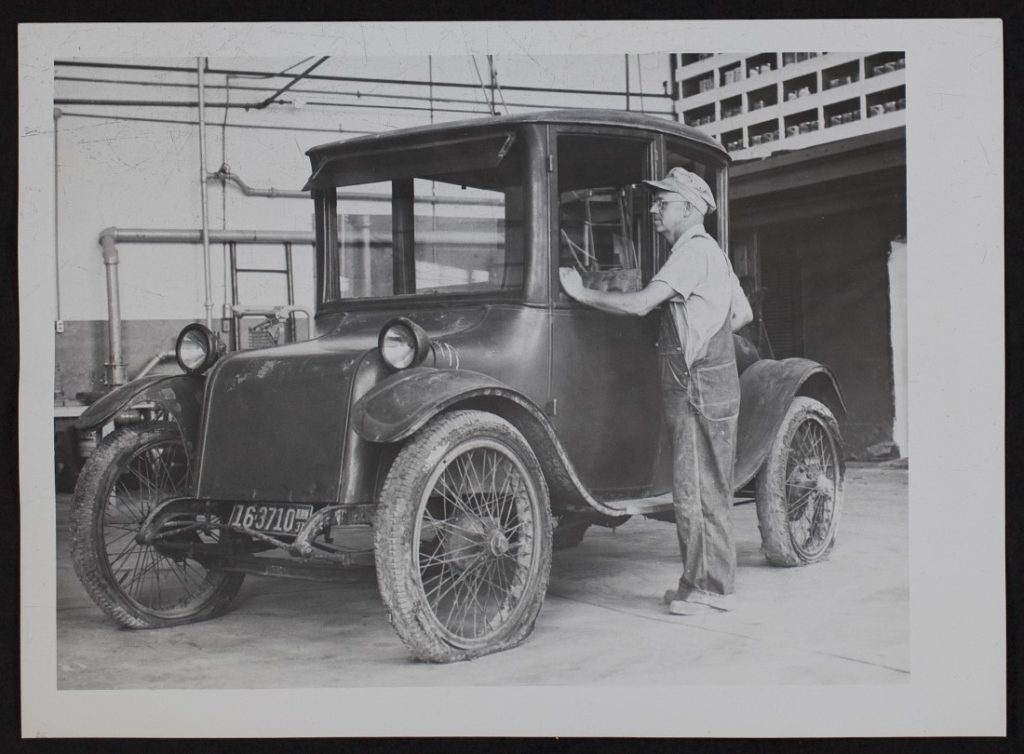
This week on That’s Distinctive! I am sharing items from the Lawrence Journal-World photograph collection. Spencer Research Library holds the newspaper’s physical photograph collection, which contains about 545 boxes of negatives and an additional 113 boxes of prints. The collection spans the 1950s through 2001. Topics in the collection include athletics, anniversary celebrations, weather events, agriculture, organizational meetings, and more. The collection is organized chronologically by date rather than topic, which can make sorting through the photos an adventure for patrons.
The images shared today are from our digital collections, which can be found on the “Find Collections” page of Spencer’s website. The library has many digital collections available online for patrons to view from anywhere they please. Per the website, “KU Libraries Digital Collections provide free, public access to thousands of objects digitized from across Spencer’s holdings, including photographs, documents, and audiovisual materials.”
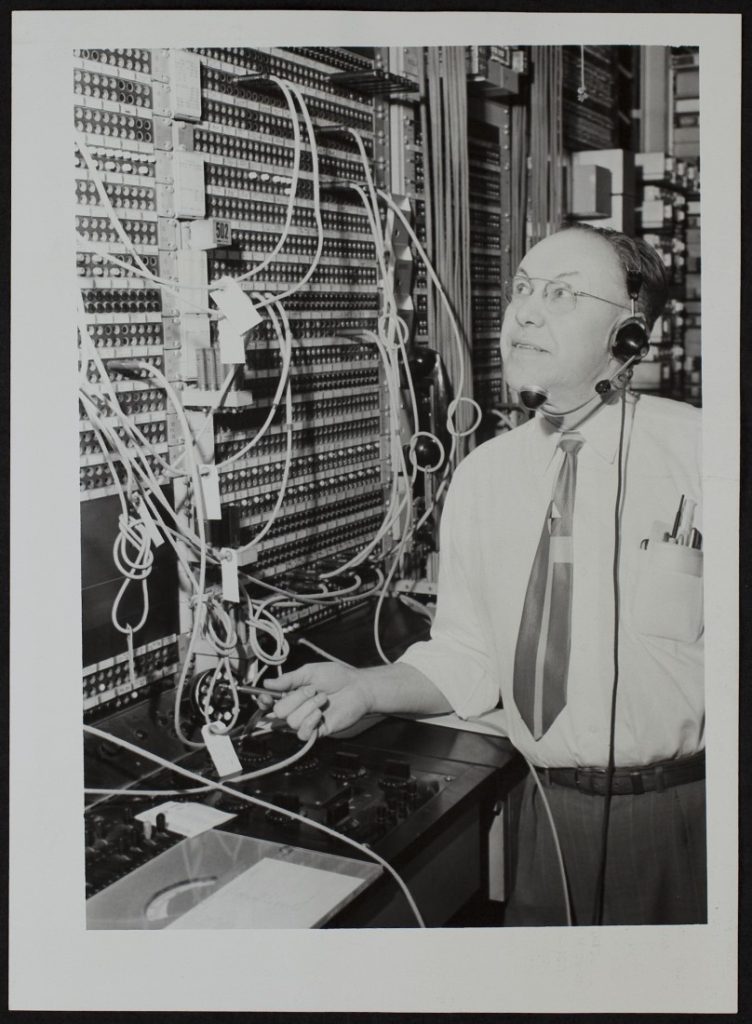
Bell Telephone employee Claude Milliken, March 1955. Lawrence Journal-World Photograph Collection. Call Number: RH PH LJW. Click image to enlarge (redirect to Spencer’s digital collections).
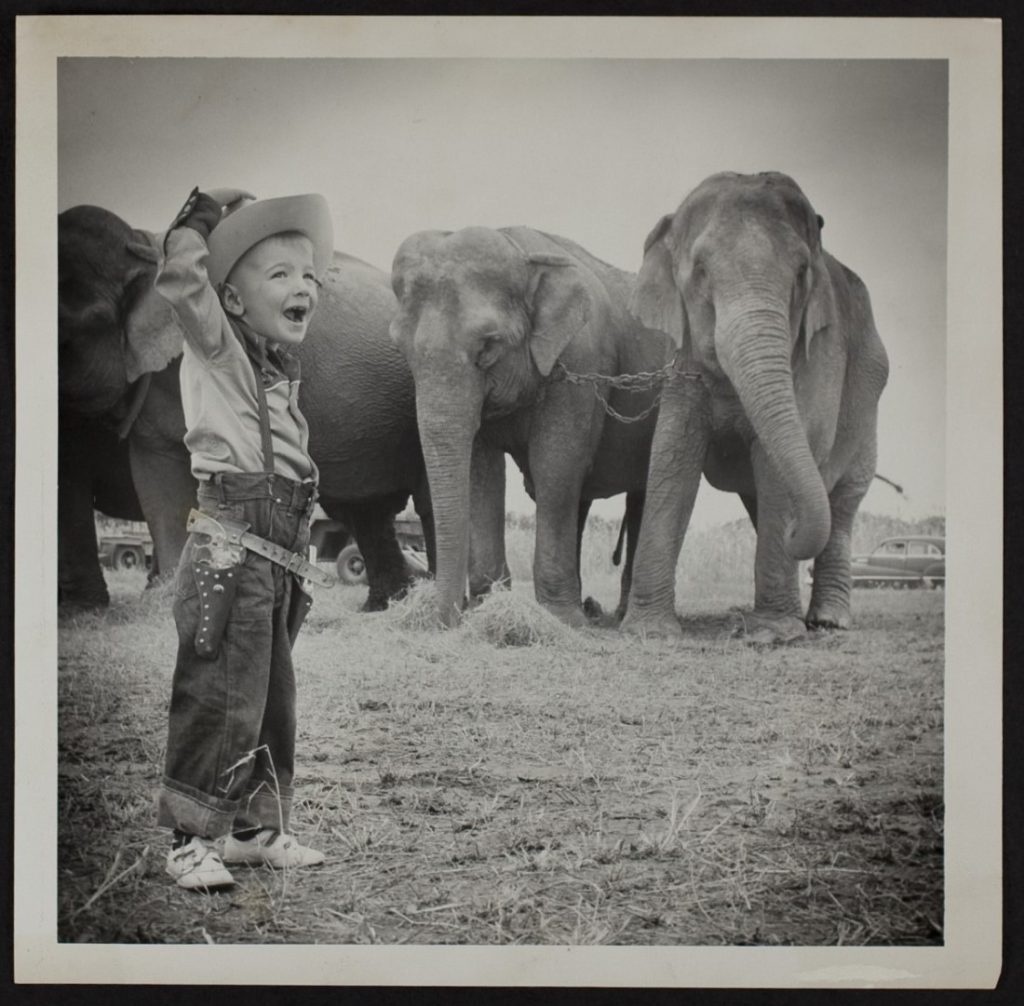
Kevin Heck with Ringing Bros. circus elephants, September-October 1954. Lawrence Journal-World Photograph Collection. Call Number: RH PH LJW. Click image to enlarge (redirect to Spencer’s digital collections).
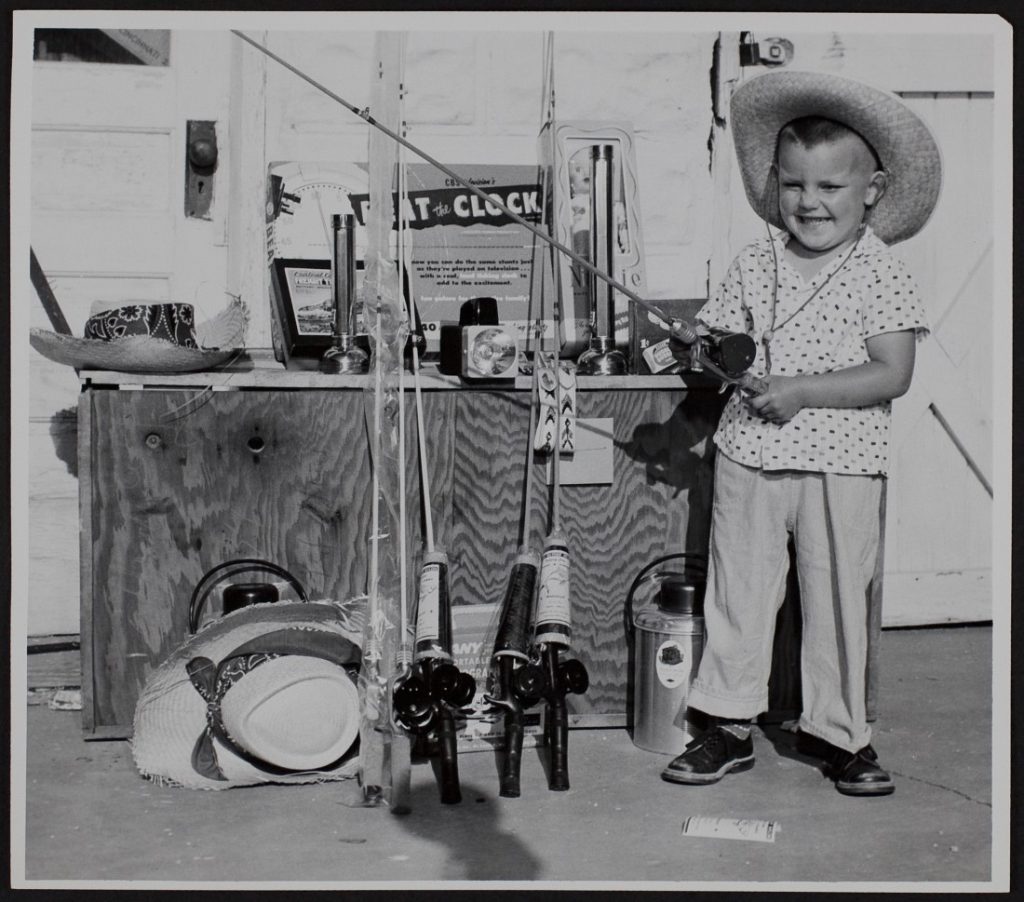
Three-year-old Chris Hunsinger looking at prizes during the Douglas County Derby, June 1957. Lawrence Journal-World Photograph Collection. Call Number: RH PH LJW. Click image to enlarge (redirect to Spencer’s digital collections).
Check the blog each Friday for a new “That’s Distinctive!” post. I created this series to provide a lighthearted glimpse into the diverse and unique items at Spencer. “That’s Distinctive!” is meant to show that the library has something for everyone regardless of interest. If you have suggested topics for a future item feature or questions about the collections, you can leave a comment at the bottom of this page. All collections, including those highlighted on the blog, are available for members of the public to explore in the Reading Room during regular hours.
This week on That’s Distinctive! I am sharing a few items from the Katie Armitage papers. Per the finding aid, “Katie Hart Armitage is a Lawrence, Kansas-based independent historian. [She] has worked both in a voluntary and in an official capacity at the Watkins Museum of History in Lawrence and the Kansas State Historical Society in Topeka, as a researcher, consultant, educator, and tour guide.” The collection, which consists of eight boxes and three oversize folders, “has been arranged into three series: Programs and special projects, Correspondence and Lawrence community materials, and Research materials.”
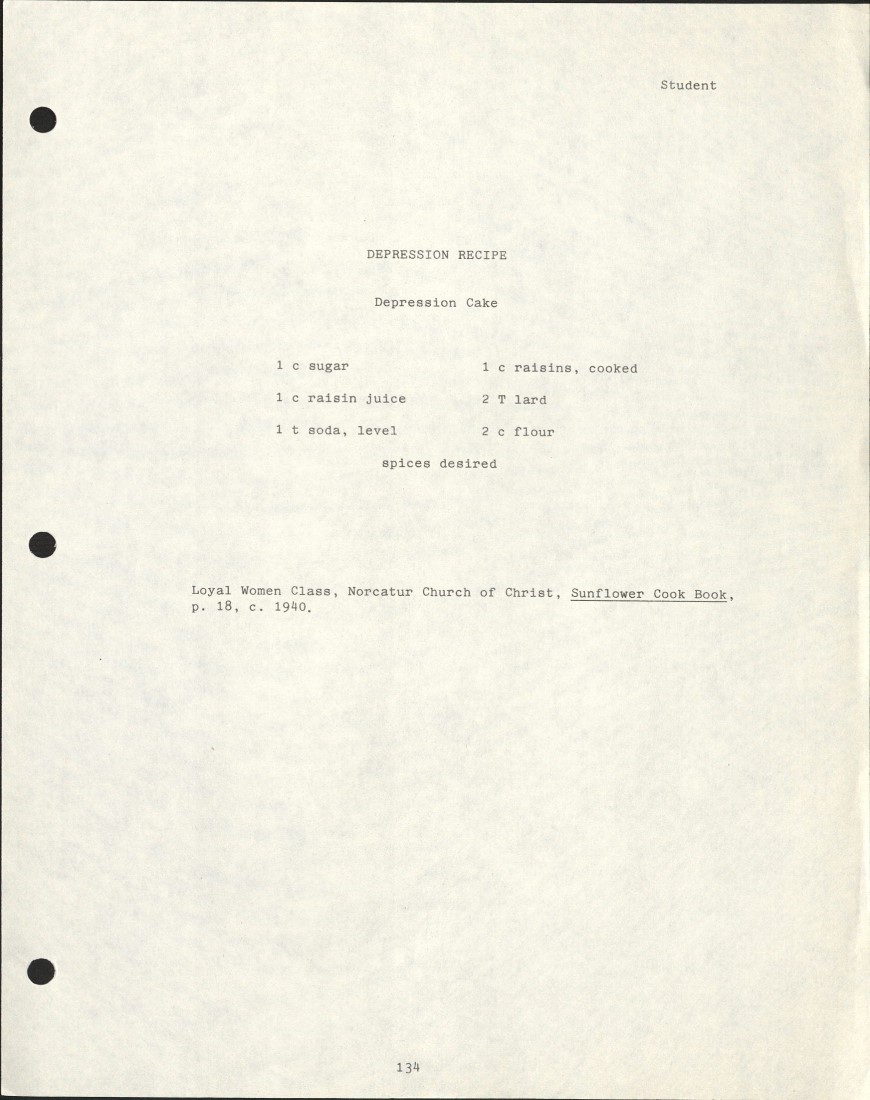
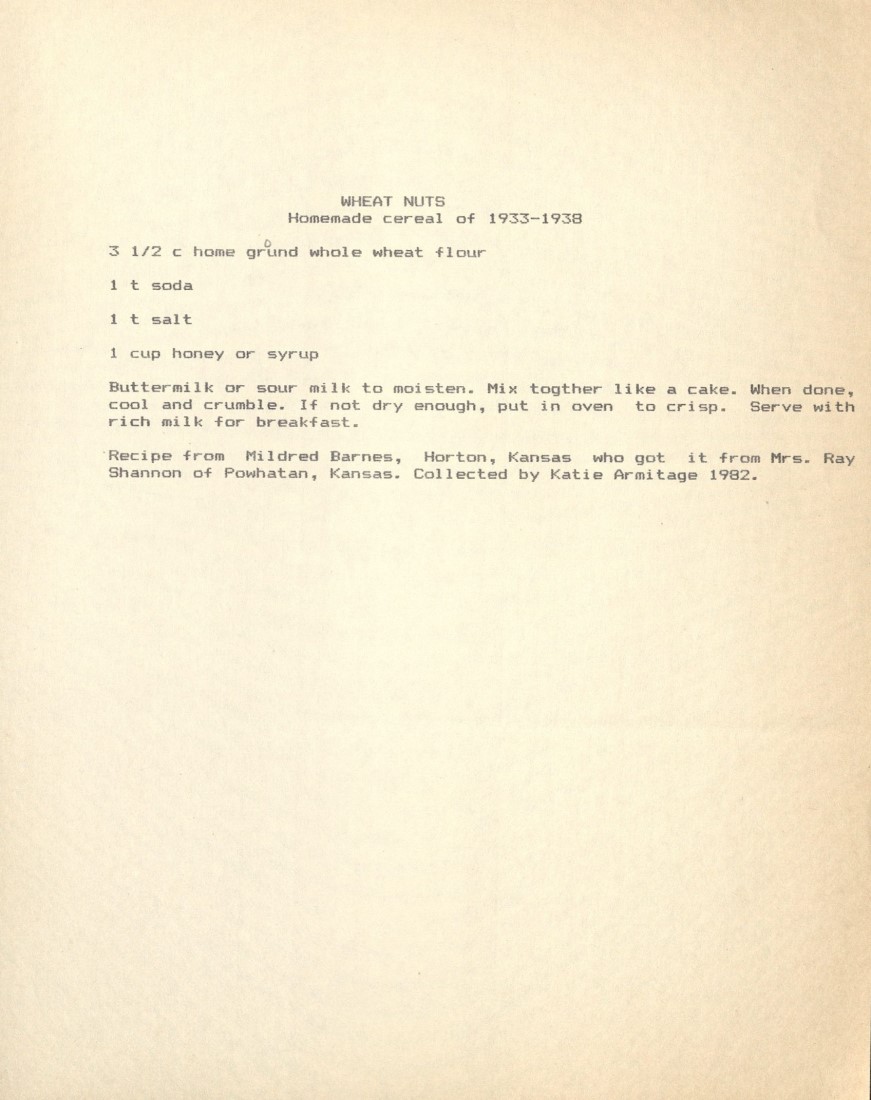
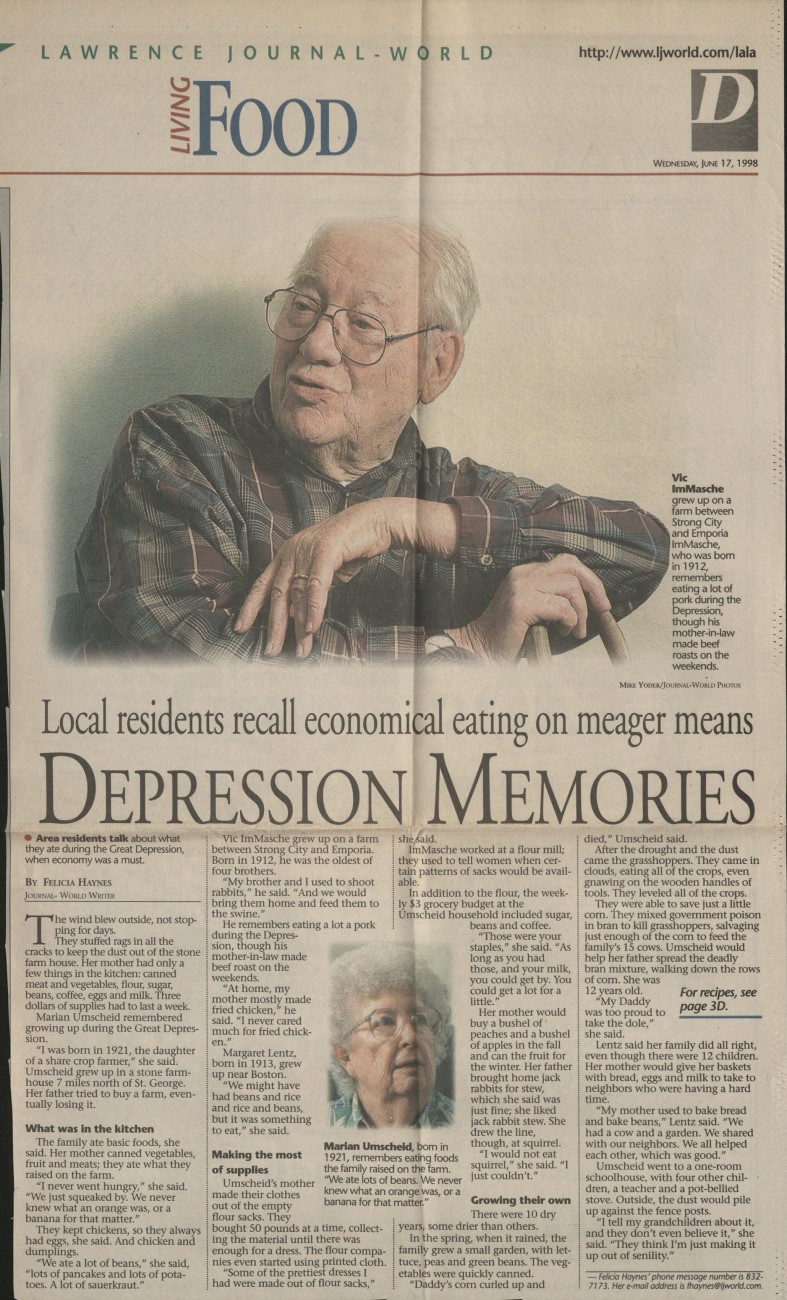
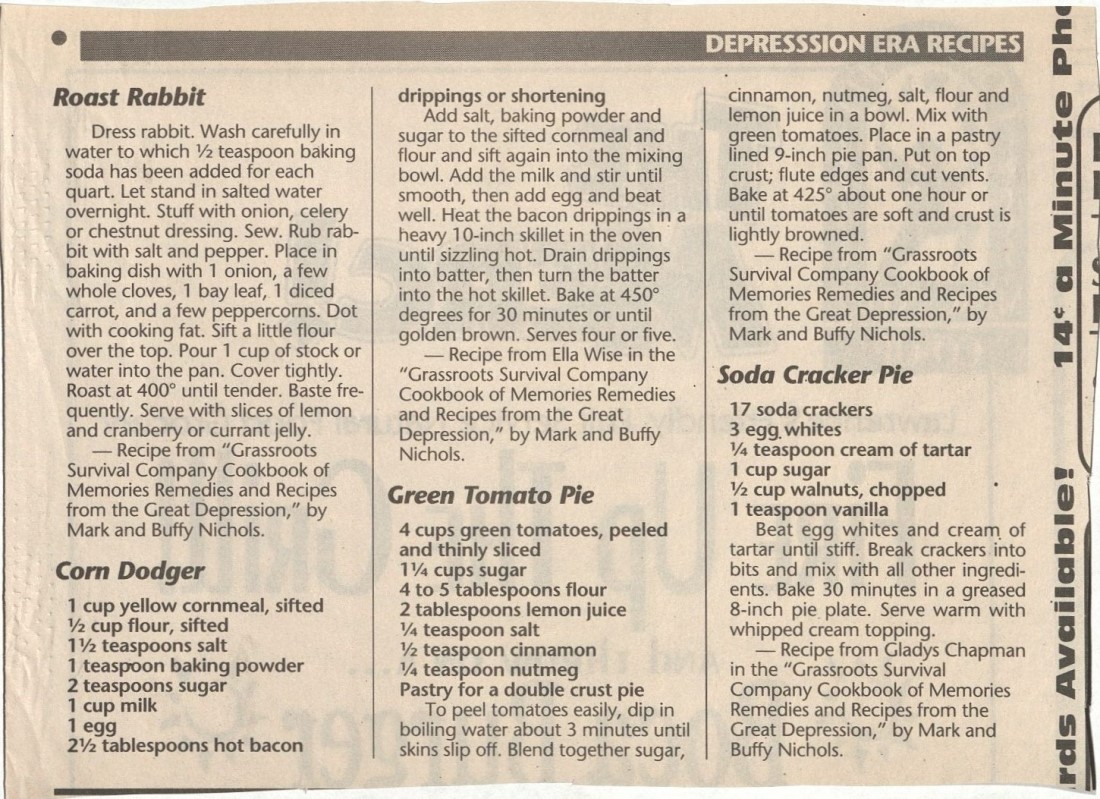
The items shared today are recipes from the Great Depression era, plus a later article from the Lawrence Journal-World titled “Depression Memories.” In the United States, the Great Depression was a severe economic downturn that spanned the 1930s. The stock market crash of 1929 marked the beginning of a decade of poverty, deflation, and lost opportunities. As noted in the Journal-World article, families had little money to get by. They could only afford the essentials, which meant they had to get creative with their recipes.
I found these documents interesting because it can be surreal to think about living through an event such as the Great Depression. We often don’t think about how those times affected people and the memories they left behind. As you look at the recipes, think about whether you would want to try them. Being a picky eater, they don’t sound too appetizing to me. But, I am sure that I would do whatever was needed to get by.
|
|
|
Recipes for Depression cake and wheat nut homemade cereal, plus a 1998 Lawrence Journal-World article of local residents’ recollections of the Great Depression, with accompanying recipes. Katie Armitage Papers. Call Number: RH MS 1479. Click images to enlarge.
Last week was the 161st anniversary of the 1863 raid of Lawrence, Kansas, home to many free-state and abolitionist leaders. In the early hours of Friday, August 21, 1863, Confederate guerilla chief William Clarke Quantrill and 400 of his men rode into town, taking it by surprise. They ransacked homes, looted stores, set fire to homes and businesses, and killed close to 190 men and boys. The focus of this post is just one of the many personal stories from that awful day.
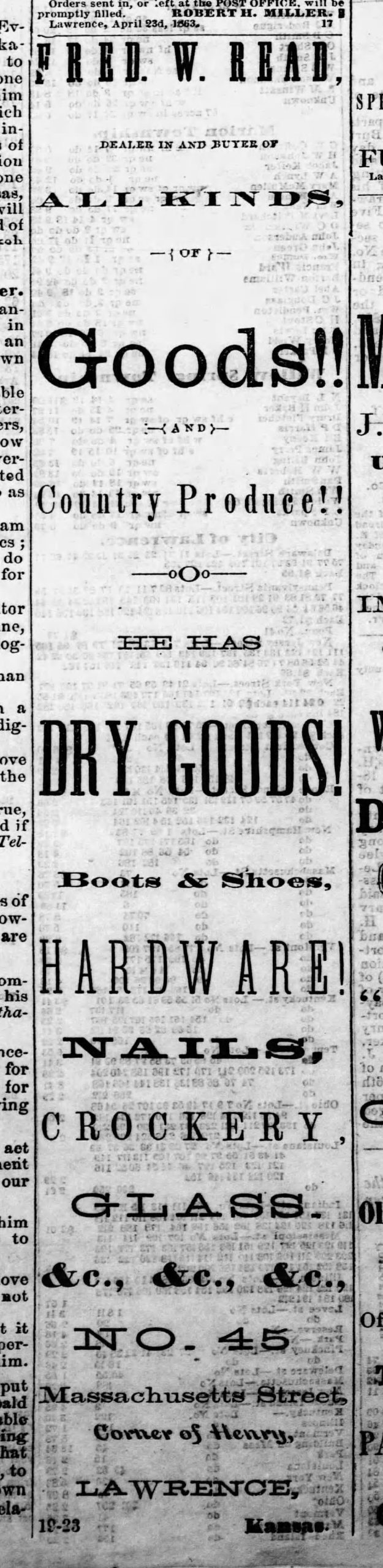
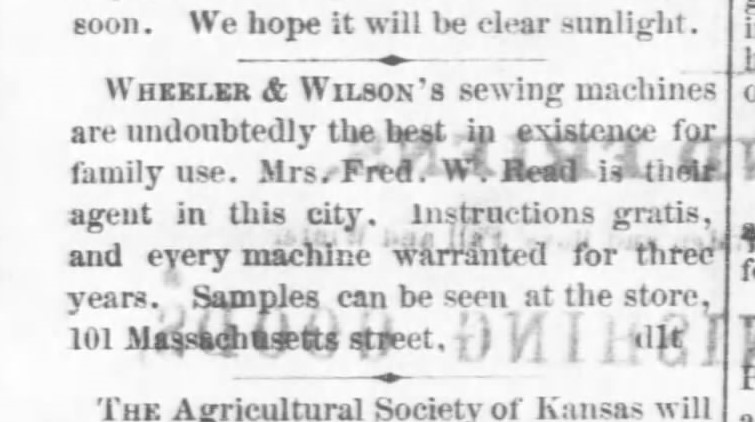
Frederick and Amelia Read were living and working in Lawrence at the time of the Raid. Frederick (1831-1901) immigrated to Lawrence from New York in 1857. It’s possible that he came as a member of one of the last parties of settlers sponsored by the New England Emigrant Aid Society, whose mission was to ensure that Kansas entered the Union as a free state (i.e. one that did not allow slavery). Frederick Read owned and operated a dry goods business for several years. After the Civil War, his wife Amelia (1834-1892) was an agent for the Wheeler & Wilson sewing machine company, working out of the family’s store.
An advertisement for Frederick Read’s store in The Lawrence Tribune, June 18, 1863. Courtesy of Newspapers.com. Click image to enlarge.
An article about the Wheeler & Wilson sewing machine company in The Daily Kansas Tribune, January 13, 1867. Courtesy of Newspapers.com. Click image to enlarge.
At the time of the Raid, Frederick and Amelia were very likely grieving the deaths of their two young daughters. In researching this post, I found the following article in the Lawrence Republican on May 3, 1860: “In this city, on Monday morning, April 30th, ADDIE L., only child of F.W. & Amelia A. Read, aged one year, eleven months and twenty-two days.” I also found, in the Complete Tombstone Census of Douglas County, Kansas, this record of the couple’s second loss: “Died at the residence of Levi Gates in West Lawrence, August 30, 1862, Freddy Rockwell Read, only child of F.W. and Amelia A. Read, aged eleven months.” Both Freddy and Addie were buried in Pioneer Cemetery, now located on the University of Kansas campus. The location of their graves is unknown.
Only the Reads’ youngest child – their son Lathrop – survived to adulthood.
Almost exactly one year after Freddy’s death, the Reads experienced significant losses during Quantrill’s Raid. Frederick escaped physical harm, but raiders looted and burned his store. Amelia was somehow able to save the family’s house from being set on fire, but she couldn’t stop the raiders from robbing the home.
There are multiple published descriptions of the Reads’ home during the Raid. One can be found in The Lawrence Massacre by a Band of Missouri Ruffians Under Quantrell [sic], published in 1865 by J. S. Boughton. Spencer Research Library has a copy of the volume; it’s also available online. Note that this account mentions daughter Addie by name, but it was her sister Freddy who had “died a few months before.”
The residence of F. W. Read was probably visited by more squads than any other place, as it is situated in the heart of the city. Seven different bands called there that morning…The next squad were for stealing, after demanding as they all did fire arms at first, they wanted money next and then helped themselves to whatever they could find. They found in the back side of a bureau drawer a little box containing a pair of gold and coral armlets [elsewhere described as bracelets] used to loop up the dress at the shoulder of their little girl Addie who had died a few months before. Mrs. Read begged very hard that he would please not take them as they had been her little dead child’s and she wanted them to remember her by, the brute replied with an oath “Damn your dead baby, she’ll never need them again.”
The heartbreaking story of the bracelets and the ambrotype below were the inspiration for this post. The ambrotype is part of Spencer’s Leonard Hollmann Photograph Collection. It’s identified as a post-mortem image of Freddy Rockwell Read, likely because it’s accompanied by a copy of the child’s obituary (quoted above). However, given the information I found while researching this post, I now believe that is incorrect.
The deceased girl in this ambrotype has been identified as Freddy Rockwell Read, who died at eleven months old in 1862. Leonard Hollmann Photograph Collection. Call Number: RH PH 536, Box 64, Folder 1. Click image to enlarge.
The child in the ambrotype looks to be about two years old, the age Addie was when she died. Thus, I believe the child in the ambrotype has been previously misidentified and is the Reads’ oldest child Addie. It’s still unclear who the bracelets belonged to.
Check the blog each Friday for a new “That’s Distinctive!” post. I created this series to provide a lighthearted glimpse into the diverse and unique items at Spencer. “That’s Distinctive!” is meant to show that the library has something for everyone regardless of interest. If you have suggested topics for a future item feature or questions about the collections, you can leave a comment at the bottom of this page. All collections, including those highlighted on the blog, are available for members of the public to explore in the Reading Room during regular hours.
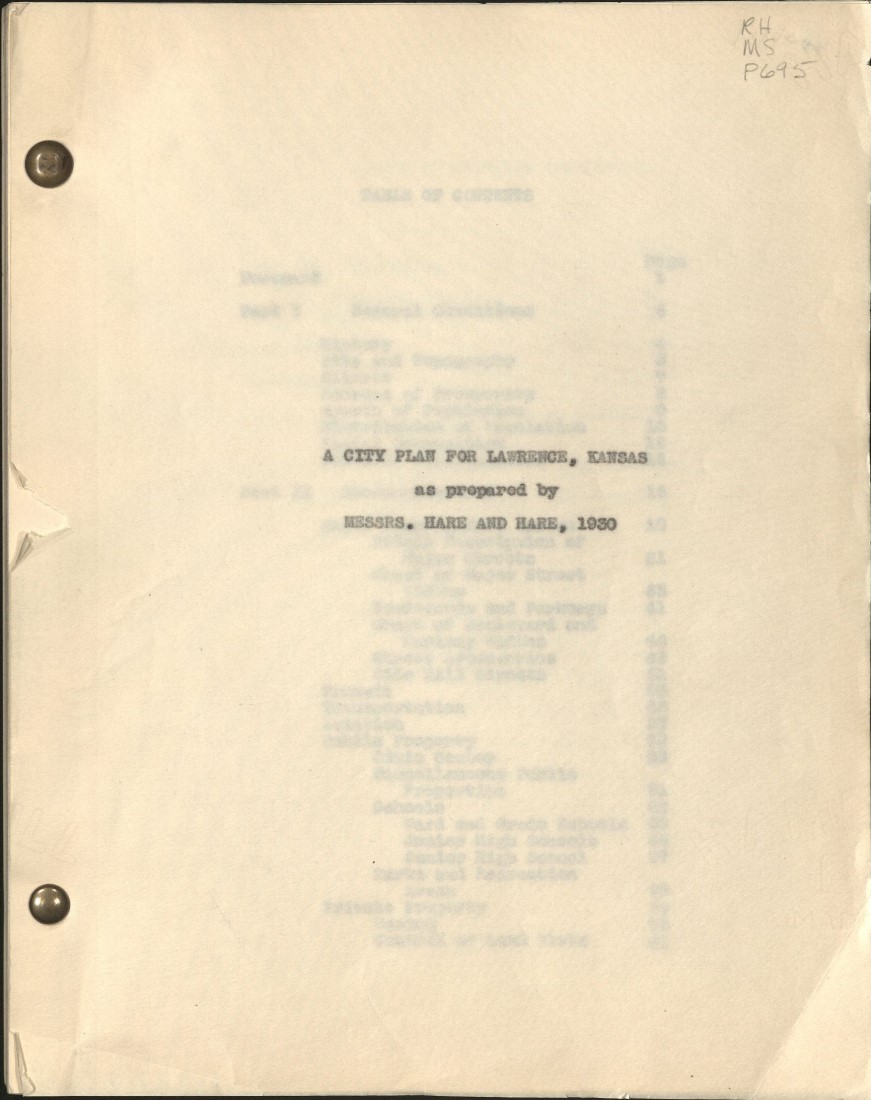
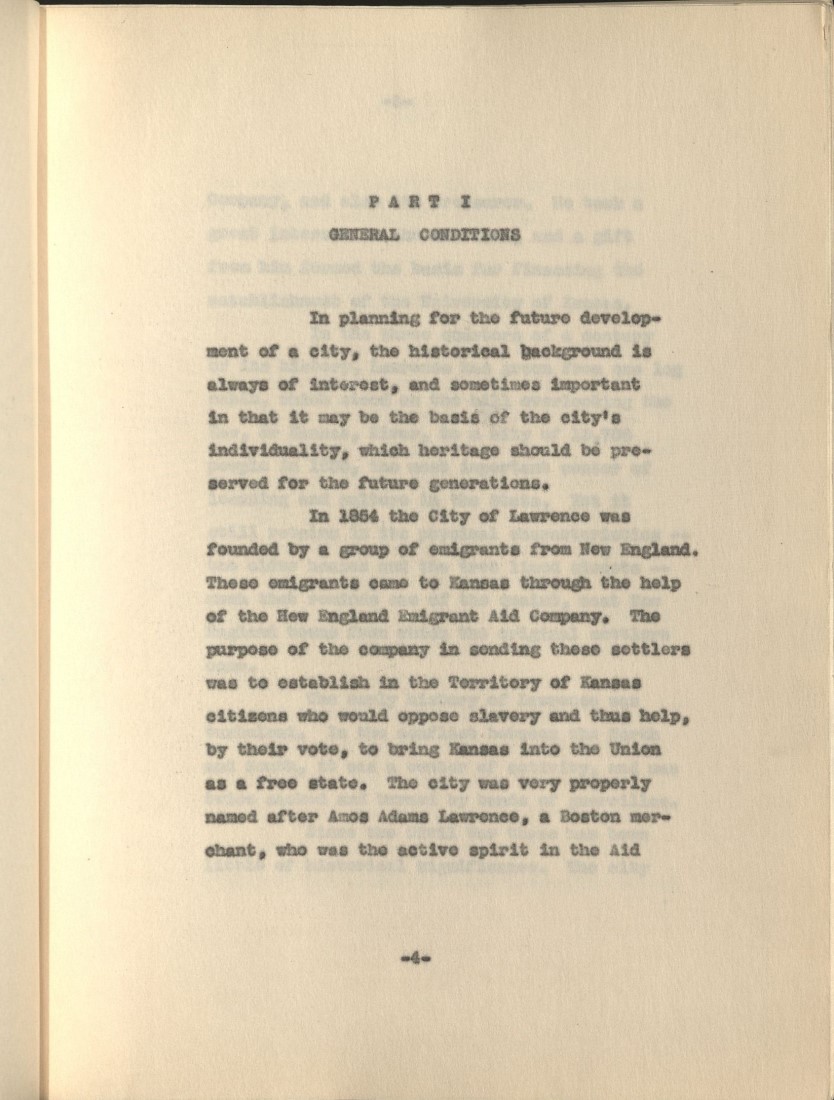
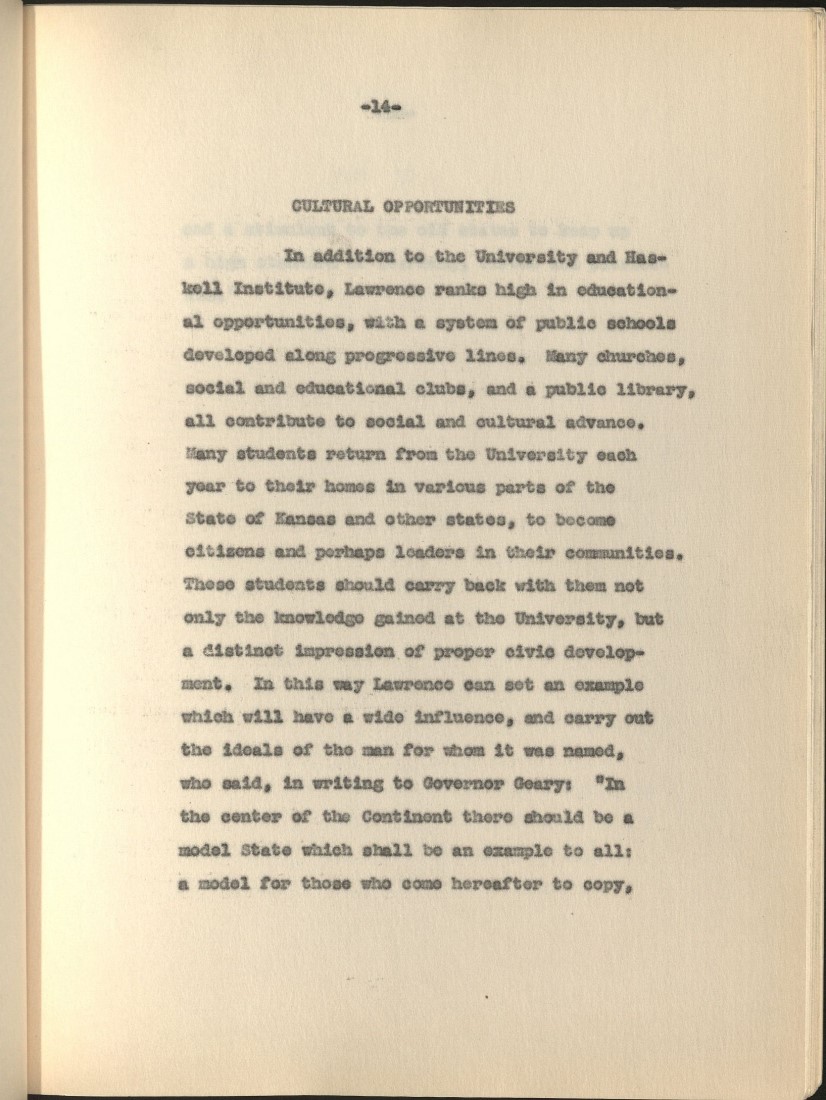
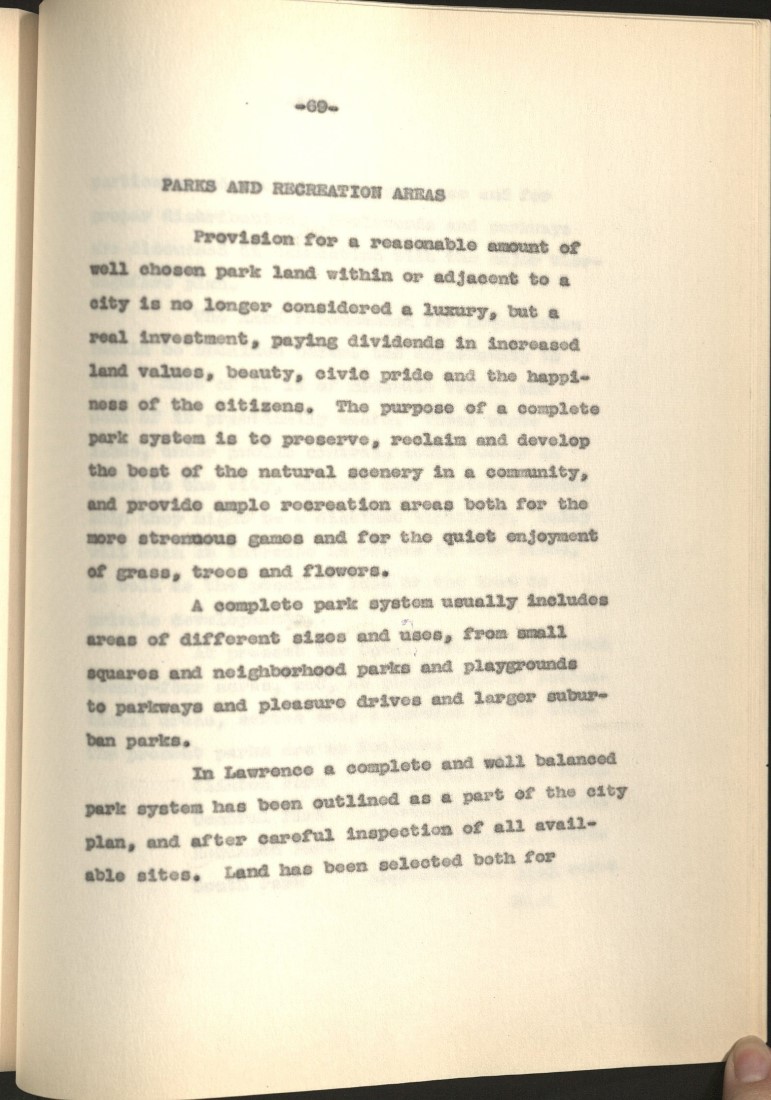
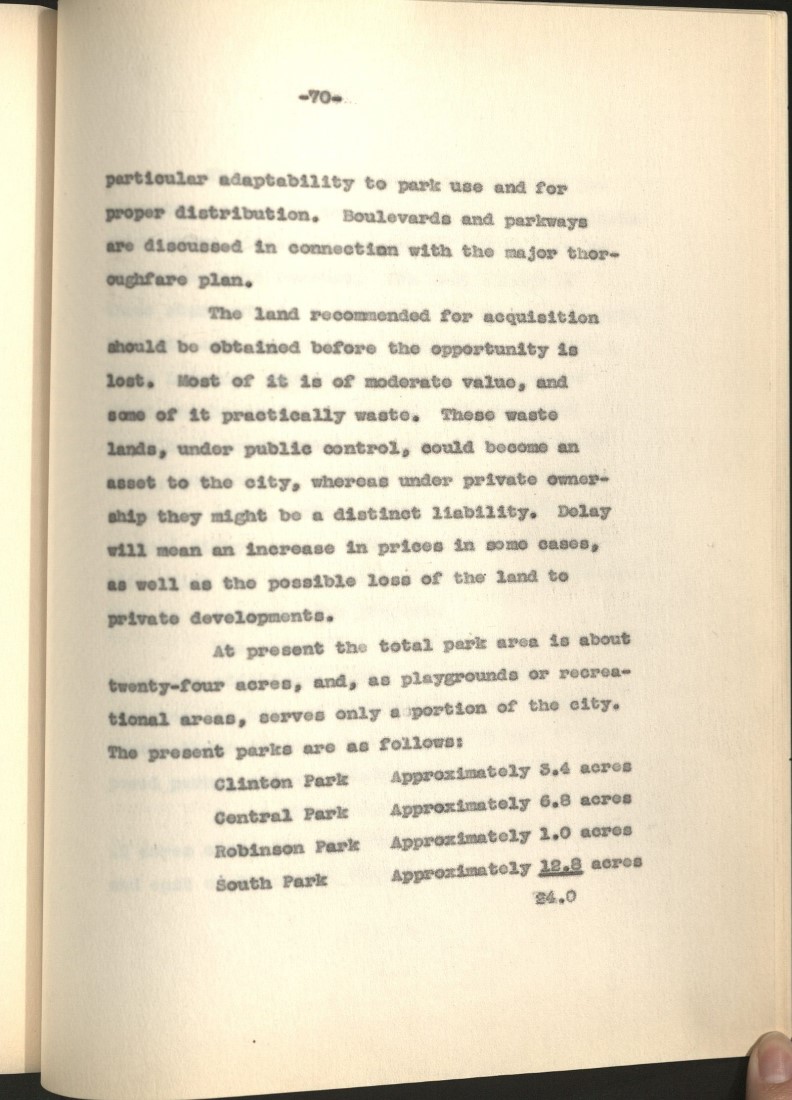
This week on That’s Distinctive! I am sharing an item from our Kansas Collection. While I frequently share books, photos, and diaries from the collection, it houses so much more. The collection also contains historic documents such as Douglas County records, architectural drawings and blueprints, and other planning documents. Today I share A City Plan for Lawrence, Kansas, from 1930. The document is a 92-page typescript report that includes recommendations regarding streets and transportation, public properties, schools, and zoning. The report was prepared by Hare & Hare, a Kansas City, Missouri, landscape architecture and planning firm that was founded by a father-and-son team in 1910. The firm’s projects ranged from cemeteries and parks to larger scale planning projects. One of the firm’s most notable projects was the Nelson-Atkins Museum of Art in Kansas City. After a couple of mergers over the years, today the firm is known as Ochsner Hare & Hare, a Design Studio of Olsson Associates.
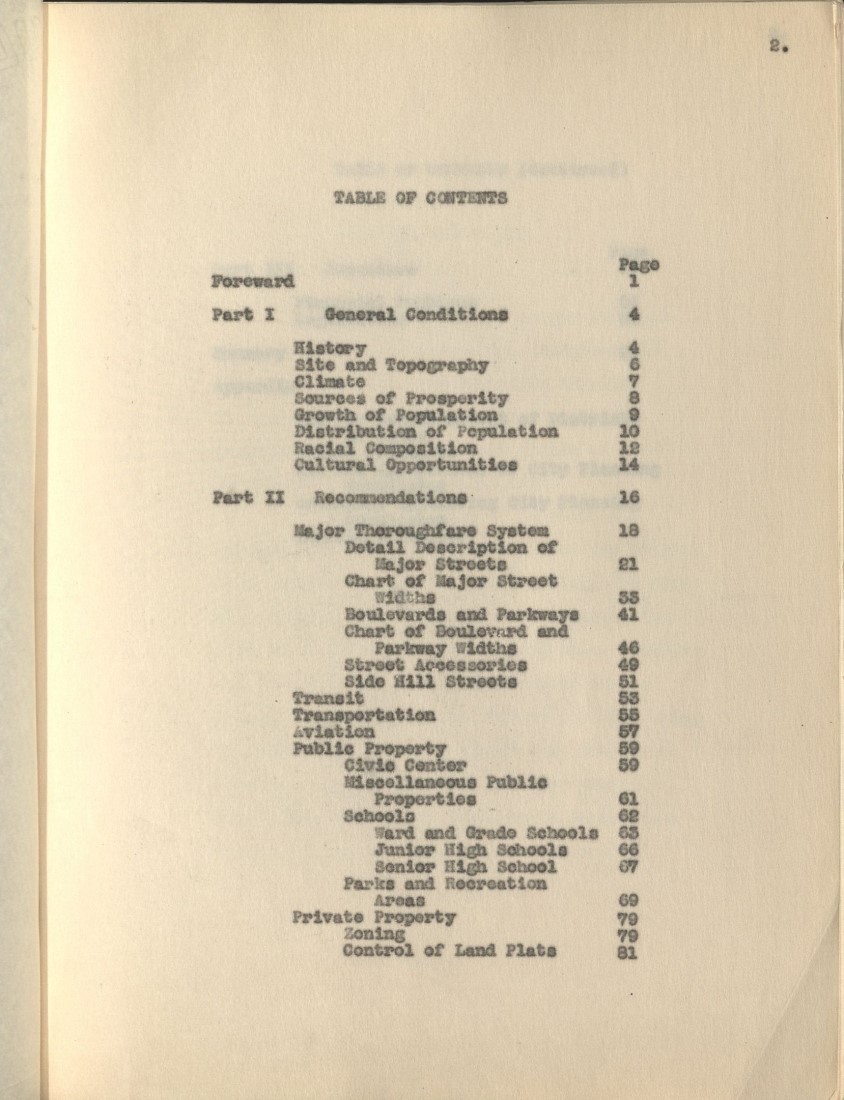
As seen by the table of contents shown below, the plan covers a wide range of topics including transit, zoning, growth and distribution of population, and private property. The plan opens with some general historical background of the city to help readers situate themselves. Of the pages shared, the “Cultural Opportunities” section seems to be hopeful that the city will have a lasting impact on students at the University of Kansas and Haskell Institute (now Haskell Indian Nations University) who come from out of town. The “Parks and Recreation Areas” section seems to urge the city to take pride in its leisurely spaces and to preserve those areas for use. It can be interesting to look back in time and see what the priorities were for those running the town then compared to those who are in charge now. Similar to looking back at pictures, you can “see” how things have shifted throughout time.
|
|
|
|
|
Selected pages from A City Plan for Lawrence, Kansas, 1930. Call Number: RH MS P695. Click images to enlarge.
Check the blog each Friday for a new “That’s Distinctive!” post. I created this series to provide a lighthearted glimpse into the diverse and unique items at Spencer. “That’s Distinctive!” is meant to show that the library has something for everyone regardless of interest. If you have suggested topics for a future item feature or questions about the collections, you can leave a comment at the bottom of this page. All collections, including those highlighted on the blog, are available for members of the public to explore in the Reading Room during regular hours.
This week on That’s Distinctive! I am sharing an item from our collection of Lawrence Public Schools (USD 497) records. The collection spans 1858 to 2022 and contains a myriad of items including records, reports, newsletters, yearbooks, and photographs. The collection consists of 144 boxes, 33 oversize boxes, 24 oversize folders, 143 video tapes, 18 audio tapes, and seven CDs. According to the collection’s finding aid, “the State of Kansas unified Lawrence schools in 1965, creating Lawrence Unified School District #497, or the Lawrence Public Schools. This was during an era when schools were consolidating across the state in part due to better transportation options.”
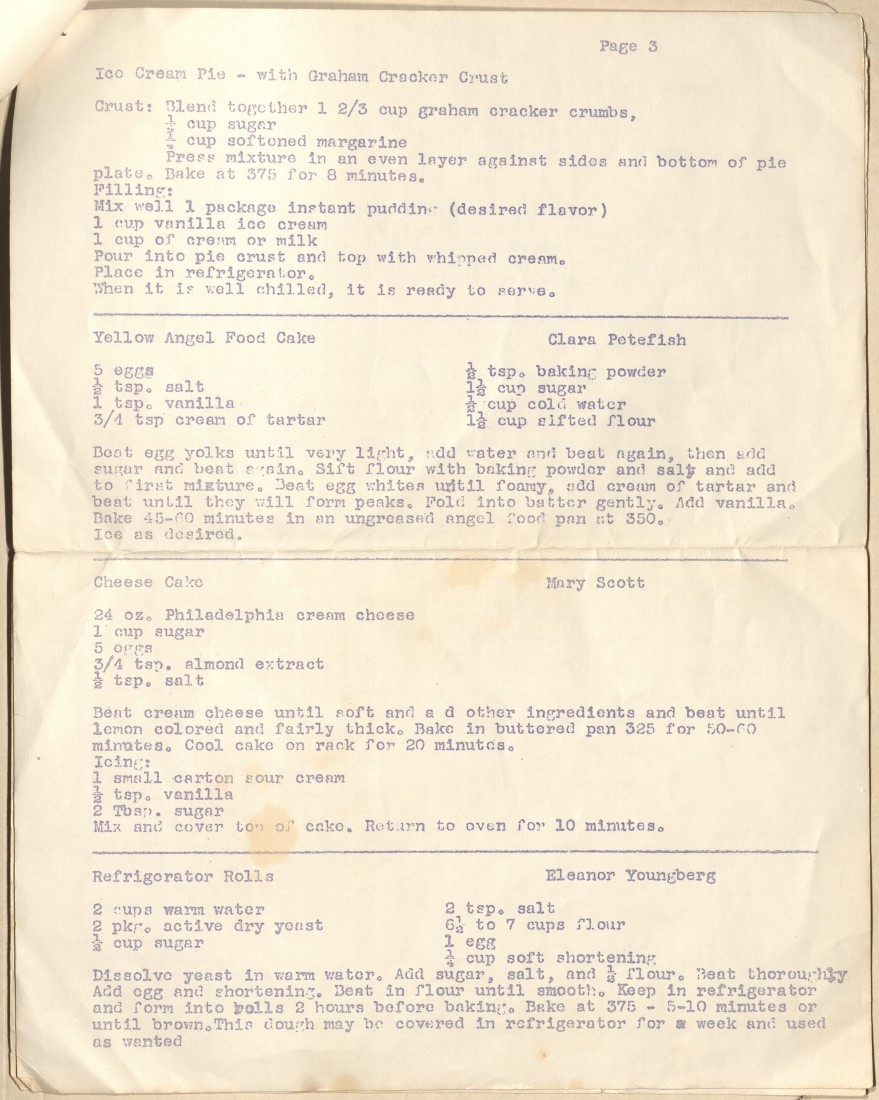
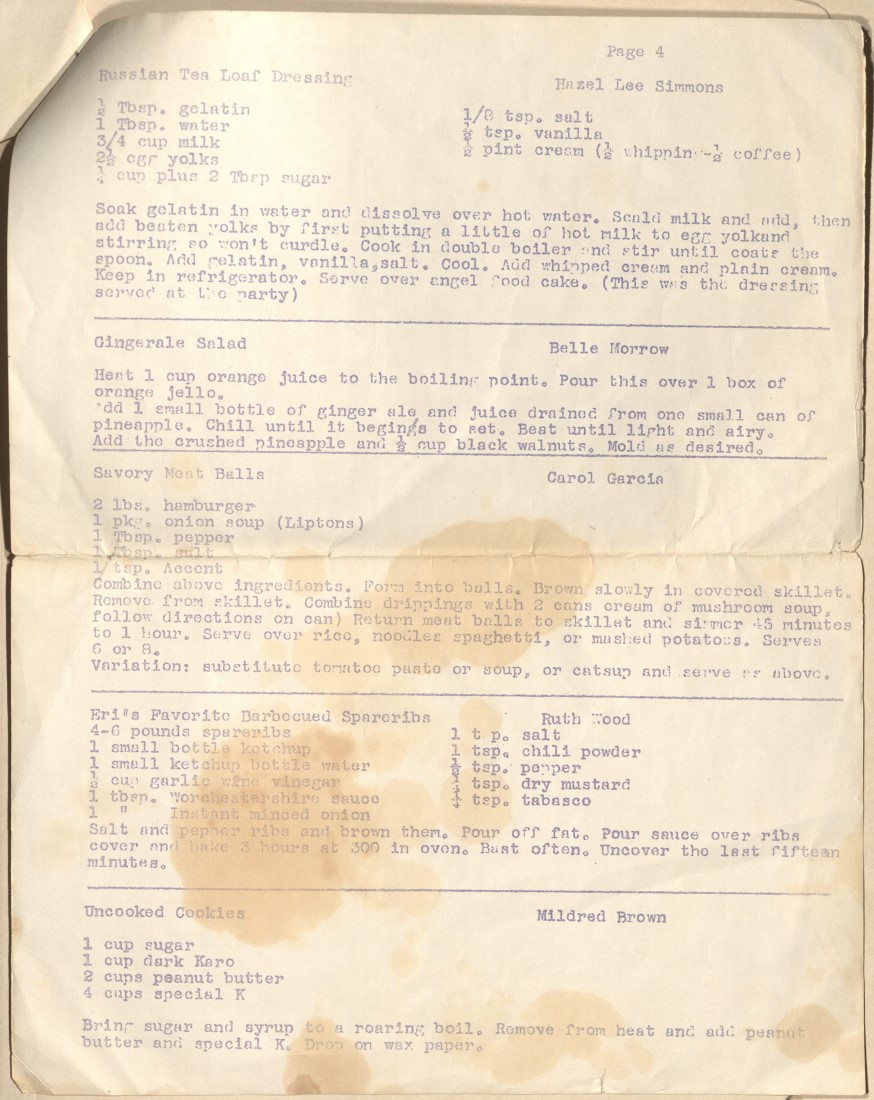
The pages shared below are from “Charlsia’s Cordley [Elementary School] Recipe Book.” The document is undated, although other items in the box range from 1962 to 2012. The recipe book contains various recipe entries for date cake, applesauce salad, refrigerator rolls, and more. I assume the recipes were submitted by students.
Before finding this item, I did not know that the USD 497 collection existed. I was digging through the finding aids looking for old recipes when I found this folder. I thought it would be fun to share given the school district is here in Lawrence.
|
|
Selected pages from “Charlsia’s Cordley Recipe Book,” undated. Unified School District 497 Records. Call Number: RH MS 1255. Click images to enlarge.