The University of Kansas

Inside Spencer: The KSRL Blog

Books on a shelf

Welcome to the Kenneth Spencer Research Library blog! As the special collections and archives library at the University of Kansas, Spencer is home to remarkable and diverse collections of rare and unique items. Explore the blog to learn about the work we do and the materials we collect.

A Nineteenth-Century Woman’s New Year’s Resolutions

December 30th, 2015

According to Wikipedia, a New Year’s resolution is “a tradition, most common in the Western Hemisphere but also found in the Eastern Hemisphere, in which a person makes a promise to do an act of self-improvement or something slightly nice, such as opening doors for people, beginning from New Year’s Day.” In January 1864 Elizabeth Duncan wrote down her resolutions on the back pages of her new diary. Little did she know that 150 years later we would use her resolutions to gain insight into what it was like to be a women in the Midwest during her lifetime.

Photograph of Elizabeth Duncan, circa 1860-1865

Photograph of Elizabeth Duncan, circa 1860-1865.
Ladies of Lawrence Portrait Album. Call Number: RH PH 51.
Click image to enlarge.

Wesley Duncan (1814-1902) and his second wife Elizabeth (1837-1879) became residents of Lawrence, Kansas, in May 1855, when the town was less than one year old. Wesley was in the dry goods and grocery business. In 1867 the family left Lawrence and traveled to California, where they briefly settled in San Jose. Sometime around 1868 they returned to Lawrence, and Wesley opened a hardware store.

Kenneth Spencer Research Library holds three of Elizabeth’s diaries, covering the years 1864, 1867, and 1868. The 1864 diary, shown here, was a gift to Elizabeth from her favorite nephew. On January 1st of that year she recorded that “This morning was intens[e]ly cold but I think some warmer than yesterday I wished all the folks a happy new year. About noon Fred Eggert…presented me this book which I value very highly.” The next day she wrote, in part, “I am going to try to live a more elevated life this year than I did last.”

Image of Elizabeth Duncan's diary, front cover

The front cover of Elizabeth’s 1864 diary. Elizabeth Duncan Collection.
Call Number: RH MS A26. Click image to enlarge.

Image of Elizabeth Duncan's diary, inscription

The inscription on the inside cover of Elizabeth’s diary reads
“From Fred to his Aunt Bettie as a New Years Present Jan 1st 1864.”
Elizabeth Duncan Collection. Call Number: RH MS A26.
Click image to enlarge.

Image of Elizabeth Duncan's diary, title page

The title page of Elizabeth’s diary. Elizabeth Duncan Collection.
Call Number: RH MS A26. Click image to enlarge.

Elizabeth began writing in this diary four months after Quantrill’s Raid, an event that took place in the turbulent years of strife between Kansas and Missouri during the American Civil War. Writing in her diary faithfully throughout 1864, Elizabeth primarily spoke of her family, daily life, and the people she knew. She only occasionally mentioned incidents and issues concerning the war and politics of the time.

In January 1864, Elizabeth (age 26) and her husband Wesley (age 50) had been married for almost ten years. Their household included two daughters, two-year-old Katie and one-year-old Cettie; seventeen-year-old William (“Willie”), Wesley’s son from his first marriage; and Ella Jackson, a nineteen-year-old domestic helper.

Image of Elizabeth Duncan's diary, New Year's resolutions

Elizabeth’s resolutions for 1864. Elizabeth Duncan Collection.
Call Number: RH MS A26. Click image to enlarge.

Elizabeth wrote her New Year’s resolutions on the volume’s back pages, dating them January 21, 1864. They are transcribed here.

Jan 21st 1864

Today I have determined more fully to live an humble and devoted Christian and so [illegible] that I may make more steady progress in the good way I have determined to pass the following 1st resolutions which are as follows.

Resolved that I will let no day pass without reading two or more chapters in the Bible or Testament.

2nd Resolved that I have stated times and place for secret prayer and if I am hindered in any way so as I am not possible attend to it just at the stated time I will improve the very first opportunity after.

3rd Resolved that I will be more firm with the children and not let my temper get control of me.

It appears that Elizabeth added another resolution later that year.

4 Resolved that by the grace of God assisting me I will do all in my power to make those around me happy especially our own family. July 22nd, 1864

To learn more about Elizabeth, her diary, and her life in 1864, check out Katie H. Armitage’s article in Kansas History; see also Armitage’s article about Duncan’s 1867-1868 diaries.

Kathy Lafferty
Public Services

Native American Heritage Month: Haskell Indian Nations University

November 23rd, 2015

In celebration of Native American Heritage Month, I’m highlighting items from our Kansas Collection that feature events and people from Haskell Indian Nations University, which has been educating First Nations students since 1884 in Lawrence, KS.

Did you know that Haskell offered the first touch-typing class in Kansas? The commercial department, now known as the business department, opened in 1895 with five typewriters. To find this information and other interesting facts about Haskell, check out their school history webpage.

Vivian McAllister and students typing in class.

Vivian McAllister with students typing in class at Haskell.
Miscellaneous photographs and negatives, ca. 1970.
Wallace Galluzzi Papers. Call Number: RH MS 807. Click Image to Enlarge.

This picture was taken in the 1930s by the well-known local photographer, Duke D’ambra. It illustrates Haskell’s long history as a diverse intertribal educational institution. Haskell continues to celebrate its cultural diversity with the annual Haskell Indian Art Market.

Unknown Haskell students. Photograph of Haskell Activities, 1930s.

Unknown Haskell students. Photograph of Haskell Activities, 1930s.
Duke D’ambra photograph collection. Call Number: RH PH 69.542.6. Click Image to Enlarge.

Haskell has a long tradition of producing exceptional athletes. Below are a couple of examples from Haskell’s rich athletic history.

John Levi played football at Haskell from 1921-1924 and then came back to coach the team from 1926-1936. He has been inducted into 3 sports hall of fames, the Kansas Sports Hall of Fame, the Oklahoma Athletic Hall of Fame, and the American Indian Athletic Hall of Fame. Check out Haskell Athletics’ Flashback Friday post on John Levi to learn more.

Photograph of Haskell football player John Levi and accompanying document describing his actions in a game against the Quantico Marines.Photograph of Haskell football player John Levi and accompanying document describing his actions in a game against the Quantico Marines.

Photograph of Haskell football player John Levi and accompanying document chronicling
his actions in a game against the Quantico Marines. Duke D’ambra photograph collection.
Call Number: RH PH 69.583.3. Click Image to Enlarge.

Billy Mills was a graduate of both Haskell and KU. He is most remembered for his surprise win of the 10,000-meter race at the 1964 Tokyo Olympic Games. To learn more about Billy Mills and his incredible life story check out this interview with Mills from Haskell Athletics’ Flashback Friday post and “Mill’s Moment” on KUHistory.com written by Mark D. Hersey.

“Billy Mills is inducted in Sports Hall of Fame.” The Indian Leader, November 27, 1964.

“Billy Mills is inducted in Sports Hall of Fame.” The Indian Leader,
November 27, 1964.William Galluzzi Papers. Call Number: RH MS 807.
Click Image to Enlarge.

Mindy Babarskis
Library Assistant and Supply Coordinator

Thanksgiving on the Post: Images from the Pennell Collection

November 20th, 2015

The following images were taken by Joseph Judd Pennell, a professional photographer in Junction City, Kansas, from 1888 to 1923. The images in the collection represent a comprehensive record of life in a turn-of-the-century small Kansas town and the nearby army post of Fort Riley.

Photograph of a football team on Thanksgiving Day, Fort Riley, Kansas, 1896

Football team on Thanksgiving Day, Fort Riley, Kansas, 1896.
Joseph Judd Pennell Photograph Collection. Call Number: RH PH Pennell.
Click image to enlarge (redirect to Spencer’s digital collections).

A major U.S. Army post, Fort Riley was the site of a light artillery unit; several cavalry units, including the 9th and 10th black cavalry troops; one of the best cavalry schools in the world; and Camp Funston, a major army induction center during World War I.

Photograph of 20th Battery Dining Hall prepared for Thanksgiving meal, Fort Riley, Kansas, 1904

Kitchen staff in the 20th Battery Dining Hall prepared for Thanksgiving dinner, Fort Riley,
Kansas, 1904. Joseph Judd Pennell Photograph Collection. Call Number: RH PH Pennell.
Click image to enlarge (redirect to Spencer’s digital collections).

Photograph of soldiers in the 20th Battery Dining Hall for Thanksgiving meal, Fort Riley, Kansas, 1904

Soldiers gathered in the 20th Battery Dining Hall for Thanksgiving dinner, Fort Riley,
Kansas, 1904. Joseph Judd Pennell Photograph Collection. Call Number: RH PH Pennell.
Click image to enlarge (redirect to Spencer’s digital collections).

Although primarily a studio portrait photographer, Pennell also went out into the community to photograph. He recorded business, social, church, and school activities; people’s prized moments and possessions; and events that touched everyone’s lives, such as floods, parades, President Theodore Roosevelt‘s visit, the racket nine-cent sale, polo games, and Chautauqua. Revealed within the photographs is the detail and complexity of rural and urban life. The collection as a whole shows how a town and its people changed over time, evidenced in things like the styles of fashion and consumer goods, the appearance of new buildings as the town grew, and the entrance of technology into everyday life. One of the most notable technological changes that Pennell documented was the gradual movement from horse to automobile power.

Photograph of a dining room set for Thanksgiving dinner, Fort Riley, Kansas, 1905

Dining room set for Thanksgiving dinner, Fort Riley, Kansas, 1905.
Joseph Judd Pennell Photograph Collection. Call Number: RH PH Pennell.
Click image to enlarge (redirect to Spencer’s digital collections).

Photograph of the 6th Band dining room set for Thanksgiving dinner, Fort Riley, Kansas, 1913

6th Band dining room set for Thanksgiving dinner, Fort Riley, Kansas, 1913.
Joseph Judd Pennell Photograph Collection. Call Number: RH PH Pennell.
Click image to enlarge (redirect to Spencer’s digital collections).

Spencer’s Pennell collection consists of approximately 30,000 glass plate negatives, 6,074 contact prints (some dry-mounted on boards), 302 original Pennell photographs, and ten studio register books containing Pennell’s negative identification system. The glass plate negatives vary in size from 4″ x 5″ to 12″ x 20″, with the bulk of the collection in the 5″ x 7″ format. There are also a small number of flexible negatives and forty-six large panoramic negatives.

Kathy Lafferty
Public Services

Happy Election Day!

November 3rd, 2015

November 3rd is Election Day here in the U.S. and although it’s not time for the presidential elections, the races and ballot initiatives taking place are no less vital. To celebrate the importance of civic engagement, I’ve selected a few items from Spencer Library’s Kansas Collection that highlight different ways of being politically active.

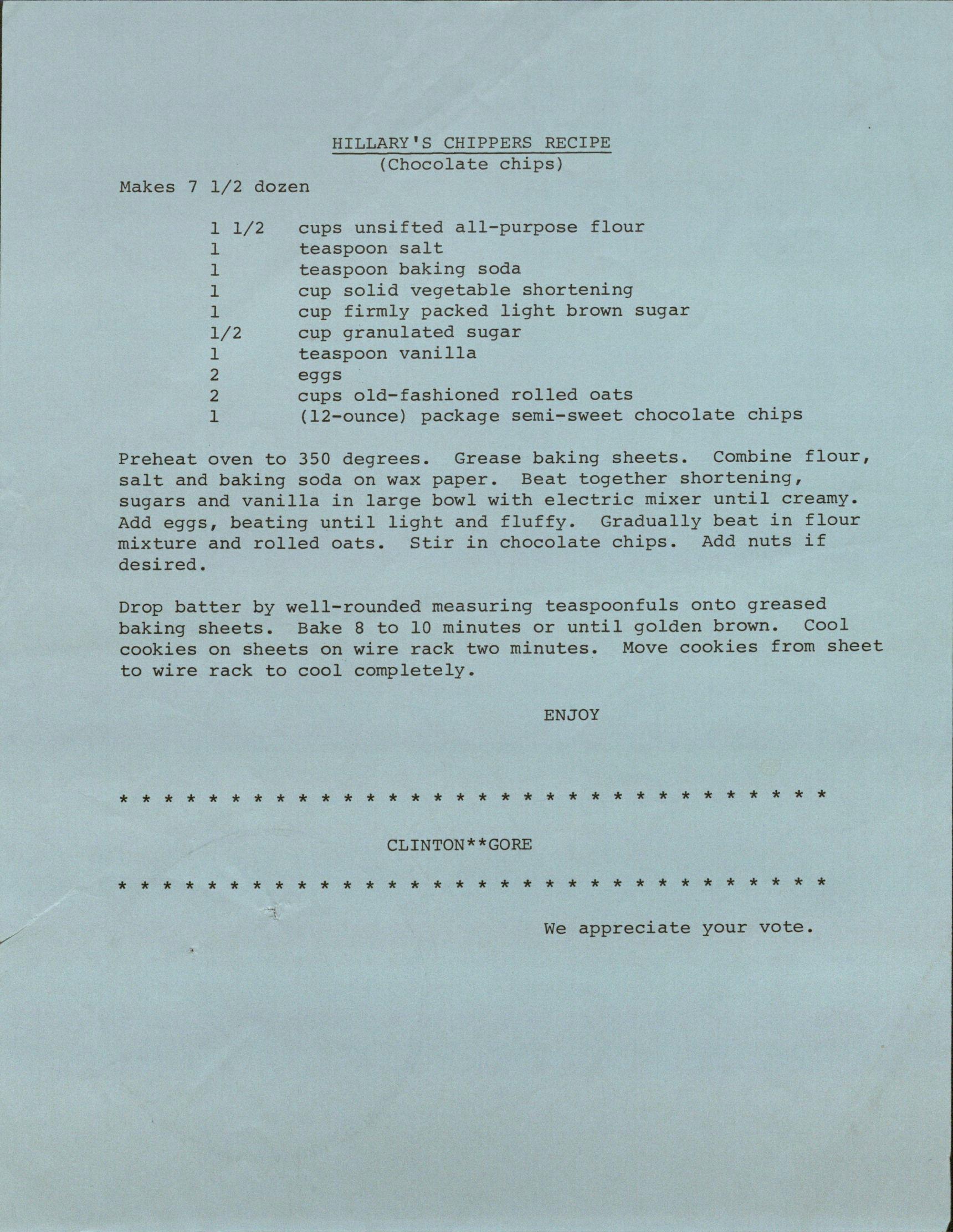
One of our researchers from the University of Chicago found this delicious thank-you note. Coffeyville, Kansas, native Bruce McKinney was thanked by Bill Clinton and Al Gore for his vote by receiving his very own copy of Hillary Clinton’s Chippers recipe!

Hillary Clinton's Chippers Recipe and note of appreciation for Bruce McKinney's vote for Clinton and Gore

Hillary Clinton’s Chippers Recipe, circa 1992-1996.
Papers of Bruce McKinney, 1900-2008. Call Number: RH MS 1164.
Click image to enlarge.

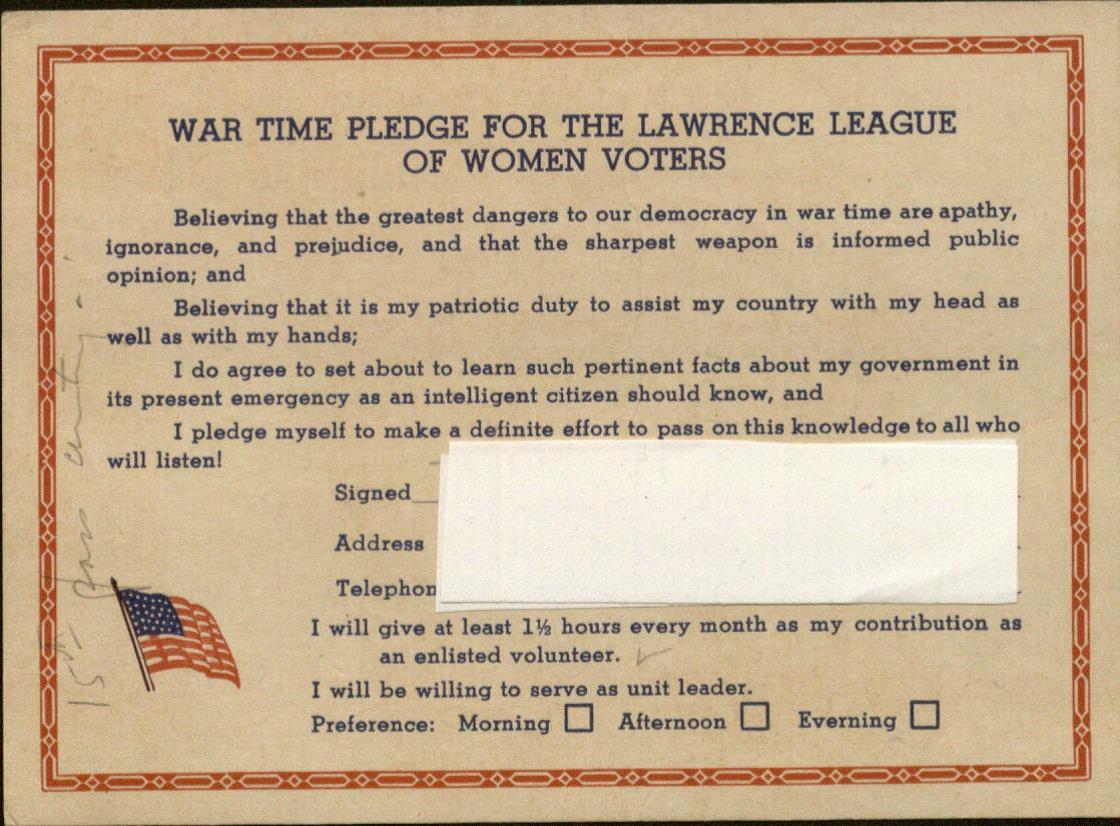
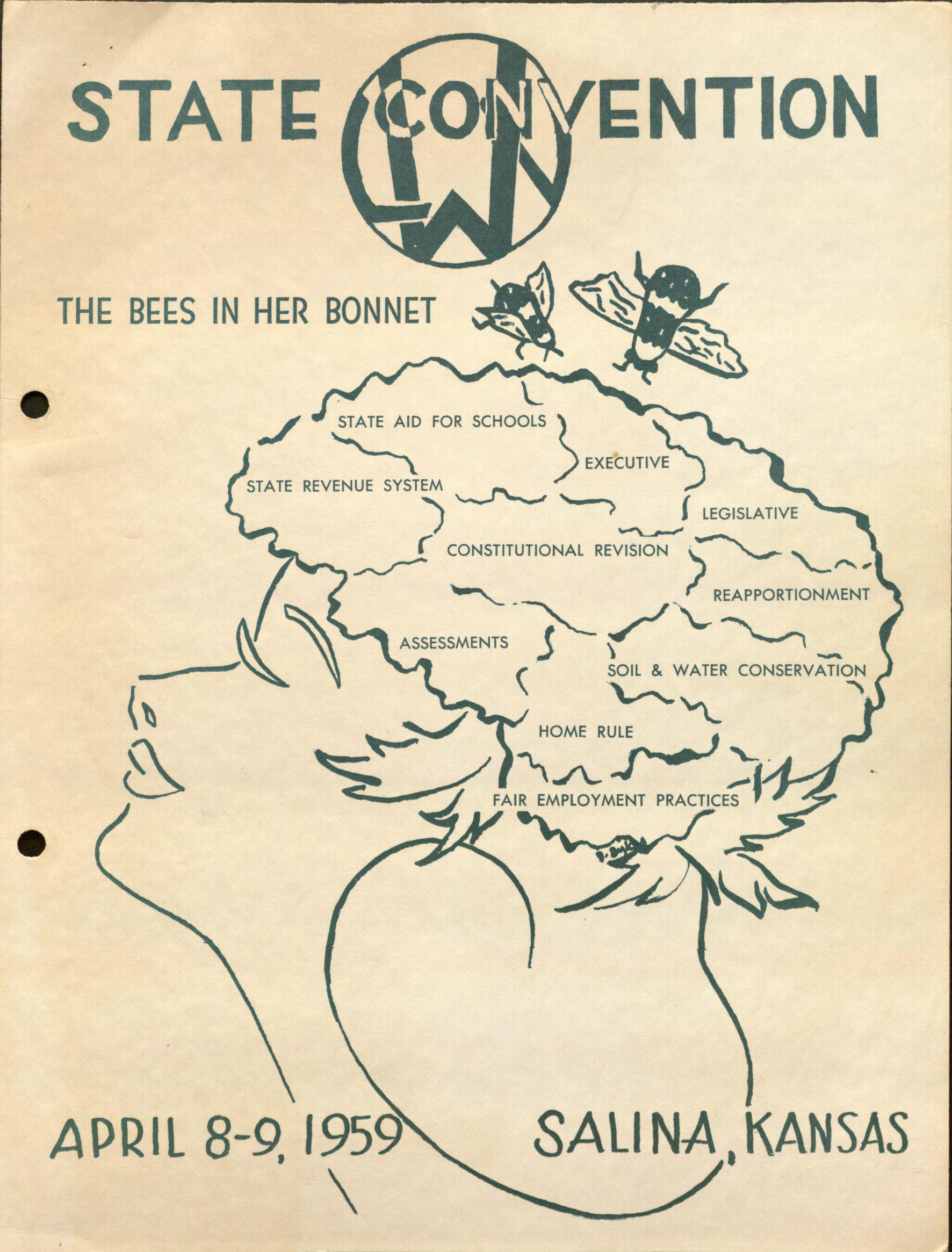
Mervyn Anderson was an active member of the League of Women Voters of Kansas. Her dedication to informing Kansans on political issues and candidates is evident in these two items from her papers.

War Time Pledge Card for the League of Women Voters of Lawrence, Kansas

War time (probably referring to the Vietnam War) pledge card for the
League of Women Voters of Lawrence, Kansas.
Mervyn Anderson Papers, 1956-1987. Call Number: RH MS 1091.
Click image to enlarge.

Cover of the April 8-9, 1959 League of Women Voters State Convention program in Salina, Kansas.

Cover of the April 8-9, 1959 League of Women Voters State Convention
program in Salina, Kansas. Mervyn Anderson Papers, 1956-1987.
Call Number: RH MS 1091. Click image to enlarge.

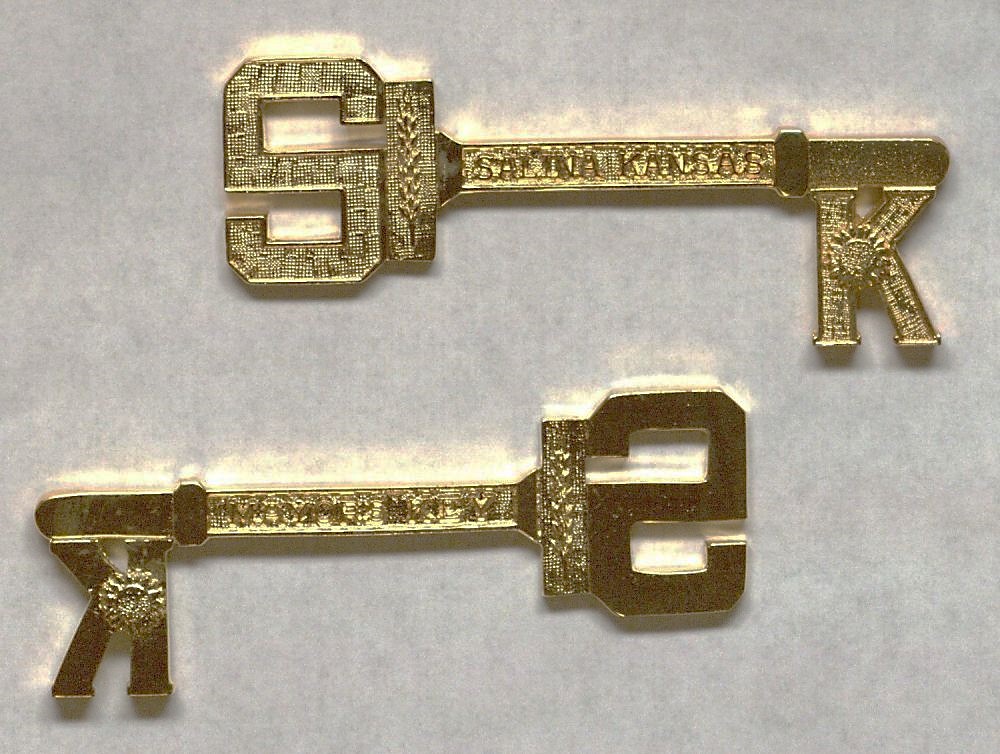
Many Kansans have engaged politically by serving in local, state, or national government. Robert C. Caldwell is an excellent example of a public servant to the city of Salina, where he was elected as the first African American mayor in 1970.

Mayor Robert C. Caldwell's keys to the city of Salina, Kansas.

Two identical keys to the city of Salina, Kansas, undated.
The key at the top displays the side engraved with Salina, Kansas,
while the key on the bottom is engraved with Mayor’s Key.
Robert C. Caldwell Family Papers, 1922-1999. Call Number: RH MS Q119. Click image to enlarge.

Mindy Babarskis
Library Assistant and Supply Coordinator

Prohibition in Kansas

October 28th, 2015

On October 28, 1919, Congress passed the National Prohibition Act, making it illegal to produce, sell or transport “intoxicating” liquors. It passed in spite of President Wilson’s veto. It was also known as the Volstead Act, named after Congressman Andrew J. Volstead of Minnesota, who worked closely with the Anti-Saloon League to draft and promote the bill until it became law. The Volstead Act implemented the Prohibition (Eighteenth) Amendment by defining the process and procedures for banning alcoholic beverages, as well as their production and distribution.

Photograph of men drinking in saloon just before the start of Prohibition, 1919

Men at an unknown saloon in June 1919. The caption reads “fill ’em up, boys; last chance.”
Ratification of the Eighteenth Amendment was certified on January 16, 1919;
it took effect one year later. Call Number: PH PH P238. Click image to enlarge.

Photograph of Ardmore [Oklahoma] Police Department members pouring out barrels of alcohol, November 22, 1916

Ardmore [Oklahoma] Police Department members pouring out barrels of alcohol,
November 22, 1916. Call Number: PH PH P1617. Click image to enlarge.

In Kansas, however, prohibition had been an issue even before statehood in 1861. Organized groups such as the Order of Good Templars, the Kansas State Temperance Union, and the Woman’s Christian Temperance Union fought for statewide prohibition, eventually establishing Kansas as the first state to adopt prohibition into its constitution. Strongly prohibitionist, Republican governor John P. St. John was elected in 1878, and by this time the legislature was like-minded. The state law was ratified by voters in November 1880, and prohibition in Kansas took effect on January 1, 1881, making it illegal to manufacture or sell intoxicating liquors in the state.

Photograph of Kansas delegates to Michigan prohibition meeting, undated

Kansas delegates to a Michigan prohibition meeting, undated.
Call Number: RH PH P164. Click image to enlarge.

Pages from Prohibition pamphlets

A Prohibition pamphlet published in Kansas City, Kansas,
by M. A. Waterman, etc., 1911. Call Number: RH C4581.
Click image to enlarge.

Prohibition may have been the law of the land in Kansas, but saloons and bars simply paid fines and used loopholes in the law to stay in business. Established temperance organizations still worked to get stronger laws and ensure enforcement of them, but the failure to enforce the law, combined with a decline of support for prohibition among the general population, caused a rise of prohibitionist radicals such as Carrie Nation (1846-1911). Nation and her followers attracted attention to the liquor issue by using unconventional methods, such as smashing saloons with rocks and hatchets and getting arrested as a result. Topeka, Kansas, became Nation’s home base as she traveled around, in state and out, taking her message to the people. While her methods may have been radical, they did get results. She addressed a joint session of the Kansas legislature, went on a lecture tour, and published a temperance newspaper called the Smasher’s Mail. In 1907 the government began real enforcement of the prohibition laws, and the governor and the legislature made the laws stronger, closing loopholes.

Cover of The Smasher’s Mail, 1901

The Smasher’s Mail, edited by Carrie Nation,
“your loving home defender.”
Topeka, Kansas: Nick Chiles, 1901.
Call Number: RH VLT H5. Click image to enlarge.

For several years national, state, and local law enforcement officials worked to make the country “dry.” However, by the 1930s, most citizens thought prohibition had failed, and the amendment was repealed by President Franklin Roosevelt in 1933. However, in Kansas prohibition continued to be the law until 1948, when it was finally voted down. Alcohol in Kansas returned to being subject to local option laws, much like those that had been in place seventy years before.

Image of two songs in the Prohibition Bugle Call, 1887

Two songs from The Prohibition Bugle Call: New Songs for Prohibition Clubs,
Temperance Societies, Gospel Temperance Meetings and the Home Circle
by H. H. Hawley.
New York: Biglow & Main, 1887. Call Number: Shull C148. Click image to enlarge.

Kathy Lafferty
Public Services