The University of Kansas

Inside Spencer: The KSRL Blog

Books on a shelf

Welcome to the Kenneth Spencer Research Library blog! As the special collections and archives library at the University of Kansas, Spencer is home to remarkable and diverse collections of rare and unique items. Explore the blog to learn about the work we do and the materials we collect.

Throwback Thursday: Fall Preview Edition

September 11th, 2014

Each week we’ll be posting a photograph from University Archives that shows a scene from KU’s past. We’ve also scanned more than 1,700 images from KU’s University Archives and made them available online; be sure to check them out!

The official beginning of autumn may still be almost two weeks away, but this week we’re getting a preview of cooler fall-like weather on Mount Oread. Who else is ready for sweaters, colorful leaves, and pumpkin-flavored treats?

Photograph of a KU student resting surrounded by leaves, undated

In this undated photograph (circa 1990-2000), a KU student rests on a blanket
surrounded by leaves. Snow Hall can be seen in the background. University Archives Photos.
Call Number: RG 0/24/1 Trees No Date Prints: Campus: Areas and Objects (Photos).
Click image to enlarge (redirect to Spencer’s digital collections).

Caitlin Donnelly
Head of Public Services

Brian Nomura
Public Services Student Assistant

Throwback Thursday: Kick Off Edition

September 4th, 2014

Each week we’ll be posting a photograph from University Archives that shows a scene from KU’s past. We’ve also scanned more than 1,700 images from KU’s University Archives and made them available online; be sure to check them out!

This week, we celebrate the start of the 2014 football season on Saturday with this image of the old scoreboard at Memorial Stadium. You can learn more about the history of this building at the KU Places Directory and the KU History website.

Photograph of KU football scoreboard, 1938

KU football scoreboard at Memorial Stadium, 1938. University Archives Photos.
Call Number: RG 66/14 Games 1938 Prints: Athletic Department: Football (Photos).
Click image to enlarge (redirect to Spencer’s digital collections).

Caitlin Donnelly
Head of Public Services

Brian Nomura
Public Services Student Assistant

Finding Aids 101

June 20th, 2014

Pillsbury Family Papers finding aid

Screenshot of the top of a Spencer finding aid for the Pillsbury Family Papers. This will be
the example finding aid used throughout this blog post. The full document
is available on the Library’s website. Click image to enlarge.

Have you ever conducted research at an archives or special collections library, come across the term “finding aid,” and wondered, “what in the world does this mean?!” If so, you’re not alone. Finding aids are a standard tool for archival materials, but most people who aren’t archivists, special collections librarians, or experienced researchers are unfamiliar with the term. On the other hand, finding aids are the gateway to archival collections – for better or worse – so understanding what they are is an important component of conducting archival research.

So, what is a finding aid?

It’s a document, on paper and/or online, created by a repository’s staff members.

It generally contains the same information found in a catalog record (an overview of the collection) plus much more detailed information that the catalog record can’t accommodate.

It describes the materials in a specific collection.

It provides contextual information about the collection.

It’s an essential tool for library staff members and researchers. Without finding aids, a library would be full of collections but have nothing written down about them. Locating and understanding collections and materials within them would be immensely difficult, if not impossible.

Who creates finding aids and why?

When a repository like Spencer acquires an archival collection, a substantial amount of work is then required to prepare the materials for use by researchers. This effort, undertaken by library staff members, is called processing. It involves going through all of the materials in the collection; organizing or arranging them in a systematic way that will facilitate use; rehousing materials in acid-free enclosures, like boxes and folders; and administering basic preservation treatments and looking out for larger problems like mold or insect damage, which is harmful to materials and users. As they work, archivists make decisions and discoveries. They record this information; combine it with details gleaned from materials in the collection, provided by the donor, or acquired through additional research; and compile everything in one place, a finding aid.

How do finding aids help researchers?

The primary goal of a finding aid is to aid, or assist, researchers (including staff members) in finding the materials they need. Hopefully, information obtained from finding aids will minimize the amount of time researchers spend examining collections or parts of collections that are irrelevant to their work.

I sometimes think of a finding aid as a Choose Your Own Adventure book. Each section of the document reveals additional details about the collection, and after reading each section the researcher asks him/herself: given what I now know about this collection, do the materials it contains still seem relevant to my project? If the answer is yes, the researcher will either continue reading the finding aid or decide to begin examining the materials in the collection. If the answer is no, the researcher can abandon the finding aid and begin the process again with a new one.

RH_MS_802_finding_aid_002

Click image to enlarge.

Look, for example, at the Collection Summary section of the example finding aid above (for Spencer’s collection of Pillsbury Family papers). It provides information to answer these important questions: How much time do I need to allot to go through this collection – is there one box or one hundred? Are the materials in the collection written in a language I can read? Are these the types of materials I need – or, for example, does this collection contain only photographs when I need correspondence? Are the people who created these documents the people I’m researching, or are they related or an entirely different group? Do the materials in the collection fall within the date range I’m studying?

RH_MS_802_finding_aid_003

Click image to enlarge.

Subsequent sections of the finding aid more thoroughly answer these questions or address new ones. Perhaps most significant is the Collection Description. This section identifies the contents of specific boxes and/or folders and also indicates how materials are arranged (e.g. by format, date, author or recipient name). Having determined that the collection may be relevant to his/her project, the researcher can use the information in this section to ascertain how much of the collection s/he will need to go through and where specific documents (or groups of documents) are located.

What are the limitations of finding aids?

Depending on factors like the size of a collection, the type of materials it contains, and when it was processed, finding aids generally provide some information about significant people, places, events, and topics represented in the collection. However, without unlimited time to process, staff members are unable to create completely comprehensive finding aids that list all names and topics that occur within all documents in a collection. Most, in fact, are not included.

RH_MS_802_finding_aid_004

Think of how many letters about Christmas (and other topics) might be “hidden” in these boxes!
Click image to enlarge.

The result is that a finding aid search may turn up few or no results, not because a repository doesn’t have archival materials on that topic, but because that topic wasn’t specifically named in a finding aid. When this happens, try different search terms or approach your topic from another angle. For example, if you’re looking for information about how Christmas was celebrated in nineteenth-century America, and a search for “Christmas” turns up limited or unhelpful results, you might instead search for collections containing family correspondence from that time period. The larger task would then be to read letters sent and received in December and January of various years.

Finding aids are exceptionally useful, but they can also be tricky documents to navigate, even for experienced researchers. If you encounter any difficulties using Spencer’s finding aids, don’t hesitate to contact me (cdonnelly@ku.edu) or another staff member for assistance.

Caitlin Donnelly
Head of Public Services

KU Students Studying Hard, 1950-1985

May 14th, 2014

Spring has finally, truly arrived on Mount Oread, which has meant the eagerly-awaited return of warmer weather and the not-so-eagerly-awaited return of final exams. The Student Activities record group in University Archives contains a number of photographs showing the bowed heads of generations of anxious KU students poring over their work.

While it’s unclear, in almost all cases, whether these pictures were taken during final exams, this time of year seems like the most appropriate time to feature some of these fun images here at “Inside Spencer.”

Good luck to all KU students on their final exams!

Photograph of group of female students studying, 1950s.

Group of students studying, 1950s. University Archives Photos.
Call Number: RG 71/0/1950s Prints: Student Activities (Photos).
Click image to enlarge.

Photograph of student with typewriter outside, 1950s.

Student with typewriter, 1950s. University Archives Photos.
Call Number: RG 71/0/1950s Prints: Student Activities (Photos).
Click image to enlarge.

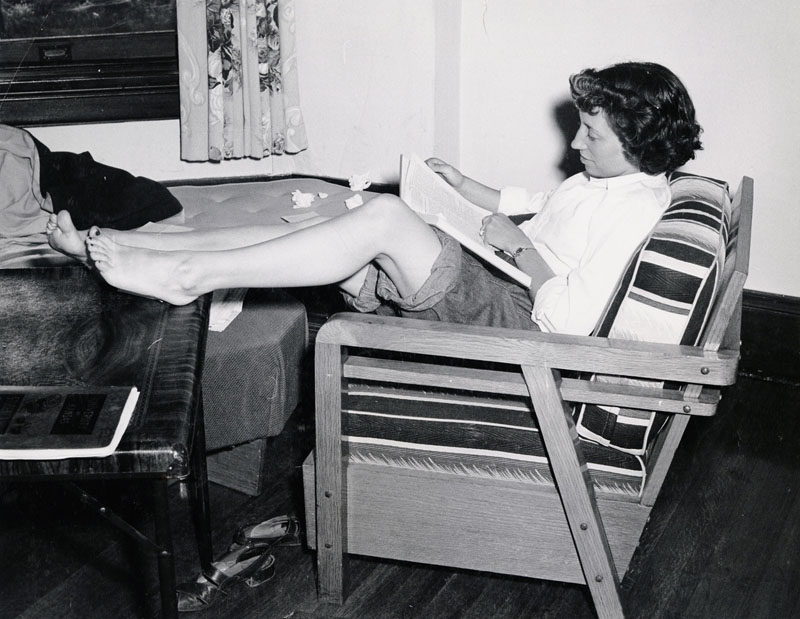
Photograph of student studying with bare feet, 1950s.

Bare feet, 1950s. University Archives Photos.
Call Number: RG 71/0/1950s Prints: Student Activities (Photos).
Click image to enlarge.

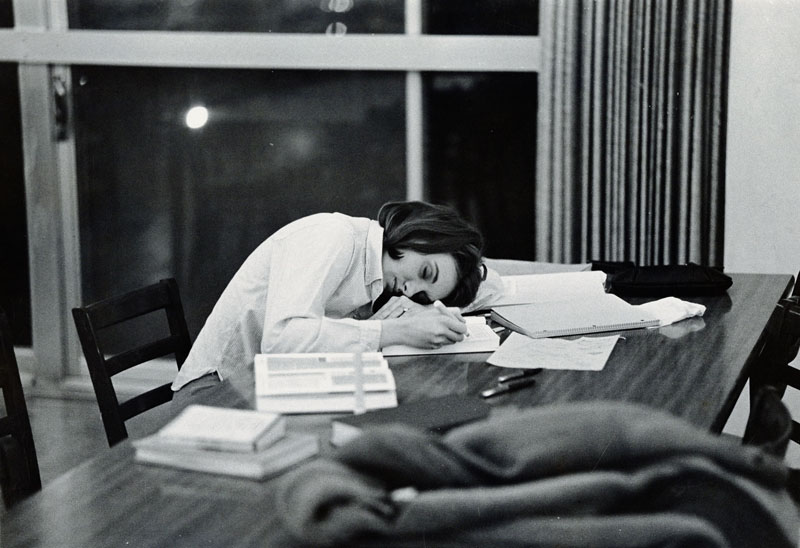
Photograph of student asleep while studying, 1967-1968.

Asleep while highlighting, 1967-1968. University Archives Photos.
Call Number: RG 71/0/1967-1968 Prints: Student Activities (Photos).
Click image to enlarge.

Photograph of student studying under trees, 1969-1970.

Studying in the shade, 1969-1970. University Archives Photos.
Call Number: RG 71/0/1969-1970 Prints: Student Activities (Photos).
Click image to enlarge.

Photograph of a student sleeping with note, 1970s.

“I’m too nervous to sleep in my room,” 1970s. University Archives Photos.
Call Number: RG 71/0/1970s Prints: Student Activities (Photos).
Click image to enlarge.

Photograph of a student studying on a stump, 1975-1976.

Studying on a stump, 1975-1976. University Archives Photos.
Call Number: RG 71/0/1975-1976 Prints: Student Activities (Photos).
Click image to enlarge.

Photograph of student studying on top of backpack, 1976-1977.

Backpack as table, 1976-1977. University Archives Photos.
Call Number: RG 71/0/1976-1977 Prints: Student Activities (Photos).
Click image to enlarge.

Photograph of a panicked student looking up, October 1978.

Panic, October 1978. University Archives Photos.
Call Number: RG 71/0/”A Day in the Life of KU, October 13, 1978″
Prints: Student Activities (Photos). Click image to enlarge.

Photograph of student studying with calculator and printouts, 1979-1980.

Calculator and computer printouts, 1979-1980. University Archives Photos.
Call Number: RG 71/0/1979-1980 Prints: Student Activities (Photos).
Click image to enlarge.

Photograph of student studying behind grate, 1979-1980.

Creative (and uncomfortable?) study location, 1979-1980. University Archives Photos.
Call Number: RG 71/0/1979-1980 Prints: Student Activities (Photos).
Click image to enlarge.

Photograph of two students studying on stairs, 1980-1981.

Studying on stairs, 1980-1981. University Archives Photos.
Call Number: RG 71/0/1980-1981 Prints: Student Activities (Photos).
Click image to enlarge.

Overhead photograph of student studying, 1981-1982.

Sprawled out, 1981-1982. University Archives Photos.
Call Number: RG 71/0/1981-1982 Prints: Student Activities (Photos).
Click image to enlarge.

Photograph of student working in his room, 1982-1983.

Student working in his room, 1982-1983. University Archives Photos.
Call Number: RG 71/0/1982-1983 Prints: Student Activities (Photos).
Click image to enlarge.

Caitlin Donnelly
Head of Public Services

Resources About Slavery at Spencer Research Library

March 29th, 2014

The success of and critical acclaim for the recent film 12 Years a Slave has generated an increased public discourse about the history, significance, and lasting implications of slavery in the United States. Beyond Spencer’s African American Experience collections, a perhaps surprising number of sources in both the Kansas Collection and Special Collections highlight various components of eighteenth- and nineteenth-century slavery from multiple points of view.

Image of "Seperation of Eliza and her Last Child," from Twelve Years a Slave
“I have seen mothers kissing for the last time the faces of their dead offspring,”
wrote Solomon Northup in Twelve Years a Slave, “I have seen them looking down
into the grave, as the earth fell with a dull sound upon their coffins,
hiding them from their eyes forever; but never have I seen
such an exhibition of intense, unmeasured, and unbounded grief, as when Eliza was parted
from her child.” Call Number: Howey B1584. Click image to enlarge.

When researching the past, it’s important to keep in mind that the written historical record – including published and unpublished sources – reflects various contexts within the broader society in which they were originally produced. In Many Thousands Gone: The First Two Centuries of Slavery in North America, historian Ira Berlin describes the relationship between masters and slaves as “profoundly asymmetrical,” writing that it was constantly being negotiated but “always informed by the master’s near monopoly of force.” However, Berlin also asserts that

Knowing that a person was a slave does not tell everything about him or her. Put another way, slaveholders severely circumscribed the lives of enslaved people, but they never fully defined them. Slaves were neither extensions of their owners’ will nor the products of the market’s demand. The slaves’ history – like all human history – was made not only by what was done to them but also what they did for themselves (2).

Given this context, it’s not surprising that a population of people denied the ability to read and write over the course of generations did not produce voluminous written documentation. However, as Berlin hints at, the written record is not completely bereft of accounts by free and formerly enslaved African Americans, describing their own experiences in their own voices.

Andrew Williams’ narrative is the sole unpublished, handwritten narrative by a formerly enslaved person in Spencer’s collections. Williams (d. 1913) was a slave near Springfield, Missouri, who served in the Civil War and survived Quantrill’s 1863 raid on Lawrence. Williams’ eleven-page narrative begins around the time he acquired his freedom and describes his experiences in the Civil War.

Image of page in Andrew Williams' narrative of a former slave
Andrew Williams, along with his mother and siblings,
was freed in September 1862 by the 6th Kansas Regiment,
described on this page of his narrative. During the raid on his owner’s farm,
the soldiers also killed livestock and confiscated guns and food.
Andrew Williams Collection. Call Number: RH MS P42. Click image to enlarge.

More numerous in Spencer’s holdings are published narratives by former slaves, including Olaudah Equiano, Juan Francisco Manzano, Sojourner Truth, Henry Box Brown, John Thompson, Thomas H. Jones, and Jermain Wesley Loguen. Also among Spencer’s holdings is an early printing of Solomon Northup’s narrative, Twelve Years a Slave.

Image of "The Staking Out and Flogging of the Girl Patsey," from Twelve Years a Slave
“It was the Sabbath of the Lord…peace and happiness seemed to reign everywhere,
save in the bosoms of Epps and his panting victim and
the silent witnesses around him.” Solomon Northup, Twelve Years a Slave.
Call Number: Howey B1584. Click image to enlarge.

Image of Arrival Home, and First Meeting with His Wife and Children," from Twelve Years a Slave
“They embraced me, and with tears flowing down their cheeks,
hung upon my neck,” wrote Solomon Northup at the end of his narrative,
Twelve Years a Slave. “But I draw a veil over a scene
which can better be imagined than described.”
Call Number: Howey B1584. Click image to enlarge.

Supplementing these sources are unpublished documents and published accounts by slaveholders and others who vigorously defended the system and by whites who passionately opposed it. Several of these works are based on the author’s personal observations of the treatment of slaves.

For example, Spencer’s Kansas Collection contains the estate records for Jackson County, Missouri, resident John Bartleson. These documents relate to the Bartleson enslaved African Americans and their legal disposition as property in the settlement of the estate. Additionally, the Kansas Collection also includes bound volumes of records from Natchez, Mississippi, located on bluffs above the Mississippi River about 100 miles upriver from New Orleans. Home to wealthy planters’ city mansions, antebellum Natchez had the most millionaires per capita of any city in the United States. These materials don’t directly address the experiences of enslaved African Americans, whose work created that wealth. However, much can be derived from these meticulous records, which document the management required to operate a sizable plantation and the business transactions of other local enterprises like a medical practice, medical society, and general store.

Image of estate inventory from the John Bartleson Estate Collection
Pages from “a full inventory” of John Bartleson’s property showing
six slaves listed as part of his personal estate, 1848.
John Bartleson Estate Collection. Call Number: RH MS 867. Click image to enlarge.

John Barleson Estate Collection, auctioneer's report, 1853
Auctioneer’s report from 1853 listing individual and total prices for
Charles, Clara and child, Courtney, Thomas, Fanny, Mary, and William.
It is assumed that they were members of one family separated by this sale
“at the Court House door in the City of Independence [Missouri].”
John Bartleson Estate Collection. Call Number: RH MS 867. Click image to enlarge.

Finally, numerous printed volumes in Spencer’s holdings show slavery was a much-considered topic that was also hotly debated in government and in public. Especially strong are works examining slavery and the slave trade in Great Britain and the British Empire in the late 1700s and early 1800s. Other works, focusing on the United States, show how the dispute over Kansas and the expansion of slavery into new territories was waged in print and how Kansas became a political and physical battleground for pro- and antislavery forces.

Caitlin Donnelly
Head of Public Services