The University of Kansas

Inside Spencer: The KSRL Blog

Books on a shelf

Welcome to the Kenneth Spencer Research Library blog! As the special collections and archives library at the University of Kansas, Spencer is home to remarkable and diverse collections of rare and unique items. Explore the blog to learn about the work we do and the materials we collect.

This blog may contain archived web content. This blog may link to catalog records which no longer exist as of a software change in 2026.

New Finding Aids, July-December 2019

January 21st, 2020

Archival collections do not always have a great deal of visual appeal—correspondence, diaries, reports, completed forms, memos, and other related record types may or may not include sketches, images, and other detritus that catches the eye when first opening a volume or folder.

But archival collections frequently contain photographs, ephemera, objects, and other items that do have visual appeal. In the last six months of 2019, Spencer Research Library staff completed processing a wide variety of archival collections, many of which have something to catch the eye as well as a great deal to research.

For example, Robert S. Lemon’s collection of photographs includes some lovely snapshots of Helen Spencer—funder of the Kenneth Spencer Research Library among many other projects on KU and elsewhere—and her husband Kenneth.
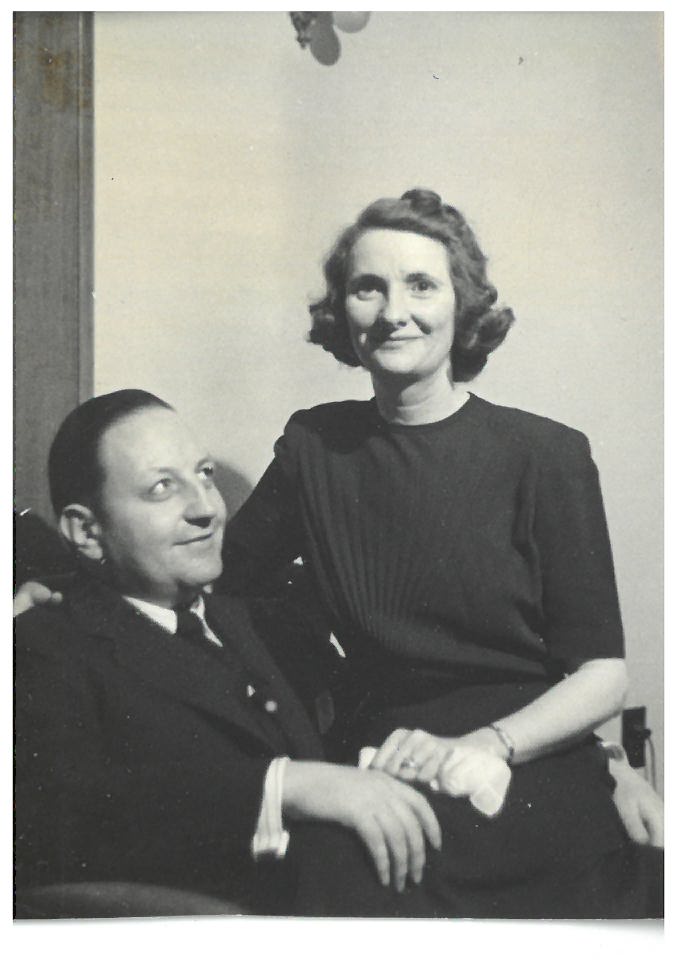
A candid photograph of Kenneth and Helen Spencer, probably dating from the 1940s
A candid photograph of Kenneth and Helen Spencer, probably dating from the 1940s. Robert S. Lemon Photographs. Call Number: RH PH P2837, Folder 2. Click image to enlarge.

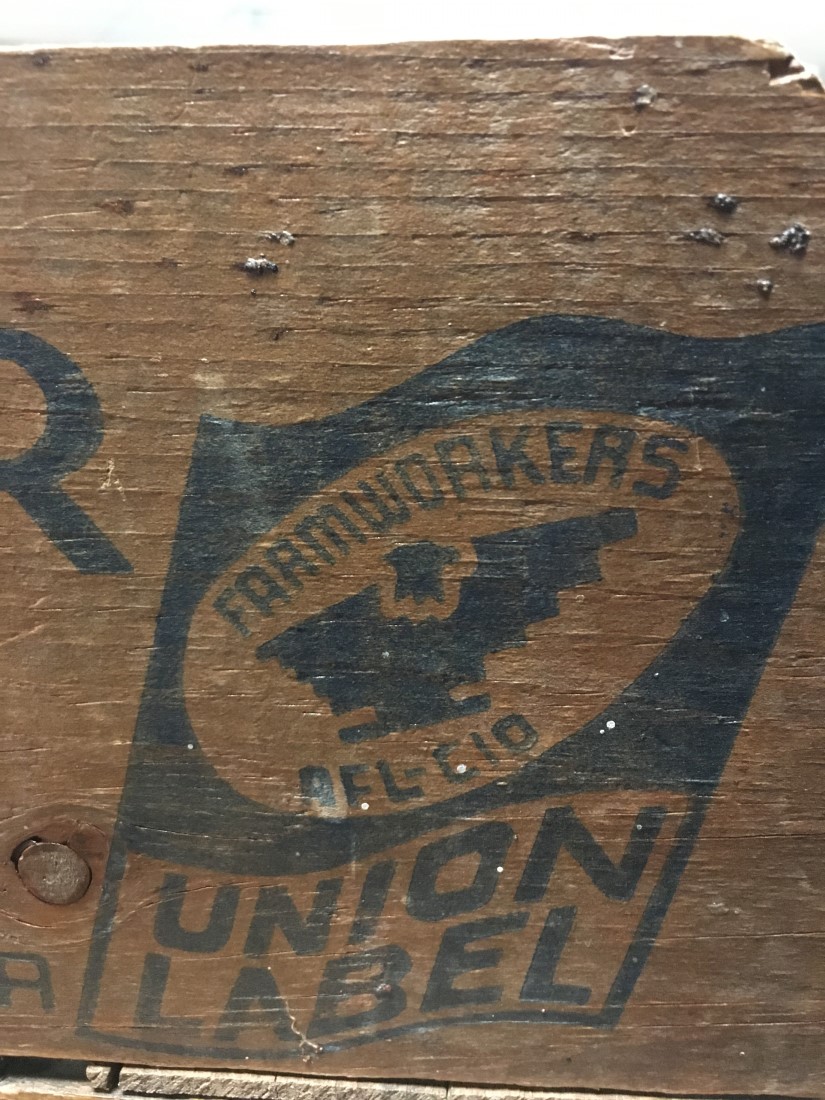
The United Farm Workers collection, part of the Wilcox Collection of Contemporary Political Movements, includes this wooden pickers’ crate proudly displaying the Farm Workers’ stamp:
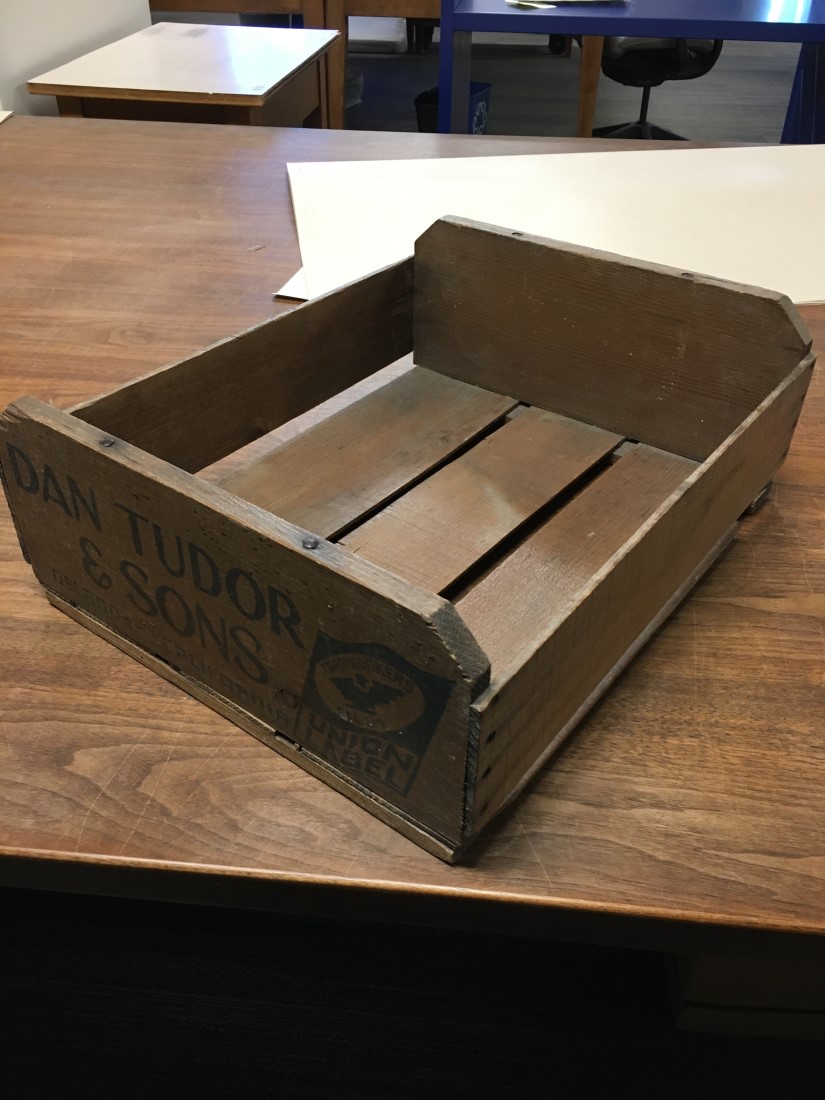
Photograph of a wooden pickers’ crate displaying the United Farm Workers' stamp
Photograph of the detail of a United Farm Workers' stamp on the wooden pickers’ crate
A wooden pickers’ crate displaying the United Farm Workers’ stamp. United Farm Workers Collection. Call Number: RH WL MS Q8, Box 2. Kenneth Spencer Research Library, University of Kansas. Click images to enlarge.

Edith Krull, a freelance art critic and journalist, reviewed and saw a wide variety of art exhibits in East Germany during the latter half of the twentieth century, presumably including this showing of Budapest-born artist Gabriella Billege:
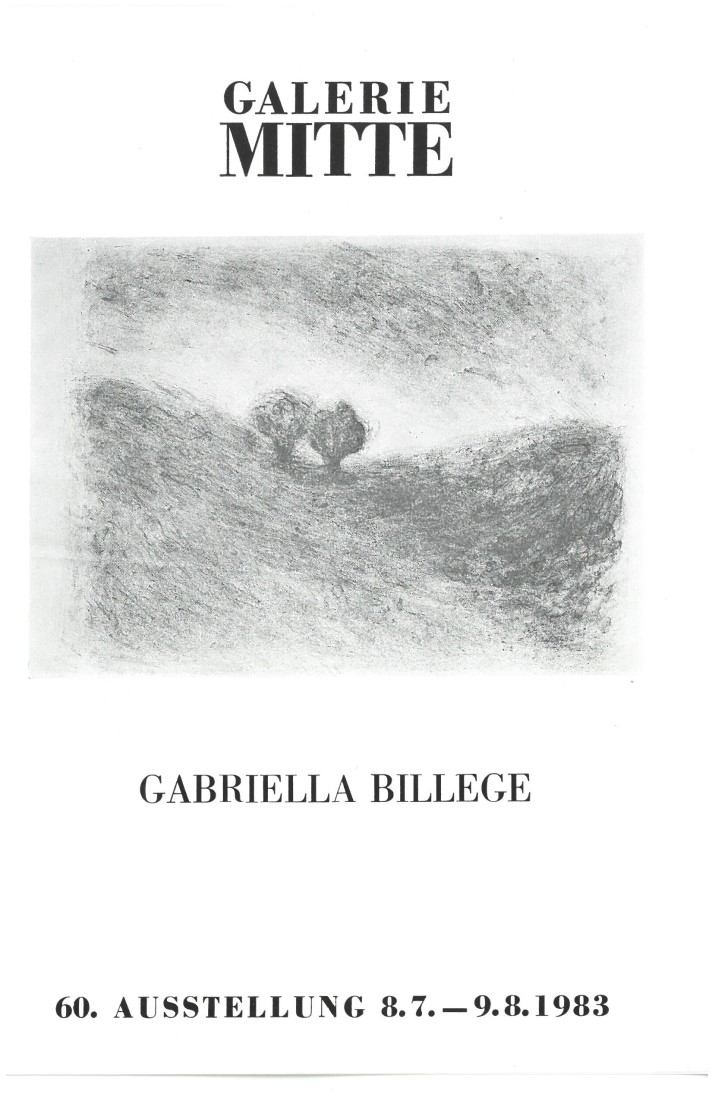
Front cover of a leaflet from the Berlin Gallerie Mitte for a 1983 show of Gabriella Billege’s works
Front cover of a leaflet from the Berlin Gallerie Mitte for a 1983 show of Gabriella Billege’s works. Edith Krull Collection. Call Number: MS 345, Box 1, Folder 34. Click image to enlarge.

Harold Orel’s 1941 “Books I Have Read” journal may not at first glance appear visually appealing, but his witty writing style makes for entertaining reading.
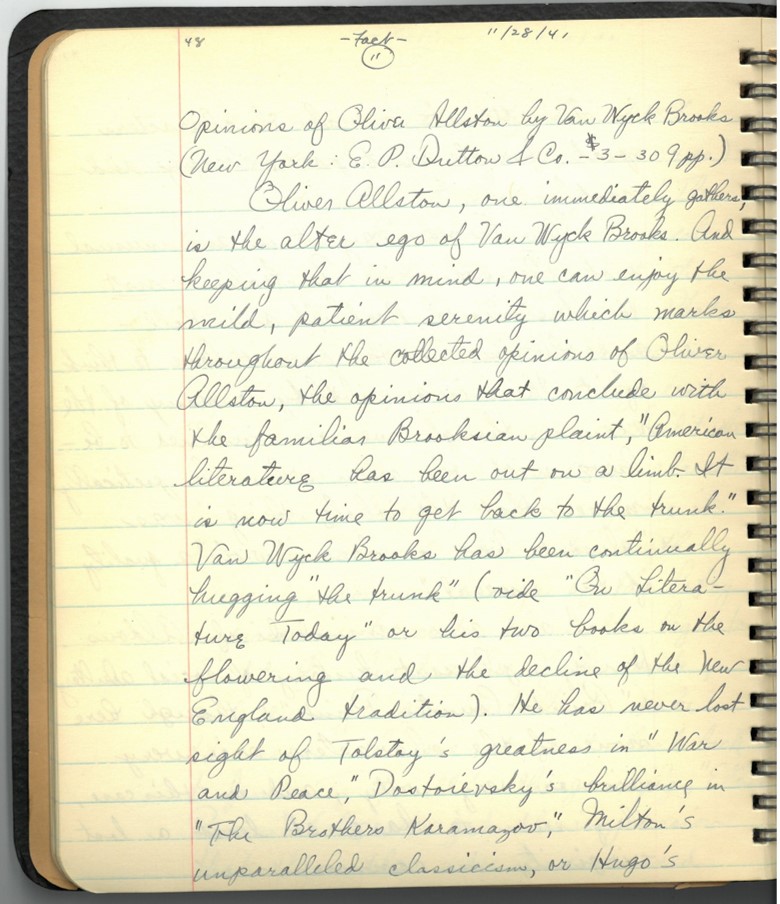
Photograph of a page from Harold Orel’s reading journal, discussing one of the books he read as a teenager in November 1941
A page from Harold Orel’s reading journal, discussing one of the books he read as a teenager in November 1941. The entry foreshadows Orel’s future career as an English professor at KU. Personal Papers of Harold Orel. Call Number: PP 615, Box 30. Click image to enlarge.

Please feel free to perform research in any of the newly processed collections listed below and see what catches your eye!

Banks family papers, 1921-2017 (RH MS 1488, RH MS-P 1488, RH MS R453)

Clyde Bysom collection, 1925-2015 (RH MS 1493, RH MS-P 1493, RH MS Q459)

Brent Campney research on racist violence against African Americans, 1863-2001 (bulk 1863-1920s) (RH MS 1492, RH MS Q458)

James B. English letters, 1968-1969 (RH MS 664)

Gilbert H. Finlay Order of Eastern Star scrapbook material, 1966-1989 (RH MS 1491)

Gerladine Mowbray-Arnett collection, 1908-2000 (RH MS 1489)

Hiat-Hett family genealogy collection, 1879 (RH MS P966)

Emmanuel Jones scrapbook, 1891-1947 (RH MS E210)

Henry C. Kollings photographs, 1906-1968 (RH PH 546, RH PH 546(f))

Robert S. Lemon photographs, 1920s-approximately 1944 (RH PH P2837)

Margaret Verhage collection, 1892-1951 (RH MS P967)

Mike Kautsch collection of William Allen White materials, majority of material found within 1929-1986 (RH MS 1494)

Ernesto Alvarado Garcia, 1939-1966 (MS 64, MS Qa26)

Jack E. Lorts collection of Larry Eigner correspondence and manuscripts, January 1960-February 26, 1962 (MS 352)

Bolton Company letters, 1695-1711 (MS 84)

Edith Krull collection, 1952-1990 (MS 345, MS Q77, MS Qa24, MS R20, MS S8)

Personal papers of Richard F. Johnston, 1962-1986 (PP 612)

Personal papers of Kala Stroup, 1959-2018 (PP 613)

Personal papers of Alton Thomas, 1948-1987 (PP 614)

Personal papers of John Walter Pozdro, 1940s-2000s (PP 616)

Personal papers of Harold Orel, 1941-2012 (PP 615)

Backus family newspapers collection, 1795-1870, 1889 (MS R24, MS Q85, MS Qa30, MS S12, MS P748)

A. Doyle Moore collection, 1967-1988 (MS 357, MS Q87)

Linda Kay Davis collection of Ed Sanders materials, 1967-2011 (MS 356, MS Q86)

Records of the Emily Taylor Center for Women & Gender Equity, 1966-2019 (RG 76/3, several CT call numbers)

John Coelln papers, 1961-1975 (RH WL MS 54)

United Farm Workers collection, 1966-1979 (RH WL MS 53, RH WL MS Q8)

Michael Zweig papers, 1964-1971 and undated (RH WL MS 55, RH WL MS Q9)

Sharon Feldman papers, 1963-1993 (RH WL MS 56, RH WL MS Q10)

George Cruse autograph album, 1901 (RH MS P968)

Hutchinson, KS Cyrus Cauldron souvenir photo book, approximately 1920s (RH PH P2838)

Dwight Eisenhower speaking at Abilene, June 22, 1945 (KC AV 90)

R.H. Gandiven and R. Hugoboom photographs, 1883-1884 (RH PH 547(f))

Barbara Hays Duke papers, 1909-2006, 2016 (RH MS 1495, RH MS-P 1495(f), RH MS Q462)

Peace Mennonite Church records, 1978-2018 (RH MS 1496)

Fred Six papers, 1929-2011 (RH MS 1506, RH MS Q467)

John Kessel papers, 1969-2019 (MS 358, MS Q88, MS Qa31, SC AV 25)

Personal papers of David Frayer, 1972-2012 (PP 619)

Marcella Huggard
Archives and Manuscripts Processing Coordinator
Throwback Thursday: Home Away From Home Edition

January 16th, 2020

Each week we’ll be posting a photograph from University Archives that shows a scene from KU’s past. We’ve also scanned more than 34,800 images from KU’s University Archives and made them available online; be sure to check them out!

Welcome back, Jayhawks! Students will be returning to campus over the next few days to get ready for the start of the spring semester next week.

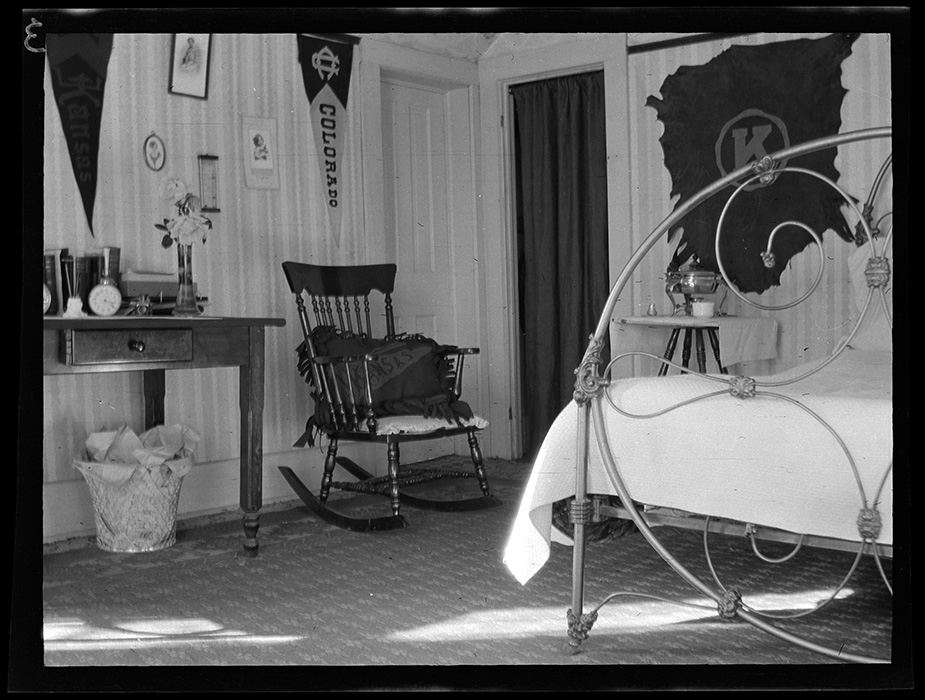
Photograph of a KU student's decorated bedroom, 1911
A KU student’s decorated bedroom, 1911. Note the KU wall hanging, pennant, and pillow. University Archives Photos. Call Number: RG 71/0 1911: Student Activities (Photos). Click image to enlarge (redirect to Spencer’s digital collections).

A KU History article about Corbin Hall – KU’s first residence hall, which opened in 1923 – noted that “originally there were no University-owned dormitories for students at the University of Kansas. During KU’s early years, housing was catch-as-catch-can, with many of the students in attendance usually hailing from the surrounding area. As such, many lived at home, or with faculty, or in other private residences.”

Caitlin Donnelly
Head of Public Services

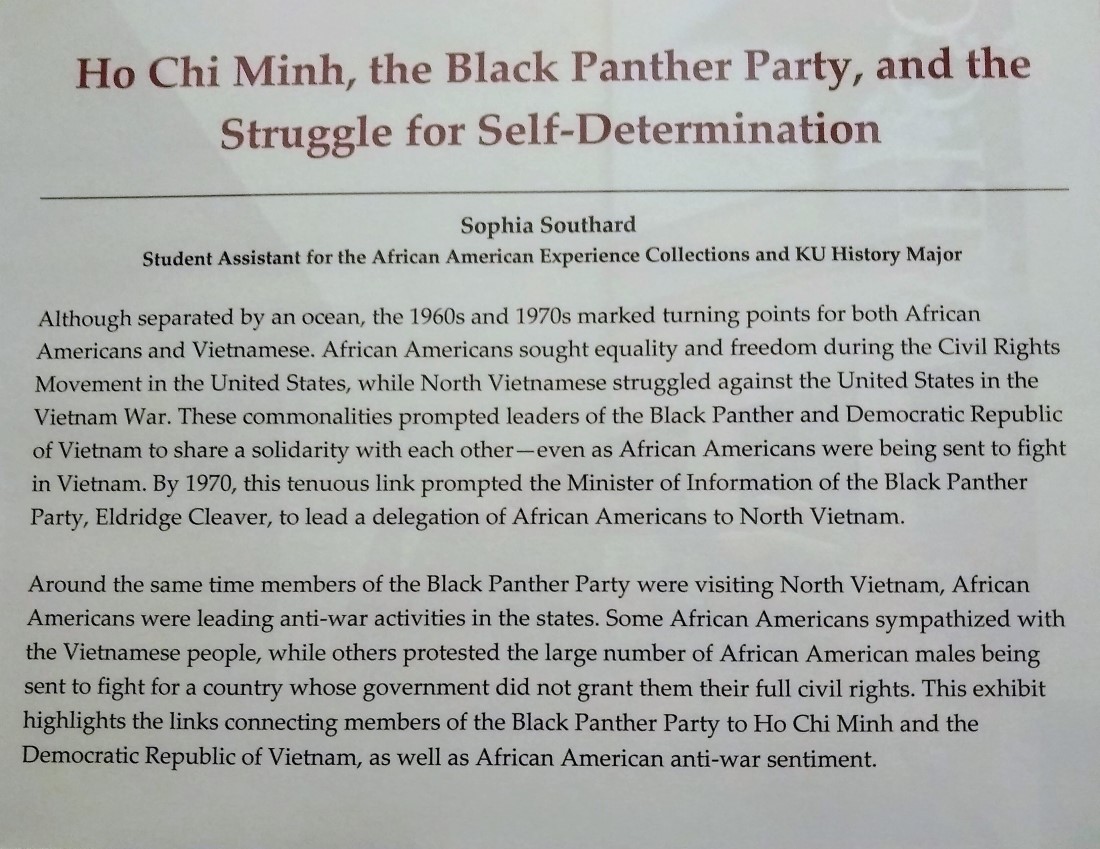
Ho Chi Minh, the Black Panther Party, and the Struggle for Self-Determination

January 15th, 2020

The temporary exhibit described in this post will be on display in Spencer’s North Gallery through the end of January.

Photograph of one of the title labels in the Ho Chi Minh temporary exhibit
One of the title labels in the Ho Chi Minh temporary exhibit. Click image to enlarge.

As a student assistant for the African American Experience Collections, I recently had an opportunity to produce a temporary exhibit in Kenneth Spencer Research Library.

After reviewing the 1968-1970 issues of The Black Panther, which was published by the Black Panther Party in Oakland, California, I uncovered an astonishing connection linking African Americans and Asians: In 1969 and 1970, the Minister of Information of the Black Panther Party, Eldridge Cleaver, led delegations of African Americans to visit North Vietnam, North Korea, and China.

Although I would have loved exploring the connections between the Black Panther Party, North Korea, and China, as a Vietnamese-American, I found myself inextricably drawn to the history of Ho Chi Minh and the Democratic Republic of Vietnam. With the topic of my temporary exhibit decided, I scoured Kenneth Spencer’s collections in search of material relating to Ho Chi Minh and the Black Panther Party.

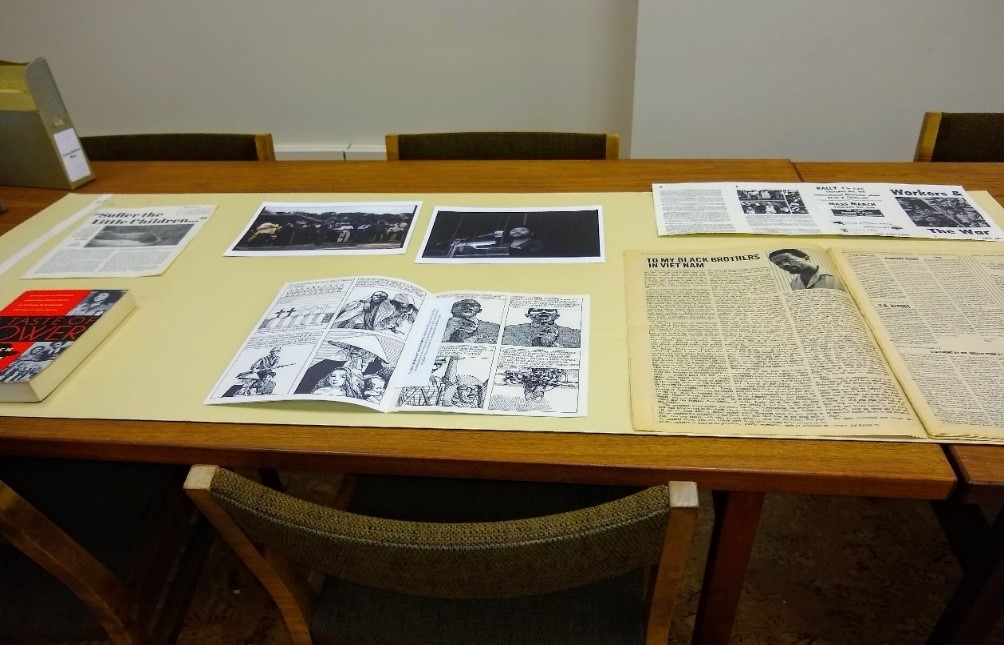
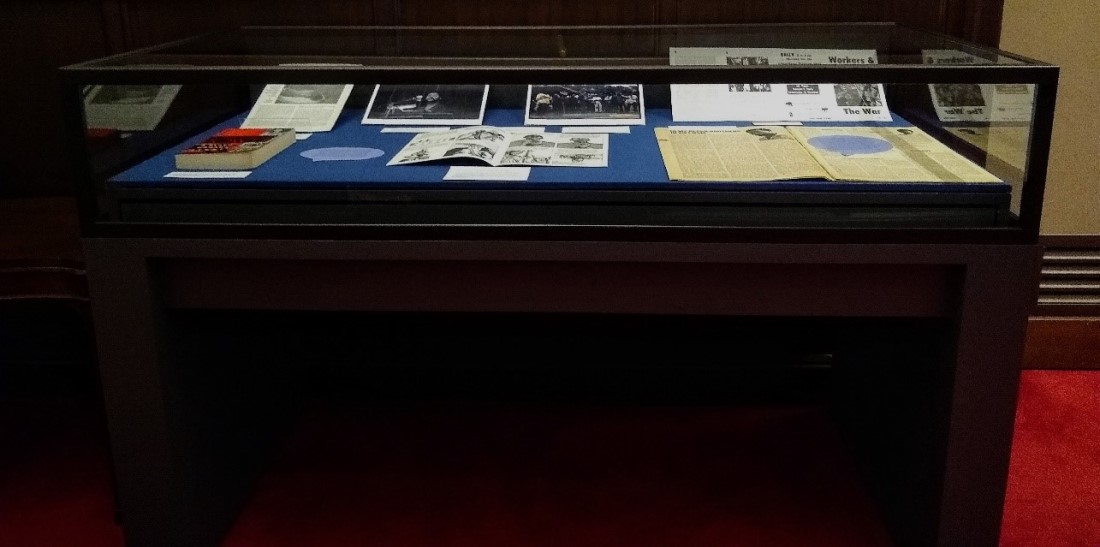
Photograph of the Ho Chi Minh temporary exhibit under development
Developing my temporary exhibit. Shown here is the second exhibit case focusing on African American anti-war sentiment. Click image to enlarge.

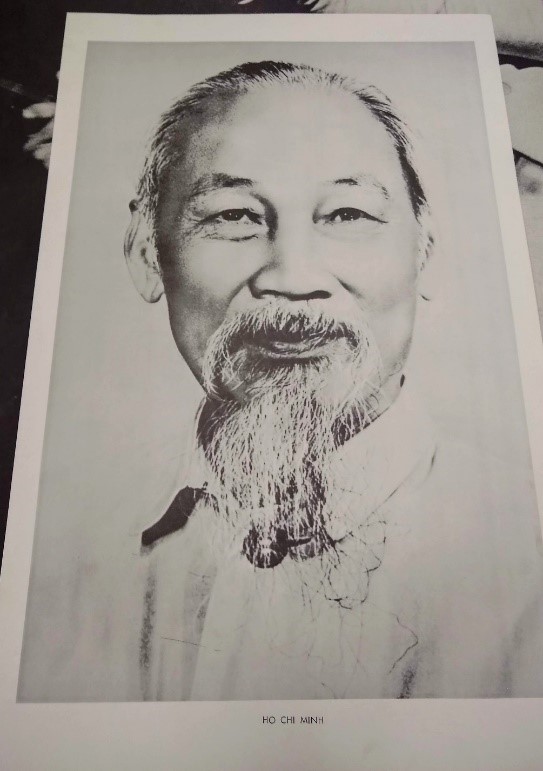
For my first exhibit case, I decided to focus solely upon Ho Chi Minh. (Notably, Ho Chi Minh is one of many pseudonyms he adopted.) I found two Black Panther Party newspapers in the African American Experience Collections but for the rest of my materials, I went digging around in the Wilcox Collection. I was fortunate enough to find a wonderful poster of Ho Chi Minh in the Counter Culture Posters Collection, along with two primary sources written by Ho, including Ho Chi Minh Answers President L.B. Johnson (Call Number: RH WL B3690) and Against U.S. Aggression for National Salvation (Call Number: RH WL B3593).

A poster of Ho Chi Minh, circa 1960s-1970s
A poster of Ho Chi Minh, circa 1960s-1970s. Counter Culture Posters Collection. Call Number: RH MS R23, Folder 3. Click image to enlarge.

Around the same time I was creating my temporary exhibit, I was also participating in an independent study relating to eighteenth-, nineteenth-, and twentieth-century Vietnamese history. There I learned that in 1924 Ho Chi Minh had penned two essays titled “Lynching” and “the Ku Klux Klan.” In these essays, Ho Chi Minh wrote about the violence and racism African Americans faced in the United States, demonstrating his awareness of the oppressions endured by peoples outside Vietnam. It is highly probable that Ho read documents published from the NAACP’s anti-lynching campaign, which included information and statistics about African Americans lynched in the United States each year beginning in 1909. However, it is also worth noting that Ho worked aboard a steamship and traveled internationally to the United States, France, England, and other European countries.

Some of the most memorable quotes from his essay on “Lynching” include:

  • “After sixty-five years of so-called emancipation, American Negroes still endure atrocious moral and material sufferings, of which the most cruel and horrible is the custom of lynching.”
  • “From 1899 to 1919, 2,600 Blacks were lynched, including 51 women and girls and ten former Great War soldiers.”
  • “Among 78 Blacks lynched in 1919, 11 were burned alive, three burned after having been killed, 31 shot, three tortured to death, one cut into pieces, one drowned and 11 put to death by various means.”
  • “Georgia heads the list with 22 victims. Mississippi follows with 12. Both have also three lynched soldiers to their credit.”

Upon Ho Chi Minh’s death, The Black Panther’s newspaper issue printed on September 13, 1969, included these two essays, along with an essay commemorating Ho’s death. However, Ho wrote these essays almost four decades before the Black Panther Party newspaper issues were printed in 1968-1970, during the height of the Vietnam War (1955-1975).

In addition, I also wanted to showcase the Black Panther Party’s anti-Vietnam propaganda and demonstrations. Once again, I found myself digging around in the Wilcox Collection. Among the items I chose for the second exhibit case include A Taste of Power: A Black Woman’s Story by Elaine Brown (Call Number: RH WL C2210). Brown acted as the Black Panther’s Southern California Chapter’s Deputy Minister of Information. Brown also accompanied Eldridge Cleaver on his visits to North Vietnam, North Korea, and China.

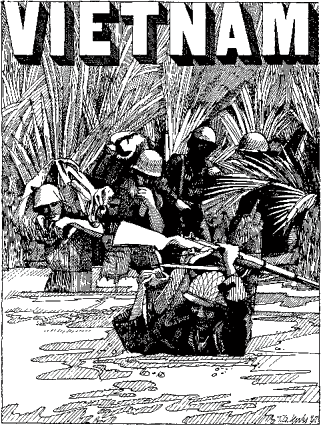
One of my favorite items in the exhibit is Vietnam: An Anti-War Comic Book by Julian Bond, a founder of the Atlanta sit-in movement and of the Student Nonviolent Coordinating Committee (SNCC). The comic book is a piece of anti-war propaganda that highlights the connections between the struggles of African Americans and the Vietnamese people during the 1970s.

Photograph of the cover of Vietnam: An Anti-War Comic Book by Julian Bond
Vietnam: An Anti-War Comic Book by Julian Bond. Frederick Allan Whitehead Papers. Call Number: RH MS 162, Box 8, Folder 8. Click image to enlarge.
Photograph of the Ho Chi Minh temporary exhibit
The finished exhibit. Click images to enlarge.

A huge thank you to Caitlin Donnelly Klepper, Angela Andres, and Letha Johnson for helping me at various stages of my exhibit, as well as to my supervisor, Deborah Dandridge, for supporting my interest in exploring a fascinating side of history that was unknown to me at the time that Kenneth Spencer Research Library provides in its variety of collections of resources. Another thank you to the staff and students at the Reading Room reference desk, who helped me with my requests.

Sophia Southard
African American Experience Collections Student Assistant

Throwback Thursday: Team Portrait Edition

January 9th, 2020

Each week we’ll be posting a photograph from University Archives that shows a scene from KU’s past. We’ve also scanned more than 34,800 images from KU’s University Archives and made them available online; be sure to check them out!

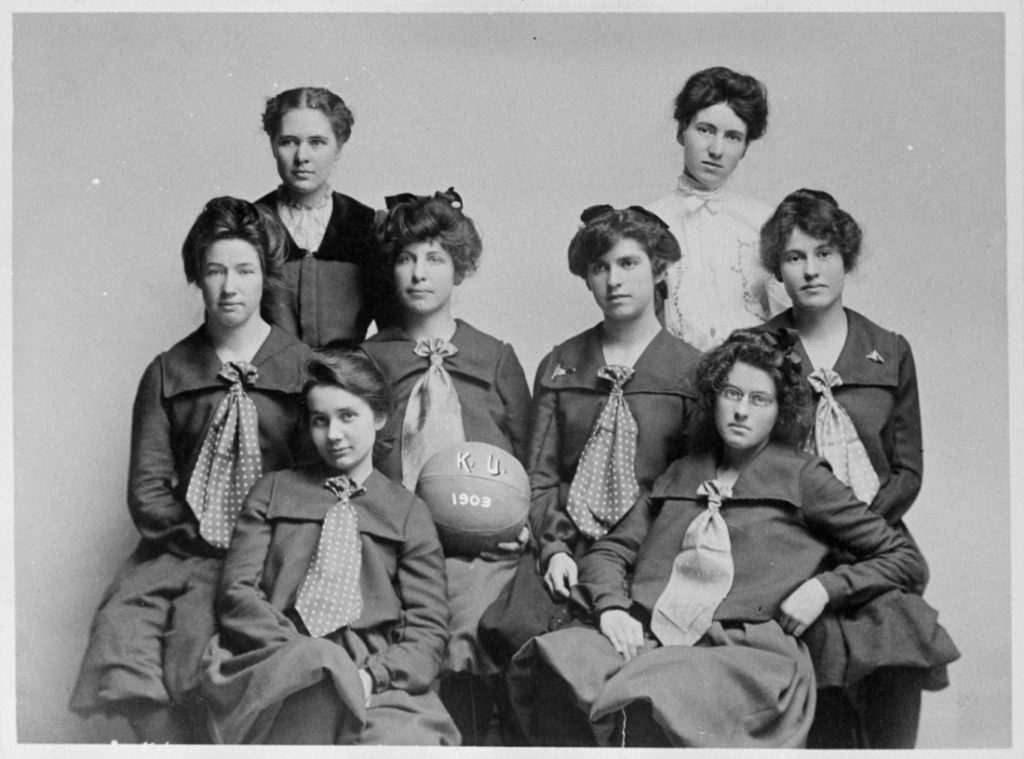
Photograph of the KU women's basketball team, 1902-1903
The KU women’s basketball team, 1902-1903. University Archives Photos. Call Number: RG 66/20/13 1902/1903: Athletic Department: Women’s Basketball (Photos). Click image to enlarge (redirect to Spencer’s digital collections).

See Spencer’s online exhibition Women’s Athletics at KU: From Physical Education to Recognized Athletic Program for more information about the history of women’s basketball and other sports at the university.

Caitlin Donnelly
Head of Public Services

Meet the KSRL Staff: Shelby Schellenger

January 7th, 2020

This is the latest installment in a recurring series of posts introducing readers to the staff of Kenneth Spencer Research Library. Today’s profile features Shelby Schellenger, who joined Spencer in October as the Reference Coordinator.

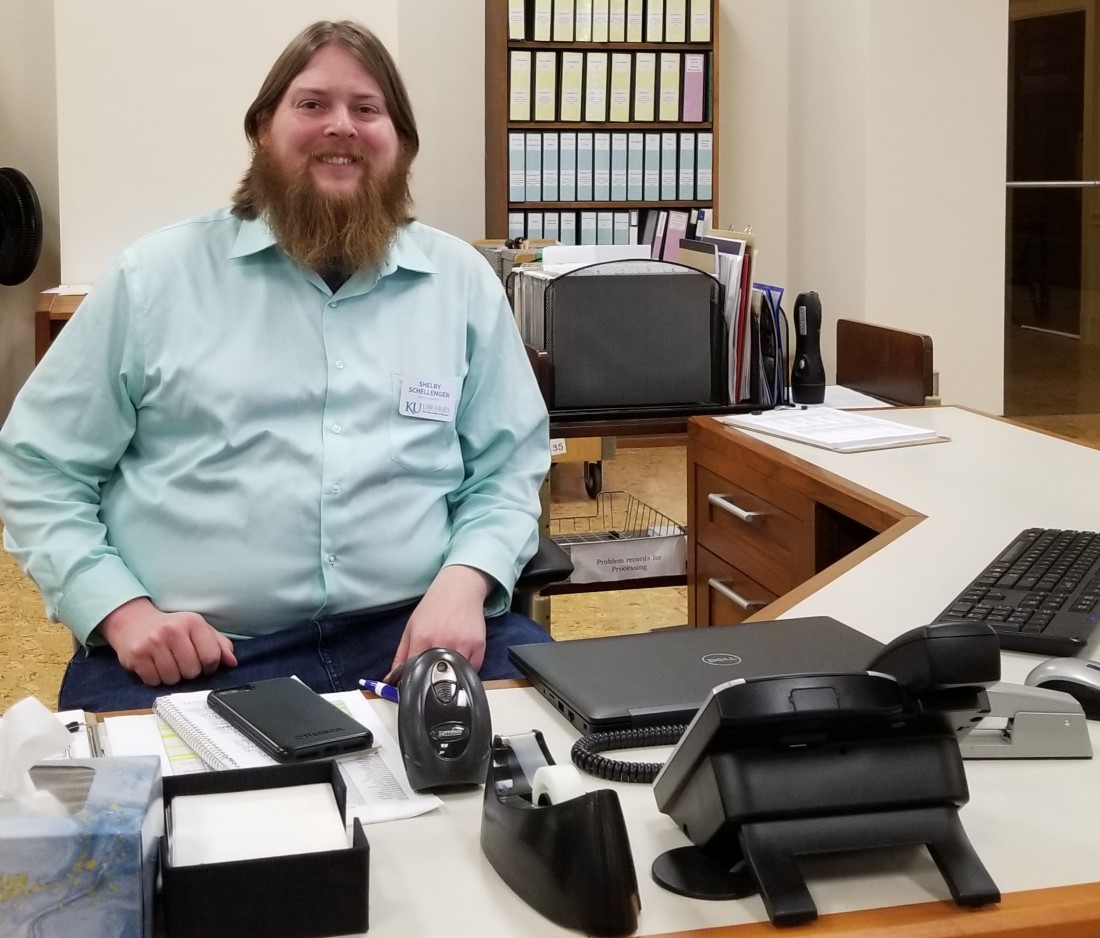
Photograph of Shelby Schellenger at Spencer's reference desk
Spencer’s new Reference Coordinator Shelby Schellenger where you’ll most frequently find him – at the reference desk. Click image to enlarge.
Where are you from?

I was born and grew up in a little town southeast of Wichita called Rose Hill. I’ve visited a number of places throughout the U.S., but have always lived in Kansas. I spent about ten years in Manhattan and five years in Topeka; I’m now working on a couple of years here in Lawrence.

What does your job at Spencer entail?

My job at Spencer is the Reference Coordinator. In the main, this involves spending my day helping patrons at the reference desk or digitally to locate and use materials from Spencer. I need to develop a good overall knowledge of the collections (I can’t know everything in detail), use good research strategies, and communicate well with patrons and the staff and curators who have expert knowledge in the particular subjects they oversee.

How did you come to work in Public Services?

In kind of a strange and convoluted way. I started my undergraduate studies in Computer Science, switched to Business Administration, managed a comic book store, worked in retail, worked in customer service, got laid off, and realized that libraries are and have always been an important part of my life. I went on to get my Master of Library Science degree and worked my way up at the Topeka and Shawnee County Public Library. When I saw this position at Kenneth Spencer Research Library I realized it would be focused on exactly the parts of librarianship I most enjoy and had to give it a shot.

What is one of the most interesting/strangest items you’ve come across in Spencer’s collections?

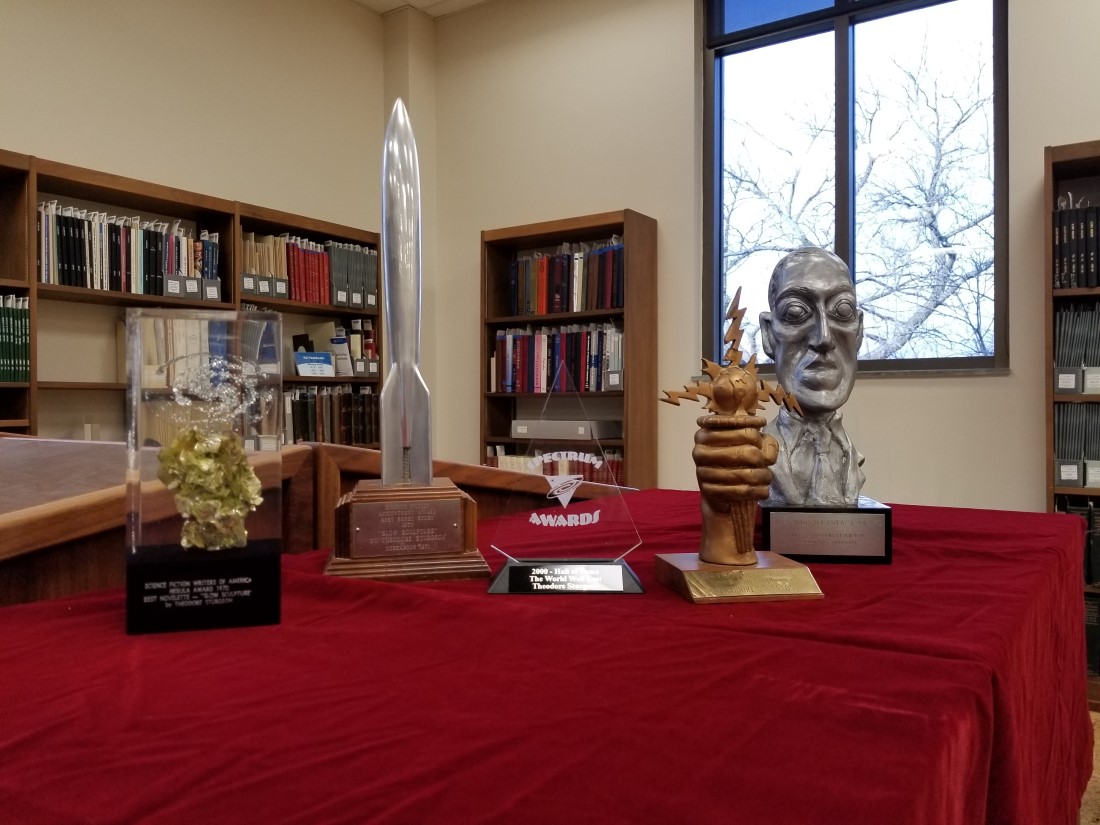
One of the most interesting things I’ve come across in Spencer’s collections are the various literary awards. I read primarily in science fiction and fantasy and it was exciting to find out we have Theodore Sturgeon’s Hugo Award, World Fantasy Award, International Fantasy Award, Nebula Award, Spectrum Award, and more! These awards mark stories I often add to my long, long to-be-read list. These are also the awards that inspire that “maybe one day” sort of feeling in me when I think about doing a little writing. It really brings home that Spencer’s collections contain more items and types of items than can be easily shared and explained. It is always worth checking if you think a little research is in order!

Photograph of a selection of science fiction awards in Spencer's collections
A selection of science fiction awards in Spencer’s collections. Click image to enlarge.
What part of your job do you like best?

I like being part of that moment when someone finds something that amazes them. Maybe it is a photograph from the 1800s that really connects someone to an unknown relative. Maybe it is a handwritten letter talking about not very much that brings home that people are much the same as they have always been. Maybe it is finding a copy of a student publication they helped with years ago and never expected to see again. That moment amazes me.

What are some of your favorite pastimes outside of work?

I am big into board games. I try and make it to a couple of events (or more) a month and have a collection that threatens my bookshelves and closet space. I tend to prefer strategy games at a medium to heavy complexity with some favorites ranging from space exploration to running a vineyard. I also have two dogs and am getting back into anime, something I have fallen a bit behind on.

What piece of advice would you offer a researcher walking into Spencer Research Library for the first time?

If at all possible, take it slowly. Give yourself the time to absorb things and explore related items. The stories you will find may be worth it!

Shelby Schellenger
Reference Coordinator