Welcome to the Kenneth Spencer Research Library blog! As the special collections and archives library at the University of Kansas, Spencer is home to remarkable and diverse collections of rare and unique items. Explore the blog to learn about the work we do and the materials we collect.
This blog may contain archived web content. This blog may link to catalog records which no longer exist as of a software change in 2026.
I am pleased to announce major changes to our policies and procedures at Kenneth Spencer Research Library. We will no longer ask patrons to seek our permission before using copies of our collection materials. Spencer Research Library is doing more than ever to make it possible for people to use our materials with as few barriers as possible.
A screenshot of the new New Reproduction Request form in Aeon. Click image to enlarge.
We recently enabled patrons to initiate the copy request process through our Aeon management system, streamlining the process for both staff and users. We decided to use this technological change as the impetus to fundamentally re-imagine our relationship with digital images of items from our collections. This approach is in keeping with KU Libraries’ emphasis on supporting open access and advocating for public accountability for the investments in public higher education.
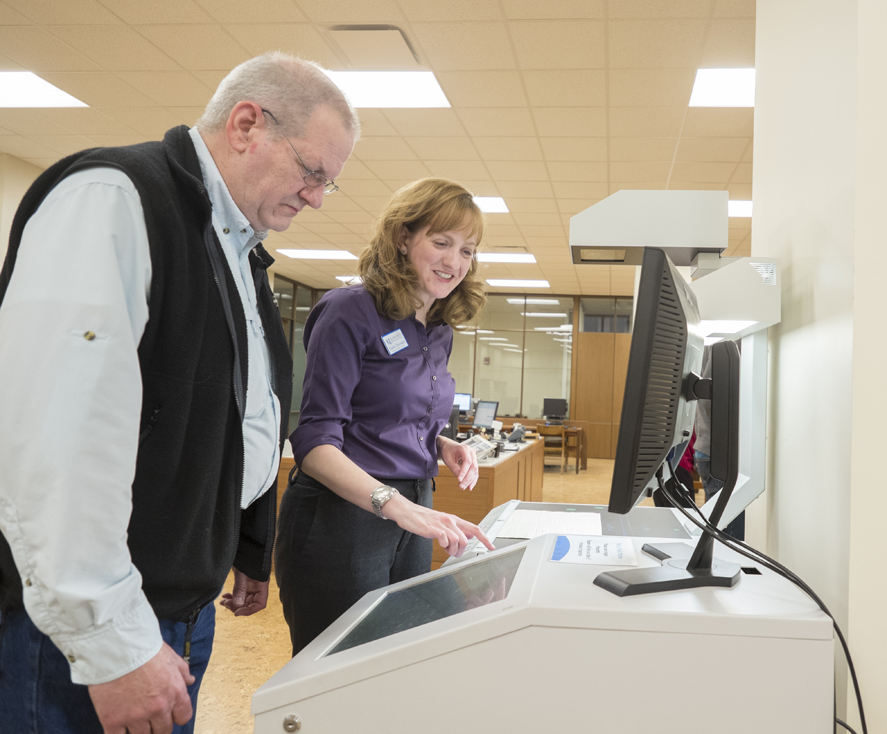
For many years now, we have allowed users to make copies of much of our collection material themselves, using either an overhead scanner in the Reading Room or their own equipment. We also make copies available when an item’s condition or format requires special handling, for a modest charge. No matter whether patrons use their own equipment or our skilled staff do the copying, patrons will no longer be expected to complete a separate form asking for “permission to publish,” as was previously required when images from our collections were to be used in exhibits, publications, or other works.
Head of Public Services Caitlin Donnelly Klepper assisting a researcher with the overhead scanner in the Reading Room at Spencer Research Library. Click image to enlarge.
We continue to inform users of their responsibilities to follow copyright law, and we provide enhanced guidance on how to do so. We also continue to honor restrictions on some specific collections necessitated by the condition of the material, donor restrictions, or other concerns. We are in the midst of revisiting our previously digitized collections to clearly indicate the copyright status (where known) and how the images can be used. Expecting researchers to seek our permission for fair use of materials smacks of what has been termed “copyfraud,” or claiming to possess rights one does not actually hold. We also realize that users have always been free to use images as they like, and that in effect, researchers who chose to follow our rules were punished with additional hurdles.
In the Reading Room, users will now experience a less complex process. If the material they are using for research can be safely copied by them, they simply need to be careful in their scanning and metadata creation. If library staff need to be involved, reference librarians will help them translate their Aeon checkout into a duplication request, and our copy services manager will take it from there.
Remote users will also see a different process. Instead of filling out a paper form and sending it to our copy services manager, they will use the Aeon system to complete their request. Then, the transaction will proceed as in the past, without the need to complete a permission to publish form.
Our website provides more guidance about these steps. We look forward to helping all our users learn our new processes and are happy to assist in any way.
Beth M. Whittaker Associate Dean for Distinctive Collections Director of Spencer Research Library
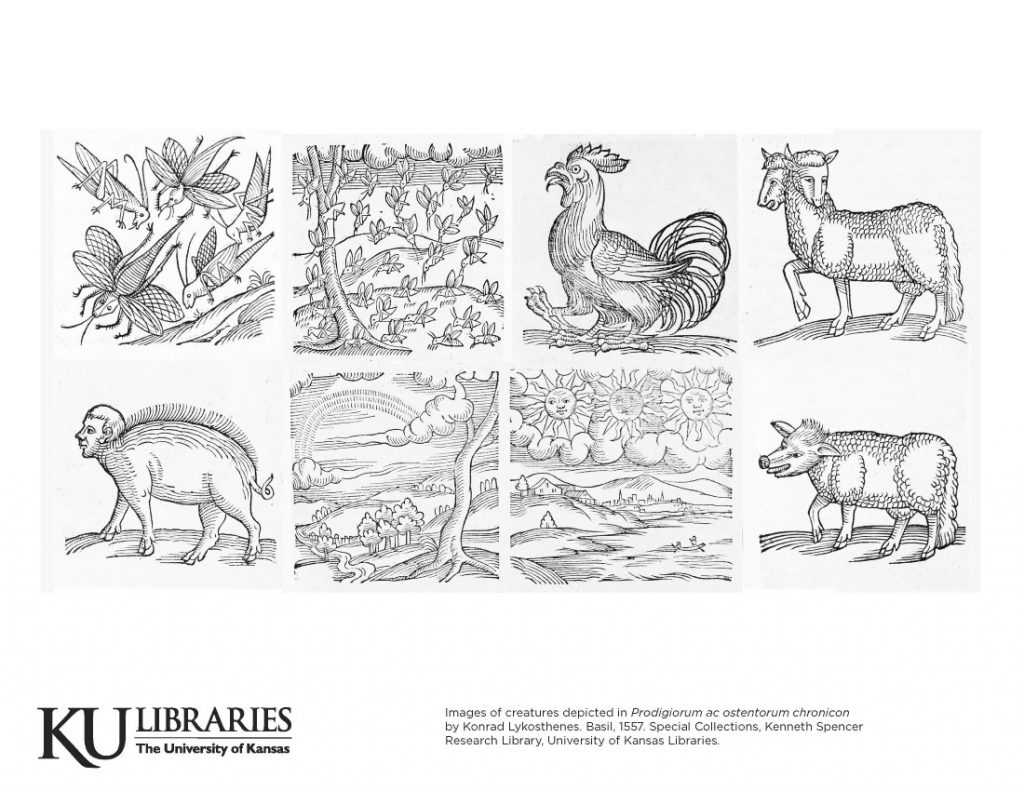
It’s the fourth-annual Color Our Collections week! Started by the New York Academy of Medicine Library in 2016, Color Our Collections is a week of coloring fun where libraries, archives, and other cultural institutions around the world share coloring pages that feature their collection materials.
KU Libraries is pleased to share this year’s submission for
the annual week of coloring craziness. Featuring the collections at Spencer
Research Library, this year’s coloring book celebrates nature, history, and
even mythical creatures! You
can download and print the book via the Color Our collections website.
While you are there, be sure to check out the submissions from our colleagues
at other institutions!
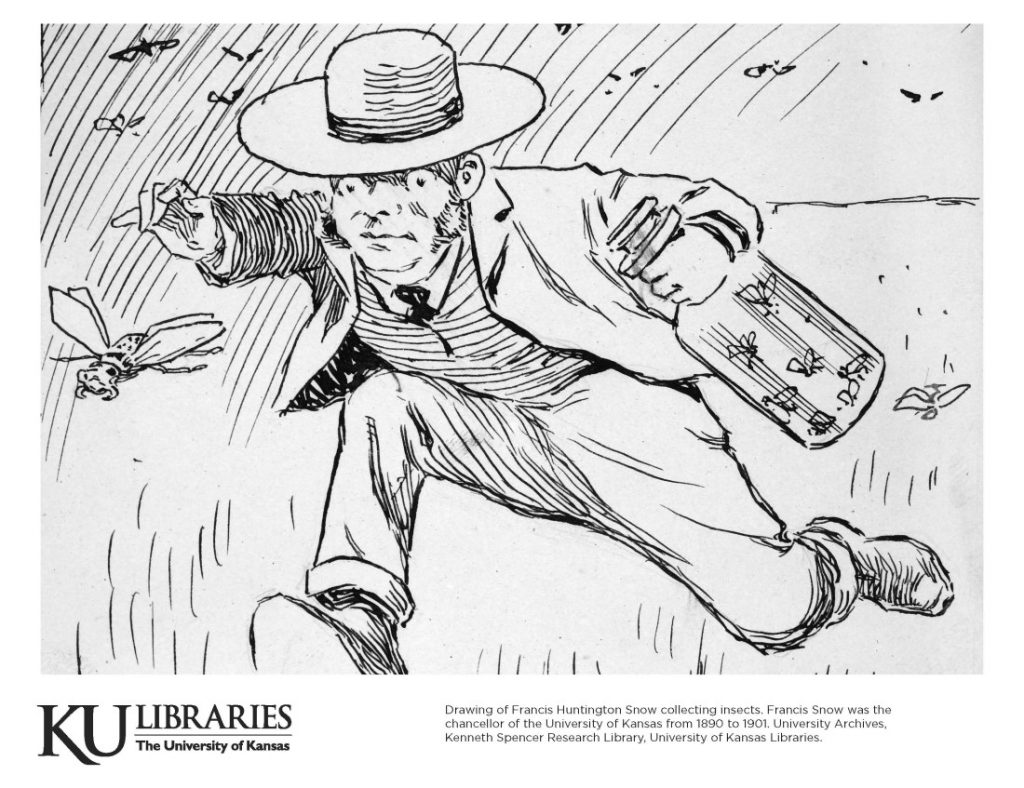
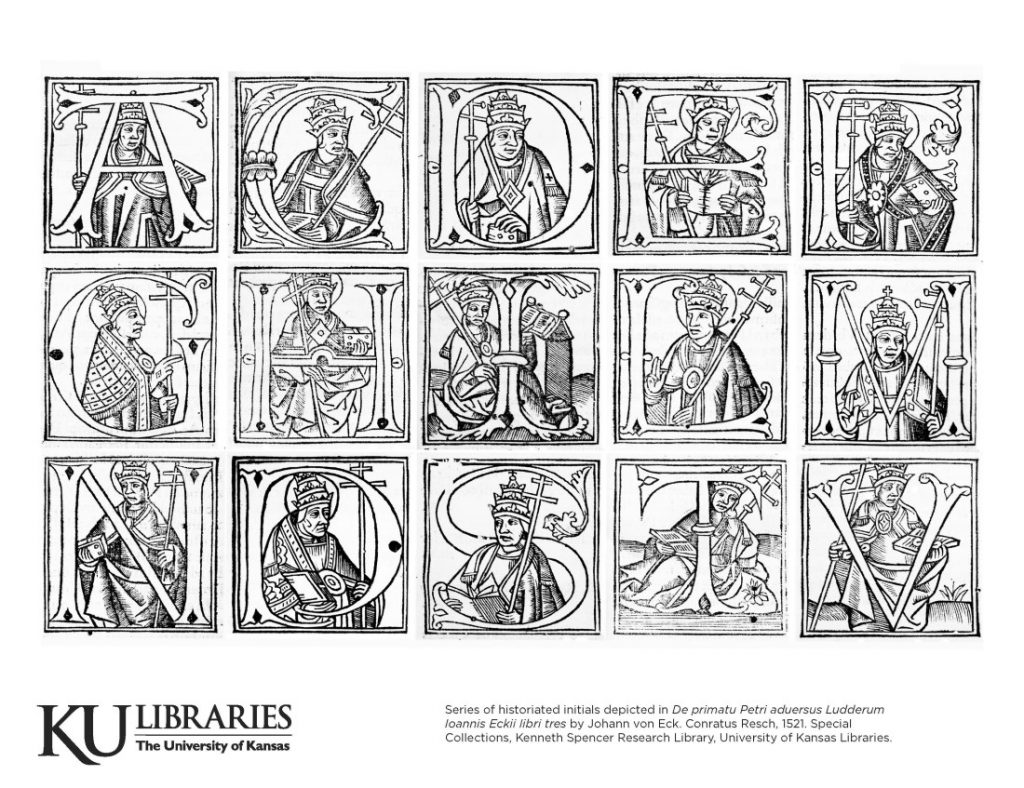
As a preview, here are three pages from the book. Click on the images to enlarge them.
Are you a fan of the collections at Spencer? Have you ever
come across an image in our materials that would make a great coloring page?
Tell us about it in the comments or email us at ksrlref@ku.edu!
Each week we’ll be posting a photograph from University Archives that shows a scene from KU’s past. We’ve also scanned more than 34,800 images from KU’s University Archives and made them available online; be sure to check them out!
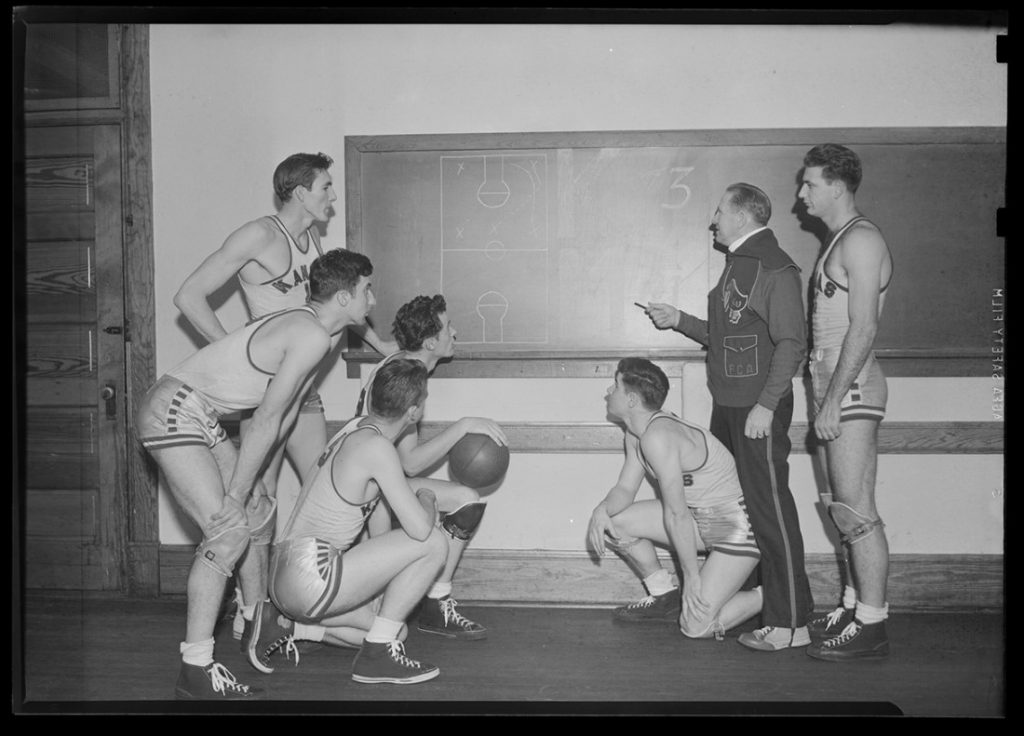
Phog Allen draws up a play on the blackboard while members of the basketball team look on, 1930s. University Archives Photos. Call Number: RG 66/22 Forrest C. Allen 1930s Negatives: Athletic Department: Coaches and Staff (Photos). Click image to enlarge (redirect to Spencer’s digital collections).
N. Kıvılcım Yavuz is conducting research on pre-1600 manuscripts at the Kenneth Spencer Research Library. Each month she will be writing about a manuscript she has worked with. The current KU Library catalog records (linked below) will be updated in accordance with her findings.
Kenneth Spencer Research Library, MS C247 is a thin parchment manuscript that was produced in the middle of the sixteenth century. It consists of 38 parchment leaves and contains a single text written in Humanistic cursive script by an unknown scribe: the Vita Capranicae [lit. Life of Capranica] by Giovanni Battista Bracciolini (1440–1470). A biography of Cardinal Dominicus Capranica (1400–1458), the Vita Capranicae is thought to have been composed in 1460s, shortly after the Cardinal’s death in 1458. The author of the biography, Giovanni Battista Bracciolini, was the second son of the renowned Italian humanist Poggio Bracciolini (1380–1459) and personally knew Cardinal Capranica; therefore, the biography is thought to be partly based on his first-hand knowledge and observations. The Vita Capranicae was first edited and published under the title Cardinalis Firmani vita in 1680 by Étienne Baluze (1630–1718) as part of his Miscellaneorum Liber Tertius. In this first edition, the text was divided into twenty-seven chapters and was misattributed to another Battista Poggio from Genoa. Over the centuries, the Vita Capranicae also was sometimes mistakenly attributed to Poggio Bracciolini himself and not to his son, as is the case in the older records of the Kenneth Spencer Research Library.
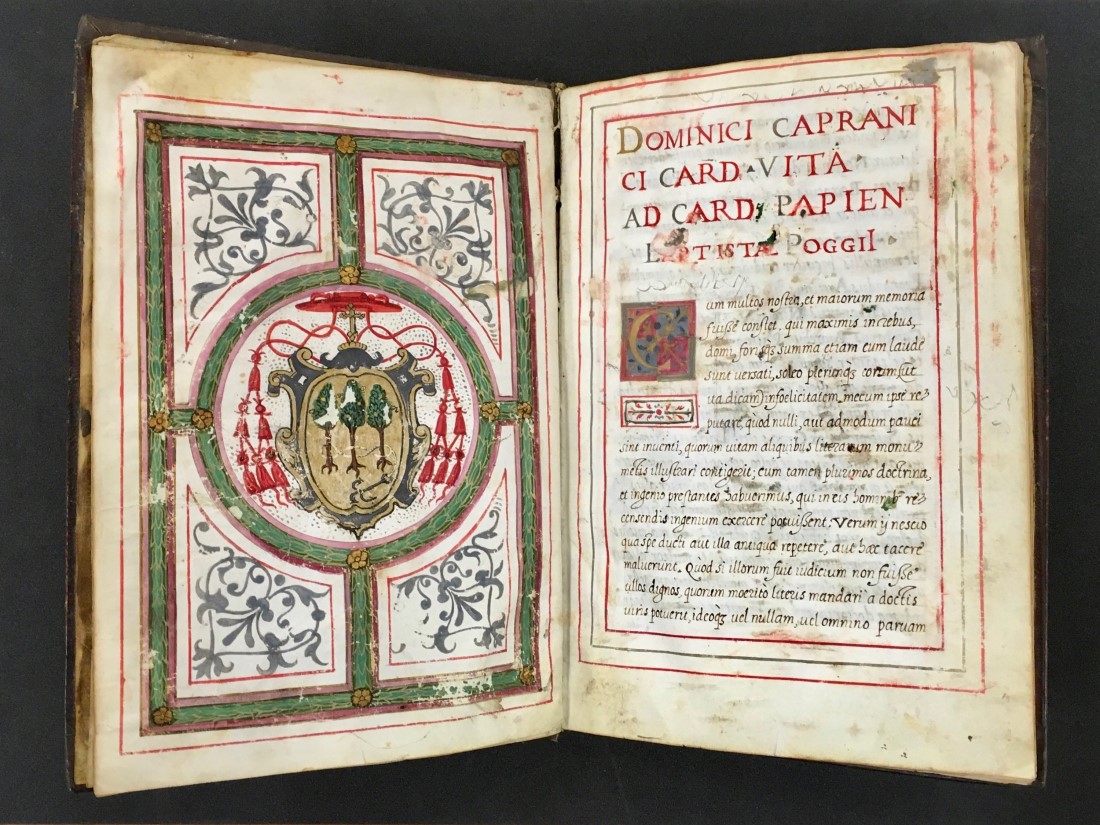
Left: Frontispiece with the coat of arms of Dominicus Capranica. Right: Beginning of the Vita Capranicae. Call Number: MS C247. Click image to enlarge.
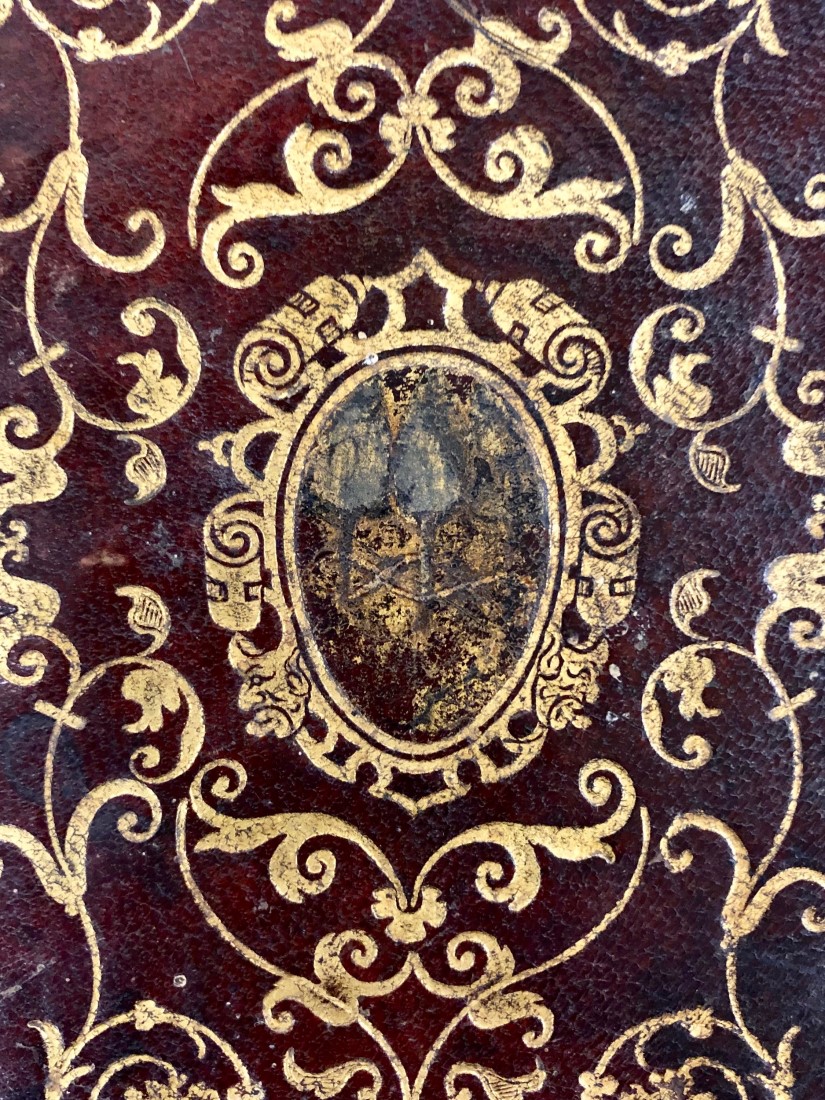
In MS C247 the text is preceded by a decorated frontispiece on folio 4v with the coat of arms of Dominicus Capranica. The coat of arms is charged with an anchor tied to a hawser intertwined around three uprooted Cypress trees on a golden field and adorned with a cross bottony and a red galero with six tassels in three rows on each side. The binding of the manuscript is contemporary to the copying of the text, possibly original. Based on stylistic features, it can be dated to the mid-sixteenth century like the text itself and was probably made in a workshop in Rome, Italy. In addition to delicate gold-tooling, the dark red leather binding also features the painted shield of Dominicus Capranica at the center of both covers.
Top: The binding featuring the shield of Dominicus Capranica. Bottom: Detail of the painted shield, now partly effaced, from the front cover. Call Number: MS C247. Click images to enlarge.
According to Ruut Kataisto, there are only nine surviving manuscripts containing the Vita Capranicae, one of which is Kenneth Spencer Research Library, MS C247. Even though it is not the earliest witness to the text, this is one of two manuscripts written on parchment (the other being Vatican City, Biblioteca Apostolica Vaticana, Vat. lat. 5882 dated to the fifteenth century) and the only one with the arms of Cardinal Capranica. As there is a frontispiece with the coat of arms of Dominicus Capranica at the beginning of the text and his shield is also featured on the binding, I think the manuscript might have been originally commissioned by a member of the Capranica family or by the Almo Collegio Capranica in Rome. Recognized as the oldest pontifical college in Rome, the Almo Collegio Capranica was founded by Cardinal Capranica in 1457 and had many notable ecclesiastics, including Pope Benedict XV and Pope Pius XII, among its students over the centuries. The coat of arms of Cardinal Capranica was adopted by the College and is still in use today.
Left: Bookplate of Frederick North, 5th Earl of Guilford in the middle of the front pastedown. Right: Ownership inscription of Rinaldo Ridolfini (“Ranaldus Ridolfinus”) and shelfmark of Sir Thomas Phillipps (“8274”). Call Number: MS C247. Click image to enlarge.
The exact origin of the manuscript is unknown but soon after its production, in the second half of the sixteenth century, it was probably in the possession of Rinaldo Ridolfini, a lawyer in Perugia, Italy, based on an inscription on folio 2r: “Ranaldus Ridolfinus.” Almost three centuries later, in 1822, the manuscript was purchased in Perugia by Frederick North (1766–1827), the 5th Earl of Guildford. Frederick North’s bookplate is pasted on the front pastedown (folio 1v) and two almost identical inscriptions, presumably by him, are found in the manuscript denoting the details of this purchase: “e libris F. Com. de Guilford empt. Perusia A. D. 1822” on folio 1v and “e libris Friderici Com. de Guilford empt. Perusia AD. 1822” on folio 2r.
The manuscript was later in the collection of Richard Heber (1773–1833), another renowned book collector in England, presumably acquired in the 1830 auction of Frederick North’s manuscripts. Within a few years, the manuscript was purchased by Payne & Foss for Sir Thomas Phillipps (1792–1872) in the 1836 auction of Heber’s manuscripts, and became part of the famous Phillipps manuscript collection, the largest private manuscript collection in the world at the time. It is inscribed “8274” in blue crayon on folio 2r, and there is also a rectangular Phillipps label with a typeset number “8274” adhered to the tail of the spine. It is estimated that Sir Thomas had some 40,000 printed books and 60,000 manuscripts in addition to paintings, prints, photographs and other materials. After his death, his will was contested but eventually Sir Thomas Phillipps’s library was inherited by Katharine Fenwick, his daughter, and later passed on to Thomas FitzRoy Fenwick, his grandson. This manuscript was probably among those inherited; however, there is no known record of it in the subsequent sales from the Phillipps library, which spanned several decades.
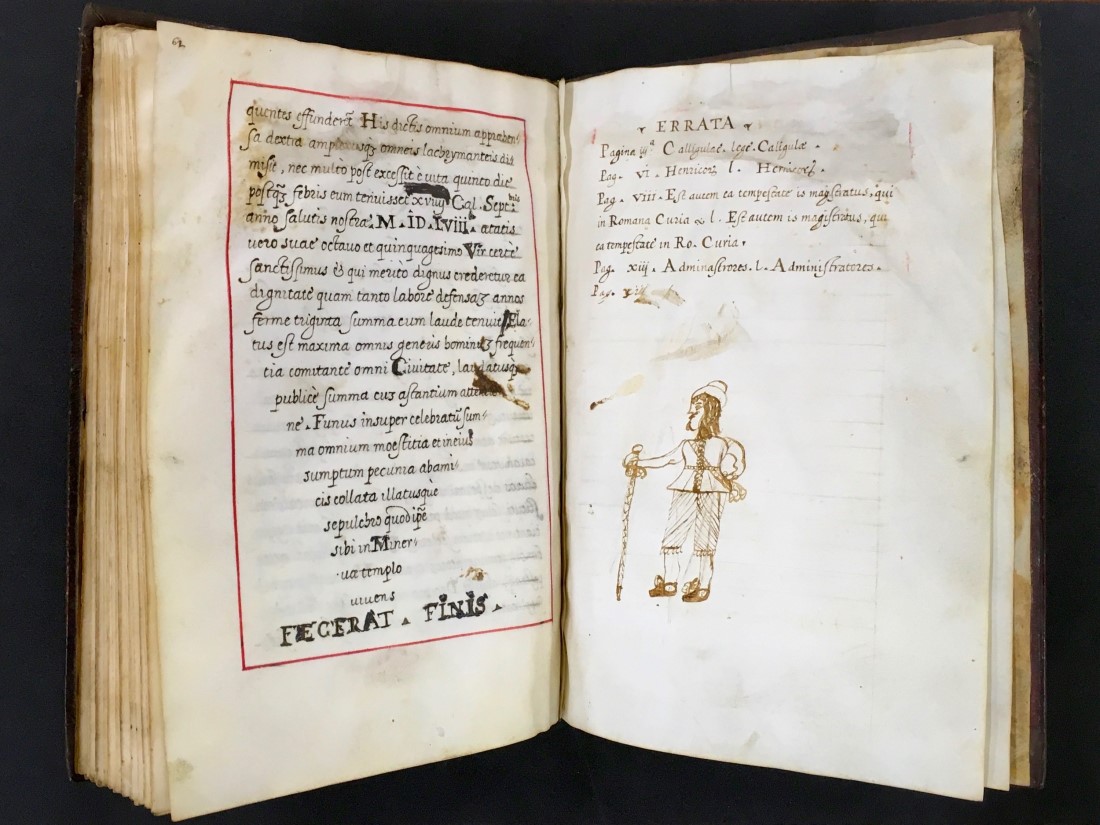
Left: Ending of the Vita Capranicae. Right: The “Errata” page. Call Number: MS C247. Click image to enlarge.
One of the most interesting features of the manuscript is that it contains an “Errata” at the end of the text on folio 36r in which the scribe lists the errors made and corrects the text. In medieval and early modern manuscripts, it is much more common to see mistakes corrected immediately over the text itself or in the margins. The end of the text on folio 35v, which is arranged like an inverted triangle, with the margins gradually increasing, as well as a doodle of a man with a sword on the lower half of folio 36r, probably drawn by a later owner, are also noteworthy.
The Kenneth Spencer Research Library purchased the manuscript from Hofmann & Freeman Antiquarian Booksellers in March 1970, and it is available for consultation in the library’s Marilyn Stokstad Reading Room.
Read more about Vita Capranicae and the other eight surviving manuscripts here: Ruut Kataisto. “G. B. Bracciolini: Vita Capranicae.” Studia Neophilologica 86, no. sup1 (2014): 104–11. DOI: https://doi.org/10.1080/00393274.2013.834105.
N. Kıvılcım Yavuz Ann Hyde Postdoctoral Researcher
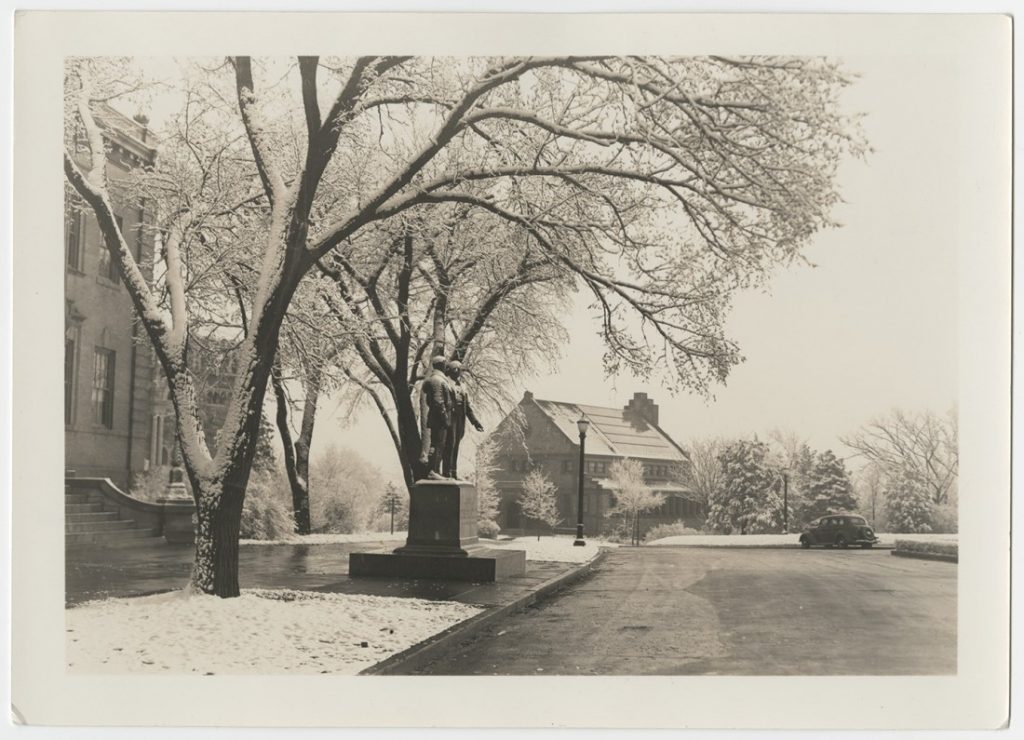
Each week we’ll be posting a photograph from University Archives that shows a scene from KU’s past. We’ve also scanned more than 34,800 images from KU’s University Archives and made them available online; be sure to check them out!