The University of Kansas

Inside Spencer: The KSRL Blog

Books on a shelf

Welcome to the Kenneth Spencer Research Library blog! As the special collections and archives library at the University of Kansas, Spencer is home to remarkable and diverse collections of rare and unique items. Explore the blog to learn about the work we do and the materials we collect.

Color Our Collections!

February 7th, 2018

Color Our Collections graphic

If you’ve ever seen an item at Spencer Research Library or on the blog and thought, “it would be fun to color a copy of this” – you’re in luck!

This year, KU Libraries is among the 149 libraries, archives, and cultural institutions from around the world participating in a week-long coloring fest sponsored by The New York Academy of Medicine. Staff members across the libraries collaborated to create a booklet containing nine coloring pages based on Spencer’s collections. You can download and print the book via the Color Our Collections website, and be sure to also check out the submissions from our colleagues at other institutions.

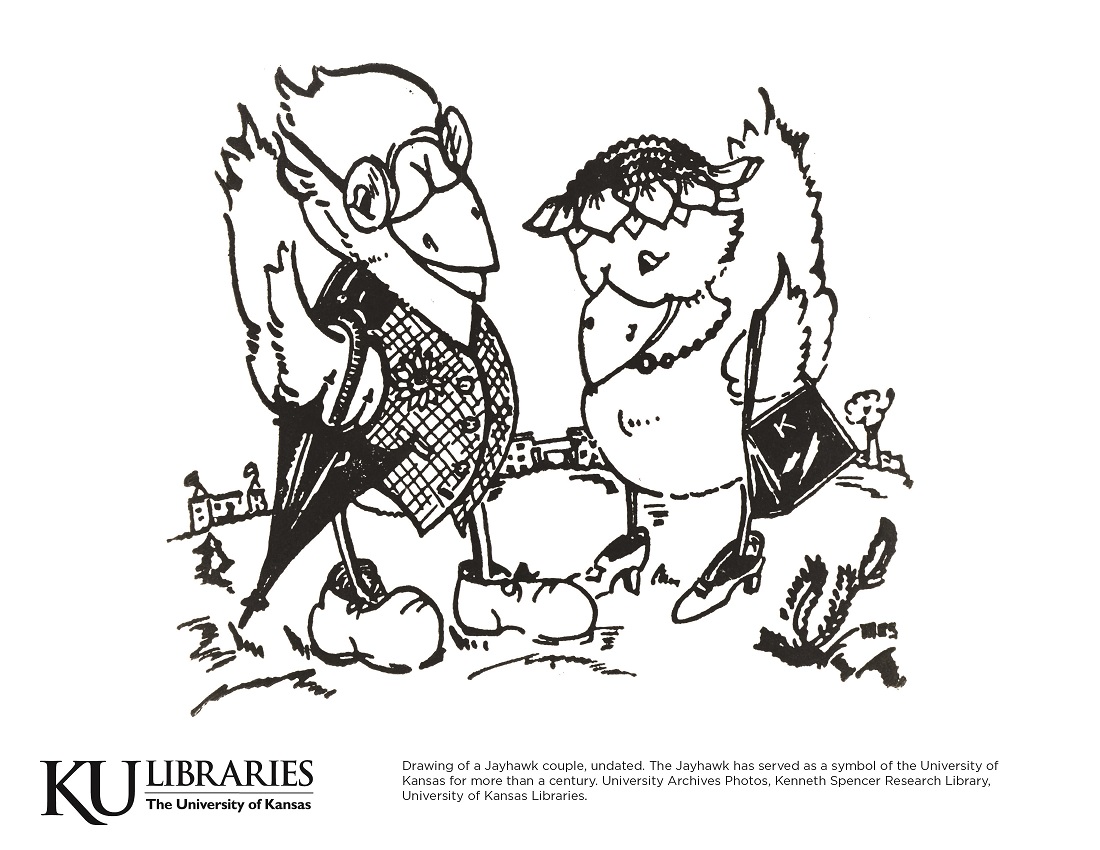
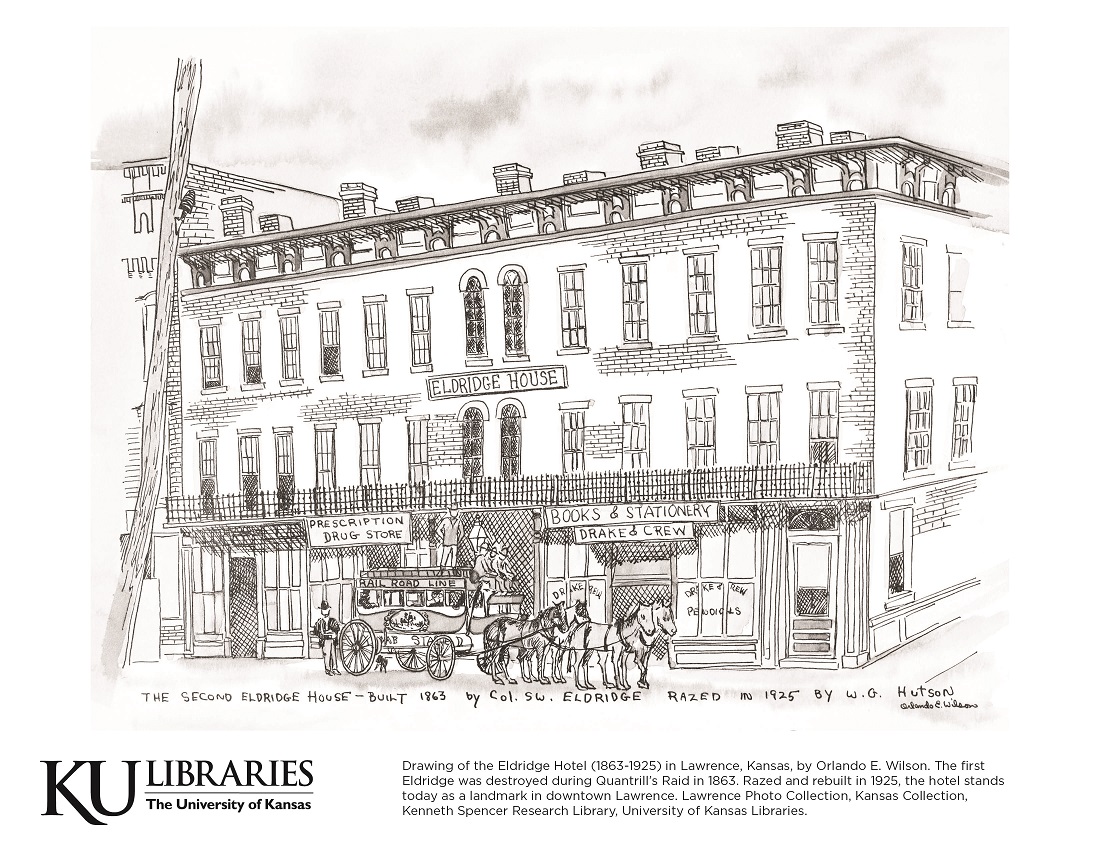
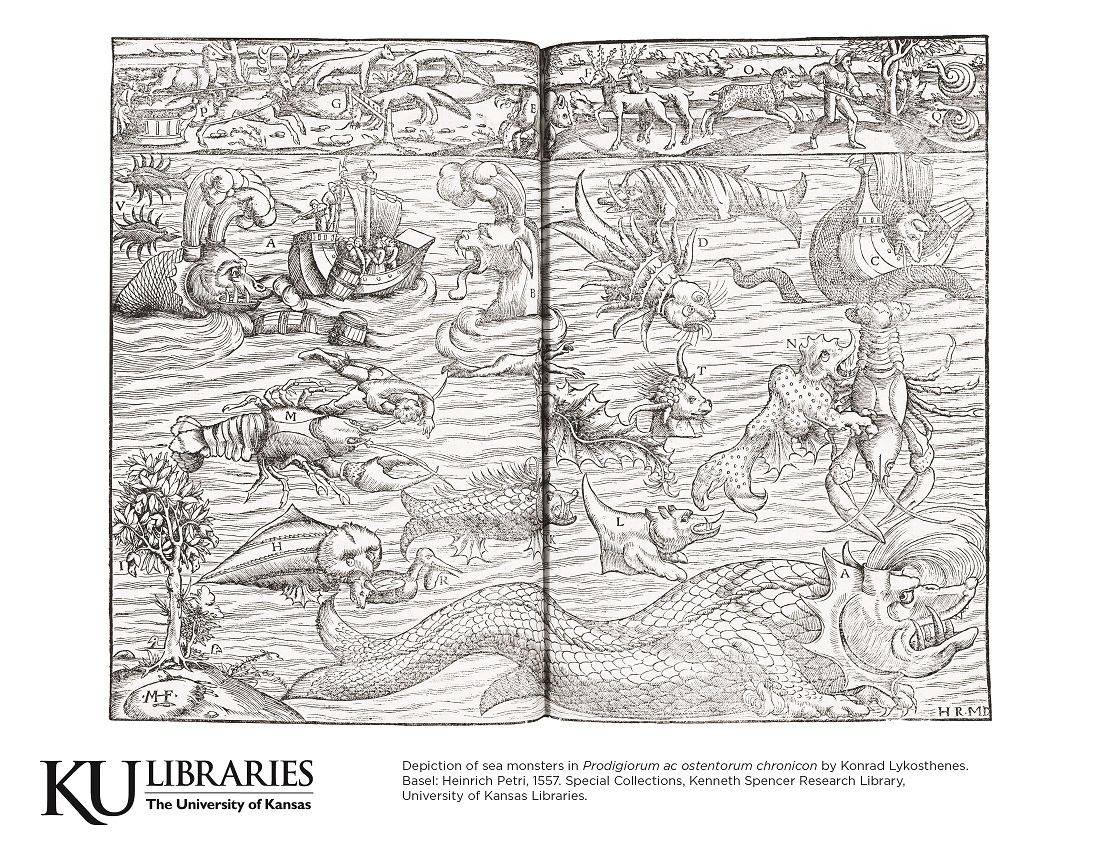
As a preview, here are three pages from the book.

Jayhawk couple image in the KU Libraries coloring book, 2018

Eldridge Hotel image in the KU Libraries coloring book, 2018

Sea monster image in the KU Libraries coloring book, 2018

Enjoy, and happy coloring!

Caitlin Donnelly
Head of Public Services


A Holinshed’s Chronicles Provenance Puzzle

February 6th, 2018

Holinshed’s Chronicles of England, Scotland, and Ireland is widely regarded as a book that inspired and informed many of William Shakespeare’s history plays, as well as tragedies such as Macbeth and King Lear. Last year Kenneth Spencer Research Library (KSRL) purchased the first edition (1577) with the aim of making the book and its 212 lively woodcut illustrations available to visiting classes and researchers. The bookseller’s description said that this copy had been in private family ownership for generations, but we never dreamed that it would be possible to trace the book back to its original owner. After unpacking the two volumes, we leafed through them page by page looking for manuscript annotations.

On the title page of volume one “William Kyllygrewe” had signed his name twice in Tudor script:
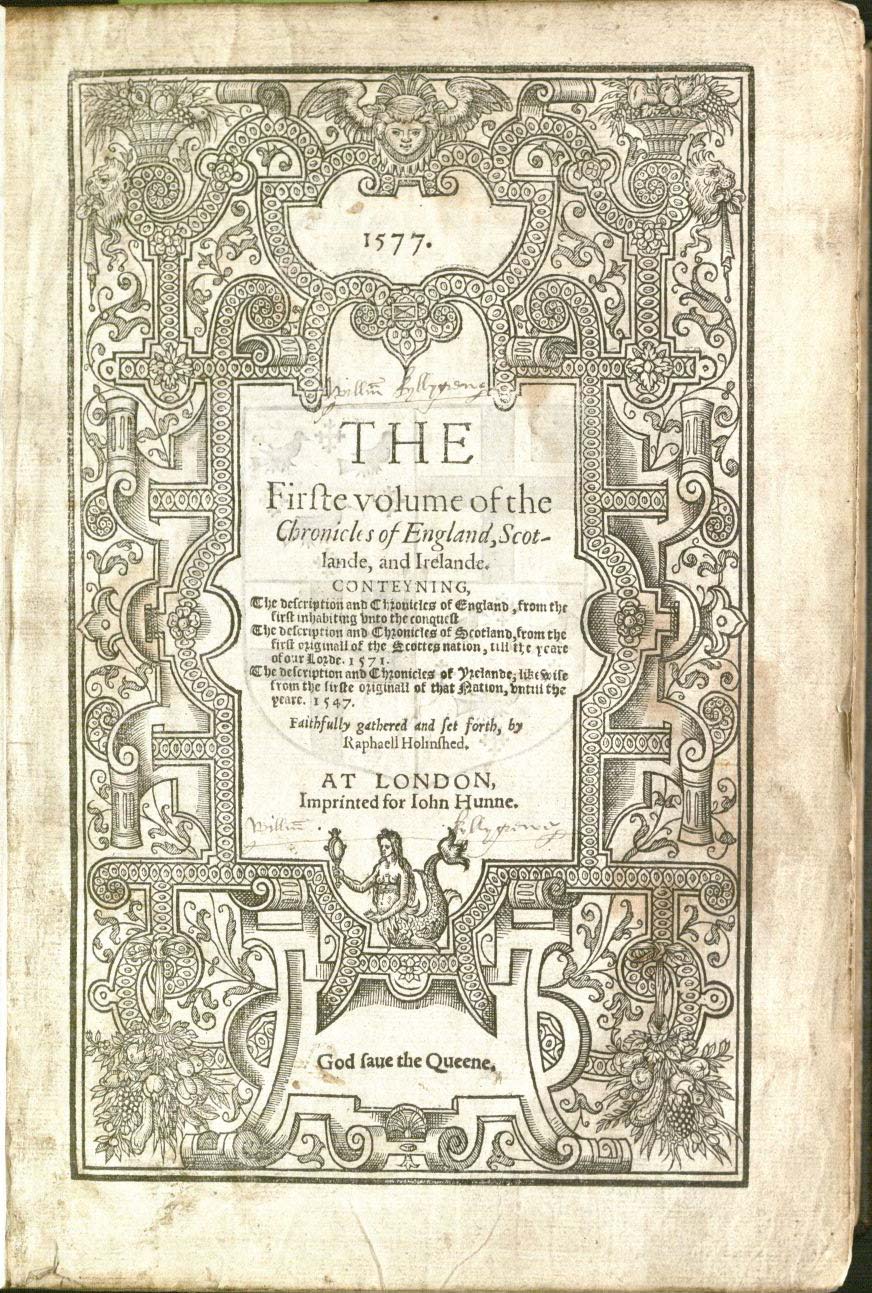
Title page of volume 1 of Holinshed's Chronicles (1577), with William Killigrew's signature

Title page of Volume 1 of Raphael Holinshed’s
Chronicles of England, Scotlande, and Irelande.
At London: Imprinted for Iohn Hunne, 1577.
Call Number: Pryce D11. Click image to enlarge.

Could William Kyllygrewe have been the original owner of the book? Browsing through the rest of the book revealed some marginal notes and manicules (sketches of a pointing hand) marking passages of interest to some past reader. There is no other handwritten evidence of ownership.

However, there is an eye-catching pictorial map in the section about the reign of Queen Elizabeth I that concludes volume two. The text recounts the conflict between the Catholic forces supporting Mary, Queen of Scots, and the Protestant forces of Queen Elizabeth during 1571-1573. The hostilities culminated in the “Lang Siege” of Edinburgh Castle.

The map shows the Protestant artillery bombarding Edinburgh Castle before achieving victory.
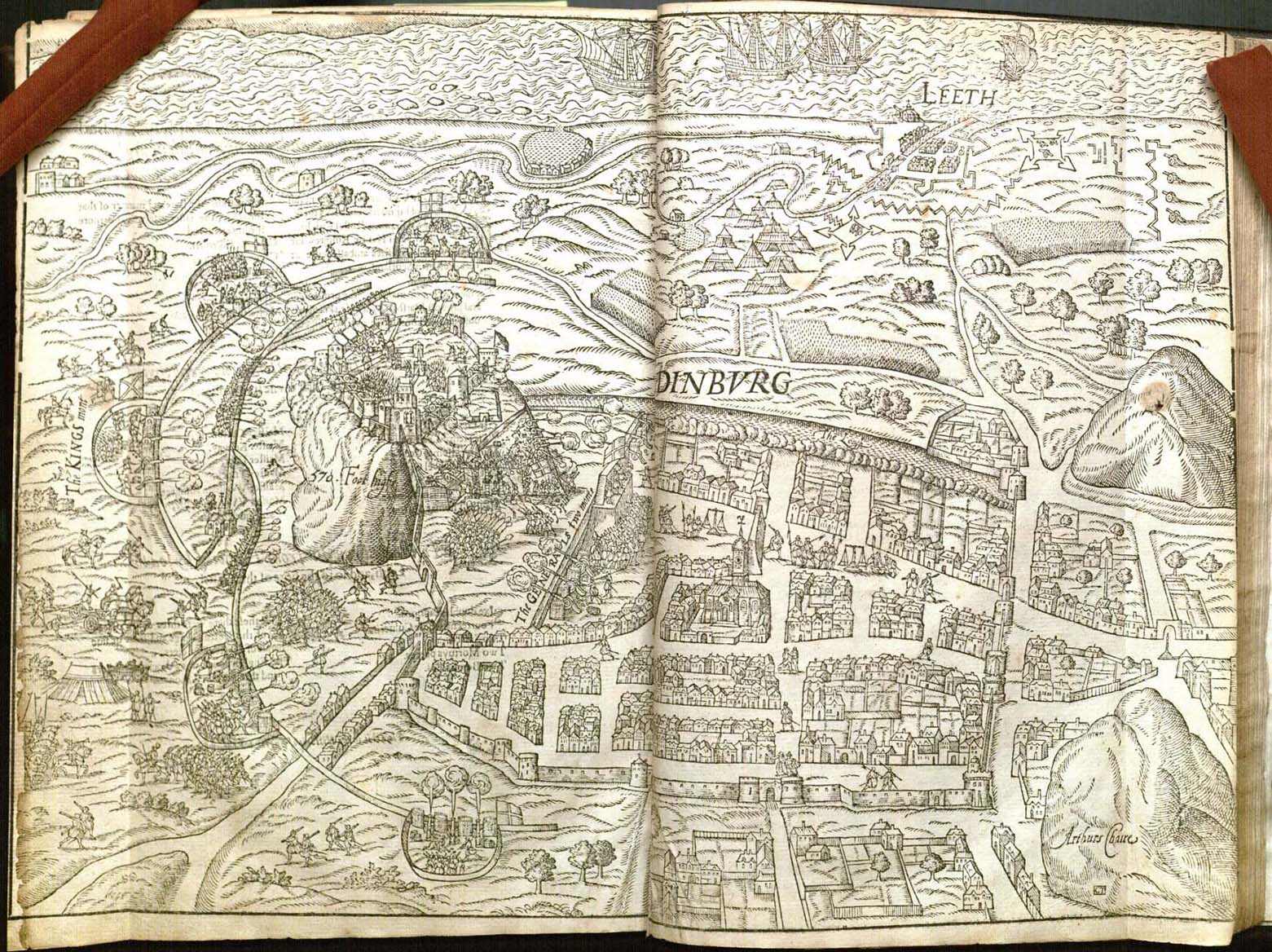
Map showing the Protestant artillery bombarding of Edinburgh Castle from volume 2 of Holinshed's Chronicles, following p. 1868

Map of the siege of Edinburgh Castle, from Vol. 2 (following page 1868) of
Holinshed’s Chronicles of England, Scotlande, and Irelande.
Call Number: Pryce D11. Click image to enlarge.

Text on the back side of the map lists the chief participants in the siege. General Sir William Drurie commanded the Protestant forces with the aid of ten Gentlemen and Captaines. One of them was “Henrie Killigrew hir maiesties ambassadoure at that present in Scotland.” Listed next are thirteen “Gentlemen as went thither to serve of their owne free willes.”

Among the gentlemen who participated “of their own free willes” is William Killigrew.
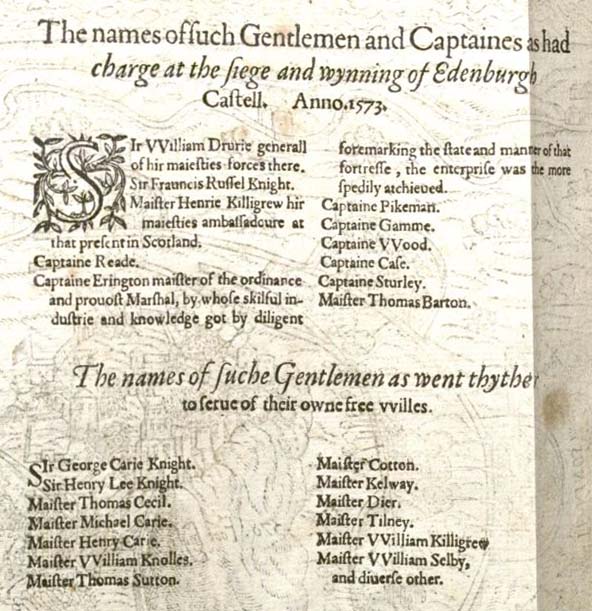
List of participants in the Siege of Edinburgh Castle, including the names of Henry and William Killigrew.

List of participants in the siege from the verso of the map of Edinburgh castle,
from Vol. 2 (following page 1868) of Holinshed’s Chronicles of England,
Scotlande, and Irelande
. Call Number: Pryce D11. Click image to enlarge.

Allowing for the variations in spelling usual at that time, could he be the William Kyllygrewe who owned this book? In his shoes, wouldn’t you want to own a book in which you and your brother are mentioned as major players in a recent military victory?

Some genealogical investigation of the Killigrew family tree with its numerous Henrys and Williams revealed that the Henry Killigrew (d. 1603) and William Killigrew (d.1622) were the fourth and fifth sons of John Killigrew and Elizabeth (née Trewennard) of Arwennack in Cornwall. As younger sons they needed to make their own way in the world and did so successfully as royal courtiers. William was elected Member of Parliament a number of times and was appointed to various government offices, including Groom of the Privy Chamber to Elizabeth I in 1576 and Chamberlain of the Exchequer under James I in 1608.  In 1594 he took an 80-year lease on Kempton and Hanworth, adjoining royal manors in Middlesex near London. In 1603 he was knighted.

While the biographical information did not answer the question whether this William Killigrew had owned our copy of Holinshed’s Chronicles, his prominence suggested that surviving documents signed by him might be located and compared with our owner’s inscription. The Discovery database at the website of The National Archives at Kew near London in England led to an archival record in the Surrey History Centre for a letter held written by William Killigrew to Sir William Moore on 3 June 1579, just two years after the publication of Holinshed’s Chronicles.

Killigrew’s letter concerns the Bishop of Winchester’s meadow at Farnham in Surrey.
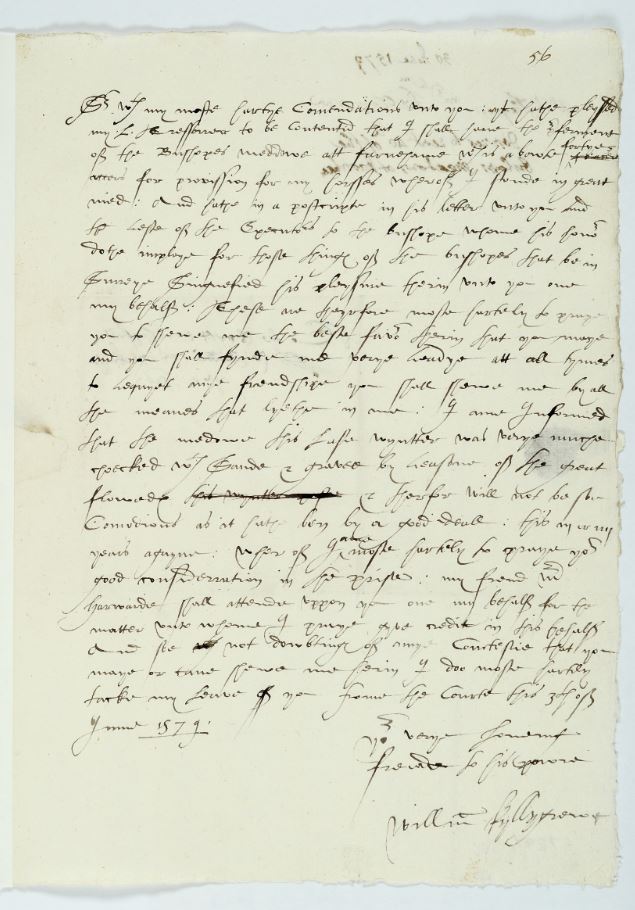
Letter from William Killigrew to Sir William Moore, 3 June 1579

Letter from William Killigrew to Sir William Moore, 3 June 1579.
Surrey History Center. Letter Ref. Number 6729/1/56.
Reproduced by permission of the More-Molyneux family and
Surrey History Centre. Click image to enlarge.

Killigrew planned to pasture his horses there but was asking Moore, one of the Bishop’s executors, to reduce the rent because the meadow was “very much choked with sand and gravel by reason of the great floods.” It was exciting for us to discover that the Killigrew signature on the letter is a close match to the ownership inscriptions in our Holinshed’s Chronicles.
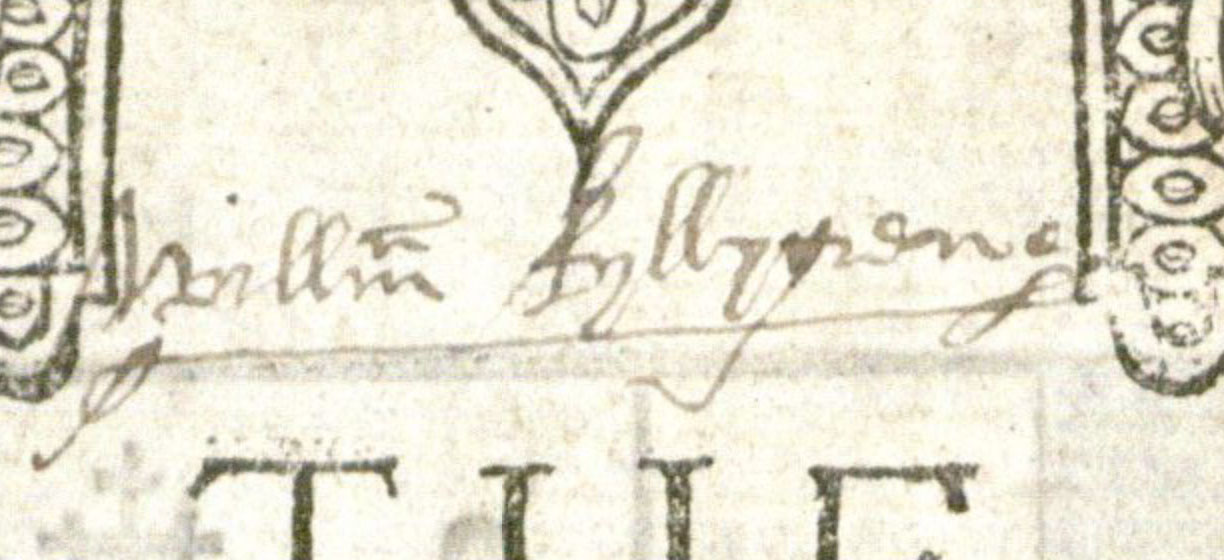
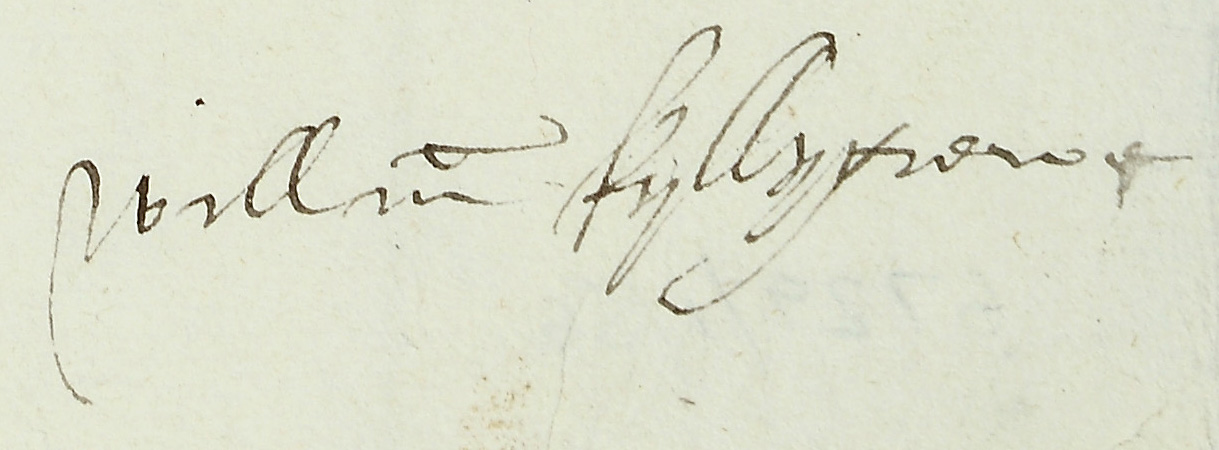
William Killigrew signature detail from the title page of volume 1 of Raphael Holinshed's Chronicles of England, Scotlande, and Irelande. William Killigrew signature from a letter from William Killigrew to Sir William Moore, 3 June 1579

Details of William Killigrew’s signatures: Holinshed’s Chronicles (left)
and the letter to Moore (right). Click image to enlarge.

In fact, the search for a William Killigrew signature need not have led so far afield. Kenneth Spencer Research Library’s large collection of English Historical Documents includes, as it turns out, a 26 October 1601 deed of covenant by William Killigrew and his son, Robert, agreeing to sell a messuage (dwelling house, outbuildings, and land) in Clerkenwell Parish, Middlesex to John Gregorye and his wife, Judith.

William Killigrew’s signature is clear at the bottom of the deed, although Robert’s signature to the right is only partly legible
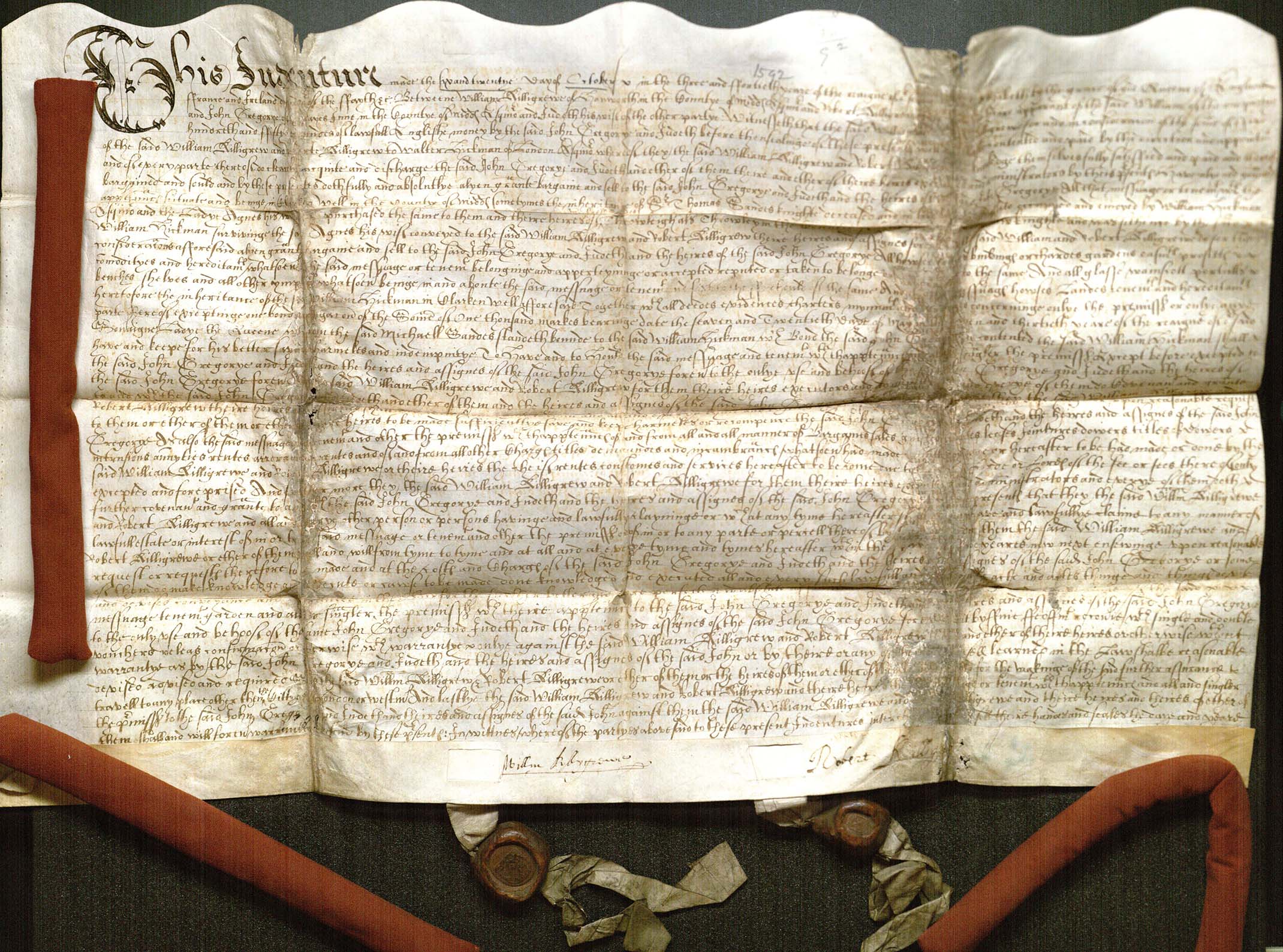
Deed of covenant by William Killigrew and his son, Robert, agreeing to sell a messuage (dwelling house, outbuildings, and land) in Clerkenwell Parish, Middlesex to John Gregorye and his wife, Judith.

Deed of covenant signed by William Killigrew, 26 October 1601.
A Miscellany of Deeds and Manorial, Estate, Probate and Family Documents, 1194-1900.
Call Number: MS 239: 2357. Click image to enlarge.

Once again, the signatures match.

William Killigrew signature detail from the title page of volume 1 of Raphael Holinshed's Chronicles of England, Scotlande, and Irelande. William Killigrew signature detail from 1601 deed of covenant.

Details of William Killigrew’s signatures: Holinshed’s Chronicles (left)
and Killigrew-Gregorye deed (right). Click images to enlarge.

The manner in which the copy of Holinshed’s Chronicles descended from the hands of William Killigrew in family ownership until Kenneth Spencer Research Library purchased it is still uncertain. The bookseller’s description suggests that a female Killigrew relative may have taken the book with her when she married into the Grenville family. More research remains to be done.

Karen Severud Cook
Special Collections Librarian

World War I Letters of Forrest W. Bassett: February 5-11, 1918

February 5th, 2018

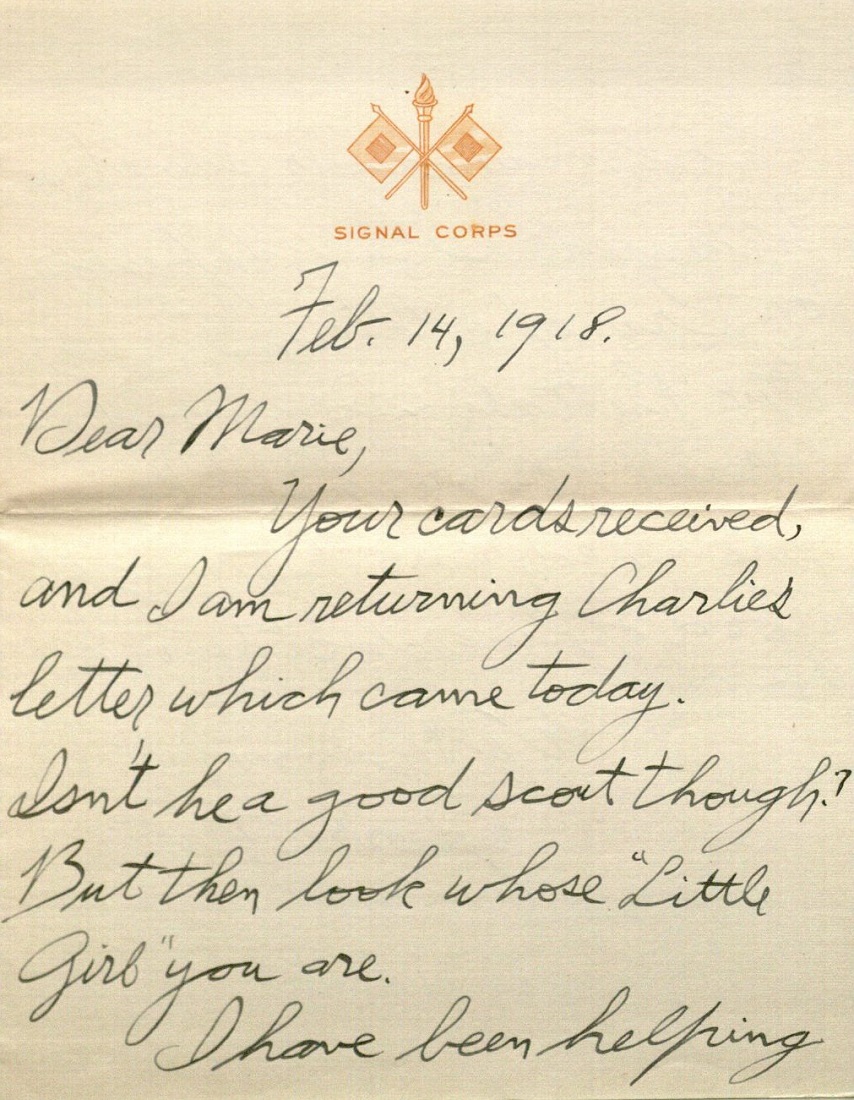
In honor of the centennial of World War I, we’re going to follow the experiences of one American soldier: nineteen-year-old Forrest W. Bassett, whose letters are held in Spencer’s Kansas Collection. Each Monday we’ll post a new entry, which will feature selected letters from Forrest to thirteen-year-old Ava Marie Shaw from that following week, one hundred years after he wrote them.

Forrest W. Bassett was born in Beloit, Wisconsin, on December 21, 1897 to Daniel F. and Ida V. Bassett. On July 20, 1917 he was sworn into military service at Jefferson Barracks near St. Louis, Missouri. Soon after, he was transferred to Fort Leavenworth, Kansas, for training as a radio operator in Company A of the U. S. Signal Corps’ 6th Field Battalion.

Ava Marie Shaw was born in Chicago, Illinois, on October 12, 1903 to Robert and Esther Shaw. Both of Marie’s parents – and her three older siblings – were born in Wisconsin. By 1910 the family was living in Woodstock, Illinois, northwest of Chicago. By 1917 they were in Beloit.

Frequently mentioned in the letters are Forrest’s older half-sister Blanche Treadway (born 1883), who had married Arthur Poquette in 1904, and Marie’s older sister Ethel (born 1896).

Image of Forrest W. Bassett's letter to Ava Marie Shaw, February 8, 1918 Image of Forrest W. Bassett's letter to Ava Marie Shaw, February 8, 1918

Image of Forrest W. Bassett's letter to Ava Marie Shaw, February 8, 1918 Image of Forrest W. Bassett's letter to Ava Marie Shaw, February 8, 1918

Click images to enlarge.

Friday, Feb. 8, 1918.

Dear Marie,

George Stock left Monday for Urbania, Ill. A young fellow from the Wisconsin University is in his place. He is a A-1 recruit, drafted, I guess, as he came here in his civilian clothes and knows absolutely nothing about military life.

We shipped all our horses to Ft. Riley a few days ago. “Ten” is in the Cavalry as his tag was marked “Cav.” A few of the horses were tagged “Artillery.” We kept most of our pack mules. One mule executed a perfectly good “Halt,” when we led him to the car door, but a rope from his halter around his hind legs, and ten men pushing, just naturally changed his mind.

Yesterday at 4:30 P.M. we had a formal “retreat” with a review of the whole 5th and 6th Battalions. It sure was some fancy.

Today we had our first battalion maneuvers in the field. We had telegraph and radio stations set up in a number of places between Leavenworth and Kickapoo. Our new radio tractor is showing itself to be some machine. I copied a message from it for the first time yesterday afternoon.

Tuesday I passed the semaphore test without an error. We are going to be tested in radio, wig-wag, and acetylene lantern later in the month. Those that fail these tests are not allowed to leave the Cantonments.

I doubt if you would find it worth while to learn either the radio or semaphore code. It is very interesting though.

Well I have hiked quite a bit today and will have to walk home so I guess I’ll quit.

With love,
Forrest.

Meredith Huff
Public Services

Emma Piazza
Public Services Student Assistant

Throwback Thursday: “Hill Climbing Not Healthful” Edition

February 1st, 2018

Each week we’ll be posting a photograph from University Archives that shows a scene from KU’s past. We’ve also scanned more than 34,800 images from KU’s University Archives and made them available online; be sure to check them out!

In conducting research for Tuesday’s blog post about large ice jams along the Kansas River near Lawrence in January 1910, my colleague Meredith Huff discovered this fun article that appeared on the front page of the University Daily Kansan (then called The Kansan) on January 25, 1910.

Image of a Daily Kansan article, "Hill Climbing Not Healthful," January 25, 1910

“Hill Climbing Not Healthful” article in The Kansan,
January 25, 1910. University Archives.
Call Number: UA Ser 69/2/1. Click image to enlarge.

Dr. Naismith‘s comments may have been precipitated by news – reported in The Kansan on January 4th – that winter weather had delayed work on the new campus streetcar line. According to the earlier article,

The students who had fond hopes of riding up to the University on the street cars after the holidays, returned to find their dreams faded. And the manager of the Lawrence car line this morning sentenced the whole student body to walk up and down the hill all the rest of the winter.

In addition to coaching basketball, Dr. Naismith’s other roles at KU included Professor of Physical Education, Director of Robinson Gymnasium, and Chapel Director. His hygiene class was required of all freshman; here is how it was described in the 1909-1910 KU Annual Catalogue:

One hour, first semester, men, Monday; women, Thursday. Lectures designed to help the students to maintain health, dealing with food, clothing, exercise, conditions conducive to study, prophylactic treatment, especially in regard to infectious and contagious diseases.

Caitlin Donnelly
Head of Public Services

The Lawrence Ice Jam of 1910

January 30th, 2018

Postcard images in Spencer’s Lawrence Photo Collection document the destruction and disruption caused by large ice jams (or ice gorges) along the Kansas (Kaw) River near Lawrence in January 1910. Articles from area newspapers provide additional details about the situation. For example, the Topeka Daily Capital reported on January 15th that “travel on the Santa Fe [railroad] tracks between Lecompton and Lawrence is practically blocked and all westbound Santa Fe trains are coming into Topeka over the Union Pacific tracks.”

Between Lecompton and Lawrence the tracks are partially submerged with water and ice and from the bridge across the Kaw river at Lawrence three miles this way the Santa Fe tracks are covered with from one to three feet of water and ice. An immense ice jam has formed at the bridge at Lawrence and the checking of the river’s flow has forced the water over the tracks. The jam is about six miles long.

Postcard showing an ice gorge at Lawrence, Kansas, 1910

The ice gorge at Lawrence, 1910. Lawrence Photo Collection.
Call Number: RH PH 18. Click image to enlarge.

Newspapers also described how widespread the problem was elsewhere along the Kaw and other rivers, in Kansas and beyond. A headline on the front page of the Topeka Daily Capital on January 15th stated that an “ice gorge in [the] Mississippi [River] in St. Louis goes out causing damage estimated at $200,000.”

Postcard showing high water caused by an ice jam, Lawrence, Kansas, 1910

High water caused by an ice jam, Lawrence, 1910.
Lawrence Photo Collection. Call Number: RH PH 18. Click image to enlarge.

Postcard showing an ice gorge at Lawrence, Kansas, 1910 Postcard showing an ice gorge at Lawrence, Kansas, 1910

The ice gorge at Lawrence, 1910. Lawrence Photo Collection.
Call Number: RH PH 18. Click images to enlarge.

A letter to the World from Burt Brown, who is at Junction City, says: “The ice has broken in the Republican river today, and at Ft. Riley the Kaw river is full of floating ice. The water is considerable above the normal stage. If all the floating ice I saw in the Kaw east of Ft. Riley reaches the ice jam at Lawrence it will surely do some damage there.”

Lawrence Daily World, January 27, 1910

Lawrence, Kan., Jan 28. — Even being a fish has had its handicaps lately, and the dwellers in the Kaw thought that the world had come to end when the ice began moving. Lou McCann was standing near the water’s edge watching the ice move down the stream, when almost at his feet a forty pound catfish was crowded out on the bank, and started for the timber to [e]scape the ice. McCann, who is fleet of foot, took after it and soon overhauled the monster cat and put it out of harm’s way.

Topeka State Journal, January 28, 1910

Since the ice gorge at Lawrence has been broken and the water has receded to the channel of the river, the Santa Fe has been able to restore its train service to normal condition.

Osage City Free Press, February 10, 1910

The county boards of Jefferson and Douglas counties held a conference at the Lecompton bridge this week for the purpose of taking some action to repair the bridge, which was partially destroyed by an ice jam in January. Nothing definite was accomplished. All three of the wrecked spans are in sight; one is about 100 feet from the wrecked bridge, one about 150 feet and the third about 400 yards distant at the mouth of the Delaware. Their condition could not be ascertained, owing to the mush ice in the river and the fact that they are partly buried in sand which is rapidly forming a bar around them…Cal Walton estimates that it will take $14,000 to repair the damage.

Lawrence Daily World, February 26, 1910

Meredith Huff
Public Services