The University of Kansas

Inside Spencer: The KSRL Blog

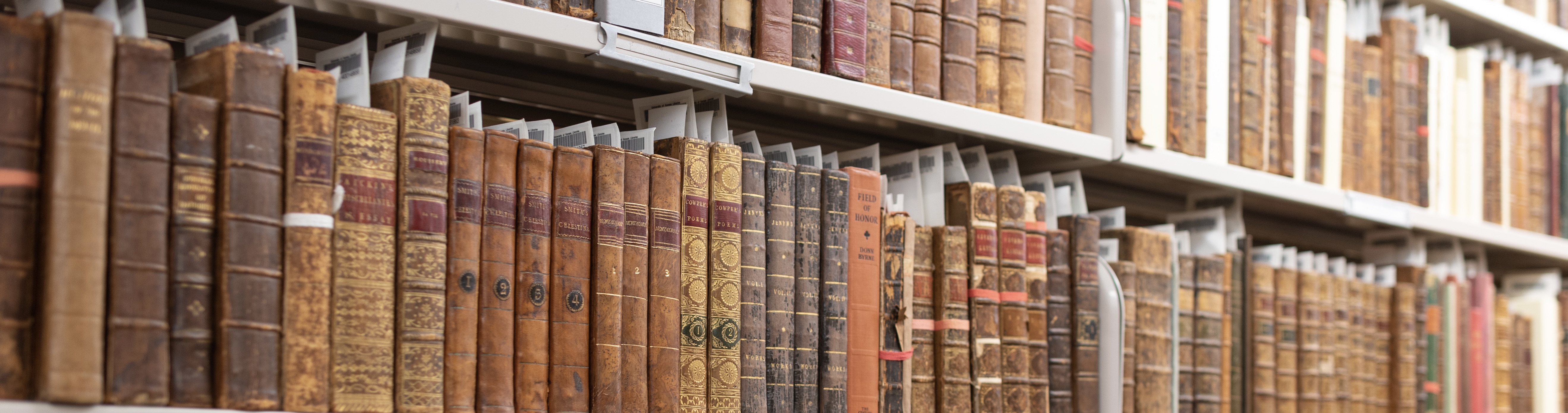
Books on a shelf

Welcome to the Kenneth Spencer Research Library blog! As the special collections and archives library at the University of Kansas, Spencer is home to remarkable and diverse collections of rare and unique items. Explore the blog to learn about the work we do and the materials we collect.

Collection Snapshot: Notes from Underground …

June 27th, 2014

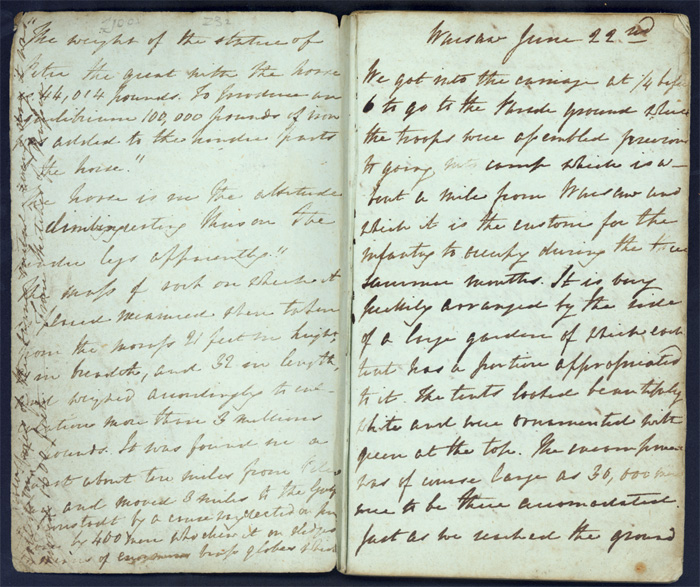
If you’re interested in matters Polish and Russian or in travels in Slavic lands and in sights seen through western eyes AND if you can read this page from the manuscript diary of an Englishwoman traveling in the summer of 1828 (186 years ago!), then YOU may be the person to transcribe the contents of this little volume. You will get to know “Roberta” and “Mr. Sayer” (their real names), who were her companions on the trip. We can picture Ms. English Lady settling into the pension at night to write … Inside the front cover she begins, “The weight of the statue of Peter The Great …” You’ve seen the blurb; now read the book!

Image of a page from the diary of an English woman open to entry for Warsaw, June 22, 1828.

An English Lady: An anonymous manuscript travel-diary, a detailed account of the sights, costumes, social services, village and town life, war aftermath, travel mishaps in Russia and Poland. Warsaw-Smolensk-Moscow-Novgorod-St. Petersburg. 22 June to 21 July 1828. Call Number: MS B144. Click image to enlarge.

Sally Haines
Rare Books Cataloger

Adapted from her Spencer Research Library exhibit, Frosted Windows: 300 Years of St. Petersburg Through Western Eyes.

Researchers Wanted!

June 6th, 2014

Ask any special collections librarian or archivist about her favorite collection item, and she may hem and haw (how can you pick just one favorite?!?). However, ask that same librarian about interesting items or collections that she wishes more researchers would use, and invariably she will rattle off a frighteningly long list.

This week, in the spirit of summer discovery, we present two intriguing selections that scream “researchers wanted!”

1.  Papers of William Poel, ca. 1895-1934 (MS 31)

As admirers of William Shakespeare know, this April marked the 450th anniversary of the playwright’s birth.  And while Spencer doesn’t have a manuscript by the Bard gathering dust on a shelf (no manuscripts in his hand are known to survive), the library does hold papers for William Poel (1852-1934), an actor, writer, and theater director known for his attempts to revive the conventions of the Elizabethan stage at the dawn of the twentieth century. The collection includes correspondence with figures from the theater world (actors, writers, critics, and others), a small number of scripts, prompt books, and journals, and ephemera such as playbills and review clippings.  Pictured below is Poel’s heavily annotated prompt copy for Fratricide Punished, a German version of Hamlet of ambiguous relation to Shakespeare’s play.  Also pictured are a theater program and a lecture announcement, examples of Poel ephemera.

Picture of Poel's Fratricide Punished Prompt book, open to the list of characters and a pasted in print announcement. Plan of playscene in Poel's Fratricide Punished prompt book.
Lecture announcement for a lecture series on Shakespeare. Image of exterior of program for Poel's production of Marlowe's Faustus
Top: Poel’s prompt book for Fratricide Punished , ca. 1924. MS 31:D4; Bottom: an announcement for a series of lectures by Poel on Shakespeare, 1900, and the program for a production of Marlowe’s Faustus directed by Poel, 1904. MS 31, F6. Click images to enlarge.

2. Don Quixote, el Castellano viejo, undated (before 1860).

This mysterious bound manuscript came to Spencer from the library of the well-known nineteenth-century art historian, bibliophile, and Hispanist, Sir William Stirling Maxwell (1818-1878).  A portion of Stirling Maxwell’s vast library was sold at auction and 1958, enabling KU to acquire a significant number of early printed Spanish volumes, including important editions that now form the basis of Spencer’s Cervantes Collection, and this manuscript.  As far as we know, the author of this manuscript has not been identified, though the text concerns Cervantes’s famed character Don Quixote.   A note pasted toward the front gives further provenance, describing it as a “curious manuscript” sold as part of the auction of the library of “the late Don Justo de Sancha” by Sotheby’s in December of 1860.  Though the hand is later than Cervantes’s time, scholars of Spanish literature might find much to pique their interest in this 205-page manuscript.  The pictures below include the table of contents, which offers readers an idea of the matter covered.

Image of the title page (in a different hand?) giving the title, Don Quixote, el Castellano viejo Image of prologue with pasted in provenance note for Don Quixote, el Castellano viejo. Image of the first page of the table of contents of Don Quixote, el Castellano viejo Image of the final page of Don Quixote, el Castellano viejo.

Bookplate of William Stirling-Maxwell Image of the beginning of Chapter 2 in Don Quixote, el Castellano viejo.

Don Quixote, el Castellano viejo, undated (before 1860). MS C73. Click images to enlarge.

For more information on these and any of our other manuscript holdings, please don’t hesitate to contact us.  After all, the summer is an ideal time to start a new research project.

Elspeth Healey
Special Collections Librarian

Anger

May 23rd, 2014

Aesop’s fables are directly descended from the 11th century Physiologus of Theobaldus and other medieval bestiaries, or treatises on birds and beasts who were blessed with certain moral, physical, and mental attributes.They were largely the creations of early Christian teachers and were a mix of natural history and Gospel Truth with snippets of folk-lore, travellers’ tales, and dimly understood scientific ideas thrown in, served up with all the authority of the Church behind them. They have continued to be popular long after they ceased to be used for religious instruction, and as has oft been pointed out, there’s a lot of “zoology” in them, and thus, they do deserve a niche in the history of science.

Howitt, Samuel. A New Work of Animals, 1818. Call number Ellis Aves E102. Kenneth Spencer Research Library, University of Kansas.

Howitt, Samuel. A New Work of Animals, 1818. Call number Ellis Aves E102. Kenneth Spencer Research Library, University of Kansas.
Text excerpt (top) and accompanying plate (bottom) from Howitt, Samuel. A New Work of Animals, 1818.
Call number Ellis Aves E102. Click images to enlarge.

Among the chief emblems of the original Physiologus were numerous herps including the sun lizard, viper, serpent, sea-tortoise, crocodile, frog, and salamander. In this fable about porcupine and snakes, there’s no bias against snakes; both herp and mammal behave badly.

Sally Haines
Rare Books Cataloger
Adapted from her Spencer Research Library exhibit and catalog, Slithy Toves: Illustrated Classic Herpetological Books at the University of Kansas in Pictures and Conversations

¿Habéiss oído hablar del medicamento comprar levitra online, entrega en 24 horas? La gente no podía imaginar su vida sin este medicamento, que les brinda confianza y la capacidad de pasar un tiempo inolvidable con su querida pareja.

Herps from Hell

April 11th, 2014

Herpetology is the study of amphibians and reptiles. Pictured here is the Supreme “Herp” from Hell in a manuscript that could be Heaven on Earth to a student of Old Russian. St. John Chrysostom was the most famous of the Greek fathers of the Church. His works consist of discourses illustrating passages of scripture, commentaries on the Biblical books, etc.

Saint John Chrysostom, Patriarch of Constantinople. [Extracts from the works, In Russian]. Manuscript from Russia, 16th-17th century. Call number MS C38. Kenneth Spencer Research Library, University of Kansas.

Above: Image from Saint John Chrysostom, Patriarch of Constantinople (died 407).
[Extracts from the works, In Russian]. Manuscript from Russia, 16th-17th century. Call Number: MS C38.

As we all know, Evil is in the eye of the beholder; indeed, the presence of a snake in a Russian peasant household was often considered an omen for Good, and brought wealth and good health. The snake, as one of the domovye, or house spritis, lived behind the stove or wherever fires were lighted. In White Russia the domovoi was called tsmok (snake). If the master of the house treated it badly or forgot to leave out some eggs for food at night, tsmok might burn the house down. In some Slavic households the snake was a bad egg, often the embodiment of a dead man’s soul, a rough and evil character like Baba Yaga.

The Spencer Library has books in Slavic languages scattered throughout the collections, and one of the best collections of rare Pollonica in the United States.

Sally Haines
Rare Books Cataloger
Adapted from her Spencer Research Library exhibit and catalog, Slithy Toves: Illustrated Classic Herpetological Books at the University of Kansas in Pictures and Conversations

Neither Fish Nor Fowl: A Printed Book of Hours

April 4th, 2014

The world of written information is changing.  We are in the midst of a major shift from print to digital culture (you are, after all, reading this online).  It seems timely, then, to look back at an artifact from another major revolution in the technology of writing — the shift from manuscript to print culture.  The first hundred years of printing offer many fascinating examples of  the overlap between the conventions of manuscript culture and the emergence of a new print culture.  One such example is this book of hours, Hore intemerate Virginis Marie secundu[m] vsum Romanum cum pluribus orationibus tam in Gallico [et] in Latino, produced in Paris circa 1505.

Image of a printed books of hours at an opening with two miniatures.

Image of an Opening featuring a miniature of the Adoration of the Magi in a Printed Book of Hours, ca. 1505.

Hore intemerate Virginis Marie secundu[m] vsum Romanum cum pluribus orationibus tam in Gallico
[et] in Latino
[Printed Book of Hours]. [Paris: G. Anabat, 1505.] Call Number: Summerfield C65

Squint and it looks like an illuminated manuscript (at least in the top image), but it is actually a printed volume, with hand-colored  illustrations and metalcut borders.  During the late medieval period, books of hours were among the most common manuscript volumes owned by laypeople (whether nobility or wealthy merchants).  Accordingly, it is not surprising that with the advent of moveable type, printers soon tried their inky hands at producing these devotional texts.  This particular volume draws upon several features of manuscript books of hours.  It is printed on vellum (treated calf skin) and contains hand-colored initials and miniatures (the latter literally painted on top of the metalcut illustrations).

Printed books of hours flourished roughly between the 1480s and 1530s, co-existing alongside their manuscript counterparts.  This volume from the Spencer Library’s collections was printed in Paris, a center for printed books of hours, by Guillaume Anabat for the bookseller Germain Hardouin and likely hand-colored in the Hardouin workshop (see the colophon pictured below).

Encountering a book like this makes one wonder which present-day artifacts will someday be seen as the products of a writing culture in transition.   In 500 years, will we look at early e-readers as strange hybrids: objects that apply the conventions of the “print world” to the digital environment?

See more….click thumbnails to enlarge.

Image of title page in printed book of hours with manuscript notations e of Almanac from a printed book of hours. Image of a printed book of hours featuring illustrations of Saint Christopher and Saint Sebastian. Image of colophon in printed book of hours

Elspeth Healey
Special Collections Librarian