The University of Kansas

Inside Spencer: The KSRL Blog

Books on a shelf

Welcome to the Kenneth Spencer Research Library blog! As the special collections and archives library at the University of Kansas, Spencer is home to remarkable and diverse collections of rare and unique items. Explore the blog to learn about the work we do and the materials we collect.

50 Shades of Yellowback: A Conservation Internship

August 3rd, 2015

Captain Dangerous, A Brother to Dragons, Romance of the Seas, and Somebody Else’s Wife: The History of a Heartless Woman! Where can one find such gripping book titles? Why at the Spencer Research Library, of course! Deep within the Spencer’s stacks is a series of shelves filled with a set of 459 volumes with eye-catching bindings of a style of book called the yellowback.

What are yellowbacks? They were a type of book printed from the 1840s through the early 1900s. They were often sold at railway stations. Much like the paperbacks we buy in the airport today, these mass-produced books were purchased by those boarding trains seeking entertainment during their travels. This cheap literature for the masses was produced in an equally cheap manner. Straw boards were covered in a glazed paper—usually, though not always, yellow in color—and the textblock constructed of roughly sewn or stapled, lower-quality paper. Although inexpensive in production, these books were not lacking in decorative creativity. Publishing companies hired artists to create tri-colored wood-block printed covers that correlated to the stories’ subject matter, and boy, are these covers spectacular. The back cover, and front and back endpapers, were often printed with advertisements, including some for the bath product Pears Soap, featuring a somewhat disturbed looking baby as the spokesmodel.

front_cover_B1505, Special Collections    back_cover_B1577, Special Collections, Spencer Research Library

Left: Front Cover, From Jest to Earnest, B1505.
Right: Back cover (featuring disturbed baby), Behind Closed Doors, B1577, Special Collections

The inexpensive production methods of yellowbacks might have proved profitable for publishing companies, but in terms of longevity for the books such poor construction came at a cost. After years of use, it was determined that the majority of the yellowback collection was in need of treatment. Many had loose or detached boards and spines, split hinges, abraded and flaking covers, and detached corners. It also appeared that some of the books had undergone previous conservation treatment involving a nasty hide-glue to reattach boards and spines. Over time, this treatment had proven to be more injurious than helpful. Luckily for the books, the conservation department had just the right summer intern up for the challenge of these little fixer-uppers.

B1346 before treatment, Special Collections, Spencer Library

Example of detached board and extra adhesive in hinge area, Tancred, B1346, Special Collections.

After conducting an in-depth survey of the entire collection, thirty-five books were determined to be the most in need of treatment. Once treatment options were discussed with the collection’s curator, work commenced. To remedy the failing hinges, a strip of kozo Japanese tissue was adhered using wheat starch paste and then dried beneath a weight. In more severe cases where the boards and spines were detached, the textblock was cleaned of any previous lining and glue using a methylcellulose poultice. If needed, the textblock was shaped with a backing hammer to create a rounder spine. A new spine lining was adhered using kizukishi Japanese paper and wheat starch paste, cut to allow for two one-inch flanges on either side of the spine. The boards were then attached using the flanges, adhering them to the interior of the cover.

B1481 before treatment, Special Collections, Spencer Library      B1481 during treatment, Special Collections, Spencer Library

Left: Spine before cleaning, Moths, B1481
Right: Spine after cleaning and lining with kizukishi paper, Moths, B1481, Special Collections.

If the spine was also missing, a modified hollow was created from a rectangular piece of tinted moriki Japanese paper, cut to the length of the book, folded three times in accordance with the book’s spine width, creating a tube-like hollow. This allows for both strength and flex in the book when patrons wish to comb through the pages. The treatments performed were minimally invasive. It was important to keep in mind that the “cure” could not be more than the book could handle, and also that the treatments not be visually distracting. After treatment, a custom-fitted Mylar wrapper was made for each volume for added protection. During my internship, thirty-five books were treated in four weeks.

B1481 before treatment, Special Collections, Spencer Library  B1481_Moths_after treatment

Left: Example of detached spine.
Right: Same book after spine reattachment. Moths, B1481, Special Collections.

These simple but sturdy fixes extend the life span of these books and allow for easier patron use. I implore you to go visit the Spencer Research Library, not only to view my handiwork, but to admire, and also find humor, in these wonderful books.

B1433 before treatment, Special Collections, Spencer Library   pic 10 B1433_AT

Left: Before treatment image featuring previously repaired spine, The Mariner’s Compass: a Novel, B1433.
Right: After treatment, with newly repaired spine, The Mariner’s Compass: a Novel, B1433, Special Collections.

Allison Brewer
2015 Ringle Conservation Intern
Conservation Services

Collection Snapshot: Campront Family Cartulary

July 27th, 2015

When I am asked about my favorite item in the Spencer collection, in addition to praising the glorious Vosper Book of Hours, I always mention a much more humble item, the Campront family cartulary, known by its call number, MS D47. A cartulary is a collection of charters, especially a book holding copies of the charters and title deeds of an estate.

Image of the first page of the Campront (de) family papers, La Manche, 1268-1438

First page of the Campront family papers,
La Manche, 1268-1438. Transcript of legal instruments. France,
copied after 1438. Call Number: MS D47. Click image to enlarge.

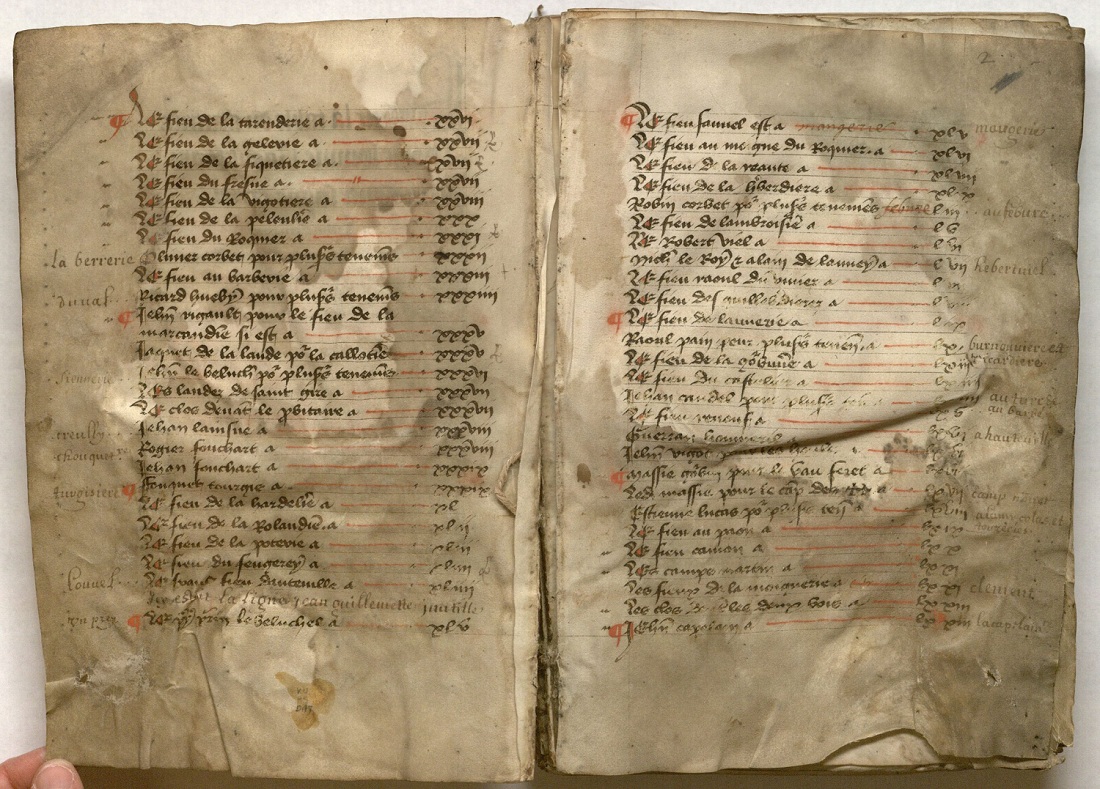
This small (23 x 16 cm), rather worn, manuscript contains copies of thirty-nine legal documents related to the Campront family of Normandy, France. Most date from the tumultuous years of the Hundred Years’ War (1337-1453), a series of conflicts between the rulers of England and France – with their allies – for control of the latter kingdom, the largest in Western Europe at the time. Land transactions, marriage settlements, and documents detailing contested claims were copied in a clear, functional hand. This was a volume designed not for show, but for its content, or, as we would say now, its “informational value.”

Image of a selected page from the Campront (de) family papers, La Manche, 1268-1438

Selected page from the Campront family cartulary. Call Number: MS D47. Click image to enlarge.

I encountered this document as a student at KU. I was thrilled to be able to work with an original manuscript and, although deciphering the old French was a challenge, I excitedly pored over each page, transcribing nearly the entire volume by hand in the days before laptop computers were widespread. I relied heavily on the preliminary work done by the late Ann Hyde, whose exhaustive description was just one example of the legacy she left behind to the Spencer Library. I learned quickly that while I could discover much about the family from this source, it was never intended to be a comprehensive document about the family’s affairs, and I was left wanting to know more about the generations of people mentioned in its pages.

Flash forward many years: I had deposited an electronic copy of my master’s thesis in the open access repository at The Ohio State University, where I then worked. (It’s also available at KU’s ScholarWorks, as is the preliminary research that formed my senior thesis.) Through the magic of Google, the current owner of the property in Normandy where the Campront family lived for hundreds of years came across my research while searching for information about his home. The historical documentation I had uncovered was personally exciting to him and, like many people, he wondered how the document ended up in Lawrence, Kansas. This gave me a chance to explain Kenneth Spencer Library and its amazing collections of early manuscripts, preserved here and made available to both amateur and professional scholars.

Image of a selected page from the Campront (de) family papers, La Manche, 1268-1438

Selected page from the Campront family cartulary.
Call Number: MS D47. Click image to enlarge.

The estate owner placed a copy of a translation of my work into the official archives of La Manche in Lower Normandy, thereby physically and linguistically extending the reach of my work even further. Finally, he offered to host me at this amazing property, parts of which appear not to have changed much from the sixteenth century, should I ever have the chance to visit.

For me, this one humble, centuries-old document, is not only a major signpost along my journey to becoming a librarian. It also captures so richly the power of the written word and the connections we make as human beings.

Beth M. Whittaker
Assistant Dean for Distinctive Collections
Director of Spencer Research Library

All Creeping Things: A History of Herpetological Illustration

May 26th, 2015

All Creeping Things: A History of Herpetological Illustration, Spencer Library’s newest exhibit, opened on May 14, 2015. Guided by Special Collections Librarian Karen Cook, students Megan Sims, Sydney Goldstein, and Ryan Ridder created and installed the exhibit for an exhibit planning and design course (MUSE 703). Whitney Baker, Head of Conservation Services at KU Libraries, Special Collections Librarian Sally Haines, and Caitlin Donnelly, Head of Public Services at Spencer, also assisted the students with their project.

The exhibit was developed in conjunction with the Society for the Study of Amphibians and Reptiles conference being held at the University of Kansas in July and features herpetological illustrations from seventeenth-, eighteenth-, and nineteenth-century books in Spencer Library’s Special Collections. Spencer has put on a few iterations of a similar exhibit for previous conferences. Each student had a unique perspective on their experience creating the exhibit.

Ryan Ridder

“One of our goals was to be distinct from Slithy Toves [a previous exhibit, by Sally Haines] and to present images that viewers familiar with that exhibition, and associated book, might not see as often. We ended up repeating a few irresistible images – the giant salamander, Agassiz’s turtles, and the famous frontispiece to Rössel von Rosenhof’s frog volume – but everything else you see is different. We thought touching on embryological illustrations would give our exhibit another unique slant.”

Photograph of Megan and Ryan installing books

Megan Sims and Ryan Ridder installing books in the cases. Click image to enlarge.

Sydney Goldstein

“I found this class to be both an overwhelming and an incredibly eye-opening experience. Coming from a graphic design background I’ve never gone through the steps of curating an exhibition or working off the computer. It was fun to rummage through a variety of books to select illustrations, figuring out how they will fit in the cases, selecting wall graphics, and working in a group. The most rewarding part was applying our vinyl title graphic ourselves. Overall, a great experience!”

Photograph of the MUSE 703 group hanging vinyl

Megan, Sydney, and Ryan hanging the vinyl title graphic.

Megan Sims

“I have installed many exhibits according to specific designs from clients, but this was my first experience selecting objects, designing signs and labels, and fabricating book mounts and wall graphics for an exhibit. Both the physical process and communication were challenging at times, but seeing the finished product was very rewarding. I’m excited for the conference members and the Lawrence community to see this exhibit!”

Photograph of the MUSE 703 exhibit team in front of title

Ryan Ridder, Sydney Goldstein, Megan Sims, and curator Karen Cook. Click image to enlarge.

All Creeping Things is free and open to the public through August 2015.

Megan Sims
Museum Studies Graduate Student

Happy Birthday, Carl Linnaeus!

May 18th, 2015

This week we celebrate the birthday of the great 18th century taxonomist Carolus Linnaeus, who was born on May 23rd, 1707. Spencer Library holds one of approximately thirty surviving copies of the first edition of Linnaeus’ epoch-making Systema Naturae. Spencer’s remarkably fine copy is housed in an ingenious binding (only half as wide as the paper, allowing the broadsheet book to be folded vertically for easy carrying). During his lifetime, Linnaeus published twelve editions of this monumental work. By 1766, when the twelfth edition was published, the taxonomic text had grown from the seven broadsheets of the first edition to 2,300 pages.

Pryce J2

Carl von Linné, Systema naturae, 1735. Special Collections. Call number Pryce J2. Note the half binding, allowing the item to be folded for use. Click image to enlarge.

The Spencer Library Linnaeus collection includes nearly all of his major works in many editions, of which a hundred or more are first editions. Particularly notable are the various editions of the Systema Naturae; a complete set of the Linnaean dissertations in their first editions; a splendid copy of the Hortus Cliffortianus (1737); the first edition, first and second issues, of the Species plantarum (1753), the work in which Linnaeus first applied binomial nomenclature to botany; and the scarce first edition of Pehr Kalm’s En Resa till Nora America (1753-1761). The collection also includes long runs of the journals published by the principal Linnaean societies, many biographical works, and early editions of works by Linnaeus’ disciples and contemporaries.

Pryce J2_detail

Detail from Carl von Linné, Systema naturae, 1735. Special Collections. Call number Pryce J2. Click image to enlarge.

Adapted From A Silver Anniversary: The First 25 Years of the Kenneth Spencer Research Library, Jim Helyar, editor (1994).

Whitney Baker
Head, Conservation Services

Hidden Treasure Found in the Stacks

April 15th, 2015

Working at Spencer for the past two years, I’ve discovered many amazing manuscripts and old novels that I never dreamed of getting the chance to actually work with. An even more far-fetched idea, however, was finding books that I read when I was a kid and had completely forgotten about.

Yet I did.

It started off as any other day: reshelving books within the stacks. I pushed my book cart, complete with its squeaky wheels, down the rows as I returned the books back to their homes on the shelves. Walking around the perimeter of the stacks, I found a section of books that I hadn’t noticed before. They stood out amongst the old, leather bound covers of books published before the 1700s. Instead, these spines were cloth and colorful, rich in design and detail.

And they looked eerily familiar.

Image of the cover of In the Reign of Terror by G. A. Henty, 1888

The cover of In the Reign of Terror by G. A. Henty.
Illustrated by J. Schönberb. London: Blackie, 1888.
Call Number: O’Hegarty B805. Click image to enlarge.

Leaving my book cart behind me, I walked up to take a closer look, disbelief forming in the back of my mind. No, these couldn’t be the same books I read in middle school, I thought. There was no chance. Upon closer inspection, my gut was proven to be right: I had discovered a treasure trove of books by British author George Alfred (G. A.) Henty. Shelves upon shelves were lined by his masterpieces, a series of adventure books that I’d barely scratched the surface of, reading them in my youth.

Instantly, I was transported back home, as an eleven-year-old, acne-riddled, glasses wearing middle-schooler, standing in my public library. I discovered a book by accident: it had a simple red cover that was torn on the sides. The title read In the Reign of Terror: The Adventures of a Westminster Boy by G. A. Henty. I have never heard of him before, but I decided to take the book home with me and give it a try.

I finished it within the week.

Henty was a mastermind of writing stories threaded within historical events. In the Reign of Terror was about a boy named Harry Sandwith, who was sent to live with the Marquis de St. Caux during the French Revolution, in a time when political stresses tore the country apart during the reign of King Louis XVI. Even though his novels were written in the late nineteenth century and intended for a young male audience (he always started off his tales with a letter to his audience, addressed to his “Dear Lads…”), I still found them to be enlightening, enjoyable and one heck of a political and historical ride.

And I had completely forgotten about Henty and his tales.

Image of the cover of St. Bartholomew's Eve, G. A. Henty, 1894

The cover of St. Bartholomew’s Eve by G. A. Henty.
Illustrated by H. J. Draper. London: Blackie, 1894.
Call Number: O’Hegarty B818. Click image to enlarge.

Since being reunited, I have been reminded of the books that I raided when I was a kid. After reading Reign, I quickly went through our library’s collection back home, which consisted of six titles. My favorite I’ve read is St. Bartholomew’s Day Massacre, which is a tale of the Huguenot Wars.

Illustration in St. Bartholomew's Eve, G. A. Henty, 1894

An illustration in St. Bartholomew’s Eve by G. A. Henty.
Illustrated by H. J. Draper. London: Blackie, 1894.
Call Number: O’Hegarty B818. Click image to enlarge.

Image of preface in St. Bartholomew's Eve, G. A. Henty, 1894 Image of preface in St. Bartholomew's Eve, G. A. Henty, 1894

The preface of St. Bartholomew’s Eve by G. A. Henty, addressed to “my dead lads.” Illustrated by H. J. Draper.
London: Blackie, 1894. Call Number: O’Hegarty B818. Click image to enlarge.

Now that I have rediscovered Henty, I’ve been looking into him again and trying to decide which book to read next in order to get back into reading him. Yet I also realized that there are plenty of controversies surrounding the author I’d accidentally discovered. While these stories are advertised as stories of adventures for young boys, they were also criticized – both during the time of publication and especially since then – as being xenophobic towards anything that wasn’t part of British culture and nationalism. His books were also labeled as strong propaganda towards British imperialism, raising the question of if there was another purpose behind Henty’s agenda for writing these novels.

None of this political scandal was noticed by me as a young reader, but recognizing it now, I think it would be interesting to go back and reread some of his stories, or pick up a brand new one. Rediscovering one of my favorite childhood authors was something I definitely didn’t expect to happen while working within the stacks. It was an experience that made me feel like I went back in time, while at the same time, opened a door to learning more about this controversial, yet very popular, late-nineteenth-century author.

It just goes to show that no matter what you’re doing in a library – working, researching or just simply browsing – the treasures waiting to be discovered are endless.

Nicole Evans
Public Services Student Assistant