The University of Kansas

Inside Spencer: The KSRL Blog

Books on a shelf

Welcome to the Kenneth Spencer Research Library blog! As the special collections and archives library at the University of Kansas, Spencer is home to remarkable and diverse collections of rare and unique items. Explore the blog to learn about the work we do and the materials we collect.

April-May Exhibit: Binder’s Waste in Early Modern Books

May 8th, 2026

The Summerfield Collection at Kenneth Spencer Research Library consists of early-modern printed books, but the focus of a current project supervised by Special Collections Curator Eve Wolynes is to identify instances of binder’s waste and, when possible, identify their original source. Binder’s waste is a term for when parts or pages of an older, often medieval, manuscript are reused as part of the structure of a book’s binding. This could mean the boards of a book, structural support for the spine, or more decorative details like the cover, flyleaves, or similar. Many of the materials used as examples here are currently available for viewing – with a second case of materials highlighting illustrations by Edward Gorey – in Spencer’s North Gallery through May 29th.

Beginning with structure, the most obvious examples of reuse can be found in the interior of a volume, generally on the boards near the spine. This kind of reuse is generally to help support either just the spine or the adherence of the boards and the spine together. Lorenzo Valla’s Elegantiae (Call Number: Summerfield B1962) has an example of this as the paper pasted on top (pastedown) has worn away enough to show some of the reuse (Fig. 1). This is clearly a medieval text, and – while it is fragmented – some of the words such as “Johannes” in the body text and “baptista” in the marginal notation among other examples illustrate that the focus of the text is on John the Baptist.
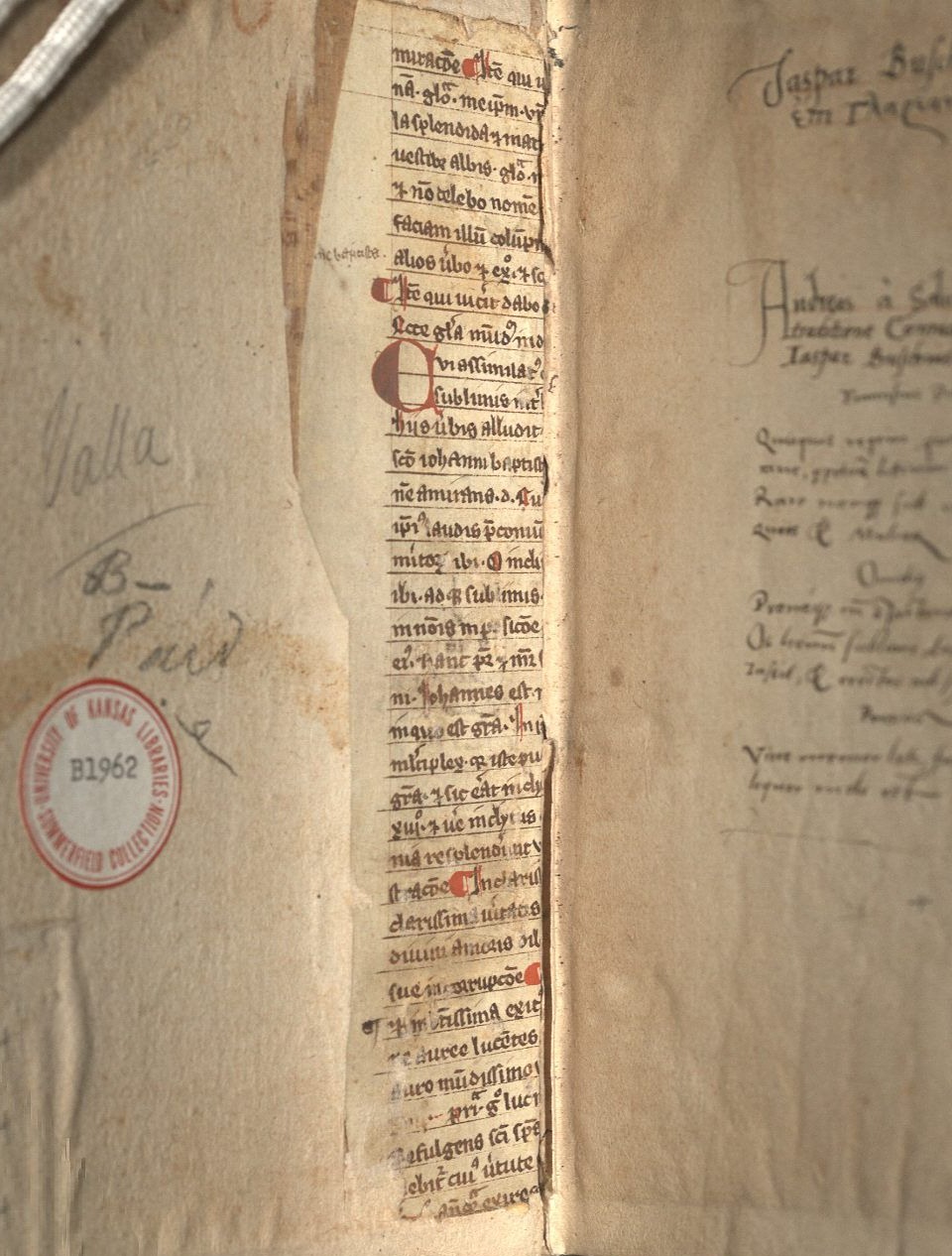
Long narrow strip of a medieval manuscript inside the front cover of an early modern book.
Fig. 1: Front interior detail, Elegantiae, 1540. Call Number: Summerfield B1962. Click image to enlarge.

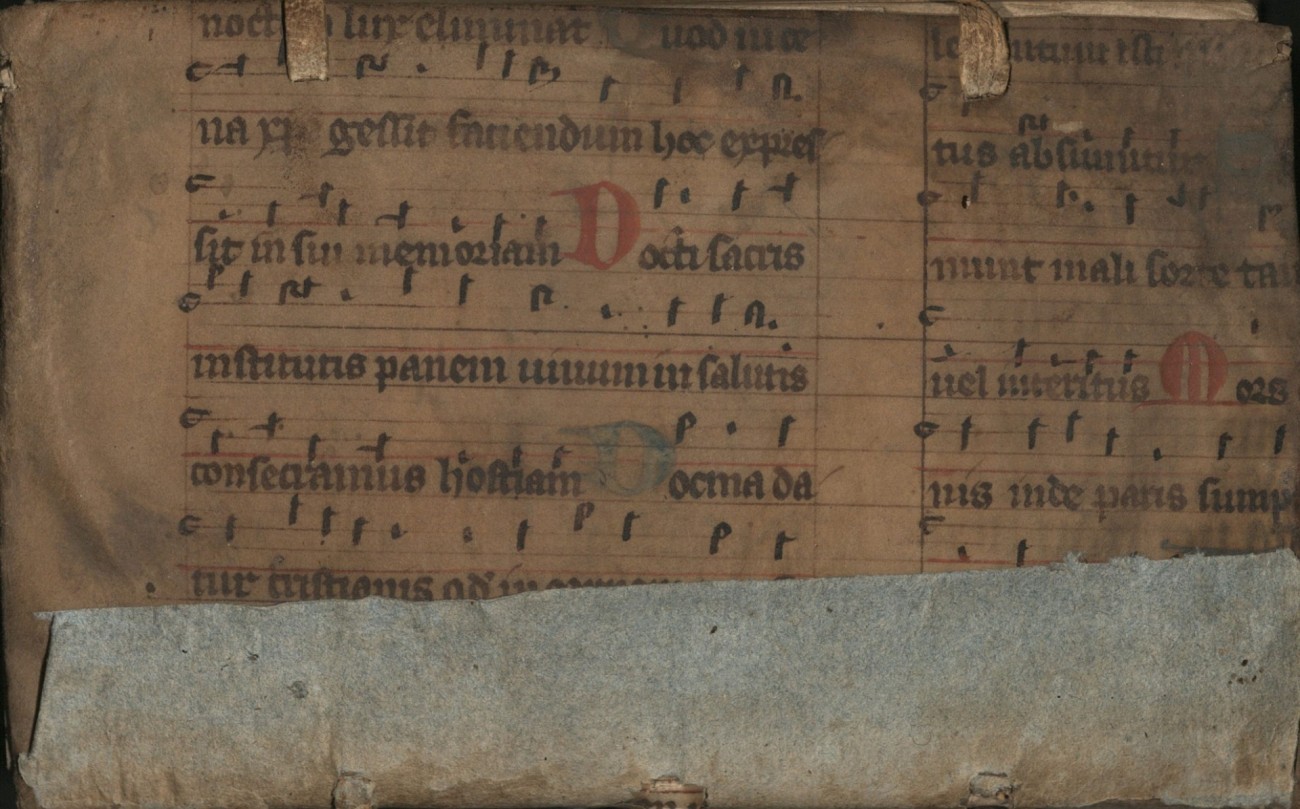
An example of more spinal support (Fig. 2.1) is seen in Analysis Logica Libri S. Lucae Qui Inscribitur Acta Apostoloru (Call Number: Summerfield B698). The strips are another method in which reuse occurs, though it can also be in longer or wider strips. The strips in this particular volume do not have any text or decoration remaining, so their exact origin cannot be certain. However, it is possible they come from the same leaf that was used to make the cover (Fig. 2.2). Based on the text visible both from the interior of the spine and the exterior cover, we can find that the lyrics to the music sheet are from “Lauda Sion,” a Christian hymn that celebrates Jesus Christ. Reuse of music sheets is fairly common within the Summerfield Collection, likely due to the rubrication and various ink colors or decoration that may accompany them.
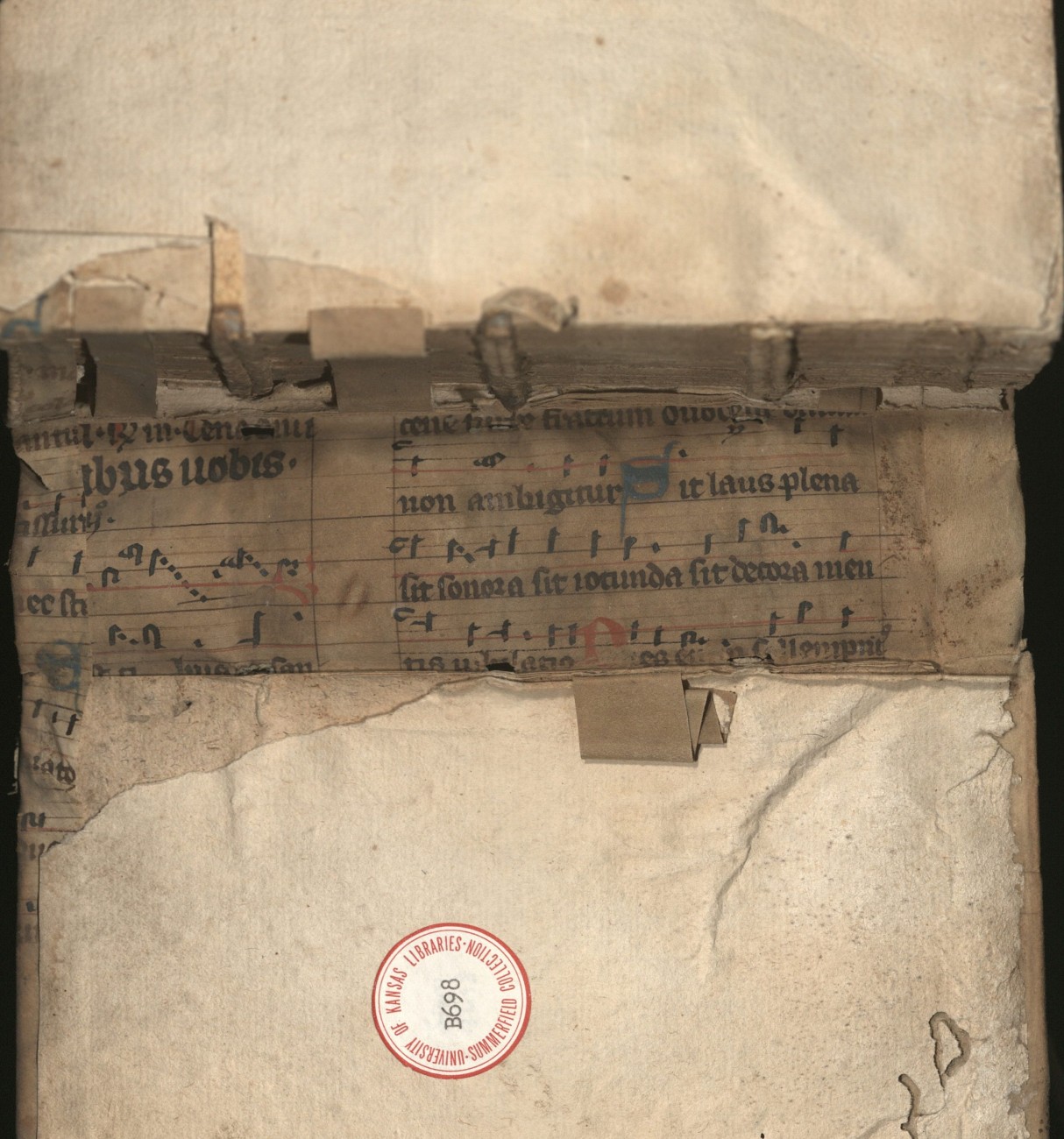
An early modern book opened to show a piece of medieval music and small strips of unmarked paper in its spine.
Fig. 2.1: Spine interior detail, Analysis Logica Libri S. Lucae Qui Inscribitur Acta Apostoloru, 1597. Call Number: Summerfield B698. Click image to enlarge.
Piece of medieval sheet music.
Fig. 2.2: Front cover, Analysis Logica Libri S. Lucae Qui Inscribitur Acta Apostoloru, 1597. Call Number: Summerfield B698. Click image to enlarge.

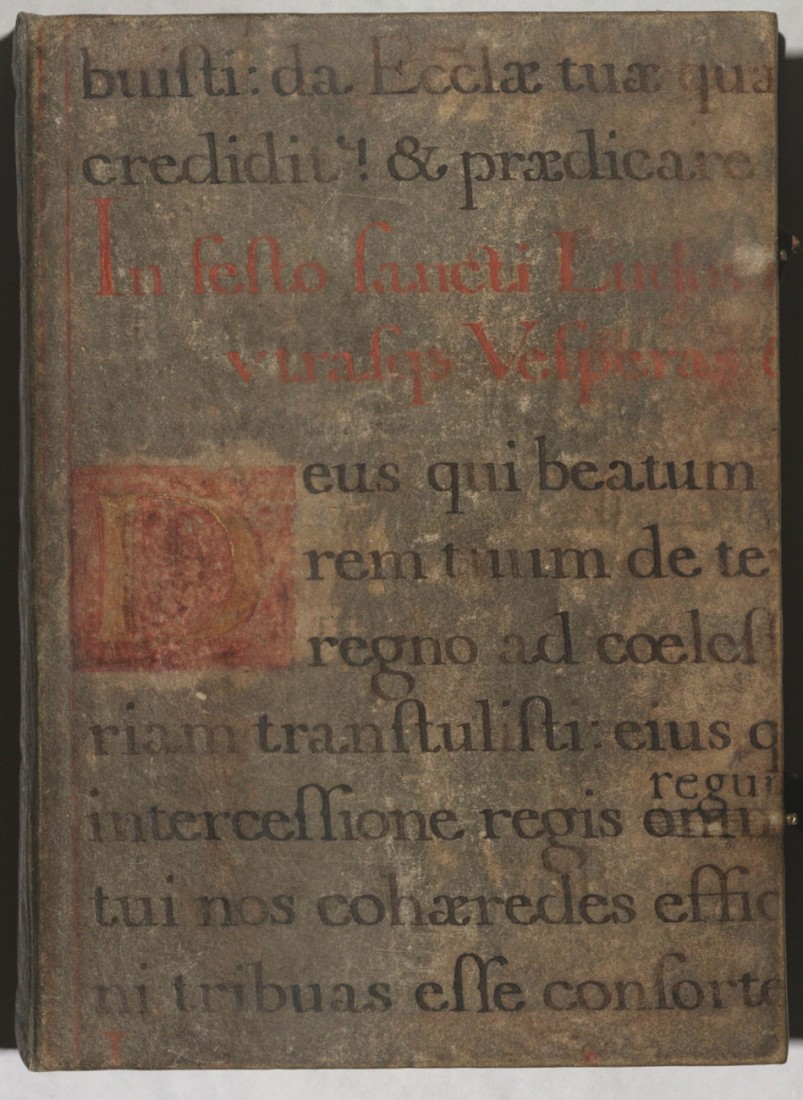
Music, although not a particularly popular feature, was not an uncommon form of reuse, either because of its wide availability or because it had some aspect of artistry and thus aesthetic interest for a cover. While actual music sheets may have been popular, texts of chant or hymnal lyrics are also quite common. A book of hours in the Summerfield Collection (Call Number: Summerfield B2890) has one such instance of reuse as the cover consists of a chant to laud St. Louis (Ludovicus in Latin), which would likely have been performed during Mass (Fig. 3).
Section of a medieval manuscript with black and red text in Latin.
Fig. 3: Front cover, Book of Hours, 1497. Call Number: Summerfield B2890. Click image to enlarge.

There were, of course, numerous other ways to reuse materials, but these are some of the most common examples within Spencer’s holdings. While some of the items are currently part of the temporary exhibit, the Summerfield Collection is always available for access in the Reading Room at Kenneth Spencer Research Library.

Kit Cavazos
Public Services student assistant
Ephemera and Binder’s Waste in Summerfield E397

April 10th, 2018

Last year, I wrote about my survey of part of the Summerfield Collection of Renaissance and Early Modern Books, and all of the lovely hidden treasures within that collection. One item that I identified during the survey as a candidate for future treatment is Summerfield E397, De statu religionis et reipublicae, Carolo Quinto Caesare, commentarii, by Johannes Sleidanus, published in 1555.

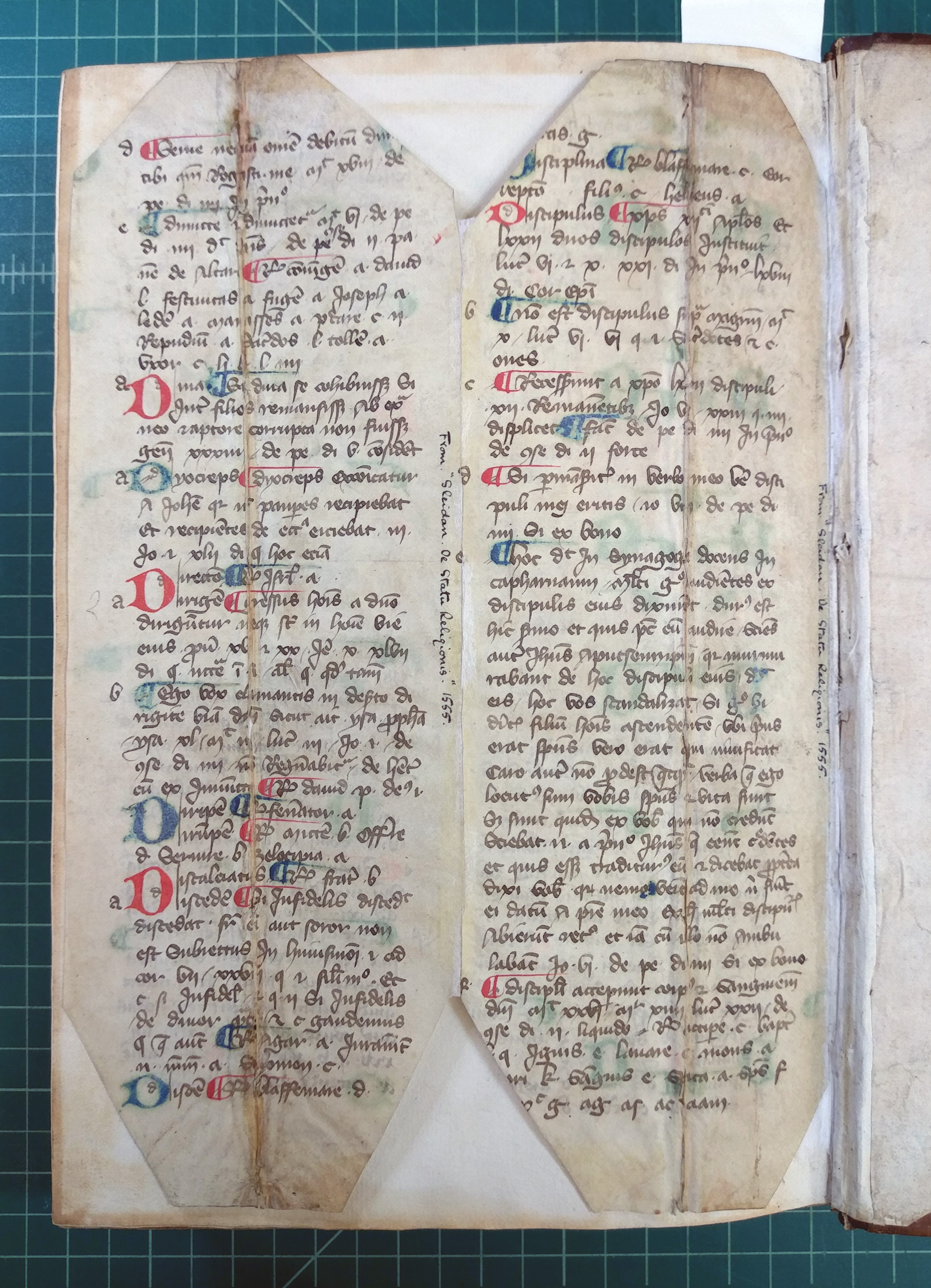
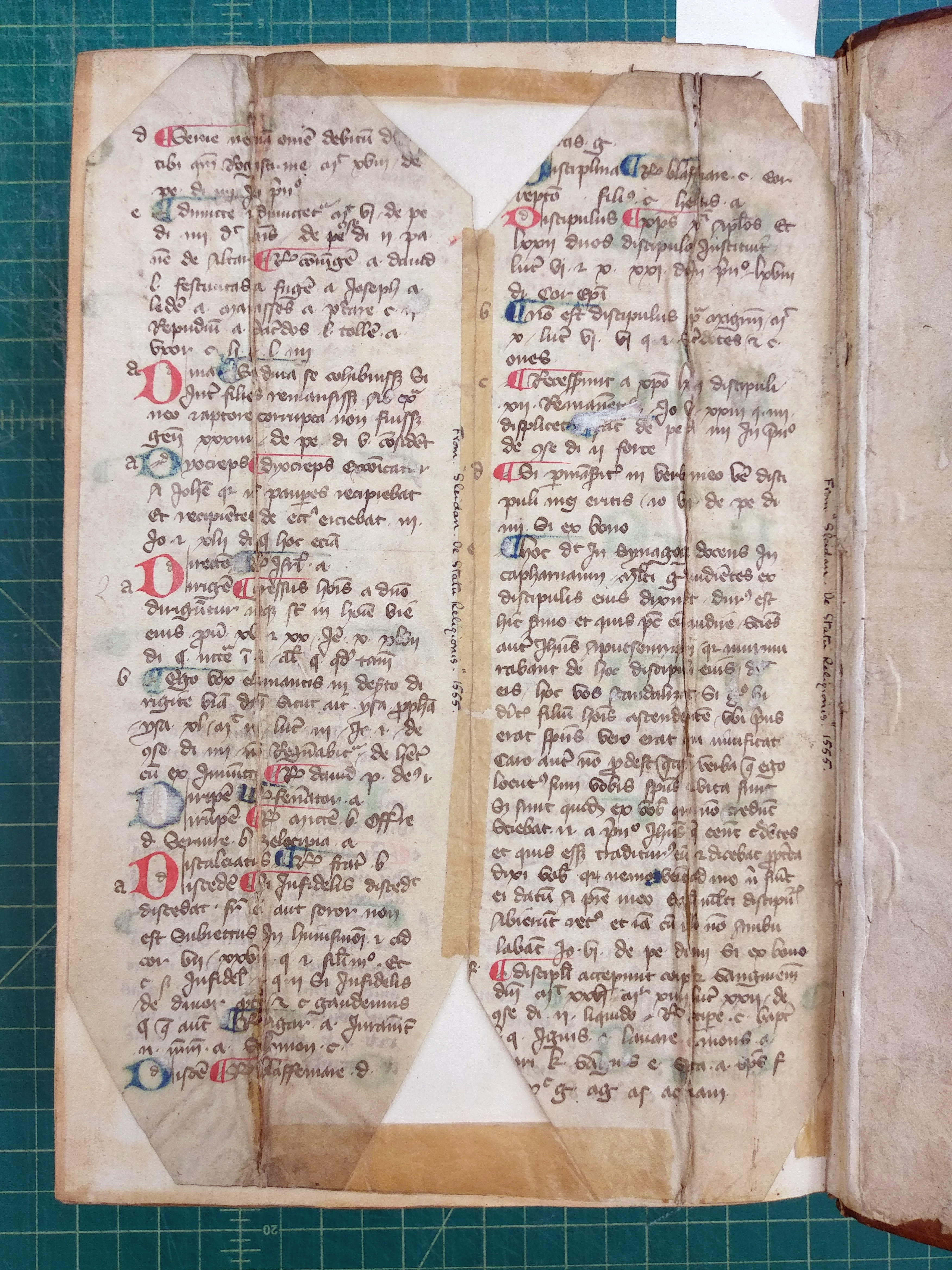
What caught my attention about this volume is the fragment of parchment manuscript that was taped inside the lower board. Actually, there are two fragments – halves of a leaf that long ago was cut apart and used to form flanges that were sewn onto either side of the text block and then adhered between the boards and pastedowns. At some later time, the book was repaired and the manuscript flanges were removed. Whoever removed them chose to retain them, piecing them back together with glassine tape and affixing them inside the back of the book.

Summerfield E97, Spencer Research Library, University of Kansas Libraries

Manuscript fragments, previously used as binder’s waste,
taped into the back of Summerfield E397. Click image to enlarge.

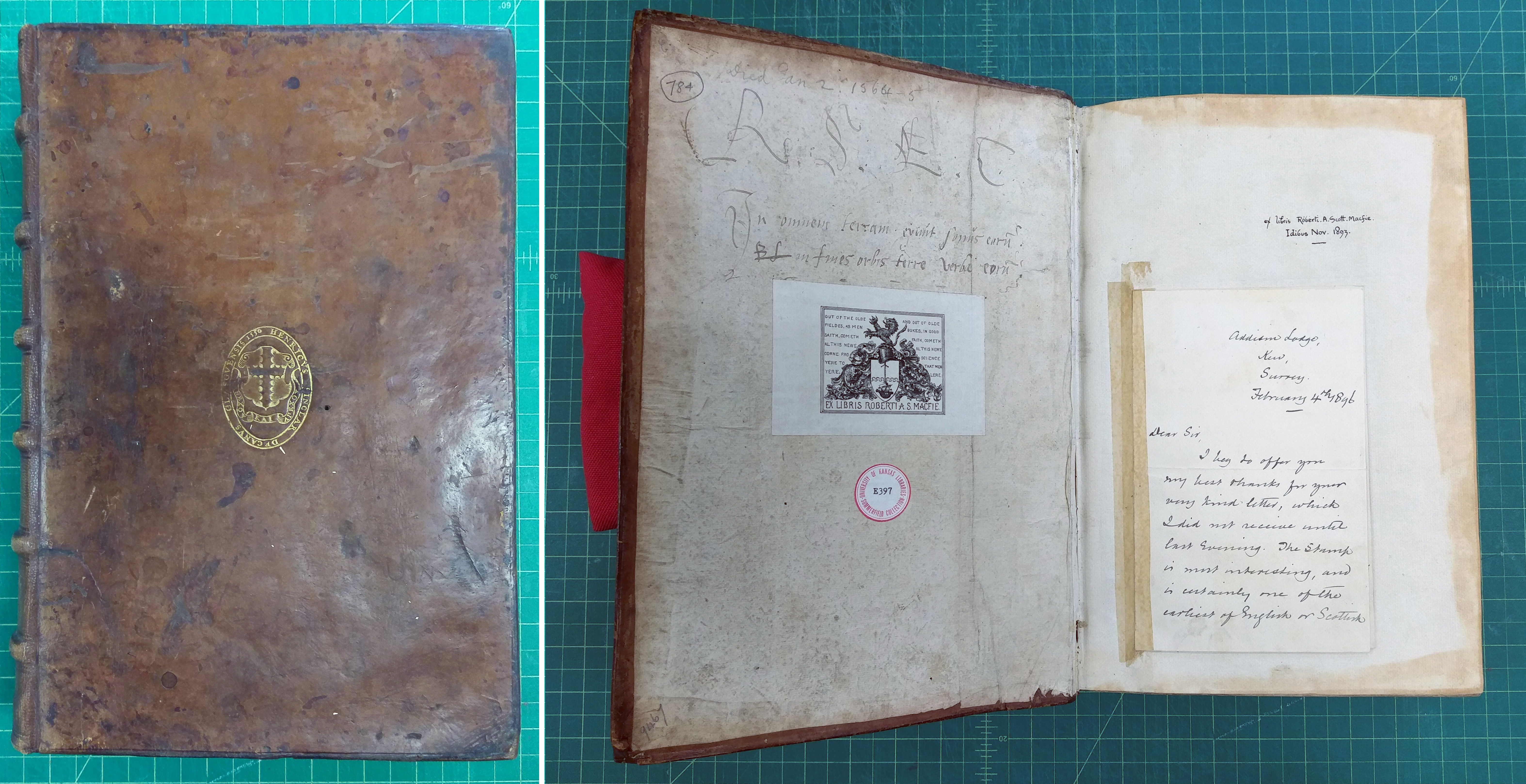
In the front of the volume are affixed two letters dated in February 1896 that a one-time owner of the volume – one Robert A. Scott Macfie – received from a William Y. Fletcher in response to an inquiry he had sent about the book (Fletcher’s name appears in a 1908 list of members of the Bibliographical Society of London). The second of these letters mentions that Fletcher had shown the book (which Macfie had lent him to examine) to “Mr. Scott and Mr. Warner, the Keeper and Assistant Keeper of MSS in the [British] Museum, and they consider [the fragments] to have belonged to an English or Scottish MS (most probably the former) of the 15th century.” How fascinating and fortunate that these records of the book’s life have survived with it.

Summerfield E97, Spencer Research Library, University of Kansas Libraries

Left: Cover of Summerfield E397. Right: Fletcher’s letters to Macfie
taped onto front flyleaf. Click image to enlarge.

At the time that I surveyed this book, I consulted with the curator about how to approach the treatment and made a note to revisit it at a later date. I recently reviewed my queue of projects and this one presented itself. In my discussion with the curator, we had agreed to leave the letters as-is, but to remove the tape from the manuscript fragments, reunite them with wheat starch paste and Japanese tissue, and tip them back into the volume with the same. Their presence in the volume tells something of the book’s story, but we felt it would be beneficial to remove the brittle, discolored tape from the parchment.

Summerfield E97, Spencer Research Library, University of Kansas Libraries

Visible threads (top) and sewing holes (bottom) indicating
these fragments had been used as binder’s waste.
Click image to enlarge.

Luckily, if one has to remove tape, this type of tape is about as easy to remove as they come. The gummed adhesive layer on this tape responds very well and quickly to a light application of methylcellulose; after just a couple of minutes, the tape carrier and most of the adhesive lift away easily. I reduced the remaining adhesive residue by gently swabbing it with damp cotton, but I did not pursue this very far – overly aggressive cleaning would leave those areas of the parchment looking too starkly white. When the tape was all removed, I used a soft brush to dislodge some surface dirt that had accumulated in the creases.

Summerfield E97, Spencer Research Library, University of Kansas Libraries

Removing the tape hinge that had held the fragments in place.
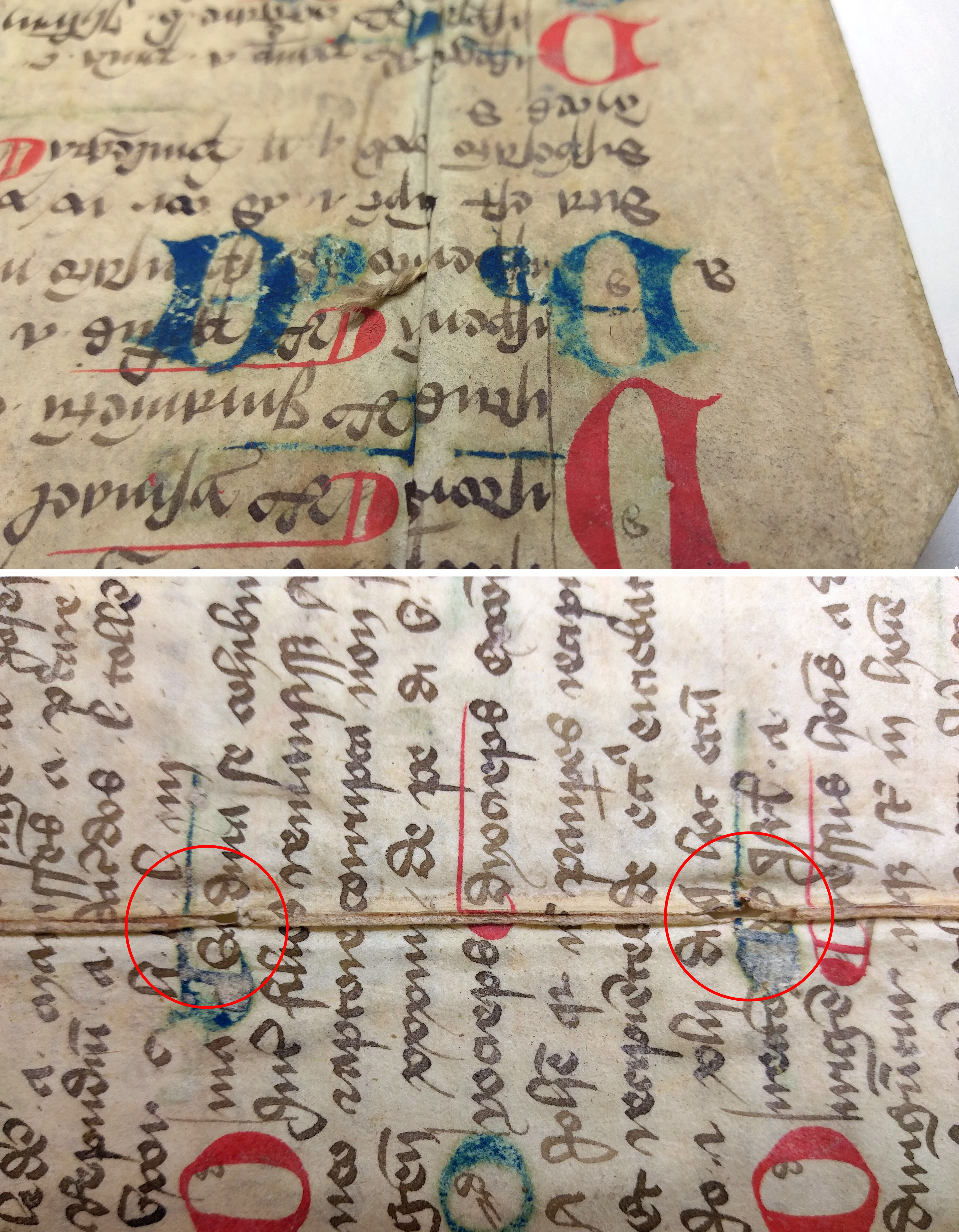
In the red circle, note the stain left by one of the blue manuscript capitals
from when the fragments served as binding material. Click image to enlarge.

Summerfield E97, Spencer Research Library, University of Kansas Libraries

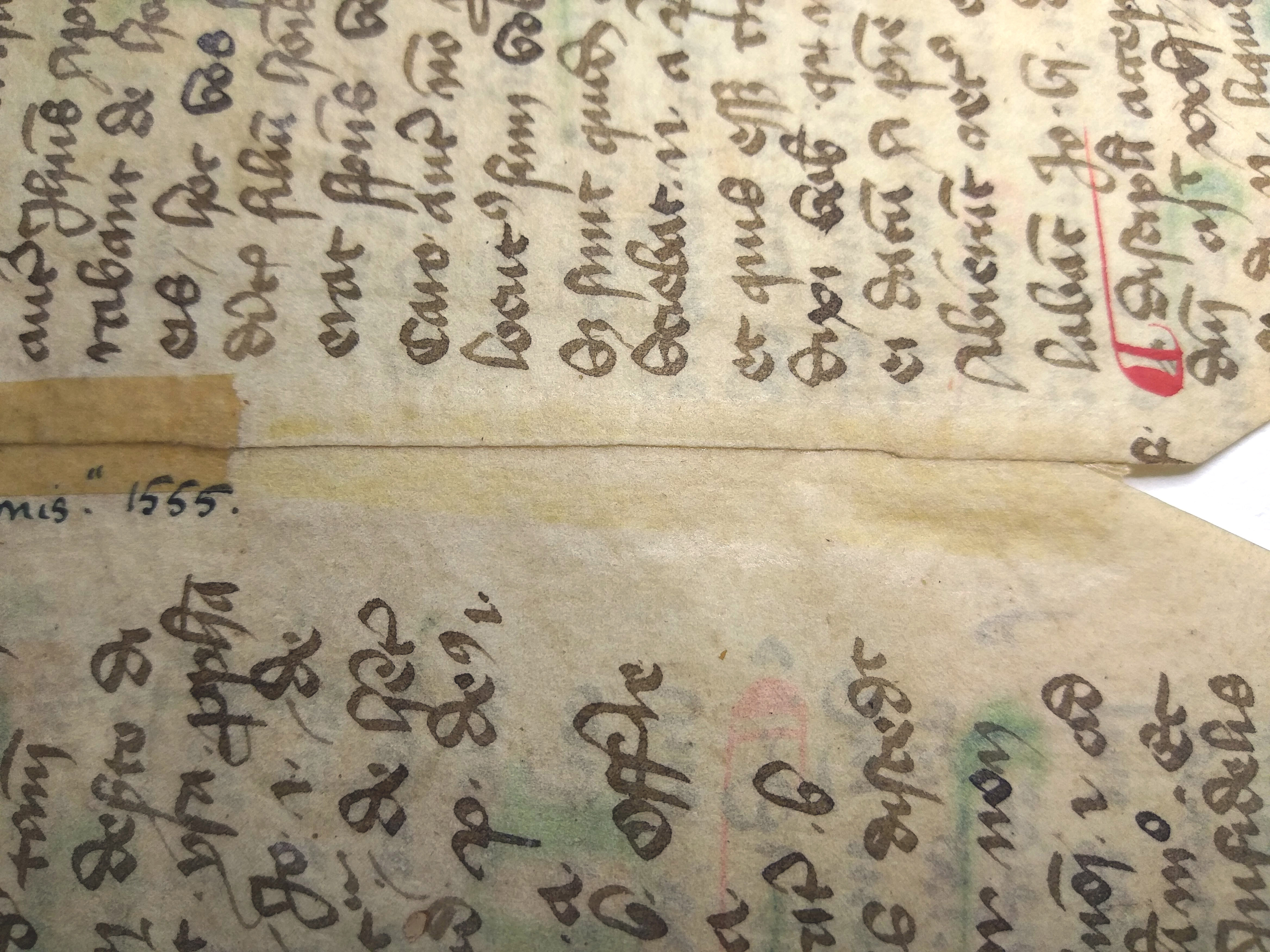
Detail of the seam where the two halves of this leaf were cut apart long ago.
Click image to enlarge.

Next, I used very dry paste and thin tissue to reattach the two halves to one another. I chose to do this in lapped sections rather than a continuous strip to allow the skins to expand and contract with subtle changes in the environment, and to distribute the stress of the repair evenly along both sides of the leaves, as well as to avoid placing adhesive over areas where ink was present. Finally, I reattached the fragments inside the lower board using a hinge of Japanese tissue and paste.

Summerfield E97, Spencer Research Library, University of Kansas Libraries

The finished manuscript fragments replaced into the volume.
Click image to enlarge.

Angela Andres
Special Collections Conservator
Conservation Services

An Embarrassment of Riches: Highlights from a Survey of the Summerfield Collection

August 29th, 2017

This year I have been conducting a survey of part of the Summerfield Collection of Renaissance and Early Modern Books. It is not an exhaustive survey, but rather a cursory look at each volume to determine its general condition, immediately address minor refurbishment or housing needs, and note any issues that can be followed up on in future projects. I have not been recording every small detail, but I still get to handle and glance over each volume, which is a great treat – the Summerfield collection is truly a treasure. Summerfield’s many beautiful bindings, in particular the limp vellum and ornately tooled alum-tawed pigskin bindings, merit their own post someday. But today I want to share some of the hidden gems that I’ve encountered in the course of my work.

Summerfield Collection, Kenneth Spencer Research Library, University of Kansas Libraries

This botanical text (Summerfield D519) has the most lovely line illustrations. Wouldn’t they make absolutely wonderful coloring pages?
(Click all images to enlarge.)


Summerfield Collection, Kenneth Spencer Research Library, University of Kansas Libraries

Summerfield E397 has two pieces of binder’s waste manuscript fragments taped into the back of the volume. Whoever put a new binding on this volume in the last century saved the fragments from the earlier binding.


Summerfield Collection, Kenneth Spencer Research Library, University of Kansas Libraries

Summerfield contains a wealth of pastepapers in classic crumpled-paper and combed patterns.


Summerfield Collection, Kenneth Spencer Research Library, University of Kansas Libraries

There are also printed pastepapers in big, bold patterns…


Summerfield Collection, Kenneth Spencer Research Library, University of Kansas Libraries

…as well as tiny, delicate printed patterns.


Summerfield Collection, Kenneth Spencer Research Library, University of Kansas Libraries

These endpapers with an oversize printed floral design might be made from wallpaper or wallpaper samples.


Summerfield Collection, Kenneth Spencer Research Library, University of Kansas Libraries

Here are two examples of colorful decorated text block edges.


Summerfield Collection, Kenneth Spencer Research Library, University of Kansas Libraries

It’s always fascinating to get a glimpse of a binding’s structure and the printed or manuscript matter that binders used in their work.


Summerfield Collection, Kenneth Spencer Research Library, University of Kansas Libraries

Traces of prior readers, such as this charming handmade bookmark, can be especially thrilling to encounter. Such evidence makes me feel particularly connected to the past and very lucky that I get to do this job!


Angela Andres
Special Collections Conservator
Conservation Services


The Long Haul: Treating One of the Neediest Cases

February 15th, 2016

(Part 1 in a series on the treatment of Summerfield D544)

The great majority of the items that we treat here in the conservation lab are in and out of the lab relatively quickly*. (*I use this word in a most qualified and highly subjective way! That usually means anywhere from a few minutes to a few hours to a couple of weeks.) A treatment need not be time-consuming or highly invasive in order to be effective; because there are so very many items in our collections that need treatment, and because we conservators try to take a conservative approach to treatments, we design most treatments to employ our resources – time and materials – as economically as possible while achieving the maximum benefit for the items being treated.

On occasion, however, we encounter items that need extra care and a fuller application of the tools available to us. These treatments are nursed along gradually and in stages, the work carried out alongside and in between shorter-term treatments, and sometimes put away for days or weeks at a time to let more immediate priorities take precedence. I currently have one such treatment on my bench, the Polish printed book, Kazania na niedziele calego roku [i.e., Sermons for Sundays of the Whole Year] by Pawel Kaczyński, published in 1683 (call number: Summerfield D544).

Book before treatment. Call number Summerfield D54, Special Collections, Spencer Research Library.

Summerfield D544 before treatment. Special Collections, Spencer Research Library. Click image to enlarge.

The catalog record notes that Spencer Library’s copy of this title is “imperfect;” indeed, we have only volume 1 of a three-volume set, our volume is missing one page, it has significant losses and edge damage throughout the text block, and not least of all, it is missing its binding. What remains of the volume is dirty and worn, and its sewing is rather carelessly executed, which limits the volume’s opening and has resulted in damage along the spine where sloppily-inserted thread has torn through the paper. In addition, the spine is coated with a thick waxy substance that is causing discoloration and breakage along the spine folds.

Book before treatment. Call number Summerfield D54, Special Collections, Spencer Research Library.

Example of damage caused by poor sewing. Click image to enlarge.

Book before treatment. Call number Summerfield D54, Special Collections, Spencer Research Library.

Damage caused by waxy spine coating. Click image to enlarge.

This poor volume had been housed in a simple envelope, and was at the very least in need of better housing, but one interesting feature drew our attention: a fragment of manuscript binder’s waste still adhered to the frayed cords on the back of the volume. It is not unusual to see repurposed manuscripts in books from this time, and the Summerfield Collection has many other examples of binder’s waste in its books. The fragment on Kazania is a bit different, however, because the language in which it is written appears to be Old Church Slavonic (while most of the manuscript fragments we see tend to be in Latin) and because the material it is written on is paper, rather than parchment.

Book before treatment. Call number Summerfield D54, Special Collections, Spencer Research Library.

Manuscript binder’s waste on the back of the volume. Click image to enlarge.

The fragment was dirty, torn, and completely obscured on one side by the pasted-down cords and layers of delaminated board from the missing binding. Normally we would attempt to preserve binder’s waste on the volume itself, but in this case, absent a binding and with the fragment at risk for further damage, we consulted with the collection curator and opted to release the fragment from the cords, clean it to the extent possible in order to reveal the concealed manuscript, and house it with the volume, including photographs of its original condition, as a teaching tool.

But what about the rest of the volume? In its present condition it is not suitable for use, and its sewing is causing damage to the text block, so we decided that the volume should be disbound, cleaned, mended, sewn up again, and placed into a limp paper conservation case binding. A paper case, similar to the one shown here at left, has many benefits: it will protect the text block and allow for safer and easier handling of the volume; it can be easily removed from the volume if its conservation or binding needs ever change in the future; and it will have an aesthetically appealing appearance that will integrate well on the shelf with other volumes in the collection.

This treatment, then, is one of those exceptions to our generally conservative practice – some items just need more help than others. Now that you’ve been introduced to this volume in its before-treatment condition, stay tuned to this blog for updates as the treatment progresses. The next installment in this series will cover the removal of the manuscript fragment, dismantling of the sewing, and the cleaning and preparation of the text block for re-sewing.

Angela Andres
Special Collections Conservator
Conservation Services