The University of Kansas

Inside Spencer: The KSRL Blog

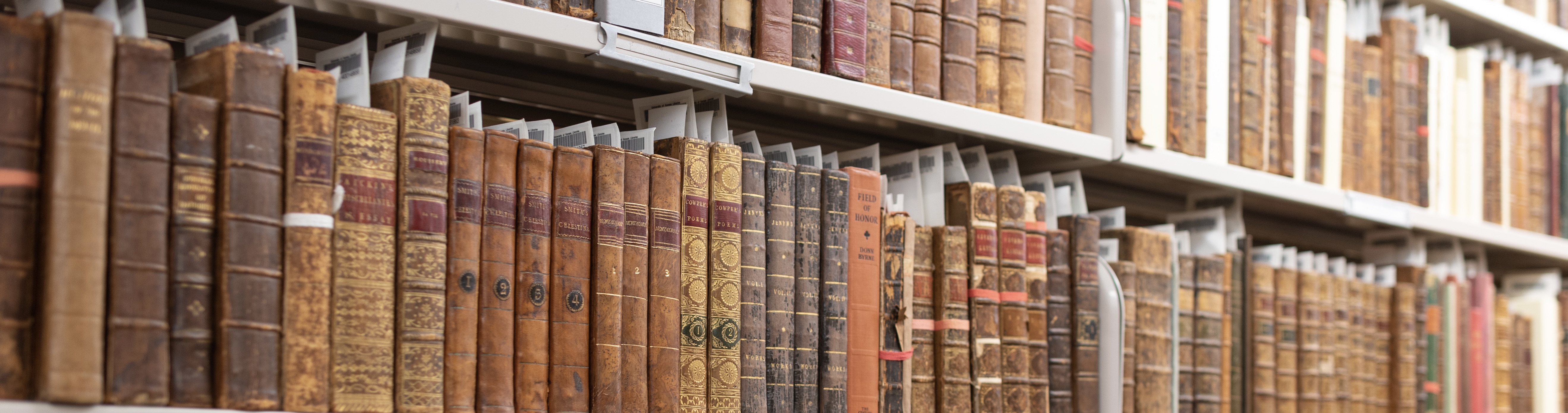
Books on a shelf

Welcome to the Kenneth Spencer Research Library blog! As the special collections and archives library at the University of Kansas, Spencer is home to remarkable and diverse collections of rare and unique items. Explore the blog to learn about the work we do and the materials we collect.

Have a Dreadful Halloween!

October 31st, 2016

Here are some spooky penny dreadfuls from our Special Collections to help you get into the Halloween spirit! Come into Spencer Research Library and take a look at the rest of our sensational tales from Victorian England.

First page of the penny dreadful titled The Old Witchcrafts by Robert and William Chambers probably published in 1854 in London and Edinburgh. Special Collections, B1229.

First page of the penny dreadful titled
The Old Witchcrafts, with illustration.
Written and published by Robert and
William Chambers, London and Edinburgh, circa 1854.
Call number: B1229. Click image to enlarge.

First page of the penny dreadful titled The Vampire, or, the Bride of the Isles. Published by G. Purkess circa 1853. Special Collections, B1239

First page of the penny dreadful titled
The Vampire, or, the Bride of the Isles,
with illustration. Published in London by
G. Purkess, circa 1853.
Call number: B1239. Click image to enlarge.

First page of the penny dreadful titled The haunted forest, or, The demon raftsman. Published in London by G. Purkess circa1853. Special Collections, B1251.

First page of the penny dreadful titled
The Haunted Forest, or, the Demon Raftsman,
with illustration. Published in London by
G. Purkess, circa 1853.
Call number: B1251. Click image to enlarge.

Mindy Babarskis
Reference Specialist
Public Services

The Home Stretch: Wrapping up treatment of Summerfield D544

October 24th, 2016

Earlier this year, I wrote here about the treatment of Kazania na niedziele calego roku [Sermons for Sundays of the Whole Year], 1683, by Pawel Kaczyński. In those posts, I discussed the beginning and middle stages of the treatment, and at long last it is time to report on the completion of this lengthy project.

Shortly after the last post was published, I finished sewing the volume. The next steps were to round and back the book (gently hammering the book in a press to create its rounded spine and raise the shoulders along the spine), add linings to the spine, and sew endbands at the head and tail. Finally, I placed the book into a case of stiff handmade paper.

Summerfield D544 during treatment. Kenneth Spencer Research Library, University of Kansas

Clockwise from upper left: Completed sewing; rounding and backing the volume; a completed endband; the volume in its paper case, under weight. Click image to enlarge.

Just to rewind a little, here’s what the book looked like a year ago when it was brought to the lab:

Summerfield D544 before treatment. Kenneth Spencer Research Library, University of Kansas

Summerfield D544 before treatment. This is a view of the back of the volume, which had no binding, showing the fragment of manuscript pasted to the cords. The fragment is mostly concealed by layers of delaminated board.

In addition to treating the volume itself, I also cleaned, mended, and housed the manuscript fragment, written in what is thought to be Old Church Slavic, that had been used as binder’s waste on the back of the book. I did minimal stabilizing mends to this piece; the paper is fairly strong, but the media on this fragment is highly water-soluble, so I was careful to place mends very selectively so as not to disturb the fragile media. I mounted the fragment in a double-window mat, which in turn sits inside a simple mat board folio. In this folio I also included before-treatment images of the volume for researchers’ and curators’ reference, and for use in teaching.

Summerfield D544 after treatment. Kenneth Spencer Research Library, University of Kansas

Manuscript fragment after treatment.

The new binding for this volume is a conservation paper case. It is not intended to be a historical reproduction – for we have no way of knowing how the book was originally bound – but rather an aesthetically sympathetic binding that will integrate well with its mates in the Summerfield collection, and, most importantly, can be safely handled.

Summerfield D544 after treatment. Kenneth Spencer Research Library, University of Kansas

Summerfield D544 after treatment, in a handmade paper case.

The finished volume and the manuscript fragment are housed together in a cloth-covered drop-spine box. It is one of the great rewards of this job to be able to return to the stacks an item that had once been inaccessible, knowing that it can now be used and enjoyed by visitors to Spencer.

Summerfield D544 after treatment. Kenneth Spencer Research Library, University of Kansas

Item in box.

Angela Andres
Special Collections Conservator
Conservation Services

Sweet and Saur

October 17th, 2016

Many a 20th century herpetologist credits his or her early interest in herpetology to the books of Raymond Ditmars. He published eight books on amphibians and reptiles for children and adults alike and, although many professionals consider him merely a popularizer and a showman, his scientific and public contributions to herpetology were substantial. When he was hired as Assistant Curator in charge of reptiles at the Bronx Zoo in 1899, his personal collection of reptiles formed the nucleus of the zoo’s collection. Later on in his career, he was active in developing techniques for curing reptile diseases, produced nature movies, created a clearing house for distribution of antivenins produced in Brazil, and co-founded an American antivenin institute. He was a popular lecturer as well.

Raymond Lee Ditmars. The Book of Prehistoric Animals, 1935. Call number Ellis Omnia D50, Kenneth Spencer Research Library, University of Kansas Libraries

Raymond Lee Ditmars. The Book of Prehistoric Animals, 1935. Ellis Omnia D50

Although this volume (and several others authored by Ditmars) is from the Ellis Collection of natural history, the Department of Special Collections also has a collection of children’s literature, more than 7,000 volumes from the late 18th to early 20th century, including lots of natural history. In fact, books for children, from a 16th-century gardening manual to 20th-century science fiction, turn up in almost all of our collections, and in them, herps abound.

Sally Haines
Rare Book Cataloger

Adapted from her Spencer Research Library exhibit and catalog, Slithy Toves: Illustrated Classic Herpetological Books at the University of Kansas in Pictures and Conversations

“Law is a Bottomless-Pit, it is a Cormorant, a Harpy, that devours everything”

October 3rd, 2016

Of the ancient professions–law, medicine, and theology–law, with its private language, its proud practitioners, its high fees, and its dependence on procedure and detail, much of which has no obvious meaning to the lay public, has been the easiest target for satire. The rise in frequency and venom of the satire appears to have coincided, at least so far as the English-speaking world is concerned, with the rise in the use of English in the courts. Once the barrier of Latin and Law-French was lowered, the satirist, like the writer of do-it-yourself law manuals, felt qualified to attack this arcane world.

By the early 18th century, satire of the law was such a recognized and accepted genre that John Arbuthnot, physician to Queen Anne, was able to satirize contemporary English politics under the guise of satirizing an extravagant lawsuit. This pamphlet is the second in his series known as the History of John Bull.

Pages from Bond B290. Kenneth Spencer Research Library, University of Kansas

Cover of John Arbuthnot’s Law is a bottomless pit, exemplify’d in the case of the Lord Strutt, John Bull, Nicholas Frog, and Lewis Baboon, who spent all they had in a lawsuit. Second edition. London: for John Morphew, 1712. Call number Bond B290.

Pages from Bond B290. Kenneth Spencer Research Library, University of Kansas

Beginning of chapter one: The occasion of the law-suit.

A contemporary owner has added notes identifying the parties and concepts involved. The lawyer, “Hocus” (for “Hocus pocus”), is the great general, Marlborough, whose supposed political ambitions–or those of his dangerously capable duchess–were greatly resented.

Pages from Bond B290. Kenneth Spencer Research Library, University of Kansas

Chapter two: How Bull and Frog grew jealous that the Lord Strutt intended to give all his custom to his grandfather, Lewis Baboon.

From Civil, Canon, and Common: Aspects of Legal History. An exhibition of books and manuscripts in the Kenneth Spencer Research Library, University of Kansas, 1996.
Alexandra Mason and James Helyar, editors

In the Thick of It: Part 2 in a series on the treatment of Summerfield D544

August 15th, 2016

Back in February, I wrote about undertaking the treatment of the 1683 volume Kazania na niedziele calego roku [Sermons for Sundays of the Whole Year] by Pawel Kaczyński (call number: Summerfield D544). At the time of that writing, I’d gotten as far as disbinding, cleaning, and mending the folios before it was necessary to put the treatment aside for a while to focus on other things. This summer I’ve brought the book out again to tackle the next phase of its treatment, preparation for rebinding.

I had already mended most of the folios along the inner spine folds, but they still needed reinforcement, or guarding, along the outer spine folds in order to be strong enough for sewing. Because there are exactly 100 single-folio sections in this volume, I chose a tissue for the guards that was as thin as possible to minimize added bulk while also providing the needed strength to the folds.

Conservation treatment of Summerfield D544, Spencer Research Library

Guarding of folios in progress. Note the smooth spine folds on the guarded folios, left, and the more ragged edges of the unguarded folios on the right. Click image to enlarge.

Conservation treatment of Summerfield D544, Spencer Research Library

The text block with guarding completed.

The amount of damage to this volume was so significant that for the sake of efficiency it was necessary to keep the mending fairly minimal, adding stabilizing mends with very thin tissue where it was most needed, rather than filling in every loss with color-matched tissue. However, there was a very large loss to the lower portion of the title page, so I chose to fill in that area; the page was physically stable, but a fill greatly improves it aesthetically. I selected a Japanese paper of about the same weight as the text paper and toned it with diluted watercolors to achieve a color that is sympathetic to the color of the text paper.

Conservation treatment of Summerfield D544, Spencer Research Library

Title page of Summerfield D544 with toned Japanese paper compensation along lower edge.

With the mending and guarding completed, the next step is sewing. The text block was originally sewn two-on, which means that two gatherings are sewn on at once with a single pass of thread, rather than sewing the gatherings one at a time. This method of sewing reduces the swell of the spine that occurs when thread is introduced; with 100 gatherings in this text block, it makes sense that the original binder chose to sew it this way, and I decided to re-sew it in the same manner. To further reduce bulking (in addition to sewing two-on), I chose a thinner thread than I’d normally use. The last step before sewing was to select endpapers for the volume; I opted for Nideggen, a paper whose tan color and subtle texture go very well with that particular warm, grimy tone of old paper. Once the endpapers were cut, I lined up the text block on the sewing frame to mark the positions of the cords, strung the cords onto the frame, and at long last, started sewing.

Conservation treatment of Summerfield D544, Spencer Research Library

Stringing up the cords on the sewing frame.

Conservation treatment of Summerfield D544, Spencer Research Library

Beginning to sew – three sections down and only 97 to go!

Conservation treatment of Summerfield D544, Spencer Research Library

About one-quarter of the way through sewing.

Conservation treatment of Summerfield D544, Spencer Research Library

Detail of double cords and kettle stitch at tail end of text block.

Sewing multiple gatherings at a time can be a little awkward at the outset, but now that I’ve found a rhythm to it, the sewing is progressing at a nice pace. Soon all that will be left to do will be to put the book into a new paper case. I look forward to presenting the finished volume in one last installment of this series later this fall!

Angela Andres
Special Collections Conservator
Conservation Services