The University of Kansas

Inside Spencer: The KSRL Blog

Books on a shelf

Welcome to the Kenneth Spencer Research Library blog! As the special collections and archives library at the University of Kansas, Spencer is home to remarkable and diverse collections of rare and unique items. Explore the blog to learn about the work we do and the materials we collect.

How Well Do You Know Your Irish Fairies?

March 14th, 2018

With St. Patrick’s Day (March 17th) just around the corner, grocery stores and pubs are suddenly awash in four-leaf clovers, leprechauns, and other trappings of the commercial elements of the holiday.  But why fixate on leprechauns when the world of Irish fairy folk is so much broader?  How well do you know your Irish fairies?

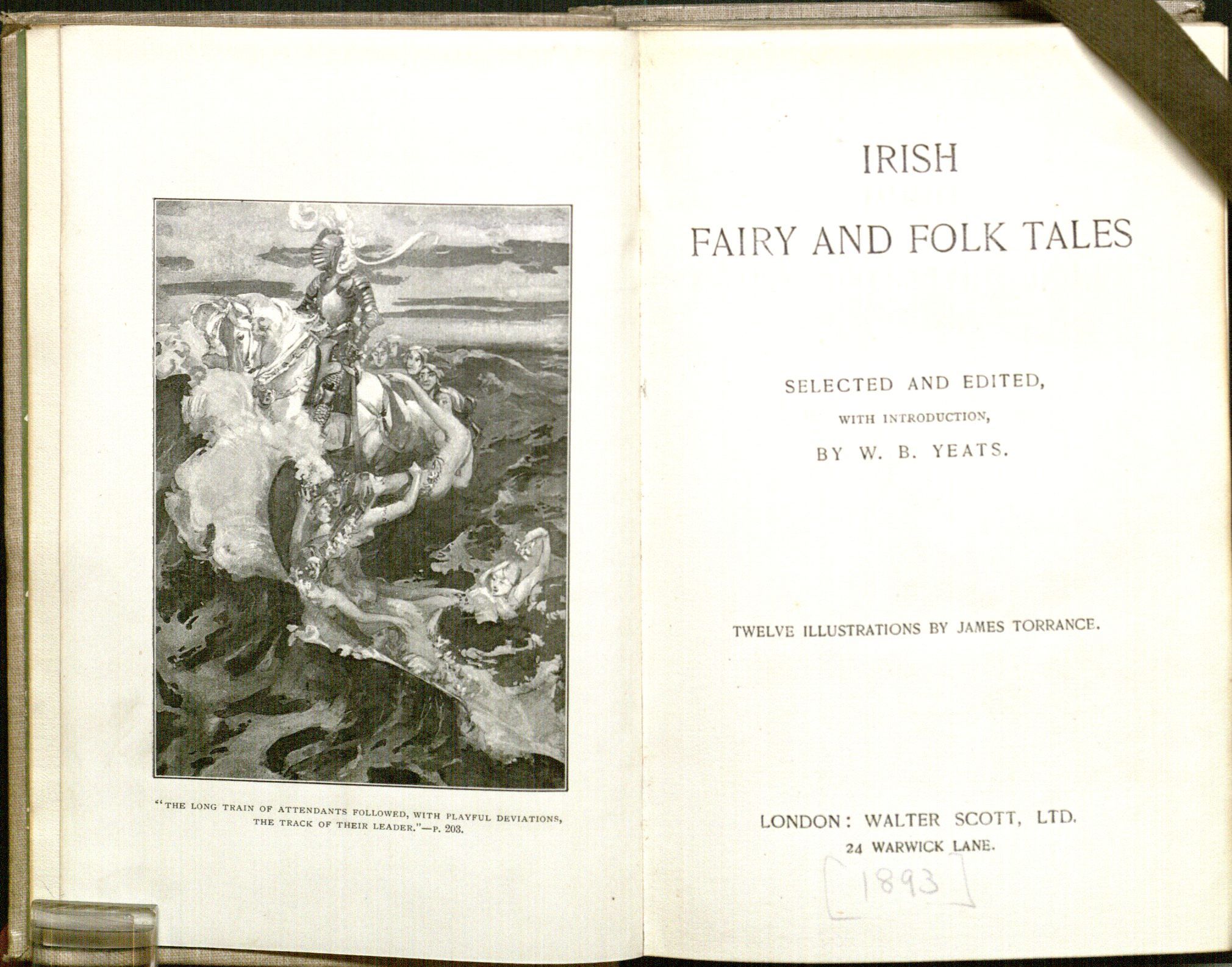
Frontispiece and title page of W. B. Yeats' Irish Fairy and Folk Tales (1893), an editon of his 1888 Fairy and Folk Tales of the Irish Peasantry, with 12 illustsrations by James Torrance.

Title page and frontispiece from Yeats’s Irish Fairy and Folk Tales (1893),
an illustrated edition of his earlier Fairy and Folk Tales of the Irish Peasantry (1888).
Call Number: Yeats Y191. Click to enlarge.

The Irish poet W. B. Yeats wrote more than once about Ireland’s different varieties of fairies. In 1888, when Yeats was in his early twenties, he edited a volume titled Fairy and Folk Tales of the Irish Peasantry, which collected stories and poems by a variety of writers on the supernatural elements of Irish folklore. In organizing the book, he assembled its pieces under several headings, including “Ghosts,” “Giants,” and “Saints, Priests.” However, he accorded fairies a place of particular honor (as is their due in Irish folklore) by beginning the anthology with them and including several short section prefaces detailing their ways. When a few years later Yeats published the anthology Irish Fairy Tales (1892) for T. Fisher Unwin’s “Children’s Library Series,” he penned  an appendix offering a “Classification of Irish Fairies.”

It would be a mistake to confuse one’s Leprechauns with one’s Merrows, since fairies — or the “gentry” as they prefer to be called — are easily offended. Thus in honor of St. Patrick’s Day, we share a shortened version of Yeats’s classification below.

Yeats begins his schema by dividing Irish fairydom into two classes: the sociable (or “Trooping Fairies,” as he named them in Fairy and Folk Tales of the Irish Peasantry) and the solitary. Of these two varieties, he writes, “The first are in the main kindly, and the second are full of uncharitableness.”

The Sociable Fairies “go about in troops, and quarrel, and make love, much as men and women do.”  They are subdivided into two main types:

  1. The Sheoques (in Irish, Sidheog, “a little fairy”): Sheoques are land fairies, whom Yeats describes as “the spirits that haunt the sacred thornbushes and green raths.” While Sheoques are on the whole good, they have one “most malicious habit”: “They steal children and leave a withered fairy, a thousand or maybe two thousand years old, instead.”  If this isn’t enough to inspire terror in Yeats’s child readers, he continues nonchalantly, “Now and then one hears of some real injury being done a person by the land fairies, but then it is nearly always deserved.  They are said to have killed two people in the last six months in the County Down district where I am now staying.  But then these persons had torn up thorn bushes belonging to the Sheoques.” I suspect Yeats’s proviso comes as little comfort to anyone who counts yardwork or landscaping among their chores!
  2. The Merrows (in Irish, Moruadh, “a sea maid)”: These are water fairies. Yeats writes that Thomas Croker, the author of Fairy Legends and Traditions of the South of Ireland (1825), suggests that “[t]he men among them […] have green teeth, green hair, pigs’ eyes, and red noses; but their women are beautiful and prefer handsome fishermen to their green-haired lovers.” Yeats, himself, is more skeptical and comments that he has never “heard tell of this grotesque appearance of the male Merrows” and judges it “probably a merely local Munster tradition.”

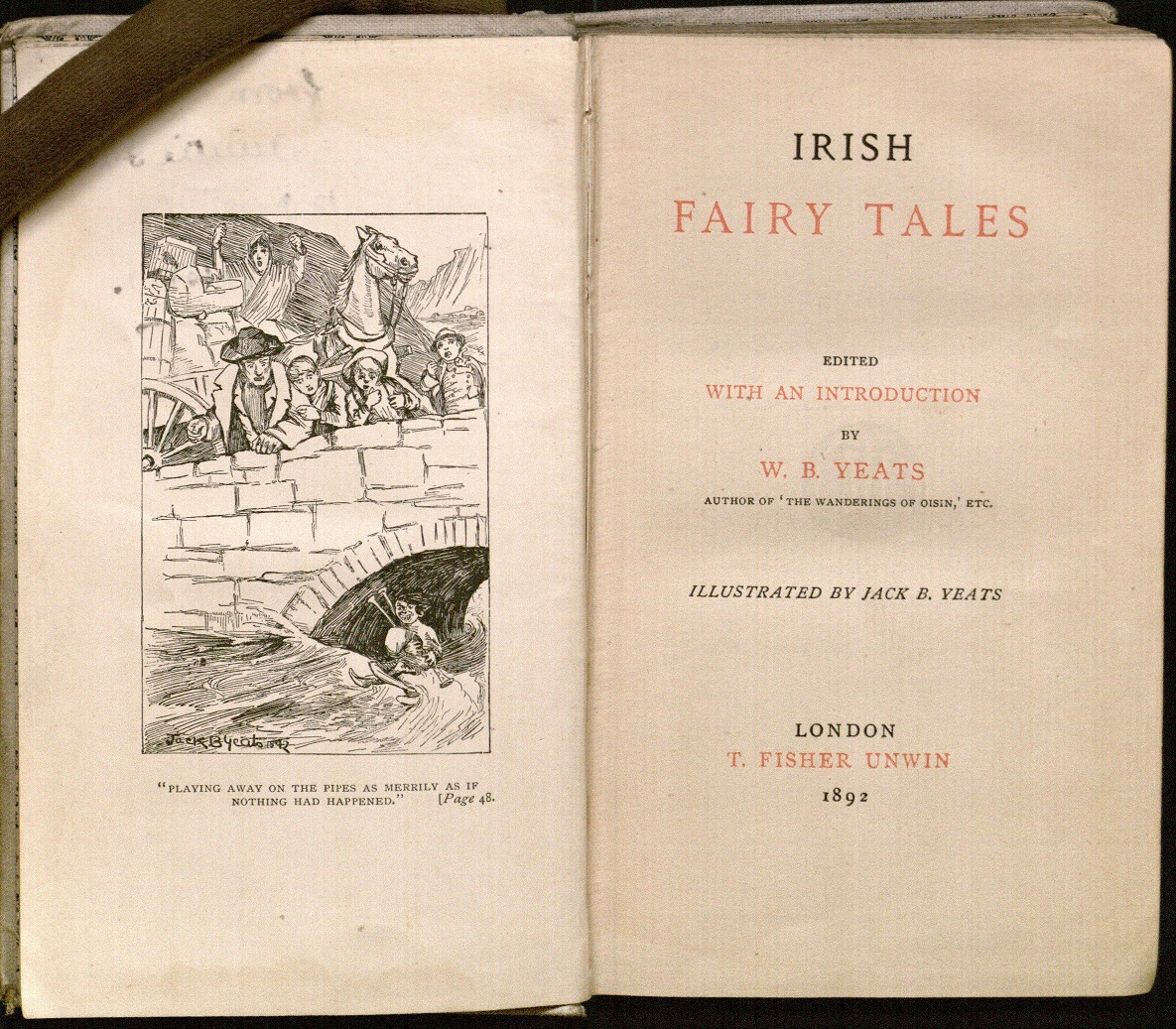
Title page for W. B. Yeats' Irish Fairy Tales (1892), with frontispiece illustration by Yeats's brother, Jack B. Yeats.

What type of fairy is that? Title page for W. B. Yeats’ Irish Fairy Tales (1892) with frontispiece illustration
by Yeats’s brother, Jack B. Yeats. Call Number: Yeats Y194. Click image to enlarge.

Yeats next delineates nine subcategories of Solitary Fairies, whom he characterizes as “nearly all gloomy and terrible in some way”:

  1. The Lepricaun (in Irish, Leith bhrogan, “the one shoe maker”): Of this staple of St. Patrick’s Day, Yeats writes, “This creature is seen sitting under a hedge mending a shoe, and one who catches him can make him deliver up his crocks of gold, for he is a miser of great wealth; but if you take your eyes off him the creature vanishes like smoke.” Don’t expect to find him in outfitted in green, though. Yeats notes that according to McAnally, author of Irish Wonders (1888), the leprechaun wears “a red coat with seven buttons in each row, and a cocked-hat, on the point of which he sometimes spins like a top.”  One wonders if Yeats’s leprechaun might also be responsible for other types of mischief, such as the fact that Yeats spells his name “Lepracaun in Fairy and Folk Tales of the Irish Peasantry (1888) but “Lepricaun in Irish Fairy Tales (1892).
  2. The Cleuricaun (in Irish, Clobltair-cean): Yeats notes that some writers “consider this to be another name for the Lepricaun, given him when he has laid aside his shoe-making at night and goes on the spree.” These fairies’ enthusiasms include “robbing wine-cellars” and “riding sheep and shepherds’ dogs.”
  3. The Gonconer or Ganconagh (in Irish, Gean-canogh, i.e. love-talker):  A “creature of the Lepricaun type” who, unlike his industrious cobbler brethren, is idle. Yeats notes he “appears in lonely valleys, always with a pipe in his mouth, and spends his time in making love to shepherdesses and milkmaids.”

[Would Yeats have concurred that modern St. Patrick’s Day celebrants perhaps possesses a touch of the Clericaun and Gonconer in their (admittedly sociable) revelry?]

  1. The Far Darrig (in Irish, Fear Dearg, i.e. red man): This fairy is “the practical joker of the other world” whom Yeats deems a “lubberly wretch.” Like the Pooka (below), “he presides over evil dreams.”
  2. The Pooka (in Irish, Púca, “a word derived by some from poc, a he-goat)”: Yeats notes that this fairy usually takes the shape of “a horse, a bull, a goat, eagle, or ass” and “most likely never appeared in human form.” He is of the “family of the nightmare” and “[h]is delight is to get a rider, whom he rushes with through ditches and rivers and over mountains, and shakes off in the gray of morning.”
  3. The Dullahan: This fairy must be a relative of the headless horseman who appears in Washington Irving’s “The Legend of Sleepy Hollow.” Yeats explains that he “has no head, or carries it under his arm,” and can be seen “driving a black coach called coach-a-bower (Ir. Coite-bodhar), drawn by headless horses.” If you hear his carriage rumble by, keep your door closed, for if you open it “a basin of blood is thrown in your face.”  As one might guess from such an unwelcome greeting, the Dullahan is “an omen of death to the houses where it pauses.”
  4. The Leanhaun Shee (in Irish, Leanhaunsidhe, i.e. fairy mistress ): Yeats writes, “This spirit seeks the love of men. If they refuse, she is their slave; if they consent, they are hers, and can only escape by finding one to take their place. Her lovers waste away, for she lives on their life.” He also refers to her as the “Gaelic muse” and asserts that many of the Gaelic poets have had a Leanhaun Shee, “for she gives inspiration to her slaves.”
  5. The Far Gorta (man of hunger): An emaciated fairy who “goes through the land in famine time, begging and bring good luck to the giver.”
  6. The Banshee (in Irish, Bean-sidhe, i.e. fairy woman): In addition to the Leprechaun, the Banshee is perhaps the other Irish fairy who will be familiar to American audiences. Yeats notes that like the Far Gorta (and unlike the other solitary fairies), the Banshee possesses a “generally good disposition.”  He suggests that perhaps she isn’t really a solitary fairy after all, “but a sociable fairy grown solitary through much sorrow.” The Banshee wails over the impending the death of “a member of some old Irish family.”  Yeats observes, “Sometimes she is an enemy of the house and screams with triumph, but more often a friend.”  In Fairy and Folk Tales of the Irish Peasantry, Yeats remarks that the “keen [caoine], the funeral cry of the peasantry, is said to be an imitation of her cry.” If more than one Banshee arrives to wail, it is a sign the dying person “must have been very holy or very brave.”

Yeats closes his taxonomy by alluding to other varieties of fairies “of which too little is known to give them each a separate mention.” Among these are the Bo men fairies of County Down, whom Yeats suggests are “Scotch fairies imported by Scotch settlers.”  This last detail offers us some hope of encountering Irish fairies on American shores, for its seems that, like us, fairy folk can travel.

To read Yeats’s “Classification of Irish Fairies” in full click here to access the appendix in PDF form or visit Spencer Research Library’s reading room to explore further writings on the topic by Yeats, Lady Wilde, Thomas Crocker, Douglas Hyde, and others in Spencer’s Irish Collections.  Happy St. Patrick’s Day!

Elspeth Healey
Special Collections Librarian

Color Our Collections!

February 7th, 2018

Color Our Collections graphic

If you’ve ever seen an item at Spencer Research Library or on the blog and thought, “it would be fun to color a copy of this” – you’re in luck!

This year, KU Libraries is among the 149 libraries, archives, and cultural institutions from around the world participating in a week-long coloring fest sponsored by The New York Academy of Medicine. Staff members across the libraries collaborated to create a booklet containing nine coloring pages based on Spencer’s collections. You can download and print the book via the Color Our Collections website, and be sure to also check out the submissions from our colleagues at other institutions.

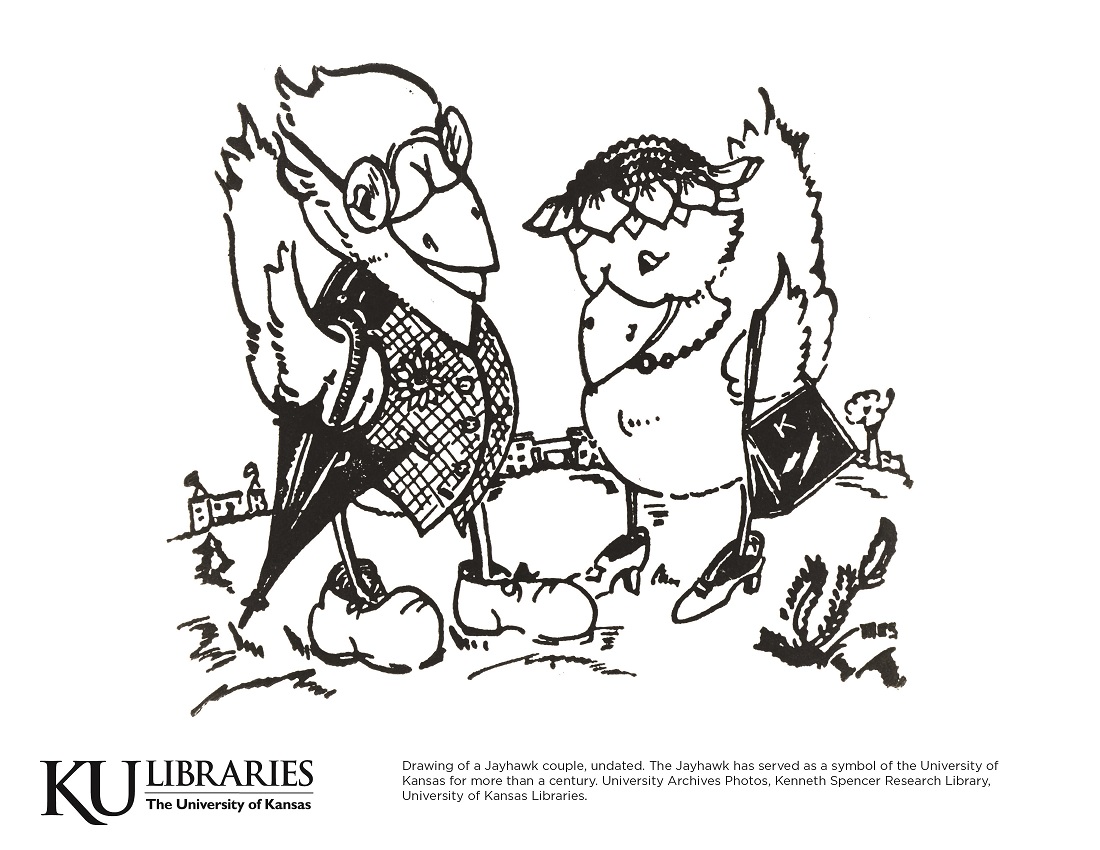
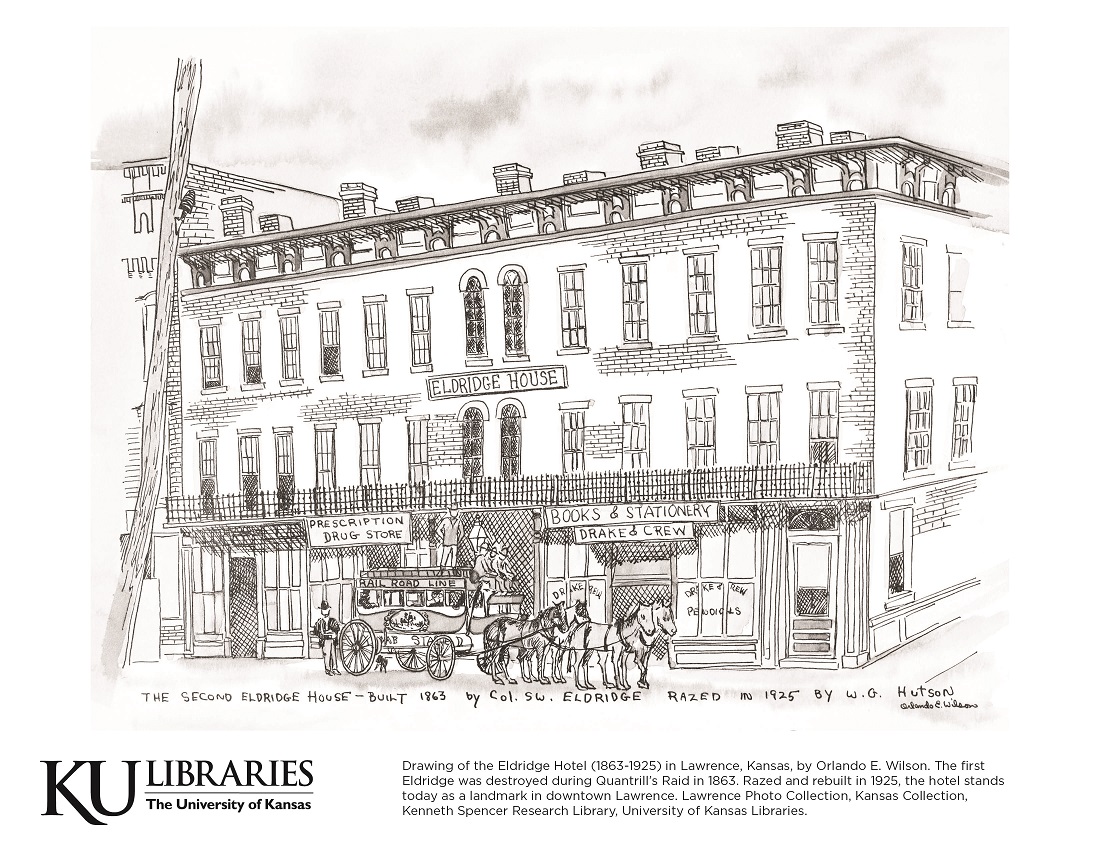
As a preview, here are three pages from the book.

Jayhawk couple image in the KU Libraries coloring book, 2018

Eldridge Hotel image in the KU Libraries coloring book, 2018

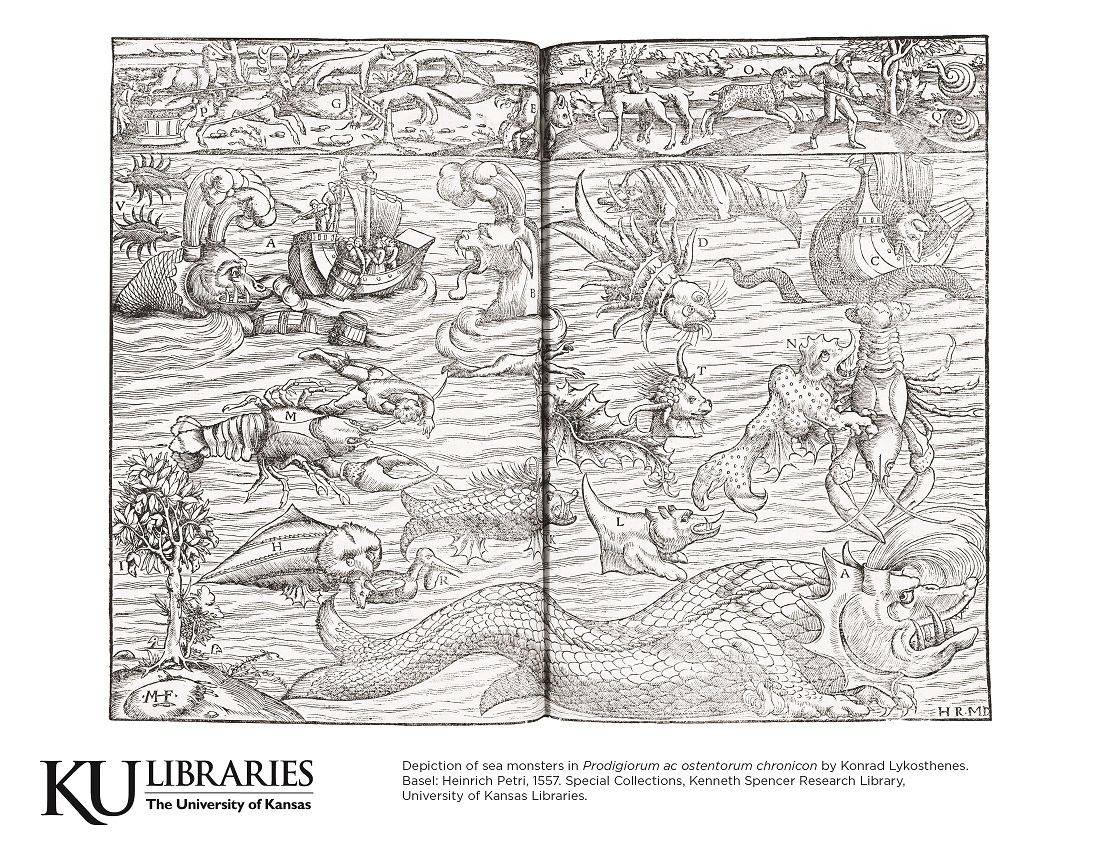
Sea monster image in the KU Libraries coloring book, 2018

Enjoy, and happy coloring!

Caitlin Donnelly
Head of Public Services


A Holinshed’s Chronicles Provenance Puzzle

February 6th, 2018

Holinshed’s Chronicles of England, Scotland, and Ireland is widely regarded as a book that inspired and informed many of William Shakespeare’s history plays, as well as tragedies such as Macbeth and King Lear. Last year Kenneth Spencer Research Library (KSRL) purchased the first edition (1577) with the aim of making the book and its 212 lively woodcut illustrations available to visiting classes and researchers. The bookseller’s description said that this copy had been in private family ownership for generations, but we never dreamed that it would be possible to trace the book back to its original owner. After unpacking the two volumes, we leafed through them page by page looking for manuscript annotations.

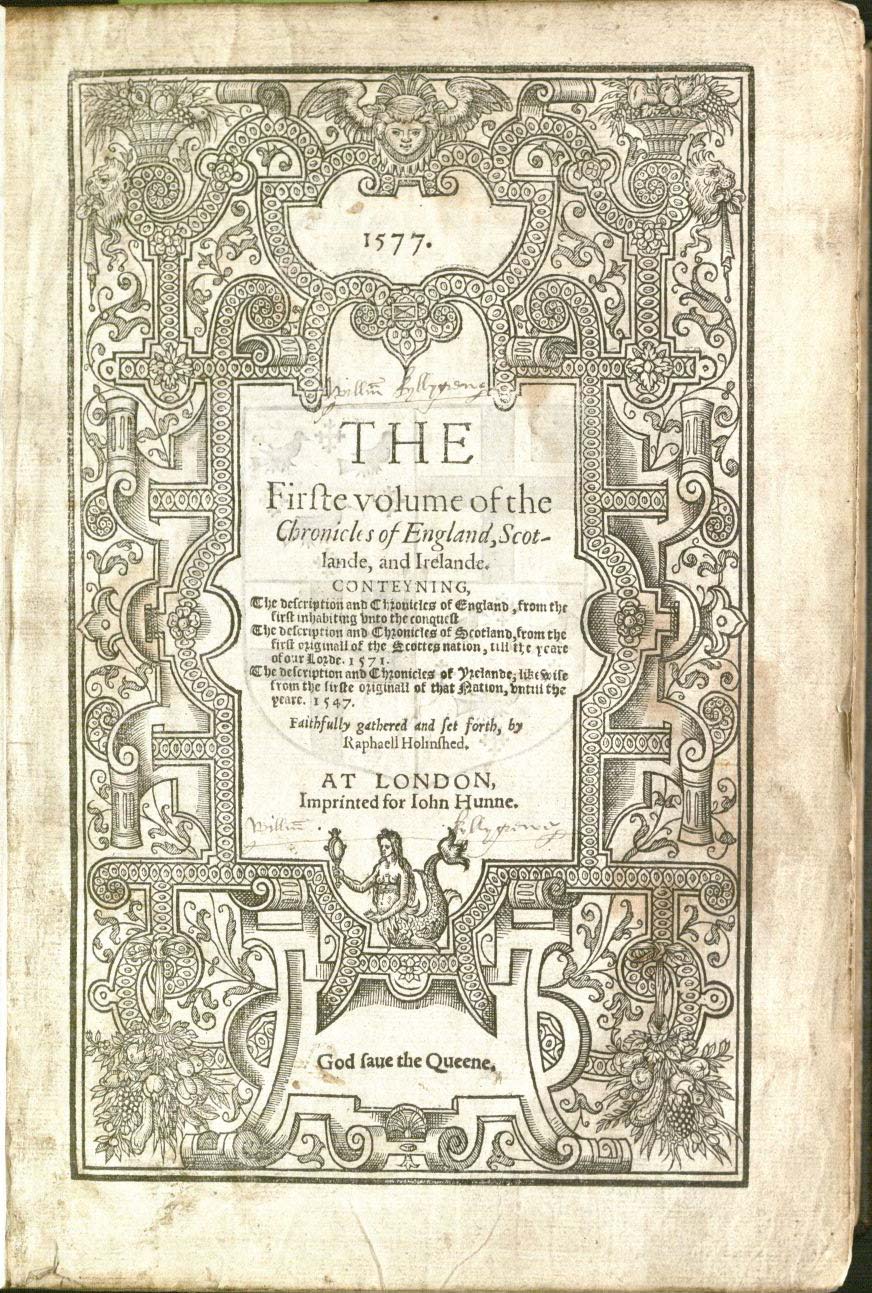
On the title page of volume one “William Kyllygrewe” had signed his name twice in Tudor script:

Title page of volume 1 of Holinshed's Chronicles (1577), with William Killigrew's signature

Title page of Volume 1 of Raphael Holinshed’s
Chronicles of England, Scotlande, and Irelande.
At London: Imprinted for Iohn Hunne, 1577.
Call Number: Pryce D11. Click image to enlarge.

Could William Kyllygrewe have been the original owner of the book? Browsing through the rest of the book revealed some marginal notes and manicules (sketches of a pointing hand) marking passages of interest to some past reader. There is no other handwritten evidence of ownership.

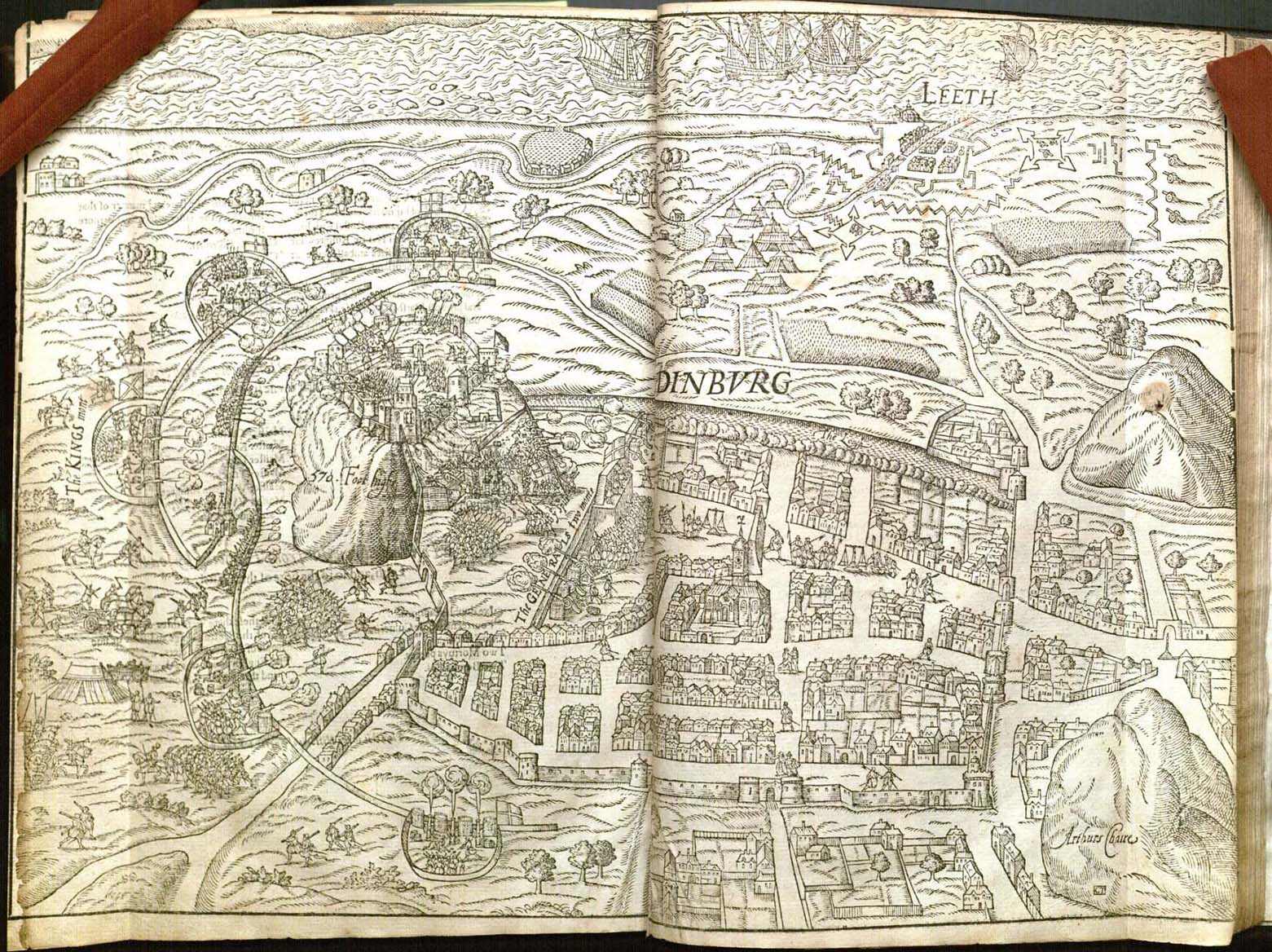
However, there is an eye-catching pictorial map in the section about the reign of Queen Elizabeth I that concludes volume two. The text recounts the conflict between the Catholic forces supporting Mary, Queen of Scots, and the Protestant forces of Queen Elizabeth during 1571-1573. The hostilities culminated in the “Lang Siege” of Edinburgh Castle.

The map shows the Protestant artillery bombarding Edinburgh Castle before achieving victory.

Map showing the Protestant artillery bombarding of Edinburgh Castle from volume 2 of Holinshed's Chronicles, following p. 1868

Map of the siege of Edinburgh Castle, from Vol. 2 (following page 1868) of
Holinshed’s Chronicles of England, Scotlande, and Irelande.
Call Number: Pryce D11. Click image to enlarge.

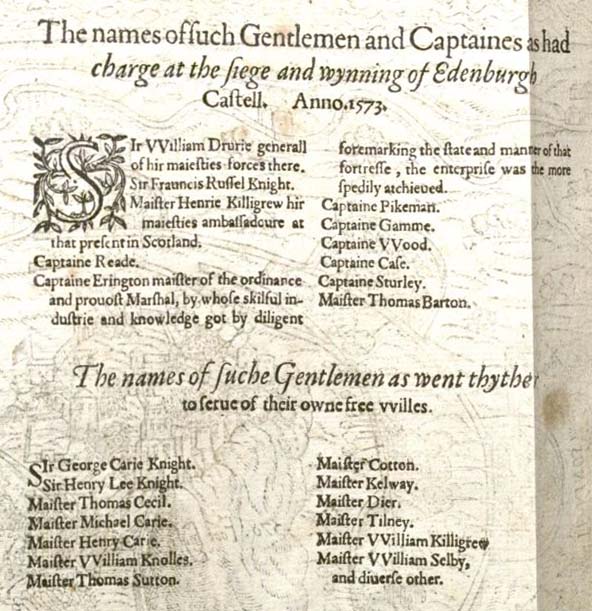
Text on the back side of the map lists the chief participants in the siege. General Sir William Drurie commanded the Protestant forces with the aid of ten Gentlemen and Captaines. One of them was “Henrie Killigrew hir maiesties ambassadoure at that present in Scotland.” Listed next are thirteen “Gentlemen as went thither to serve of their owne free willes.”

Among the gentlemen who participated “of their own free willes” is William Killigrew.

List of participants in the Siege of Edinburgh Castle, including the names of Henry and William Killigrew.

List of participants in the siege from the verso of the map of Edinburgh castle,
from Vol. 2 (following page 1868) of Holinshed’s Chronicles of England,
Scotlande, and Irelande
. Call Number: Pryce D11. Click image to enlarge.

Allowing for the variations in spelling usual at that time, could he be the William Kyllygrewe who owned this book? In his shoes, wouldn’t you want to own a book in which you and your brother are mentioned as major players in a recent military victory?

Some genealogical investigation of the Killigrew family tree with its numerous Henrys and Williams revealed that the Henry Killigrew (d. 1603) and William Killigrew (d.1622) were the fourth and fifth sons of John Killigrew and Elizabeth (née Trewennard) of Arwennack in Cornwall. As younger sons they needed to make their own way in the world and did so successfully as royal courtiers. William was elected Member of Parliament a number of times and was appointed to various government offices, including Groom of the Privy Chamber to Elizabeth I in 1576 and Chamberlain of the Exchequer under James I in 1608.  In 1594 he took an 80-year lease on Kempton and Hanworth, adjoining royal manors in Middlesex near London. In 1603 he was knighted.

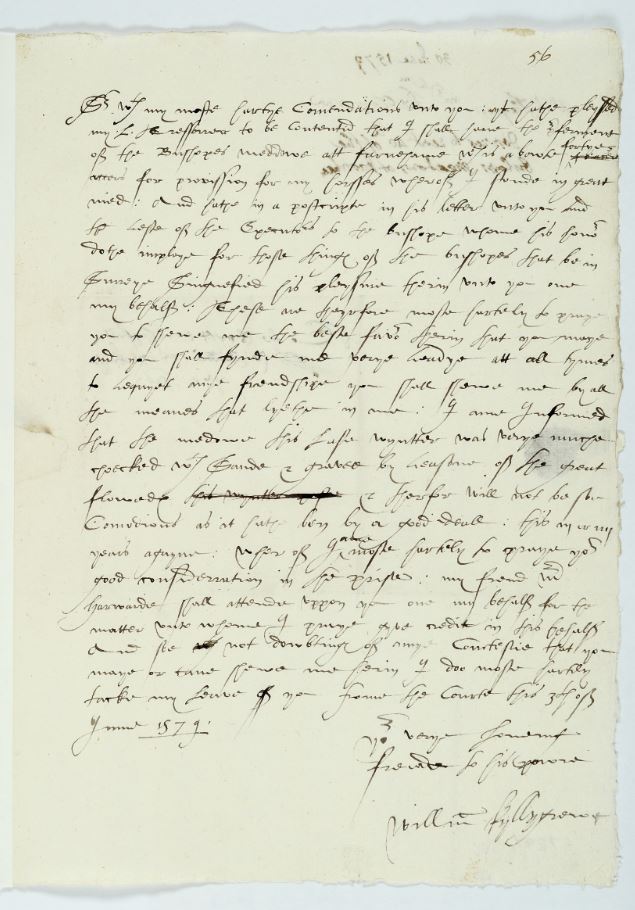
While the biographical information did not answer the question whether this William Killigrew had owned our copy of Holinshed’s Chronicles, his prominence suggested that surviving documents signed by him might be located and compared with our owner’s inscription. The Discovery database at the website of The National Archives at Kew near London in England led to an archival record in the Surrey History Centre for a letter held written by William Killigrew to Sir William Moore on 3 June 1579, just two years after the publication of Holinshed’s Chronicles.

Killigrew’s letter concerns the Bishop of Winchester’s meadow at Farnham in Surrey.

Letter from William Killigrew to Sir William Moore, 3 June 1579

Letter from William Killigrew to Sir William Moore, 3 June 1579.
Surrey History Center. Letter Ref. Number 6729/1/56.
Reproduced by permission of the More-Molyneux family and
Surrey History Centre. Click image to enlarge.

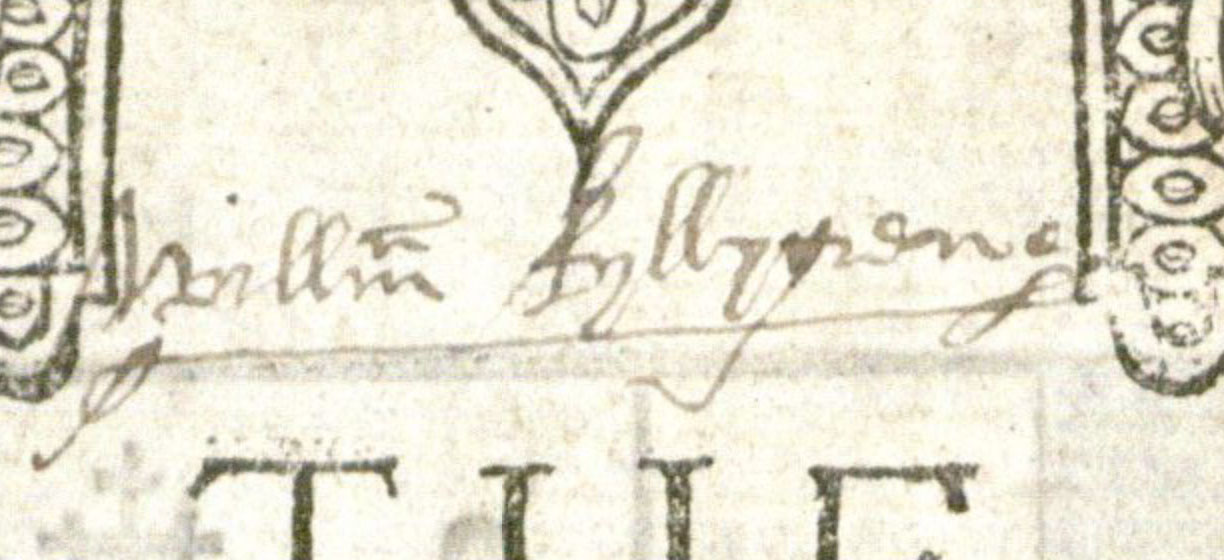
Killigrew planned to pasture his horses there but was asking Moore, one of the Bishop’s executors, to reduce the rent because the meadow was “very much choked with sand and gravel by reason of the great floods.” It was exciting for us to discover that the Killigrew signature on the letter is a close match to the ownership inscriptions in our Holinshed’s Chronicles.

William Killigrew signature detail from the title page of volume 1 of Raphael Holinshed's Chronicles of England, Scotlande, and Irelande. William Killigrew signature from a letter from William Killigrew to Sir William Moore, 3 June 1579

Details of William Killigrew’s signatures: Holinshed’s Chronicles (left)
and the letter to Moore (right). Click image to enlarge.

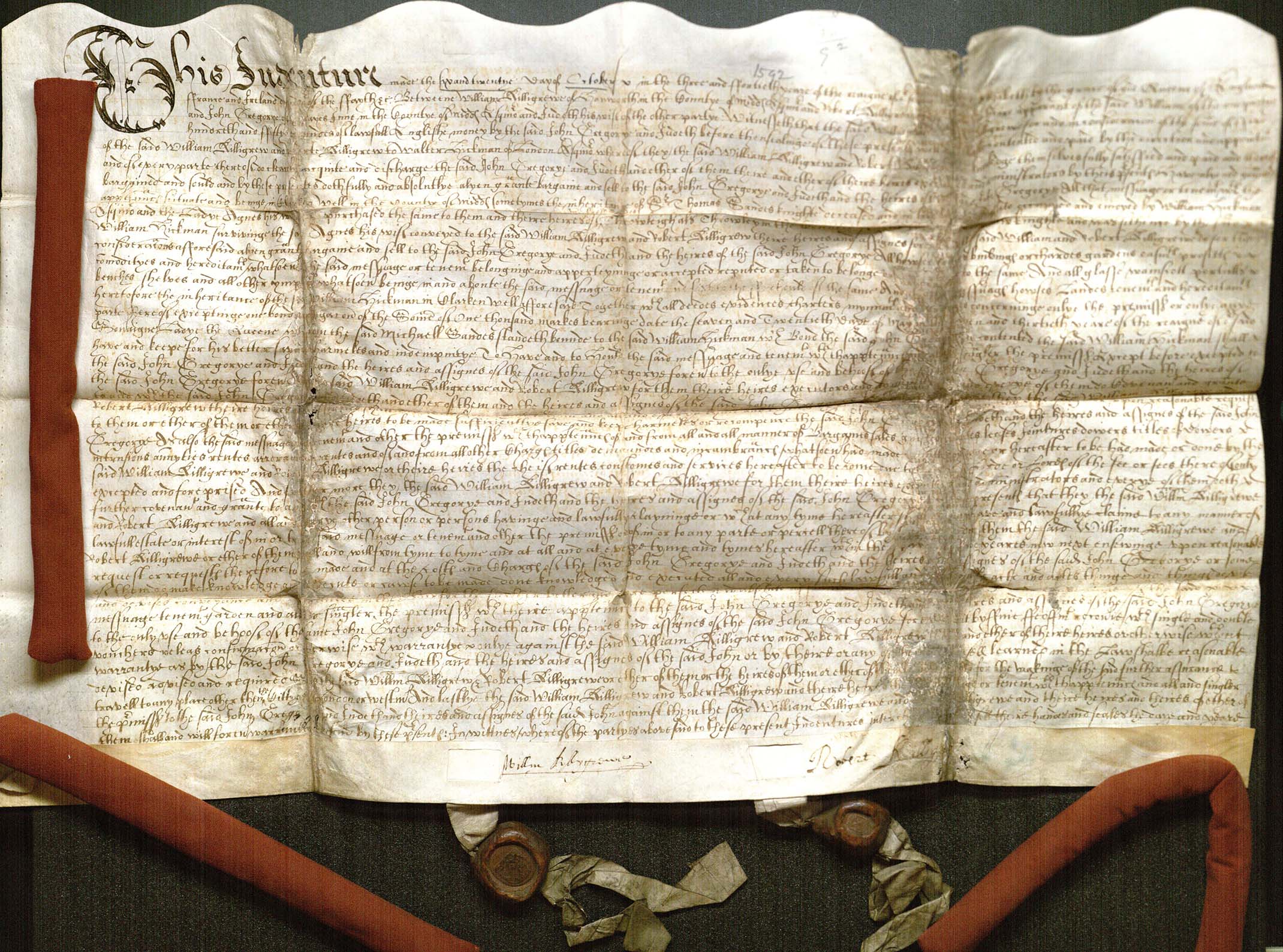
In fact, the search for a William Killigrew signature need not have led so far afield. Kenneth Spencer Research Library’s large collection of English Historical Documents includes, as it turns out, a 26 October 1601 deed of covenant by William Killigrew and his son, Robert, agreeing to sell a messuage (dwelling house, outbuildings, and land) in Clerkenwell Parish, Middlesex to John Gregorye and his wife, Judith.

William Killigrew’s signature is clear at the bottom of the deed, although Robert’s signature to the right is only partly legible

Deed of covenant by William Killigrew and his son, Robert, agreeing to sell a messuage (dwelling house, outbuildings, and land) in Clerkenwell Parish, Middlesex to John Gregorye and his wife, Judith.

Deed of covenant signed by William Killigrew, 26 October 1601.
A Miscellany of Deeds and Manorial, Estate, Probate and Family Documents, 1194-1900.
Call Number: MS 239: 2357. Click image to enlarge.

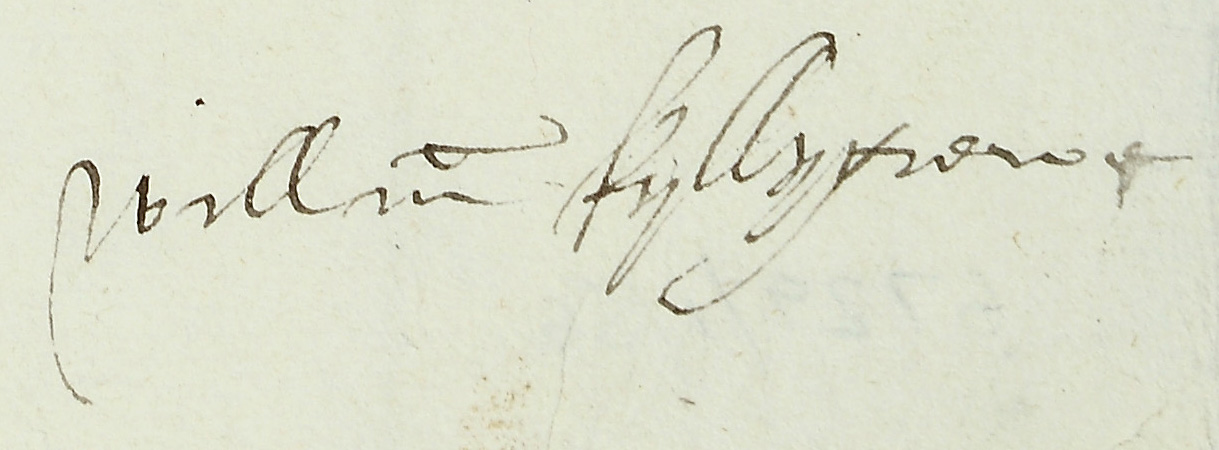
Once again, the signatures match.

William Killigrew signature detail from the title page of volume 1 of Raphael Holinshed's Chronicles of England, Scotlande, and Irelande. William Killigrew signature detail from 1601 deed of covenant.

Details of William Killigrew’s signatures: Holinshed’s Chronicles (left)
and Killigrew-Gregorye deed (right). Click images to enlarge.

The manner in which the copy of Holinshed’s Chronicles descended from the hands of William Killigrew in family ownership until Kenneth Spencer Research Library purchased it is still uncertain. The bookseller’s description suggests that a female Killigrew relative may have taken the book with her when she married into the Grenville family. More research remains to be done.

Karen Severud Cook
Special Collections Librarian

“Happy Christmas to All and to All a Good Night”

December 19th, 2017

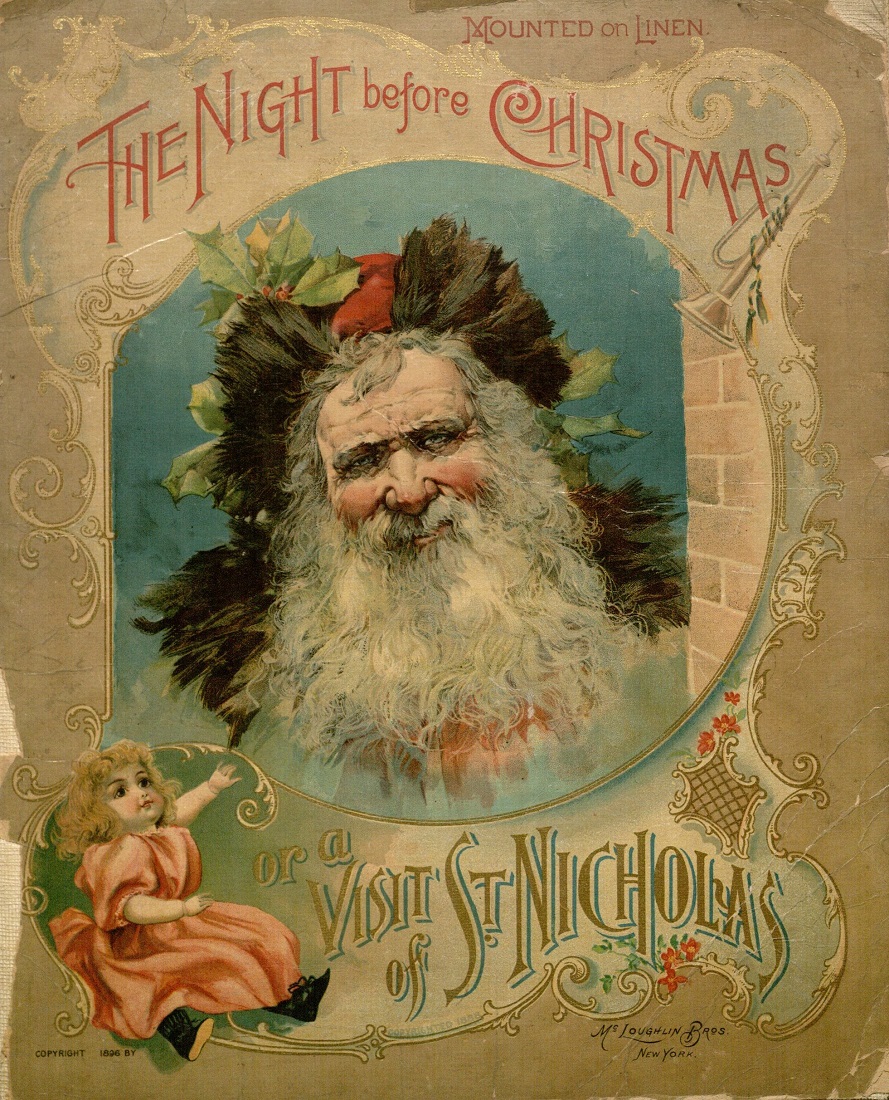
To help celebrate the holidays, we’re sharing Clement Clarke Moore’s poem The Night Before Christmas (originally published in 1823 as A Visit from St. Nicholas) as illustrated by two copies of the text in Spencer’s collections – one from 1896 and the other from the early 1900s. The version of the poem used here comes from a 1920 edition, also in the library’s holdings.

Image of The Night Before Christmas, cover, 1896

The Night Before Christmas, or, A Visit of St. Nicholas
by Clement Clarke Moore, 1896.
Call Number: Children E39. Click image to enlarge.

‘Twas the night before Christmas, when all through the house
Not a creature was stirring, not even a mouse;
The stockings were hung by the chimney with care,
In hopes that St Nicholas soon would be there;

The children were nestled all snug in their beds,
While visions of sugar-plums danced in their heads;
And Mamma in her kerchief, and I in my cap,
Had just settled our brains for a long winter’s nap,

When out on the lawn there arose such a clatter,
I sprang from the bed to see what was the matter.
Away to the window I flew like a flash,
Tore open the shutters and threw up the sash.

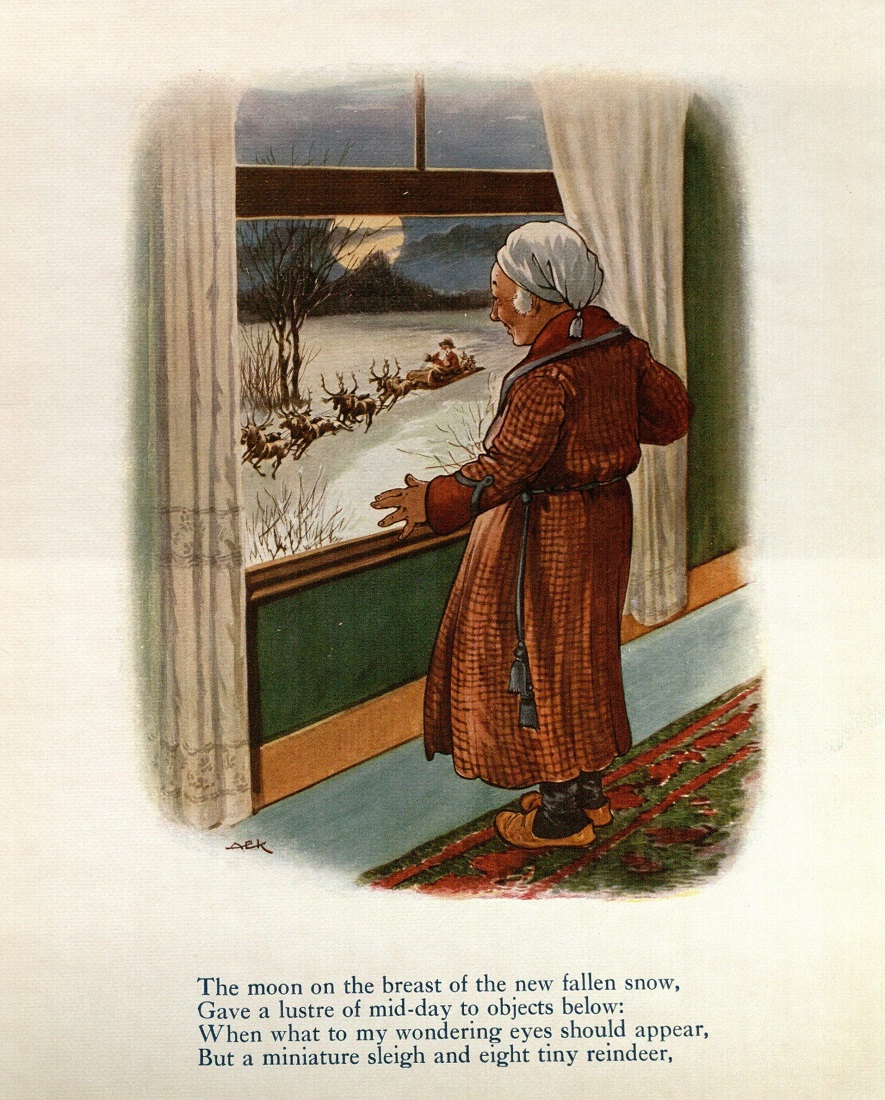
Illustration from The Night Before Christmas, circa early 1900s

The Night Before Christmas by Clement Clarke Moore,
undated, circa early 1900s. Call Number: Children E40.
Click image to enlarge.

The moon on the breast of the new-fallen snow
Gave the lustre of midday to objects below,
When, what to my wondering eyes should appear,
But a miniature sleigh, and eight tiny reindeer,

With a little old driver, so lively and quick,
I knew in a moment it must be St Nick.
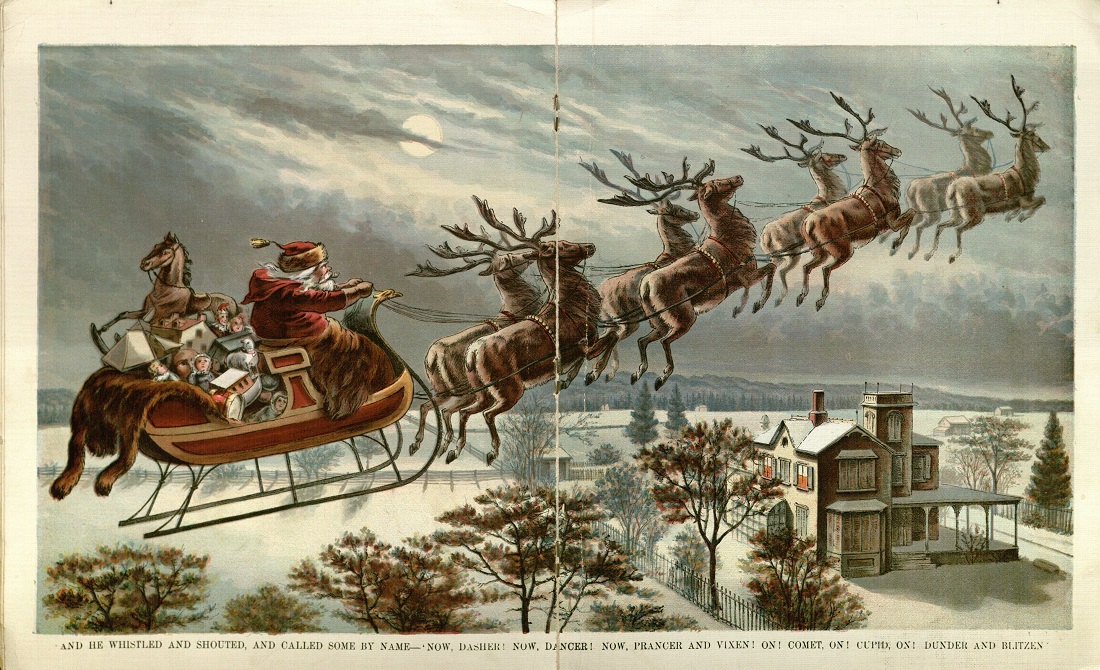
More rapid than eagles his coursers they came,
And he whistled, and shouted, and called them by name:

Illustration from The Night Before Christmas, 1896

The Night Before Christmas, 1896.
Call Number: Children E39. Click image to enlarge.

“Now, Dasher! now, Dancer! now, Prancer and Vixen!
On, Comet! on, Cupid! on, Donner and Blitzen!
To the top of the porch! to the top of the wall!
Now dash away! dash away! dash away all!”

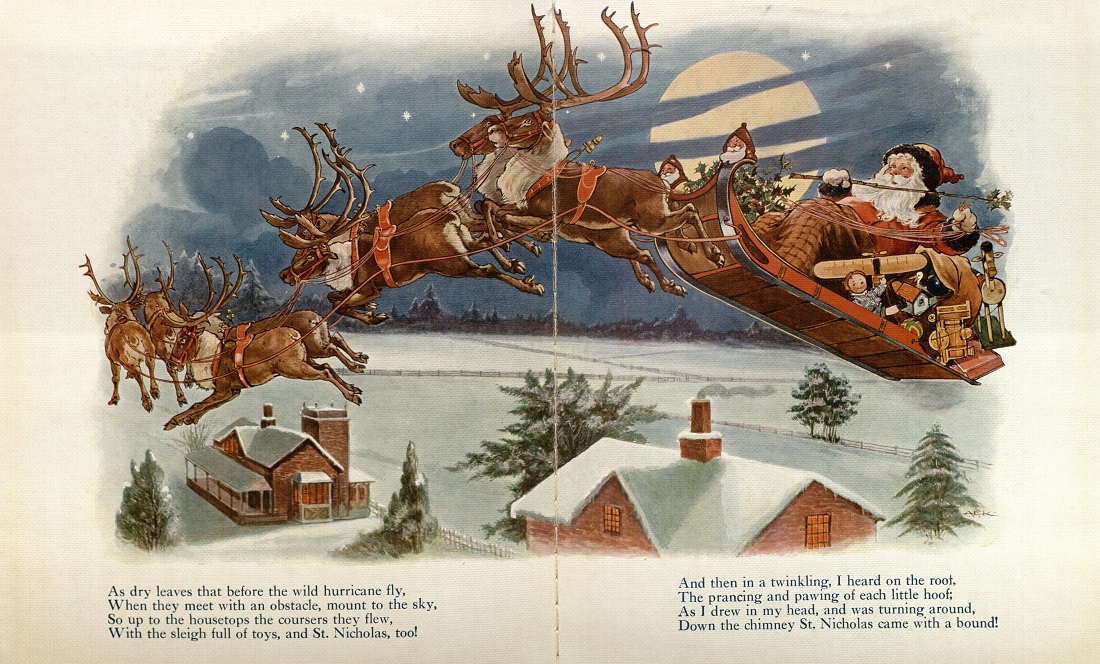
As dry leaves that before the wild hurricane fly,
When they meet with an obstacle, mount to the sky,
So up to the house-top the coursers they flew,
With the sleigh full of Toys, and St Nicholas too.

Illustration from The Night Before Christmas, circa early 1900s

The Night Before Christmas, undated, circa early 1900s.
Call Number: Children E40. Click image to enlarge.

And then, in a twinkling, I heard on the roof
The prancing and pawing of each little hoof.
As I drew in my head, and was turning around,
Down the chimney St Nicholas came with a bound

What constitutes a “cause of action” remains something of an open question, although claims of recruitment based on inflated grades and employment rates have supported many applications to date student loan forgiveness program. In late January, the Wall Street Journal reported that the Obama administration had already waived student loans for 1, 300 students in Corinthia, amounting to $28 million. This development has opened the floodgates for other disgruntled graduates to also demand refunds. The Journal’s analysis found that more than 7,500 people have applied for $164 million in student loan forgiveness in the past six months.Through 2015, only five people applied for a waiver under the program – and only three of them did so successfully, the Journal said.

He was dressed all in fur, from his head to his foot,
And his clothes were all tarnished with ashes and soot;
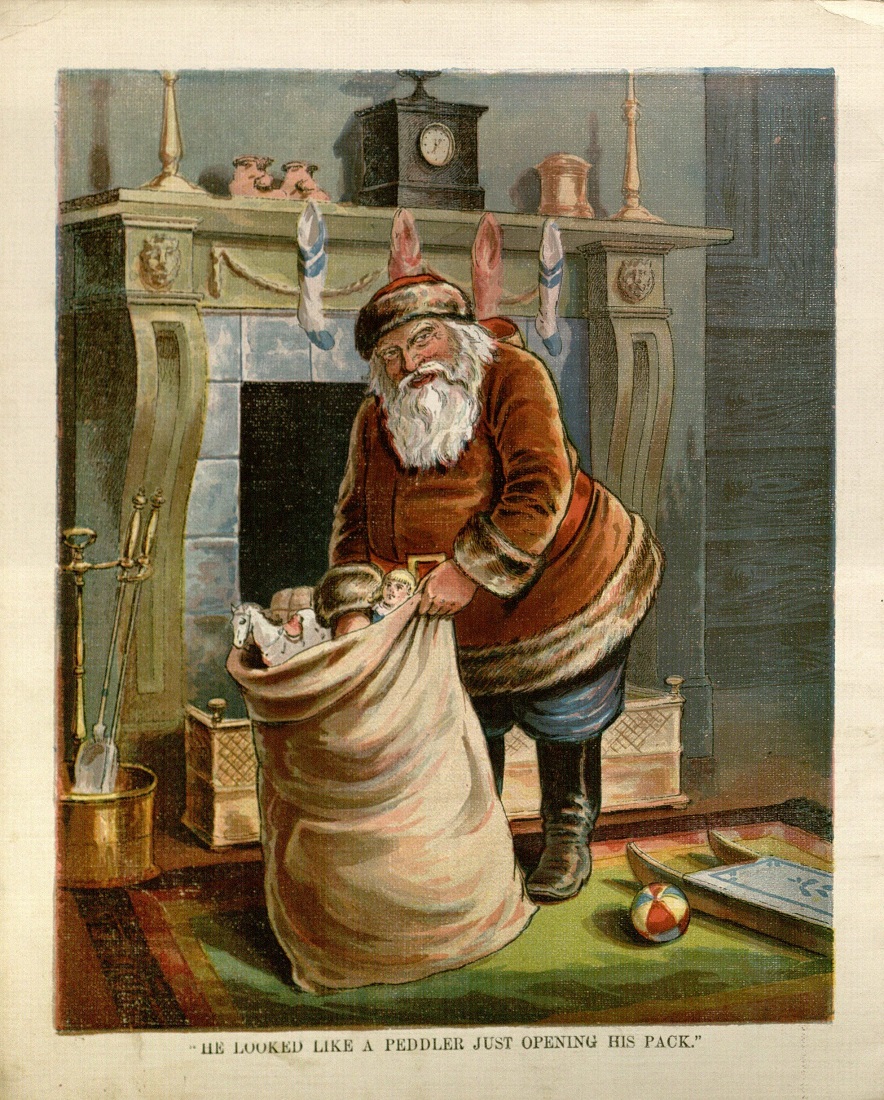
A bundle of Toys he had flung on his back,
And he looked like a pedlar just opening his pack.

Illustration from The Night Before Christmas, 1896

The Night Before Christmas, 1896.
Call Number: Children E39. Click image to enlarge.

His eyes – how they twinkled! his dimples how merry!
His cheeks were like roses, his nose like a cherry!
His droll little mouth was drawn up like a bow,
And the beard of his chin was white as snow;

The stump of a pipe he held tight in his teeth,
And the smoke it encircled his head like a wreath;
He had a broad face and little round belly,
That shook when he laughed, like a bowlful of jelly.

He was chubby and plump, a right jolly old elf,
And I laughed when I saw him, in spite of myself;
A wink of his eye and twist of head
Soon gave me to know I had nothing to dread.

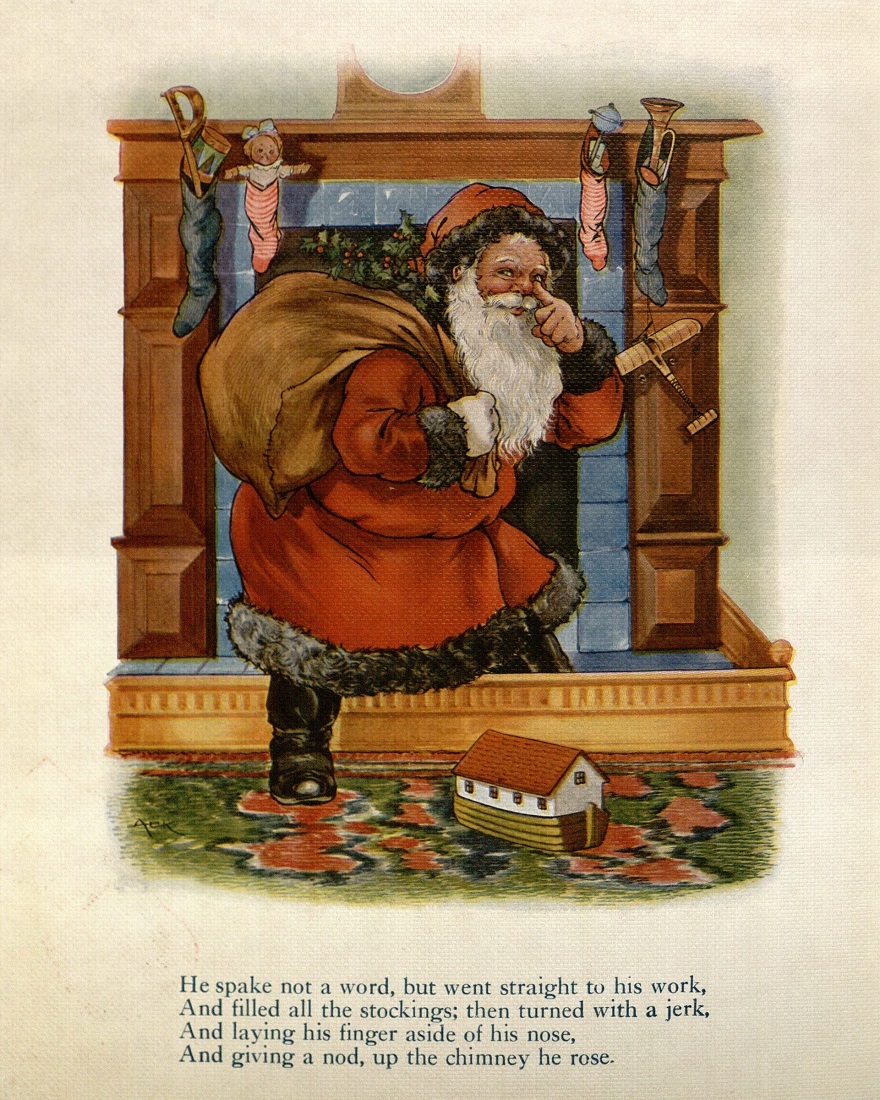
Illustration from The Night Before Christmas, circa early 1900s

The Night Before Christmas, undated, circa early 1900s.
Call Number: Children E40. Click image to enlarge.

He spoke not a word, but went straight to his work,
And filled all the stockings; then turned with a jerk,
And laying his finger aside of his nose,
And giving a nod, up the chimney he rose;

He sprang to his sleigh, to his team he gave a whistle,
And away they all flew like the down of a thistle.
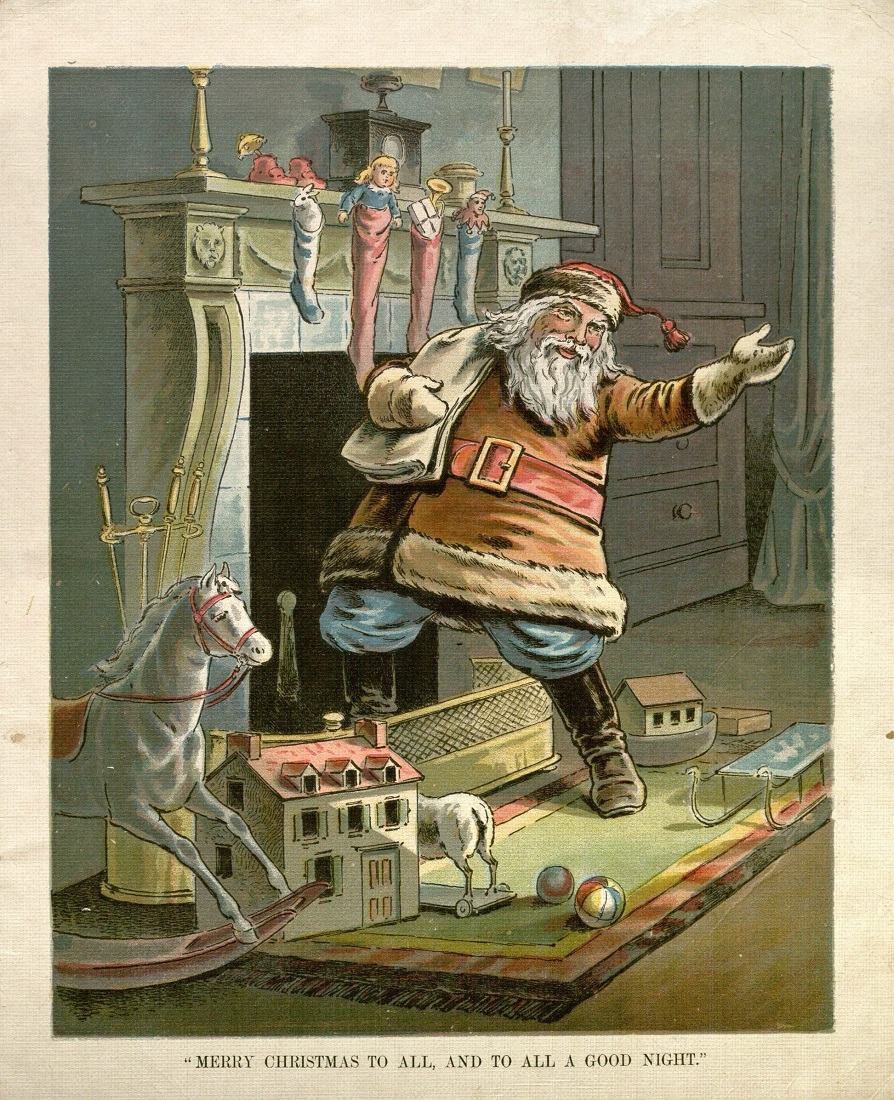
But I heard him exclaim, ere he drove out of sight,
HAPPY CHRISTMAS TO ALL AND TO ALL A GOOD NIGHT

Illustration from The Night Before Christmas, 1896

The Night Before Christmas, 1896.
Call Number: Children E39. Click image to enlarge.

Meredith Huff
Public Services

Collection Snapshot: Late for Dinner?

November 29th, 2017

It’s that time of year when dinner parties and invitations of all sorts abound, so we thought it might be interesting to turn to a nineteenth-century etiquette book to explore its advice on the age-old question of when to arrive for dinner.

Stamped cloth binding of Etiquette for Gentlemen (1841 edition)  Title page of Etiquette for Gentlemen

Stamped cloth binding and title page of  and title page of Etiquette for Gentlemen: With Hints on the Art of Conversation. London: Tilt and Bogue, 1841. Call #: A445. Click images to enlarge.

Of the numerous etiquette books in Spencer Research Library’s collections, Etiquette for Gentlemen: With Hints on the Art of Conversation offers particularly unyielding guidance.  Its anonymous author advises:

If you accept [a dinner invitation], you arrive at the house rigourously at the hour specified. It is equally inconvenient to be too late and to be too early.  If you fall into the latter error, you find every thing in disorder; the master of the house is in his dressing-room; the lady is still in the pantry; the fire not yet lighted in the parlour.  If by accident or thoughtlessness you arrive too soon, you may pretend that you called to inquire the exact hour at which they dine, having mislaid the note, and then retire to walk for an appetite. If you are too late, the evil is still greater, and indeed almost without remedy.  Your delay spoils the dinner and destroys the appetite and temper of the guests; and you yourself are so much embarrassed at the inconvenience you have occasioned, that you commit a thousand errors at table.  If you do not reach the house until dinner is served, you had better retire to a restaurateur’s, and thence send an apology, and not interrupt the harmony of the courses by awkward excuses and cold acceptances.

Passage on arriving at the appointed time for dinner in Etiquette for Gentlemen

Arrival etiquette in Etiquette for Gentlemen: With Hints on the Art of Conversation. London: Tilt and Bogue, 1841. Call #: A445. Click image to enlarge.

Etiquette for Gentlemen appears to have been first published in 1838, and the library holds the 1841 edition. The book’s advice, however, is hardly new as its preface confesses:  “It is […] scarcely possible that anything original should be found in a brochure like the present: almost all that it contains must have fallen under the notice of every gentleman who has been in the habit of frequenting good society.”  As with many etiquette books, the volume’s directives will strike modern readers as by turns sensible, humorous, odd, ill-conceived, and offensive. The volume itself is small enough to fit in the palm of one’s hand (and certainly one’s pocket) for ready consultation whenever the need might arise. Although, isn’t it perhaps impolite to pause a social interaction in order to consult one’s etiquette book?!

Elspeth Healey
Special Collections Librarian