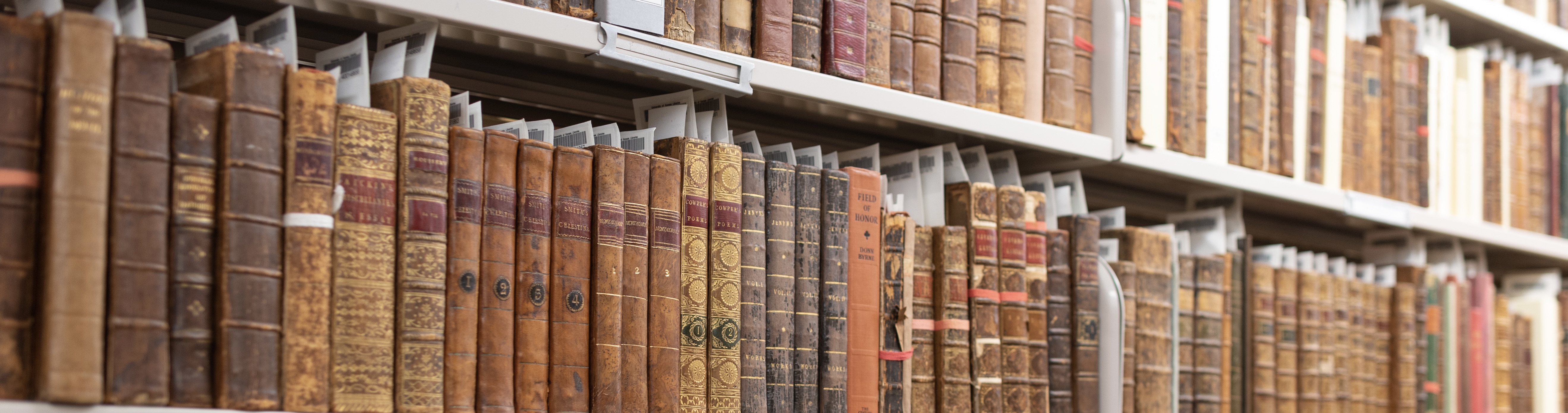
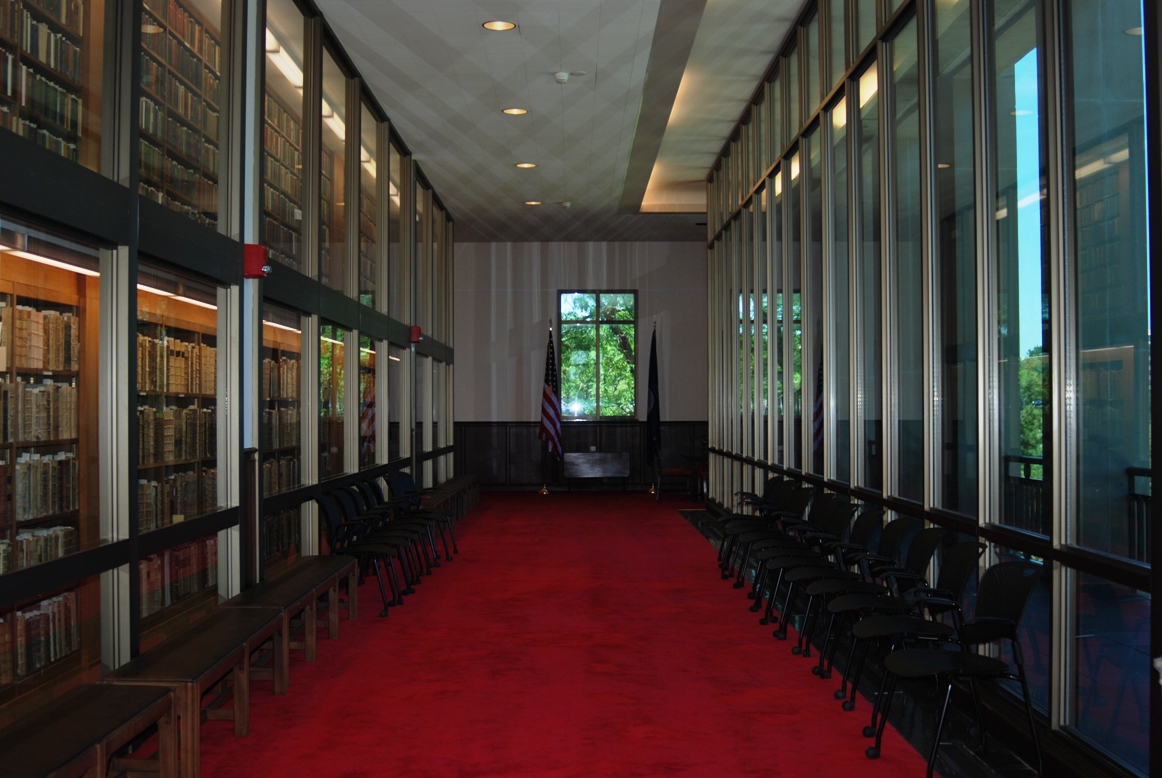
July 18th, 2012 The word “iconic” is often overused, but I believe it describes, better than any other word, the power of the Spencer’s North Gallery. People who have not been on campus for decades remember “the red room,” or the “room with the books.” Often, of course, they remember the “room with the view of the Campanile.”

Kenneth Spencer Research Library’s North Gallery, view into the
Summerfield and P. S. O’Hegarty collections. Click image to enlarge.
The exposed shelving of the North Gallery (once called “the Ambulatory”) has housed outstanding items from Special Collections since the opening of the library in 1968. Its visual and intellectual appeal cannot be overstated. It not only houses books, like a section of the larger Summerfield volumes, for example, but intriguing artifacts like several horn books and the jumbled writs of habeus corpus that fascinate visitors every day.

Kenneth Spencer Research Library’s North Gallery, with view of the Rilke Collection
and the horn books (center shelf) on display. Click image to enlarge.
The Spencer collections, however, are not the same as they were in 1968 when the third floor was the province of Special Collections and books were the name of the game. With the consolidation of the public spaces of Special Collections, Kansas Collection, and University Archives in the early years of the 21st century, and the continuing desire to provide a more interpretive context for our collections in general, we are considering how best to program this stunning space as a true gallery. An enthusiastic group of Museum Studies students recently completed a project to explore bringing diversity and experience into the space through an interesting array of physical and virtual exhibit “stations.”
What would you like see in our signature space for visitors? Is there something we should consider as we move forward with these plans? I’d welcome your input and suggestions as we look ahead to the future of the North Gallery.
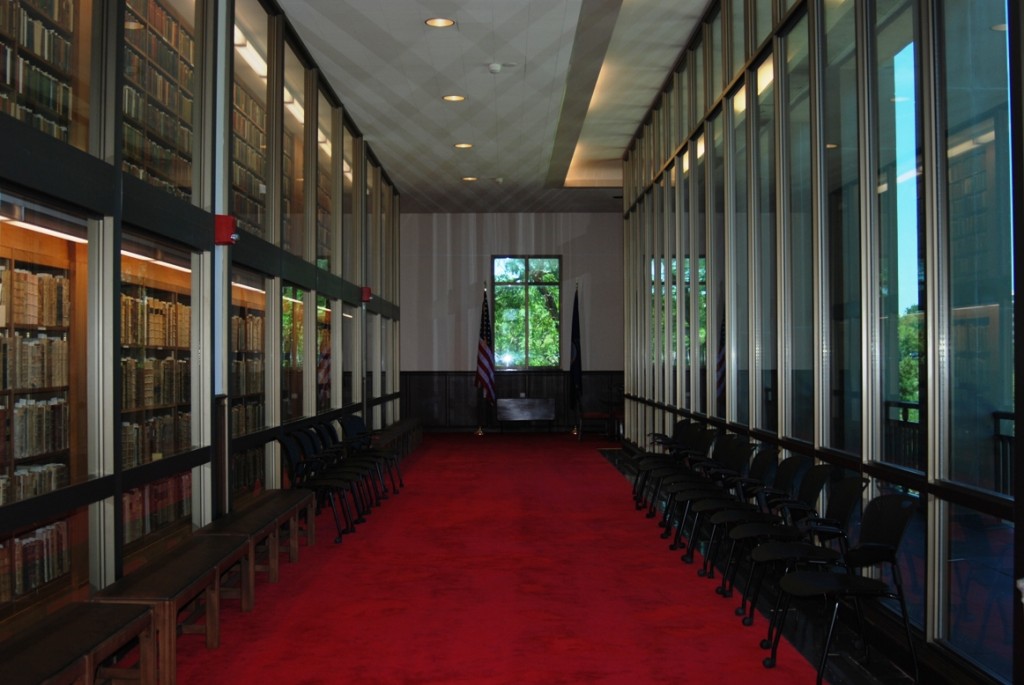
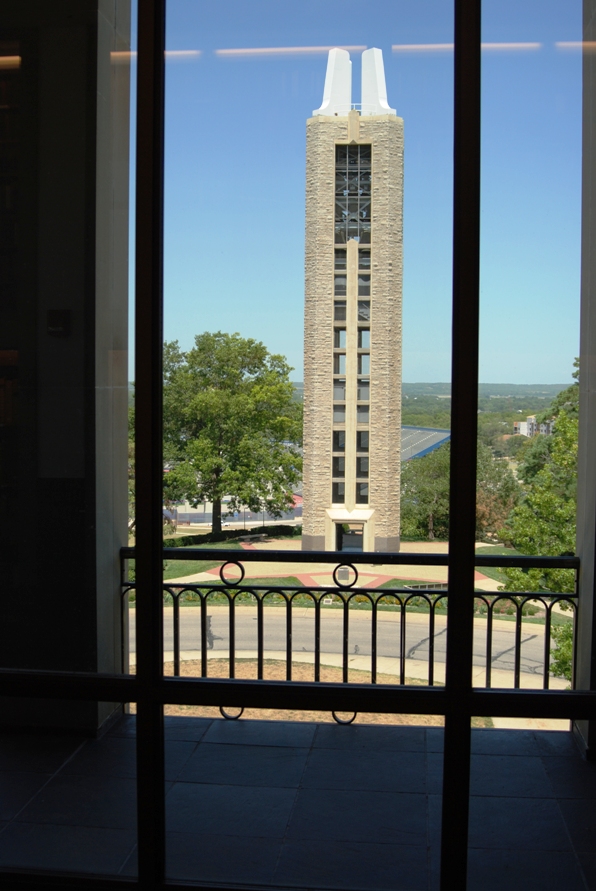
Amazing vistas: A wide view of the North Gallery (top)
and looking outward onto the Campanile (bottom).
Click images to enlarge.
Beth M. Whittaker
Head of Kenneth Spencer Research Library
Tags: Beth M. Whittaker, Cultural Heritage Institutions, Exhibitions, Gallery redesigns, Kenneth Spencer Research Library, Public Spaces
Posted in Exhibitions, Kansas Collection, Special Collections, University Archives |
6 Comments »
July 13th, 2012 No kidding, there really was a seven-headed hydra, and it took an 18th century St. George to slay it: Swedish naturalist Carl Linnaeus. In Hamburg, Germany, Linnaeus exposed as a fake the specimen of a seven-headed hydra that its owner, the mayor of Hamburg, had been trying to sell–and his asking price was high. This curious critter had been looted from a church in 1648 after the Battle of Prague and had come into the mayor’s hands. Even the king of Denmark had supposedly made an unsuccessful bid for it. The mayor found he was having to lower his price, which had been falling steadily when Linnaeus tactlessly published his findings that the jaws and feet were those of a weasel and that carefully joined snake-skins covered the body. Fearing the mayor’s revenge for rendering his hydra worthless, the Swede made a hasty exit from the city. The Kenneth Spencer Research Library holds a significant collection of Linnaeus and Linnaeana (follow the link and scroll down for a brief description of the collection).

Historiae Naturalis de Serpentibus, by Joannes Jonstonus (1603-1675). Heilbronnae: apud Franciscum
Iosephum Eckebrecht, 1757. Call Number: Ellis Omnia E26 item 2. (Click image to enlarge.)
Jonstonus (or Jonston, sometimes Johnstone) was a naturalist of Scottish descent born in Poland. After studying botany and medicine at Cambridge, he settled in Leiden in order to indulge his interest in natural history. His writings are criticized as laborious compilations, and the copper-plate engravings are mostly copies from Belon, Rondelet, Gessner, and others.
Sally Haines
Rare Books Cataloger
Adapted from her Spencer Research Library exhibit and catalog, Slithy Toves: Illustrated Classic Herpetological Books at the University of Kansas in Pictures and Conservations (print copies of the exhibition catalog are available at KU Libraries).
Tags: Carl Linneaus, Historiae Naturalis de Serpentibus, Hydras, Joannes Jonstonus, mythical creatures, natural history, Sally Haines
Posted in Exhibitions, Special Collections |
No Comments Yet »
June 22nd, 2012 Friedrich von Adelung was a Prussian historian, linguist, and bibliographer, a.k.a. Fedor Pavlovich Adelung, when he pulled up roots and moved to Russia at age 26. He was dubbed patron saint of Russian librarians when he compiled – with statistician K. Storch – a five-year review of Russian literature, 1810-1811, that marked the beginning of Russian bibliographical statistics. He also wrote a literary review of travelers to Russia up to 1700, Western and otherwise; compiled a universally celebrated bibliography of Sanskrit, 1811; and assembled another bibliography of foreign maps of Russia, 1306-1699.

Siegmund Freiherr von Herberstein: mit besonderer Ruecksicht auf seine Reisen in Russland,
by Friedrich von Adelung (1768-1843). St. Petersburg: N. Gretsch, 1818. Call Number: C135
This portrait of Sigmund von Herberstein is from Adelung’s biography of that early German traveler to Russia. Among other important bibliographical works, Adelung published, in 1827, the Austrian Augustin von Meyerberg’s account of his travels in Russia in 1661 and 1662. Adelung died during his presidency of the Petersburg Academy of Sciences.
Sally Haines
Rare Books Cataloger
Adapted from her Spencer Research Library exhibit, Frosted Windows: 300 Years of St. Petersburg Through Western Eyes.
Tags: Fedor Pavlovich Adelung, Friedrich von Adelung, Russia, Sally Haines, Siegmund Freiherr von Herberstein: mit besonderer Ruecksicht auf seine Reisen in Russland
Posted in Exhibitions, Special Collections |
No Comments Yet »
May 30th, 2012 Both the French and the Germans were intrigued with Russian military uniforms and with good reason (see the image below). But one would think the tassels and plumes and chinstraps would have slowed a guy down and made him want to scratch rather than fight. And imagine the combatants’ manly gossip: “Tsk tsk, Yuri’s frockcoat is full of moth holes and he doesn’t know his shako from his kepi.”
![Image from Armee francaise et armee Rusee [1886?]](https://blogs.lib.ku.edu/spencer/wp-content/uploads/2012/04/C5407.jpg "C5407")
Armée française et armée russe. Paris: A. Taride, [1886?] Call Number: C5407
When Peter I created a standing army early in the 18th century he introduced standard uniforms for each branch. These uniforms evolved through the decades with each change of the guard, most starting out quite complicated and later becoming simpler and more comfortable. But how much time and energy was spent just getting fitted for these elaborate get-ups? And since the purpose of the covering was to distinguish the enemy from the fellow-traveler, how much fashion schooling did a soldier need not to take out his brother with friendly fire? Indeed sometimes the designs backfired when the color of a coat in certain terrain exposed its wearer on the battlefield. Camouflage became the order of the day in the early 20th century: 1904 in Britain, 1906 in Russia, but not until 1908 in the USA. WWI saw the re-appearance of metal headgear: the steel helmet, but the Soviets didn’t begin wearing it until the 1930s. As for hair, compare the powdered wigs of officers and the braids of infantrymen under Paul I of Russia (1796-1801) with the buzz cuts of today.
In the Kenneth Spencer Research Library’s collections is an Austrian publication with equally attractive plates, Die Russische Armee im Felde, Wien: [s. n.] 1888, (call number: B5201).
Sally Haines
Rare Books Cataloger
Adapted from her Spencer Research Library exhibit, Frosted Windows: 300 Years of St. Petersburg Through Western Eyes.
Tags: Armée française et armée russe, Military Uniforms, Russia, Sally Haines
Posted in Exhibitions, Special Collections |
No Comments Yet »
May 18th, 2012 Did you know that the Kenneth Spencer Research Library has a KU-themed Monopoly game or a memory game created by Mark Twain? Come see the diversity of the Spencer Library’s collections presented in a new exhibition entitled “Riddle Me This: A History of Games and Puzzles.”


“Riddle Me This” exhibition. Right: Gavitt’s Stock Exchange (G-S-E).
Topeka, Kan.: W.W. Gavitt Printing and Publishing Co., 1903. Call number: RH E615
Read the rest of this entry »
Tags: Ashley Sharratt, board games, cards, exhibition, Gavitt’s Stock Exchange, Gillian Armstrong, Jami Roskamp, Megan Perez, Melissa Doebele, puzzles, word games
Posted in Events, Exhibitions, Kansas Collection, Special Collections, University Archives |
No Comments Yet »