February 8th, 2013 Pliny the Elder, that most famous and trustworthy of the ancient Roman naturalists, was too curious about natural phenomena for his own good; as every school-child knows, he was asphyxiated by volcanic dust and gasses when he went to investigate the same eruption of Vesuvius that destroyed Pompeii in 79 A.D.
Aristotle and Pliny are the names that come to mind when we think of naturalists of the ancient world. Aristotle was the originator of biological classification; in contrast to the Biblical groups of animals as “clean” or “unclean,” he established categories based primarily on anatomical and other observable characteristics. His was a coherent natural system. The Spencer Library has several editions of Aristotle’s Historia Animalium, the earliest printed in 1493.
The only surviving work of Pliny is the encylopedic Naturalis Historia, the earliest extant manuscript of which dates from the 10th century.** His work was a compilation of all the animals and plants that he knew of or had heard about, and contained little that was original. He was not yet a systematist and there was little order in his arrangement, but we have him to thank for the survival of some of the writings of others, and he is regarded as THE authority on natural history from the days of Imperial Rome through the Middle Ages.
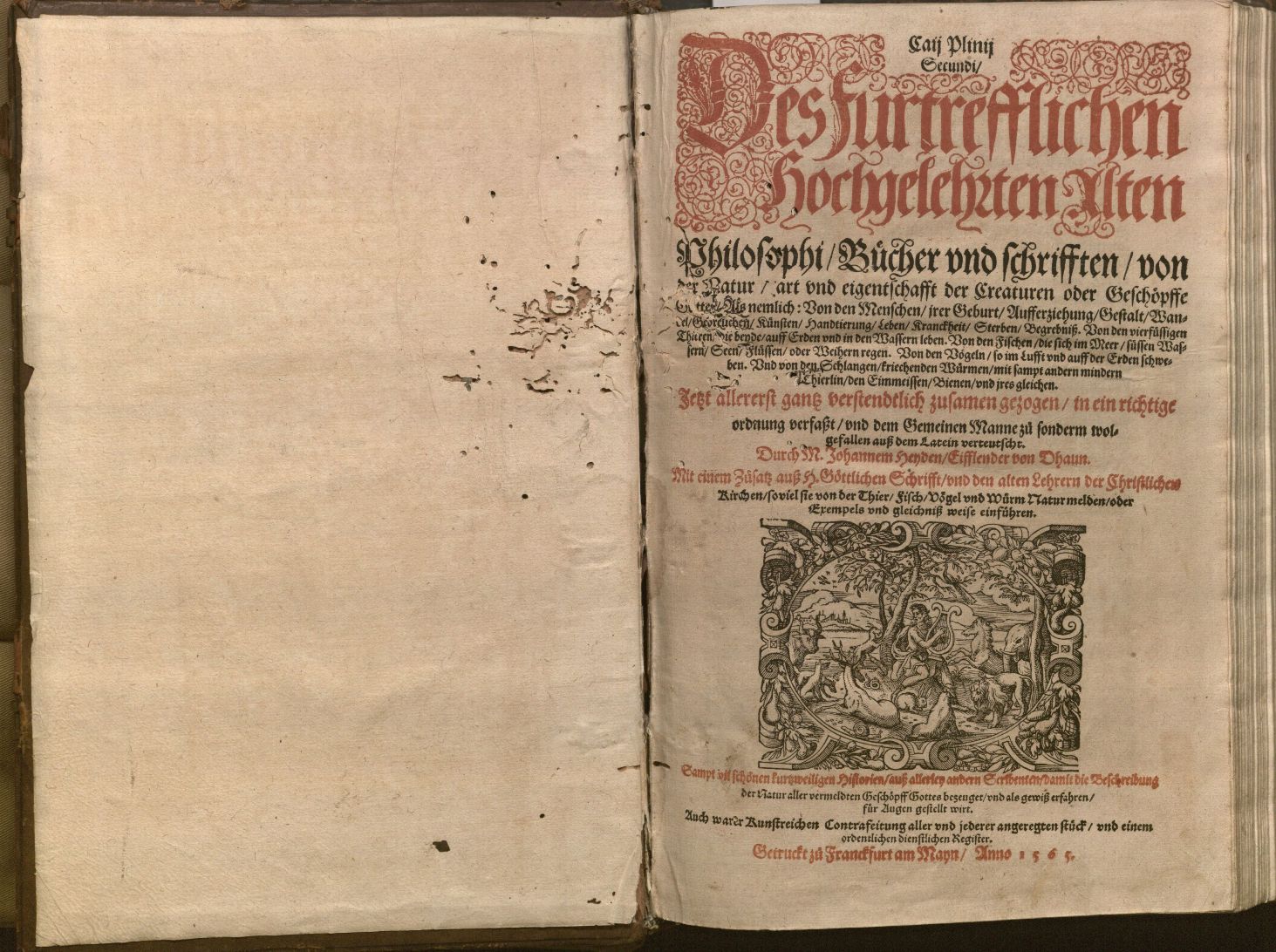
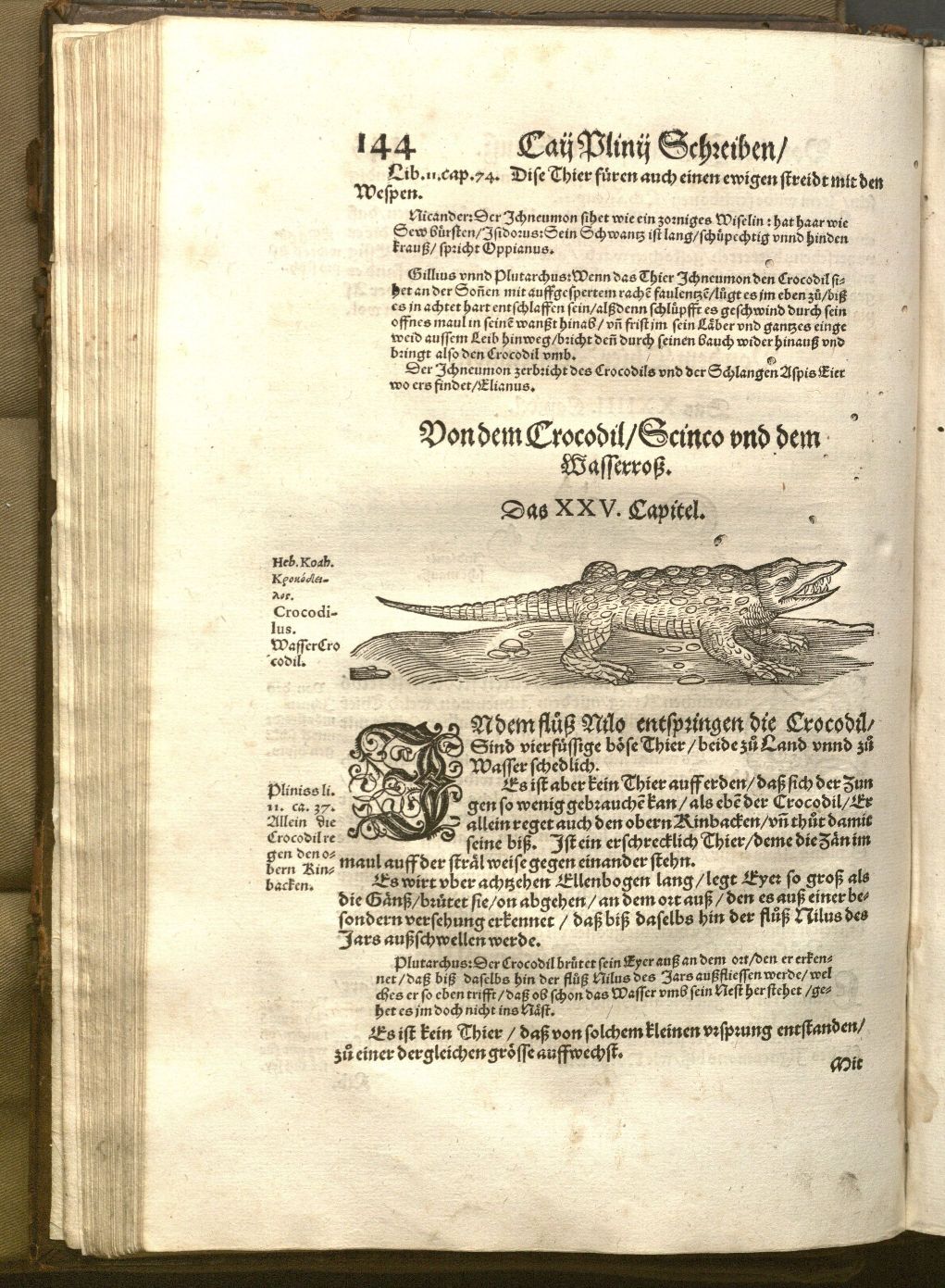
Pliny, the Elder. Caji Plinii Secundi … Bücher und Schrifften von der Natur, Art und Eigenschafft der Creaturen oder Geschöpfe Gottes … [Naturalis historia. German.] Franckfurt am Mayn : Feyrabend und Hüter, 1565. Call Number: Summerfield E1059. Click images to enlarge.
Beginning with the earliest printing of Pliny in 1469, there were at least 42 printings in numerous languages, including English, before 1536. The Kenneth Spencer Research Library houses 21 separate editions produced between 1476 and 1685. This German version contains books 7-10 and part of book 11. The translation was made by J. Heyden Eifflender von Dhaun and is illustrated with woodcuts by Jost Amman and Virgil Solis.
Sally Haines
Rare Books Cataloger
Adapted from her Spencer Research Library exhibit and catalog, Slithy Toves: Illustrated Classic Herpetological Books at the University of Kansas in Pictures and Conservations
**Author’s Note: This is the information we had at the time of publication of Slithy Toves in 2000; Mr. Roger Pearse has recently pointed out that in fact there do exist fragments of 5th century codices of Pliny.
Tags: Aristotle, Bücher und Schrifften von der Natur, classification, Crocodiles, Historia Animalium, J. Heyden Eifflender von Dhaun, Jost Amman, natural history, Naturalis Historia, Pliny the Elder, Sally Haines, Slithy Toves, Virgil Solis
Posted in Exhibitions, Special Collections |
No Comments Yet »
December 27th, 2012 The only image of St. Petersburg more plentiful in western books about 19th century Russia than the bronze horseman, is the ice hill, or “flying mountain,” a peculiarly Russian entertainment that may have something to do with the fact that Petersburgers are flatlanders. Paris, Rome, Athens, and Lawrence have their high points, hogbacks, and hills, but at no point on the delta on which Peter built his city is there a spot over thirty feet above sea-level. Of all the ailments that have plagued that city – typhoid fever, typhus, cholera, giardia, influenza, malaria, diphtheria, syphilis, smallpox, and the common cold – altitude sickness has not been one of them, and actually the hill provides some relief from high barometric pressure if not from a queasy stomach.
![Image of title page and frontispiece of Scenes in Russia [...], 1814 (Call number: Children A933)](https://blogs.lib.ku.edu/spencer/wp-content/uploads/2012/12/ChildrenA933.jpg "Scenes in Russia [...], 1814 (Call number: Children A933)")
Scenes in Russia; Describing the Manners, Customs, Diversions, Modes of traveling, &c. of the Inhabitants of that Country. London: printed for J. And E. Wallis, 1814. Call Number: Children 5310 (click image to enlarge).

This contraption seems to be a combination of ski-jump and roller coaster: each person climbs into a small 4-wheeled shallow sided box at the top of a platform and careens downhill on a track. Sometimes ridges (moguls?) are added to increase velocity coming down enough to send them up the other side. When the River Neva is frozen the flying mountains are erected on the ice.
Adapted from the Spencer Research Library exhibit, Frosted Windows: 300 Years of St. Petersburg Through Western Eyes.
Sally Haines
Rare Books Cataloger
Tags: flying mountains, ice hills, Russia, Sally Haines, Scenes in Russia, St. Petersburg, winter sports
Posted in Exhibitions, Special Collections |
No Comments Yet »
December 7th, 2012 Have you ever wondered what steps are involved in mounting an exhibit? We recently completed installation of “100 Years of Jayhawks: 1912-2012,” curated by University Archivist Becky Schulte, with assistance from Letha Johnson and Sherry Williams. The exhibit celebrates the evolution of the Jayhawk, the mascot of the University of Kansas, from the first, long-legged version drawn by Hank Maloy to the present design. This is the first exhibit to be mounted in a newly renovated space in Spencer, in the former location of the Special Collections reception area.
Becky Schulte retrieved many items from the stacks and determined the theme of each of the five cases. Assistant Conservator Roberta Woodrick and I covered the exhibit case bases with the cloth Becky had selected. Once the cases were ready, Becky laid out objects in the cases in rough configurations, determining the best location for each item while considering the flow of the exhibition “story.”

Initial layout of materials in the case. Click image to enlarge.
After items were placed in the cases, we constructed mounts for materials in order to elevate, highlight, and soundly support them during the course of the exhibit. For this exhibition we selected archival matboard and Volara polyethylene foam as mount materials, both of which are inert and will not chemically or physically damage objects on display.

University Archivist Becky Schulte positioning an item on matboard within the case.
Click image to enlarge.
Once the labels and mounts were finished, the Jayhawks were placed in the cases. We measured and determined safe lighting levels for the exhibition space to limit light exposure to objects on display.

Finished Product! The final version of one of the exhibition’s five display cases.
Click image to enlarge.
The exhibit will be on open through March and may be viewed during regular Kenneth Spencer Research Library Hours: Monday-Friday, 9:00am-5:00pm, and (when regular classes are in session) Saturday 12:00pm-4:00pm . Please visit and let us know what you think!
For images from the exhibition’s opening celebration on Wednesday, December 5, please click on the thumbnails below.


Whitney Baker
Head, Conservation Services
Tags: 100 Years of Jayhawks: 1912-2012, Becky Schulte, conservation, Exhibitions, Jayhawks, Mounting an exhibition, University Archives, University of Kansas, Whitney Baker
Posted in Conservation, Events, Exhibitions, News, University Archives |
No Comments Yet »
October 5th, 2012 In his book on the viper, Nouvelles experiences sur la vipere, Parisian apothecary Moyse (or Moïse) Charas takes to task Italian physician, naturalist, and poet Francesco Redi (1626-1697), for his scientific study of viper bites, the first such research ever. Charas was of the opinion (and not alone in it) that venom per se was harmless and that death was caused by poisonous spirits injected into the victim by the mind of an infuriated viper. Charas’s title-page shows two vipers entwined as in the caduceus, or staff of Mercury, one of the symbols of the medical profession. The Aesculapian staff, after the Greco-Roman God of medicine and healing, Aesculapius, is branched at the top with a single snake twined around it; it is the official insignia of the American Medical Association.

Charas, Moyse (1618-1698). Nouvelles experiences sur la vipere.
A Paris: chez l’auteur et Olivier de Varennes, 1669. Ellis Omnia B30.
Click image to enlarge.
Charas recommended viper as a staple of the diet and as a preventive and cure for a good many diseases. His 17th century compatriot and contemporary Pierre Pomet (1658-1699) recommended distilled salts of viper to prevent measles, smallpox, plague, and scurvy, and to cure gout, rheumatisum, and venereal disease. Viper heart was prescribed for mealcholia. In another book, Trakat über den Theriak, Charas extols theriac, an anti-leprosy medicine made from powdered snake and used since antiquity; in medieval Europe the powder was formed into tablets, stamped with a snake image, and used against the bubonic plague. But that ain’t nothin’; our American frontiersmen gladly bought greasy-kid-stuff from snake-oil salesmen who took their money and swore the oil would grow hair back on their heads and cure the goiter to boot.
On the added engraved title-page of the Spencer Library’s copy (pictured above) is the inscription of the book’s former owner, French pharmacist and botanist Jean Leon Soubeiran (1827-1892). Soubeiran was the author of books on materia medica from all the kingdoms of nature–plant, animal, and mineral–including one on the venom of poisonous snakes.
Sally Haines
Rare Books Cataloger
Adapted from her Spencer Research Library exhibit and catalog, Slithy Toves: Illustrated Classic Herpetological Books at the University of Kansas in Pictures and Conservations.
Tags: history of science, Jean Leon Soubeiran, Moyse Charas, natural history, Nouvelles experiences sur la vipere, Sally Haines, snakes, Vipers
Posted in Exhibitions, Special Collections |
No Comments Yet »
September 7th, 2012 The bullfrog, Rana catesbeiana, is the largest frog in North America. However, even as flat as he looks on this plate, he’s an unlikely candidate for road pizza on your plate, because although he’s an amphibian, the adult bullfrog tends to stay in his moist habitat and not to venture out onto dry land. Unfortunately for him, in this country, he’s one of the few species large enough to provide a satisfactory meal of frog legs for Homo sapiens.
![Plate from James Petiver's Gazophylacii Naturae & Artis in qua animalia [...]](https://blogs.lib.ku.edu/spencer/wp-content/uploads/2012/09/EllisAves_E116_item2.jpg "Plate from James Petiver's Gazophylacii Naturae & Artis in qua animalia [...]")
James Petiver (1663 [or 4]-1718). Gazophylacii naturæ & artis,: decas prima-[decima]. In quâ animalia,
quadrupeda, aves, pisces, reptilia, […] descriptionibus breviubs & iconibus illustrantur. Londonii: Ex Officinâ
Christ. Bateman ad insignia Bibliæ & Coronæ, vico vulgo dict. Pater-Noster-Row., MDCCII. [1702-1706?]
Call Number: Ellis Aves E116 item 2. Click image to enlarge.
James Petiver, known primarily as a botanist and as one of the founders of British entomology, went to considerable expense to have ships’ captains and surgeons supply him with specimens of natural history from around the world for his museum. In the Gazophylacium, one of Petiver’s rarest and most interesting productions, the figures of reptiles and amphibians, plants, shells, insects, birds, and other animals are displayed together on the same plate. It was the intention of both author and publisher that the text be pasted down on the versos of the plates facing the appropriate plate, with dedication mounted at the foot of each, as in the Spencer Library’s copy; however, in most states of the work, text is simply printed on the back of each plate.
Sally Haines
Rare Books Cataloger
Adapted from her Spencer Research Library exhibit and catalog, Slithy Toves: Illustrated Classic Herpetological Books at the University of Kansas in Pictures and Conservations
Tags: Bullfrogs, Gazophylacii Naturae & Artis, James Petiver, natural history, Rana catesbeiana, Sally Haines
Posted in Exhibitions, Special Collections |
No Comments Yet »