The University of Kansas

Inside Spencer: The KSRL Blog

Books on a shelf

Welcome to the Kenneth Spencer Research Library blog! As the special collections and archives library at the University of Kansas, Spencer is home to remarkable and diverse collections of rare and unique items. Explore the blog to learn about the work we do and the materials we collect.

Historic Kansas Photographs Recently Donated are the Subject of a Temporary Exhibit (Part One)

August 6th, 2019

Leonard Henry Hollmann from Eudora, Kansas was passionate about photography and collecting photographs, especially those about Kansas or by Kansas photographers.

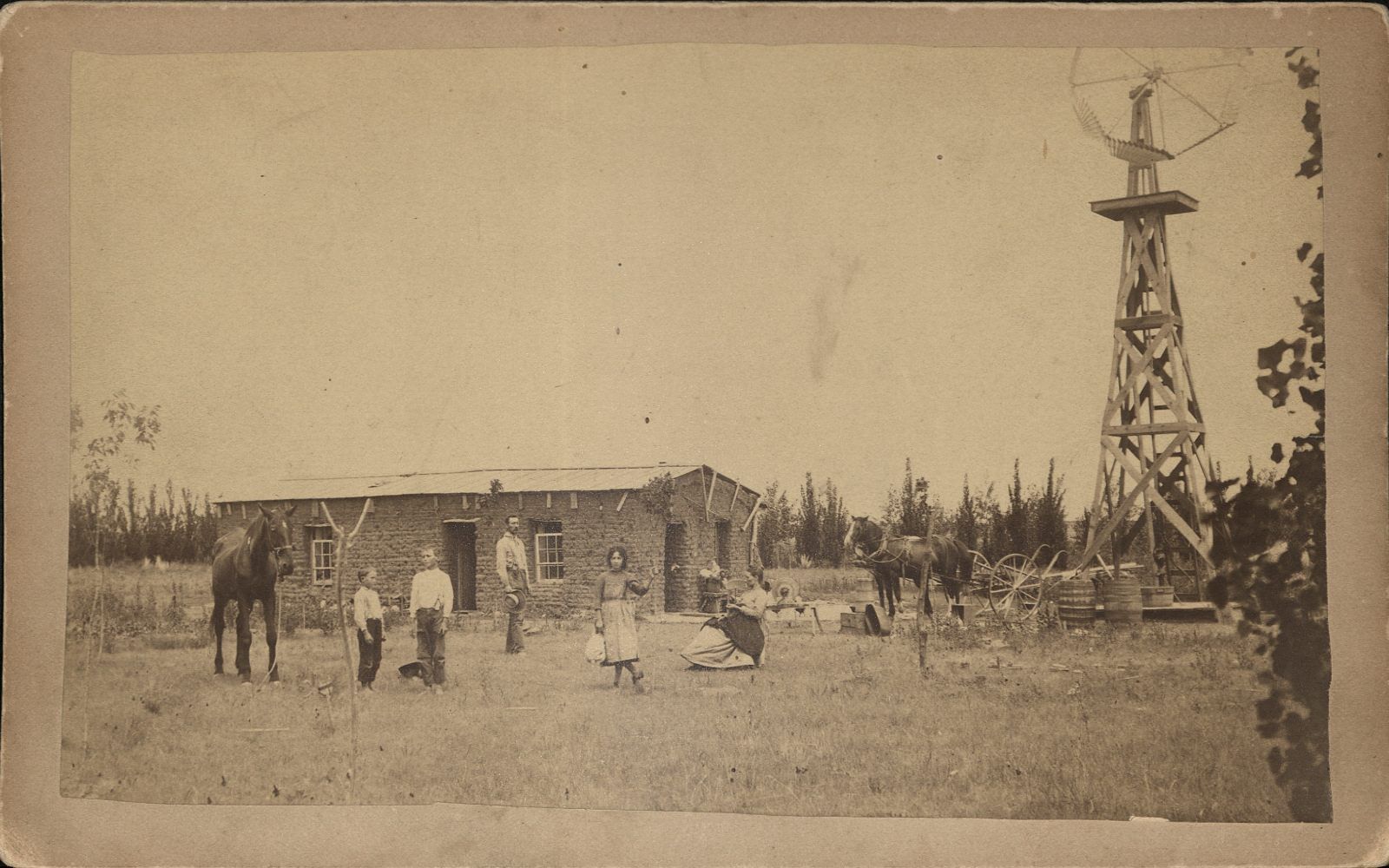
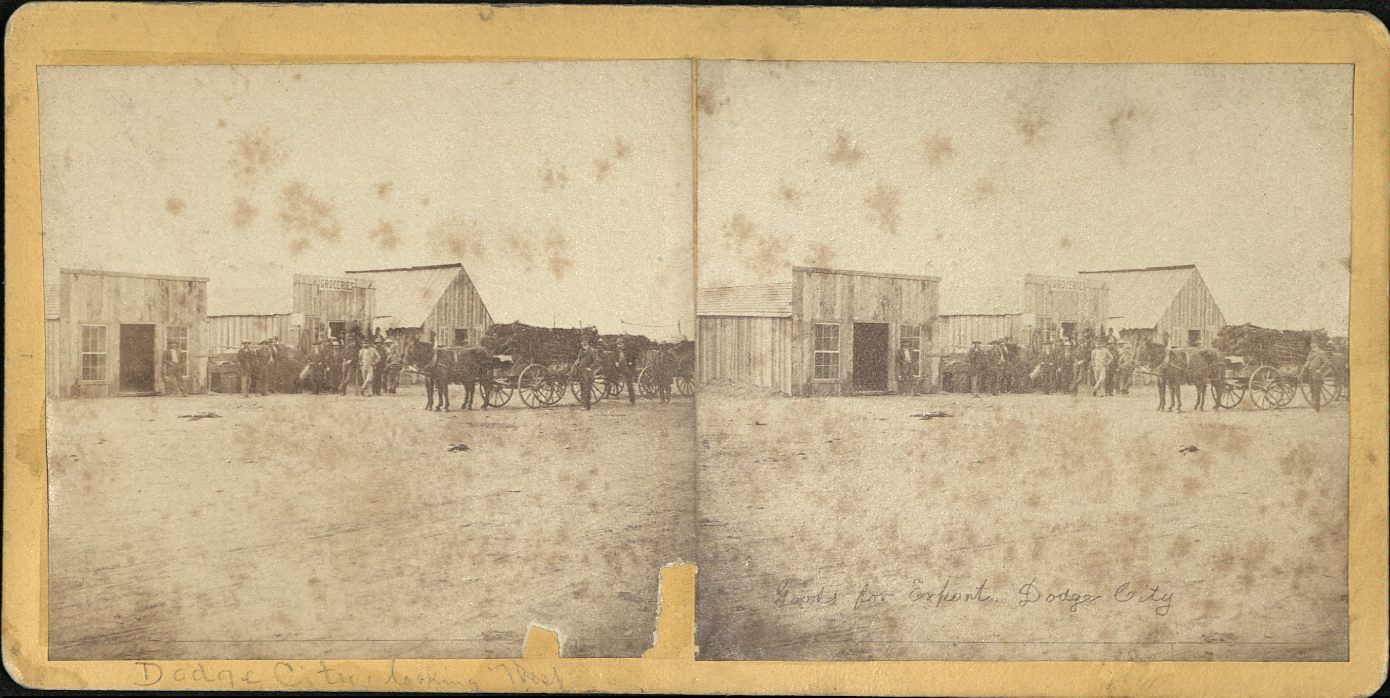
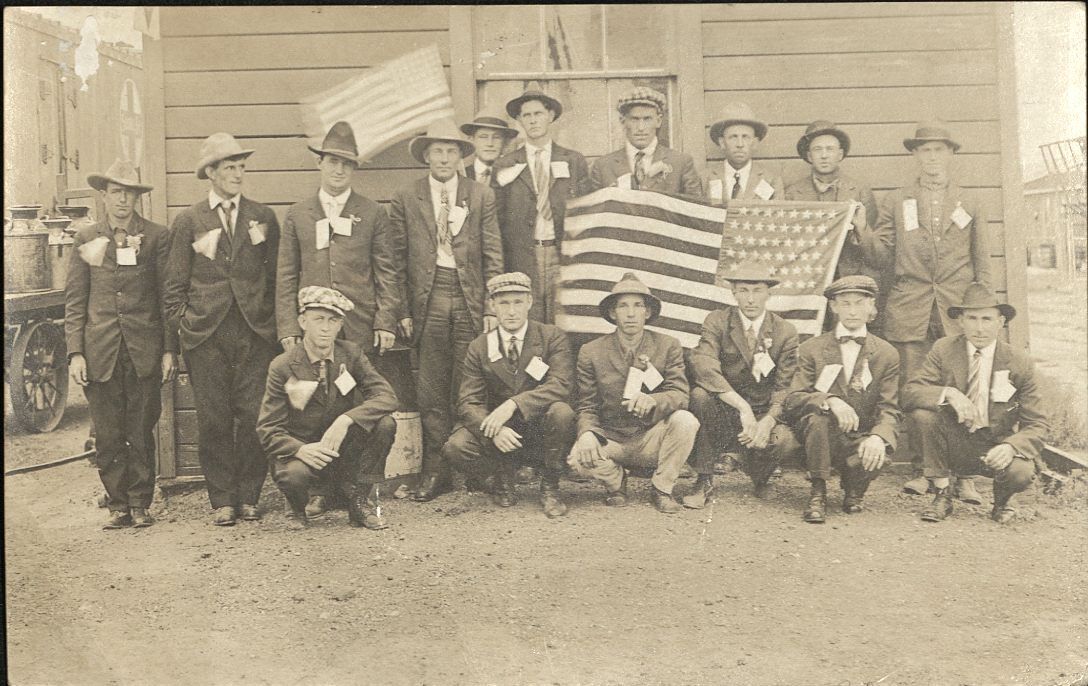
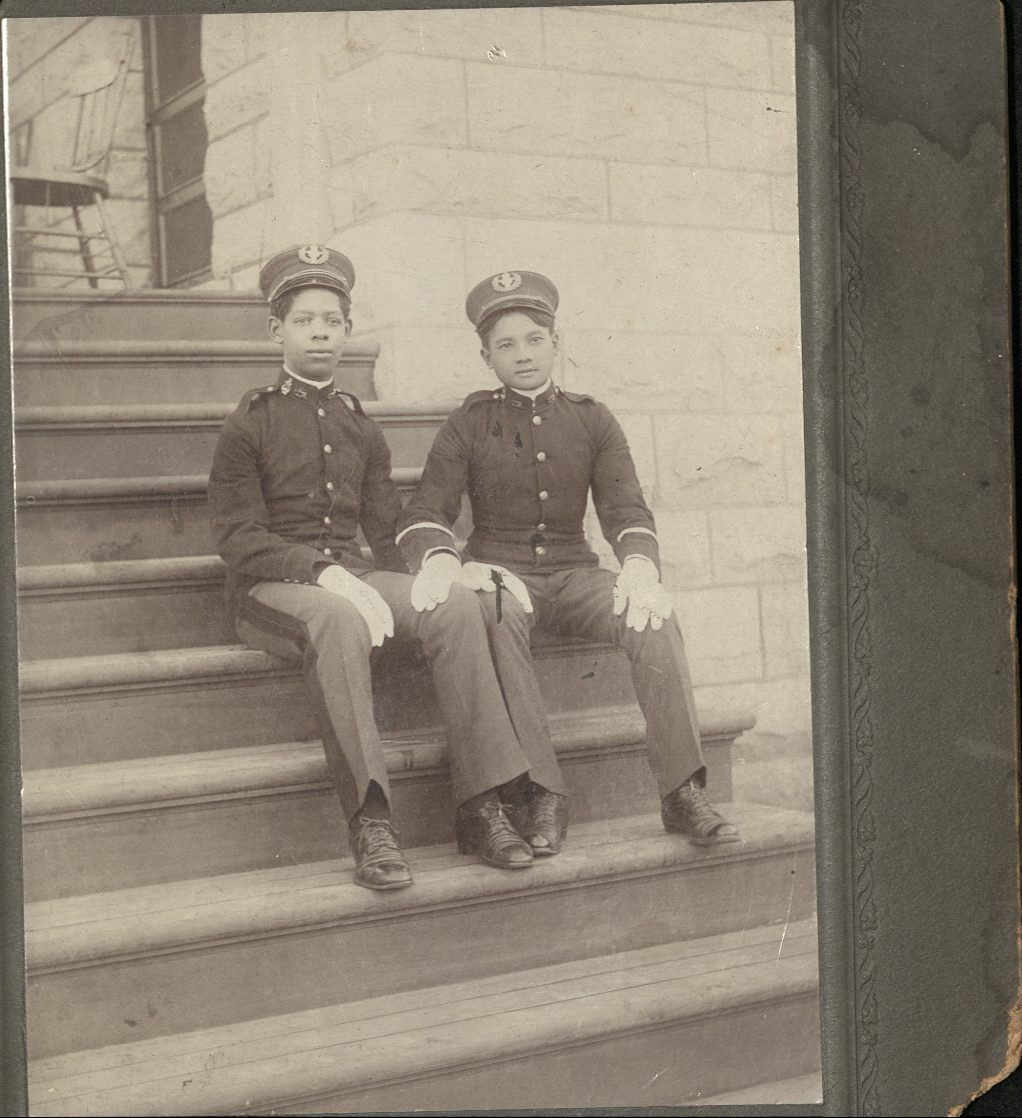
Mr. Hollmann donated his photographic collection to the Spencer Research Library shortly before he passed away in January 2016. Containing over 10,000 images, the collection is a gem. Hollmann had carefully collected images from across Kansas (and some from Missouri and Nebraska), with a concentration on Lawrence and Douglas County. Most of the images date from the 1850s-1930s.

The collection contains many types of photographic formats including ambrotypes, tintypes, cartes de visite, cabinet cards, postcards, and stereoviews. The arranging and describing of the collection, because of its enormity, took seven months.

This amazing collection is now available for researchers. View the finding aid here: Guide to the Leonard Hollmann photograph collection. At the very top of the finding aid there is a search box where you can enter any keyword to search the document. Try typing in a town name or something else, like “dog” or “bicycle.”

A selection of the Hollmann photograph collection is on exhibit in the North Gallery of the Spencer Research Library until the end of August. The temporary exhibit highlights about 35 images of Lawrence, Kansas and other Kansas towns. The photographs on view date from 1862 to 1918. Some of them are rare and have not been viewed by the public before.

Our two-part blog will feature Lawrence photographs in the first installment and Kansas images in the second installment.

Early Lawrence residents
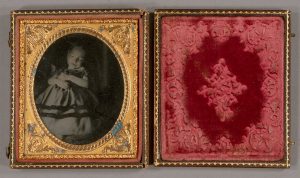
Ambrotype of deceased 11 month old Lawrence girl, Freddie Rockwell Read, 1862

 Ambrotype of deceased eleven-month-old Lawrence girl Freddie Rockwell Read, 1862.
Call Number: RH PH 536, Box 64, Folder 1. Click image to enlarge.

One of the most defining moments in Lawrence’s history was Quantrill’s Raid in 1863. Before and during the Civil War, Kansas and Missouri had many unofficial skirmishes between each other. William Quantrill’s raid on the free-state town of Lawrence, Kansas (also known as the Lawrence Massacre) was a defining moment in this time period. At dawn on August 21, 1863, Quantrill and his guerrillas rode into Lawrence, where they burned much of the town and killed between 160 and 190 men and boys.

An early type of photograph, ambrotypes were produced by placing a glass negative against a dark background. Although they were more affordable for families, it was uncommon to have an ambrotype photograph taken. Unlike tintypes, only one ambrotype was produced during a photographic sitting. It is possible that this is the first time that this photograph of Freddie Read has ever been published, or been on exhibit!
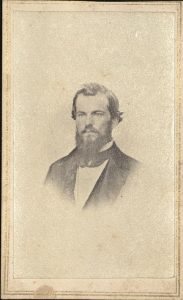
Carte de visite of John Lewis Crane. Photographer L. M. Price, no location.

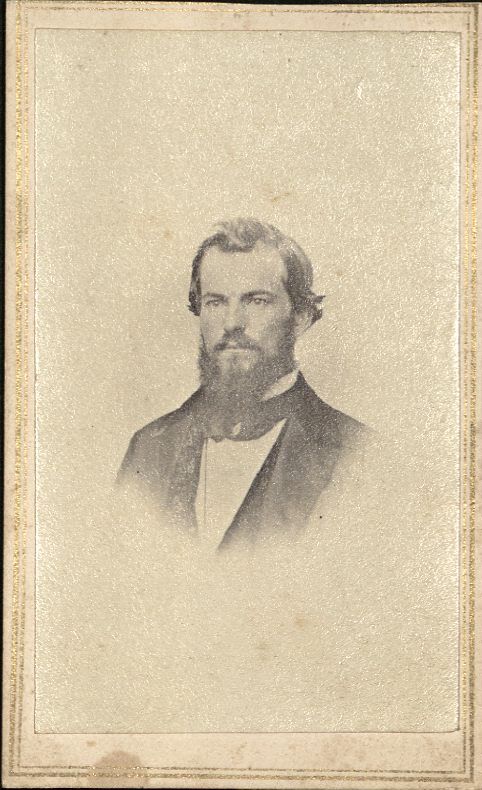
Carte de visite of John Lewis Crane. Photographer L. M. Price, no location.
Call Number: RH PH 536, Box 58, Folder 17. Click image to enlarge.

Originally from Connecticut, John Lewis Crane was a partner in a shoe store in Lawrence before he was killed during Quantrill’s raid. Photographs of two of his siblings and brother-in-law Gurdon Grovenor are also in this collection.

University of Kansas
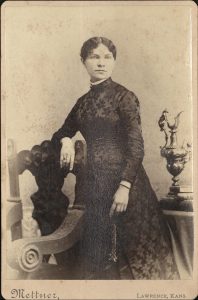
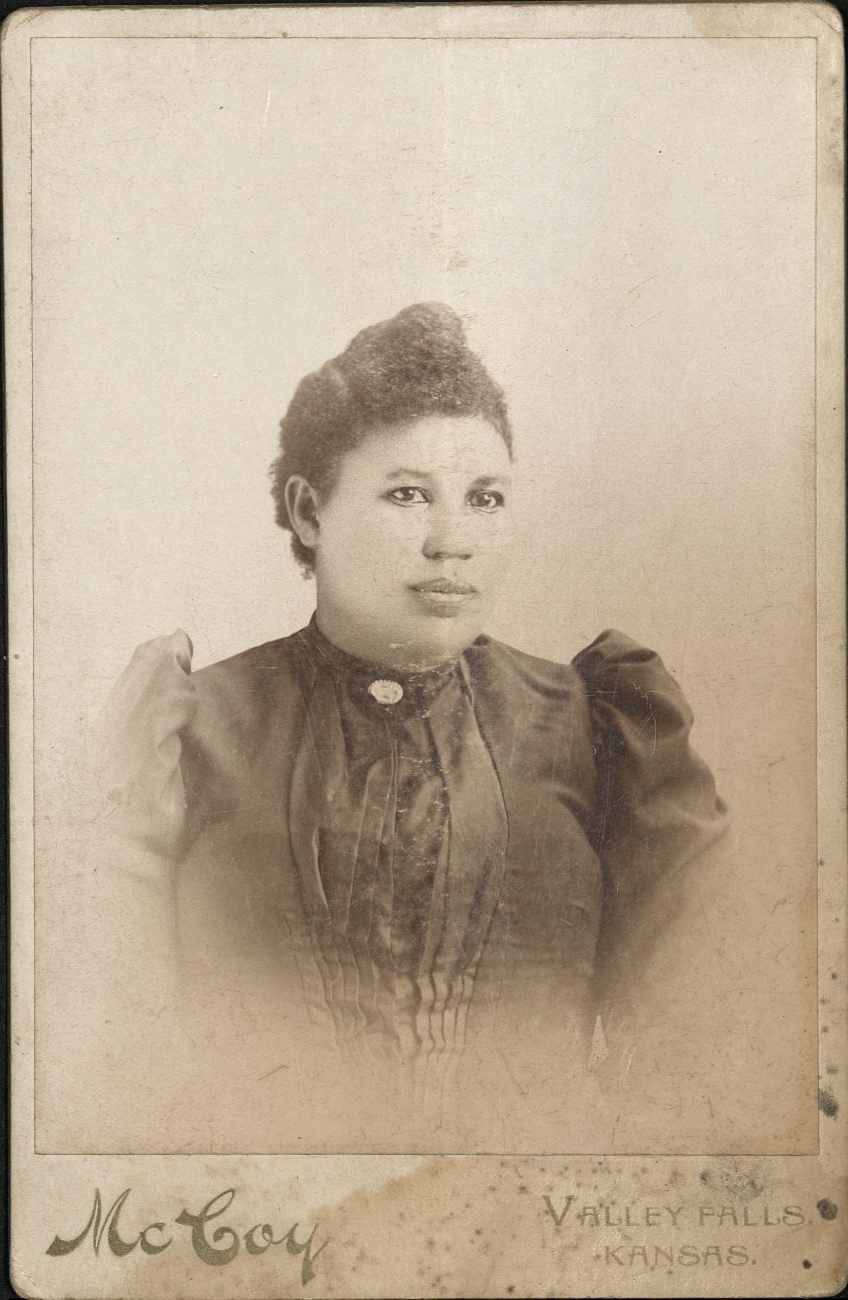
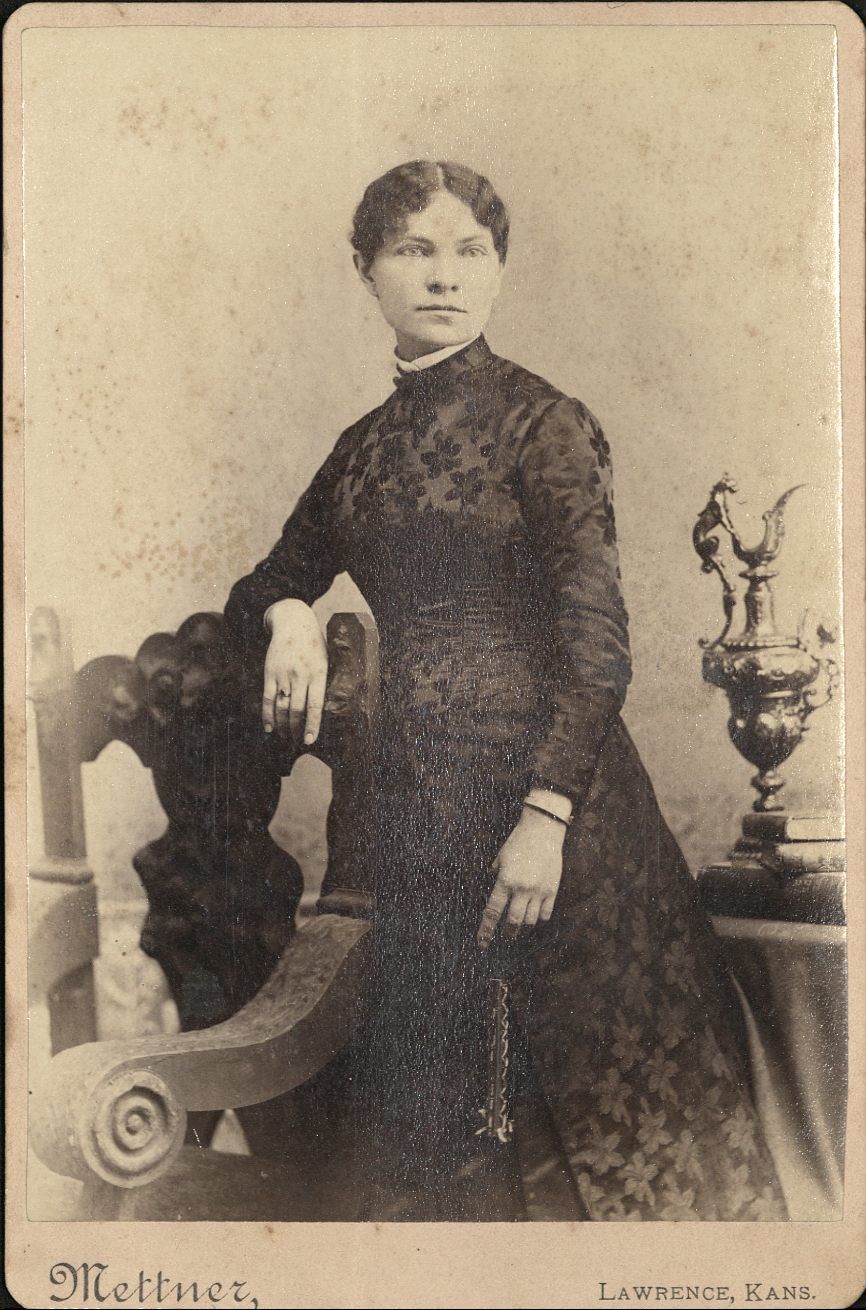
Cabinet card of Hannah Oliver.  Photographer Mettner of Lawrence, Kansas.
Cabinet card of Hannah Oliver. Photographer Mettner of Lawrence, Kansas.
Call Number: RH PH 536, Box 36, Folder 5. Click image to enlarge.

A Quantrill’s raid survivor, Hannah Oliver received her Bachelor of Arts in 1874 and her Master of Arts in 1888 from the University of Kansas. She joined the faculty of KU in 1890, teaching Latin. She retired in 1931. The finding aid for her personal papers at Spencer Research Library can be accessed through this link: Guide to the Hannah Oliver collection.
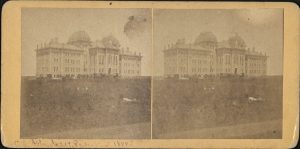
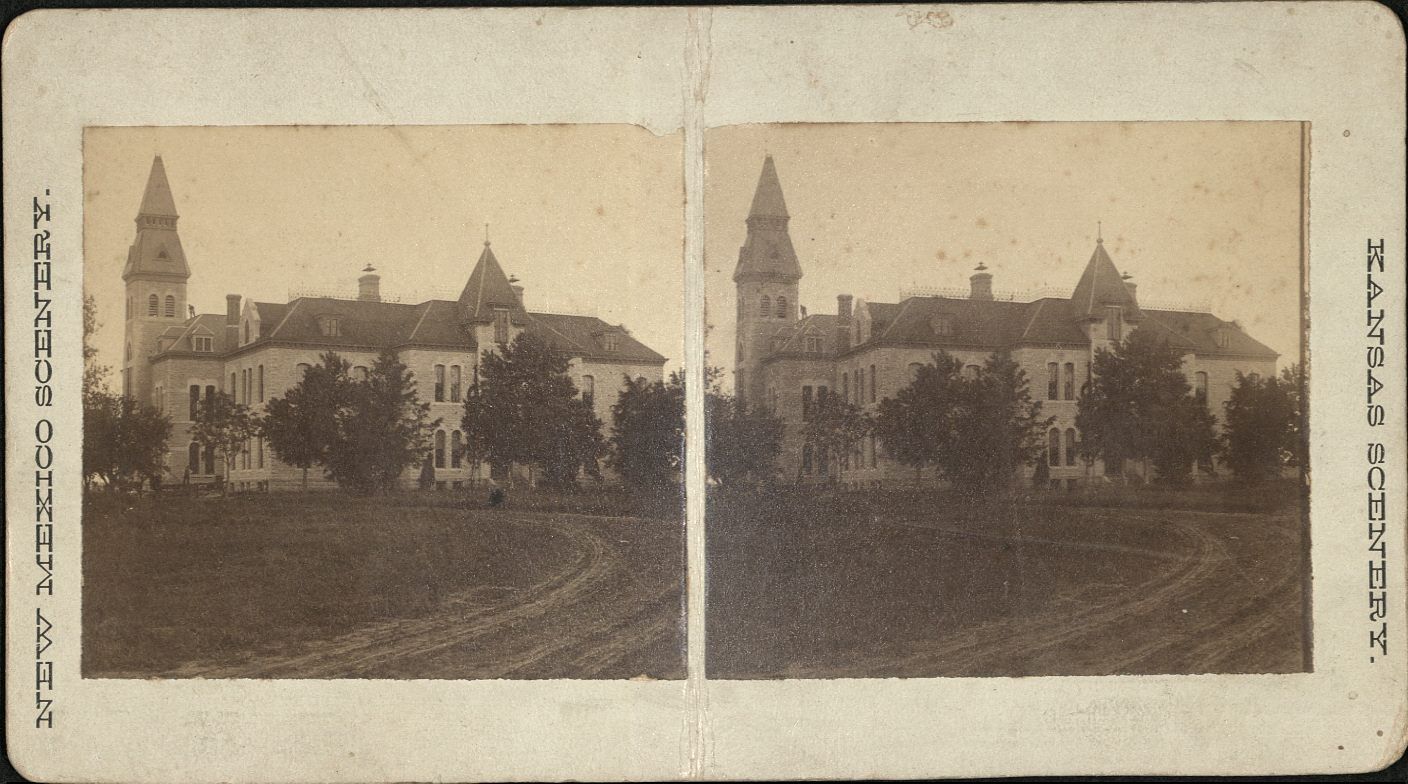
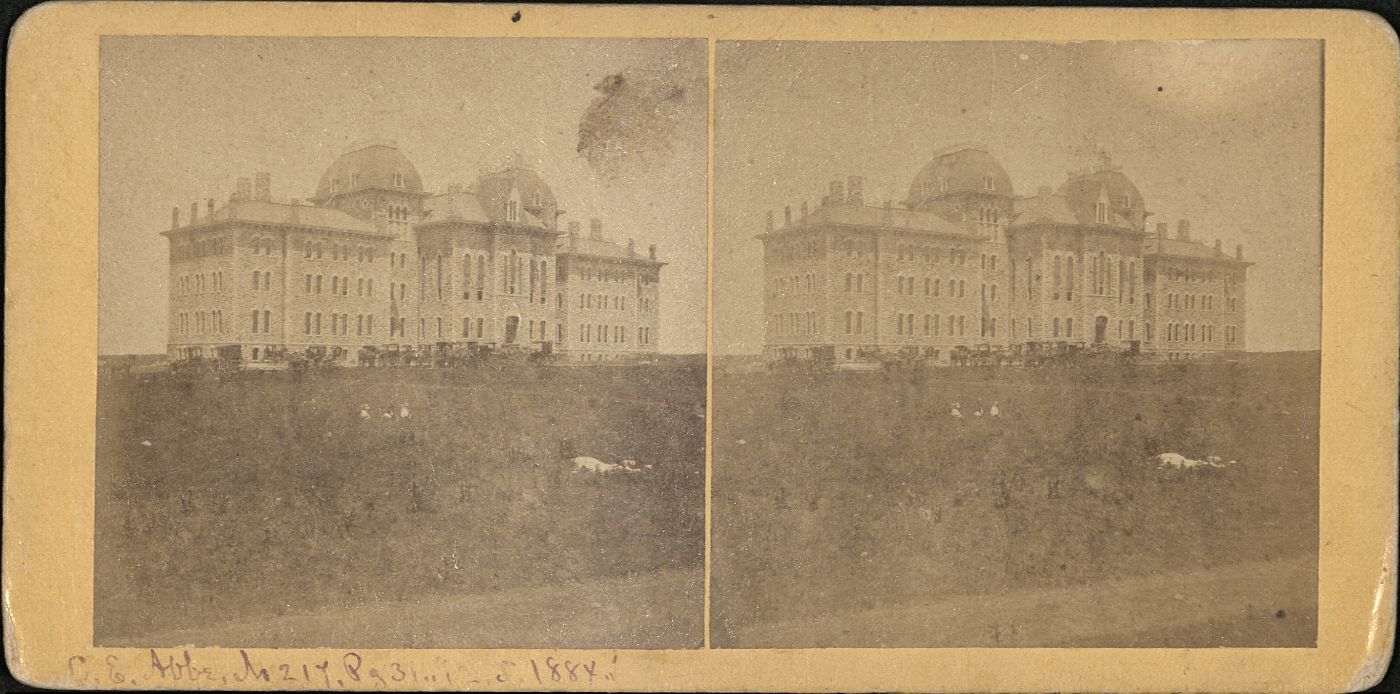
Stereoview card of Old Fraser Hall, published by W. H. Lamon, of Lawrence, dated 1884.

Stereoview card of Old Fraser Hall, published by W. H. Lamon, of Lawrence, dated 1884.
Call Number: RH PH 536, Box 85, Folder 7. Click image to enlarge.

The “New Building,” as it was called when it was built in 1872, was later called “Fraser Hall” after KU’s second chancellor, General John Fraser. In these images, several covered buggies and horses are visible next to the building. It was demolished in 1965.

The Hollmann photograph collection contains thousands of stereoview cards. These were popular as a form of entertainment from the 1850s to the 1930s. To view the image, the card was inserted into a stereoviewer. When the two separate images depicting left-eye and right-eye views of the same scene are viewed through the viewer, the brain merges both together, creating one three-dimensional image. While stereoview cards in general are common, the cards in the Hollmann photograph collection are mostly of rarer scenes. Some may even be one-of-a-kind.

Haskell Institute

Now known as the Haskell Indian Nations University, images of this important Lawrence school and college are represented in the Hollmann photograph collection.
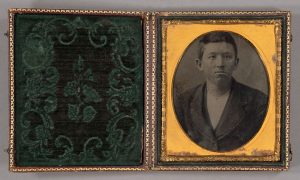
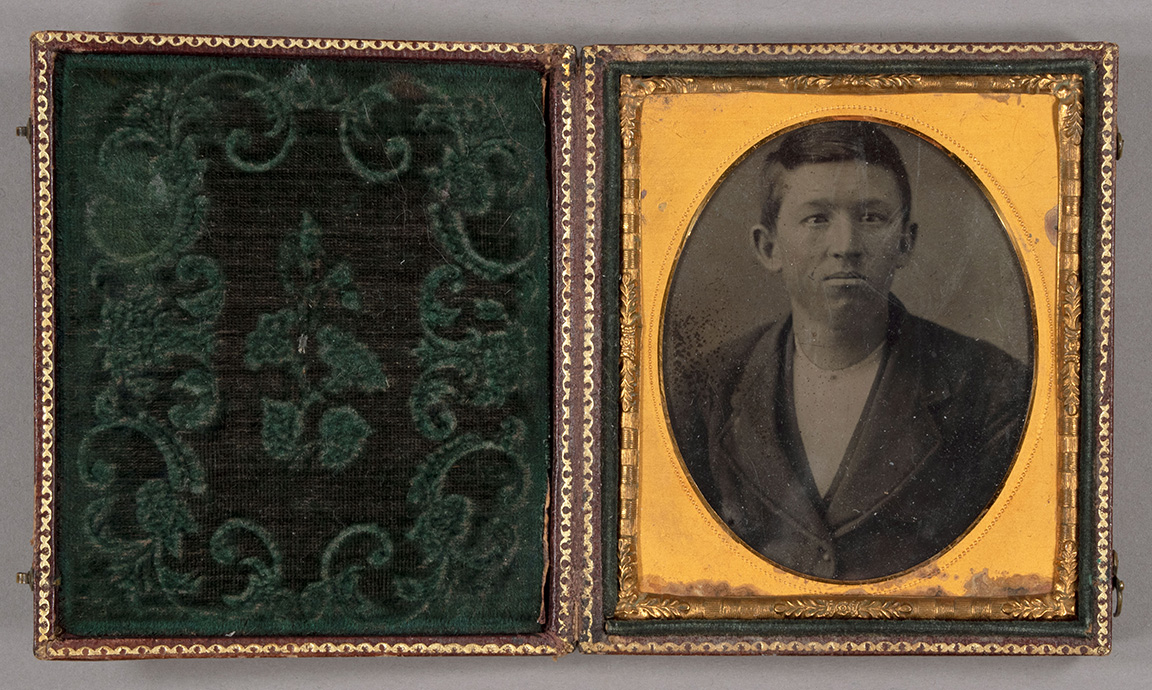
Tintype of Standing Fox, also known as Ephram Cloud, Junior

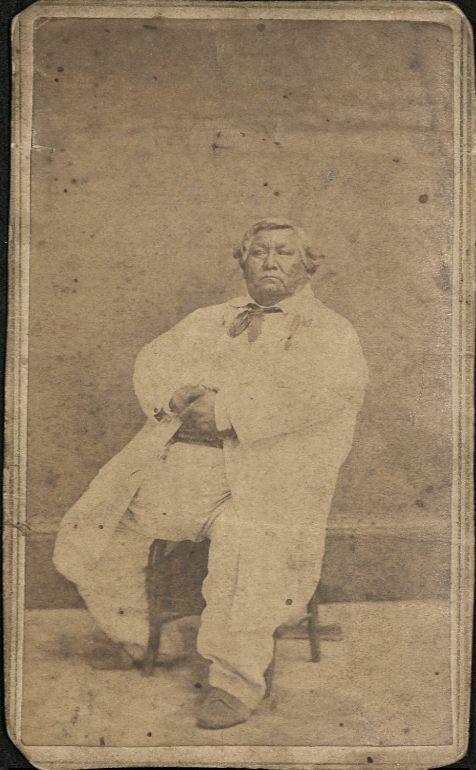
Tintype of Standing Fox, also known as Ephram Cloud, Junior.
Call Number: RH PH 536, Box 63, Folder 37. Click image to enlarge.

Little is known of the cased tintype of Standing Fox, also known as Ephram Cloud, Junior. According to paperwork with the image, he may be associated with Haskell Institute.
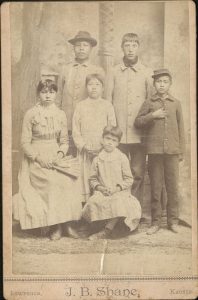
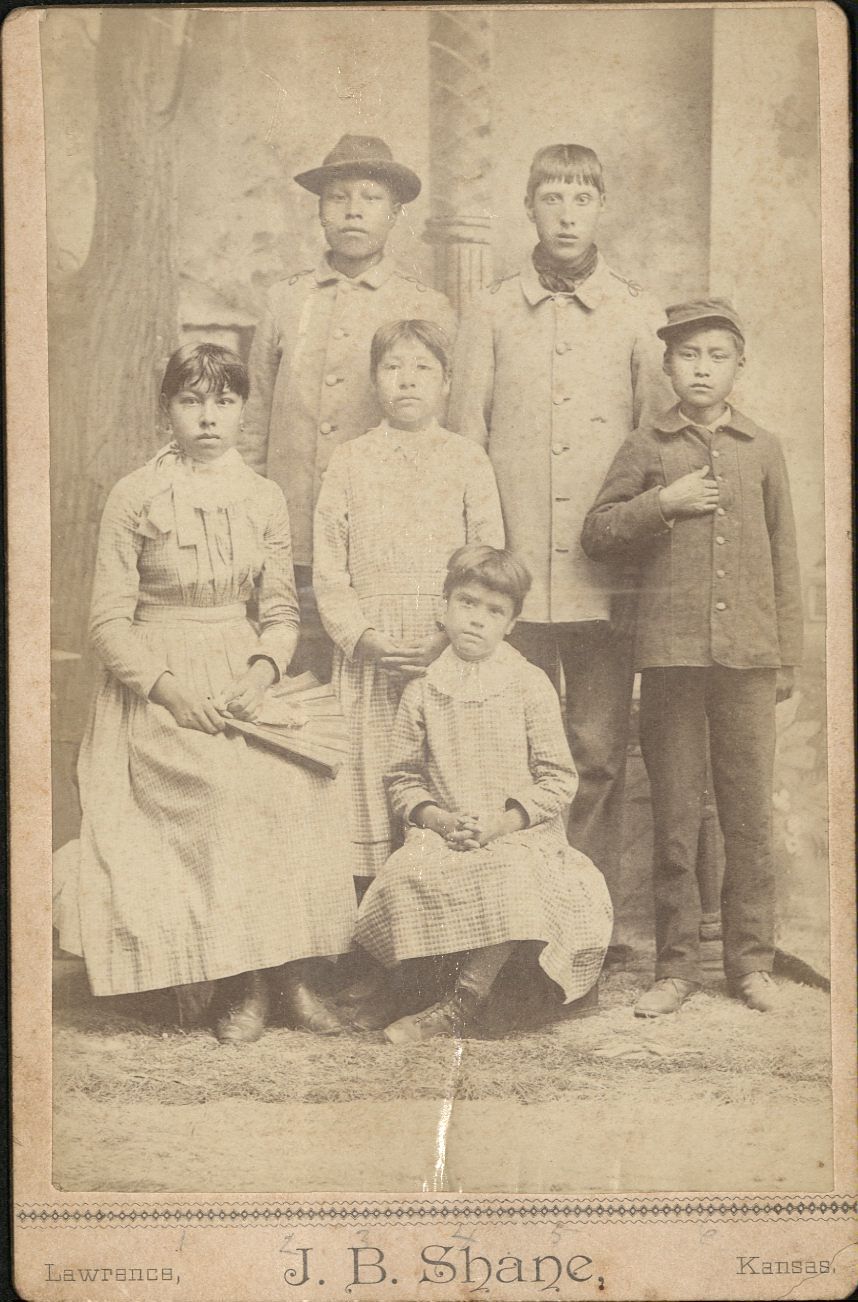
Cabinet card with identified students of Haskell Institute, photographer J. B. Shane of Lawrence. Students identified on the back as: 1. Geneva Roberts, Wichita (seated, far left); 2. Wiley Morgan, Seminole (standing, on left in back row); 3. Nellie Bates, Wichita (standing, center); 4. Nora Guy, Caddo (in front); 5. Peter Williams, Caddo (standing, on right in back row); 6. Richard Longhat, Caddo (standing, in dark uniform on far right).

Cabinet card with identified students of Haskell Institute, photographer J. B. Shane of Lawrence.
Call Number: RH PH 536, Box 37, Folder 21. Click image to enlarge.

These children have been identified on the back of the photograph as: 1. Geneva Roberts, Wichita (seated, far left); 2. Wiley Morgan, Seminole (standing, on left in back row); 3. Nellie Bates, Wichita (standing, center); 4. Nora Guy, Caddo (in front); 5. Peter Williams, Caddo (standing, on right in back row); 6. Richard Longhat, Caddo (standing, in dark uniform on far right).

Be sure to come view the temporary exhibit in the North Gallery in the Spencer Research Library before it closes at the end of August! Spencer Research Library is open to everyone. If you would like to do research with the Hollmann photograph collection, please see our website for information on visiting and using the collection at Kenneth Spencer Research Library.

Lynn Ward
Processing Archivist

[1]  From Quantrill and the border wars, by William Elsey Connelley, page 367, Spencer Research Library call number RH C5055.
Throwback Thursday: Max Falkenstien Edition

August 1st, 2019

Each week we’ll be posting a photograph from University Archives that shows a scene from KU’s past. We’ve also scanned more than 34,800 images from KU’s University Archives and made them available online; be sure to check them out!

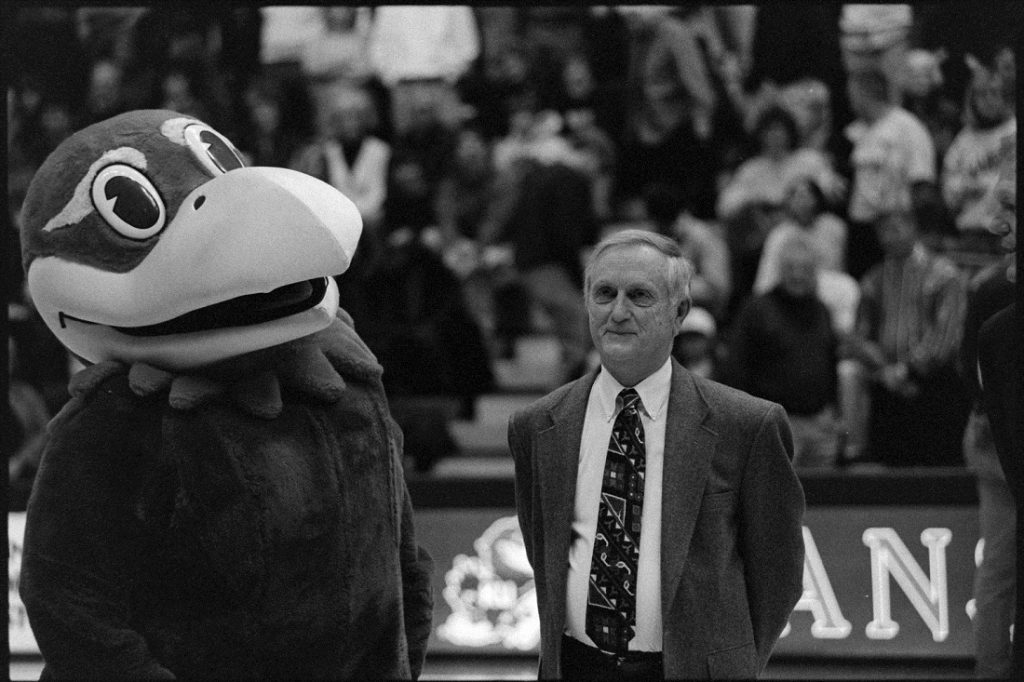
This week’s post features Max Falkenstien, the “Voice of the Jayhawks” who broadcast University of Kansas football and men’s basketball games for sixty years. He died on Monday at age ninety-five.

Photograph of Max Falkenstien with Big Jay, 1996
Max Falkenstien with Big Jay during a halftime ceremony at Allen Fieldhouse, February 4, 1996. The event celebrated Falkenstien’s induction into the KU Athletics Hall of Fame; he was the first member of the media to receive this honor. University Archives Photos. Call Number: RG P/ Max Falkenstien (Photos). Click image to enlarge (redirect to Spencer’s digital collections).

Caitlin Donnelly
Head of Public Services

Throwback Thursday: Listen to the Music Edition

July 25th, 2019

Each week we’ll be posting a photograph from University Archives that shows a scene from KU’s past. We’ve also scanned more than 34,800 images from KU’s University Archives and made them available online; be sure to check them out!

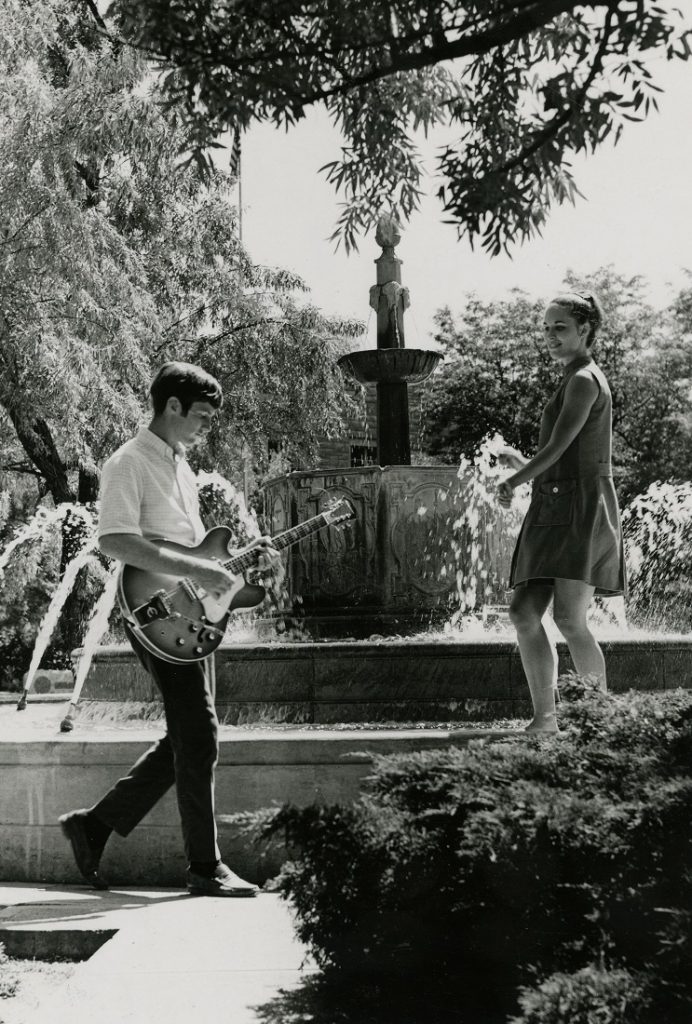
Photograph of a man playing a guitar as a woman watches from the Chi Omega Fountain, 1969-1970
A man plays a guitar as a woman watches from the Chi Omega Fountain, 1969-1970. University Archives Photos. Call Number: RG 0/24/1 Chi Omega Fountain 1969/1970 Prints: Campus: Areas and Objects (Photos). Click image to enlarge (redirect to Spencer’s digital collection).

Caitlin Donnelly
Head of Public Services

Throwback Thursday: KU Astronaut Edition

July 18th, 2019

Each week we’ll be posting a photograph from University Archives that shows a scene from KU’s past. We’ve also scanned more than 34,800 images from KU’s University Archives and made them available online; be sure to check them out!

As we commemorate the fiftieth anniversary of Apollo 11 – the first manned mission to land on the Moon – this week’s photograph features astronaut Ron Evans (1933-1990), a Kansas native who graduated from KU with a bachelor’s degree in 1955.

A Navy pilot during the Vietnam War, Evans was one of the nineteen astronauts selected by NASA in 1966. He served as a member of the astronaut support crews for the Apollo 7 and Apollo 11 flights and as backup Command Module Pilot for Apollo 14. Evans’ only space flight was as Command Module Pilot of Apollo 17. (It was during this December 1972 mission that the moon rock housed at Spencer Research Library was collected.)

Photograph of Astronaut Ron Evans presenting a memento carried to the moon, April 1973
Astronaut Ron Evans presenting a KU flag he carried to the moon during the Apollo 17 mission, April 1973. The plaque is inscribed “To the men and women of KU where I took my first steps toward the moon.” Lawrence Journal-World Photo Collection, University Archives Photos. Call Number: RG LJW P/ Ron Evans (Photos). Click image to enlarge.

During the Apollo 17 mission, Evans piloted the command module to the Moon. Once there, the lunar module separated from the command module and carried astronauts Eugene Cernan and Harrison Schmitt to the Moon’s surface. Evans (and five mice) maintained lunar orbit while Cernan and Schmitt explored the Moon’s surface, setting records for the longest time in lunar orbit (almost 148 hours) and the number of lunar orbits (seventy-five). According to a NASA description of Apollo 17, Evans also conducted numerous scientific activities.

In addition to the panoramic camera, the mapping camera, and the laser altimeter (which were used on previous missions), three new experiments were included in the service module. An ultraviolet spectrometer measured lunar atmospheric density and composition, an infrared radiometer mapped the thermal characteristics of the Moon, and a lunar sounder acquired data on the subsurface structure.

Finally, Evans brought the astronauts back to Earth. While en route, he completed an hour-long spacewalk to retrieve film cassettes from the lunar sounder, mapping camera, and panoramic camera.

Evans returned to the KU campus in April 1973 to receive the university’s Distinguished Services Award, the highest honor given by the University of Kansas and the KU Alumni Association. (Kenneth and Helen Spencer were the first couple to receive the citation – in 1943 and 1968, respectively.) Evans also spoke a the Senior-Parent luncheon, an event for graduating seniors and their relatives. During the luncheon, Evans presented Chancellor Raymond Nichols with the plaque shown in the photograph above. The plaque was placed in the auditorium of Nichols Hall, which was then the space technology building on campus. The hall’s auditorium was renamed the Ron Evans Apollo Room.

A letter from Robert P. Ryan to Robert E. Foster, 1972
A letter from Robert E. Foster to Robert P. Ryan, 1972
One month before the Apollo 17 mission, KU alumnus Robert P. Ryan at NASA wrote to Robert E. Foster, KU’s Director of Bands, requesting a copy of KU fight songs. Ryan had “received permission to wake up Mr. Evans one morning with” one. Foster was able to provide the songs. Copies of letters in Ron Evans’ biographical file, University Archives. Click images to enlarge.

According to an account in the June 1973 issue of Kansas Alumni, Evans noted in his brief talk at the Senior-Parent luncheon that “I have come back to KU to redeem myself. One day during the flight, they played the Jayhawk fight song three or four times to wake me up and I didn’t hear it!”

An article entitled "Behind the Scenes in the Space Program," Kansas Alumni, March 1973
This article in the March 1973 issue of Kansas Alumni lists the names of KU alumni with known involvement in the space program during preparations for the Apollo 17 mission. Call Number: LH 1 .K3 G73. Click image to enlarge.

Caitlin Donnelly
Head of Public Services

Throwback Thursday: First Chancellor’s Residence Edition

July 11th, 2019

Each week we’ll be posting a photograph from University Archives that shows a scene from KU’s past. We’ve also scanned more than 34,800 images from KU’s University Archives and made them available online; be sure to check them out!

Did you know that KU did not have an official residence for the Chancellor until 1893, when the university was almost thirty years old? This first residence wasn’t The Outlook, the home of Jabez and Elizabeth Watkins that became the Chancellor’s Residence in 1939. It was another home at 1345 Louisiana that was demolished in 1953 to make way for present-day Douthart Hall.

Photograph of the KU Chancellor's Residence at 1345 Louisiana, 1897
The KU Chancellor’s Residence at 1345 Louisiana, 1897. It was located just behind Spooner Hall, the corner of which is visible on the left. University Archives Photos. Call Number: RG 0/22/11 1897 Prints: Campus: Buildings: Chancellor’s Residence (Photos). Click image to enlarge (redirect to Spencer’s digital collections).

The article “An Old Friend” on the KU history website tells the story of how the first Chancellor’s Residence came to be built.

In 1891, the University had received a generous $91,618 bequest from the estate of William B. Spooner, a successful Boston leather merchant and philanthropist. Spooner, the uncle of then-KU Chancellor Francis Huntington Snow, had placed no restrictions on the use of his donation. The bulk of these funds, approximately $80,000, thus went to fill a desperate University need, that being a new freestanding library. Completed in 1894 and named in honor of its benefactor, the Henry van Brunt-designed Spooner Library – now known as Spooner Hall – stands today as Mount Oread’s oldest continually used academic structure.

Adequate library space was hardly the only thing the not yet 30-year-old University of Kansas lacked at this time. Also missing was an official chancellor’s residence, which forced KU’s early chief executives to keep their own private homes in town. Perhaps it was only fitting, then – considering the Spooner endowment’s familial origins – that when KU decided to spend the remaining $12,000 to construct a proper chancellor’s quarters, Chancellor Snow should be the first one to benefit.

Another van Brunt creation, the three-story, early Prairie Style home located at 1345 Louisiana Street welcomed the Snow family in December 1893.

Caitlin Donnelly
Head of Public Services