Welcome to the Kenneth Spencer Research Library blog! As the special collections and archives library at the University of Kansas, Spencer is home to remarkable and diverse collections of rare and unique items. Explore the blog to learn about the work we do and the materials we collect.
Each week we’ll be posting a photograph from University Archives that shows a scene from KU’s past. We’ve also scanned more than 34,800 images from KU’s University Archives and made them available online; be sure to check them out!
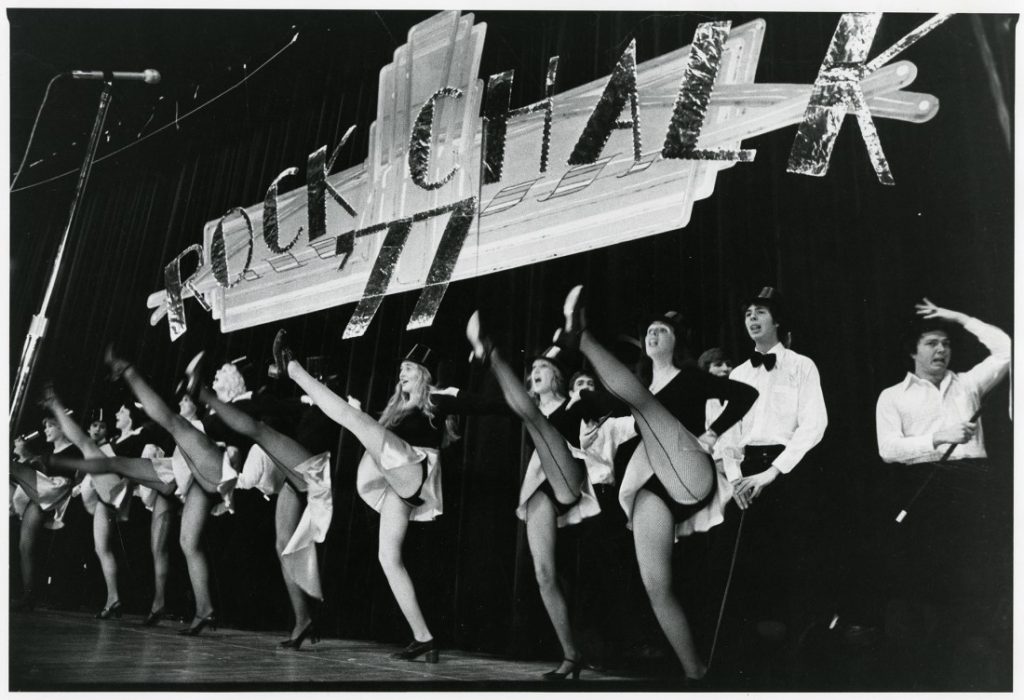
A chorus line in the Rock Chalk Revue, 1977. University Archives Photos. Call Number: RG 71/4 1977 Prints: Student Activities: Rock Chalk Revue (Photos). Click image to enlarge (redirect to Spencer’s digital collections).
Each week we’ll be posting a photograph from University Archives that shows a scene from KU’s past. We’ve also scanned more than 34,800 images from KU’s University Archives and made them available online; be sure to check them out!
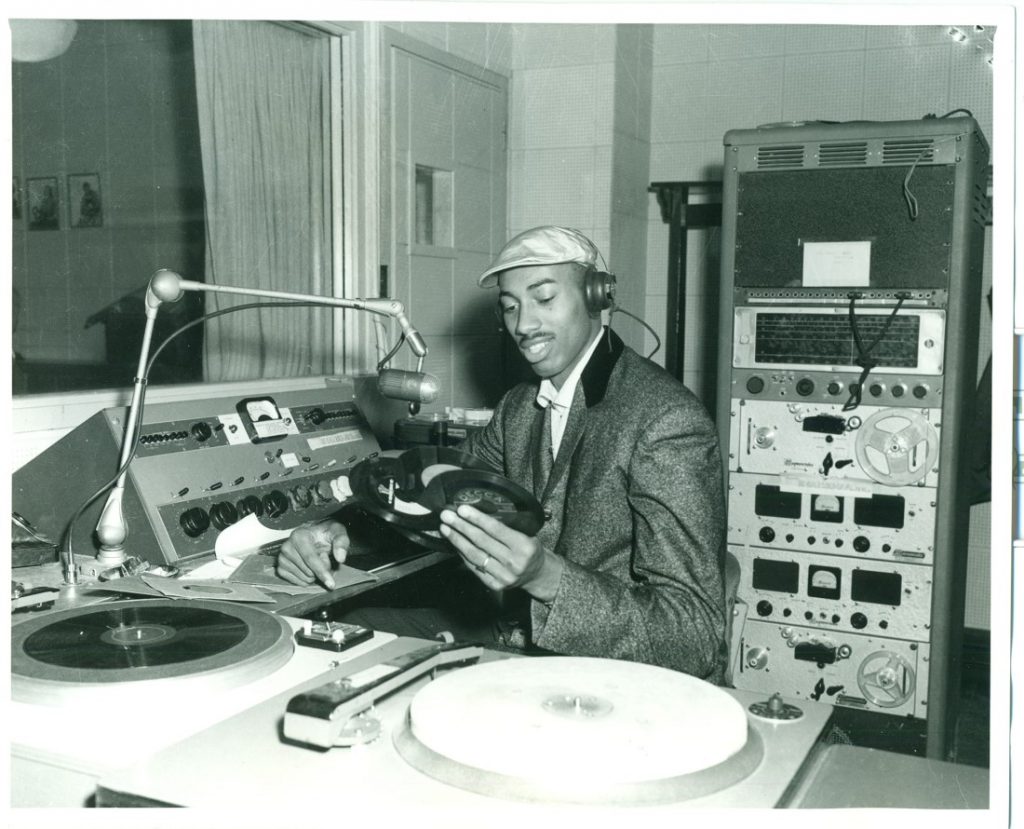
KU basketball player Wilt Chamberlain looks at vinyl records in a radio studio, 1955-1958. University Archives Photos. Call Number: RG 66/13 Chamberlain, Wilt: Athletic Department: Basketball: Players (Photos). Click image to enlarge (redirect to Spencer’s digital collections).
According to the article “Center of Attention” on the KU History website, Chamberlain “had his own thirty-minute weekly radio show on student station KUOK” during his time at the University of Kansas. “‘Flip’er with Dipper’ featured current hit records and Chamberlain’s banter, as well as occasional guest appearances by his fellow Jayhawks.”
When new collections, or additions to existing collections, are accessioned into the Spencer Research Library, I arrange and describe the material so that researchers can access them. More often than not, when I begin to look through the unprocessed boxes, I find some interesting surprises.
The Frowe and Lathrop families collection recently received a donation of many additional boxes of correspondence, photographs, diaries, slides, documents, and other material. This collection comprises several generations of the Frowe and Lathrop families from the 1840s to 2016, many of whom lived primarily in Kansas.
The collection addition was received in multiple boxes. A photograph of Eva Lathrop can be seen on top of one of the boxes. Frowe and Lathrop Families Records. Kansas Collection. RH MS 1510. Click image to enlarge.
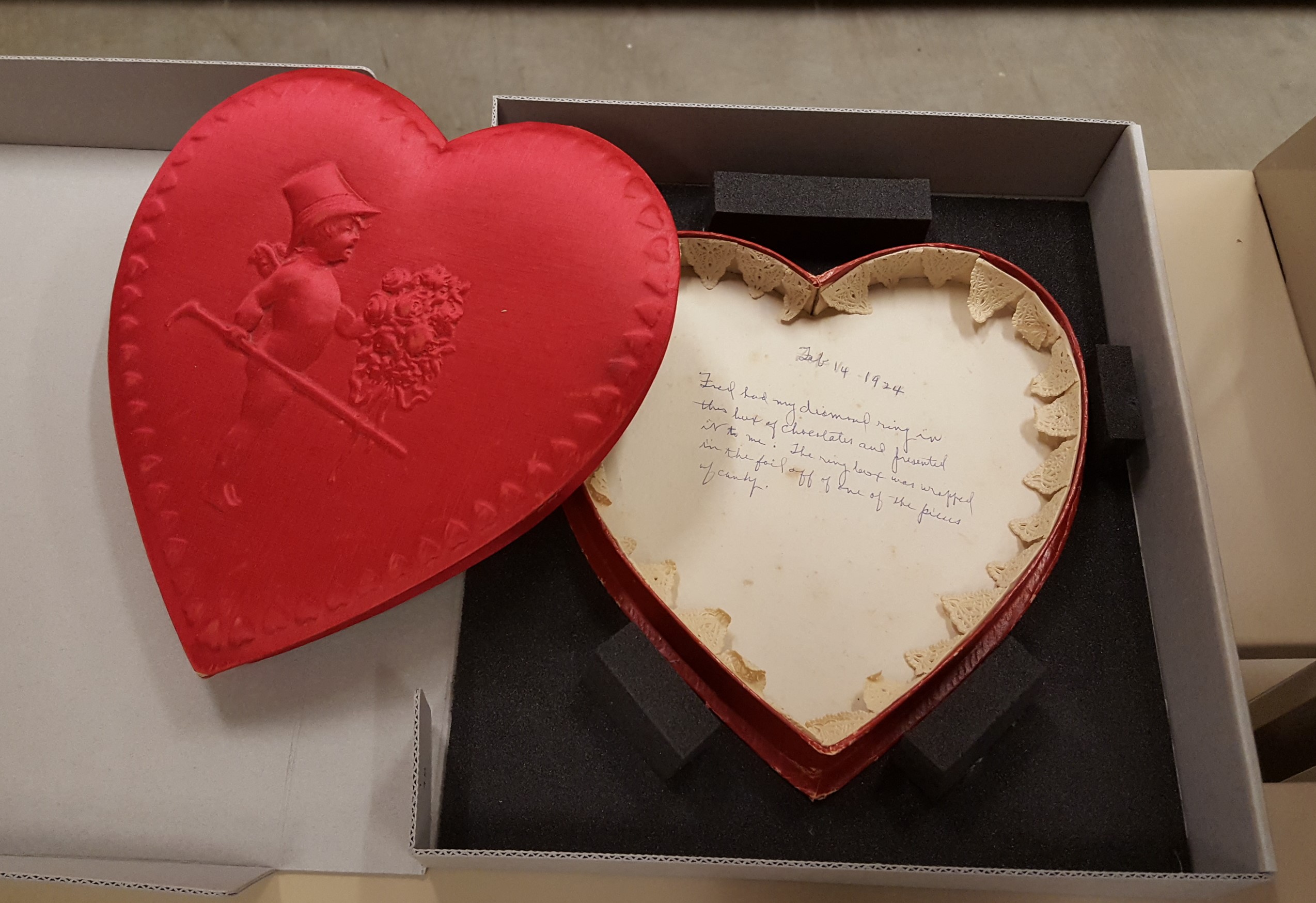
One of the interesting items that I found while going through the unprocessed boxes was a red satin Valentine box. When I opened the candy box, underneath cherished cards and invitations, I found an inscription on the bottom written by Eva Lathrop, “Feb[ruary] 14, 1924/ Fred had my diamond ring in this box of chocolates and presented it to me. The ring box was wrapped in the foil off of one of the pieces of candy.” She accepted A. G. (Fred) Phillips’ proposal, and they were married several months later. Spencer Research Library doesn’t always keep objects unless they have a good story to tell, which this candy box does. Kaitlin McGrath, a student in the conservation department working with Collections Conservator Roberta Woodrick, created a special box to house the Valentine box.
The Phillips’ valentine candy box with a ‘sweet’ story! Frowe and Lathrop Families Records. Kansas Collection. RH MS 1510, box 14. Click image to enlarge.
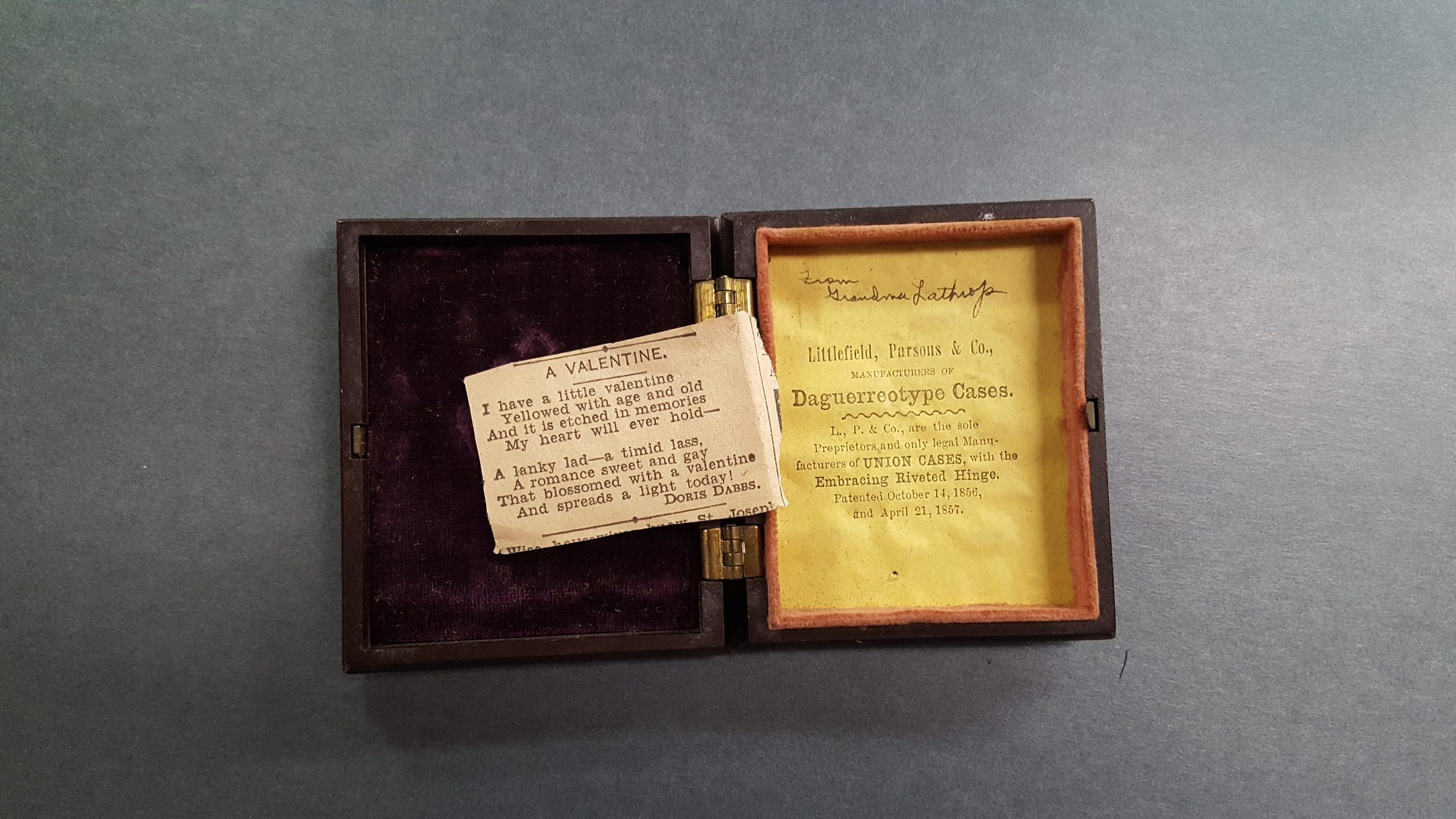
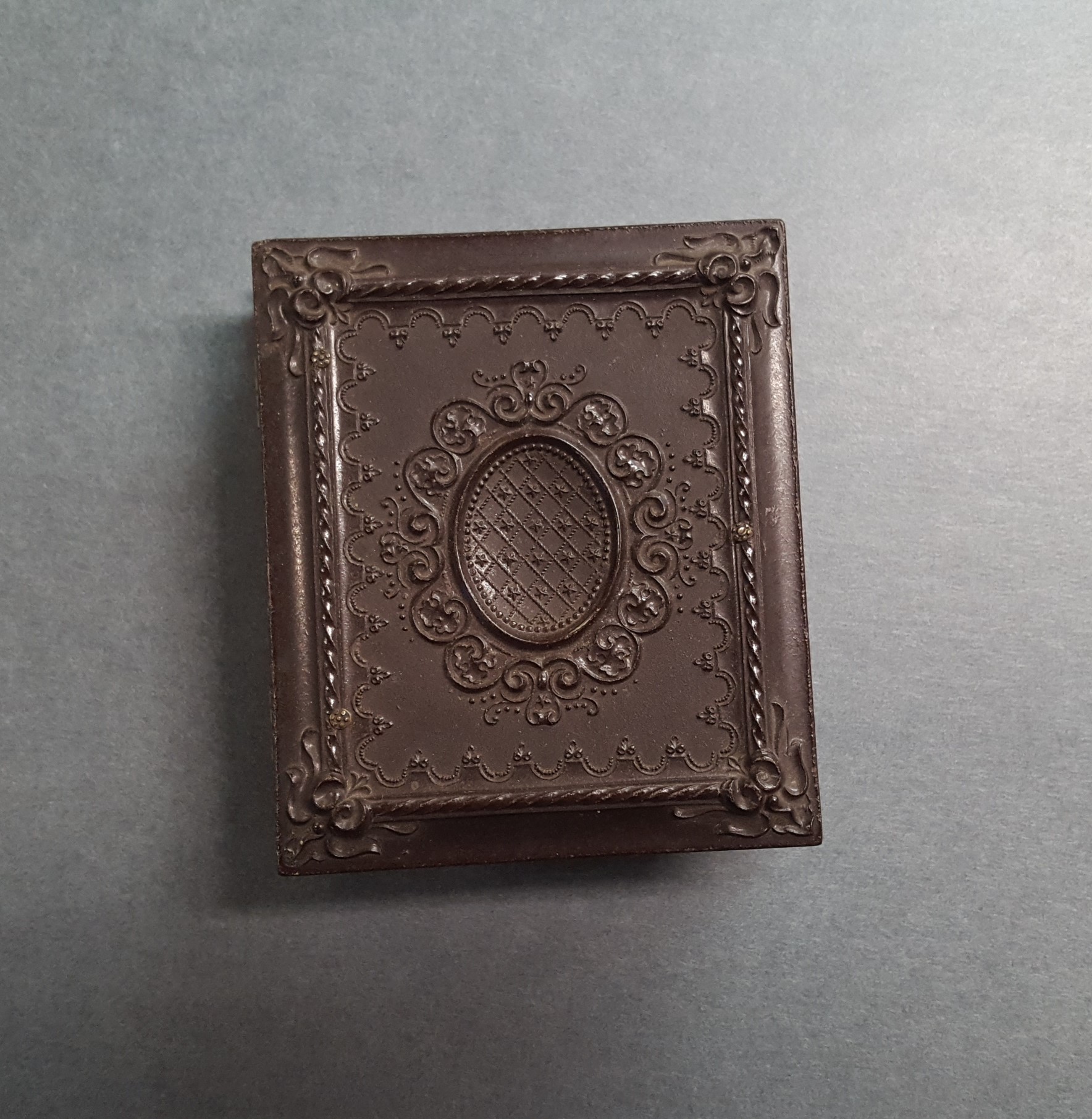
One of the most interesting sets of finds in this collection were very early family photographs inside hinged cases, dated from the 1850s-1870s. There are over 20 daguerreotypes, tintypes, and ambrotypes of identified or partially identified men, women, and children related to the Frowe and Lathrop families. Some of the small, ornately-decorated cases appear to be made out of gutta purcha or vulcanite—common plant-based materials used in this time period. Normally, print photographs are put into acid-free folders and a document case. However, these fragile, bulky photographs in their cases needed special consideration for housing and accessibility.
The interior of a photograph case containing a Valentine poem clipped from a newspaper. Frowe and Lathrop Families Records. Kansas Collection. RH MS-P 1510(f), box 1. Click image to enlarge.
Exterior of a photograph case containing a Valentine poem. The case is possibly made out of gutta purcha or vulcanite. Frowe and Lathrop Families Records. Kansas Collection. RH MS-P 1510(f), box 1. Click image to enlarge.
Angela Andres,
Special Collections Conservator:
Most of the cased photographs that Spencer already holds are
individual items within their collections, so they are housed individually in
custom enclosures. The size of this group makes that approach impractical; it
would be time-consuming to make so many special enclosures from scratch, and
they would take up a lot of shelf space, which is always a consideration when
housing our collections. Housing this group of photographs together also made
sense from an access perspective; a single container is easier for staff to
retrieve and for researchers to view than twenty-some separate containers.
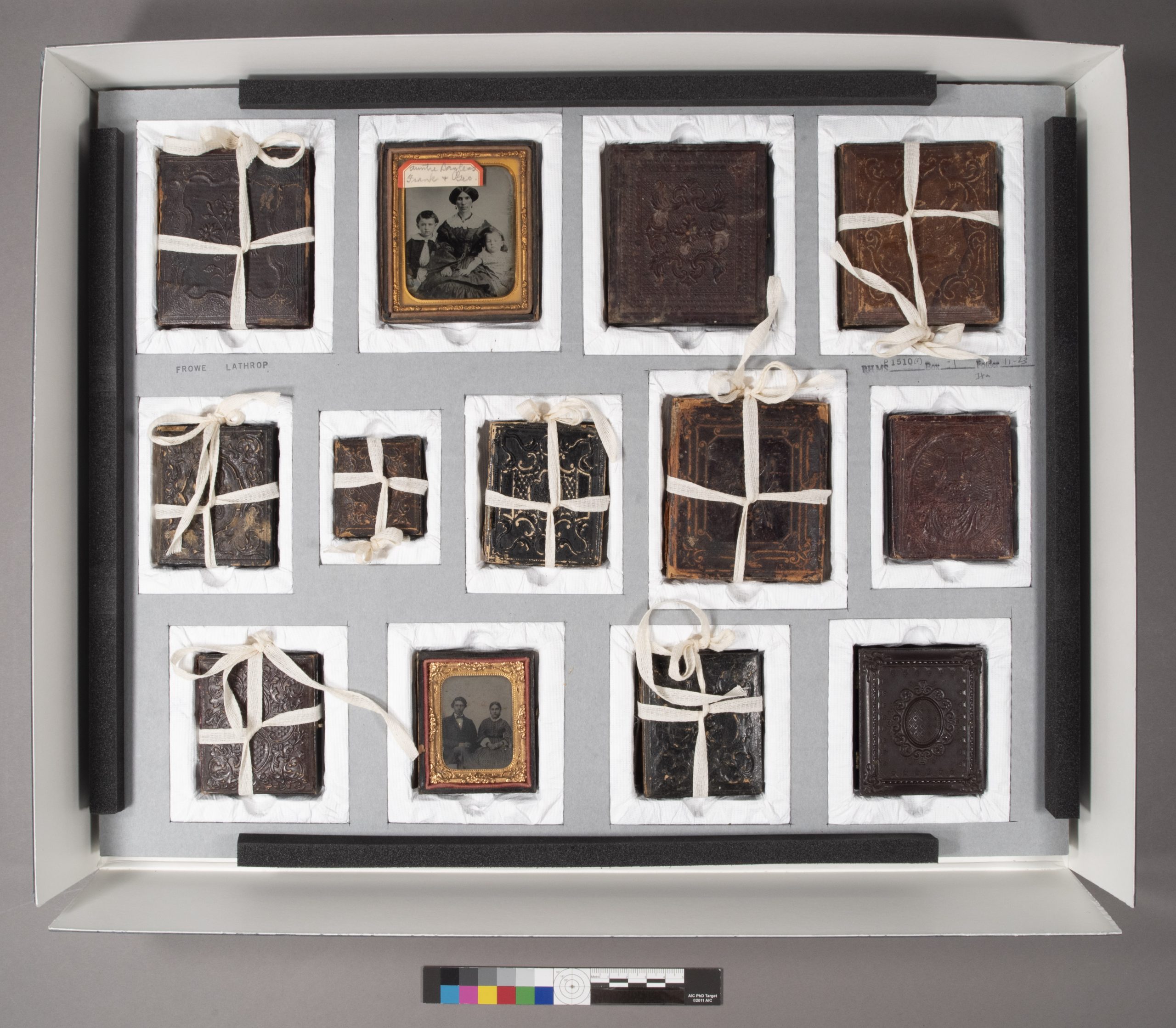
I estimated that I could fit all of the photographs into one standard size flat archival box, provided I could safely arrange them in two layers. Lynn sorted the photographs by family groups into two sets, and then set about devising a lightweight but protective structure for the interior of the box. I created two trays from layers of archival corrugated cardboard, with cavities cut to fit each of the cased photographs. Each cavity is lined with soft Tyvek® fabric to prevent abrasion of the cases, and cases with loose covers are tied with cotton tape to prevent shifting. I attached strips of archival foam around the edges of the lower tray to support the upper tray, and added handles of linen tape to the upper tray for easy removal.
The upper tray of the photograph housing, with handles for lifting the tray out. Frowe and Lathrop Families Records. Kansas Collection. RH MS-P 1510(f), box 1. Click image to enlarge.
The lower tray of the photograph housing, with foam bumpers to support the upper tray. Frowe and Lathrop Families Records. Kansas Collection. RH MS-P 1510(f), box 1. Click image to enlarge.
Lynn Ward, Processing
Archivist:
After the cases returned from conservation in their special box, I needed to come up with a way to describe the cased photographs. Normally for a print photograph, the description would be connected to the folder in which the photograph is housed. Since these cased photographs were arranged in layers in their special box, I decided to describe them by layer and by rows within each layer. Each photograph in its case was described with its location in the box, as well as the identification, or partial identification of the individual(s) when known.
Each week we’ll be posting a photograph from University Archives that shows a scene from KU’s past. We’ve also scanned more than 34,800 images from KU’s University Archives and made them available online; be sure to check them out!
Each week we’ll be posting a photograph from University Archives that shows a scene from KU’s past. We’ve also scanned more than 34,800 images from KU’s University Archives and made them available online; be sure to check them out!
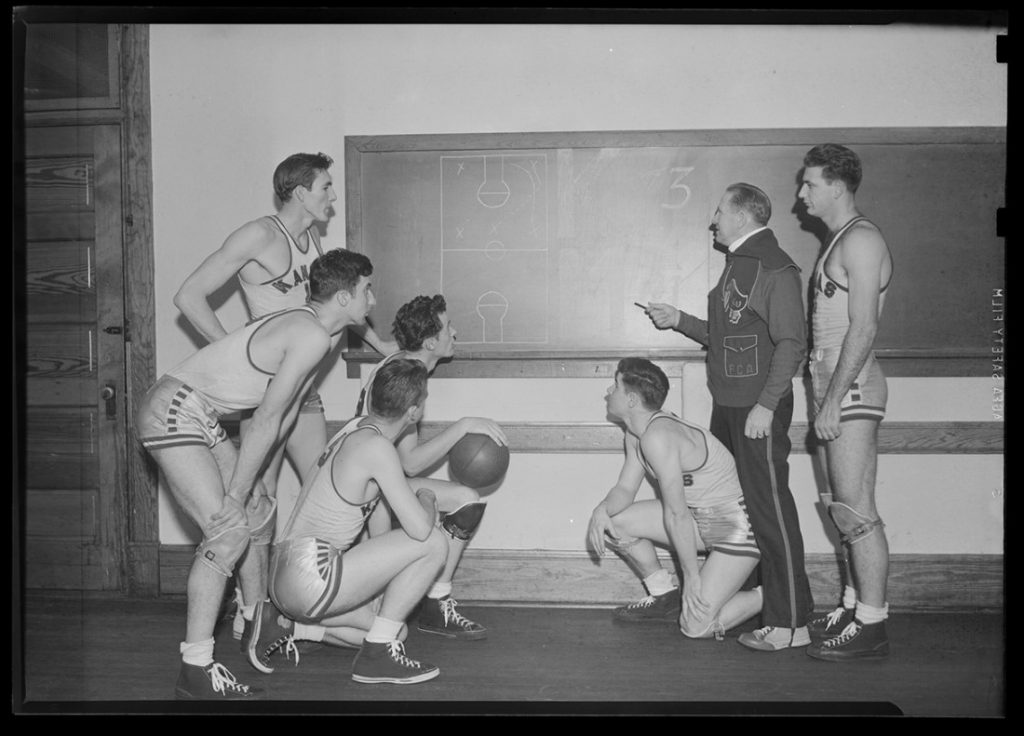
Phog Allen draws up a play on the blackboard while members of the basketball team look on, 1930s. University Archives Photos. Call Number: RG 66/22 Forrest C. Allen 1930s Negatives: Athletic Department: Coaches and Staff (Photos). Click image to enlarge (redirect to Spencer’s digital collections).