The University of Kansas

Inside Spencer: The KSRL Blog

Books on a shelf

Welcome to the Kenneth Spencer Research Library blog! As the special collections and archives library at the University of Kansas, Spencer is home to remarkable and diverse collections of rare and unique items. Explore the blog to learn about the work we do and the materials we collect.

Entre los Estantes: Latina/o Collection Items

April 6th, 2026

As I work to develop the Spencer’s new Latina/o Collections*, I wanted to take a moment and look back at the interesting materials that are already sitting within our library stacks and viewable in our Reading Room today! All the materials presented allow us to briefly see how Latina/os have gathered and built community within different places across Kansas.

Take a look at some of those materials below.

Aztlán de Leavenworth, volume 1

First published May 5, 1970, Aztlán de Leavenworth was a bilingual Chicano prisoner newspaper edited and published at Leavenworth Federal Penitentiary in Kansas. It features poet and activist raúlrsalinas’ famous poem “A Trip Through the Mind Jail.” Other members of the publication team included Albert Mares, Ruben Estrella, Alfredo Arellanes, Ricardo Mena, and Beto Palomino. Inspired by Aztec history and iconography, the newspaper is named after Aztlán, the ancestral home of the Aztecs, and features images of Tizoc and designs inspired by Aztec art.
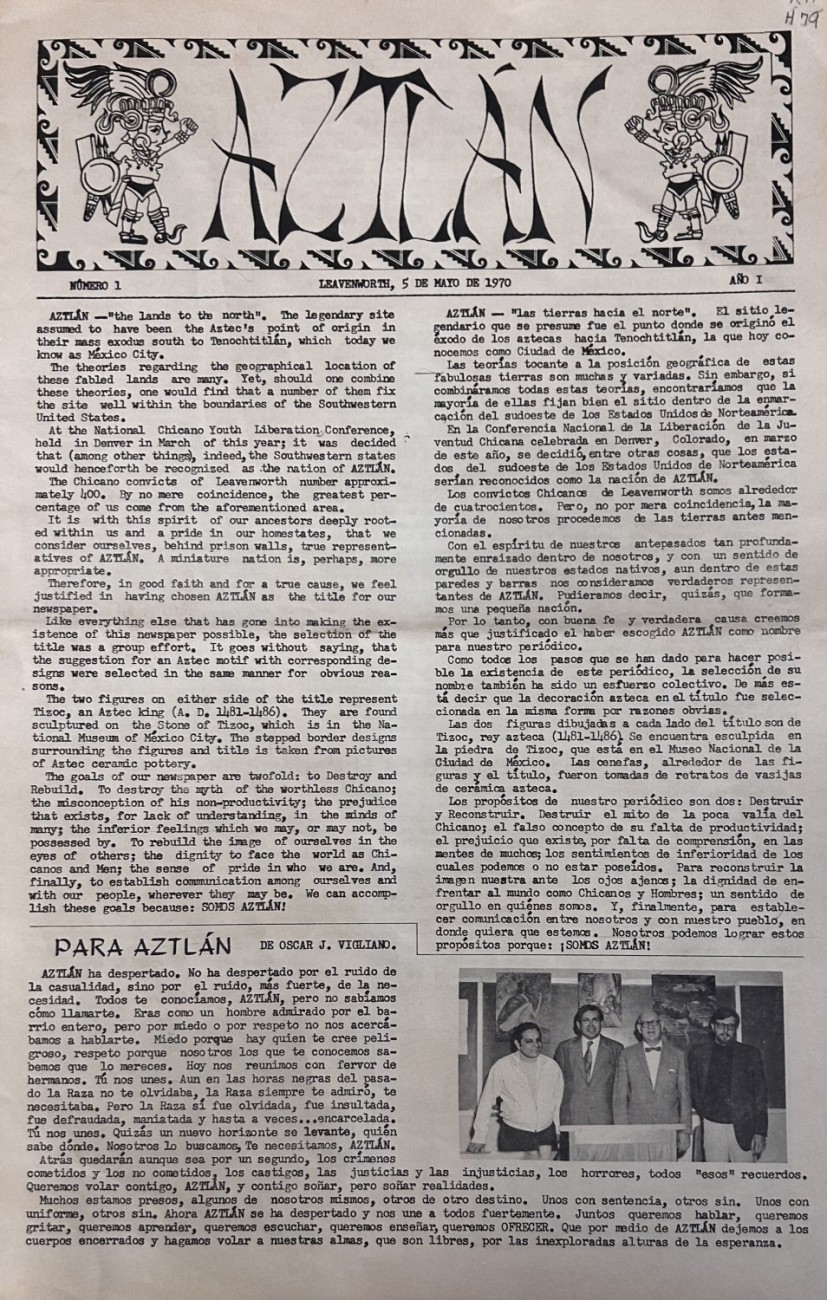
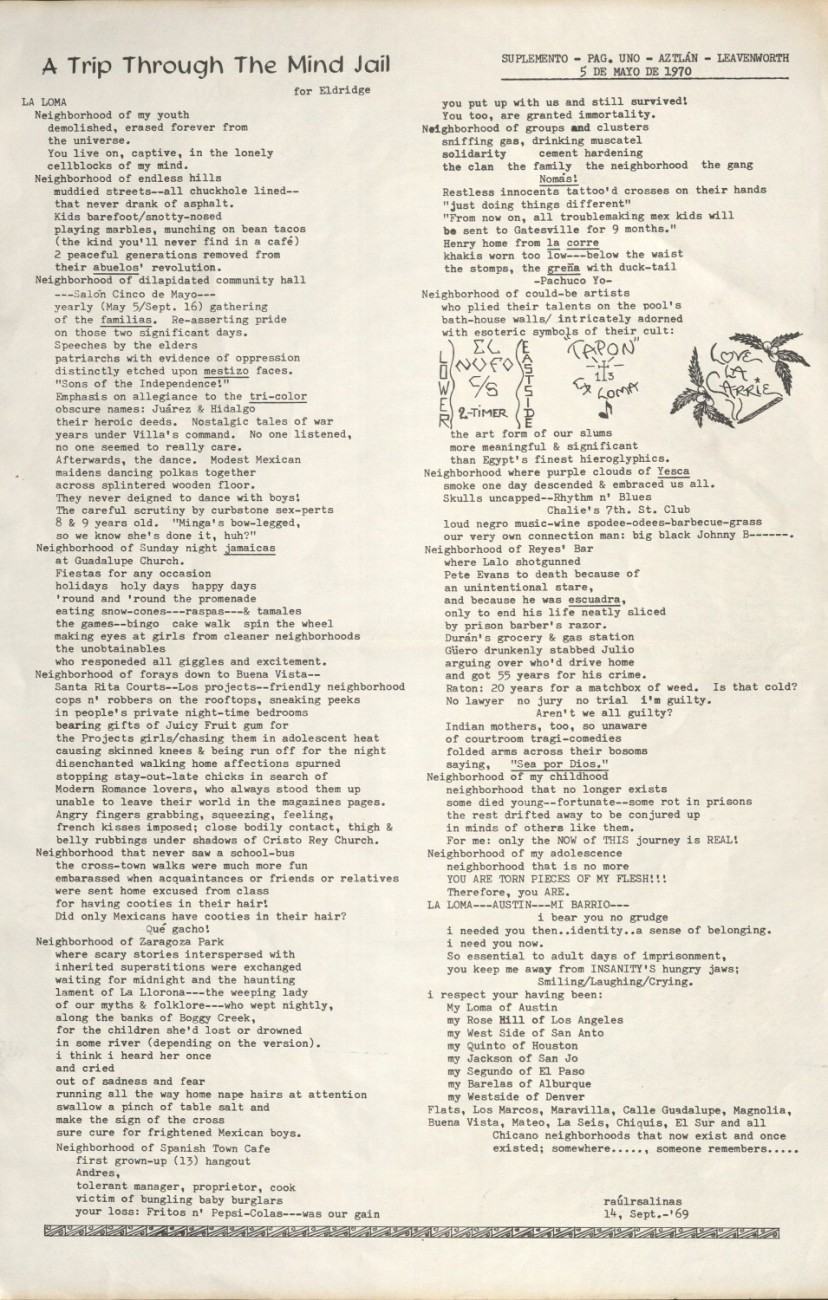
Left: The front cover of Aztlán de Leavenworth, 1970. Right: The page of Aztlán de Leavenworth featuring “A Trip Through the Mind Jail,” 1970. Call Number: RH H79, volume 1. Click images to enlarge.

KACMAA Special Report, 1981

This 1981 special report was created by Kansas’ Advisory Committee in Mexican American Affairs (KACMAA). As explained in the report’s introduction, it “optimistically highlights important accomplishments and measurable in Hispanic’s social, economic, and political life” but also “clarifies the work that remains to be done.” While the KACMAA originally concentrated on projects to promote people of Mexican heritage, the organization evolved to include all Hispanics and Latinos across the state and is now known as the Kansas Hispanic and Latino American Affairs Commission.
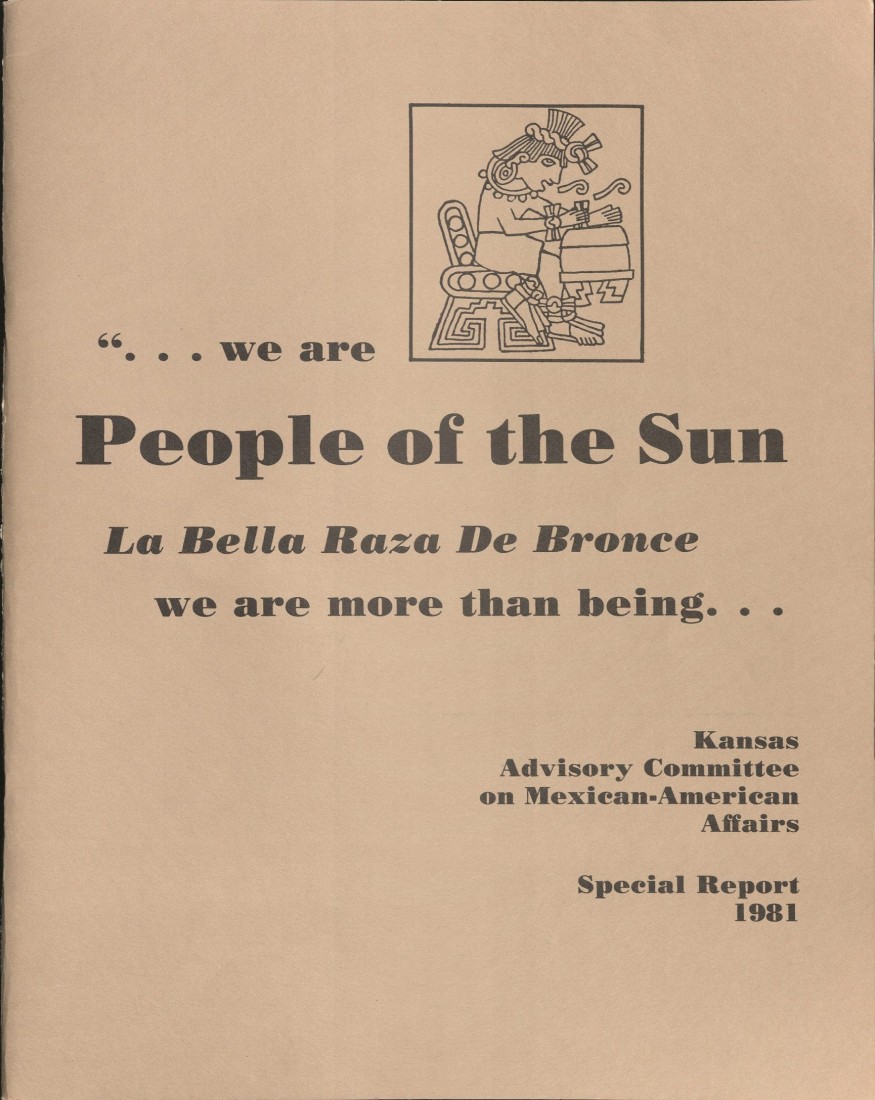
Line drawing of an Aztec symbol with the text "...we are People of the Sun / La Bella Raza De Bronce / we are more than being..."
The front cover of the KCMAA’s 1981 Special Report. Call Number: RH D6100. Click image to enlarge.
Music groups in Emporia

Taken some time in 1932, these photographic prints from the Oral History Project Regarding the Hispanic Community of Emporia, Kansas (Call Number: RH PH 182) allow us to see some of Emporia’s early musical groups. The first photo shows members of the Mexican band Orquesta de Leora posing with their instruments, while the second features the women who made up the Coro de Santa Catalina, or St. Catherine’s Choir. St. Catherine’s Catholic Church still exists to this day and continues to offer Catholic services to Spanish speakers in Emporia.
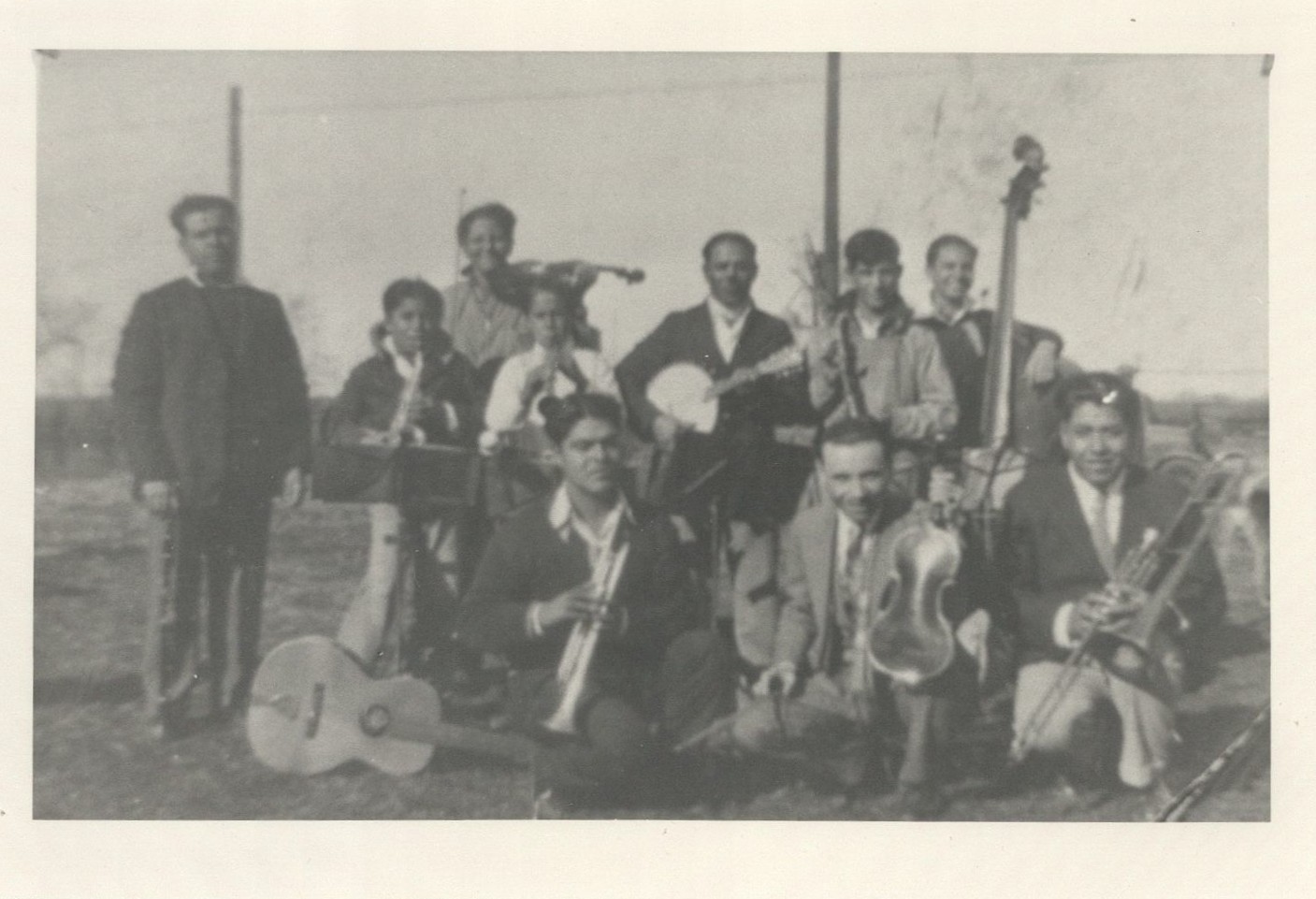
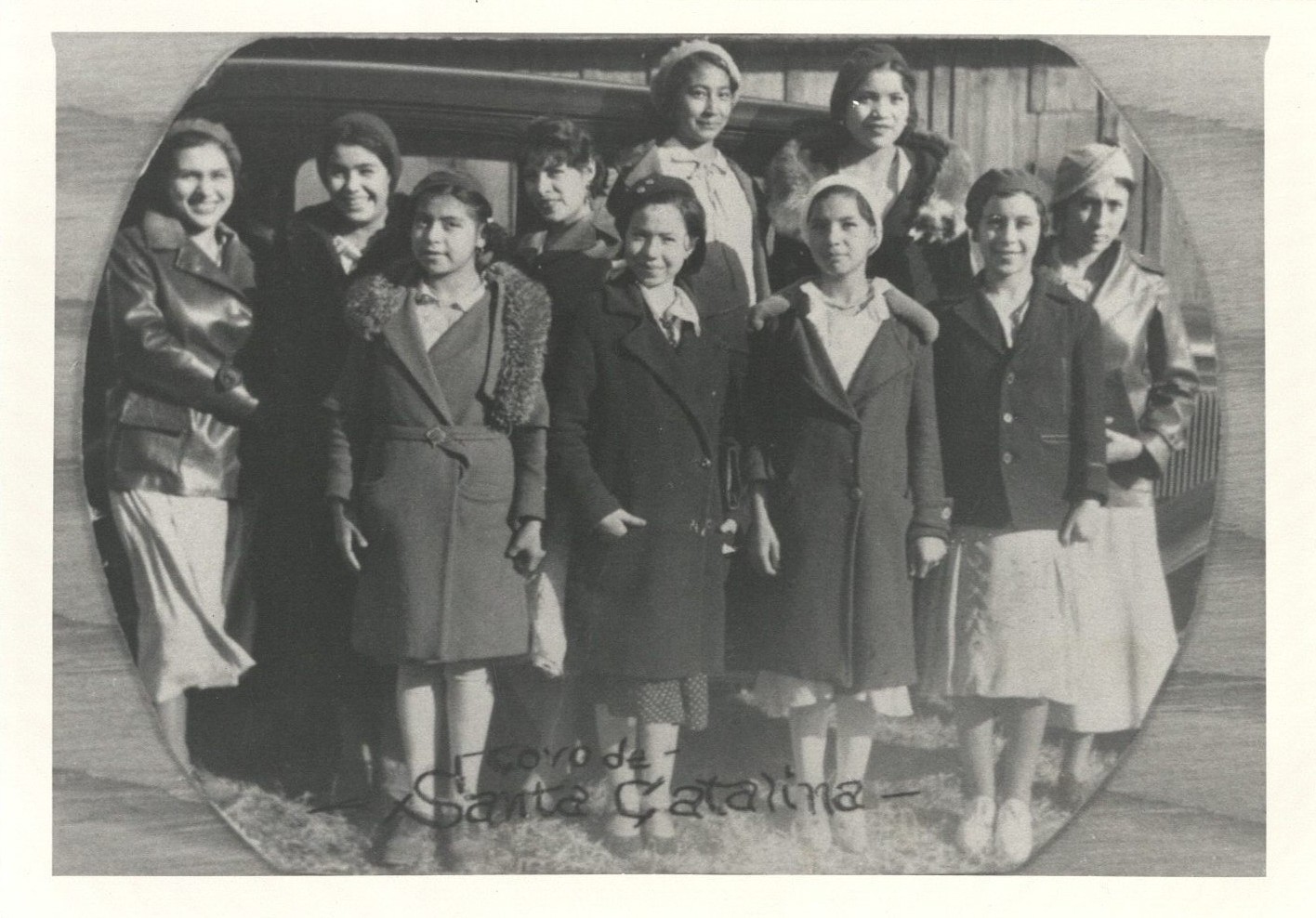
Left: Photograph of Orquesta de Leora, 1932. Right: Photograph of St. Catherine’s Choir, 1932. Oral History Project Regarding the Hispanic Community of Emporia, Kansas. Call Number: RH PH 182, Box 1, Folders 11 and 19. Click images to enlarge.

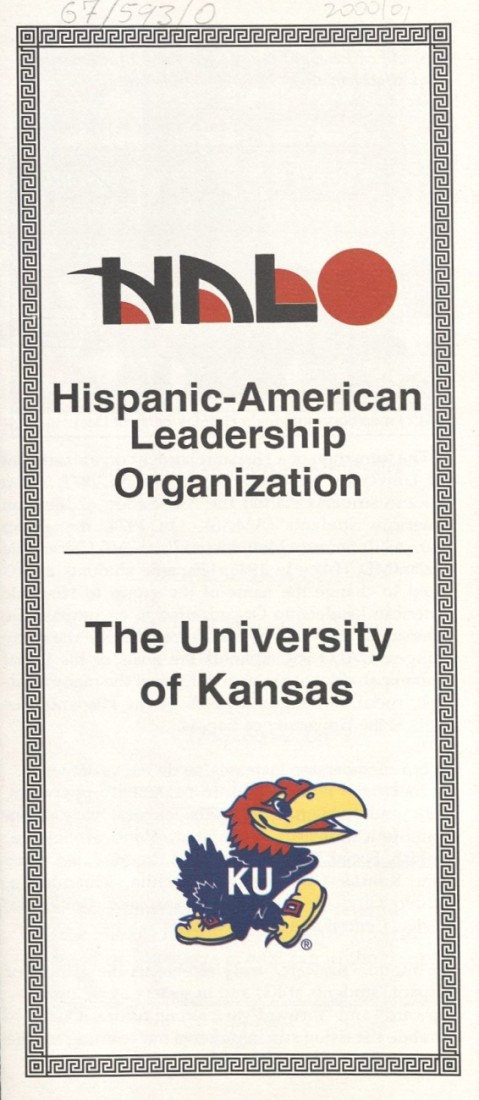
MEChA & HALO Pamphlets

Records of a Latina/o focused group at the University of Kansas have existed since the 1970s. However, before it was LASU (Latin American Student Union), KU’s Latino student group went by many names. It first went by the name AMAS (Association of Mexican American Students), and then it was MEChA (Movimiento Estudiantil Chicano de Aztlán). The group took the name HALO (Hispanic American Leadership Organization) when it was re-established in the 1980s, and it finally became LASU to further expand its inclusion of all students of Latin American heritage or background.  
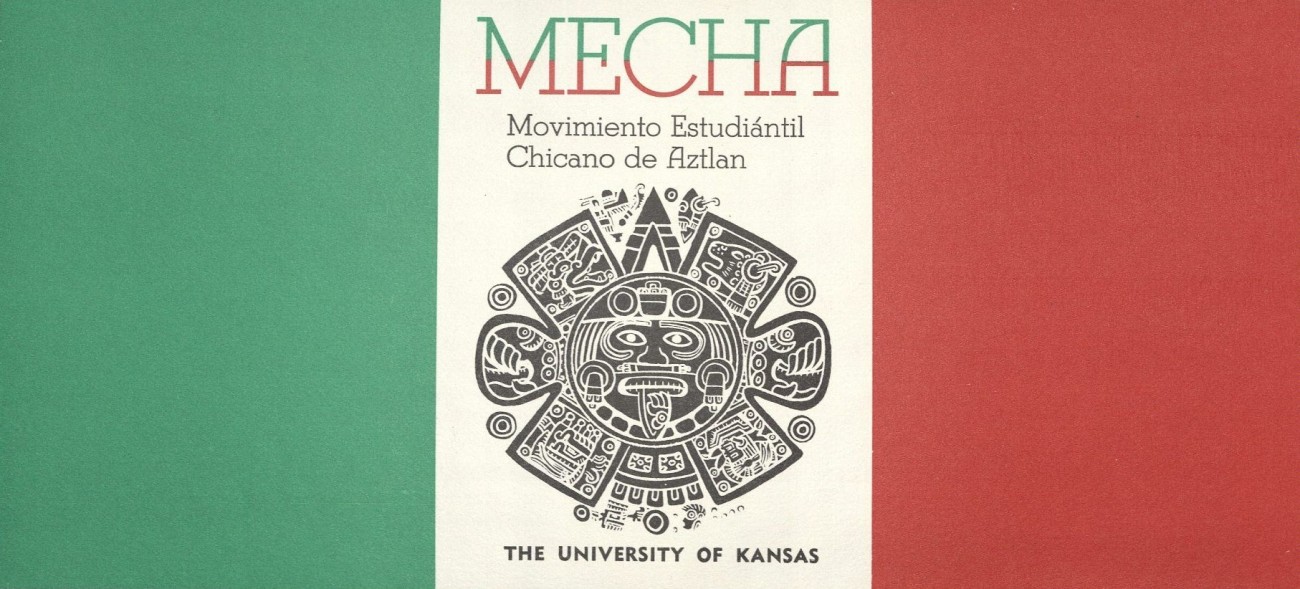
The name of the organization with a black-and-white sketch of an Aztec symbol, all against the Mexican tri-color flag as a background.
|
The name of the organization with a Jayhawk, all against a white background.
Top: MEChA pamphlet, circa 1970. Bottom: HALO pamphlet, circa 1997. KU Student Organization Records: Hispanic American Leadership Organization. Call Number: RG 67/593, Box 1, Folders 1970s and 1997. Click images to enlarge.

Rebekah Ramos
Curator of Latina/o Collections

Sources

“A Trip Through the Mind Jail: A Textual History of raúlrsalinas’ Magnum Opus” by Santiago Vidales Martínez in Textual Cultures 14.1 (2021): 208–229. DOI: https://doi.org/10.14434/tc.v14i1.32858

Kansas Hispanic & Latino American Affairs Commission website, “Our Mission and Our Origins from KACMAA to KHLAAC.”

KU Latin American Student Union website, “LASU History.”

*While many terms exist to identify people in the United States of Latin American origin and/or ancestry (i.e. Hispanic, Chicano, Latino, Latina/o, Latinx, Latine) at Spencer Research Library we chose to use “Latina/o” for the collection’s title. As the collection grows and evolves, the term used might change.
Meet the KSRL Staff: Rebekah Ramos

February 4th, 2026

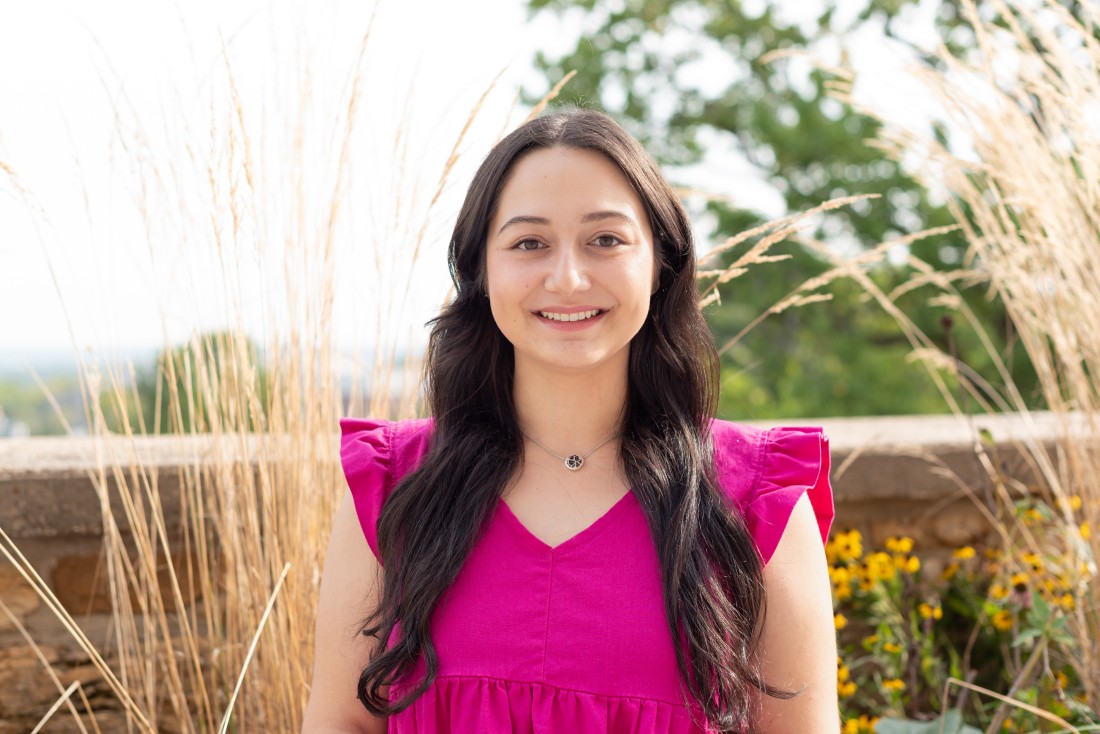
This is the latest installment in a recurring series of posts introducing readers to the staff of Kenneth Spencer Research Library. Today’s profile features Rebekah Ramos, who joined Spencer Research Library in August 2025 as the Curator of Latina/o Collections.

Headshot photograph of a woman in a bright pink top.
Rebekah Ramos, Curator of Latina/o Collections. Click image to enlarge.
Where are you from?

I was born and raised in Puerto Vallarta, Jalisco, Mexico but I moved to Texas when I was sixteen. I jumped around the state quite a bit for school, living in cities like Frisco, Lubbock, Sherman, and most recently Austin.

What does your job at Spencer entail?

As curator of Latina/o Collections I’m in charge of collecting materials that document and preserve the history of Latina/o individuals, families, and organizations in Kansas. Latinos have been part of this state’s history for more than a hundred years, and I’m working to build a collection that reflects the many experiences and stories that exist within this community.

How did you come to work in libraries/archives/special collections?

During undergrad, in the midst of a new semester and trying to stay sane during Zoom classes, I applied for and was hired as a student assistant at the Vietnam Center and Sam Johnson Vietnam Archive’s Oral History Project. During my time there, I reviewed and cleaned up transcriptions of oral history interviews that were conducted with Vietnam War veterans. Then, while I was completing my degree in Information Studies at the University of Texas at Austin, I worked as a graduate student technician at the LLILAS Benson’s Digital Scholarship Lab, where I had the opportunity to work with Latin American and U.S. Latina/o archival materials.  

What part of your job do you like best?

I love getting to meet new people! As someone who is not originally from here, it’s been interesting getting to learn about the variety of nationalities, backgrounds, and stories that make up the Latino community in Kansas.

What do you have on your desk?

I have a bunch of sticky notes with reminders of things I need to look up or do, and a huge pile of books I’m trying to read, like What Kansas Means to Me, Who Owns Native Culture?, and Catching Stories: A Practical Guide to Oral History. There are also a couple of trinkets to remind me of home, like a Mexican rag doll I keep under my monitor.

What is one of the most interesting items you’ve come across in Spencer’s collections?

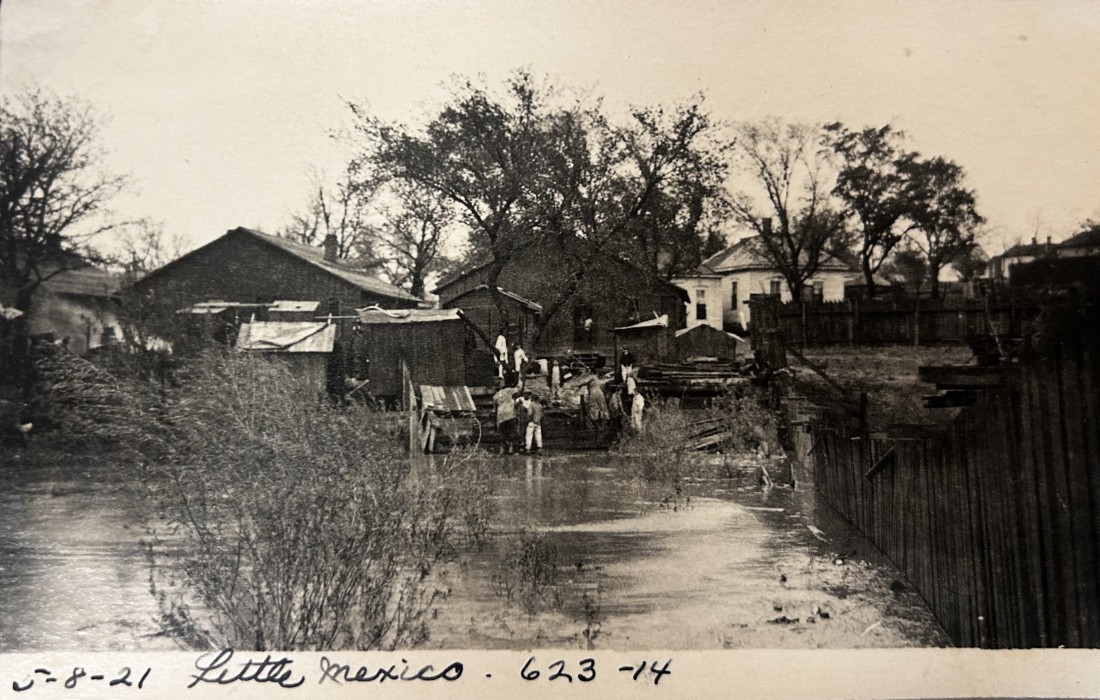
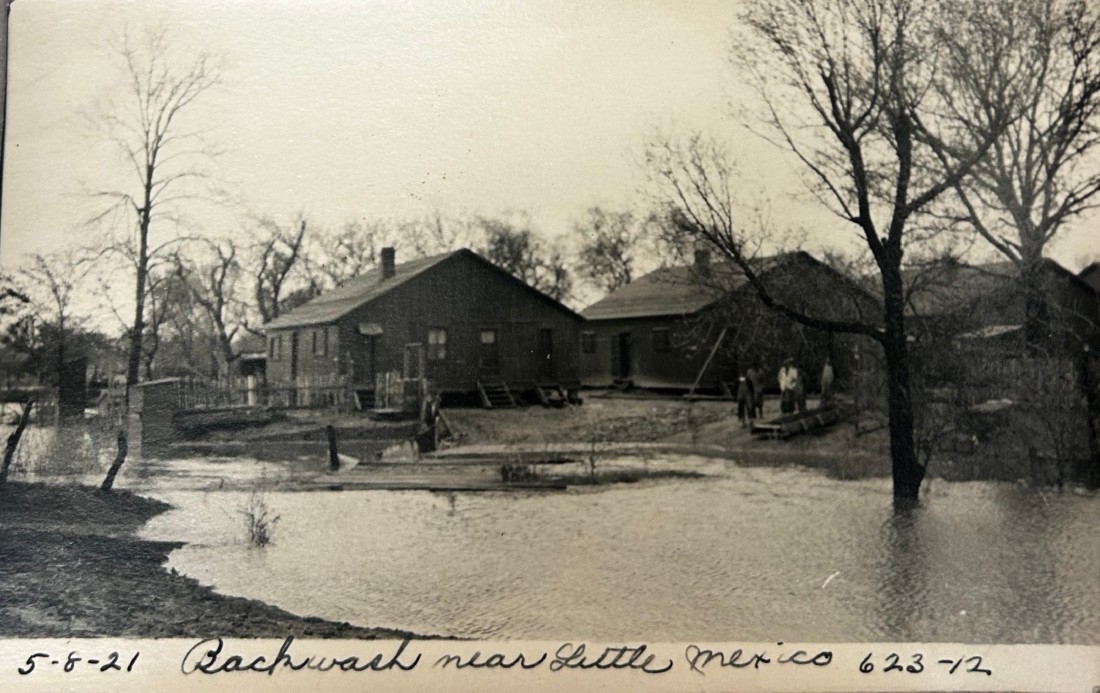
Some of the most interesting items I’ve come across were two photographs I found in the Bourquin Family Collection. Photographs in this collection were taken by a Swiss family that moved to Horton, Kansas, in the late 1800s. The collection’s finding aid showed that there are a couple of photographs that include the name “Little Mexico” in their title.

I was really surprised to find these photographs, since I hadn’t seen any record or evidence of Mexican immigrants in Horton in any of our other collections or online sources. Digitized newspaper clippings confirmed that during the 1920s there was an area of the town that housed many of the Mexican immigrants that had come to work at the local railroad center.

“High water at railroad dam and Little Mexico, May 8, 1921.” Bourquin Family Collection. Call Number: RH PH 30, Box 14, Folder 623. Click images to enlarge.

What are some of your favorite pastimes outside of work?

I am an avid reader and proud bookworm! But I also love going to the movie theater, getting food or coffee with friends, baking, and watching TV.

Rebekah Ramos
Curator of Latina/o Collections

Happy Holidays from Spencer Research Library!

December 19th, 2025
Sepia-toned photograph of five people standing around a car, one trying to tie a Christmas tree to the roof.
Lawrencians securing a Christmas tree to the top of their car, November 25, 1984. Lawrence Journal-World Photograph Collection. Call number: RH PH LJW. Click image to enlarge (redirect to Spencer’s digital collections).

Spencer Research Library will be closed from December 22nd through January 2nd and will reopen on January 5th. We look forward to seeing you in 2026 and sharing more stories about our collections, staff, and services.

Visit the KU Libraries website for more information on winter recess across the libraries.

Caitlin Klepper
Head of Public Services

KSRL is Now TLDR: Topper’s Library for Dog Research!

April 1st, 2025
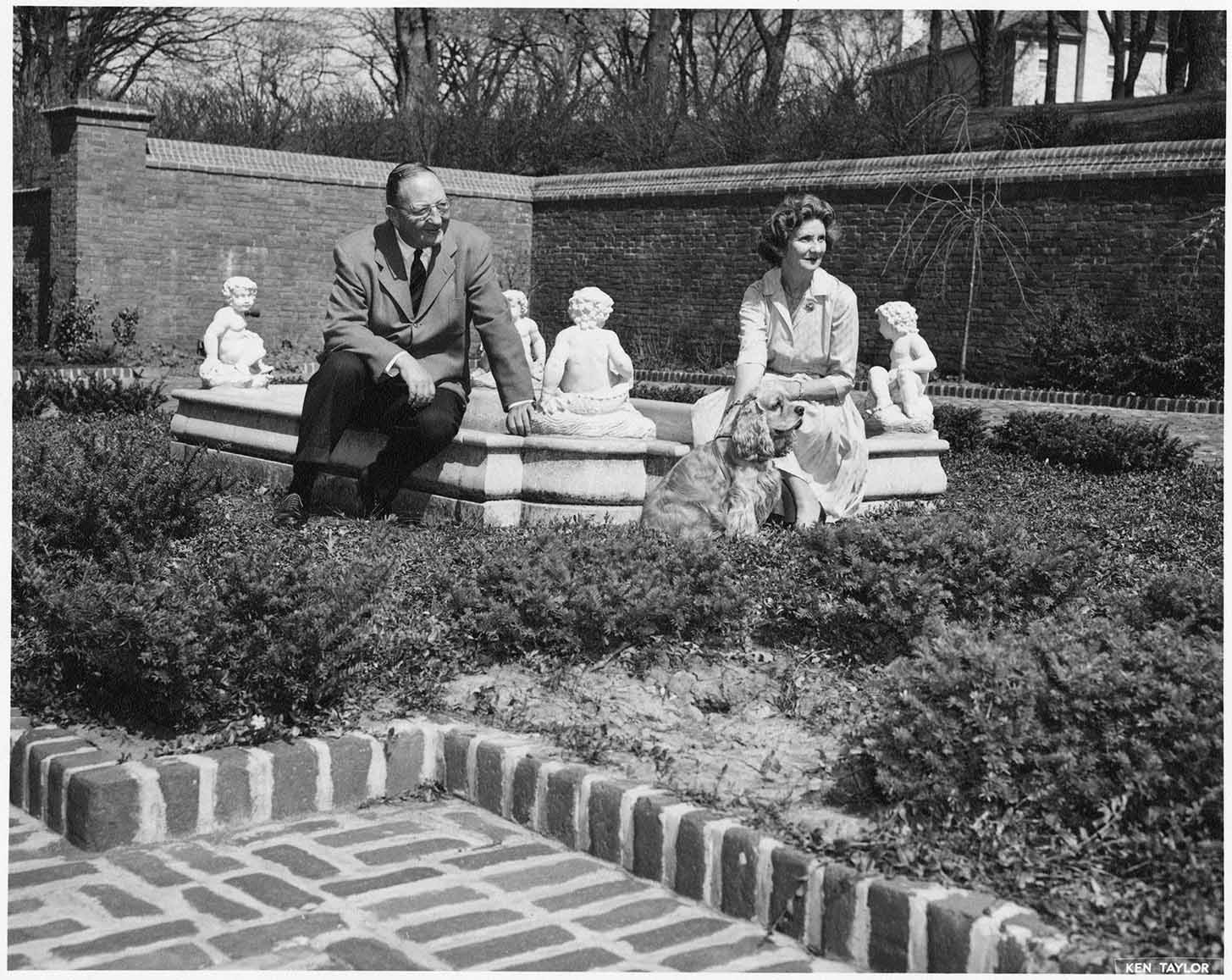
Black-and-white photo of people sitting on the edge of a fountain, accompanied by their dog.
Kenneth and Helen Spencer with their dog Topper in the garden of their home in Mission Hills, Kansas, spring 1959. Helen Foresman Spencer Papers. Call Number: RH MS-P 542. Click image to enlarge.

After much deliberation, Kenneth Spencer Research Library (KSRL) will be changing its name to Topper’s Library for Dog Research (TLDR) in honor of the Kenneth and Helen Spencer’s dog Topper, pictured above. Here at KSRL, staff seek to tell the stories of the hidden figures of history, not just people of great renown. Behind every Alice Walker (RH PH P2851) or Langston Hughes (RH MS 127), there are communities who helped support these figures of history. And of course, what greater support could there be than the support of man’s best friend!

The TLDR, formerly known as the KSRL, already has many historical items featuring these good boys and girls of history, and we seek to collect and preserve even more. We’ve included some of our favorite photographs of TLDR’s canine companions below.

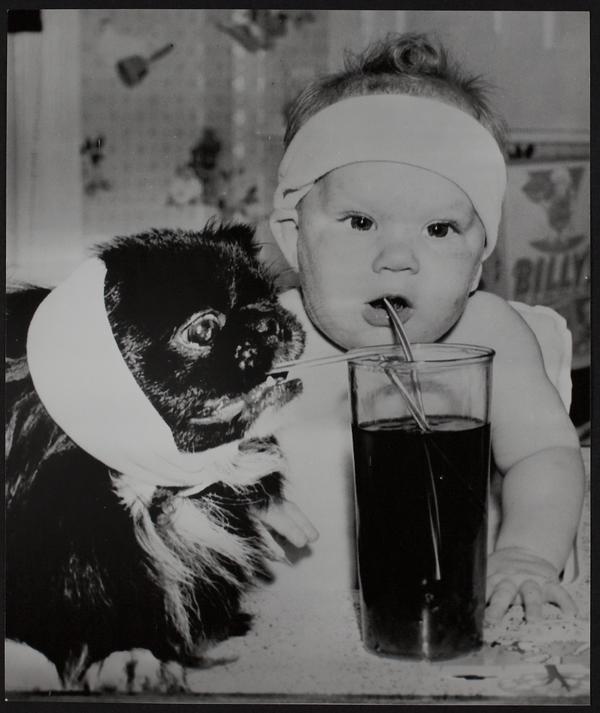
Black-and-white photograph of a baby and a small dog drinking from a glass with straws.
“One way to beat the heat. Little Georgeann Levon of Pottstown PA and her dog, Mike, wrap in wet towels and drink,” June 1957. Lawrence Journal-World Photograph Collection. Call number: RH PH LJW. Click image to enlarge (redirect to Spencer’s digital collections).
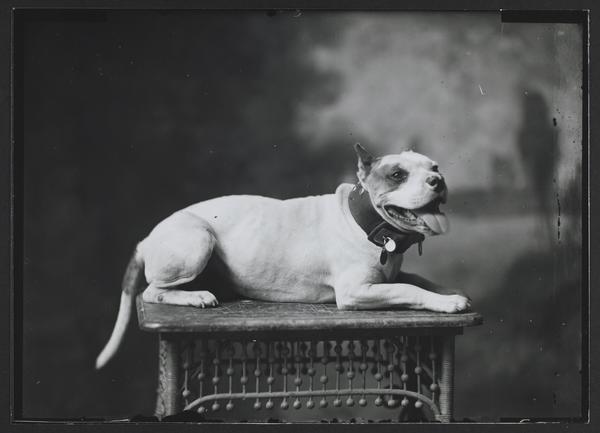
Black-and-white photograph of white dog wearing a collar and sitting on a table.
Fred Durand’s dog, 1901. Joseph Judd Pennell Photograph Collection. Call Number: RH PH Pennell. Click image to enlarge (redirect to Spencer’s digital collections).
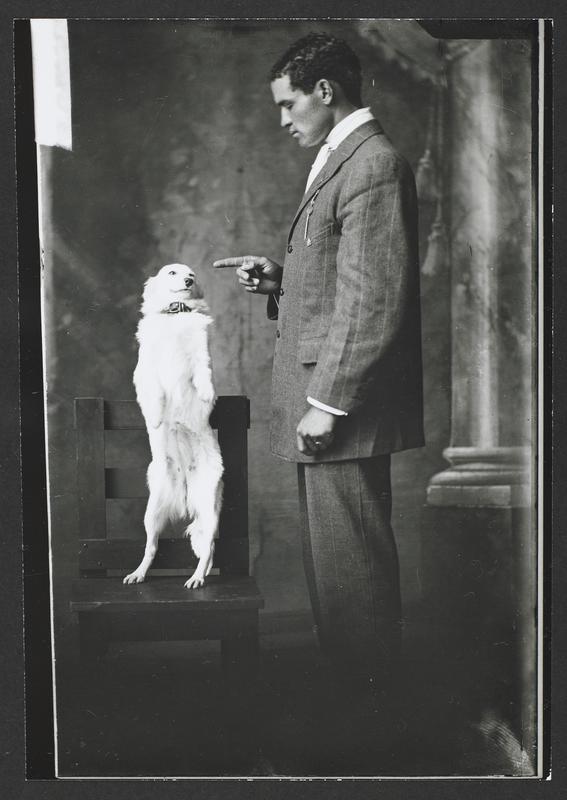
Black-and-white photograph of a man standing and pointing at a white dog on a chair who is standing on its two back legs.
Portrait of H. G. Davis and his dog, 1911. Joseph Judd Pennell Photograph Collection. Call Number: RH PH Pennell. Click image to enlarge (redirect to Spencer’s digital collections).
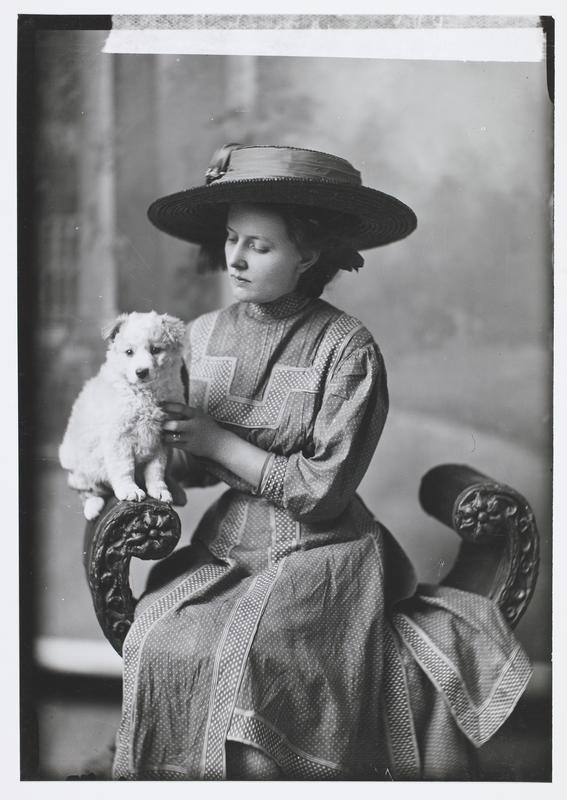
Black-and-white photograph of a woman in a long dress and wide-brimmed hat, sitting on a stool and holding a small white dog.
Portrait of Mrs. Dot Kline and her dog, 1909. Joseph Judd Pennell Photograph Collection. Call Number: RH PH Pennell. Click image to enlarge (redirect to Spencer’s digital collections).

We here at TLDR encourage you to also take part in this important record-keeping process. Take and share a photo of a dog today. Be sure to include names and dates! Here’s hoping some doggy smiles brighten your April Fools’ Day.

Charissa Pincock
Archives and Manuscripts Coordinator

“Snap Shots of My University Life”: The Student Scrapbook of Nola Ayers 

March 7th, 2025
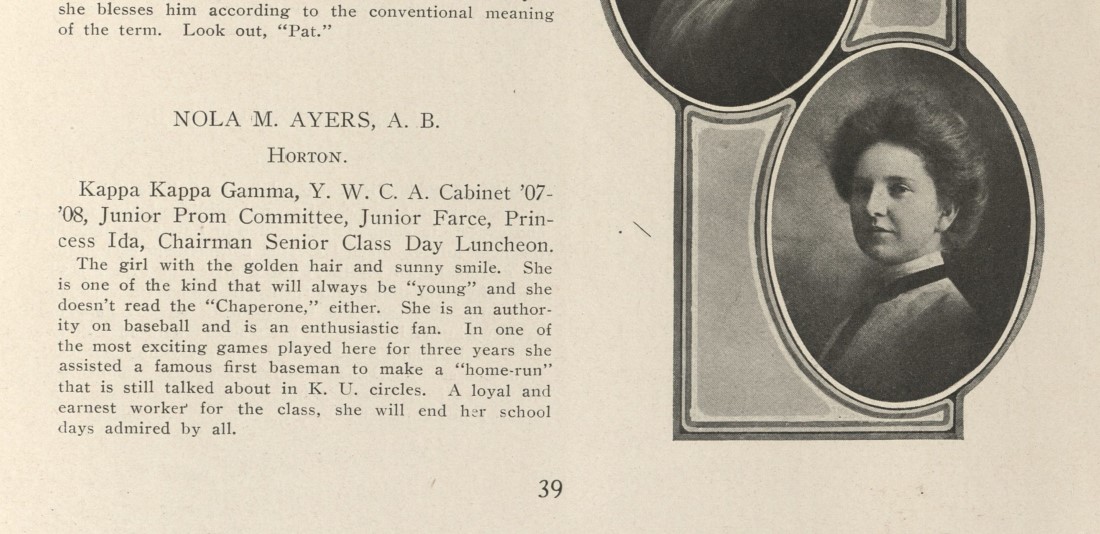
This image has text.
Nola Ayers’s senior picture and a description of her KU life in the 1909 Jayhawker yearbook. University Archives. Call Number: LD 2697 .J3. Click image to enlarge.

Nola Mary Ayers was born in Horton, Kansas, in 1886. She arrived in Lawrence in the fall of 1905 to enter the University of Kansas and graduated from KU with a bachelor’s degree in 1909. Nola documented her college years by creating a scrapbook, as did many other university students at the time. 

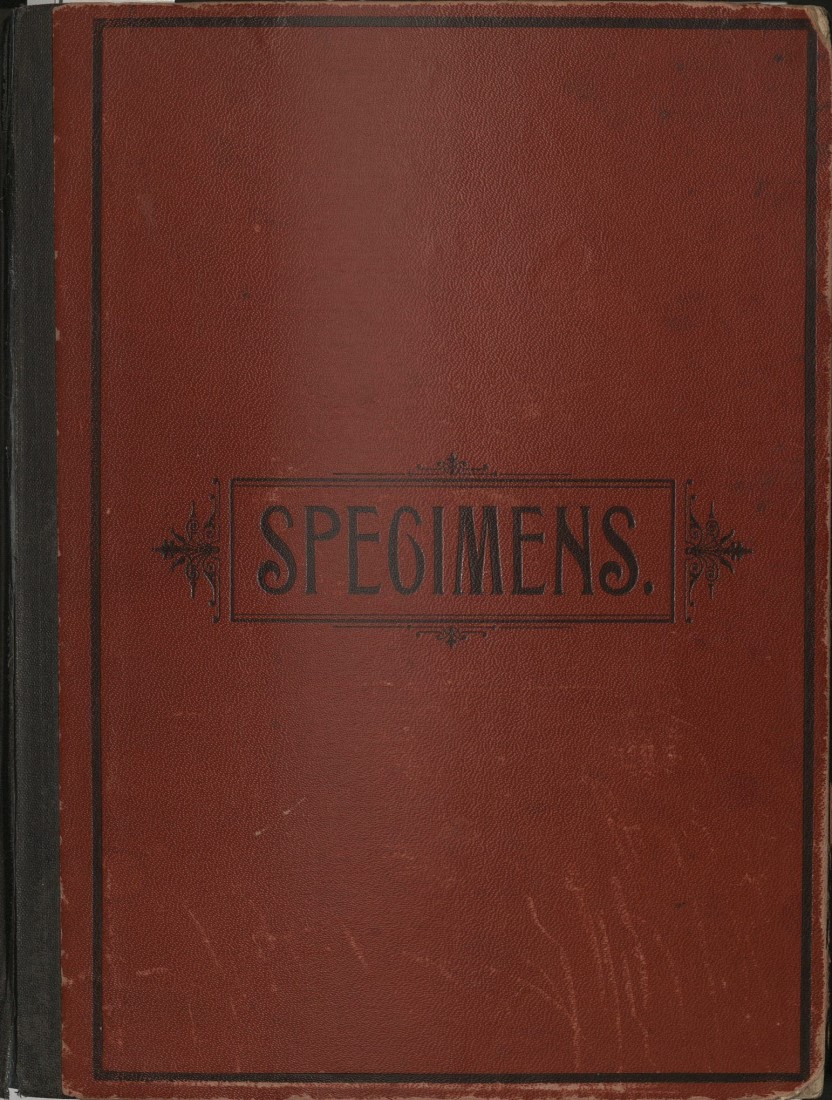
Typically, students purchased a large scrapbook from one of the bookstores near the university. Nola broke with tradition by using a blank “Specimens” science notebook to paste in mementos of her life at KU. 

Red book cover with the word "Specimens" in black text.
The front cover of Nola Ayers’s scrapbook, 1905-1909. Call Number: SB 71/99/8. Click image to enlarge.

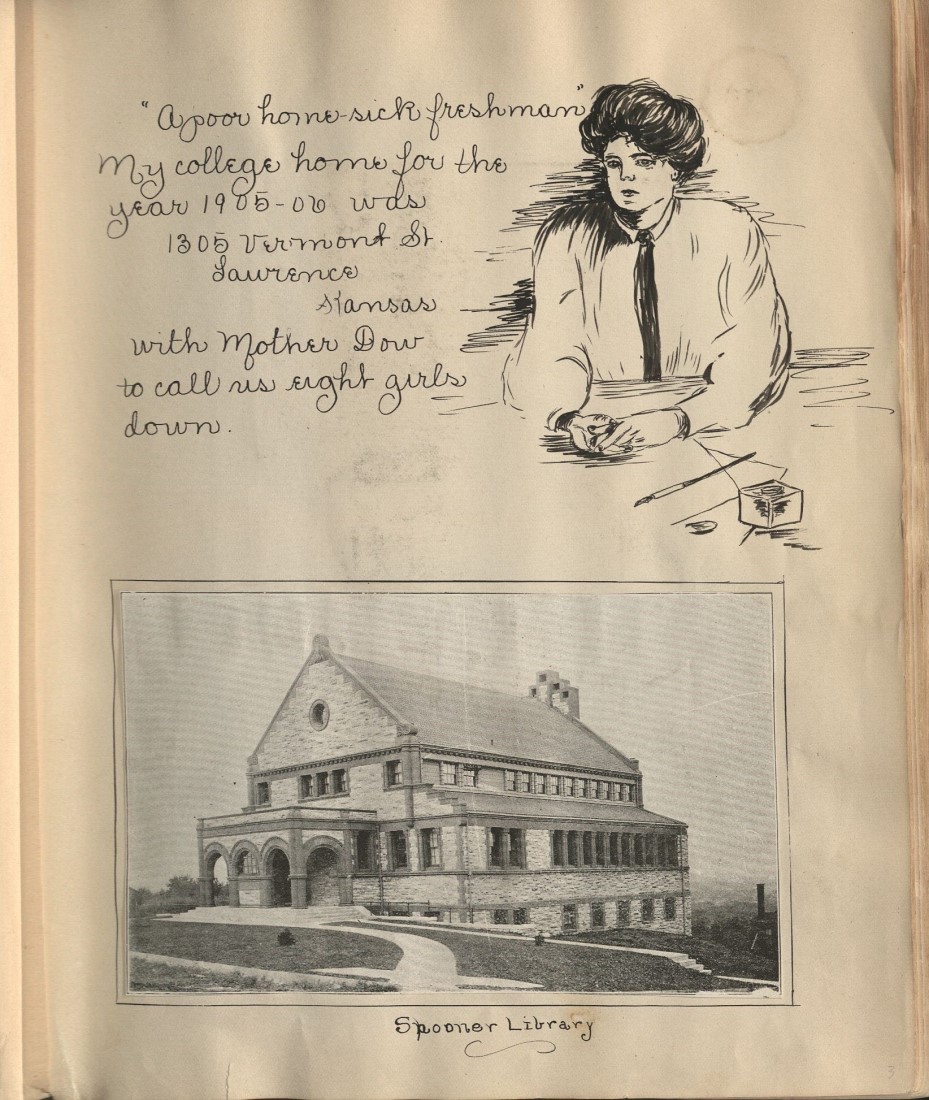
Nola’s scrapbook was also unique because she was an artist and decorated her album with original pen and ink drawings. One of the first drawings in the scrapbook is a self-portrait where she describes herself as a “poor home sick freshman” whose “college home for the year 1905-06 was 1305 Vermont St. Lawrence, Kansas with Mother Dow to call us eight girls down.” This house on Vermont is still standing in the Oread neighborhood. In the years before dormitories, many students lived in boarding houses near campus; many of these large multi-story houses still exist. 

This image has text accompanied by a black-and-white sketch of a woman sitting at a desk. There is also a photograph of Spooner Library.
Nola Ayers’s scrapbook entry about being “a poor home-sick freshman,” 1905. Call Number: SB 71/99/8. Click image to enlarge.

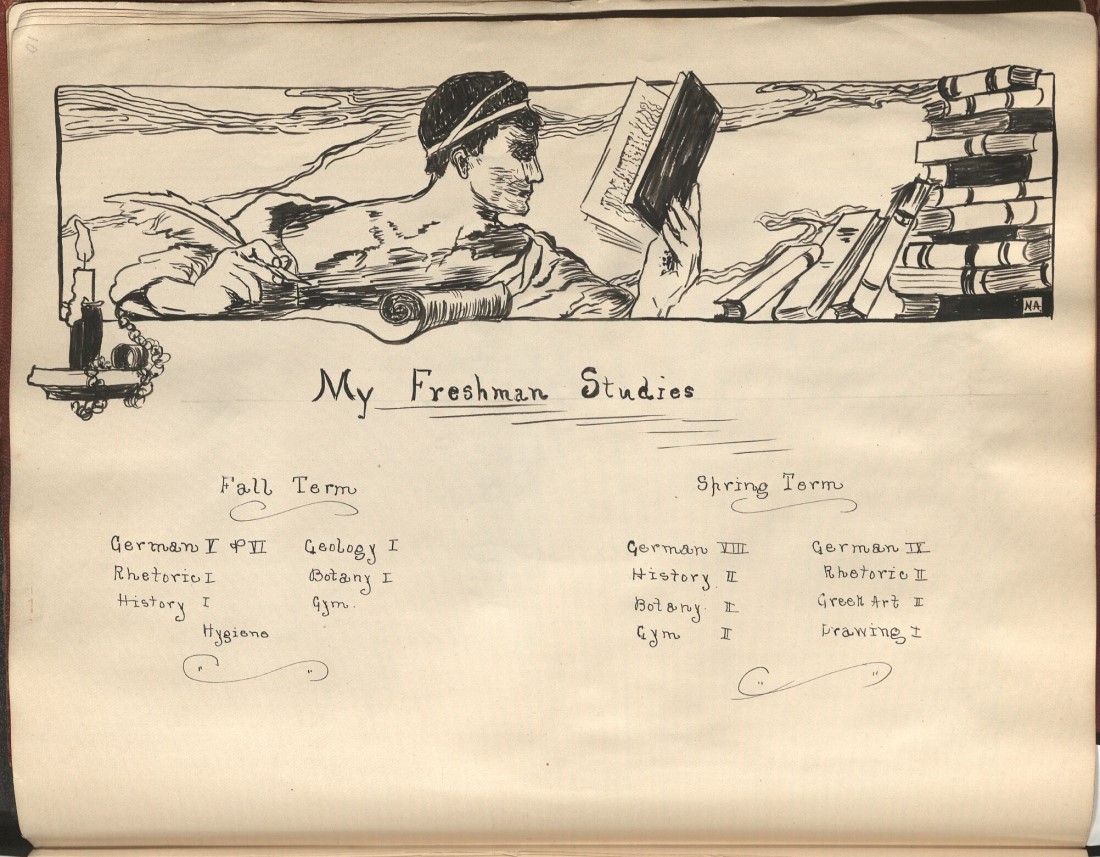
Nola documented her studies in her scrapbook. As seen in the image below, she took “Hygiene” and “Gymnasium” during her freshman year – courses that all KU students in the early twentieth century were required to enroll in. Nola also studied rhetoric, German, geology, solid geometry, and botany. Her scrapbook reflects her love of drawing, and her coursework included drawing, ornament design, and Greek art. 

List of classes taken by Nola Mary Ayers in the fall and spring terms of her freshman year. There is a black-and-white sketch of a man reading and writing.
Nola Ayers’s freshman-year courses listed in her student scrapbook, circa 1906. Call Number: SB 71/99/8. Click image to enlarge.

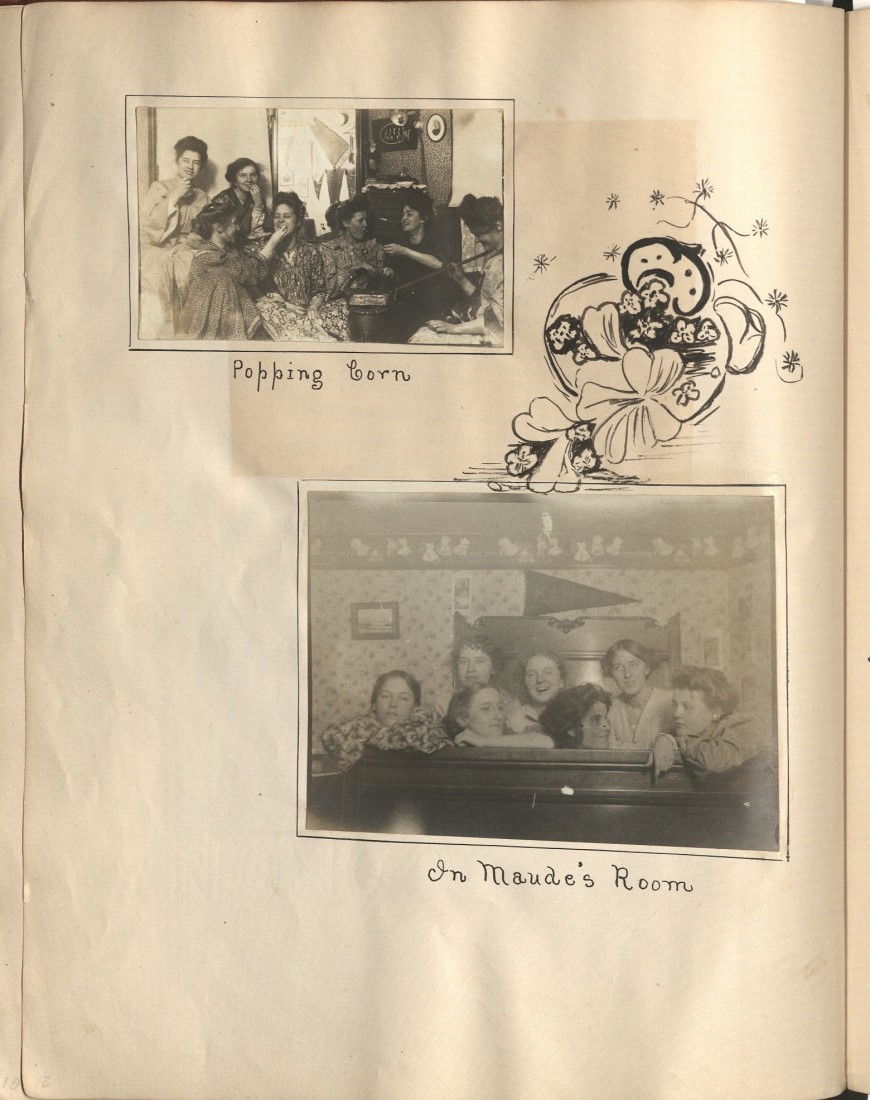
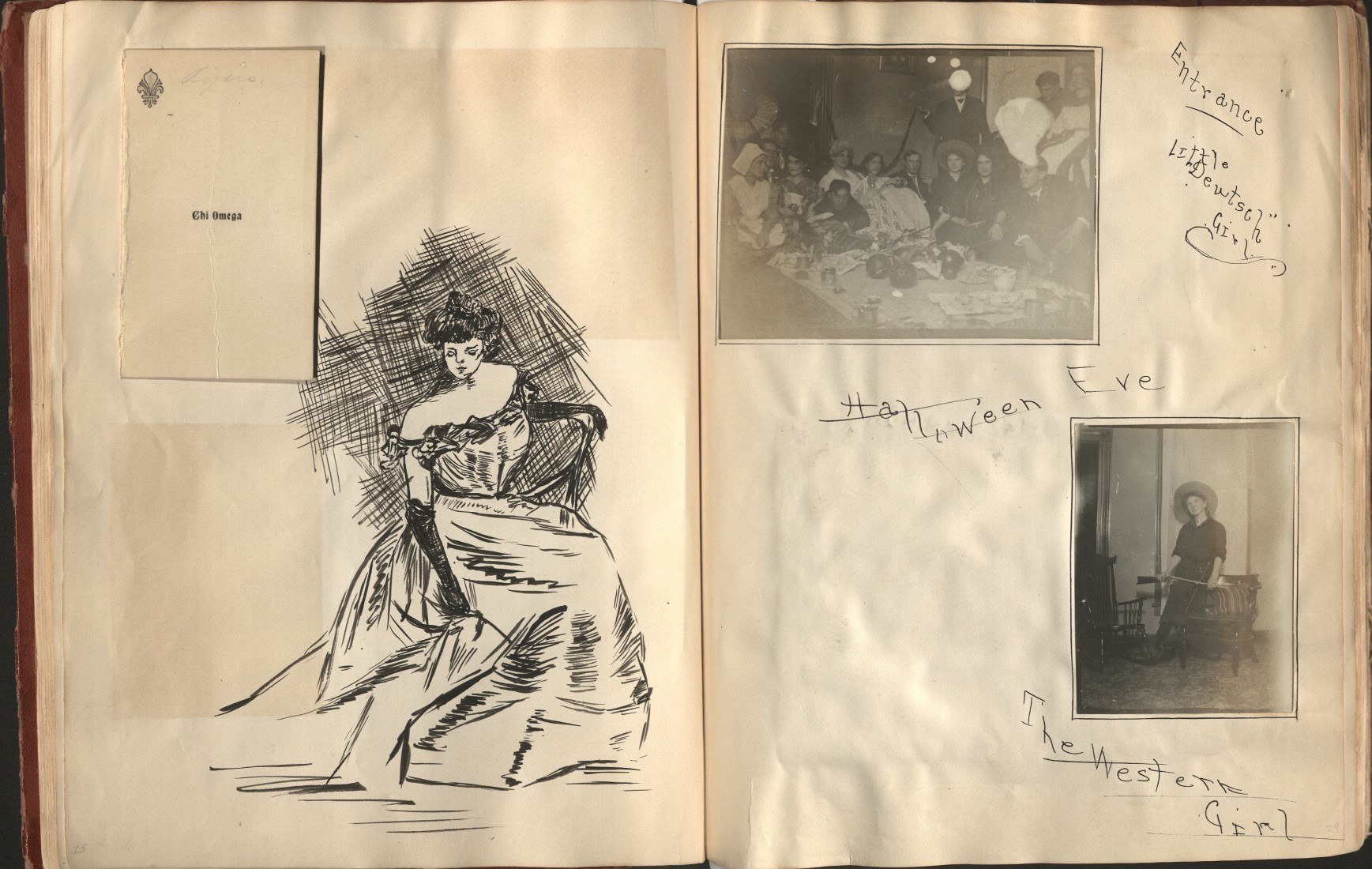
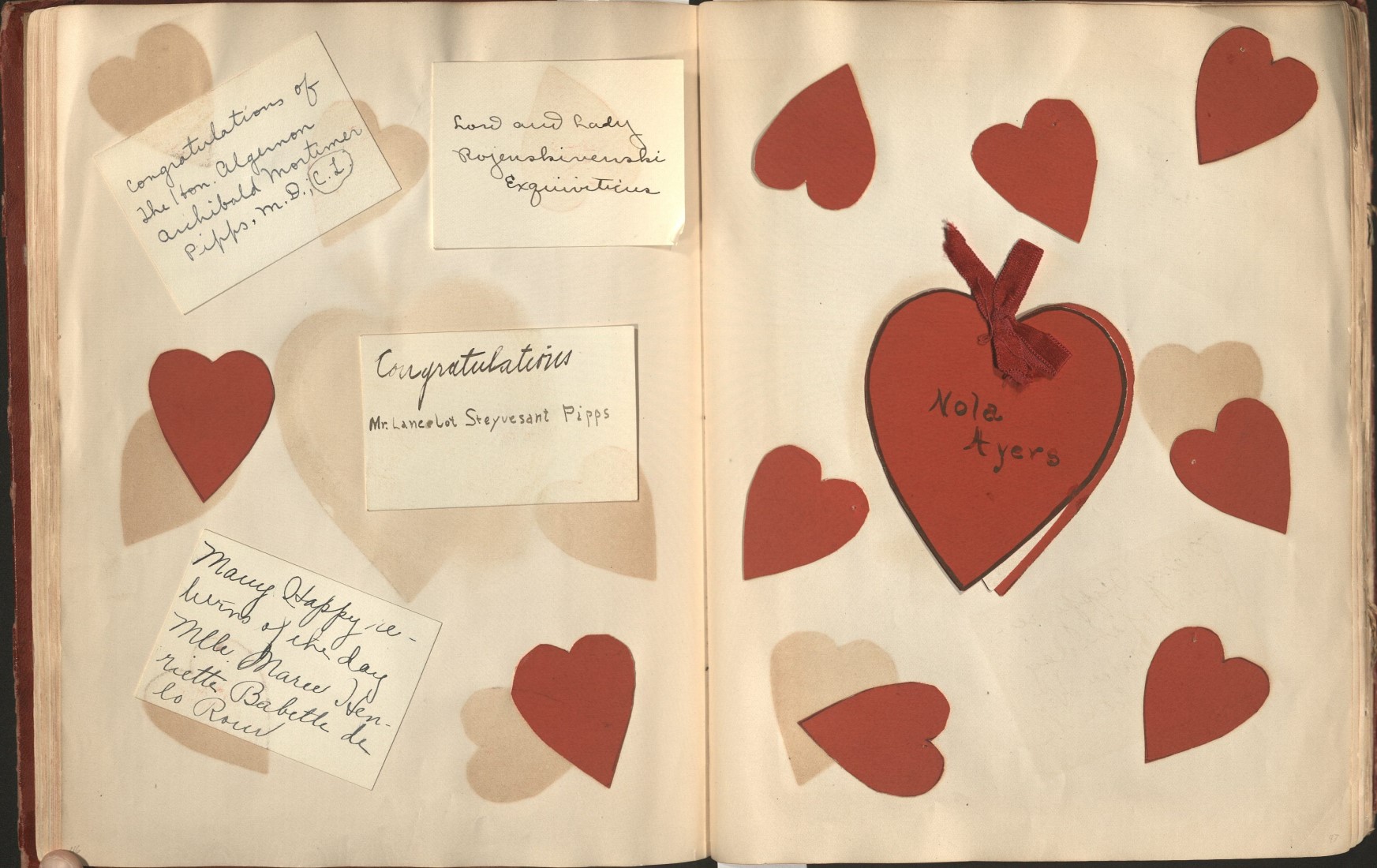
Besides coursework, friendships with other students are well represented in the pages of Nola’s scrapbook. She documented slumber parties with other girls, popcorn making, a Halloween party where she dressed as the “Western Girl,” and events at her sorority, Kappa Kappa Gamma. Nola celebrated Valentine’s Day with a party and red hearts pasted into her scrapbook. 

Two black-and-white photos attached to a larger piece of off-white paper. One shows a group of girls making and eating popcorn. The other shows a group of girls laying on a bed "in Maude's room."
|
Two-page scrapbook page. On the left is a dance card and a black-and-white sketch of a girl in an evening gown. On the right are two black-and-white photos: a group at a Halloween party and Nola Mary Ayers dressed as "the Western Girl."
|
Two-page scrapbook page with Valentine's notes and red paper hearts.
Selected pages from Nola Ayers’s scrapbook showing her hanging out and celebrating holidays with friends, 1905-1909. Call Number: SB 71/99/8. Click images to enlarge.

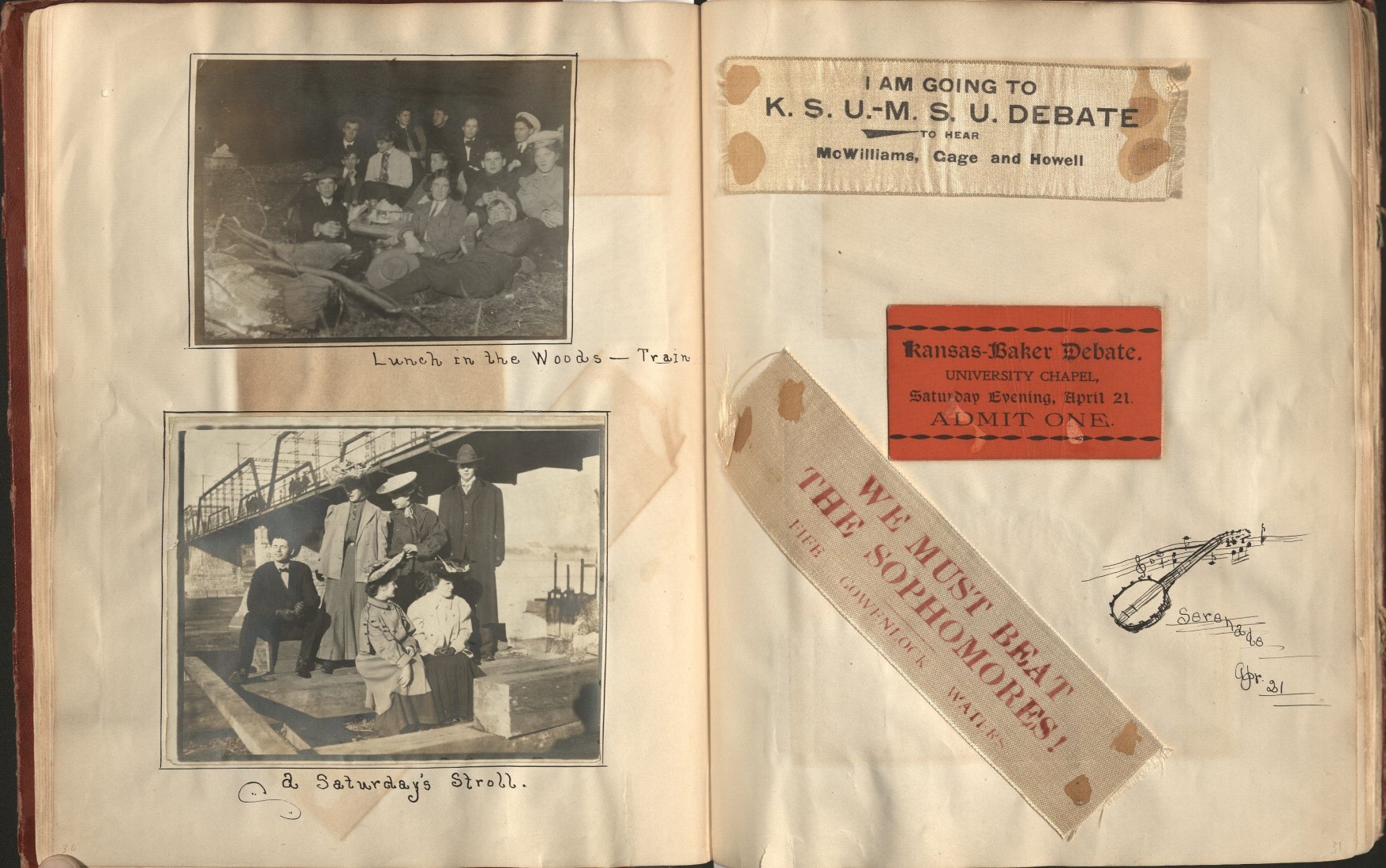
As evidenced by her scrapbook, Nola partook many of the outdoor activities KU students enjoyed in the early twentieth century: walking, boating on the Kaw River, picnicking in the countryside, and attending sporting events. According to the 1908 Jayhawker yearbook, Nola was an “authority on baseball” and an “enthusiastic fan.” Indeed, she pasted photos of the KU baseball team into her scrapbook. Nola also included items related to the KU debate team. Debate was almost as popular as athletic sports during the early twentieth century, and students would travel to other cities like Topeka to support the KU team. 

Two-page scrapbook page with photographs of students enjoying "lunch in the woods" and "a Saturday's stroll." There are also two items from KU debate team events.
A two-page spread in Nola Ayers’s scrapbook, circa 1906. Call Number: SB 71/99/8. Click image to enlarge.

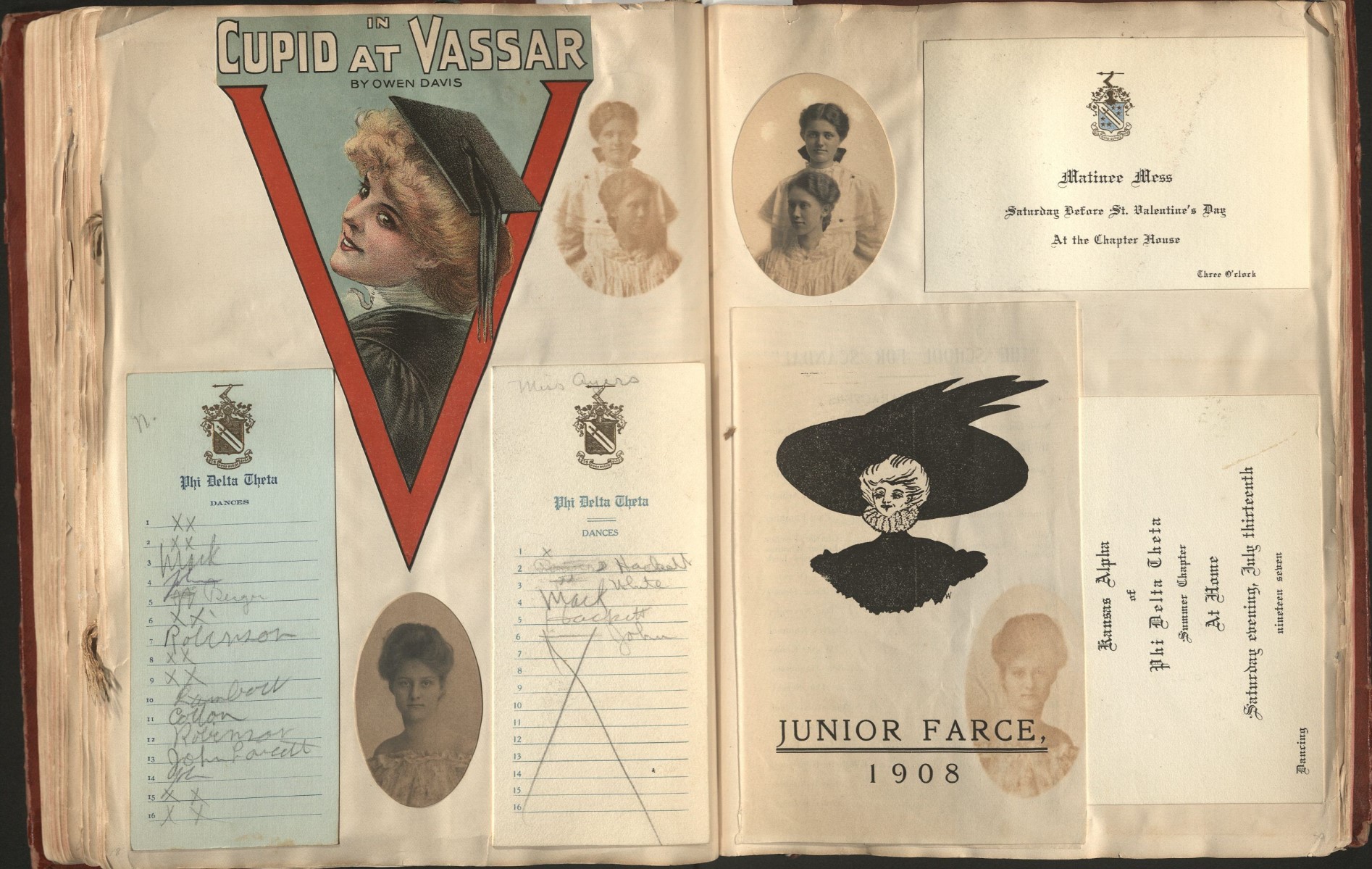
According to a newspaper article, Nola was crowned Queen of the May at the second annual May Fete in 1909. She was a member of Allemania (German Club) and attended their events. She appeared to have attended many dances, plays, and concerts while a student, as documented by the many programs decorating her scrapbook. Plays and concerts were held on campus and in downtown Lawrence at the Bowersock Opera House. 

Two-page scrapbook page with invitations, dance cards, photographs, and a dance program.
A page of invitations and dance cards in Nola Ayers’s KU student scrapbook, circa 1907-1908. Call Number: SB 71/99/8. Click image to enlarge.
Scrapbook page with two black-and-white photographs: the Kappa Kappa Gamma House at the University of Colorado, and a group of women in graduation caps and gowns.
The bottom photo on this page might show Nola Ayers with her housemates, circa 1909. During her junior and senior years at KU, Nola lived at 1400 Tennessee Street in Lawrence. Call Number: SB 71/99/8. Click image to enlarge.

Nola Ayers married KU alumus Benjamin P. Young in 1910. According to a newspaper article announcing their wedding, the couple settled in Halstead, Kansas, where Ben was a high school principal. Ben and Nola relocated to Ithaca, New York, by 1923 and appear to have lived there for the rest of their lives. They had two children. Ben died in 1958; Nola passed away in 1973 at age 86.

Becky Schulte
Retired University Archivist and Curator of the Wilcox Collection