16th-Century Medicine for the Fascination of 21st-Century Audiences
July 19th, 2013Yesterday, KU announced a magnificent gift to the libraries and the KU Medical Campus from the estate of the late KUMC Dean Stata Norton Ringle and her husband David Ringle. One of the projects that tied Stata Norton Ringle to the Kenneth Spencer Research Library was her translation of a manuscript from our collections. Produced circa 1562, Libro de i secretti & ricette, also known as the Jesuatti Book of Remedies (MS Pryce E1), is a collection of remedies used by the friars of the Order of Saint Jerome in Lucca, Italy to treat an array of ailments. These range from the common (digestive problems, colds, wounds and sores) to the cosmetic (baldness) to the strange (“For the crust that comes on the head of little children“) to the most dire (the plague, malaria). The remedies recorded in the manuscript are a variety of galenical mixtures of herbs, alchemical distillates, prayers, and incantations.
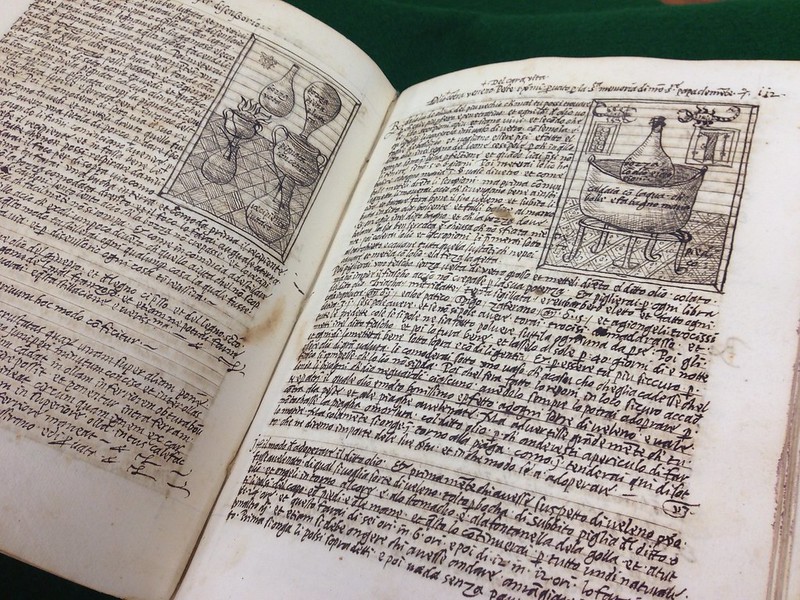
Jesuatti Book of Remedies. Lucca, Italy, circa 1562. Call number: MS Pryce E1. Click image to enlarge.
Image courtesy of KU Libraries Flickr Photostream.
This volume so captivated Professor Ringle that she taught herself Renaissance-era Italian to undertake its translation. The result was a digital edition, published in collaboration with KU Libraries’ Center for Digital Scholarship, that combines her annotated English translation with manuscript page images.
Browsing the digital edition, it’s easy to see why a professor of pharmacology, toxicology and therapeutics, like Dr. Ringle, would want to share this fascinating manuscript with scholars and the public at large. We have it on good authority from our web gurus that the most scatological, blush-inducing, and comically bizarre search terms driving internet traffic to the KU Libraries website tend to be page hits for the Jesuatti Book of Remedies. (I won’t list those search terms here, but this passage should give you a sense of some of the more sensitive topics the remedies address).
To celebrate the late Professor Ringle and her work, we reproduce three remedies from her translation and encourage you to continue on and peruse the entire volume online. In her preface, she wisely cautions that the translation is for “historical information only.” We hope you enjoy reading these remedies, but please don’t try them at home!
Best remedy for headache. [From folio 13 verso]
Take 1 handful each of good marjoram and rosemary and make fine powder of them. In the morning take half a glass of good white wine and put therein a tablespoon of this powder, heat it and drink this early in the morning and soon you will be cured. This is also powerful to save the teeth so they will not decay and it will give you a good breath. It is the thing used by gentlemen. […]
To make gray hair dark. [From folio 19 recto]
Take equal amounts of soft dark soap and quicklime and yellow litharge and incorporate them in the form of an unguent and with this rub the gray hair several times and it will become dark. Continue this rubbing according to how you see the need as it turns from being white to dark.
Another for the aforesaid and also good. Take the juice of beets mixed with ashes made of chicken feathers and boil them together a while. Rub yourself with this in the evening when you go to sleep. […]
To remove redness from the face and make it the way one wants. [From folio 162 verso].
Take 1 ounce of native sulfur, 1 dram each of white incense and myrrh and ½ ounce of camphor. Powder everything very finely and mix it with ½ lb. of rose water and distill it in a little glass still. Preserve this water well-closed and bathe the face in the evening and morning with a sponge, rubbing well. Soon the redness of the face will disappear. This has been tested by many persons. [...]


From the Jesuatti Book of Remedies digital edition: (left) “Best remedy for headache” folio 13v; (center) “To make gray hair dark” folio 19r; and (right) “To remove redness from the face and make it the way one wants,” folio 162v. Translated with notes by Stata Norton. Electronic edition published by the Center for Digital Scholarship, University of Kansas Libraries, 2010. http://etext.ku.edu/view?docId=jesuatti/jesuatti.xml. Click images to enlarge.